Differences in molar relationships and occlusal
contact areas evaluated from the buccal and lingual aspects using 3-dimensional digital models
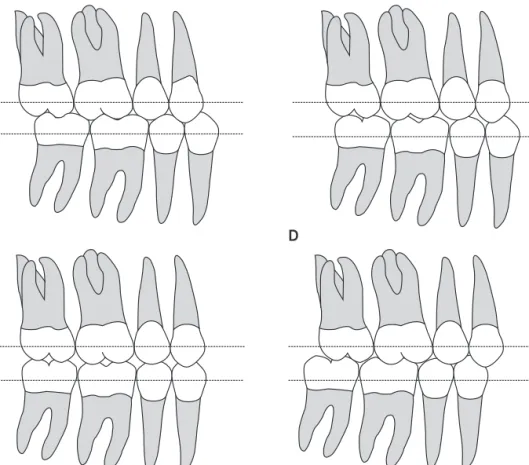
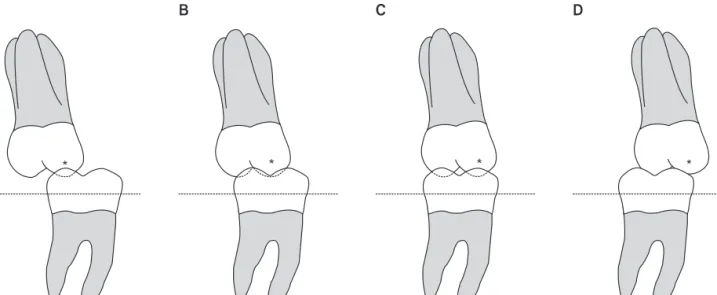
Objective: The aims of this study were to use a 3-dimensional (3D) system to compare molar relationship assessments performed from the buccal and lingual aspects, and to measure differences in occlusal contact areas between Class II and Class I molar relationships. Methods: Study casts (232 pairs from 232 subjects, yielding a total of 380 sides) were evaluated from both the buccal and lingual aspects, so that molar relationships could be classified according to the scheme devised by Liu and Melsen. Occlusal contact areas were quantified using 3D digital models, which were generated through surface scanning of the study casts. Results: A cusp-to-central fossa relationship was observed from the lingual aspect in the majority of cases classified from the buccal aspect as Class I (89.6%) or mild Class II (86.7%). However, severe Class II cases had lingual cusp-to- mesial triangular fossa or marginal ridge relationships. Mean occlusal contact areas were similar in the Class I and mild Class II groups, while the severe Class II group had significantly lower values than either of the other 2 groups (p < 0.05).
Conclusions: Buccal and lingual assessments of molar relationships were not always consistent. Occlusal contact areas were lowest for the Class II-severe group, which seems to have the worst molar relationships - especially as seen from the lingual aspect.
[Korean J Orthod 2012;42(4):182-189]
Key words: Digital models, Classification, Dental cast analysis, Class II Sook-Yoon Jang
Minji Kim Youn-Sic Chun
Department of Clinical Orthodontics, Graduate School of Clinical Dentistry, Ewha Womans University, Seoul, Korea
Received April 24, 2012; Revised June 5, 2012; Accepted June 11, 2012.
Corresponding author: Youn-Sic Chun.
Professor, Department of Orthodontics, Graduate School of Clinical Dentistry, Ewha Womans University, 911-1 Mok-dong, Yangcheon-gu, Seoul 158-710, Korea
Tel +82-2-2650-5112 e-mail [email protected]
The work was supported by the Ewha Global Top 5 Grant 2011 of Ewha Womans University.
© 2012 The Korean Association of Orthodontists.
The authors report no commercial, proprietary, or financial interest in the products or companies described in this article.
This is an Open Access article distributed under the terms of the Creative Commons Attribution Non-Commercial License (http://creativecommons.org/licenses/by-nc/3.0) which permits unrestricted non-commercial use, distribution, and reproduction in any medium, provided the original work is properly cited.