Natural Product Sciences 21(4) : 248-250 (2015)
http://dx.doi.org/10.20307/nps.2015.21.4.248
248
Violapyrone J, α-Pyrone Derivative from a Marine-derived Actinomycetes, Streptomyces sp.
Alain S. Leutou
1, Inho Yang
1, Chi Nam Seong
2, Jaeyoung Ko
3, and Sang-Jip Nam
1,*
1
Department of Chemistry and Nano Science, Global Top 5 Program, Ewha Womans University, Seoul 120-750, Korea
2
Department of Biology, College of Life Science and Natural Resources, Sunchon National University, Suncheon 540-742, Korea
3
Skin Research Division Amorepacific R&D Unit, Yongin 449-729, Korea
Abstract − A new α-pyrone derivative, violapyrone J (1), and along with the two known violapyrones B (2) and C (3) were isolated from the fermentation broth of a marine actinomycete Streptomyces sp. SC0718. The structure of violapyrone J (1) was elucidated from 1D and 2D NMR spectroscopic analyses.
Keywords − α-Pyrone, Violapyrone, Marine actinomycetes, Streptomyces sp.
Introduction
Microbial natural products are responsible for more than 50% of the anticancer medications and antibiotics available commercially today.
1However, the frequent re- discovery of the secondary metabolites from soil-derived microorganisms has decreased the attention for natural products in drug discovery programs. Recently, microor- ganisms isolated from marine environments have been recognized as a prolific source for discovering structurally unique natural products with diverse biological activities.
2-7In addition, several researches suggested that the actual producers of the half of drugs in the market developed from marine natural products could be microorganisms.
8Microorganisms isolated from unexplored marine environ- ments could be a great niche to provide new biologically active secondary metabolites.
9As part of the program for discovering marine microorganisms from Korean marine environments, a Streptomyces sp. SC0718 was isolated from the marine sediment in Sunchon Bay. Intensive study for chemical components of this strain has yielded a new α-pyrone derivative, violapyrone J (1), with the two known violapyrone derivatives, violapyrones B (2) and C (3).
Experimental
General experimental procedures – The optical rotation was measured on a Autopol III polarimeter (Rudolph Research) with a 5 cm cell. IR spectrum was recorded on a Varian Scimitar Series spectrometer. NMR spectra were recorded on Varian Inova NMR spectrometer (700 and 175 MHz for
1H and
13C NMR, respectively), using the signals of the residual solvent protons and the solvent carbons as internal references ( δ
H3.33 and δ
C49.3 ppm for MeOD). Low resolution LC-MS data were measured using an Agilent Technology 6120 quadrupole LC/MS system with a reversed phase column (Phenomenex luna C18(2) 100 Å, 50 mm × 4.6 mm, 5 μm) at a flow rate of 1.0 mL/min.
Strain and cultivation – Streptomyces sp. SC0718 was isolated from a marine sediment collected from the mudflat of Suncheon bay, South Sea of Korea. It was classified according to 16S rRNA analysis with 99.7%
identity with Streptomyces sp. zx-10-19 (Gene bank accession no. HQ611066.1).
Strain SC0718 was cultured in 20 of 2.5-L Ultra Yield Flasks each containing 1 L of the medium (10 g/L of soluble starch, 2 g/L of yeast, 4 g/L of peptone, dissolved in 750 mL natural seawater and 250 mL of distilled water) at 25
oC with shaking at 150 rpm. After 7 days, the whole culture (20 L) was extracted with EtOAc, and was concentrated in vauo to yield 1.3 g of an extract.
*Author for correspondence
Sang-Jip Nam, Department of Chemistry and Nano Science, Global
Top 5 Program, Ewha Womans University, Seoul, 120-750, Korea
Tel: +82-2-3277-6805; E-mail: [email protected]
Vol. 21, No. 4, 2015 249
Isolation of violapyrones J, B and C (1 - 3) – The crude extract (1.3 g) was fractionated by C18 vacuum column chromatography eluting with a step gradient from 10 to 100% MeOH in H
2O. The 60% MeOH/H
2O fraction (63.3 mg) was subjected to reversed-phase HPLC with 35% aqueous acetonitrile (Phenomenex Luna C-18 (2), 250 × 100 mm, 2.5 mL/min, 5 μm, 100 Å, UV = 254 nm) to afford violapyrones J (1, 1.0 mg) and B (2, 4.0 mg), with retention times of 22 and 33 min, respectively.
The 70% MeOH/H
2O fraction (72.7 mg) from C18 vacuum column chromatography was also subjected to reversed- phase HPLC with 55% aqueous acetonitrile (Phenomenex Luna C-18 (2), 250 × 100 mm, 2.5 mL/min, 5 μm, 100 Å, UV =254 nm) to afford violapyrones C (3, 4.0 mg), with a retention time of 24 min.
Violapyrones J (1) – white amorphous powder;
+72 (c 0.038, MeOH); UV/vis (MeOH) λ
max(log ε) 196 (3.27), 292 (2.47) nm; IR (KBr) ν
max3387, 1960, 1644 cm
−1;
1H and
13C NMR data, See Table 1; HRESQTOF m/z 211.1335 [M+H]
+(calculated for C
12H
19O
3, 211.1334).
Result and Discussion
Violapyrone J (1) was isolated as a white amorphous powder. The molecular formula C
12H
18O
3was deduced from the [M+H]
+peak at m/z 211.1335 (calcd for 211.1334) in the HRESQTOF, which required four degrees of unsaturation. Its IR absorptions at 3419, 1638, and 1577 cm
−1and the UV maximum peak at 292 nm indicated the typical α-pyrone chromophore.
10,11The
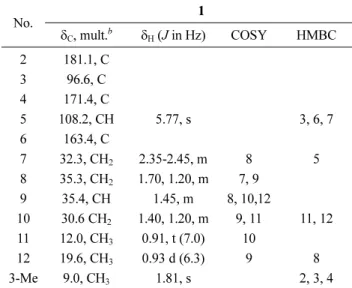
1H NMR spectrum of 1 displayed an olefinic proton H-5 [ δ
H5.77 (s)], a methyl triplet H-11 [( δ
H0.91, t, J = 7.0)], a methyl doublet H-12 [(δ
H0.93, d, J = 6.3)], and a methyl singlet 3-Me [( δ
H1.81, s)]. The
13C and HSQC spectroscopic data revealed three methyl, three methylene, two methine, and four fully-substituted carbons. The
1H and
13C spectra of 1 had very similar features to those of previously reported natural product, violapyrone A,
12except for the differences of the carbon chemical shifts at C-11 and C-12.
Two substructures, a linear aliphatic chain and a α- pyrone moiety, were assigned by analyses of
1H,
13C, COSY, HSQC, and HMBC NMR spectroscopic data (Fig.
2). A linear aliphatic chain with a six carbons unit was determined by the interpretation of
1H–
1H COSY and HMBC spectroscopic data. The COSY cross-peaks [H-7/
H-8/H-9/H-10/H-11, H-9/H12] and HMBC correlations from H-12 to carbons C-8, C-9, C-10, and from H-11 to carbons C-9, and C-10 permitted the construction of a linear aliphatic chain. A α-pyrone moiety was established by HMBC correlations from 3-Me to carbons C-2, C-3, and C-4, and from H-5 to a carbon C-4. Lastly, HMBC correlations from H-5 to carbons C-6, and C-7 provided the attachment of C-6/C-7, completing the assignment of 1 as shown in Fig. 2.
α [ ]
D24Table 1. NMR data of violapyrone J (1) in CD
3OD. ( δ in ppm)
aNo. 1
δ
C, mult.
bδ
H(J in Hz) COSY HMBC
2 181.1, C
3 96.6, C
4 171.4, C
5 108.2, CH 5.77, s 3, 6, 7
6 163.4, C
7 32.3, CH
22.35-2.45, m 8 5
8 35.3, CH
21.70, 1.20, m 7, 9 9 35.4, CH 1.45, m 8, 10,12
10 30.6 CH
21.40, 1.20, m 9, 11 11, 12 11 12.0, CH
30.91, t (7.0) 10
12 19.6, CH
30.93 d (6.3) 9 8
3-Me 9.0, CH
31.81, s 2, 3, 4
a