Enhancement of Exercise Capacity by Black Ginseng Extract in Rats
Gyeong Seok Jo
1,2, Hee-Youl Chai
1, Hyeong Jin Ji
1, Mi Hyun Kang
1, Shin-Jyung Kang
3, Joong-Gu Ji
4, Dae Joong Kim
1,2and Beom Jun Lee
2*
1
Laboratory Animal Research Center, College of Veterinary Medicine, Chungbuk National University, Cheongju, Korea
2
College of Veterinary Medicine and Research Institute of Veterinary Medicine, Chungbuk National University, Cheongju, Korea
3
Department of Herbal Pharmaceutical Science, Joongbu University, Chubu, Korea
4
Department of Oriental Health Care, Joongbu University Chubu, Korea
This study was carried out to investigate an enhancing effect of black ginseng extract (BGE) on exercise capacity in an endurance exercising animal model. Fifty Sprague-Dawley rats were assigned to 5 experimental groups including non-training control, training control, and 3 treated groups (BGE at doses of 75, 150 and 300 mg/kg). The animals were treated with BGE for 6 weeks and their exercise ability in the maximal running distance test was determined using a treadmill every week. The blood lactic acid (LA) level and the activity of citrate synthase (CS) in the muscle were also measured after the exercise.
The levels of glucose and glucose-6-phosphate (G-6-P) in the liver and muscle were determined using commercial assay kits. BGE treatments at the doses of 150 and 300 mg/kg significantly increased the exercise capacity compared with the non-training control or training control groups (P<0.05). The level of blood LA was decreased but the activity of CS was increased by the treatment of BGE at the dose of 300 mg/kg compared with the training control group. The level of G-6-P in the liver was elevated by the treatment of BGE at the dose of 300 mg/kg, compared to the training group. As compared with non- training control group, the treatments of BGE increased the levels of glucose and G-6-P in the liver and soleus muscle of rats. These results indicate that BGE have a potential for promoting exercise capacity by increasing CS activity in the muscle and decreasing LA in the serum of rats. These results also suggested that BGE can be used as a candidate supplement of health food products for promoting endurance exercise capacity in human athletes.
Key words: Black ginseng extract, ginseng saponins, exercise capacity, glucose, citrate synthase, lactic acid Received 14 July 2010; Revised version received 13 September 2010; Accepted 14 September 2010
규칙적인 운동은 면역력을 증가시키고 심혈관질환 및 2형 당뇨 등을 예방한다고 알려져 있다(Stampfer et al., 2000; Hu et al., 2001; Terblanche et al., 2001). 운동 은 다양한 생리적 변화를 일으키고, 특히 지속적인 운동 은 호기성 대사에 포함된 효소의 활성과 골격근의 산화 를 증가시킨다(Voces et al., 1999). 그 중 가장 중요한 변 화는 체내에 증가한 호흡과 산소의 활용이다.
골격근의 산화력과 호흡능력을 측정하는 대표적 평가 지표인 citrate synthase (CS)는 tricarboxylic acid cycle 내에서 oxaloacetate와 acetyl-coenzyme A로부터 citrate
형성을 촉매하며, 에너지발생 대사경로를 조절하는 효소 들 중에 하나이다(Spina et al., 1996; Carter et al., 2001). 또한 장시간 운동 시 운동수행능력에 영향을 미 치는 여러 가지 요소들 중에 운동 시 피로물질로 알려진 젖산(lactic acid; LA)은 운동강도 및 지속시간과 밀접한 관련이 있다(Voss et al., 2002). 과도한 운동으로 젖산이 축적되면 체내산성화가 초래되어 운동 중 당질대사에 관 여하는 인산화효소의 활성저하, pH 감소, myosin-ATPase 활성도 저하 등으로 운동에너지를 공급하는 포도당의 신 생이 억제된다. 즉, 포도당의 감소는 에너지 소비를 의미 하며 혈청 젖산의 증가는 피로현상을 의미한다(Roberto, 2001).
운동과 함께 골격근 수축에 의한 포도당 흡수는 근섬 유를 통해 근육 내로 포도당 수송의 증가와 포도당을 이 용하는 효소의 활성에 의하여 운동의 강도와 지속시간에 비례하여 증가된다(Wasserman, 2009). 또한 근육 내
*Corresponding author: Beom Jun Lee, Department of Veterinary Public Health, College of Veterinary Medicine, Chungbuk National University, 410 Seongbongro (Gaeshin-dong), Cheongju, Chungbuk 361-763, Korea
Tel: +82-43-261-3357
Fax: +82-43-271-3246
E-mail: [email protected]
glycogen의 증가는 수축에 의한 포도당 흡수를 감소시키 고 혈청 포도당 농도가 감소하였을 때 지속된 운동은 다 리 근육의 포도당 흡수를 감소시킨다고 알려져 있다 (Garber, 2004). 생리적 범위 내의 포도당의 농도와 운동 량이 거의 일정할 때, 운동 시 혈청 내에 포도당의 농도 는 비례적으로 근육 내에 포도당 흡수량을 변화시킨다 (Steensberg et al., 2002). 즉, 증가한 근육 내의 혈류량은 근육의 물질대사의 수요와 일치하며, 혈청 내 포도당의 농도가 포도당 흡수에 중요한 인자이다(Merry and McConell, 2009). 또한 혈청 포도당은 골격 근육 수축을 위한 중요한 기질이고 근육 수축은 근육의 당원 수준을 장기적으로 감소시키므로 운동의 강도 및 포도당 이용률 은 지속적 운동능력의 중요한 결정 요인이다(Hargreaves, 1998).
혈청 포도당 농도의 증가에 필수적인 glucose-6- phosphatase는 혈액으로의 이동을 위해 주로 간에서 탈 인산화 또는 당분해로 진행된다(Patrick et al, 2003). 당 분해는 glucose-6-phosphate (G-6-P)가 운반되어 ATP의 생 성이 충분할 때 포도당을 당원으로 저장하는 것이 세포 에 유용하다. 따라서 glycogen synthase는 혈청 포도당과 세포 내 G-6-P가 높게 일어날 때 활동적이다(Rose and Richter, 2005).
인삼은 약물학적 활성을 나타내는 성분이 복합적으로 함유되어서 운동능력 증강, 노화방지, 항스트레스, 항산 화, 항암 등의 효과가 발표되었다(Kim et al., 2000; Park et al., 2002). 새로운 가공인삼인 흑삼은 증숙법의 하나 인 한약재의 가공방법 중 물과 불을 함께 사용하는 가장 대표적인 방법으로 아홉 번 찌고 말리는 과정을 반복하 여 제조하는 구증구포의 원리를 이용하였다(Lee et al., 2006; Song et al., 2006). 또한 흑삼의 생물학적 활성은 기존의 백삼이나 홍삼에 비해서 증기 가공되는 동안 진 세노사이드(ginsenosides), 사포닌(saponins), 페놀(phenols) 및 단백질 등을 다량 포함하며(Baek et al., 1996; Yun, 2003; Kim et al., 2007b; Lee et al., 2009), 백삼보다 높은 약물학적 효과를 나타내고, 사람과 동물에서 면역력 증가, 항암, 항스트레스, 비만억제 등의 효과가 알려져 있 다(Wargovich, 2001; Lee et al., 1997, 2006; Kang et al., 2006; Kim et al., 2007a). 하지만 흑삼의 운동능력 증강작용에 대해서는 아직 명확히 규명되지 않았다.
따라서, 본 연구에서는 지속적인 운동 모델 랫드에서 흑삼추출물(black ginseng extract; BGE)의 투여와 함께 운 동훈련을 하여 최대운동거리를 측정하고, 혈청 젖산 분석 및 가자미근에서의 CS의 활성도를 확인하였다. 또한 운 동능력 증강효과와 밀접한 혈청, 간 및 가자미근의 포도 당 함량과 G-6-P 함량을 분석하여 BGE의 운동능력 증강 효과의 기전을 확인해보고자 하였다.
재료 및 방법
실험물질
실험물질인 BGE는 중부대학교 산학협력단(대동고려삼;
충남 금산, 한국)에서 제공을 받았다. 이 BGE의 제조방 법은 홍삼을 아홉 번 찌고 말리는 구증구포를 반복하여 제조한 흑삼을 분말화하여 120
oC 물에 분산시켜서 2시 간 끓이고, pectinase, cellualse 및 amylase로 반응시킨 뒤, 진공동결 건조하여 제조하였다. 제공 받은 흑삼의 주 요한 진세노사이드의 함량은 Rg3: 7,297.9 ppm, Rh:
1,187.3 ppm, Rg2: 658.5 ppm, Rb1: 102.8 ppm, Rd:
14.5 ppm 및 Rb2: 12.8 ppm 등이었다.
실험동물
실험동물은 6주령 수컷 Sprague-Dawley 랫드(샘타코;
경기도 오산, 한국)를 구입하여 사육상자(polysulfone cage) 에 2-3마리씩 넣어 사육하였다. 실험기간 동안의 사육환 경은 온도 22±2
oC, 상대습도 50±10%, 환기횟수 10-15 회/hr, 인공조명(12시간 점등, 12시간 소등), 조도 150-300 lux 의 조건을 유지하였다. 사육 관리할 때 사료와 깔짚은 멸균하여 사용하였고, 이 동물시험은 충북대학교 동물실 험윤리위원회에 의해 승인을 받아 수행하였다.
실험동물의 선발 및 시험군의 구성
실험동물의 순화 기간 후 운동을 하는데 무리가 없는 건강한 개체를 선발하기 위하여 군분리 이전에 2주간 Treadmill (LE8710, Panlab s.l., Barcelona, Spain)에서 기 울기 0
o, 속도 20 cm/sec로 5분 동안 운동을 시켜 운동 수행능력을 가진 개체를 사용하였다(Ferrando et al., 1999). 시험군의 구성은 50마리의 수컷 랫드를 5개 군에 각 군당 10마리로 분리하였다. 비운동대조군과 운동대조 군은 멸균수를 6주 동안 투여하였고, 운동대조군만 운동 을 병행하여 실험을 수행하였다. 흑삼투여군의 농도는 기 존 연구에서 사용한 추출물을 중간농도로 하고 저 및 고 농도를 2배수로 하여 각각 BGE 75, 150 및 300 mg/kg 을 멸균수에 용해하여 10 mL/kg의 용량으로 6주 동안 경 구투여하였다(Antonio et al., 2001).
최대운동거리 측정
운동 훈련에서 랫드의 운동능력 평가는 treadmill을 이
용하였고(Hatta et al., 1994), 비운동대조군은 최대운동거
리 측정 5일전 3일 동안 기울기 5-10
o, 속도 30 cm/sec
조건으로 30분간 지속적인 운동을 시켰으며, 운동군은 운
동 시작 30분 전 식이를 수거하고, 훈련횟수는 2일 운동
하고 2일 쉬는 2일주기로 하여 6주 동안 총 20회 운동
하였으며, 처음 2주 동안은 기울기 0
o, 속도 20-25 cm/
sec 조건으로 30분간 지속적인 운동을 시켰으며, 나머지 4주 동안은 기울기 5-10
o, 속도 25-30 cm/sec 조건으로 30분간 지속적인 운동을 시켰다. 최대운동거리 측정은 운 동훈련 6주차에 생리적 스트레스를 피하기 위하여 48시 간 휴식 후 기울기 10
o, 속도 30 cm/sec로 treadmill을 이 용한 탈진적 운동을 통하여 전기 자극 및 기타 자극에 10초간 무반응을 보이면 총 운동시간을 기록하고 최대운 동거리를 계산하였다.
혈청 젖산 및 포도당 분석
비운동군과 운동군 모두에서 최대운동거리 측정 후 혈 청 운동능력의 평가지표를 측정하기 위하여 운동 20-30 분 후에 diethyl ether로 마취한 후 경정맥으로 채혈하고 혈청분리 tube에 넣어서 3,000 rpm, 4
oC 에서 10분간 원 심분리하여 혈청을 분리하였고, LA의 측정은 자동 젖산 분석기(YSI 1500 SPORT auto lactate analyzer; Milwaukee, USA)를 이용하여 측정하였다. 포도당의 측정은 자동혈액 화학분석기(HITACHI 7080; Tokyo, Japan)를 이용하여 측 정하였다.
가자미근의 CS 활성도 측정
가자미근의 구연산염 합성효소는 CS assay kit (Sigma, St. Louis, USA)를 이용하여 측정하였다. 시료는 조직 samples 50 mg에 20배의 phosphate-buffered saline (PBS) 를 넣어 homogenizer (TK-AM5; Tokken Inc., Tokyo, Japan)로 분쇄하였고, 1,100 g, 4
oC에서 10분간 원심분리 하여 상층액을 얻었다. 이 상층액을 96-well plate에 6 µL 넣고 1×assay buffer와 reaction buffer를 넣어 총 volume 을 50 µL/well로 하였으며, ELISA reader (BioTek; Seattle, USA)에서 흡광도 570 nm, 측정간격 10초, 지속시간 1.5 분으로 설정하여 분석하였다. CS의 활성도는 다음과 같 이 계산하였다: Units (mmole/mL/min)=(412 nm)/min×V (mL)×dil/emM×L (cm)×Venz (mL). 여기서 dil은 조직샘플 의 희석배수, V는 reaction buffer의 양, Venz는 enzyme sample의 양, emM (mM
−1cm
−1)는 412 nm에서 trinitro- benzene (TNB)의 소멸계수 (13.6), L은는 흡광도 측정길 이 (pathlength=0.552 cm)이다.
간 및 가자미근의 G-6-P 측정
간 및 가자미근의 G-6-P는 glucose-6-phosphate assay kit (Biovision, Mountain View, USA)를 이용하여 측정하였 다. 시료는 조직 100 mg에 3배의 PBS buffer를 넣어 homogenizer로 분쇄하였고, 13,000 rpm, 4
oC 에서 10분간 원심분리하여 상층액을 얻었다. 이 상층액을 96-well plate 에 2-6 µL 넣어 G-6-P assay buffer로 총 volume을 50 µL/well로 하였다. Standard curve는 각각 0, 2, 4, 6, 8, 및 10 µL 넣고 G-6-P assay buffer를 넣어 총 volume
을 50 µL/well로 하였다. 30분간 37
oC에서 배양한 후 흡 광도 570 nm에서 ELISA reader를 이용해 분석하였다.
간 및 가자미근의 포도당 측정
간 및 가자미근의 포도당은 glucose assay kit (Biovision) 를 이용하여 측정하였다. 시료는 조직 100 mg에 3배의 PBS buffer를 넣어 homogenizer로 분쇄하였고, 13,000 rpm, 4
oC에서 10분간 원심분리하여 상층액을 얻었다. 이 상층액을 96-well plate에 6 µL넣어 glucose assay buffer로 총 volume을 50 µL/well로 하였다. Standard curve는 각각 0, 2, 4, 6, 8, 10 µL를 넣고 glucose assay buffer를 넣 어 총 volume을 50 µL/well로 하였다. 30분간 37
oC에서 배양한 후 흡광도 450 nm에서 ELISA reader를 이용해 분 석하였다.
통계학적 분석
모든 실험 결과는 mean±SEM로 표시하고 모든 자료들 에 대해 분산의 동질성을 비교하기 위해 one-way analysis of variance를 SPSS software (version 12.0K; SPSS Institute, Chicago, USA)를 이용하여 분석하였다. 통계학적 으로 유의차가 있는 군은 P<0.05로 나타내었다.
결 과
최대운동거리에 대한 효과
운동훈련 6주차에 최대운동거리를 측정한 결과, 비운동 대조군은 1,901.4±175.0 m이고 운동대조군은 1,938.0±
167.5 m인데 비하여 BGE 150 mg/kg군은 2,542.0±625.5 m, BGE 300 mg/kg 군은 2,609.7±189.2 m로 비운동대조 군 및 운동대조군에 비해 유의성 있는 증가가 나타났다 (P<0.05) (Figure 1).
가자미근의 CS 활성도 변화
가자미근에서 구연산염 합성효소 활성을 측정한 결과, 비운동대조군의 0.18±0.02 nmole/µL/min에 비하여 BGE 75 mg/kg은 0.38±0.04 nmole/µL/min, BGE 300 mg/kg은 0.44±0.05 nmole/µL/min으로 유의성 있는 증가가 나타났 다(P<0.05). 또한 운동대조군의 0.28±0.04 nmole/µL/min 에 비하여 BGE 300 mg/kg에서 유의성 있는 구연산염 합 성효소 활성의 증가가 나타났다(P<0.05) (Figure 2).
혈청 젖산의 변화
비운동군과 운동군의 최대운동거리 측정 후 얻은 혈청
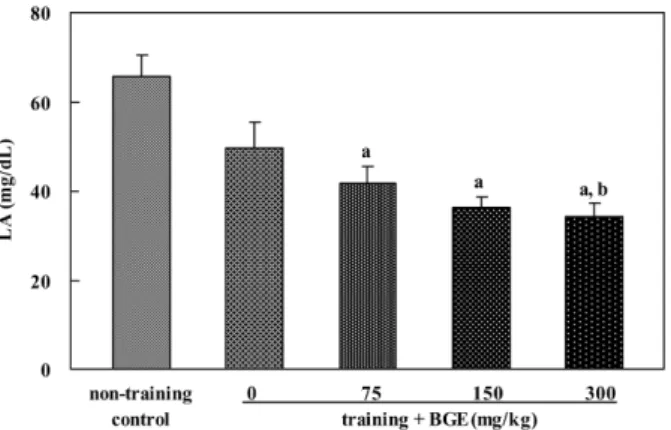
젖산의 분석결과, 비운동대조군은 65.7±4.7 mg/dL에 비하
여 BGE 75 mg/kg군은 41.8±3.6 mg/dL, BGE 150 mg/kg
군은 36.1±2.5 mg/dL, BGE 300 mg/kg군은 34.1±3.2
mg/dL 로 모든 BGE 처치군에서 유의성 있게 감소하였다
(P<0.05) (Figure 3). 또한 운동대조군의 49.7±5.6 mg/dL 에 비하여 BGE 300 mg/kg군에서 유의성 있게 젖산이 감 소하였다(P<0.05).
혈청 포도당 농도의 변화
비운동군과 운동군의 최대운동거리 측정 후 얻은 혈청 포도당의 분석결과, 비운동대조군의 69.4±4.5 mg/dL에 비 하여 BGE 75 mg/kg군은 100.7±8.3 mg/dL, BGE 150 mg/kg 군은 109.4±10.6 mg/dL, BGE 300 mg/kg군은 106.7±10.3 mg/dL로 BGE투여군 모두에서 유의성 있게 증가하였다
(P<0.05) (Figure 4). 그러나 운동대조군에 비해서 BGE 처 치군에서 유의적인 증가는 나타나지 않았다.
간과 가자미근에서 G-6-P의 변화
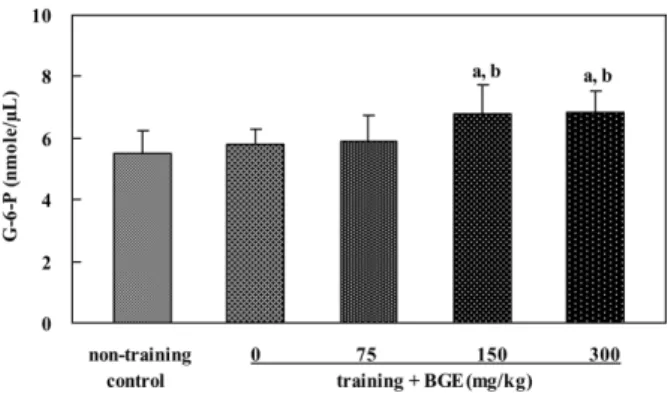
간에서 G-6-P의 측정결과, 비운동대조군은 5.52±0.73 nmole/µL이고 운동대조군은 5.77±0.50 nmole/µL이었다 (Figure 5). BGE 150 mg/kg 은 6.79±0.91 nmole/µL, BGE 300 mg/kg은 6.82±0.70 nmole/µL로 비운동대조군 및 운 동대조군에 비해 유의성 있는 증가가 나타났다(P<0.05).
가자미근에서 G-6-P의 측정결과, 비운동대조군은 5.05±
0.35 nmole/µL에 비하여 BGE 150 mg/kg은 5.77±0.31 nmole/µL, BGE 300 mg/kg은 5.74±0.28 nmole/µL로 유 의성 있는 증가가 나타났다(P<0.05). 그러나 운동대조군 Figure 3. Serum lactic acid (LA) level of rats treated with black ginseng extract (BGE). BGE at the oral doses of 75, 150, or 300 mg/kg was administered to animals for 6 weeks. Lactic acid in serum was analyzed using an automatic lactic acid analyzer. Data were represented as mean±SEM (n=5-6).
a
Significantly different from non-training control group at P<0.05.
bSignificantly different from training control group at P<0.05.
Figure 4. Serum glucose level of rats treated with black ginseng extract (BGE). BGE at the oral doses of 75, 150, or 300 mg/kg was administered to animals for 6 weeks. Glucose in blood was analyzed using a biochemical analyzer. Data were represented as mean±SEM (n=5-6).
aSignificantly different from non-training control group at P<0.05.
Figure 1. Maximal running distance (MRD) in rats treated with black ginseng extract (BGE). BGE at the oral doses of 75, 150, or 300 mg/kg was administered to rats for 6 weeks. Exercise capacity was assessed as running time and distance to exhaustion on a treadmill. Data were represented as mean±
SEM (n=7-10).
aSignificantly different from non-training control group at P<0.05.
bSignificantly different from training control group at P<0.05.
Figure 2. Citrate synthase (CS) activity in the soleus muscle of rats treated with black ginseng extract (BGE). BGE at the oral doses of 75, 150, or 300 mg/kg was administered to animals for 6 weeks. Citrate synthase in the soleus muscle was analyzed using an enzyme assay kit. Data were represented as mean±
SEM (n=5).
aSignificantly different from non-training control
group at P<0.05.
bSignificantly different from training control
group at P<0.05.
에 비하여 BGE투여군 모두에서 유의적 증가는 보이지 않 았다(Figure 6).
간과 가자미근에서 포도당의 농도변화
간에서 포도당 농도의 측정결과, 비운동대조군 9.08±
0.66 nmole/µL이고 운동대조군은 9.48±1.24 nmole/µL에 비하여 BGE 75 mg/kg은 9.80±1.15 nmole/µL, BGE 150 mg/kg은 10.38±0.82 nmole/µL, BGE 300 mg/kg은 10.76
±1.21 nmole/µL로 BGE투여군 모두에서 증가하는 것으로 나타났지만 대조군에 비해 유의성 있는 증가는 나타나지 않았다(Figure 7).
가자미근에서 포도당의 농도 측정결과, 비운동대조군 0.10±0.02 nmole/µL에 비하여 투여군 BGE 150 mg/kg은 0.17±0.02 nmole/µL, BGE 300 mg/kg은 0.17±0.02 nmole/
µL로 유의성 있는 증가가 나타났다(P<0.05) (Figure 8). 그
러나 운동대조군에 비해서 BGE투여군 모두에서 유의적 증가는 나타나지 않았다.
고 찰
BGE 는 홍삼을 구증구포의 열처리로 가공하여 만든 고 농축 진세노사이드 복합물로 특히 진세노사이드 Rh, Rg2, Rg3 가 다량 함유되어서 사람과 동물에서 홍삼보다 항염 증, 항암, 항스트레스, 항산화 등의 더 높은 효과가 보고 되었지만, BGE의 운동능력 증강작용에 대해서는 아직 명 확히 규명되지 않았다(Oh et al., 2004; Leung et al., 2007). 따라서 본 연구에서는 BGE의 운동능력 증강작용 을 알아보기 위하여, 지속적인 운동모델 랫드에서 점증적 운동부하법을 이용한 규칙적인 운동과 함께 BGE투여를 Figure 5. Glucose-6-phosphate (G-6-P) level in the liver of rats
treated with black ginseng extract (BGE). BGE at the oral doses of 75, 150, or 300 mg/kg was administered to animals for 6 weeks. G-6-P in liver was analyzed with an enzyme assay kit.
Data were represented as mean±SEM (n=5-6).
aSignificantly different from non-training control group at P<0.05.
b
Significantly different from training control group at P<0.05.
Figure 6. Glucose-6-phosphate level in the soleus muscle of rats treated with black ginseng extract (BGE). BGE at the oral doses of 75, 150, or 300 mg/kg was administered to animals for 6 weeks. G-6-P in muscle was analyzed with an enzyme assay kit. Data were represented as mean±SEM (n=6).
aSignificantly different from non-training control group at P<0.05.
Figure 7. Glucose level in the liver of rats treated with black ginseng extract (BGE). BGE at the oral doses of 75, 150, or 300 mg/kg was administered to animals for 6 weeks. Glucose concentrations in liver were analyzed using an glucose assay kit. Data were represented as mean±SEM (n=6).
Figure 8. Glucose level in the soleus muscle of rats treated
with black ginseng extract (BGE) for 6 weeks. BGE at the oral
doses of 75, 150, or 300 mg/kg was administered to animals for
6 weeks. Glucose concentrations in soleus muscle were
analyzed using an glucose assay kit. Data were represented as
mean±SEM (n=6).
aSignificantly different from non-training
control group at P<0.05.
병행하여 최대운동거리측정, 혈청 젖산 농도, 가자미근의 구연산염 합성효소 활성과 혈청, 가자미근 및 간의 포도 당, G-6-P 함량을 측정하였다.
이 연구에서 혈청 젖산농도 측정결과는 비운동군에 비 해 운동군의 젖산농도가 낮게 나타났는데 이는 운동훈련 을 통한 운동능력의 증가로 젖산의 농도가 낮게 나타난 것으로 보였고, 운동대조군에 비해 BGE 고농도군의 농도 가 유의적으로 감소되었으며, 정기적인 운동과 함께 BGE 투여가 젖산의 축적이 최고치에 이르는 운동직후 시점에 혈청 젖산농도를 유의성 있게 감소시켰는데, 이는 다른 인삼류의 처리로 혈청 젖산농도를 감소시켰다는 다른 연 구결과와 일치한다(Ohira et al., 2003). 젖산은 pyruvic acid가 환원되어 생성된 혐기성 해당반응의 종말대사체로 서 강렬한 운동 중에 체액에서의 농도가 증가되며, 인체 조직은 아주 좁은 pH 범위 내에서만 이상적으로 작용하 므로 근육과 혈액의 젖산 증가로 pH가 낮아져 산성화되 면 미토콘드리아의 작용이 방해를 받게 되어 근육의 에 너지 생산능력이 저해되며 그 결과 근육수축에 어려움을 겪게 되어 근력도 약해지게 된다고 보고되었다(Powers and Howely, 1997). 또한 최근 연구결과에서는 인삼의 섭 취가 최대산소섭취량과 장기적인 탈진적 운동의 증가 및 휴식 중 심박수의 감소와 동정맥혈 산소교차를 증가시킬 수 있다고 보고되었으며(Bucci, 2000), 지속적인 운동 중 운동선수와 건강한 지원자를 대상으로 한 연구에서 젖산 의 생성을 감소시킨다는 것이 보고되었다(Vogler et al., 1999).
본 연구에서 가자미근의 CS 활성도 측정결과는 운동대 조군에 비해 BGE 고농도군에서 유의적인 증가가 나타났 다. 이는 BGE의 투여가 근육 내 CS의 활성도를 증가시 켜서 근육의 산화력과 호흡능력이 증가된 것으로 사료된 다(Fu and Ji, 2003). 일반적으로 운동과 관련된 근육대사 는 산화력을 증가시키고 근육피로 상태를 지연시키는 주 요한 변화를 겪는다. 이러한 변화는 mitochondrial oxidative enzymes, CS, cytochrome C oxidase, succinate dehydrogenase의 활성도에 반영되어 운동기간과 강도에 따라 변화가 나타나며, 특히 CS는 호기성 근육에서 운동 후 최고활성을 나타내는 호기성 에너지 체계에서 대표적 인 mitochondrial oxidative enzymes의 주요한 평가지표로 서 잘 알려져 있다(Houmard, 1998). 따라서 정기적인 운 동과 함께 BGE 투여가 혈청 젖산농도를 유의성 있게 감 소시키고, 근육 내 CS 활성도의 증가에 따른 근육의 산 화력과 호흡능력의 증가로 인한 최대운동거리의 증가를 나타낸 것으로 보인다.
본 연구에서 사용된 랫드의 간과 가자미근에서 포도당 작용의 중간체인 G-6-P의 함량을 측정한 결과, BGE가 투 여된 랫드는 멸균수만 투여한 운동대조군에 비해 상대적 으로 높은 G-6-P 함량을 나타냈으며, 이 결과는 G-6-P 함량의 증가가 혈청, 간 내 포도당 이용률을 증가시켜서
운동능력 증강작용을 나타낸 것으로 보인다. 최근의 연구 에서는 지속적 운동모델 동물에 인삼을 투여 했을 때 나 타나는 운동능력의 수준이 그렇지 않은 동물에 비하여 높 게 나타난다는 연구결과가 보고되었다(Min et al., 2002).
G-6-P 는 간에서 당원대사를 조절하는 신호분자와 같은 중 요한 역할을 하며, 응집된 상태로 분포되고 당원 생성효 소의 활성수준을 조절하여 포도당대사에 관여한다고 보 도되었다(Roger et al., 2003). 그러나 근육 내의 G-6-P 함량의 차이가 유의적으로 나타나지 않은 이유는 간과 신 장에서 포도당 신생합성에 의해 생산된 포도당은 혈액으 로 방출되고 계속해서 대사에 필요를 충족시키기 위해 근 육, 뇌, 심장 및 적혈구에 의해 흡수되어 당원의 합성활 성이 주로 간과 신장에서 이루어지기 때문인 것으로 사 료된다(Jung et al., 2004).
본 연구에서는 실험에 사용된 동물의 혈청, 근육 및 가 자미근의 포도당 농도를 측정하여 비교하였다. 그 결과 BGE가 투여된 동물은 멸균수만 투여한 운동대조군에 비 해 높은 포도당 함량을 나타내는 것이 확인되었다. 이러 한 결과는 이전에 보고된 결과와 일치하는 것이며, 그 기 전은 BGE가 포도당 작용의 중간체인 G-6-P에 직접적으 로 작용하는 것으로 보이며(Adams et al., 1994), 최대 산 소 섭취량의 60-80% 강도로 장시간 운동 중 당원 흡수 가 피로를 30-60분 지연시킨다고 보고되었다(Coyle et al., 1983). 또한 유산소 운동과 함께 인삼을 섭취한 랫드는 운동을 하는 동안 혈청 포도당 유지율과 혈청 유리지방 산을 증가시키고 골격근육에 있는 산화 섬유, 모세관 조 밀도 및 미토콘드리아 함량을 증가시켰으며, 근육은 운동 시간이 길어질수록 더 많은 포도당을 소모하며 체온증가, 간과 신장의 순환감소 등으로 포도당 신생합성에 이용되 는 전구물질의 이용을 제한시켜 당신생을 제한하고, 근육 의 포도당 요구량이 간에서의 포도당 방출량을 초과하게 되어 혈중 포도당의 양은 감소한다는 연구결과가 보고되 었다(Wang and Lee, 1998). 또한 체계적인 운동을 통해 근육이나 간에서 저장되어 있는 당원의 고갈을 지연하여 장시간 지구성 운동능력을 향상시킨다고 발표되어져 있 으며(Ivy et al., 1979), 또한 운동 중 포도당의 흡수는 운 동 중 혈당의 증가와 회복기에서 혈청 젖산의 급격한 감 소를 야기하여 운동수행능력과 운동피로의 회복에 효과 가 있는 것으로 보고되었다(Hargreaves et al., 1984).
이상의 결과를 종합해 보면 정기적인 운동과 함께 홍삼
을 가공하여 만든 고농축 진세노사이드 복합물인 BGE를
투여한 군은 운동대조군에 비해 혈청 젖산 농도감소 및
근육 내 CS 활성도 증가로 인한 최대운동거리의 유의적
인 증가가 나타났고, 간과 근육의 G-6-P 함량 증가에 따
른 혈청, 간 및 근육 내 포도당 함량의 증가로 인한 운동
능력 증강작용이 뛰어난 것으로 나타났다. 따라서 BGE에
대한 건강기능성식품으로의 가능성을 기대할 수 있다.
감사의 글
이 논문은 대한민국 지식경제부에서 자금을 지원하는 지역연고산업육성사업 인삼약초지역혁신클러스트육성사업 단의 약효검증사업의 일환으로 진행된 연구입니다
참고문헌