Clinical Study of the Effects of Juglandis Semen Pharmacopuncture Therapy on Shoulder Pain
Han-Na Choi*, Seoung-Whon Lee, Cheol-Hong Kim, Hyun-Min Yoon, Kyung-Jeon Jang
Department of Acupuncture & Moxibution Dong-Eui University College of Oriental Medicine, Busan, Korea
*Samse Oriental Medical Hospital, Busan, Korea KEY WORDS:
Juglandis Semen Pharmacopuncture Therapy; shoulder pain Received : Nov 1, 2011 Accepted : Nov 30, 2011
I
. 서론Abstract
Objectives: The purpose of this study is to examine the effects of Juglandis Semen Pharmaco-punc- ture Therapy on Shoulder Pain. .
Methods & Results: Clinical studies on shoulder pain were carried out on 34 patients who were treat- ed at Department of Acupuncture & Moxibusition, Samse Oriental Medical Hospital from June to October, 2009. Patients were divided into two groups, i.e.Sample group(Group A) and Control group(Group B). Group B were treated by body acupuncture and cupping therapies while Group A were added juglandis semen pharmacopuncture therapy to therapies of Group A.
All patients of both groups were treated three times a week for three weeks.
In order to evaluate pain degree, we apply Shoulder Pain and Disability Index(SPADI), Visual Analogue Scale(VAS) and the tool developed by Japan’s Industrial Hygienics Society and modified by Korean Doctor.
Evaluations were done after first week, second week and third week during period of treatment.
Results: Both groups showed significant pain decreasing tendencies. But Group A showed more effi- ciency comparing to Group B.
Conclusions: According to the above-mentioned results, it seems that Juglandis Semen pharmacop- uncture therapy could be applied as the effective method for reducing shoulder pain.
Case Report
호도약침이 견비통에 미치는 임상적 연구
2011 Korean Pharmacopuncture institute
This study was supported by Dong-Eui University 2010 project.
http://pharmacopuncture.co.kr This is an Open-Access article distributed under the terms of the
Creative Commons Attribution Non-Commercial License (http://cre- ativecommons.org/licenses/by-nc/3.0/) which permits unrestricted non- commercial use, distribution, and reproduction in any medium, provid- ed the original work is properly cited.
Corresponding Author
Kyung-Jeon Jang, Dong-Eui University, Oriental Medicine Hospital San 45-1, Yangjung2-Dong, Busanjin-Gu, Busan 614-710, Korea Tel: +82-51-850-8752
E-mail: [email protected]
cc
II
. 연구 대상 및 방법1
2009 6 1 10 15
20 60
34
17 Group B
17 Group A
2
2.1 3
2.2
3
3.1
3.2
3.3
3.4
3.5
3.6
3.7
3.8
3.9
4
3 3
4.1 Group B
(GB
21) (TE
15) (SI
11) (SI
10) (LI
11) (SI
3) (TE
3)
0.20cm 3cm stainless steel 15
(GB
21) (SI
11)
(B
43) (L
1) 5
4.2 (=Group A)
(GB
21) (TE
15) (SI
11) (SI
10) (GB
20)
0.05cc 0.25cc
26G*12.7mm 1.0ml/cc syringe(
5
5
3 3 9
Shoulder Pain and Disability
Index(SPADI) (VAS)
1, 2, 3
Shoulder Pain and Disability Index(SPADI) (VAS)
6
6.1
(1988)
11
0 1 2
6.2
(1988)
10
0 1 2
3 4 5
6.3 Shoulder Pain and Disability Index(SPADI) Roach, KE et al. Shoulder Pain and Disability Index(SPADI) Pain scale 5
100mm
0 100
6.4 (VAS)
Cline et al.
(Visual Analogue Scale: VAS) 10cm
0 10
7
SAS 9.1
two-sample t-test paired t-test
two-sample t-test P
0.05
III
. 결과1.
46.94 9.05
44 10.04 6.41 0.8
6.65 0.86 8.29 1.57
8.59 1.33
15 (88.24%) 2 (11.76%) 14
(82.35%) 3 (17.65%)
4.47 1.55
3.94 1.6 14.53
4.42 14.94 5.27 Shoulder Pain and Disability Index(SPADI) 48.55 23.15
40.72 23.55 (VAS)
6.22 1.78 6.31 2.21 (Group A) (Group B)
(Table 1)
2
Group
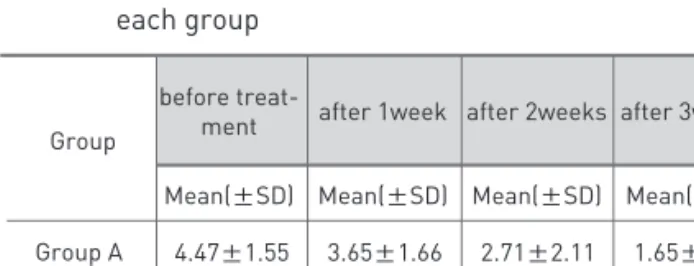
A 4.47 1.55 1 3.65 1.66
0.82 1.42 (P=0.02
99), Group B 3.94 1.6
3.59 1.58 0.35 0.61 (P=0.0289)
(P=0.2235). Group A 2 2.71 2.11 1.76 1.39
(<0.001) Group B 2 3 1.5 0.94 1.14
(P=0.0037)
(P=0.0688). Group A 3 1.65 1.66 2.82 1.13
(<0.001), Group B 3 2.12 1.54 1.82 0.81
(<0.001)
(P=0.0057), (Table 2, Table 2-1, Table 2-2, Fig. 1).
No. of subjects(%) Group A
(n=17)
Group B (n=17)
female sleeping hours/day
15(88.24%)
6.41 0.8
14(82.35%)
6.65 0.86 Age
Sex
46.94 9.05 44 10.04
male 2(11.76%) 3(17.65%)
working
hours/day 8.29 1.57 8.59 1.33 Degree of feeling
inconvenient in every day life
4.47 1.55 3.94 1.6
Degree of subjec- tive symptoms of shoulder pain
14.53 4.42 14.94 5.27
SPADI 48.55 23.15 40.72 23.55
VAS 6.22 1.78 6.31 2.21
Table 1. General characteristics of study population at baseline
t Value
0.9
-0.83
-.0.59
0.98
-0.25
0.98 -0.14
P value
0.3765
0.4142
0.5595
0.3338
0.8066
0.3353 0.8921
before treat-
ment after 1week after 2weeks after 3weeks
Mean( SD) Mean( SD) Mean( SD) Mean( SD) Group A 4.47 1.55 3.65 1.66 2.71 2.11 1.65 1.66 Group B 3.94 1.6 3.59 1.58 3 1.5 2.12 1.54 Table 2. Degree of feeling inconvenient in every day life in
each group
Group
after 1week -before treatment
after 2weeks -before treatment
after 3weeks -before treatment
Mean( SD) Mean( SD) Mean( SD)
Group A -0.82 1.42 -1.76 1.39 -2.82 1.13 t
p Group B
t p
-2.38 0.0299 -0.35 0.61
-2.4 0.0289
-5.22 .0001 -0.94 1.14
-3.39 0.0037
-10.29 .0001 -1.82 0.81
-9.29 .0001 Table 2-1. The changes of Degree of feeling inconvenient
in every day life in each group
Group
3
Group A
14.53 4.42 1 11.88 4.04
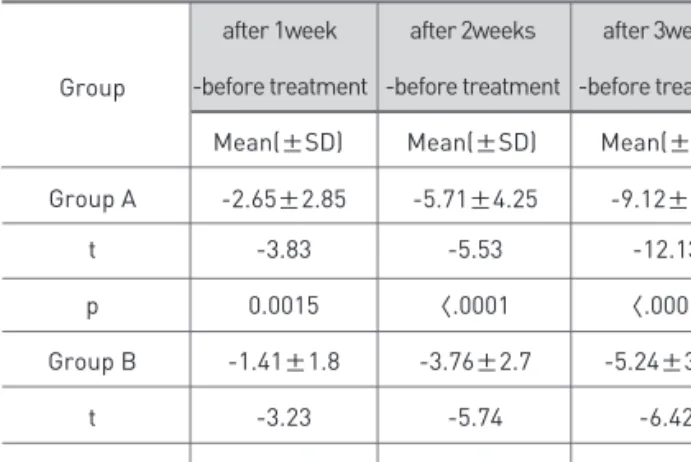
2.65 2.85 (P=0.0015),
Group B 14.94 5.27 1 13.
53 4.76 1.41 1.8 (P=0.0053)
(P=0.1408). Group A 2 8.82 5.32 5.71 4.25
(<0.001), Group B 2 11.18 4.2 3.76 2.7
(<0.001)
(P=0.1222). Group A 3 5.41 3.97 9.12 3.1
(<0.001), Group B 3 9.71 4.62 5.24 3.36
(<0.001)
(P=0.0014), (Table 3, Table 3-1, Table 3-2, Fig. 2)
after 1week -before treatment
after 2weeks -before treatment
after 3weeks -before treatment
DF 21.6 32 32
t -1.25 -1.88 -2.96
Pr t 0.2235 0.0688 0.0057
Table 2-2. Comparison of changes of Degree of feeling inconvenient in every day life between Group A &
Group B
Fig. 1. Comparison of changes of Degree of feeling incon- venient in every day life between Group A & Group B
after 1week -before treatment
after 2weeks -before treatment
after 3weeks -before treatment
Mean( SD) Mean( SD) Mean( SD)
Group A -2.65 2.85 -5.71 4.25 -9.12 3.1 t
p Group B
t p
-3.83 0.0015 -1.41 1.8
-3.23 0.0053
-5.53 .0001 -3.76 2.7
-5.74 .0001
-12.13 .0001 -5.24 3.36
-6.42 .0001 Table 3-1. The changes of Degree of subjective symptoms
of shoulder pain in each group
Group
before treat-
ment after 1week after 2weeks after 3weeks
Mean( SD) Mean( SD) Mean( SD) Mean( SD) Group A 14.53 4.42 11.88 4.04 8.82 5.32 5.41 3.97 Group B 14.94 5.27 13.53 4.76 11.18 4.2 9.71 4.62 Table 3. Degree of subjective symptoms of shoulder pain
in each group
Group
after 1week -before treatment
after 2weeks -before treatment
after 3weeks -before treatment
DF 32 32 32
t -1.51 -1.59 -3.5
Pr t 0.1408 0.1222 0.0014
Table 3-2. Comparison of changes of Degree of subjective symptoms of shoulder pain between Group A &
Group B
Fig. 2. Comparison of changes of Degree of subjective symptoms of shoulder pain between Group A &
Group B
4
Shoulder Pain and Disability Index(SPADI)
Group A 48.55 23.15
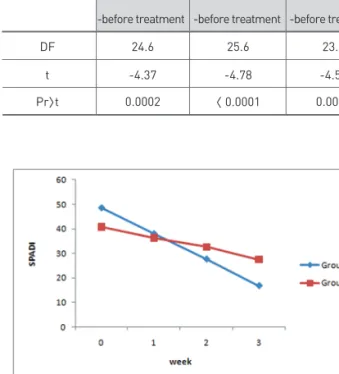
1 37.95 20.75 10.6 5.15
(<.0001), Group B
40.72 23.55 1 36.31 22.52
4.41 2.77 (<.0001)
(P=0.0002). Group A 2 27.62 17.68
20.93 9.56 (<0.001), Group
B 2 32.57 22.15 8.15 5.51
(<0.001)
(P<0.0001). Group A 3 16.76
13.36 31.79 15.24
(<0.001), Group B 3
27.47 21.87 13.25
7.37 (<0.001)
(P=0.0002), (Table 4, Table 4-1, Table 4-2, Fig. 3).
5
(VAS) Group
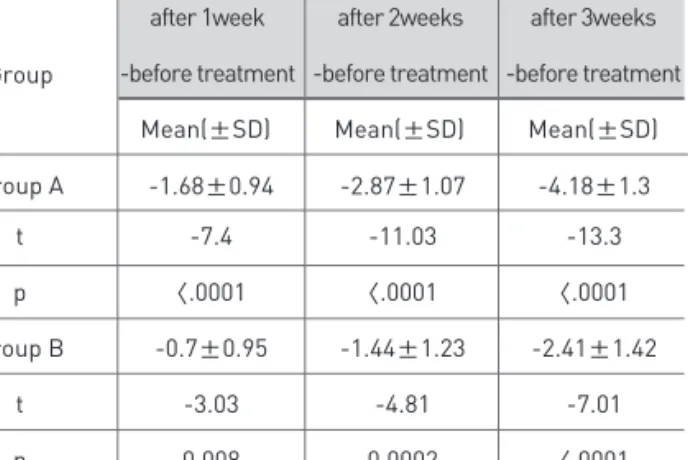
A 6.22 1.78 1 4.54 1.98
1.68 0.94 (<.0001)
Group B 6.31 2.21 1 5.61
1.77 0.7 0.95
(P=0.0008)
(P=0.0048). Group A 2 3.35 1.66 2.87 1.07
(<0.001), Group B 2 4.88 1.57
1.44 1.23 (P=0.0004)
(P=0.001). Group A
3 2.04 1.99
4.18 1.3 (<0.001),
Group B 3 3.91 1.53
2.41 1.42 (<0.001)
(P=0.0006), (Table 5, Table 5-1, Table 5-2, Fig. 4).
after 1week -before treatment
after 2weeks -before treatment
after 3weeks -before treatment
Mean( SD) Mean( SD) Mean( SD)
Group A -10.6 5.15 -20.93 9.56 -31.79 15.24 t
p Group B
t p
-8.49 .0001 -4.41 2.77
-6.55 .0001
-9.03 .0001 -8.15 5.51
-6.1 .0001
-8.6 .0001 -13.25 7.37
-7.41 .0001 Table 4-1. The changes of SPADI in each group
Group
before treat-
ment after 1week after 2weeks after 3weeks
Mean( SD) Mean( SD) Mean( SD) Mean( SD) Group A 48.55 23.15 37.95 20.75 27.62 17.68 16.76 13.36 Group B 40.72 23.55 36.31 22.52 32.57 22.15 27.47 21.87 Table 4. SPADI (Shoulder Pain and Disability Index) in each
group
Group
after 1week -before treatment
after 2weeks -before treatment
after 3weeks -before treatment
DF 24.6 25.6 23.1
t -4.37 -4.78 -4.52
Pr t 0.0002 0.0001 0.0002
Table 4-2. Comparison of changes of SPADI between Group A & Group B
Fig. 3. Comparison of changes of SPADI (Shoulder Pain
and Disability Index) between Group A & Group B
IV
. 고찰(scapula) (humerus) (clavicle) (rib) (sternum)
(sternoclavicular joint)
(acromioclavicular joint) (scapulotho- racic joint) (glenohumeral joint)
Trigger point 2
Trigger point 1
after 1week -before treatment
after 2weeks -before treatment
after 3weeks -before treatment
Mean( SD) Mean( SD) Mean( SD)
Group A -1.68 0.94 -2.87 1.07 -4.18 1.3 t
p Group B
t p
-7.4 .0001 -0.7 0.95
-3.03 0.008
-11.03 .0001 -1.44 1.23
-4.81 0.0002
-13.3 .0001 -2.41 1.42
-7.01 .0001 Table 5-1. The changes of VAS in each group
Group
before treat-
ment after 1week after 2weeks after 3weeks
Mean( SD) Mean( SD) Mean( SD) Mean( SD) Group A 6.22 1.78 4.54 1.98 3.35 1.66 2.04 1.99 Group B 6.31 2.21 5.61 1.77 4.88 1.57 3.91 1.53 Table 5. VAS (Visual Analogue Scale) in each group
Group
after 1week -before treatment
after 2weeks -before treatment
after 3weeks -before treatment
DF 32 32 32
t -3.03 -3.63 -3.82
Pr t 0.0048 0.001 0.0006
Table 5-2. Comparison of changes of VAS between Group A
& Group B
Fig. 4. Comparison of changes of VAS(Visual Analogue
Scale) between Group A & Group B
1960
(Juglandis Semen)
2 3 2
1 1 GB
21)
(TE
15)
(SI
11)
(SI
10)
(LI
11)
(SI
3)
(TE
3)
(G
20)
(B
43)
(L
I1)
1
2 3
1 2
3
Sham Pharmacopuncture placebo
(VAS), Shoulder Pain and Disability Index(SP- ADI)
Sham Pharmacopuncture
V
. 결론2009 6 1 10 15
3 3
1. 3
2. 3
3. Shoulder Pain and Disability
Index(SPADI) 1 2 3
4. (VAS) 1
2 3
Acknowledgement
This study was supported by Dong-Eui University 2010 project.
References
1. Kim CY. The Effect of Taping therapy on Frozen shoulder. Ulsan collage collection of dissertations. 2011;28(1):313-23.
2. C YT etc. Acupuncture(the third volume).
Seoul:Jipmoondang.
1993:1264-1265, 1457-1467.
3. Kim KS. Clinical study on effect of acupunc-
ture and moxibustion treatment on shoulder
pain. The journal of Korean Oriental Medical
Society. 1981;2(2):58-61.
4. Seoul 2002 516 298, 343
5. Seoul: Dae-Sung munwha
Publishing Co. 1989:228.
6. Jung DH, An HJ, Hwang KS, Yoon KB, KIM TW, Moon JH, Baek JY, Lee SM. Clinical Study on Effect of Carthmi-Flos Herbal acu-puncture therapy on shoulder pain. The journal of Korean Acupuncture & Moxibusion Society.
2002;19(6):184-92.
7. Kim HJ, Jang SY, Lee EY. Clinical Study on Effect of Herbal acupuncture therapy on shoul- der pain. Journal of Pharmacopuncture.
2005;8(2):47-52.
8. Heo SW, Kwon MJ, Kim HK, Jung KK, Kim SM, Min YK, Ahn CB, Song CH, Yoon HM, Jang KJ. Clinical Study on Effect of Ginger Herbal Acupuncture Therapy on Shoulder Pain of Paralytic Patients. The journal of Korean Acupuncture & Moxibusion Society.
2006;23(5):145-54.
9. Son MH. The effectiveness of the intervention in the workplace on patients suffering from Cervicobrachial disorder. Korean Journal of Occupational and Environmental Medicine.
1999;11(4):460-75.
10. Roach, KE, Budiman-Mark E, Sonsiridej N, et al. Development of a shoulder pain and dis- ability index. Arthritis Care and Res.
1991;4(4),143-49.
11. Cline ME, Herman J, Shaw ER, Morton RD.
Standardization of the Visual Analogue Scale.
Nursing Research. 1992;41:378.
12. Lee JS, Lim HH, Shin BC. Chuna manual medicine. Seoul:Korean Society of Chuna Manual Medicine. 2002:307.
13. Gray, H. Anatomy of the Human body, 28th ed. philadelphia: Lea & Febiger. 1996.
14. The Korean Orthopaedic Association. Orthpe- dics. Seoul: Choishin Medicine Publish-ing Co. 2004:363-377.
15. Kim KW. Orthopaedic Medicine Taping
Therapy. Goyang: Jungdam. 2004:170.
16. Kim CH, Kim YS. Treatment on Myofascial pain syndrome. Seoul: Jungdam. 1995:44-7.
17.
1981:22.25.
18. Seoul: Dae-Sung munwha
Publishing Co. 1995:67-70.
19. Seoul: Namsandang. 1976:298-9.
20. Jung SH, Lee JS, Kim SS, Shin HD. Current Tendency for Herb-Medication of the Frizen Shoulder. The journal of Korean Oriental Medical Society. 1989;10(2):91.
21. Kim YH. A Clinical Research of Shoulder Pain. Oriental-Western Medicine.
1985;10(4):32.
22. Song IK. Kim KS. Lee SD. A study of similar- ities between VDT syndrome and Kyunbitong (jianbeitong, ( )) on the ground of medi- cal records. The journal of Korean Acupun- cture & Moxibusion Society.
2001;18(2):37.
23. Kim KS. The Study about the Comparison of Oriental-Western Medicine on the Classificat- ion and Acupunture Treatment of Shoulder Pain. The journal of Korean Acupuncture &
Moxibusion Society. 1985;6(2):81-88.
24. Ha KI etc. The point of diagnosis and test of muscloskeletal disease. Seoul: Hanmi-Euihak.
2002:62.
25. Lee TH, Jang SY, Kim HJ, Kim DJ, Kim KT, Yoo HJ, We JS, Lee EY. The Comparison of Effectiveness between Shunjing-quxue Needling and Jiejing-quxue Needling on Shoulder Pain Patient. The journal of Korean Acupuncture & Moxibusion Society.
2005;22(6):93-100.
26. Korean Pharmacopuncture institute. The guide of Pharmacopuncture. Seoul: Korean Pharma- copuncture institute. 1999:13.
27. Baek SI, Ahn JC, Kim YJ, Kim HS, Kwon
KR. Type Analysis of Pharmacopuncture
Papers Published in the Journal of Korean
Acupuncture and Moxibustion. The journal of Korean Acupuncture & Moxibusion Society.
2006;23(6):19-27.
28. Baek SI, Lee JY, Han YJ, Kim JH, Kim YJ, Kwon KR. Type analysis of Pharmacopuncture papers published in the Journal of Korean Institute of Pharmacopuncture. Journal of Pharmacopuncture. 2006;9(3):147-54.
29. Park HS, Park JH. The Effects of Gardeniae Fructus Aqua-Acupuncture on Liver Injury of Rats Induced by CCI4. Journal of Pharmaco- puncture. 2000;3(2):55-77.
30. Seoul 1980:91
31. Seoul 1997:233-4
32. Effect of Perilla oil and Juglandis Semen aqua-acupuncture on reliving pain.
Kyung-Hee Univ. collection of dissertations.
1987;10:151-168.
33. Kim YH, Kim KS. Antioxidant Effect of Juglandis Semen Herb-Acupuncture Solution.
The journal of Korean Oriental Medical Soc- iety. 1996;17(1):9-20.
34. Lee KY, Song CH. Effect of Juglandis Semen aqua-acupuncture on Hg-induced liver cell damage. The journal of Korean Acupuncture &
Moxibusion Society. 1999;16(3):221-230.
35. Lee BH, Seo JC, Yoon HM, Song CH, Ahn CB, Kang KJ. The Effect of Juglandis Semen Aquacupuncture on Urine Concentrating Defect in Glycerol-induced Acute Renal Failure. Journal of Pharmacopuncture.
2001;18(3):114-122.
36. Baek SI, Lee YT, Jang KJ. Effect of Juglandis Semen Bl13,BL17 Aqua-acupuncture and Acupuncture on the Allergic Response. The journal of Korean Acupuncture & Moxibusion Society. 2003;20(4):180-191.
37. Kim DC, Kim KS, Ahn CB. The Clinical study on shoulder pain. The journal of Korean Oriental Medical Society. 1987;8(2):56-61.
38. Andrea F de Winter, Marielle P Jans, Rob J PM Scholten, Walter Deville, Dirkjan van
Schaardenburg, Lex M Bouter. Diagnostic classification of shoulder disorders: interob- server agreement and determination of dis- agreement. Ann Rheum Dis. 1999;58:272-7.
39. Choi YT etc. Acupuncture(the first volume).
Seoul: Jipmoondang. 2004:303, 331, 441, 448,
449, 506, 587, 598, 633.
일반적인 특성 조사지
견비통 자각 증상
일상생활 불편감 도구
Shoulder Pain and Disability Index(SPADI)
VAS 측정