DOI: http://doi.org/10.15205/kschs.2017.06.30.864
r한국 간호사 스트레스 중재 프로그램 동향
김원순 , 오수미
고신대학교 간호학과 대학원, 인제대학교 보건행정학과 대학원
3)
The Trend of Research on Korean Nurses Stress Program Intervention in Korea
Won-Soon Kim, Su-Mi Oh
College of Nursing, Graduate School, Kosin University, Department of Health Policy and Management, Graduate School, In Je University
(Received April 09, 2017; Revised April 20, 2017; Accepted April 30, 2017) Abstract
Purpose. The purpose of this study was to investigate the trends of the stress intervention program for domestic nurses.
Methods. This study was conducted by analyzing 28 papers, which were selected from three hundred seventeen dissertation theses on Domestic Dissertations and Major Associated Journals on Nursing Stress Intervention by searching the Academic Research Information Service(http://riss4u.net) from 1995 to February 2017.
Results. 1. The theses were analyzed by academic field, year, research subject, research program type, research topic, analysis of intervention study method and result variables. 2. The study showed that 15(82.14%) theses are masters’, 8(28.57) theses are doctors’ and 5(17) are journals. By nurses position, 26(92.86%) theses were about general nurses. By hospital, 21(75.00%) theses were about nurses working at the general hopitals whose wards were more than 300. 3. For research type, 7 theses were about aromatherapy(25.00). For the research subjects, 16 theses were about psy- chological variables. The study showed that the subjects were 22.62±7.62 persons and mean inter- vention period was 3.8± 2.61 weeks. For experimental methods, 19 cases (67.86%) were non-equal- ty control group, which are most.
Conclusions. In conclusion, research on nurses stress mediation has been steadily increasing.
However, the studies on nurses stress intervention need to be diversified and activated because the intervention methods and types are fragmentary and the research fileds are concentrated on theses.
Key words: Nurses, Stress, Stress Intervention Program
*Corresponding author : [email protected]
1. 서 론
1.1. 연구의 필요성
병원의 보건 인력 중 간호사는 병원조직의 43.2%를 차지하는 등 병원 업무의 주요 역할을 담당하고 있는 것으로 보고된 바 있다
1). 또한 간호사는 환자의 건강결과에 영향을 미치는 주 요한 인력으로 확인되기도 하였으며
2)미국간호 사협회 (American nurses association)에서는 적정 한 간호사 인력의 확보는 환자의 질적 간호에 가장 중요한 요인이므로 간호사 인력확보의 중 요성을 강조하였다
3). 한편 한국노동 연구소 보 고서
4)에 의하면 국내 주요병원에 근무하는 간 호사의 평균 근속기간은 6.4년, 연령은 30세로 다른 보건의료 직종에 비해 평균 근속기간과 연 령이 낮은 것으로 보고된 바 있어 우리나라는 심각한 간호사인력 부족현상을 겪고 있는 실정 이다 . 이와 같은 간호사 인력 부족현상은 전 세 계적인 현상으로
5)우리나라도 이러한 현상을 해결하기 위하여 2007년 간호 대학 입학 정원 을 증원하는 등 다양한 노력을 기울였으나 면허 간호사 수는 연 평균 4.8% 수준으로 지속적으 로 증가하고 있는 반면 병원의 실질적인 인력인 임상간호사는 계속 줄고 있다 . 실제로 임상에서 실무를 하고 있는 간호사는 인구 1,000명당 5.2 명으로 OECD 평균(9.8명)의 절반에 못 미치는 수준이다
6). 이처럼 우리나라의 병원 내 간호사 인력부족과 더불어 이직현상에 관심과 대책이 필요하다 .
우선 간호사의 인력부족과 이직과 관련된 많 은 선행연구에서 간호사의 평균 근속기간과 연 령이 낮은 이유는 생명을 다루는 직업의 특성상 업무의 강도가 (인력부족, 환자 수, 업무량, 근무 형태 )가 타 직종에 비해 매우 높기 때문인 것으 로 나타났다
7). 또한 간호사의 주요 이직 사유는 간호 업무 및 간호 환경 등에서 유발되는 업무 스트레스 등인 것으로 보고된 바 있다
8). 실제로 보건의료노조 보고서
9)에 의하면 간호사의 이직 의도 요인으로는 업무과중이 29.9%로 가장 높 았으며 그 외에 낮은 임금수준 (14.5%), 직무불
만족(9.8%) 등의 업무 환경 등의 요인으로 나타 났다. 이러한 간호사의 업무로 인한 스트레스가 지속될 시에는 간호사는 누적된 피로와 소진을 유발시키며 이직을 유발시킨다
10)11)12). 이러한 간 호사의 높은 이직률은 임상에 남아 있는 간호사 들의 업무스트레스와 더불어 의료사고의 증가 로 이어져 간호사의 직무만족도 저하와
13)간호의 질적 저하를 초래한다
14).또한 간호사의 인력은 대부분 여성으로 기혼여성은 양육, 가정과 일을 양립해야 하는 등의 양육 스트레스를 경험하는 것으로 보고되고 있다
15). 이렇듯 간호사의 업무 관련 스트레스는 건강문제와, 이직, 간호의 질 과 환자 안전에 대한 위험성 등의 스트레스비용 을 초래한다
16). 그러므로 간호사의 스트레스를 낮춰주는 방안과 연구가 지속적으로 진행될 필 요가 있다.
지금까지 간호사 대상의 스트레스 중재 프로 그램은 지속적으로 발표되어 왔으나
17)간호사 대상의 스트레스 중재 프로그램을 분석한 국내 연구 논문은 거의 없는 실정이다. 그러므로 간 호사의 건강증진과 더불어 간호사의 이직률을 낮춰 간호의 질적 향상을 도모하기 위하여 간호 사를 대상으로 수행된 스트레스 중재 완화 프로 그램 연구의 흐름을 파악하고 향후 중재방향을 모색하기 위한 연구가 수행될 필요가 있다.
이에 본 연구자는 간호사를 대상으로 한 국 내연구를 학문분야, 연구 설계, 프로그램 내용, 연구 주제, 중재방법에 따른 연구변수의 유의성 등을 중심으로 분석함으로써 간호사 스트레스 완화 프로그램 국내 연구 동향을 파악하고 이를 기초로 간호사 스트레스 프로그램 연구방향을 제시함과 동시에 간호사 스트레스 중재를 위한 효과적인 간호중재 프로그램 개발을 위한 기초 자료를 제공하고자 한다.
1.2. 연구 목적
본 연구는 국내 간호사 대상의 스트레스 중 재 프로그램 연구동향을 파악하기 위한 것으로 서 구체적인 연구목적은 다음과 같다.
1) 학문분야, 연구대상자, 프로그램 내용을
파악한다 .
2) 프로그램 주제 및 주요개념을 파악한다.
3) 프로그램과 연구 설계방법 및 종속 변수 와 결과를 파악한다.
1.3. 연구의 제한점
본 연구의 대상은 학술연구정보서비스 (http://
www.riss4u. net)에서 선정하였으므로 이에 등록 되지 않은 논문은 누락될 수 있다 .
2. 연구 방법
2.1. 연구 설계
본 연구는 간호사 대상의 스트레스 완화 중 재 프로그램에 연구의 동향을 파악하기 위한 서 술적 연구 (descriptive study)이다.
2.2. 연구 대상 및 자료 수집 방법
본 연구는 간호사 스트레스 완화 중재 프로 그램의 핵심어를 조합하여 학술연구정보 서비 스 (http://www.riss4u.net)를 검색하여 1995년에서 2017년 2월까지 발표된 간호사 스트레스 중재 에 관한 국내 학위논문 및 주요 관련학회지에 개재된 논문을 대상으로 하다. 이러한 과정을 거쳐 석·박사 학위논문 317편과 학회지 논문 79 편이 선정되었으며, 분석 대상 논문 중 학위논 문과 학술지에 이중으로 게재된 논문은 학위논 문을 분석 대상으로 선정하고 의학 논문 중 질 병치료 및 병리중심의 논문은 제외하다 . 그 결 과 317편의 학위논문 중 23편의 학위논문과, 79 편의 학회지 논문 중 학회지 논문 5편으로 총 28편을 분석 대상으로 선정하였다.
2.3. 자료 분석 방법
본 연구에서 수집된 연구논문들을 분석하기 위해 조헌하와 윤지원(2010)의 분석방법을 수정 보완하여 사용하였다. 5년 단위로 구분하여 다 음과 같은 기준 하에 분석을 실시하였다.
1) 연구 학문분야 : 관련 학문분야를 세분화 하여 분류하였다.
2) 대상 : 간호사(근무부서, 병원 형태, 직위), 기타로 분류하였다.
3) 연구 프로그램 유형 : 프로그램내용을 세 분화하였다
4) 연구 주제별 : 프로그램에 사용된 변수를 주제별로 세분화 하였다.
5) 중재분석 : 대상자, 연구방법, 프로그램 유 형(독립변수), 프로그램 적용 기간, 프로그 램 내용, 관련변수, 프로그램 효과(종속변 수)로 분류하였다.
3. 연구결과
3.1. 학문 분야
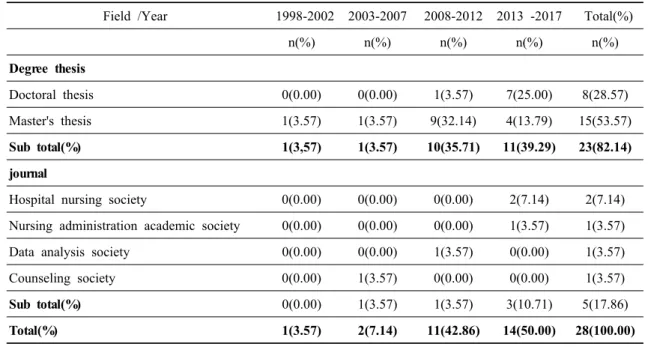
학문분야별 분석결과를 살펴보면 석사 15편
(82.14%)으로 가장 많았으며 박사 8편(28.57%)
으로 나타났으며 학회지는 총 5편(17%)으로 나
타났다. 석사연구는 1998년 이후 1편 정도로 발
표되다가 2008년 이후 9편(32.14%)으로 급격히
증가하였으나 2013년 이후 4편(13.79%)으로 감
소추세로 나타났다. 그러나 반면 박사연구는
1998년 이후 거의 한편도 발표되지 않고 있다
가 2008년 이후 1편(3.75%), 2013년 이후 7편
(25.00%)로 급격히 증가하다가 2013년 이후 8편
(28.57%)으로 꾸준한 증가를 보였다. 학회지는
병원간호사회지가가 2013년 이후 2편(7.14%),
병원 행정학회지가 1편(3.57%), 자료 분석학회
지가 1편 (3.57%), 상담학회지가 1편(3.57%)으
로 총 5편(17.86)이 진행되었다(Table 1).
Field /Year 1998-2002 2003-2007 2008-2012 2013 -2017 Total(%)
n(%) n(%) n(%) n(%) n(%)
Degree thesis
Doctoral thesis 0(0.00) 0(0.00) 1(3.57) 7(25.00) 8(28.57)
Master's thesis 1(3.57) 1(3.57) 9(32.14) 4(13.79) 15(53.57)
Sub total(%) 1(3,57) 1(3.57) 10(35.71) 11(39.29) 23(82.14)
journal
Hospital nursing society 0(0.00) 0(0.00) 0(0.00) 2(7.14) 2(7.14) Nursing administration academic society 0(0.00) 0(0.00) 0(0.00) 1(3.57) 1(3.57)
Data analysis society 0(0.00) 0(0.00) 1(3.57) 0(0.00) 1(3.57)
Counseling society 0(0.00) 1(3.57) 0(0.00) 0(0.00) 1(3.57)
Sub total(%) 0(0.00) 1(3.57) 1(3.57) 3(10.71) 5(17.86)
Total(%) 1(3.57) 2(7.14) 11(42.86) 14(50.00) 28(100.00)
Table 1. Field of Study Analysis
(N=28)3.2. 연구 대상자
연구대상자를 분석한 결과를 살펴보면 병동 형태는 일반 병동 간호사가 17편(60.71%)으로 가장 많았으며 특수병동간호사가 총 11편 (39.27%)으로 진행되었다. 특수병동간호사는 중 환자실 간호사 3편(10.71%), 수술실 간호사 3편 (10.71%), 정신과 간호사 1편(3.57%), 응급실 간 호사 2편(7.14%), 종양병동 간호사 2편(7.14%) 으로 나타났다. 간호사 직위별로 대상자를 살펴 보면 일반 간호사 26편( 92.86%)으로 가장 많았 으며 특히 일반 간호사 중 3교대간호사가 3편 (10.34%)으로 진행되었으며 신규간호사(36개월 미만 )는 1편(3.57%), 관리자 1편(3.57%)순으로 나타났다 . 병원 형태별로 분석한 결과를 살펴보 면 300병동 이상 종합병원 간호사가 21편
(75.00%)으로 가장 많았으며 대학병원간호사가 7편(25.00%)으로 나타났다(Table 2).
3.3. 연구 프로그램 유형
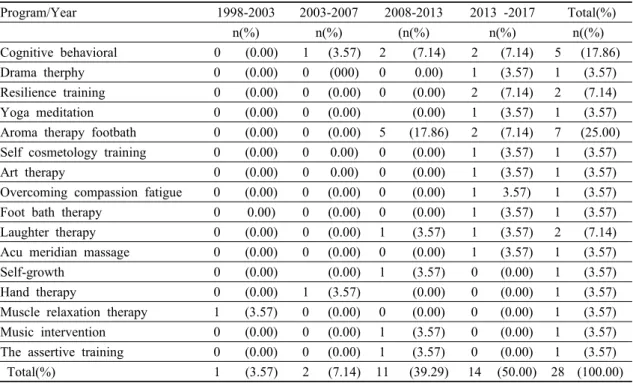
연구유형별 분석 결과를 살펴보면 아로마 테
라피 7편 (25.00)으로 가장 많았으며 인지 행동
프로그램 5편 (17.86%), 회복탄력성 2편(7.14%),
웃음 치료 2편(7.14), 연극치료 1편(3.57%), 요가
명상 1편(3.57%), 자가 미용교육 1편(3.57%), 집
단 미술치료 1편(3.57%), 공감 피로 극복 1편
(3.57%), 족욕 1편(3.57%), 수지요법 1편(3.57%),
자기 성장 1편(3.57%), 손 마사지 1편 (3.57%),
근육이완 1편(3.57%), 음악 요법 1편(3.57%), 자
기 주장 훈련 1편(3.57%)으로 나타났다(Table 3).
Subject/Year 1998-2002 2003-2007 2008-2012 2013 -2017 Total(%)
n(%) n(%) n(%) n(%) n(%)
Working department Special ward
Intensive care unit 0 (0.00) 0 (0.00) 2 (7.14) 1 (3.57) 3 (10.71)
Operating 0 (0.00) 0 (0.00) 2 (7.14) 1 (3.57) 3 (10.71)
Psychiatric 0 (0.00) 0 (0.00) 1 (3.57) 0 (0.00) 1 (3.57)
Oncology 0 (0.00) 0 (0.00) 0 (0.00) 1 (7.14) 2 (7.14)
Emergency 0 (0.00) 0 (0.00) 0 (0.00) 2 (7.14) 2 (7.14)
Sub total(%) 0 (0.00) 0 (0.00) 5 (17.85) 5 (21.43) 11 (39.27) General ward
General 1 (3.57) 2 (7.14) 5 17.86) 10 (35.71) 17 (60.71) Total(%) 1 (3.57) 2 (7.14) 10 (35.71) 15 (53.57)) 28 (100.00) Nurse position
Nursing manager 0 (0.00) 0 0.00) 0 0.00) 1 3.4) 1 (3.57)
General nurse 26 92.86)
General 1 (3.57) 2 (6.90) 8 (31.03) 12 (41.4) 23 (82.76) 3 Shift working 0 (0.00) 0 (0.00) 2 (6.90) 1 (3.57) 3 (10.34) New nurse (less than 36 months) 0 (0.00) 0 (0.00) 0 (0.00) 1 (3.57) 1 (3.57) Total(%) 1 (3.57) 2 (7.14) 10 (35.71) 15 (53.57) 28 (100.00) Hospital type
University hospital nurse 0 (0.00 ) 0 (0.00) 4 (14.29 ) 3 (10.71) 7 (25.00) Over 300 beds general hospital 1 (3.57) 2 (7.14) 6 (21.43) 12 (42.86) 21 (75.00 )
Total(%) 1 (3.57) 2 (7.14) 10 35.71) 15 53.57) 28 100.00)
Table 2. Research Subject Analysis
(N=28)Program/Year 1998-2003 2003-2007 2008-2013 2013 -2017 Total(%)
n(%) n(%) (n(%) n(%) n((%)
Cognitive behavioral 0 (0.00) 1 (3.57) 2 (7.14) 2 (7.14) 5 (17.86)
Drama therphy 0 (0.00) 0 (000) 0 0.00) 1 (3.57) 1 (3.57)
Resilience training 0 (0.00) 0 (0.00) 0 (0.00) 2 (7.14) 2 (7.14)
Yoga meditation 0 (0.00) 0 (0.00) (0.00) 1 (3.57) 1 (3.57)
Aroma therapy footbath 0 (0.00) 0 (0.00) 5 (17.86) 2 (7.14) 7 (25.00) Self cosmetology training 0 (0.00) 0 0.00) 0 (0.00) 1 (3.57) 1 (3.57)
Art therapy 0 (0.00) 0 0.00) 0 (0.00) 1 (3.57) 1 (3.57)
Overcoming compassion fatigue 0 (0.00) 0 (0.00) 0 (0.00) 1 3.57) 1 (3.57)
Foot bath therapy 0 0.00) 0 (0.00) 0 (0.00) 1 (3.57) 1 (3.57)
Laughter therapy 0 (0.00) 0 (0.00) 1 (3.57) 1 (3.57) 2 (7.14)
Acu meridian massage 0 (0.00) 0 (0.00) 0 (0.00) 1 (3.57) 1 (3.57)
Self-growth 0 (0.00) (0.00) 1 (3.57) 0 (0.00) 1 (3.57)
Hand therapy 0 (0.00) 1 (3.57) (0.00) 0 (0.00) 1 (3.57)
Muscle relaxation therapy 1 (3.57) 0 (0.00) 0 (0.00) 0 (0.00) 1 (3.57)
Music intervention 0 (0.00) 0 (0.00) 1 (3.57) 0 (0.00) 1 (3.57)
The assertive training 0 (0.00) 0 (0.00) 1 (3.57) 0 (0.00) 1 (3.57)
Total(%) 1 (3.57) 2 (7.14) 11 (39.29) 14 (50.00) 28 (100.00)
Table 3. Program Analysis (N=28)
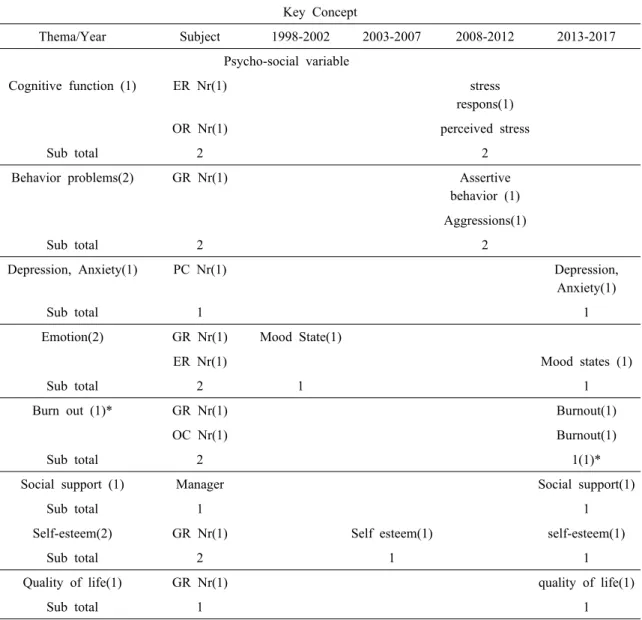
Key Concept
Thema/Year Subject 1998-2002 2003-2007 2008-2012 2013-2017
Psycho-social variable
Cognitive function (1) ER Nr(1) stress
respons(1)
OR Nr(1) perceived stress
Sub total 2 2
Behavior problems(2) GR Nr(1) Assertive
behavior (1) Aggressions(1)
Sub total 2 2
Depression, Anxiety(1) PC Nr(1) Depression,
Anxiety(1)
Sub total 1 1
Emotion(2) GR Nr(1) Mood State(1)
ER Nr(1) Mood states (1)
Sub total 2 1 1
Burn out (1)* GR Nr(1) Burnout(1)
OC Nr(1) Burnout(1)
Sub total 2 1(1)*
Social support (1) Manager Social support(1)
Sub total 1 1
Self-esteem(2) GR Nr(1) Self esteem(1) self-esteem(1)
Sub total 2 1 1
Quality of life(1) GR Nr(1) quality of life(1)
Sub total 1 1
Table 4. Research Theme Analysis
(N=28)3.4. 연구 주제별
연구주제별로 분석결과를 살펴보면 심리적 변수에 응급실 간호사 대상의 인지기능 1편 (3.57%), 정서 2편(7.14%), 정신과 간호사 대상 의 불안, 우울 1편(3.57%), 일반, 중간 관리자 대상의 사회적지지 1편(3.57%), 일반 간호사 대 상의 행동문제 2편(7.14%), 자기효능감 2편 (7.14%), 회복탄력성 2편(7.14%), 소진 2편 (7.14%), 삶의 질 1편(3.57%)으로 나타났다. 생 리적 변수를 살펴보면 일반 간호사 대상으로 활 력징후가 3편(10.71%)으로 가장 많았으며 근육
통증 2편(7.14%), 피로 1편1편(3.57%), 수면 1편
(3.57%), 타액 산도 1편(3.57%) 이였으며 중환자
실 간호사 대상의 활력징후 3편(10.71%), 수술
실 간호사 대상의 피로 2편(7.14%)으로 나타났
다. 1998년 이후 주제는 정서 1편으로 진행되었
고 2003년 이후 자기 효능감 1편(3.57%), 활력
징후 2편(7.14%)이었으며 2008년 이후 활력징
후, 인지, 행동, 수면, 피로 등을 주제로 진행되
었고 2013년 이후 불안 과 우울, 사회적 지지,
소진, 삶의 질, 회복탄력성, 근육통증 등을 주제
로 진행되었다(Table 4).
Resiliance (2) GR Nr(1)* resilience(1)*
2 2
Physical variables
Sleep(1) GR Nr(1) Quality of
sleep(1)
Sub total 1 1
Vital signs(6) GR Nr(2)* Vital signs(1)* Vital signs(1)
ICU Nr(2)* "Vital signs(1)* Vital signs(1)
Sub total 6 1 1(1)* 1(1)*
pain (2) GR Nr(1)* muscle pain (1) Musculo skeletal
Pain(1)
Sub total 2 1 1
Fatigue (2) OR Nr(1)* Fatigue(1) Fatigue(1)
Sub total 2 1(1)* 1(1)*
Others (1)† GR Nr(1) Salivary pH (1)
Sub total 1 1
1 1 2 11 14
주 * Duplication
ICU Nr Intensive Care Unit nurse OR Nr Nr Operating nurse PC Nr Psychiatric nurse OC Nr Oncology nurse ER Nr Emergency nurse GR Nr General nurse
3.5. 실험연구방법
실험 연구방법 분석결과를 살펴보면 연구대 상자의 실험군의 평균 22.62± 7.62 명이었고 통 제군은평균 (22.97± 7.69)명이었다. 평균 중재기 간은 3.88±2.61주였으며 자기성장 프로그램이 평균 5.33±4.03주, 자기주장 5.25±2.92주 , 합리 정서 행동이 평균 5.33 ± 3.51주로 가장 중재기 간이 길었던 것으로 나타났다. 중재 횟수는 평 균 주당 8.81± 7.33 회로 아로마 테라피가 평균 10.86 ± 9.21회로 가장 많은 회기로 진행되었으 며 가장 짧은 회기는 근육이완 프로그램으로 평
균 5.00 ± 2.22회로 나타났다. 중재시간은 평균
중재 1회당 63.50±84.61분으로 나타났다. 가장
중재시간이 길었던 프로그램은 공격성 관리 프
로그램으로 85.81±143.57분 이었으며 가장 짧게
진행되었던 프로그램은 손 마사지 25.00±7.07분,
근육이완요법 20.00± 8.22 이었다 . 실험연구방
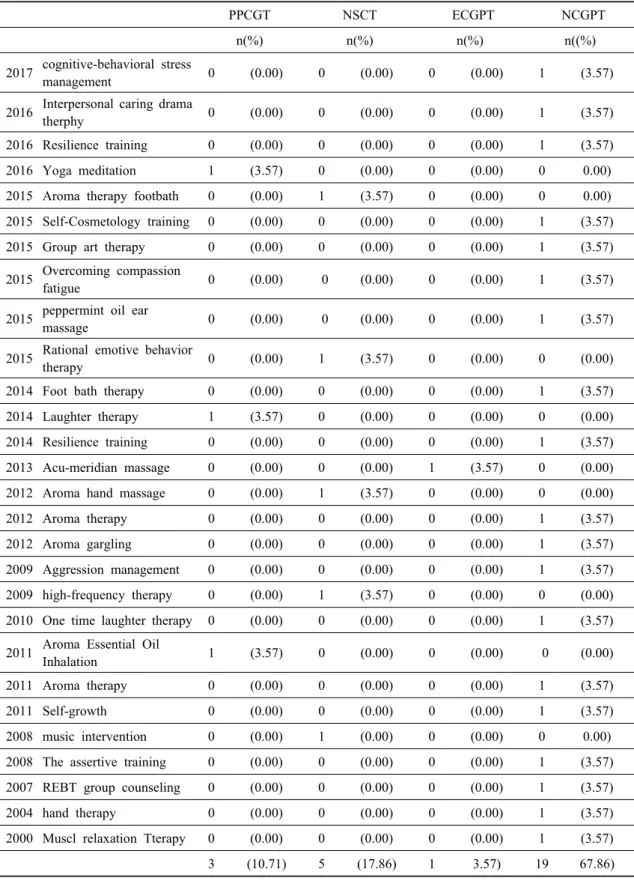
법은 비동등성 대조군 사전 사후 실험설계 가
19편(67.86%)으로 가장 많았으며 비동등성 대조
군 사전, 사후 시차설계가 5편(17.86%), 무작위
대조군 전후 시차실험 설계가 3편 (10.71%), 동
등성 대조군 사전 사후 실험 설계 1편(3.57%)순
이었다 (Table 5),(Table 6).
Year nterventions contents
Sample Size ntervention
Experimental Control Duration (week)
Frequency (week)
Time (minute)
M±SD M±SD M±SD M±SD M±SD
2017 cognitive-behavioral
stress management 24.46 ± 8.12 24.57 ± 8.07 3.82 ± 8.24 8.86 ± 8.24 69.81 ± 97.42 2016 Interpersonal caring
drama therphy 23.93 ± 7.75 24.00 ± 7.62 3.81 ± 8.39 8.93 ± 8.39 70.63 ± 99.42 2016 Resilience training 23.73 ± 7.84 23.77 ± 7.67 3.81 ± 8.55 8.96 ± 8.55 69.78 ± 101.57 2016 Yoga meditation 23.56 ± 7.95 23.61 ± 7.78 3.8 ± 8.67 9.16 ± 8.67 67.51 ± 103.35 2015 Aroma
therapy footbath 23.29 ± 8,00 23.33 ± 7.83 3.63 ± 8.73 8.88 ± 8.73 67.52 ± 103.35 2015 Self-cosmetology
training 22.96 ± 8.01 23.00 ± 7.83 3.74 ± 8.76 9.22 ± 8.76 69.29 ± 105.56 2015 Group art therapy 22.82 ± 8.17 22.68 ± 7.86 3.77 ± 8.86 9.51 ± 8.86 69.29 ± 105.56 2015 Overcoming
compassion fatigue 23.24 ± 8.12 23.05 ± 7.86 3.57 ± 9.08 9.57 ± 9.08 69.75 ± 108.28 2015 peppermint oil ear
massage 23.7 ± 8.05 23.31 ± 7.98 3.52 ± 9.25 9.81 ± 9.25 69.21 ± 111.22 2015 Rational emotive
behavior therapy 23.58 ± 8.25 23.58 ± 8.11 3.58 ± 8.15 8.74 ± 8.15 73.00 ± 113.17 2014 Foot bath therapy 23.56 ± 8.49 23.56 ± 8.33 3.33 ± 8.38 8.78 ± 8.38 66.71 ± 113.36 2014 Laughter therapy 23.47 ± 8.74 23.47 ± 8.58 3.35 ± 8.62 8.59 ± 8.61 69.63 ± 116.42 2014 resilience training 23.06 ± 8.86 23.06 ± 8.69 3.19 ± 8.86 8.75 ± 8.86 70.27 ± 120.47 2013 Acu-meridian
massage 22.73 ± 9.07 22.73 ± 8.89 3.13 ± 9.07 9.07 ± 9.07 66.71 ± 124.21 2012 Aroma hand massage 22.43 ± 9.33 22.51 ± 9.18 3.21 ± 9.31 9.43 ± 9.31 67.23 ± 129.26 2012 Aroma therapy 22.31 ± 9.71 22.62 ± 9.54 3.31 ± 9.59 9.08 ± 9.59 72.00 ± 133.81 2012 Aroma gargling 21.83 ± 9.97 22.17 ± 9.82 3.42 ± 8.06 7.52 ± 8.06 78.09 ± 138.58 2009 Aggression
management 20.18 ± 8.57 20.55 ± 8.45 3.64 ± 8.32 7.91 ± 8.32 85.81 ± 143.57 2009 high-frequency
therapy 21.11 ± 8.44 21.51 ± 8.26 3.91 ± 8.44 8.61 ± 8.44 42.00 ± 40.09 2010 one time laughter
therapy 22.89 ± 6.64 23.33 ± 6.24 4.00 ± 8.89 8.89 ± 8.89 44.75 ± 41.94 2011 Aroma essential Oil
inhalation 23.38 ± 6.93 23.88 ± 6.45 4.38 ± 8.97 9.88 ± 8.97 42.57 ± 44.81 2011 Aroma therapy 22.43 ± 6.91 23.00 ± 6.43 4.86 ± 9.21 10.86 ± 9.21 49.17 ± 45.21 2011 Self-growth 22.33 ± 7.55 23.00 ± 7.04 5.33 ± 4.03 7.67 ± 4.03 58.00 ± 44.38 2008 music intervention 20.81 ± 7.33 21.62 ± 6.88 4.41 ± 4.32 7.22 ± 4.32 50.00 ± 46.91 2008 The assertive training 18.00 ± 4.42 19.52 ± 5.81 5.25 ± 2.99 8.75 ± 2.99 56.67 ± 55.08 2007 Rebt group counseling 17.33 ± 5.13 19.33 ± 7.09 5.33 ± 3.51 8.33 ± 3.51 56.67 ± 55.08 2004 hand therapy 18 ± 7.07 20.00 ± 9.90 4.00 ± 4.95 8.51 ± 4.95 25.00 ± 7.07 2000 Muscl relaxation
therapy 23 ± 8.2 27.00 ± 11.34 5.00 ± 2.21 5.00 ± 2.2 20.00 ± 8.23 22.62 ± 7.66 22.97 ± 7.69 3.88 ± 2.61 8.81 ± 7.33 63.50 ± 84.62
Table 5. Interventions Method of Experimental Studies
(N=28)PPCGT NSCT ECGPT NCGPT
n(%) n(%) n(%) n((%)
2017 cognitive-behavioral stress
management 0 (0.00) 0 (0.00) 0 (0.00) 1 (3.57)
2016 Interpersonal caring drama
therphy 0 (0.00) 0 (0.00) 0 (0.00) 1 (3.57)
2016 Resilience training 0 (0.00) 0 (0.00) 0 (0.00) 1 (3.57)
2016 Yoga meditation 1 (3.57) 0 (0.00) 0 (0.00) 0 0.00)
2015 Aroma therapy footbath 0 (0.00) 1 (3.57) 0 (0.00) 0 0.00) 2015 Self-Cosmetology training 0 (0.00) 0 (0.00) 0 (0.00) 1 (3.57)
2015 Group art therapy 0 (0.00) 0 (0.00) 0 (0.00) 1 (3.57)
2015 Overcoming compassion
fatigue 0 (0.00) 0 (0.00) 0 (0.00) 1 (3.57)
2015 peppermint oil ear
massage 0 (0.00) 0 (0.00) 0 (0.00) 1 (3.57)
2015 Rational emotive behavior
therapy 0 (0.00) 1 (3.57) 0 (0.00) 0 (0.00)
2014 Foot bath therapy 0 (0.00) 0 (0.00) 0 (0.00) 1 (3.57)
2014 Laughter therapy 1 (3.57) 0 (0.00) 0 (0.00) 0 (0.00)
2014 Resilience training 0 (0.00) 0 (0.00) 0 (0.00) 1 (3.57)
2013 Acu-meridian massage 0 (0.00) 0 (0.00) 1 (3.57) 0 (0.00)
2012 Aroma hand massage 0 (0.00) 1 (3.57) 0 (0.00) 0 (0.00)
2012 Aroma therapy 0 (0.00) 0 (0.00) 0 (0.00) 1 (3.57)
2012 Aroma gargling 0 (0.00) 0 (0.00) 0 (0.00) 1 (3.57)
2009 Aggression management 0 (0.00) 0 (0.00) 0 (0.00) 1 (3.57) 2009 high-frequency therapy 0 (0.00) 1 (3.57) 0 (0.00) 0 (0.00) 2010 One time laughter therapy 0 (0.00) 0 (0.00) 0 (0.00) 1 (3.57) 2011 Aroma Essential Oil
Inhalation 1 (3.57) 0 (0.00) 0 (0.00) 0 (0.00)
2011 Aroma therapy 0 (0.00) 0 (0.00) 0 (0.00) 1 (3.57)
2011 Self-growth 0 (0.00) 0 (0.00) 0 (0.00) 1 (3.57)
2008 music intervention 0 (0.00) 1 (0.00) 0 (0.00) 0 0.00)
2008 The assertive training 0 (0.00) 0 (0.00) 0 (0.00) 1 (3.57) 2007 REBT group counseling 0 (0.00) 0 (0.00) 0 (0.00) 1 (3.57)
2004 hand therapy 0 (0.00) 0 (0.00) 0 (0.00) 1 (3.57)
2000 Muscl relaxation Tterapy 0 (0.00) 0 (0.00) 0 (0.00) 1 (3.57)
3 (10.71) 5 (17.86) 1 3.57) 19 67.86)
주 PPCGT Pretest-posttest control group design NSCT Non-synchronized design.
ECGPT Equivalent control group with pre-post design NCGPT Non equivalent control group with pre-post design
Table 6. Interventions Type of Experimental Studies
(N=28)Thema Year Subject Method Program dependent variable Outcome
Physical
variable 2016 GR Nr PPCGT Yoga meditation
Stress Response Depression Musculoskeletal Pain Natural Killer Cell Levels
support support support reject
2004 GR Nr NCGPT hand therapy
Subjective Fatigue Symptom Blood Pressure Critical flicker-fusion frequency
Diastolic blood pressure pulses
support support support support
2015 ER Nr NCGPT
Overcoming Compassion
Fatigue
Ego-resiliency Compassion satisfaction Compassion fatigue of ProQOL 5
Salivary cortisol level
support support support support
2008 ICU Nr NCGPT music intervention
Anxiety
Systolic diastolic blood pressure Heart rate, respiratory rate
support support support
2010 ICU Nr NCGPT one time laughter therapy
Blood pressure Pulse Cortisol Depression
Anxiety
support support support Reject
2015 GR Nr NSCT Aroma
therapy footbath
Stress, fatigue Blood pressure
Autonomic nervous system activity
support support Reject
Table 7. Interventions of Outcome Variables
(N=28)3.6. 중재연구의 변수
중재방법에 따라 사용된 결과변수의 유의성 은 총 28편의 실험연구결과 22편(75.00%)은 유 의하였으며 유의 하지 않은 변수는 총 6편 (25.00%)으로 타액1개, NK 세포수치 1개, 자율 신경활성화시스템 1개, 불안이 2개 소진이 1개 였다 . 실험 연구결과의 변수는 생리적변수가 12 편 (42.86%)으로 가장 많았으며 사용된 변수는 활력징후가 가장 많았으며 Cotisol 수치, NK 세 포수치 , 피로, 통증, 수면의 질 등 이었다. 생리 적 변수 외에 심리적 변수는 11편(39.29%)으로 소진 , 회복탄력성, 공격성 태도, 부정적, 긍정적 정서 , 직무 만족도, 직무 스트레스, 임파워먼트, 자기효능감 등이었다. 불안과 우울변수는 2편
(7.14%)이었으며 삶의 질과 관련한 변수 1편
(3.57%), 회복탄력성 1편으로 나타났다. 실험연
구결과 유의하지 않은 프로그램은 요가명상 프
로그램으로 NK 세포수치변수가 기각되었으며
아로마 족욕은 자율신경계 활성화 지수변수가
기각, 집단 미술치료는 소진이 기각. 공감 피로
극복 프로그램은 공감피로와 코티졸수치가 기
각되었다. 또한 페퍼민트 귀마사지와 일회성 웃
음 치료는 불안이 기각, 손 마사지는 혈압수치
가 기각되었다. 실험방법 중 유의하지 않은 결
과로 나타난 실험방법은 무작위 사전 사후 실험
연구 1편(3.57%)과 비동등성 시차설계 연구 1편
(3.57%), 비동등성 사전 사후 실험설계 5편
(17.86)으로 나타났다(Table 5).
2009 GR Nr NSCT high-frequency therapy
Alleviation of trapezius muscle pain stress
support support support
2012 GR Nr NCGPT Aroma gargling
Stress Xerostomia Halitosis
Salivary pH
support reject support
2013 ICU
Nr ECGPT Acu-meridian Massage
Systolic and diastolic blood pressure Pulse
NK cell TGF-β leve
support support support support
2014 OR Nr NCGPT Foot bath therapy
Lower extremities edema Stress
Fatigue
support support
2012 GR Nr NSCT Aroma hand massage
Stress Fatigue
support support
2011 GR Nr PPCGT
Aroma essential oil inhalation
Stress Fatigue Quality of Sleep
support support support Sub
Total(%) 12(42.86)) support
Quality
of life 2016 GR Nr NCGPT
Interpersonal caring drama
therphy
Emotional Intelligence Work stress quality of life
support support support 1(3.57)
Resilience 2016 ICU Nr NCGPT Resilience training
Resilience Positive affect PerceivedSstress assessment
support support support Sub
Total(%) 1(3.57) support
Psychosocial
problem 2017 ER Nr NCGPT
cognitive-behavior al stress management
Psychosocial Stress Change mood states positively Learn effective ways of coping
support support support support
2015 GR Nr NCGPT Self-cosmetology training
Self-esteem burnout
stress Self-efficacy
support support support support 2015 OC Nr NCGPT Group art therapy Job stress
Burnout
support reject
2015 GR Nr NSCT Rational emotive behavior therapy
Job stress Burnout Job satisfaction, Organizational commitment
Turnover intention
support support support support
2014 Manegement PPCGT Laughter therapy
Stress responses Empowerment Social support
support support support
2009 PC
Nr NCGPT Aggression management
Aggression Management Knowledge Aggression Attitudes
support support support
2011 OR Nr NCGPT Aroma
therapy Perceived stress support
2011 GR Nr NCGPT Self-growth Stress
Stress respons
support support
2008 GR Nr NCGPT The Assertive training
Assertive behavior Symptom of stress interpersonal
relationship
support support support
2007 GR Nr NCGPT REBT group counseling
Job stress Positive affect Negative affect
Self-esteem
support support support support 2000 GR Nr NSCT Muscl relaxation
therapy
Mood state Job stress
support support Sub
Total(%) 11(39.29) Depression/
Anxiety 2015 GR Nr NCGPT Peppermint oil ear massage
Stress Depression
Anxiety
support support reject
2012 OR Nr NCGPT Aroma therapy
Stress Fatigue Depression
support support support Sub
Total(%) 2(7.14)
Total(%) 28(100.00)
* Duplication
ICU Nr Intensive Care Unit nurse GR Nr General nurse
OR Nr Nr Operating nurse PPCGT Pretest-posttest control group design PC Nr Psychiatric nurse NSCT Non-synchronized design.
OC Nr Oncology nurse ECGPT Equivalent control group with pre-post design ER Nr Emergency nurse NCGPT Non equivalent control group with pre-post design
4. 논의
본 연구는 최근 약 20년간 국내 간호사 대상 의 중재연구들의 특성을 5년 단위로 학문 분야 별 , 대상자, 연구 설계방법, 측정결과변수를 중 심으로 연구결과와 변수 특성을 분석하였다 . 본 분석을 통하여 최근까지의 간호사 스트레스중
며 향후 간호사 스트레스완화와 간호사 스트레
스 관련 행동 심리증상을 감소시킬 수 있는 간
호사 스트레스 중재에 관한 근거중심 간호 중재
의 기초자료를 제공하고자 하였다. 본연구의 분
석대상 논문은 317편의 학위논문 중 23편
(82.14%)의 학위논문과, 79편의 학회지 논문 중
학회지 논문 5편(17.86%)으로 나타났다. 이중
학위논문 23편 중 석사 15편(82.14%)이 가장 많
았으며 박사 8편(28.57)순으로 나타났다. 석사연 구는 1998년 이후 1편 정도로 발표되었으며 2013년 이후 4편(13.79%)으로 감소추세였으나 반면 박사연구는 2008년 이후 1편으로 발표되 다가 2013년 이후 15편(53.57%)으로 급격한 증 가를 보였다. 이는 전 세계적으로 간호학 박사 과정이 늘어나고 있어 나타난 현상으로 사료된 다 . 실제로 2010년 미국 AACN(association of colleges of nursing)보고서에 의하면 미국은 153 개의 임상중심의 DNP(doctorate in nursing practice)과정과 124개 연구 중심의 PhD(doctor of philosophy)과정의 박사과정이 있어 계속적으 로 간호학 박사가 증가하고 있는 것으로 보고된 바 있다. 우리나라도 2007년 이후 총 21개의 대 학원 박사학위과정이 개설되면서 박사학위논문 이 급격히 증가하였으며 2005년 INDEN (international network for doctoral education in nursing)보고서에 의하면 미국, 영국, 호주에 이 어 의하면 31개국 중 네 번째로 간호학 박사과 정 많은 나라로 보고된바 있다
18). 학회지는 총 5편(17.86%)으로 나타났는데 이는 간호학 학회 지의 연구 동향이 비 실험 연구가 54.3%에서 75.7%의 비율로 나타났으며 반면 실험연구가 6.2%에서 23.4%로 상대적으로 실험 연구가 낮 은 경향을 보여
19)연구목적에 맞는 적절한 연구 방법과 분석이 필요함을 시사하는 바이다 . 학회 지는 병원 간호사회가 2편으로 나타났는데 이 는 대상자가 임상에서 실무를 담당하고 있는 간 호사 대상의 스트레스 프로그램이므로 나타난 결과로 사료된다 . 연구대상자별 분석결과는 일 반 간호사 17편 (60.71%), 특수병동간호사 11편 (39.27%)로 일반 간호사가 약 20% 많았다. 이는 일반 간호사가 특수병동 간호사가보다 비율이 높고 간호인증제 관련한 스트레스와
20)환자의 중증도 증가로 인한 환자안전문제와 관련한 업 무과중 등으로 직무스트레스 증가하고 있는 것 으로 보고된 바 있어 일반 간호사 중재 연구가 많은 것으로 사료된다
21. 특수병동 간호사 중재 연구는 11편(39.27%)으로 높게 나타났는데 중환 자실간호사는 일반 병동간호사와 비교 연구한 결과 우울과 소진이 높고
22)응급실 간호사는
교통사고로 인한 심각한 외상환자를 경험하는
반도가 높아 심각한 신체, 심리증상인 외상 후
스트레스장애를 경험빈도가 높은 것으로 확인
된바 있어
23)특수병동 간호사 스트레스중재 연
구가 지속적으로 발표되고 있는 것으로 사료된
다. 또한 수술실 간호사는 다양한 수술기기와
숙련된 조작과 같은 수술실 업무와 관련한 고도
의 기술을 필요로 하며 의와의 갈등 등으로 업
무 스트레스가 높은 것으로 보고된 바 있다
24.
정신과 간호사는 정신과 환자를 간호하면서 정
신과 환자의 행동 등의 관찰과 책임감 등을 경
험하며
25환자로부터 신체 폭력, 폭언 등의 공격
적 행동에 노출로 업무스트레스 높은 것으로
26)나타났으며 종양병동간호사는 임종환자를 돌보
는 과정 중 죽음불안과 같은 임종간호 스트레스
가 심각한 것으로 나타나 특별한 스트레스관리
가 필요한 대상자로 나타났다
27)). 간호사 직위별
로 대상자를 살펴보면 일반 간호사 26편
(92.86%)으로 가장 많았으며 특히 일반 간호사
중 3교대간호사가 3편(10.34%)으로 많았는데 3
교대 근무간호사는 회복탄력성 등과 같은 심리
적 기능이 떨어지며 불안과 스트레스가 높은 것
으로 보고된 바 있다
28). 신규간호사(36개월 미
만)는 1편(3.57%)으로 나타났는데 신규간호사는
간호업무의 미숙함과 대인관계와 같은 사회적
기술이 낮고 숙련된 간호기술의 부족 등으로 스
트레스가 높아
29)이직률도 높은 것으로 보고되
고 있어
30)스트레스 중재가 많이 이루어져야함
에 불구하고 다소 연구가 적은 것으로 나타났
다. 연구프로그램 유형분석결과는 아로마 테라
피가 7편(60.71%)으로 가장 많았는데 아로마 테
라피는 대표적인 전인적 치유(holistic therapy)의
대체요법으로 심신을 진정시키고 면역력을 증
강시키며 스트레스를 낮추는 효과가 있는 것으
로 보고된바 있다.
31).인지행동치료는 5편
(17.86%)으로 나타났는데 인지행동 프로그램은
우울, 불안, 분노와 같은 스트레스관련 문제행
동을 낮추는 것으로 보고된 바 있다
32). 또한 간
호사대상의 연구에서도 인지행동 프로그램이
스트레스를 낮추는 것으로 확인된 바 있다
33).
그 외에도 회복탄력성 프로그램 2편과 웃음 치
료 2편, 연극치료 2편 등으로 나타났다. 연구주 제별로 분석결과를 살펴보면 심리적 주제로는 행동문제 2편(7.14%), 자기 효능감 2편(7.14%), 회복탄력성 2편(7.14%), 소진 2편(7.14%) 등으 로 나타났는데 이와 관련하여 회복탄력성과 같 은 긍정 적인 심리는 스트레스를 완화시키며
34)자기효능감 또한 스트레스를 완화시키는 것으 로 확인된 바 있다
35). 행동문제와 관련하며 스 트레스가 높으면 공격성, 불안과 같은 행동적인 문제가 나타나는데 이러한 행동문제를 나추기 위한 스트레스중재프로그램이 제안 된 바 있어
36)
간호사 스트레스 중재에도 적용된 것으로 도 사료된다 . 또한 간호사의 직무 스트레스가 높으 면 소진이 높아지므로
37)간호사 대상의 소진을 주제로 중재프로그램이 적용된 것으로 사료된 다 . 이외의 심리적 주제로는 우울증상 및 불안 이 1편으로 나타났는데 심각한 수준의 스트레스 는 우울증상 및 불안장애로 나타나 일상생활의 적응에 문제를 나타나는 것으로 보고된 바 있다
38)