대한감각통합치료학회지 제16권 3호
The Journal of Korean Academy of Sensory Integration 2018 Vol. 16, No. 3
http://dx.doi.org/10.18064/JKASI.2018.16.3.023
국내 아동 작업치료사의 평가도구 사용 동향
이선희*, 홍초롱**, 박혜연***
*연세대학교 대학원 작업치료학과 박사과정,
**연세대학교 대학원 작업치료학과 석사과정, ***연세대학교 보건과학대학 작업치료학과 조교수
국문초록
목적 : 본 연구는 국내 아동 작업치료사들이 사용하고 있는 평가도구를 영역별로 구체화하여, 평가도구의 사용 동향을 파악하고자 하였다.
연구방법 : 본 연구는 아동 작업치료사를 대상으로 평가도구 사용에 대한 설문을 실시하였다. 평가도구의 하위영역은 작업수행, 일상생활활동, 교육, 놀이, 감각-지각, 운동 및 실행, 인지, 사회적 상호작용 기술, 발달, 이학적 검사로 구성하였다. 설문에 응답한 105명의 자료를 대상으로 기술통계 및 빈도분석을 사용하여 분석하였다.
결과 : 본 연구 결과는 초기 평가 시 소요되는 시간은 30∼60분(41.9%)이 가장 많았으며, 재평가 주기는 3~6개월(41.0%) 로 가장 많이 실시하는 것으로 나타났다. 영역 별 평가도구를 살펴보면, 작업 수행은 Canadian Occupation Performance Measure(55.2%)을, 일상생활활동은 Wee Functional Independence Measure(57.1%)을, 교육은 School Function Assessment(2.5%)를, 놀이 평가도구는 Revised Knox Preschool Play Scale(28.6%)을, 감각-지 각은 Developmental Test of Visual Perception(94.3%)을, 운동 및 실행 평가도구는 Bruininks-Oseretsky Test of Motor Proficiency-2(42.9%)를, 인지 평가도구는 Lowenstein Occupational Therapy Cognitive Assessment(11.4%)를, 사회적 상호작용 기술은 Evaluation of Social Interaction(6.1%)을, 발달은 Denver Developmental Screening Test-II(92.4%)를, 이학적 검사는 임상관찰(89.5%)을 주로 사용하는 것으로 나타났다.
결론 : 본 연구를 통하여 국내 아동작업치료사들이 사용하고 있는 평가도구를 영역별로 구체적으로 파악할 수 있었으며, 이를 통해 추후 평가 교육 및 개발을 위한 기초적인 근거자료가 될 것으로 기대된다.
주제어 : 아동 작업치료사, 평가도구, 평가
교신저자: 박혜연([email protected])
Ⅰ. 서 론
작업치료 분야에서 평가는 전반적인 절차와 사고의 과정 으로 평가(evaluation)와 사정(assessment)은 종종 서로 상호 교대로 사용된다(Neistadt & Crepeau, 1998). 평가 (evaluation)란 중재를 위해 필요한 정보를 모으고 해석하는 과정으로 평가 과정과 결과에 대해 계획을 세우고 문서화하 는 것을 포함한다. 사정(assessment)은 평가 과정 동안에 특정한 도구나 기구를 사용하는 것을 말한다(AOTA, 2010).
이처럼 가장 유용한 평가 활동, 도구, 자료를 선택하는 것은 임상적 추론을 필요로 하며, 평가를 위해 많은 요소들(예.
아동과 가족 특성, 평가 목적, 기술, 환경 등)을 고려해야 하 므로 평가 과정에서 가장 어려운 부분 중 하나이다. 평가는 구조화된 평가 도구 형식, 공식적인 절차, 관찰, 인터뷰의 비 구조화된 형식, 자연스러운 관찰을 포함한 비공식적인 관 찰 형식과 같이 세 가지 방법이 있다(Mulligan, 2003).
아동 작업치료사들은 아동의 발달적, 기능적 능력을 평 가하기 위하여 다양한 방법을 사용한다. 이것은 표준화된 평 가(표준참조 검사, 기준참조 검사), 체크리스트, 인터뷰, 가 정과 학교 관찰과 같은 방법을 포함한다(Crowe, 1989). 그 중 표준화된 검사는 아동에게 치료 서비스가 적절한지를 결 정하고, 치료에서의 진전을 관찰하고, 아동에게 가장 효과적 인 치료 유형을 결정하기 위해 사용된다. 아동 작업치료사들 은 표준화된 검사를 통해 특정 영역에서의 아동 수행에 대한 정확한 측정과 표준점수를 제공받을 수 있다(Case-Smith
& O'Brien, 2015).
선행연구를 살펴보면, Rodger(1994)는 아동 작업치료사 의 평가도구 사용에 대한 조사를 통해 Motor Free Perception Test, Bruininks-Oseretsky Test of Motor Proficiency, Visual Motor Integration Test, Ayres’
Clinical Observations, Non-Motor Test of Visual Perception, Revised Gesell Developmental Schedule을 가장 빈번하게 사용하는 것으로 보고하였다. Park과 Yoo(2002)의 한국 작업치료사의 평가도구 사용에 관한 연 구를 살펴보면, 발달검사 평가도구에서 Denver Developmental Screening Test(51.0%)를, 감각통합기능 검사 도구에서 Sensory Profile(14.6%)을 많이 사용하고 있 었다. 또한 Yoo, Jung, Park과 Choi(2006)의 한국 작업치 료사의 영역별 평가도구 사용 동향에 대한 연구를 살펴보면,
아동 작업치료 평가는 발달, 운동적합성, 감각통합, 인지-지 각, 일상생활, 이학적 검사와 같이 약 6개의 영역이었다. 그 중 전반적 발달검사에서 Denver Developmental Screening Test(97.0%)를, 운동적합성에서 Bruininks- Oseretsky Test of Motor Proficiency(35.8%)를, 감각통 합평가는 Sensory Profile(61.2%)을, 인지-지각평가는 Developmental Test of Visual Perception(47.8%)를, 일 상생활에서는 Wee FIM(74.6%)을 가장 많이 사용한 것으로 나타났다. 이와 같이 작업치료는 다양한 영역에서의 평가도 구가 이용되는 전문적인 지식이 강조되는 분야이다(Yoo et al., 2006).
작업치료사는 임상현장에서 평가도구를 선택하는 과정 에서 실제로 사용 가능한 평가도구를 선택한다(Law, Baum, & Dunn, 2016). 그러나 국내에서는 평가도구에 대 한 교육이 부족하고 정확하지 않은 사용법으로 인한 어려움 을 겪고 있는 실정이다(Park, & Yoo, 2002). 또한 Jo, Jeong, Choi, & Yoo(2015)의 국내 아동작업치료사를 대상 으로 한 연구가 있으나 2011년에 설문조사가 실시되어 7년 이상의 기간이 지나 최신 경향을 반영하지 못하고 있어 최근 임상에서 아동 작업치료사들의 평가도구 사용에 대한 연구 가 필요하다.
이에 본 연구에서는 국내 아동 작업치료사들이 사용하고 있는 평가도구를 영역별로 구체화하여, 평가도구의 사용 동 향을 파악하고자 한다. 또한 국내 아동 작업치료사들이 사용 하고 있는 평가도구와 개발 될 필요가 있는 영역을 알아보는 봄으로써 임상 현장 및 작업치료 전공 과정에서 아동 작업치 료 평가 교육을 위한 기초 자료를 제시하고자 한다.
Ⅱ. 연구 방법 1. 연구 대상
본 연구는 현재, 현직에 종사하는 아동 작업치료사 105명 을 대상으로 편의표본추출로 시작하여 눈덩이 표본추출로 선 정하였다. 연구자가 선정기준에 맞는 대상자를 정한 후 응답 자들의 연속적인 추천을 통하여 시행하였다.
대상자에게 연구 결과는 익명으로 사용하며 연구 목적 이 외에는 사용하지 않을 것임을 알려주고, 본 연구 목적에 동의
한 자를 대상으로 평가도구 사용에 대한 설문을 실시하였다.
2. 연구과정
1) 설문지 작성
본 연구를 위한 설문지 제작은 Yoo 등(2006)의 한국 작업 치료사의 영역별 평가도구 사용 동향 및 미국 작업치료협회 의 평가도구 지침서(Asher, 2014)와 Law 등(2016)의 평가 도구 안내서를 참고하여 임상에서 사용되는 평가도구에 대 한 설문을 영역별로 분류하여 구성하였다. 평가도구는 작업 수행, 일상생활활동, 교육, 놀이, 감각-지각, 운동 및 실행, 인지, 사회적 상호작용 기술, 발달, 이학적 검사로 하위 영역 을 나누었다. 개발될 필요가 있는 평가도구 영역에 대한 설 문은 미국 작업치료협회의 평가도구 지침서(Asher, 2014) 를 토대로 작업수행, 일상생활활동, 교육, 놀이, 감각-지각, 운동 및 실행, 인지, 사회적 참여, 발달, 이학적 검사를 비롯 하여 휴식, 수면을 추가로 포함하여 구성하였다.
2) 설문지의 배포 및 수거
설문지의 배포는 국내 작업치료사 면허를 소지하고 아동 을 대상으로 임상에 종사하는 작업치료사를 대상으로 2018 년 1월부터 2월까지 실시하였다. 설문 참여에 동의한 130명 의 작업치료사에게 전자우편으로 설문을 발송하여 총 110부 (회수율 84.6%)가 회수 되었다. 이 중 응답하지 않거나 불성
실하게 응답한 문항이 포함된 설문을 제외하고 총 105부의 설문지를 분석하였다.
3. 분석방법
본 연구의 결과 분석은 설문지 105부를 가지고 실시하였 다. 통계프로그램은 SPSS Version 23을 사용하였다. 연구 대상자의 일반적 특성 및 평가 관련 정보, 영역 별 평가도구 사용, 개발될 필요가 있는 평가 영역을 알아보기 위하여 기 술 통계와 빈도분석을 실시하였다.
Ⅲ. 연구 결과 1. 연구 대상자의 일반적 특성
연구 대상자의 연령은 25세 이하가 23명(21.9%), 26∼35 세가 72명(68.5%), 36세 이상이 10명(9.6%)이었으며, 임상 경력은 2년 이하가 11명(10.5%), 2∼5년이 17명(63.7%), 6
∼10년이 66명(62.8%), 10년 이상이 11명(10.5%)이었다.
근무 기관은 아동 센터 65명(61.9%), 의원 17명(16.3%), 재 활병원 11명(10.5%), 복지관 10명(9.5%), 대학병원 2명 (1.9%)순으로 나타났다(Table 1).
Table 1. General characteristics of participants (N=105)
Characteristic Categories n %
Age (years)
≤25 23 21.9
26~35 72 68.5
36≤ 10 9.6
Career (years)
≤ 2 11 10.5
2~5 17 16.2
6~10 66 62.8
10 ≤ 11 10.5
Place of employment
Pediatric center 65 61.9
Clinic 17 16.2
Rehabilitation hospital 11 10.5
Community center 10 9.5
General hospital 2 1.9
2. 연구 대상자의 평가 관련 정보
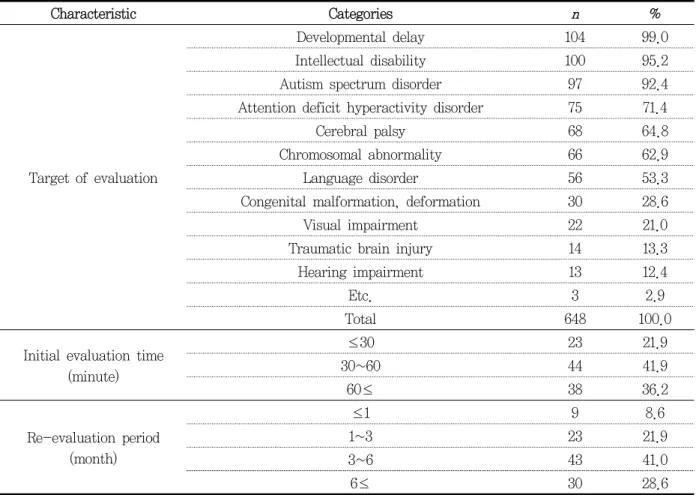
연구 대상자가 평가하는 대상은 중복대답을 허용하였는 데, 발달 지연(99.0%), 지적 장애(95.2%), 자폐 범주성 장애 (92.4%), 주의력 결핍 과잉행동 장애(71.4%), 뇌성마비 (64.8%) 선천성 기형 및 변형(62.9%), 언어장애(53.3%), 유
전 및 염색체 이상(28.6%), 시각장애(21.0%), 외상성 뇌손 상(13.3%), 청각장애(12.4%), 기타(2.9%) 순으로 나타났다.
초기 평가 시 소요되는 시간은 30∼60분이 전체 응답자 중 41.9%로 가장 많았으며, 재평가 주기는 3∼6개월이 41.0%
로 가장 많이 실시하는 것으로 나타났다(Table 2).
Table 2. Information on the evaluation of participants (N=105)
Characteristic Categories n %
Target of evaluation
Developmental delay 104 99.0
Intellectual disability 100 95.2 Autism spectrum disorder 97 92.4 Attention deficit hyperactivity disorder 75 71.4
Cerebral palsy 68 64.8
Chromosomal abnormality 66 62.9
Language disorder 56 53.3
Congenital malformation, deformation 30 28.6
Visual impairment 22 21.0
Traumatic brain injury 14 13.3
Hearing impairment 13 12.4
Etc. 3 2.9
Total 648 100.0
Initial evaluation time (minute)
≤30 23 21.9
30~60 44 41.9
60≤ 38 36.2
Re-evaluation period (month)
≤1 9 8.6
1~3 23 21.9
3~6 43 41.0
6≤ 30 28.6
3. 영역 별 평가도구 사용
영역 별 평가도구를 살펴보면, 작업 수행 평가도구는 Canadian Occupation Performance Measure 을 전체 응 답자 중 55.2%가 사용하는 것으로 나타났으며, 일상생활활 동 평가도구는 Wee Functional Independence Measure 이 57.1%로 가장 많이 사용하는 것으로 나타났다. 교육 평가 도구는 School Function Assessment(2.5%)로 낮은 사용 빈도를 보였으며, 놀이 평가도구는 Revised Knox Preschool Play Scale(28.6%)를 사용하는 것으로 나타났
다. 감각-지각 평가도구는 Developmental Test of Visual Perception (94.3%), Sensory Profile(93.3%)를 주로 사 용하는 것으로 나타났다. 운동 및 실행 평가도구는 Bruininks-Oseretsky Test of Motor Proficiency-2 (42.9%), Clinical Observation of Motor and Postural Skills(31.4%)를 주로 사용하는 것으로 나타났다. 인지 평 가도구는 Lowenstein Occupational Therapy Cognitive Assessment(11.4%)를 주로 사용하며, 사회적 상호작용 기 술 평가도구는 Evaluation of Social Interaction(6.1%) 로 낮은 사용빈도를 보였다. 발달 평가도구는 Denver
Table 3. Using frequency of assessment tool (N=105)
Categories
n%
Occupational performance
Canadian Occupation Performance Measure(COPM) 58 55.2
Perceived Efficacy and Goal Setting System(PEGS) 0 0.0
Activities of daily living
Wee Functional Independence Measure(Wee-FIM) 60 57.1
Pediatric Evaluation of Disability Inventory(PEDI) 17 16.2
Assessment of Motor and Process Skills(AMPS) 16 15.2
School Version of the Assessment of Motor and Process Skills(School AMPS) 1 1.0
Education School Function Assessment(SFA) 3 2.9
Play Revised Knox Preschool Play Scale(RKPPS) 30 28.6
Test of Playfulness(ToP) 2 1.9
Sensory -perceptual
Developmental Test of Visual Perception(DTVP) 99 94.3
Sensory Profile 98 93.3
Motor-Free Visual Perception Test(MVPT) 47 44.8
Sensory Integration Praxis Test(SIPT) 17 16.2
Test of Sensory Function in Infants 3 2.9
Motor / Praxis
Bruininks-Oseretsky Test of Motor Proficiency-2(BOT-2) 45 42.9 Clinical Observation of Motor and Postural Skills(COMPS) 33 31.4
Erhardt Developmental Prehension Assessment(EDPA) 25 23.8
Grooved Pegboard Test 21 20.0
Box and Block Test 14 13.3
Jebsen-Taylor Hand Function Test(JHFT) 9 8.6
Nine-Hole Peg Test 8 7.6
Gross Motor Function Measure(GMFM) 7 6.7
Cognition
Lowenstein Occupational Therapy Cognitive Assessment(LOTCA) 12 11.4
STROOP Color and Word Test Children's Version 7 6.1
Dynamic Occupational Therapy Cognitive Assessment for Children(DOTCA-Ch) 7 6.7
Leiter international performance scale-R(Leiter-R) 3 2.9
Goodenough-Harris Drawing Test 1 1.0
Social interaction skills
Evaluation of Social Interaction(ESI) 7 6.1
Social Skills Improvement System-Rating Scales(SSIS-RS) 0 0.0
Development
Denver Developmental Screening Test-II(DDST-II) 97 92.4
Bayley Scales of Infants Development(BSID) 47 41.2
Peabody Developmental Motor Scale(PDMS) 23 21.9
Gesell Developmental Schedules 11 10.5
Portage Developmental Checklist 7 6.7
Miller Assessment for Preschoolers(MAP) 4 3.8
Etc. 1 1.0
Physical examination
Clinical observation 94 89.5
Sensory test 46 43.8
Oral motor observation 43 41.0
Reflex test 42 40.0
Range of motion test 29 27.6
Muscle tone test 28 26.7
Manual muscle test 25 23.8
Table 4. Evaluation area that needs to be developed (N=105)
Categories n %
Social participation 63 55.3
Play 52 45.6
Activities of daily living 47 41.2
Occupational performance 35 30.7
Sensory-perceptual 35 30.7
Sleep 34 29.8
Cognition 24 21.1
Rest 20 17.5
Development 19 16.7
Education 18 15.8
Physical examination 4 3.5
Motor / Praxis 2 1.8
Etc. 2 1.8
Developmental Screening Test-II(92.4%)가 가장 사용 빈도가 높았고, 이학적 검사는 임상관찰(89.5%)을 주로 사 용하는 것으로 나타났다(Table 3).
4. 개발 될 필요가 있는 평가 영역
아동 작업치료 임상 현장에서 개발될 필요가 있는 평가 영역은 중복대답을 허용하였으며, 사회적 참여(55.3%), 놀 이(45.6%), 일상생활활동(41.2%) 순으로 높은 빈도를 보였 다(Table 4).
Ⅳ. 고 찰
본 연구의 목적은 국내 아동 작업치료사들이 사용하고 있 는 평가도구를 영역별로 구체화하여, 평가도구의 사용 동향 을 확인하는 것이다. 이를 위해 2018년 1월부터 2월까지 아 동을 대상으로 임상에 종사하는 작업치료사를 대상으로 설 문지를 배포하였으며, 최종 수집된 105부를 결과분석에 사 용하였다.
영역 별 평가도구를 살펴보면, 작업 수행 평가도구는 Canadian Occupation Performance Measure (55.2%), 일상생활활동 평가도구는 Wee Functional Independence Measure(57.1%), 교육 평가도구는 School Function
Assessment(2.5%), 놀이 평가도구는 Revised Knox Preschool Play Scale(28.6%)를 사용하는 것으로 나타났 다. 본 연구에서는 일상생활활동 평가도구 중 Wee Functional Independence Measure이 사용 빈도가 많은 것으로 나타났는데, 이는 선행연구 결과와 일치하였다 (Song, 2012; Yoo et al., 2006; Jo et al., 2015). 그러나 본 연구 결과에서 개발될 필요가 있는 평가 영역 중 일상생활 활동이 41.2%로 나타난 것으로 보아 일상생활활동 평가도구 에 대해 추가적인 필요성이 요구되는 것으로 보인다. Law, Baum과 Dunn(2016)은 향후의 일상생활활동 평가는 수행 되는 환경을 고려해야하며, 또한 일상생활활동의 하위 항목 을 구체화한 평가도구가 개발되어야 한다고 제언하였다. 이 를 통해 일상생활활동의 하위 항목 중 특정 영역을 구체화한 평가도구에 대한 연구가 필요한 것으로 사료된다.
교육 평가도구인 School Function Assessment(SFA)의 경우 사용빈도가 낮게 나타났으나, 최근 국내에서 한글판 SFA의 타당도 및 신뢰도 연구와 지적장애아동의 학교활동 참여분석에 대한 연구가 이루어진 바가 있어 향후 국내에서 SFA의 활발한 사용이 기대되는 바이다(Hong, Chang, &
Kim, 2013; Shin, Park, Lee, & Park, 2014;). 놀이 평가 도구는 Revised Knox Preschool Play Scale(RKPPS)를 주로 사용하고 있는 것으로 나타났음에도 불구하고 개발될 필요가 있는 평가 영역 중 놀이가 45.6%로 높은 빈도를 보였 다. 이는 국내 실정에 맞게 표준화된 놀이 평가도구가 부족
하므로 임상 현장에서 놀이 평가의 사용이 낮으며 놀이 평가 도구의 개발이 필요함을 제시한 선행연구 결과를 통해 본 연 구 결과가 지지됨을 알 수 있다(Lee & Park, 2017).
감각-지각 평가도구는 Developmental Test of Visual Perception(94.3%), Sensory Profile(93.3%)을, 운동 및 실행 평가도구는 Bruininks-Oseretsky Test of Motor Proficiency-2(42.9%), Clinical Observation of Motor and Postural Skills(31.4%)를 주로 사용하는 것으로 나타 났다. 이는 선행연구에서 아동 작업치료사들이 운동적합성 영역에서 Bruininks-Oseretsky Test of Motor Proficiency를 가장 많이 사용하며, Developmental Test of Visual Perception과 Motor-Free Visual Perception Test를 선호한 것으로 나타난 결과와 일치하였다(Yoo et al, 2006). 그러나 Bruininks-Oseretsky Test of Motor Proficiency-2(BOT-2)의 경우, 국내 실정에 맞게 표준화 되지 않아 한국 아동들에게 사용하기에 제한적이며, 추후에 는 BOT-2의 표준화를 위한 연구가 필요하다(Hong et al., 2016). Sensory Profile의 경우, Lim, Park과 Yoo(2007) 의 국내적용을 위한 번역연구 이루어져 활용도가 높은 것으 로 사료된다. 또한 짧은 시간 안에 감각처리능력을 평가할 수 있고 결과를 해석하는 방법이 용이하다는 장점을 가지고 있어 국내 아동 작업치료 분야에서 감각 통합 도구 중 가장 많이 사용된다는 선행 연구 결과와 본 연구 결과가 일치하였 다(Dunn, 1999; Yoo et al., 2006). 그러나 Sensory Profile의 구성타당도 연구에 의하면 23개 항목이 부적합 항 목으로 판정되어 신뢰도와 타당도가 높은 감각조절장애의 문제를 조기에 발견할 수 있는 평가도구가 개발되어야 한다 고 제시하고 있다(Park et al., 2011). 최근 Dunn에 의해 개정된 Short Sensory Profile2를 국내에서 사용하기 위한 신뢰도와 타당도 연구가 이루어져 이를 임상에서 사용할 수 있을 것으로 판단된다(Bak, Kim, Yoo, & Cha, 2017).
인지 평가도구는 Lowenstein Occupational Therapy Cognitive Assessment(11.4%)를 주로 사용하며, 사회적 상호작용 기술 평가도구는 Evaluation of Social Interaction(6.1%)로 낮은 사용빈도를 보였다. 이는 인지- 지각 평가도구에서 Lowenstein Occupational Therapy Cognitive Assessment(LOTCA)를 사용한다고 보고한 선 행연구 결과와 일치하였다(Song, 2012; Yoo et al., 2006).
그러나 LOTCA의 경우 뇌질환을 동반한 성인과 6세 이상의 아동에게 사용이 가능하므로, 아동을 대상으로 인지를 평가
함에 있어 연령에 따른 대상에 제한이 있음을 알 수 있다 (Itzkovich, Elazar, & Averbuch, 1993).
사회적 상호작용 평가도구의 경우, 감각통합기능장애를 가진 아동의 작업치료중재과정 모델을 적용한 사례연구에서 Evaluation of Social Interaction를 사용하였으나, 아직까 지 선행연구가 부족한 실정이다(Kim, 2011). 또한 본 연구 결과에서 개발될 필요가 있는 평가 영역 중 사회적 참여가 55.3%로 가장 높게 나타난 것으로 보아 사회적 참여 및 사회 적 상호작용 평가도구의 임상적 필요성이 높음을 알 수 있었 으며 이에 대한 연구가 필요할 것으로 보인다.
발달 평가도구는 Denver Developmental Screening Test-II(92.4%)와 Bayley Scales of Infants Development(41.2%)가 사용빈도가 높았으며, 이학적 검사 는 임상관찰(89.5%)을 주로 사용하는 것으로 나타났다 (Table 3). 이는 발달 검사 중 Denver Developmental Screening Test를 많이 사용한다고 보고한 선행연구와 일 치하였으며, 국내 아동 작업치료 연구동향을 분석한 선행연 구에서 Denver Developmental Screening Test를 비교적 높은 비율로 사용한다는 보고를 통해 국내 아동 작업치료분 야의 연구에서 많이 사용되는 평가도구라는 것을 알 수 있다 (Kim & Min, 2016; Yoo et al., 2006, Jo et al., 2015).
발달 평가도구에서 선행연구와 여전히 일치한 결과가 나타 났는데, 이는 Denver Developmental Screening Test-II 는 한국형 덴버발달선별검사II(Shin et al., 2002), Bayley Scales of Infants Development는 한국판 베일리영유아발 달검사II(Cho & Park, 2004)와 같이 국내 실정에 맞게 표 준화되었기 때문에 활발히 사용되고 있는 것으로 여겨진다.
또한 이학적 검사에서 임상 관찰의 경우, 사용빈도가 가장 높게 나타난 선행 연구와의 일치한 연구결과를 보인다(Yoo et al., 2006). 임상관찰은 아동 작업치료사들이 임상에서 아동의 감각, 운동에 관한 신경근계 검사로써 사용한다. 표 준화된 평가만으로는 문제를 정확히 파악하는 데에는 제한 이 있으므로 비 표준화된 평가들이 상호보완적으로 사용된 다(Ji, Kim, Keum, & Kim, 2009). 그러나 이를 보완하기 위하여 감각통합 영역에서는 Clinical Observation of Motor and Process Skills(COMPS)가 개발되어 유용한 근 거가 되고 있다. 국내에서도 COMPS를 적용한 연구가 이루 어지고 있어 임상에서의 적용이 기대된다(Kim et al., 2008).
최근 국내 아동 작업치료 분야의 평가도구에 대한 연구
를 살펴보면, 학령기 아동의 글씨쓰기 평가도구와 활동 참여 평가도구와 같이 다양한 영역의 평가도구 개발이 이루어지 고 있음을 알 수 있다(Lim et al., 2018; Kim et al., 2013).
그러나 국내 실정에 맞게 개발되었음에도 불구하고 아직까 지 보편적으로 사용하고 있지 않아 향후에는 국내에서 개발 한 아동 작업치료 영역의 평가도구에 대한 교육이 필요한 것 으로 보인다.
본 연구는 아동 작업치료사 대상으로 평가도구 사용 동향 에 대해서 알 수 있었으나 근무기관 혹은 평가하는 대상을 분류하여 분석하지 못한 제한점이 있다. 후속 연구에서는 아 동 작업치료사들의 평가도구 사용에 영향을 주는 요인들을 조사하여 그에 따른 차이를 분석하는 것이 필요할 것이다.
Ⅴ. 결 론
본 연구는 국내 아동 작업치료사를 대상으로 사용하고 있 는 평가도구의 사용 동향을 확인하고자 아동을 대상으로 임 상에 종사하는 작업치료사를 대상으로 설문조사를 실시하였 다. 연구에 포함된 평가 도구는 작업수행, 일상생활활동, 교 육, 놀이, 감각-지각, 운동 및 실행, 인지, 사회적 상호작용 기술, 발달, 이학적 검사로 하위 영역을 나누었다. 본 연구 결과를 통하여 국내 아동 작업치료사들이 사용하고 있는 평 가도구를 영역별로 구체적으로 파악할 수 있었으며 추후 평 가도구 교육 및 평가도구 개발 대한 기초적인 근거자료가 될 수 있을 것으로 기대된다.
참고문헌
American Occupational Therapy Association. (2010).
Standards of practice for occupational therapy.
American Journal of Occupational Therapy, 64(Suppl.), 106–111. http://dx.doi.org/10.5014/
ajot.2010.64S106
Asher, I. (2014). Asher’s occupational therapy assessment tools: An annotated index (4th ed.).
Bethesda, MD: AOTA Press.
Bak, A. R., Kim, H., Yoo, D. H., & Cha, T. H. (2017).
Study to reliability and validity of short sensory profile2. Journal of Korean Society of Occupational Therapy, 25(2), 131-139.
http://dx.doi.org/10.14519/jksot.2017.25.3.10 Crowe, T. K. (1989). Pediatric assessments: A survey
of their use by occupational therapists in northwestern school systems. Occupational Therapy Journal of Research, 9. 273-286.
Case-Smith, J., & O'Brien, J. C. (2015). Occupational therapy for children and adolescents. St. Louis, Missouri: Elsevier,
Cho, B. H., & Park, H. W. (2004). The stand- ardization study of korean bayley scales of infant development (K-BSID-II): Analyses of korean infants’ performance of K-BSID-II in terms of demographical variables. Korean Journal of Developmental Psychology, 17(1), 191-206.
Dunn, W. (1999). Sensory profile: User’s manual. San Antonio, T.X: Psychological Corporation.
Hong, K. H., Kim, D. Y., Kang, H. B., Park, T. Y., Yun, E. J., Lee, J. Y., et al. (2016). A preliminary study on motor ability of preschool aged children by using bruininks-oseretsky test of motor proficiency-2 (BOT-2) short form.
Journal of Korean Academy of Sensory Integration, 14(1), 31-40. http://dx.doi.org/10.18064/
JKASI.2016.14.1.031
Hong, S. Y., Chang, M. Y., & Kim, K, M. (2013).
Analysis of participation of students with intellectual disabilities in a school environment using the PEO model. Journal of Korean Society of Occupational Therapy, 21(1), 95-105.
Itzkovich, M., Elazar, B., & Averbuch, S. (1993), Lowenstein occupational therapy cognitive assessment manual. New Jersey: Maddak Inc.
Jo, E. M., Jeong, Y. J., Choi, Y. M., & Yoo, E. Y.
(2015). Current trends of occupational therapy assessment tool by Korean pediatric occupational therapist. Journal of Korean Society of
Occupational Therapy for Child and School, 6, 53-64.
Ji, S. Y., Kim, M. S., Keum, H. J., & Kim, S. H.
(2009). Developmental standard of short sensory profile for korean children of school age (7 to 9 years old). Journal of Korean Academy of Sensory Integration, 7(1), 27-36.
Kim, J. H. (2011). Application of occupational therapy intervention process model : A case of child with sensory integration dysfunction. Journal of Korean Academy of Sensory Integration, 9(2), 1-13.
Kim, M. H., Namgung, E. Y., Bu, K. H., Sim, J. H.,
& Lee, E. S. (2008). The performance of the clinical observations of motor and postural skills (COMPS) in school-aged normal children.
Journal of Korean Academy of Sensory Integration, 1(1), 17-23.
Kim, S. Y., & Min, Y. S. (2016). Literature review of korean occupational therapy research for children and youth regarding the international classification of functioning: Focusing on the korean society of occupational therapy. Journal of Korean Society of Occupational Therapy, 24(4), 161-174. http://dx.doi.org/10.14519/jksot.
2016.24.4.12
Kim, S. Y., Yoo, E. Y., Jung, M. Y., Park, S. Y., Lee, J, S., & Lee, J. Y. (2013). Development of activity participation assessment for school age children. Journal of Korean Society of Occupational Therapy, 21(2), 13-23.
Lee, S. H., Park, H. Y. (2017). Occupational therapy intervention for improving play of children: A systematic review. Journal of Korean Academy of Sensory Integration, 15(2), 93-106.
http://dx.doi.org/10.18064/jksot.2017.15.2.093 Lim, K. M., Yoo, E. Y., Jung, M. Y., Lee, J, S., Kim,
J. R., & Park, H. Y. (2018). Development of the evaluation tool of school-aged children’s and writing. Journal of Korean Society of
Occupational Therapy, 26(1), 103-118.
http://dx. doi.org/10.14519/jksot.2018.26.1.08 Lim, Y. J., Park, K. Y., & Yoo, E. Y. (2007). Pilot
study to establish content validity of a korean-translated version of a sensory profile.
Journal of Korean Society of Occupational Therapy, 15(2), 25-42.
Law, M., Baum, C., & Dunn, W. (2016). Measuring occupational performance: Supporting best practice in occupational therapy. Thorofare, NJ:
Slack.
Mulligan SE. (2003). Occupational therapy evaluation for children: A pocket guide. Philadelphia:
Lippincott Williams & Wilkins.
Neistadt, M., & Crepeau, E. B. (1998). Glossary. In M.E. Neistadt & E.B. Crepeau (Eds.), Willard &
Sparkman’s occupational therapy (9th ed., pp.
90-100). Philadelphia, PA: Lippincott Williams
& Wilkins.
Park, K. Y., Yoo, E. Y., Jung, M. Y., Park, S. Y., Lee, J. S., & Park, S. Y. (2011). Validation of the sensory profile for korean children With pervasive developmental disorder. Journal of Korean Society of Occupational Therapy, 19(3), 1-12.
Park, S. Y., & Yoo, E. Y. (2002). The use of occupational therapy assessment tool by Korean occupational therapist. Journal of Korean Society of Occupational Therapy, 10(2), 99-108.
Rodger, S. (1994). A survey of assessment used by paediatric occupational therapists. Australian Occupational Therapy Journal. 41, 137-142.
http://dx.doi/10.5762/KAIS.2012.13.11.5229 Shin, H. S., Han, K. J., Oh, K. S., Oh, J. J., & Ha,
M. N. (2002). Korean denver developmental screening test II. Seoul: Hyunmunsa.
Shin, Y. N., Park, S. H., Lee, J. Y., & Park, J. H.
(2014). Validity and reliability of the korean version of the school function assessment.
Journal of Korean Society of Occupational
Therapy, 22(4), 27-37. http://dx.doi/10.14519/jksot.
2014.22.4.03
Song, C. S. (2012). Current trends and future-oriented view of clinical measurement used by neurological occupational therapist.
Journal of the Korea Academia-Industrial
Cooperation Society, 13(11), 5229-5237.
Yoo, E. Y,, Jung, M. Y., Park, S. Y., & Choi, E. H.
(2006). Current trends of occupational therapy assessment tool by Korean occupational therapist. Journal of Korean Society of Occupational Therapy, 14(3), 27-37.
Abstract
Current Trend in Use of Occupational Therapy Assessment Tool by Pediatric Occupational Therapist
Lee, Sun-Hee*, M.S., O.T., Hong, Cho-Rong*, B.H.Sc., O.T., Park, Hae Yean**, Ph.D., O.T.
*Dept. of Occupational Therapy, The Graduate School, Yonsei University
**Dept. of Occupational Therapy, College of Health Science, Yonsei University
Objective : The purpose of this study is to investigate trend in use of occupational therapy assessment tools used by pediatric occupational therapist.
Methods : Survey questionnaire developed for this study were used to for data collection. The questionnaires are divided into 10 area: occupational performance, activities of daily living, education, play, sensory–perceptual, motor and praxis, cognition, social interaction skills, development, and physical examination. Total 105 responses were analyzed using descriptive statistics analysis and frequency analysis.
Results : For the general process of evaluation in pediatric occupational therapy, major response on the initial evaluation time was 30∼60minutes (41.9%), and major response on the re-evaluation period was 3∼6months (41.0%). The major assessment tool for each area Canadian Occupation Performance Measure (55.2%) for occupational performance assessments, Wee Functional Independence Measure (57.1%) for activities of daily living assessments, School Function Assessment (2.5%) for education assessments, Knox Preschool Play Scale (28.6%) for play assessments, Developmental Test of Visual Perception (94.3%) for sensory-perceptual assessments, Bruininks-Oseretsky Test of Motor Proficiency (42.9%) for motor and praxis assessments, Evaluation of Social Interaction (6.1%) for social interaction skills assessments, Denver Developmental Screening Test (92.4%) for development assessments, Clinical Observation (89.5%) for physical examination assessments.
Conclusion : The study identified the most assessment tools used for specific area by pediatric occupational therapists. The results can be used as a basic data to educate about pediatric occupational therapy evaluation, as well as to develop new assessment tools in pediatric setting in future.
Key words : assessment tool, evaluation, pediatric occupational therapist