J O U R N A L O F
Veterinary Science
pISSN 1229-845X, eISSN 1976-555X J. Vet. Sci. (2010), 11(4), 363-365 DOI: 10.4142/jvs.2010.11.4.363
Received: 06 May 2010, Accepted: 18 Sep. 2010
Case Report
*Corresponding author
Tel: +1473-439-2000; Fax: +1473-439-5068 E-mail: [email protected]
Prevalence and patterns of self-reported animal-related injury among veterinarians in metropolitan Kampala
Richard M. Kabuusu
1,2,*, Emmanuel O. Keku
2, Robert Kiyini
3, Theresa J. McCann
41
Pathobiology Academic Program, School of Veterinary Medicine, and Departments of
2Public Health and Preventive Medicine, and
4Behavioral Sciences, School of Medicine, St. George’s University, P.O Box 7, St. George’s Grenada, West Indies
3
Makerere University, Faculty of Veterinary Medicine, P.O. Box 7062 Kampala, Uganda
To establish the prevalence, patterns and risk factors of animal-related injuries among veterinarians, self-administered questionnaires were given to 60 veterinarians practicing in metropolitan Kampala. The prevalence of animal-related injuries in metropolitan Kampala was 72% (95%CI, 57∼84).
Some veterinarians (34%) suffered multiple injuries with a mean and median of 2.1 and 2.0 injuries per veterinarian, respectively. Of a total of 70 self-reported animal related injuries, cattle accounted for 72%, cats for 25%, dogs for 23%, self inoculation for 15% and birds for 13%. Injuries associated with poultry did not require hospital treatment.
The upper limb was the most the frequently (68%) injured anatomical body part of veterinarians, and vaccination of animals (25%) was the major activity associated with injury.
Animal-related injuries are common among practicing veterinarians in metropolitan Kampala; however, they did not differ significantly based on the veterinarian’s gender, experience or risk awareness.
Keywords: animal-related injury, patterns, prevalence, self- reported, veterinarians
The constant interaction between veterinarians and animals in homes, dairy farms, cattle ranches, zoos, animal hospitals, pet stores, wildlife parks, and animal slaughter houses exposes veterinarians to occupational injuries, some of which may be fatal. Such occupationally-related hazards range from physical injuries such as kicks, scratches, bites, stings, pecking, crushing of hands and feet, and being run-over to zoonotic diseases. The injuries experienced at veterinary work places result in pain, suffering, and occasionally disability, death and serious economic and legal consequences for veterinarians, as well
as indirect effects on the families of the injured veterinarians [1,6,7].
Although veterinarians are an occupational group with a high risk of injury, few studies have focused on injury among this high risk group [4,6]. Intentional and unintentional animal-related injuries have been investigated in the United States, Australia, and Germany, and found to be widespread [1,4,6]. However, there has been little or no comparative research in the area of animal- related injuries in many developing countries, including Uganda. Therefore, this cross-sectional study was conducted to determine the prevalence and patterns of self-reported animal-related injuries, and to determine the factors which increased the risk of animal-related injuries among veterinarians in metropolitan Kampala.
More than 500 veterinarians are registered with the
Uganda Veterinary Board; however, accurate information
regarding their occupational activities or veterinary
practices is not readily available [3]. Therefore, between
May and July 2006, we visited the Uganda Veterinary
Association, the Faculty of Veterinary Medicine at
Makerere University and divisional administrative offices
in metropolitan Kampala, which include the Nakawa,
Makindye, Kawempe and Rubaga divisions. From these
sources, we compiled a list of names and mobile cell
numbers of 91 veterinarians. We then issued 60
self-administered questionnaires to extract self-reported
information regarding variables including the gender of
veterinarian, type of injury suffered, animal species that
caused the injury, type of practice, use of personal
protection equipment, number of years in practice, any risk
awareness training acquired, body part of the veterinarian
affected by the injury, the outcome of the injury and the
activity that was being performed by the veterinarian at the
time of the injury. Animal-related injury was defined as
broken skin, fractured bone and pain or skin swelling
suffered by the veterinarian as a result of being bitten,
kicked/stepped on, pecked, scratched, or rolled-over by an
364 Richard M. Kabuusu et al.
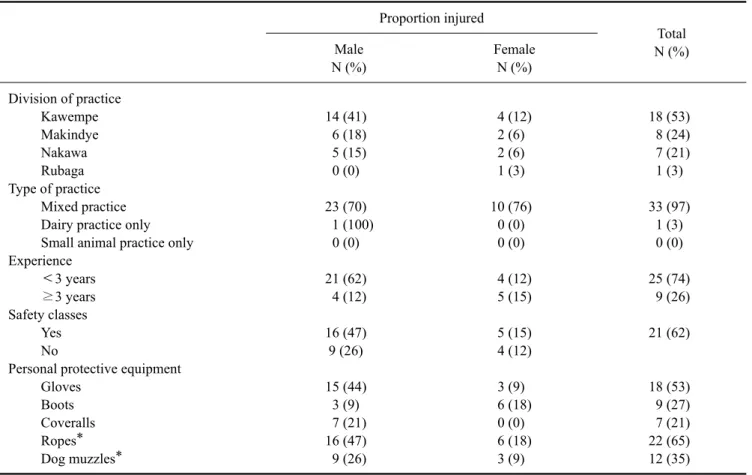
Table 1. Behavioral patterns of 34 injured veterinarians in metropolitan Kampala Proportion injured
Total N (%) Male
N (%)
Female N (%) Division of practice
Kawempe 14 (41) 4 (12) 18 (53)
Makindye 6 (18) 2 (6) 8 (24)
Nakawa 5 (15) 2 (6) 7 (21)
Rubaga 0 (0) 1 (3) 1 (3)
Type of practice
Mixed practice 23 (70) 10 (76) 33 (97)
Dairy practice only 1 (100) 0 (0) 1 (3)
Small animal practice only 0 (0) 0 (0) 0 (0)
Experience
<3 years 21 (62) 4 (12) 25 (74)
≥3 years 4 (12) 5 (15) 9 (26)
Safety classes
Yes 16 (47) 5 (15) 21 (62)
No 9 (26) 4 (12)
Personal protective equipment
Gloves 15 (44) 3 (9) 18 (53)
Boots 3 (9) 6 (18) 9 (27)
Coveralls 7 (21) 0 (0) 7 (21)
Ropes* 16 (47) 6 (18) 22 (65)
Dog muzzles* 9 (26) 3 (9) 12 (35)
N: sample population, *Restraint devices available to veterinarians.
animal. Prevalence and odds ratios were determined using descriptive statistics and 2 × 2 tables, respectively, at a significance level of α = 0.05 using the statistical analysis software (SPSS-version 13; SPSS, USA).
Telephone contact was made with only 66% (60/91) of the recruited veterinarians because the mobile cell numbers of only 60 veterinarians were active during the period of data collection (May-July, 2006). Moreover, completed questionnaires were only received from 47 veterinarians, giving a response rate of 78% (47/60) or 51.65% (47/91).
Most veterinarians (97%) were engaged in mixed animal practice, but none were involved in small animal practice alone (Table 1). It was not established whether the farms visited by the veterinarians had adequate animal restraint devices.
The prevalence of animal related injury of all causes in metropolitan Kampala was 72% (95% CI, 57∼84). Some veterinarians (34%) suffered multiple injuries with a mean and median of 2.1 and 2.0 injuries per veterinarian, respectively. Self inoculation caused 15% (7/47) and bird pecks caused 13% (6/47). Compared to dog and cattle-related injuries, injuries associated with poultry were less severe and often did not require hospital treatment (Table 2). Animal-
related injuries did not differ significantly by gender, experience or attendance of safety classes. All of the prevalence risk ratios included the null value of 1.0, and are therefore not reported here. This may be purely due to random variation associated with unmeasured confounding factors.
We speculate that the popularity and temperament of this cross breed of cattle (local Uganda cattle crossed with Friesian cattle) may have contributed considerably to the high prevalence (72%; 34/47) of cattle-associated injuries reported in this study [2,5]. Compared to cattle, cats and dogs are not as popular and they have a lower socioeconomic value for people in metropolitan Kampala, and this may explain the lower prevalence of injuries associated with cats and dogs (25%; 12/47 and 23%; 11/47 respectively).
Vaccination of chickens against infectious bursal disease
(Gumboro) and Newcastle disease was the single most
important cause of self-inoculations. There is a direct
correlation between these injury-associated activities and
the habitual responsibilities of veterinarians in metropolitan
Kampala. The inclusion of topics on animal behavior
coupled with identification and separation of dangerous
animals in safety classes may further reduce the prevalence
and severity of animal-injury among veterinarians.
Self-reported animal-related injury among veterinarians 365
Table 2. Characteristics of veterinarians in metropolitan Kampala stratified by the mechanism of injury
Cattle Dog Bird Cat Self
Total
kick bite peck scratch inoculation
N (%) N (%) N(%) N (%) N (%) N*
Veterinarian's gender
Male (n=34) 25(73) 7 (20) 0 (0) 5 (15) 5 (15) 42
Female (n=13) 9 (69) 4 (30) 6 (46) 7 (54) 2 (15) 28
Overall prevalence 34 (72) 11(23) 6 (13) 12 (25) 7 (15) 70
Veterinarian's activity at time of injury
Spraying or washing animal 7 4 0 3 0 14
Vaccination 6 1 3 1 7 18
Treatment 10 3 2 1 0 16
Physical examination 5 0 0 2 0 7
Drawing blood 3 0 0 1 0 4
Inspecting premises/passing by 3 3 1 4 0 11
Anatomical location of injury on vet
Head 1 0 0 0 0 1
Trunk 5 0 0 0 0 5
Upper limb 23 7 2 9 7 48
Lower limb 5 4 4 3 0 16
Medical help sought by injured vet
Hospital/ clinic 9 4 0 0 0 13
Self treatment 17 4 0 4 0 25
None 8 3 6 8 7 32
N: sample population, *: total number of injuries suffered.