ABSTRACT
Background and Objectives: Over the past decades, transradial approach for percutaneous coronary intervention (PCI) has been increasingly adopted in clinical practice. Women represent a large population who will possibly benefit from PCI, but they are often under- represented in clinical studies. Therefore, the role of TRI in women remains to be further defined. This study sought to compare safety and efficacy for transradial intervention (TRI) and transfemoral intervention (TFI) in women undergoing PCI in China.
Methods: The study population consisted of 5,067 women undergoing PCI at Fuwai Hospital, Beijing, China between 2006 and 2011 (TRI: n=4,105, TFI: n=962). Incidence rates of clinical outcomes during hospitalization and at 1-year follow-up were compared between TRI and TFI. In order to minimize potential biases, a 1:1 propensity score matching (PSM) was performed. A total of 899 pairs were matched.
Results: Baseline and procedural characteristics were well-balanced between TRI and TFI groups after controlling for confounders using PSM. TRI was associated with reduced major post-PCI bleeding (odds ratio [OR], 0.64; 95% confidence interval [CI], 0.54–0.76; p<0.001) and access site complications (OR, 0.67; 95% CI, 0.61–0.74; p<0.001) after PSM. There was no statistical differences in the incidence rates of major adverse cardiac events (a composite of cardiac death, myocardial infarction, and target vessel revascularization) both during hospitalization and at 1-year follow-up (p>0.05).
Conclusions: In this propensity score-based analysis of TRI versus TFI in Chinese women, TRI showed advantages of safety and feasibility over TFI. A wider adoption of TRI in women has the potential to improve outcomes in treatment of coronary artery diseases.
Keywords: Coronary artery disease; Percutaneous coronary intervention; Women;
Radial artery; Femoral artery
INTRODUCTION
Since its first introduction into clinical practice in 1993,1) transradial approach has been increasingly adopted for percutaneous coronary intervention (PCI) over the past two decades.
Comparing with traditional transfemoral intervention (TFI), transradial intervention (TRI)
Original Article
Received: Feb 1, 2018 Revised: Mar 22, 2018 Accepted: Apr 4, 2018 Correspondence to Yuejin Yang, MD, PhD
State Key Laboratory of Cardiovascular Disease, Fuwai Hospital, National Center of Cardiovascular Diseases, Chinese Academy of Medical Sciences and Peking Union Medical College, 167, Beilishi Road, Beijing 100037, China.
E-mail: [email protected]
Copyright © 2018. The Korean Society of Cardiology
This is an Open Access article distributed under the terms of the Creative Commons Attribution Non-Commercial License (https://
creativecommons.org/licenses/by-nc/4.0) which permits unrestricted noncommercial use, distribution, and reproduction in any medium, provided the original work is properly cited.
ORCID iDs Yi Xu
https://orcid.org/0000-0003-4249-0071 Chen Jin
https://orcid.org/0000-0001-5806-1613 Shubin Qiao
https://orcid.org/0000-0002-1501-0039 Yongjian Wu
https://orcid.org/0000-0001-9277-5898 Hongbing Yan
https://orcid.org/0000-0002-8203-2588 Kefei Dou
https://orcid.org/0000-0002-5539-0005 Bo Xu
https://orcid.org/0000-0003-0972-0234
Yi Xu , BM, Chen Jin , MD, MSc, Shubin Qiao , MD, PhD,
Yongjian Wu , MD, PhD, Hongbing Yan , MD, PhD, Kefei Dou , MD, PhD, Bo Xu , BS, Jingang Yang , MD, PhD, and Yuejin Yang , MD, PhD
State Key Laboratory of Cardiovascular Disease, Fuwai Hospital, National Center of Cardiovascular Diseases, Chinese Academy of Medical Sciences and Peking Union Medical College, Beijing, China
A Comparison of Transradial and
Transfemoral Percutaneous Coronary
Intervention in Chinese Women Based
on a Propensity Score Analysis
Jingang Yang
https://orcid.org/0000-0002-9619-7586 Yuejin Yang
https://orcid.org/0000-0002-1309-2667 Conflict of Interest
The authors have no financial conflicts of interest.
Author Contributions
Conceptualization: Jin C, Xu B, Yang Y;
Data curation: Yang Y; Formal analysis:
Xu Y, Jin C; Investigation: Jin C, Qiao S, Yang Y; Methodology: Xu Y, Jin C, Yang J;
Project administration: Qiao S, Xu B, Yang Y;
Resources: Qiao S, Wu Y, Yan H, Dou K, Xu B, Yang J, Yang Y; Supervision: Qiao S, Wu Y, Yan H, Dou K, Xu B, Yang Y; Validation: Wu Y, Yan H, Dou K, Xu B, Yang J, Yang Y; Visualization:
Yang Y; Writing - original draft: Xu Y, Yang Y;
Writing - review & editing: Xu Y, Yang Y.
has been shown to hold potential advantages of fewer access site-related bleeding and vascular complications and better patients' satisfaction.2-8) So far the safety and efficacy of TRI has been demonstrated in several specific patient populations, such as the elderly and the obesity.9-11)
Due to their high prevalence of coronary artery disease (CAD), women represent another large group of patients who will possibly benefit from PCI.12)13) However, they are often under- represented in clinical studies.14)15) Therefore, the role of TRI in women remains to be further defined. Using data from the Fuwai database, a single-center registry based on the largest heart center in People's Republic of China, we sought to examine the safety and efficacy of TRI in women in China.
METHODS
Study population
Our study population consisted of 5,067 women undergoing PCI at Fuwai Hospital, Beijing, China between 2006 and 2011. TRI was performed in 4,105 patients and 962 patients received TFI. Patients were prospectively followed up for around 1 year after discharge. The Institutional Review Board of Fuwai Hospital, Peking Union Medical College (approval number: 2016-847), approved the study and waived the requirement for informed consent.
Endpoint definition
The primary endpoint was major adverse cardiac events (MACEs) during hospitalization and at 1-year follow-up. It is a composite of cardiac death, myocardial infarction (MI), and target vessel revascularization (TVR). Secondary endpoints included each component of the primary endpoint, major bleeding, and access site complications.
Bleeding events were evaluated according to the Bleeding Academic Research Consortium (BARC) definition16) and major bleeding was defined as a bleeding event with BARC grade
≥3. Access site complications in our study included local hematoma that prolonged hospital stay, mediastinal hematoma, retroperitoneal hematoma, aneurysm, and arteriovenous fistula. Patients' baseline and procedural characteristics were obtained from medical record system and the catheterization laboratory's database. In-hospital outcomes were validated by medical record review. Follow-up was performed by trained staff at Fuwai Hospital via phone visits at 6 months and 1 year after discharge.
Statistical analysis
Continuous variables were expressed as mean±standard deviation and compared using Student's t-test. Categorical variables were described using frequencies and percentages and compared using chi-square test or Fisher's exact test, as appropriate. In-hospital and 1-year outcomes between TRI and TFI groups were analyzed by logistic and Cox regression respectively and were expressed as odds ratio (OR)/hazard ratio (HR) and 95% confidence interval (CI).
Since treatment decisions (TRI or TFI) in real-world practice is not made based on randomization, a 1:1 matched propensity score matching (PSM) was performed to control for potential biases. Propensity scores were calculated from a logistic regression model with access route as the dependent variable. Independent variables included age; prior history of
MI, coronary artery bypass grafting (CABG) surgery, PCI, stroke, diabetes mellitus (DM), hypertension, or hyperlipidemia; clinical diagnosis; left ventricle ejection fraction (LVEF) before PCI; hemoglobin level before PCI; creatinine concentration before PCI; use of glycoprotein (GP) IIb/IIIa inhibitors; use of low molecular weight heparin; single-, double-,or triple-vessel lesion; left main disease; lesion type (de novo, intrastent, or restenosis); lesion location (ostial or bifurcation lesion); chronic total occlusion; number of treated lesion;
number of stents used; use of drug-eluting stents (DESs). The caliper was set as 0.02. In the end 899 pairs were matched and the C-statistics for the propensity score model was 0.63.
Paired t-test for continuous variables and paired χ2 test or Fisher exact test for categorical variables were then performed within the matched patients. Data were analyzed according to intention-to-treat principle (before the potential crossover). All statistical analyses were performed using IBM SPSS Software, version 22.0 (IBM Corp., Armonk, NY, USA) and a 2-sided p<0.05 was considered significant.
RESULTS
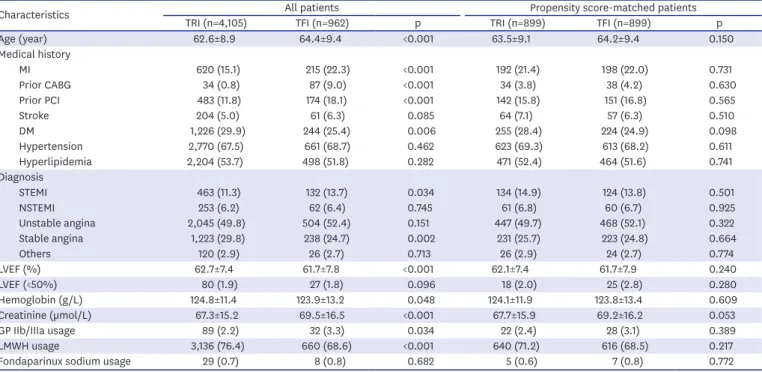
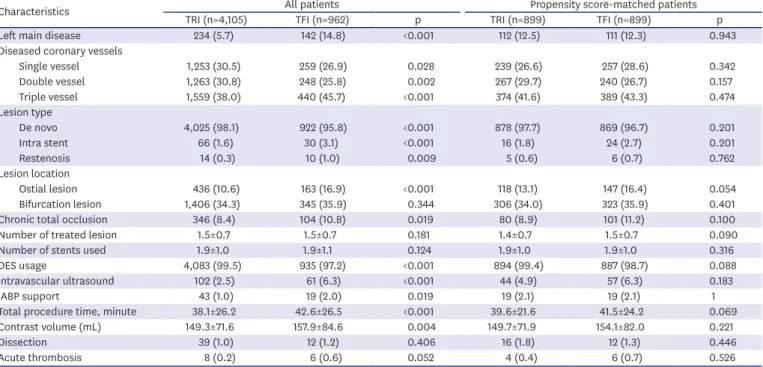
Baseline and procedural characteristics of women undergoing TRI and TFI are shown in Tables 1 and 2. Compared with TFI, TRI patients were slightly younger; had lower prevalence of prior MI, CABG, or PCI; higher prevalence of DM; less likely to present with ST-segment elevated MI; and were more likely to have stable angina. They were also more likely to undergo PCI for single or double-vessel lesions and were less likely to receive the procedure for triple-vessel lesions, left main diseases, or ostial lesions. TRI group were also noted to have a shorter average total procedure time. After PSM, all characteristics were well-balanced between TRI and TFI patients.
Table 1. Baseline characteristics of women undergoing TRI and TFI
Characteristics All patients Propensity score-matched patients
TRI (n=4,105) TFI (n=962) p TRI (n=899) TFI (n=899) p
Age (year) 62.6±8.9 64.4±9.4 <0.001 63.5±9.1 64.2±9.4 0.150
Medical history
MI 620 (15.1) 215 (22.3) <0.001 192 (21.4) 198 (22.0) 0.731
Prior CABG 34 (0.8) 87 (9.0) <0.001 34 (3.8) 38 (4.2) 0.630
Prior PCI 483 (11.8) 174 (18.1) <0.001 142 (15.8) 151 (16.8) 0.565
Stroke 204 (5.0) 61 (6.3) 0.085 64 (7.1) 57 (6.3) 0.510
DM 1,226 (29.9) 244 (25.4) 0.006 255 (28.4) 224 (24.9) 0.098
Hypertension 2,770 (67.5) 661 (68.7) 0.462 623 (69.3) 613 (68.2) 0.611
Hyperlipidemia 2,204 (53.7) 498 (51.8) 0.282 471 (52.4) 464 (51.6) 0.741
Diagnosis
STEMI 463 (11.3) 132 (13.7) 0.034 134 (14.9) 124 (13.8) 0.501
NSTEMI 253 (6.2) 62 (6.4) 0.745 61 (6.8) 60 (6.7) 0.925
Unstable angina 2,045 (49.8) 504 (52.4) 0.151 447 (49.7) 468 (52.1) 0.322
Stable angina 1,223 (29.8) 238 (24.7) 0.002 231 (25.7) 223 (24.8) 0.664
Others 120 (2.9) 26 (2.7) 0.713 26 (2.9) 24 (2.7) 0.774
LVEF (%) 62.7±7.4 61.7±7.8 <0.001 62.1±7.4 61.7±7.9 0.240
LVEF (<50%) 80 (1.9) 27 (1.8) 0.096 18 (2.0) 25 (2.8) 0.280
Hemoglobin (g/L) 124.8±11.4 123.9±13.2 0.048 124.1±11.9 123.8±13.4 0.609
Creatinine (µmol/L) 67.3±15.2 69.5±16.5 <0.001 67.7±15.9 69.2±16.2 0.053
GP IIb/IIIa usage 89 (2.2) 32 (3.3) 0.034 22 (2.4) 28 (3.1) 0.389
LMWH usage 3,136 (76.4) 660 (68.6) <0.001 640 (71.2) 616 (68.5) 0.217
Fondaparinux sodium usage 29 (0.7) 8 (0.8) 0.682 5 (0.6) 7 (0.8) 0.772
Dara shown are number (%) or mean±SD.
CABG = coronary arterial bypass grafting; DM = diabetes mellitus; GP = glycoprotein; LMWH = low molecular weight heparin; LVEF = left ventricle ejection fraction; MI = myocardial infarction; NSTEMI = non-ST-segment elevation myocardial infarction; PCI = percutaneous coronary intervention; TFI = transfemoral intervention; TRI = transradial intervention; SD = standard deviation; STEMI, ST-segment elevation myocardial infarction.
Sixty-nine patients (1.7%) had failed TRI procedure and were converted to TFI. No patients in the TFI group were crossed over to the TRI group. A vascular closure device was used in 388 (40.3%) patients in the TFI group.
Bleeding and complications from PCI are shown in Table 3. The incidence rates for BARC ≥2 (8.5% vs. 18.7%, p<0.001) and BARC ≥3 (0.9% vs. 3.2%, p<0.001) post-PCI bleeding were significantly lower in the TRI group than the TFI group. Both access-site-related (0.6% vs.
2.1%, p<0.001) and non-access-site-related (0.3% vs. 1.1%, p=0.002) major bleeding were less frequently observed among TRI patients. Moreover, TRI group had significantly fewer access site complications (8.9% vs. 19.5%, p<0.001), which was mainly due to a lower rate of local hematoma that prolonged hospitalization (8.7% vs. 18.5%, p<0.001). In propensity Table 2. Angiographic and procedural characteristics of women undergoing TRI and TFI
Characteristics All patients Propensity score-matched patients
TRI (n=4,105) TFI (n=962) p TRI (n=899) TFI (n=899) p
Left main disease 234 (5.7) 142 (14.8) <0.001 112 (12.5) 111 (12.3) 0.943
Diseased coronary vessels
Single vessel 1,253 (30.5) 259 (26.9) 0.028 239 (26.6) 257 (28.6) 0.342
Double vessel 1,263 (30.8) 248 (25.8) 0.002 267 (29.7) 240 (26.7) 0.157
Triple vessel 1,559 (38.0) 440 (45.7) <0.001 374 (41.6) 389 (43.3) 0.474
Lesion type
De novo 4,025 (98.1) 922 (95.8) <0.001 878 (97.7) 869 (96.7) 0.201
Intra stent 66 (1.6) 30 (3.1) <0.001 16 (1.8) 24 (2.7) 0.201
Restenosis 14 (0.3) 10 (1.0) 0.009 5 (0.6) 6 (0.7) 0.762
Lesion location
Ostial lesion 436 (10.6) 163 (16.9) <0.001 118 (13.1) 147 (16.4) 0.054
Bifurcation lesion 1,406 (34.3) 345 (35.9) 0.344 306 (34.0) 323 (35.9) 0.401
Chronic total occlusion 346 (8.4) 104 (10.8) 0.019 80 (8.9) 101 (11.2) 0.100
Number of treated lesion 1.5±0.7 1.5±0.7 0.181 1.4±0.7 1.5±0.7 0.090
Number of stents used 1.9±1.0 1.9±1.1 0.124 1.9±1.0 1.9±1.0 0.316
DES usage 4,083 (99.5) 935 (97.2) <0.001 894 (99.4) 887 (98.7) 0.088
Intravascular ultrasound 102 (2.5) 61 (6.3) <0.001 44 (4.9) 57 (6.3) 0.183
IABP support 43 (1.0) 19 (2.0) 0.019 19 (2.1) 19 (2.1) 1
Total procedure time, minute 38.1±26.2 42.6±26.5 <0.001 39.6±21.6 41.5±24.2 0.069
Contrast volume (mL) 149.3±71.6 157.9±84.6 0.004 149.7±71.9 154.1±82.0 0.221
Dissection 39 (1.0) 12 (1.2) 0.406 16 (1.8) 12 (1.3) 0.446
Acute thrombosis 8 (0.2) 6 (0.6) 0.052 4 (0.4) 6 (0.7) 0.526
Dara shown are number (%) or mean±SD.
DES = drug-eluting stent; IABP = intra-aortic balloon pump; TFI = transfemoral intervention; TRI = transradial intervention; SD = standard deviation.
Table 3. Bleeding and complications of women undergoing TRI and TFI
Complications All patients Propensity score-matched patients
TRI (n=4,105) TFI (n=962) p TRI (n=899) TFI (n=899) p
BARC ≥2 bleeding 350 (8.5) 180 (18.7) <0.001 76 (8.5) 168 (18.7) <0.001
BARC ≥3 bleeding 36 (0.9) 31 (3.2) <0.001 9 (1.0) 31 (3.4) <0.001
Access-site-related major bleeding 23 (0.6) 20 (2.1) <0.001 6 (0.7) 20 (2.2) 0.006
Non-access-site-related major
bleeding 13 (0.3) 11 (1.1) 0.002 3 (0.3) 11 (1.2) 0.032
Access site complications 364 (8.9) 188 (19.5) <0.001 79 (8.8) 179 (19.9) <0.001
Local hematoma 357 (8.7) 178 (18.5) <0.001 77 (8.6) 169 (18.8) <0.001
Mediastinal hematoma 1 (0) 2 (0.2) 0.094 0 2 (0.2) 0.500
Retroperitoneal hematoma 1 (0) 2 (0.2) 0.094 0 2 (0.2) 0.500
Aneurysm 4 (0.1) 3 (0.3) 0.131 1 (0.1) 3 (0.3) 0.625
Arteriovenous fistula 1 (0) 3 (0.3) 0.023 1 (0.1) 3 (0.3) 0.625
Transfusion 3 (0.1) 6 (0.6) 0.002 1 (0.1) 6 (0.7) 0.124
Dara shown are number (%).
BARC = Bleeding Academic Research Consortium; TFI = transfemoral intervention; TRI = transradial intervention.
score-matched patients, all these differences remained significant (BARC ≥2: 8.5% vs. 18.7%, p<0.001; BARC ≥3: 1.0% vs. 3.4%, p<0.001; and access site complications: 8.8% vs. 19.9%, p<0.001, respectively) (Figure 1).
In-hospital outcomes are shown in Table 4. The rates of MACE, MI, and TVR were similar in the 2 groups both before and after PSM. Cardiac death was less frequently observed among TRI patients (0.1% vs. 0.5%, p=0.016) but this did not remain significant in propensity score- matched patients. Logistic regression analysis showed that TRI was an independent predictor of reduced in-hospital major bleeding (OR, 0.64; 95% CI, 0.54–0.76; p<0.001) and access site complications (OR, 0.67; 95% CI, 0.61–0.74; p<0.001).
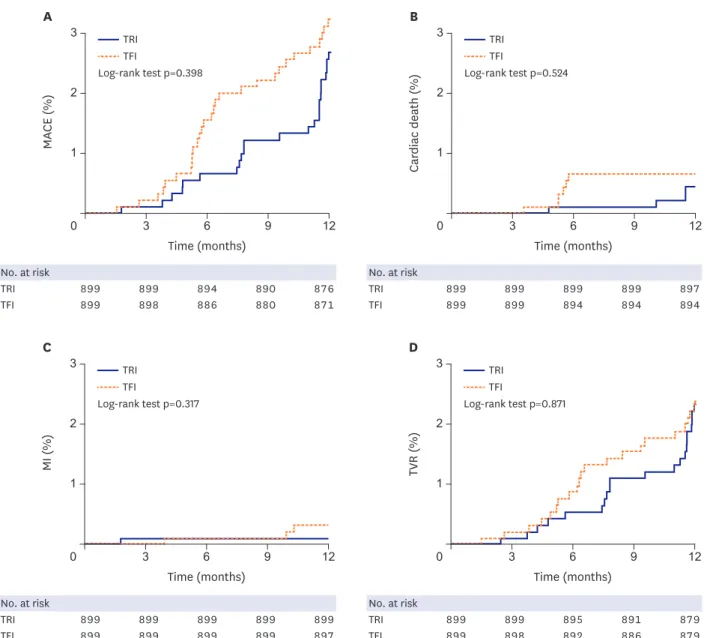
Follow-up work was completed in all patients with a median follow-up time of 361 days (interquartile range [IQR], 354–366 days) and 360 days (IQR, 354–366 days) in TRI and TFI groups respectively. The Kaplan-Meier curves for 1-year outcomes in propensity score-matched patients are shown in Figure 2. Incidence rates of 1-year MACE and its components tended to be lower in TRI group, but this did not reach statistical significance (p>0.05; Table 4).
BARC ≥2
bleeding BARC ≥3
bleeding Access site complications 0
Incidence rates (%)
20
15
10
5
p<0.001
p<0.001
p<0.001 TFI TRI
Figure 1. Comparison of bleeding and access site complication between TRI and TFI groups in propensity score- matched patients.
BARC = Bleeding Academic Research Consortium; TFI = transfemoral intervention; TRI = transradial intervention.
Table 4. In-hospital and 1-year outcomes of women undergoing TRI and TFI
Outcomes All patients Propensity score-matched patients
TRI (n=4,105) TFI (n=962) OR/HR (95% CI) p TRI (n=899) TFI (n=899) OR/HR (95% CI) p In-hospital outcomes
MACE 65 (1.6) 21 (2.2) 0.77 (0.53–1.13) 0.195 15 (1.7) 20 (2.2) 0.87 (0.65–1.17) 0.393
Cardiac death 4 (0.1) 5 (0.5) 0.34 (0.19–0.61) 0.016 2 (0.2) 5 (0.6) 0.70 (0.44–1.12) 0.452
MI 61 (1.5) 17 (1.8) 0.87 (0.57–1.33) 0.524 13 (1.4) 16 (1.8) 0.91 (0.65–1.26) 0.574
TVR 4 (0.1) 2 (0.2) 0.57 (0.18–1.77) 0.320 1 (0.1) 2 (0.2) 0.75 (0.34–1.67) 1
Major bleeding 36 (0.9) 31 (3.2) 0.40 (0.31–0.52) <0.001 9 (1.0) 31 (3.5) 0.64 (0.54–0.76) <0.001 Access site complications 364 (8.9) 188 (19.5) 0.50 (0.44–0.58) <0.001 79 (8.8) 179 (19.9) 0.67 (0.61–0.74) <0.001 One-year outcomes
MACE 100 (2.4) 32 (3.3) 0.78 (0.57–1.06) 0.119 24 (2.7) 30 (3.3) 0.90 (0.70–1.14) 0.407
Cardiac death 13 (0.3) 6 (0.6) 0.60 (0.31–1.17) 0.234 4 (0.4) 6 (0.7) 0.83 (0.50–1.38) 0.526
MI 7 (0.2) 3 (0.3) 0.63 (0.25–1.63) 0.413 1 (0.1) 3 (0.3) 0.67 (0.38–1.18) 0.317
TVR 84 (2.0) 24 (2.5) 0.85 (0.60–1.22) 0.386 21 (2.3) 22 (2.4) 0.98 (0.73–1.31) 0.877
Data shown are number (%) not otherwise specified.
CI = confidence interval; HR = hazard ratio; MACE = major adverse cardiac event; MI = myocardial infarction; OR = odds ratio; TFI = transfemoral intervention;
TRI = transradial intervention; TVR = target vessel revascularization.
DISCUSSION
The present study represents a large cohort of women undergoing PCI in real world clinical practice. We found that TRI was associated with significantly reduced in-hospital major bleeding and access site complications. Although TRI was more likely to be performed in patients with lower risk, such significance persisted after controlling for potential biases using PSM. Our findings demonstrate the safety and efficacy of TRI in women and add evidence to promote more widespread adoption of TRI in female patients.
Transradial approach has become the primary approach for PCI in China.17) Due to
advantages in safety, efficacy, and patients' satisfaction, it has been widely adopted in clinical practice.2-8) However, most of the evidences came from studies conducted in both genders, in No. at risk
TRI 899 899 894 890 876
TFI 899 898 886 880 871
No. at risk
TRI 899 899 899 899 899
TFI 899 899 899 899 897
No. at risk
TRI 899 899 899 899 897
TFI 899 899 894 894 894
No. at risk
TRI 899 899 895 891 879
TFI 899 898 892 886 879
Time (months) A
0 3 6 9 12
MACE (%)
3
2
1
Time (months)
0 3 6 9 12
B
Cardiac death (%)
3
1 2 TRI
TFI
Log-rank test p=0.398
TRI TFI
Log-rank test p=0.524
Time (months) C
0 3 6 9 12
MI (%)
3
2
1
Time (months)
0 3 6 9 12
D
TVR (%)
3
1 2 TRI
TFI
Log-rank test p=0.317
TRI TFI
Log-rank test p=0.871
Figure 2. Kaplan-Meier curves for occurrence of MACE (A), cardiac death (B), MI (C), and TVR (D) between TRI and TFI groups of 1-year follow-up in propensity score-matched patients.
MACE = major adverse cardiac event; MI = myocardial infarction; TFI = transfemoral intervention; TRI = transradial intervention; TVR = target vessel revascularization.
which women are often under-represented.14)15) As for women themselves, they are at higher risk of adverse events after CADs and PCI.13) Performing TRI in women is considered more technically demanding because of smaller caliber radial arteries than men and increased rate of vasospasms, which could lead to procedure failure and worse outcomes.18) Thus, it is reasonable to believe that women may respond to treatment strategies differently than men, and the safety and efficacy of TRI in women should be evaluated separately. However, only a few studies have compared TRI with TFI in female patients so far.18-21)
Bleeding has been recognized as a strong predictor of worst outcomes after PCI.22) Several bleeding avoidance strategies have been suggested to improve safety of the procedure, including pharmacological, technological, and procedural approaches.23) As one of the major procedural approaches, TRI has been shown to reduce bleeding by both randomized3)5)6) and observational8)19)24)25) studies. Since radial arteries are superficial and readily compressible, TRI is also believed to reduce bleeding in women.26) The Radial Vs femorAL access for coronary intervention (RIVAL) trial is the largest randomized TRI versus TFI study up to date.3) Results of its subgroup analysis of women demonstrated that radial access was effective in reducing bleeding complications.18 The Study of Access Site for Enhancement of PCI (SAFE-PCI) for Women trial21) represents the first randomized trial of TRI versus TFI performed solely in women. Although the trial was terminated early due to lower than expected rates of endpoint events, there was still a trend of fewer bleeding in women undergoing TRI. Other observational retrospective analyses also came up with similar results, suggesting that women undergoing TRI was less likely to suffer from major BARC bleeding events.19)20) Consistent with previous studies, we found that TRI was associated with reduced major post-PCI bleeding (OR, 0.64; 95% CI, 0.54–0.76; p<0.001). Our findings support the safety of TRI and suggest that its wider adoption could lead to improved outcomes in women.
Lower risk of access site complications is considered another major benefit of TRI.4) However, as stated above, most of the studies supporting this idea were conducted in whole populations, a large proportion of which were men. Previous analyses have shown that the rates of access site vascular complications were higher in women than in men.3)18) Randomized studies, including the SAFE-PCI trial and gender-specific sub-analysis of the RIVAL trial, suggested that safety of catheterization was improved by transradial approach in women, with significantly fewer access site vascular complications.18)21) As for observational data, the retrospective study by Kedev et al.20) also reported that TRI was associated with less vascular complications than traditional TFI. Our study demonstrated that TRI group had significantly fewer access site complications both before and after PSM adjustments (all patients: 8.9% vs. 19.5%, p<0.001; propensity score-matched patients: 8.8% vs. 19.9%, p<0.001). Transradial approach was also identified as an independent predictor of reduced access site complications (OR, 0.67; 95% CI, 0.61–0.74; p<0.001). Thus, TRI seems to be effective in reducing access site complications in women.
Several limitations of this study should also be acknowledged. First of all, it was a retrospective observational analysis, which was limited by its nonrandomized nature.
Although a 1:1 matched PSM was performed to control for potential biases, this was still not an acceptable substitute for randomization. Second, since our study was based on retrospective data, it is possible that the incidence rates of events were underestimated. This could explain the low rate of MACE in our study. Third, the potential advantages of TRI in women are likely to depend on operator's experience.27) Researchers from both the RIVAL
trial and SAFE-PCI trial have suggested that TRI was shown to be superior to TFI only if performed by experienced operators and therefore its advantages might not be applicable to those who are novice in transradial approach.3)18)21) Moreover, our study only include data from a single center where TRI dominates. Importantly, operators' experience and training with transradial approach may differ from site to site. Thus, the generalizability of our findings to other less-experienced centers remains to be further defined.
In conclusion, in this large propensity score-based single center comparison of TRI versus TFI in women, TRI showed advantages of safety and feasibility over TFI, with significant reduction in major post-PCI bleeding and access site complications. A widespread adoption of TRI in women has the potential to improve outcomes in treatment of CADs.
REFERENCES
1. Kiemeneij F, Jan Laarman G. Percutaneous transradial artery approach for coronary stent implantation.
Cathet Cardiovasc Diagn 1993;30:173-8.
PUBMED | CROSSREF
2. Jolly SS, Amlani S, Hamon M, Yusuf S, Mehta SR. Radial versus femoral access for coronary angiography or intervention and the impact on major bleeding and ischemic events: a systematic review and meta- analysis of randomized trials. Am Heart J 2009;157:132-40.
PUBMED | CROSSREF
3. Jolly SS, Yusuf S, Cairns J, et al. Radial versus femoral access for coronary angiography and intervention in patients with acute coronary syndromes (RIVAL): a randomised, parallel group, multicentre trial. Lancet 2011;377:1409-20.
PUBMED | CROSSREF
4. Bertrand OF, Bélisle P, Joyal D, et al. Comparison of transradial and femoral approaches for percutaneous coronary interventions: a systematic review and hierarchical Bayesian meta-analysis. Am Heart J 2012;163:632-48.
PUBMED | CROSSREF
5. Valgimigli M, Gagnor A, Calabró P, et al. Radial versus femoral access in patients with acute coronary syndromes undergoing invasive management: a randomised multicentre trial. Lancet 2015;385:2465-76.
PUBMED | CROSSREF
6. Romagnoli E, Biondi-Zoccai G, Sciahbasi A, et al. Radial versus femoral randomized investigation in ST-segment elevation acute coronary syndrome: the RIFLE-STEACS (Radial Versus Femoral Randomized Investigation in ST-Elevation Acute Coronary Syndrome) study. J Am Coll Cardiol 2012;60:2481-9.
PUBMED | CROSSREF
7. Cooper CJ, El-Shiekh RA, Cohen DJ, et al. Effect of transradial access on quality of life and cost of cardiac catheterization: a randomized comparison. Am Heart J 1999;138:430-6.
PUBMED | CROSSREF
8. Yang YJ, Kandzari DE, Gao Z, et al. Transradial versus transfemoral method of percutaneous coronary revascularization for unprotected left main coronary artery disease: comparison of procedural and late- term outcomes. JACC Cardiovasc Interv 2010;3:1035-42.
PUBMED | CROSSREF
9. Lee HW, Cha KS, Ahn J, et al. Comparison of transradial and transfemoral coronary intervention in octogenarians with acute myocardial infarction. Int J Cardiol 2016;202:419-24.
PUBMED | CROSSREF
10. Jin C, Xu Y, Qiao SB, et al. Transradial versus transfemoral approach for percutaneous coronary intervention in elderly patients in China: a retrospective analysis. Chin Med Sci J 2017;32:161-70.
PUBMED
11. Hibbert B, Simard T, Wilson KR, et al. Transradial versus transfemoral artery approach for coronary angiography and percutaneous coronary intervention in the extremely obese. JACC Cardiovasc Interv 2012;5:819-26.
PUBMED | CROSSREF
12. Hochman JS, Tamis JE, Thompson TD, et al. Sex, clinical presentation, and outcome in patients with acute coronary syndromes. N Engl J Med 1999;341:226-32.
PUBMED | CROSSREF
13. Lansky AJ, Hochman JS, Ward PA, et al. Percutaneous coronary intervention and adjunctive pharmacotherapy in women: a statement for healthcare professionals from the American Heart Association. Circulation 2005;111:940-53.
PUBMED | CROSSREF
14. Mazure CM, Jones DP. Twenty years and still counting: including women as participants and studying sex and gender in biomedical research. BMC Womens Health 2015;15:94.
PUBMED | CROSSREF
15. Bucholz EM, Krumholz HM. Women in clinical research: what we need for progress. Circ Cardiovasc Qual Outcomes 2015;8:S1-3.
PUBMED | CROSSREF
16. Mehran R, Rao SV, Bhatt DL, et al. Standardized bleeding definitions for cardiovascular clinical trials a consensus report from the bleeding academic research consortium. Circulation 2011;123:2736-47.
PUBMED | CROSSREF
17. Wang L, Yang Y, Zhou Y, Xu B, Zhao L. Prevalence of transradial coronary angiography and intervention in China: report from the Transradial coronary intervention Registration Investigation in China (TRI- China). Int J Cardiol 2010;145:246-7.
PUBMED | CROSSREF
18. Pandie S, Mehta SR, Cantor WJ, et al. Radial versus femoral access for coronary angiography/intervention in women with acute coronary syndromes: insights from the rival trial (radial vs femoral access for coronary intervention). JACC Cardiovasc Interv 2015;8:505-12.
PUBMED | CROSSREF
19. Jin C, Xu Y, Qiao S, et al. Comparison of transradial and transfemoral approaches in women undergoing percutaneous coronary intervention in China: a retrospective observational study. Angiology 2017;68:799-806.
PUBMED | CROSSREF
20. Kedev S, Sukmawan R, Kalpak O, et al. Transradial versus transfemoral access for female patients who underwent primary PCI in STEMI: two years follow-up data from acute STEMI interventional registry. Int J Cardiol 2016;217:S16-20.
PUBMED | CROSSREF
21. Rao SV, Hess CN, Barham B, et al. A registry-based randomized trial comparing radial and femoral approaches in women undergoing percutaneous coronary intervention: the SAFE-PCI for Women (Study of Access Site for Enhancement of PCI for Women) trial. JACC Cardiovasc Interv 2014;7:857-67.
PUBMED | CROSSREF
22. Doyle BJ, Rihal CS, Gastineau DA, Holmes DR. Bleeding, blood transfusion, and increased mortality after percutaneous coronary intervention: implications for contemporary practice. J Am Coll Cardiol 2009;53:2019-27.
PUBMED | CROSSREF
23. Dauerman HL, Rao SV, Resnic FS, Applegate RJ. Bleeding avoidance strategies: consensus and controversy. J Am Coll Cardiol 2011;58:1-10.
PUBMED | CROSSREF
24. Feldman DN, Swaminathan RV, Kaltenbach LA, et al. Adoption of radial access and comparison of outcomes to femoral access in percutaneous coronary intervention an updated report from the National Cardiovascular Data Registry (2007–2012). Circulation 2013;127:2295-306.
PUBMED | CROSSREF
25. Jin C, Li W, Qiao SB, et al. Costs and benefits associated with transradial versus transfemoral percutaneous coronary intervention in China. J Am Heart Assoc 2016;5:e002684.
PUBMED
26. Kiemeneij F, Laarman GJ, Odekerken D, Slagboom T, van der Wieken R. A randomized comparison of percutaneous transluminal coronary angioplasty by the radial, brachial and femoral approaches: the access study. J Am Coll Cardiol 1997;29:1269-75.
PUBMED | CROSSREF
27. Ball WT, Sharieff W, Jolly SS, et al. Characterization of operator learning curve for transradial coronary interventions. Circ Cardiovasc Interv 2011;4:336-41.
PUBMED | CROSSREF