This is an Open Access article distributed under the terms of the Creative Commons Attribution Non-Commercial License (http: //creativecommons.org/licenses/by- nc/4.0/) which permits unrestricted non-commercial use, distribution, and reproduction in any medium, provided the original work is properly cited.
Copyright: © 2020 Korean Journal of Agrcultural Science
ANIMAL
Effect of Lactobacillus acidophilus based probiotic product supplementation on the blood profile, fecal noxious gas emission, and fecal shedding of lactic acid bacteria and coliform bacteria in healthy adult Beagle dogs
Hao Yang Sun
1,2, In Ho Kim
1,*1
Department of Animal Resource and Science, Dankook University, Cheonan 31116, Korea
2
Institute of Animal Nutrition, Northeast Agricultural University, Harbin 150030, PR China
*
Corresponding author: [email protected]
Abstract
The aim of this study was to evaluate the effect of Lactobacillus acidophilus probiotic (LAP) product supplementation on the blood profile, fecal noxious gas emission, and fecal shedding of lactic acid bacteria and coliform bacteria in healthy adult Beagle dogs. In total, 14 Beagle dogs with an average initial body weight of 10.19 ± 0.61 kg were randomly assigned into two dietary treatments,with and without LAP supplementation, for a 28-day feeding trial. At the end of the experiment, there was no significant (p > 0.05) difference in the concentration of serum total cholesterol, high-density lipoprotein cholesterol (HDL-C), low- density lipoprotein cholesterol (LDL-C), white blood cell (WBC), red blood cell (RBC), blood lymphocyte percentage, fecal hydrogen sulfide (H
2S) and total mercaptans (R.SH) emission, and fecal coliforms counts. However, the serum concentrations of the triglyceride and fecal ammonia (NH
3) emission of the LAP treatment were significantly (p < 0.05) decreased in the group compared with the CON dogs. Fecal total lactic acid bacteria counts were significantly (p < 0.05) increased in the LAP treatment. In conclusion, the supplementation of LAP in Beagle dog diets could decrease the blood triglyceride level and enhance the gut Lactobacillus count which may have positive effects on dogs.
Keywords: adult Beagle dogs, blood profile, fecal bacteria shedding, fecal noxious gas emission, Lactobacillus acidophilus probiotic
Introduction
Probiotics have been widely researched as one of the alternatives to antimicrobial growth promoter following the ban of antibiotics usage as growth promoters in animal feeds throughout Europe in 2006 (Liu et al., 2018a). Probiotics are defined as living microorganisms, which confer beneficial health effect on the host animal by improving the balance of the intestinal microbiota (Lan et al., 2016). Lactobacillus is lactic acid-producing bacteria and Gram-positive microbiota which OPEN ACCESS
Accepted: July 03, 2020 Revised: June 22, 2020 Received: May 20, 2020
Citation: Sun HY, Kim IH. 2020. Effect of Lactobacillus acidophilus based probiotic product supplementation on the blood profile, fecal noxious gas emission, and fecal shedding of lactic acid bacteria and coliform bacteria in healthy adult Beagle dogs. Korean Journal of Agricultural Science 47:437-443.
https://doi.org/10.7744/kjoas.20200033
extensively existed in the gastrointestinal tract of most animals (Fuller et al., 1978). It is the most commonly utilized genus as a probiotic because of its various beneficial properties (McCoy and Gilliland, 2007). Its potential health and nutritional benefits for humans and animals include but not limited to improve nutritional value of food, control of some types of cancer, serum cholesterol levels, and intestinal infection, and maintain the gastrointestinal microbiota structure (Uyeno et al., 2015;
Strompfová et al., 2017).
The species of Lactobacillus acidophilus (L. acidophilus) was first isolated by Moro in 1900 from infant feces and is characterized as homofermentative and microaerophilic (Gonzalez et al., 1989). It was reported that L. acidophilus species remains to be the most widely recognized and commercially distributed probiotic culture (Altermann et al., 2005). Previous studies reported that L. acidophilus as being probiotic that have positive effects in farm animals (Hossain et al., 2015;
Qiao et al., 2015; Lan et al., 2017a). However, researches on the effects of probiotic L. acidophilus in dog feed are still limited. Therefore, the objective of this experiment was to investigate the effects of L. acidophilus probiotic (LAP) on blood parameters, fecal shedding of lactic acid bacteria and coliform bacteria, and fecal noxious gas emission in adult Beagle dogs.
Materials and Methods
The experimental protocol used in this study was approved by the local animal care and use committee (case no. DK-1- 1824), the feeding trials were carried out in Cheonan-si, Chungnam, South Korea.
Experimental design, animals, and diets
A total of 14 Beagle dogs with an initial body weight (BW) of 10.19 ± 0.61 kg were used in a 4-week feeding trail. Dogs based on BW were randomly assigned to two dietary treatments with 7 replications per treatment and one dog per cage.
The dietary treatments containing commercial basal diet (CON) and LAP diet (CON + 10 mL of L. acidophilus probiotics).
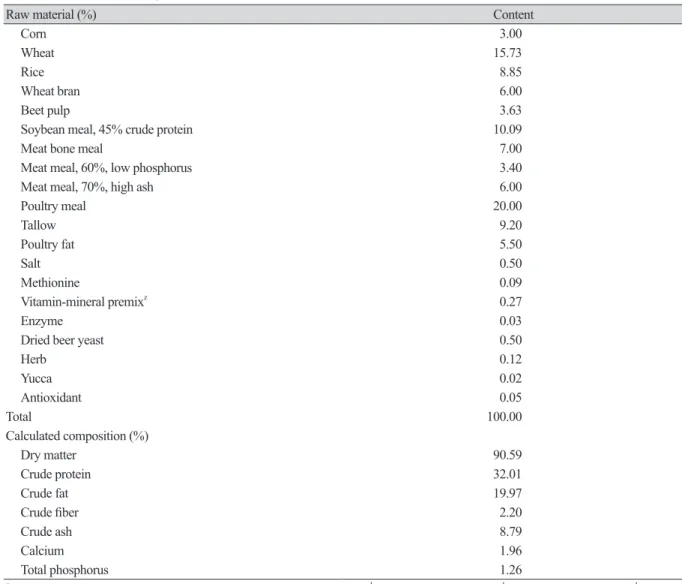
Commercial basal diet was formulated in accordance with the Association of American Feed Control Officials (AAFCO, 2009) nutrient guide for dogs and balanced to meet maintenance requirements. The nutrient values of basal diet are shown in Table 1. Dogs were individually fed twice a day (0800 h and 1600 h) in sufficient amount to supply their metabolizable energy (ME) requirements, according to the National Research Council (NRC, 2006). Beagles were housed in cages (100 cm × 210 cm) that were equipped with a feeder, a water bucket, and slatted plastic flooring in an environmentally controlled room. Dogs were allowed ad libitum access to drinking water throughout the experiment. Room temperature and relative humidity were maintained at 20 ± 3℃ and 50 ± 10%, respectively.
Product information
In the present study, we used L. acidophilus fermentation product derived from L. acidophilus in an anaerobic fermentation
technology platform to produce beneficial microbial metabolites. L. acidophilus fermentation product was kindly provided
by a commercial company (B&B Korea CO., LTD., Pyeongtaek, Korea). It was guaranteed to contain at least 3.0 × 10
8cfu·mL
-1of L. acidophilus.
Sampling and measurements
Fecal samples and blood samples were collected at the end of week 4. Blood samples were taken from each dog into vacuum tubes and K
3EDTA tubes (Becton Dickinson Vacutainer Systems, Franklin Lakes, NJ, USA) to obtain serum and whole blood, respectively. White blood cells (WBC), red blood cells (RBC), and lymphocyte counts of whole blood samples were determined using an automatic blood analyzer (ADVIA 120, Bayer, Tarrytown, NY, USA). Serum was separated by centrifugation for 30 min at 2000 g at 4℃ and stored until further analysis. Serum lipid profiles, including total cholesterol, high-density lipoprotein cholesterol (HDL-C), low-density lipoprotein cholesterol (LDL-C), and triglyceride were analyzed by using an automatic biochemistry analyzer (Hitachi 747; Hitachi Ltd., Tokyo, Japan) with commercial kits (Sigma Diagnostics, MO, USA) according to the manufacturer �s protocol.
Table 1. Basal diet composition (as-fed basis).
Raw material (%) Content
Corn 3.00
Wheat 15.73
Rice 8.85
Wheat bran 6.00
Beet pulp 3.63
Soybean meal, 45% crude protein 10.09
Meat bone meal 7.00
Meat meal, 60%, low phosphorus 3.40
Meat meal, 70%, high ash 6.00
Poultry meal 20.00
Tallow 9.20
Poultry fat 5.50
Salt 0.50
Methionine 0.09
Vitamin-mineral premix
z0.27
Enzyme 0.03
Dried beer yeast 0.50
Herb 0.12
Yucca 0.02
Antioxidant 0.05
Total 100.00
Calculated composition (%)
Dry matter 90.59
Crude protein 32.01
Crude fat 19.97
Crude fiber 2.20
Crude ash 8.79
Calcium 1.96
Total phosphorus 1.26
z