1
PCR
다형성에 의한 양송이(Agaricus bisporus) 계통의 유전적 다양성 분석
민경진1,2·김종군2·곽아민1·공원식3·오연희3·강희완1,2*
1한경대학교 미래융합기술대학원, 2(주)제이케이바이오테크, 3농촌진흥청 국립특작과학원 버섯과
Genetic Diversity of Agaricus bisporus Strains by PCR Polymorphism
Kyong-Jin Min1,2, Jong-Kun Kim2, A-Min Kwak1, Won-Sik Kong3, Youn-Hee Oh3 and Hee-Wan Kang1,2*
1Graduate School of Future Convergence Technology, Hankyong National University, Ansung 456-749, Korea
2JK BioTech. Co. Ltd., Ansung 456-749, Korea
3Mushroom Science Division, National Institute of Horticultural and Herbal Science, RDA, Eumseong 369-873, Korea
ABSTRACT : Twelve Universal fungal PCR fingerprint (UFPF) primers that were modified from Universal rice primer (URP) were used to assess genetic diversity of 64 Agaricus strains including 45 A. bisporus strains and other 19 strains of other Agaricus spp.
Eight primers, UFPF1, UFPF2, UFPF3, UFPF7, UFPF9, UFPF10, UFPF11, and UFPF12 produced PCR polymorphic bands within and between the Agaricus species. Primer UFPF7 produced specific PCR polymorphic bands that are distinct Korean strain from different strains. Ninety five PCR polymorphic bands were inputted for UPGMA cluster analysis. Forty five strains of A. bisporus are genetically clustered into 8 groups, showing coefficient similarity from 0.75 to 0.9 among them. The varieties, Saea, Saedo, Saejeong and Saeyeon that have recently been developed in Korea were involved in the same group with close genetic relationship of coefficient similarity over 0.96, whereas, other Korean strains were genetically related to A. bisporus strains that were introduced from USA, Eroupe and Chinese.
KEYWORDS : Agaricus bisporus strains, Genetic diversity, PCR polymorphism
서 론
양송이(Agaricus bisporus)은 세계적으로 가장 많이 재배 되는 식용버섯 중 하나이며 분류학상 Basidiomycota문, Agaricales목, Agaricaceae과, Agaricus속에 속하며 식용버 섯과 독버섯을 포함하여 300여종이 분포한다[1]. Agari-
cus속에서 가장 중요한 종은 흰색 양송이로 세계적으로 가 장 많이 재배되고 있으며 전 세계적으로 생산량이 약 40억 톤에 이르며 47억달러의 경제적 가치가 있는 것으로 알려 져 있다[2]. 양송이버섯은 1개의 담자기에 1~7개의 담자 포자가 착생되고 그 수에 따라 핵의 이동으로 인한 특성도 달라지며 각 담자기에는 2핵포자가 95%이상 형성되는 유 전양식을 가지고 있다. 따라서 5% 내외의 단핵포자형성은 반수체(Haploid)교배에 의한 품종육성을 위한 육종프로그 램에 걸림돌이 되고 있다[2]. 1981년에 최초로 양송이 교잡 품종 Horst U1이 개발된 이후 동 품종에서 조직분리에 의 한 품종육성이 성행하여 재배품종간 유전적 다양성이 느타 리버섯 등에 비하여 월등히 떨어진다[3]. 우리나라에서 재 배되고 있는 양송이 계통은 미국, 유럽 등 여러 국가에서 상당부분의 종균이 수입되어 국내농가에서 재배하고 있는 실정이다. 최근 국내에서 반수체 포자교배에 의한 양송이 품종이 개발되어 농가에 보급되기 시작하고 있으며 국내 품종 점유율이 4%에서 27%까지 국내 양송이 품종으로 대 체되어 국내고유 양송이품종의 자급화에 박차를 가하고 있
*Corresponding author E-mail: [email protected] Received March 4, 2014 Revised March 8, 2014 Accepted March 15, 2014
This is an Open Access article distributed under the terms of the Creative Commons Attribution Non-Commercial License (http://
creativecommons.org/licenses/by-nc/3.0/) which permits unrestricted non-commercial use, distribution, and reproduction in any medium, provided the original work is properly cited.
Kor. J. Mycol. 2014 March, 42(1): 1-8 http://dx.doi.org/10.4489/KJM.2014.42.1.1 pISSN 0253-651X
© The Korean Society of Mycology
다[4].
버섯품종계통 간의 유전적 유연관계와 품종 특이적인 DNA마커는 버섯유전자원을 표지검정할 수 있기 때문에 육 종 효율을 증진시킬 수 있다[2]. 최근 국제식물신품종보호 동맹(UPOV)이 발동되어 품종의 지적 재산권 권리 수호를 위한 로열티 요구 등 제재가 예상되고 있어 국내 등록품종 의 유전적 특성을 조사하여 이를 바탕으로 우리 고유 품종 의 특성을 보호하고 품종 육성을 위한 기초자료로 이용하 기 위하여 정확한 품종구분법이 요구되고 있다. 양송이버 섯계통 또는 품종의 유전적 다양성을 구분하기 위하여 inter-single sequence repeat (ISSR), simple sequence repeat (SSR), sequence-related amplified polymorphism (SRAP), random amplified polymorphic DNA (RAPD), sequence characterized amplified regions (SCAR) 등 다양한 PCR기 법이 적용되어 왔다[1,2,5-9]. 야생종과 재배종 간의 유전 적 다양성을 검출에는 위의 DNA마커가 유용하나 재배 품 종간의 유전적 특성을 검출에는 한계가 있다.
Universal rice primer (URP) primer는 벼의 반복배열 염 기서열로부터 고안되었으며 동물, 식물, 미생물 등 다양한 생물 종에 적용할 수 있는 다범위 primer의 특징을 가지고 있다[10]. URP primer의 특징은 20 mer로 구성되어 PCR 반응시 ISSR과 같이 55oC 이상에서 annealing을 할 수 있
어 RAPD분석에 비교적 재현성이 높으며 종 또는 종내 특 이 PCR 다형성 검출할 수 있다[10]. URP primer는 국내 외의 많은 연구에서 효모에서 담자균에 이르기까지 33속, 142종, 1,489의 다양한 진핵균류에 적용되어 그 유용성이 평가되어 왔다[12]. URP-PCR은 국내 느타리버섯, 동충하 초, Phellinus spp.을 비롯한 다양한 버섯류의 종내 계통 또 는 품종의 유전적 특징을 구분에 매우 유용한 것으로 보고 된 바 있다[11,12]. 최근에는 다양한 균류에 적용할 수 있는 universal fungal PCR fingerprint(UFPF) primer가 URP primer를 보완하였다(www.JKbiotech.co.kr).
본 연구는 국내외에서 수집한 A. bisporus 계통 45균주와
Agaricus속 균 19균주를 포함한 총 64균주를 대상으로 UFPF
primer로 PCR다형성 분석을 실시하였으며 계통간 유전적 다양성검출 DNA마커를 개발하여 양송이 육종효율증진을 위한 기초자료를 제공하고자 한다.
재료 및 방법
공시품종 및 배양
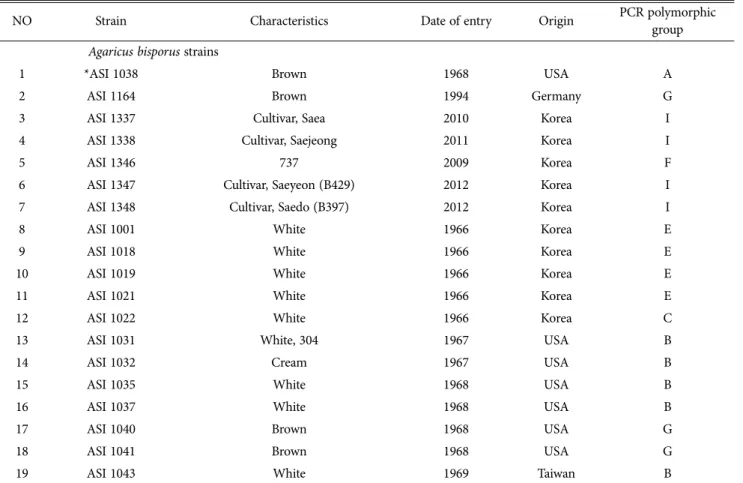
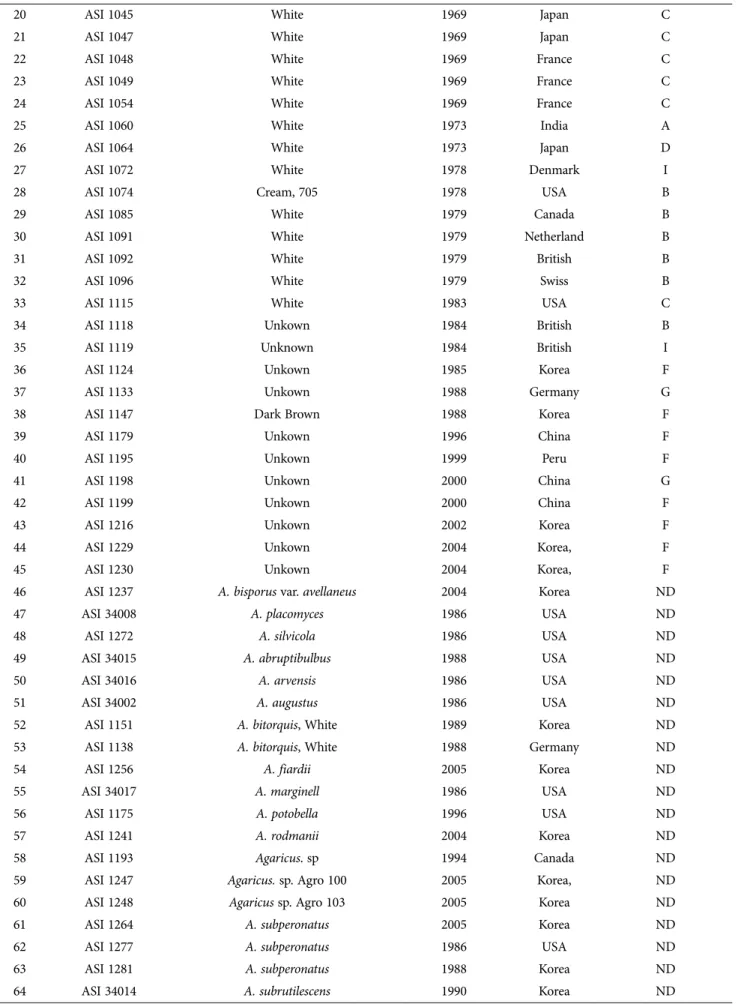
본 시험에 사용된 양송이 균주는 Table 1과 같이 국내외 에서 수집한 A. bisporus 계통 45균주와 Agaricus속의 A.
abruptibulbus, A. arvensis, A. augustus, A. bisporus var.
Table 1. List of Agaricus strains used in this study and their PCR polymorphic groups
NO Strain Characteristics Date of entry Origin PCR polymorphic
group Agaricus bisporus strains
1 *ASI 1038 Brown 1968 USA A
2 ASI 1164 Brown 1994 Germany G
3 ASI 1337 Cultivar, Saea 2010 Korea I
4 ASI 1338 Cultivar, Saejeong 2011 Korea I
5 ASI 1346 737 2009 Korea F
6 ASI 1347 Cultivar, Saeyeon (B429) 2012 Korea I
7 ASI 1348 Cultivar, Saedo (B397) 2012 Korea I
8 ASI 1001 White 1966 Korea E
9 ASI 1018 White 1966 Korea E
10 ASI 1019 White 1966 Korea E
11 ASI 1021 White 1966 Korea E
12 ASI 1022 White 1966 Korea C
13 ASI 1031 White, 304 1967 USA B
14 ASI 1032 Cream 1967 USA B
15 ASI 1035 White 1968 USA B
16 ASI 1037 White 1968 USA B
17 ASI 1040 Brown 1968 USA G
18 ASI 1041 Brown 1968 USA G
19 ASI 1043 White 1969 Taiwan B
*ASI: Agricultural Science Institute. Acronym for mushroom strains used in Mushroom Science Div. in RDA.
20 ASI 1045 White 1969 Japan C
21 ASI 1047 White 1969 Japan C
22 ASI 1048 White 1969 France C
23 ASI 1049 White 1969 France C
24 ASI 1054 White 1969 France C
25 ASI 1060 White 1973 India A
26 ASI 1064 White 1973 Japan D
27 ASI 1072 White 1978 Denmark I
28 ASI 1074 Cream, 705 1978 USA B
29 ASI 1085 White 1979 Canada B
30 ASI 1091 White 1979 Netherland B
31 ASI 1092 White 1979 British B
32 ASI 1096 White 1979 Swiss B
33 ASI 1115 White 1983 USA C
34 ASI 1118 Unkown 1984 British B
35 ASI 1119 Unknown 1984 British I
36 ASI 1124 Unkown 1985 Korea F
37 ASI 1133 Unkown 1988 Germany G
38 ASI 1147 Dark Brown 1988 Korea F
39 ASI 1179 Unkown 1996 China F
40 ASI 1195 Unkown 1999 Peru F
41 ASI 1198 Unkown 2000 China G
42 ASI 1199 Unkown 2000 China F
43 ASI 1216 Unkown 2002 Korea F
44 ASI 1229 Unkown 2004 Korea, F
45 ASI 1230 Unkown 2004 Korea, F
46 ASI 1237 A. bisporus var. avellaneus 2004 Korea ND
47 ASI 34008 A. placomyces 1986 USA ND
48 ASI 1272 A. silvicola 1986 USA ND
49 ASI 34015 A. abruptibulbus 1988 USA ND
50 ASI 34016 A. arvensis 1986 USA ND
51 ASI 34002 A. augustus 1986 USA ND
52 ASI 1151 A. bitorquis, White 1989 Korea ND
53 ASI 1138 A. bitorquis, White 1988 Germany ND
54 ASI 1256 A. fiardii 2005 Korea ND
55 ASI 34017 A. marginell 1986 USA ND
56 ASI 1175 A. potobella 1996 USA ND
57 ASI 1241 A. rodmanii 2004 Korea ND
58 ASI 1193 Agaricus. sp 1994 Canada ND
59 ASI 1247 Agaricus. sp. Agro 100 2005 Korea, ND
60 ASI 1248 Agaricus sp. Agro 103 2005 Korea ND
61 ASI 1264 A. subperonatus 2005 Korea ND
62 ASI 1277 A. subperonatus 1986 USA ND
63 ASI 1281 A. subperonatus 1988 Korea ND
64 ASI 34014 A. subrutilescens 1990 Korea ND
Table 1. List of Agaricus strains used in this study and their PCR polymorphic groups Table 1. Continued
avellaneus, A. bitorquis, A. fiardii, A. marginell, A. placo- myces, A. potobella, A. rodmanii, A. silvicola, A. subpero- natus, A. subrutilescens 등 총 64균주를 농촌진흥청 원예특 작과학원 인삼특작부 버섯과로부터 분양 받아 공시하였다.
양송이배지는 퇴비추출물(양송이퇴비 40 g/L)에 PDA (po- tato dextrose agar)를 첨가하여 사용하였으며 25oC에서 15 일간 배양하였다.
Genomic DNA추출
Genomic DNA를 분리하기 위하여 Petri dish내 퇴비추출 물배지에 셀로판필름을 깔고 직경 5 mm 균사절편을 중간 에 접종하여 배양 25일 후에 셀로판필름 위에 형성된 균사 체를 수집하여 동결 건조한 균사체를 이쑤시개로 곱게 마 쇄하였다. 200 µg의 균사체를 1.5 ml의 에펜도르프 튜브에 옮기고 완충액(200 mM Tris-HCl, pH 8.0; 200 mM NaCl;
25 mM EDTA; 0.5% SDS) 400µl와 Proteinase K (20 mg/
ml)를 첨가하여 유리봉으로 buffer상에서 잘 섞어준 다음 37oC에서 1시간 동안 유지하였다. 이 혼합액에 2 X CTAB buffer를 동량으로 첨가하여 65oC에서 15분간 방치하고 ch- loroform:isoamylalcohol (24:1)을 넣고 철저히 혼합한 후 12,000 rpm에서 원심분리하였다. 상등액을 새로운 튜브에 옮기고 0.7 volume의 isopropanol을 첨가하고 실온에서 10분간 방치 후 12,000 rpm에서 5분간 원심분리하여 DNA 를 침전하였다. 70%의 ethanol로 DNA침전물을 세척하여 진공 건조한 후 TE buffer (10 mM Tris-HCl pH 8.0, 1 mM EDTA) 100µl에 용해하였다. 10 mg/ml RNase 2 µl를 넣어 37oC에서 30분 처리하여 용액 속에 함유된 RNA를 제거하 였다. DNA함량을 측정하기 위하여 DNA를 100배로 희석 하여 spectrophotometer의 260 nm의 파장에서 실시하였다.
PCR 다형성분석
PCR 다형성 분석을 위하여 URP primer를 곰팡이종 분
석에 적용하기 위하여 변형한 12종류의 universal fungal fingerprinting PCR (UFFP) primer (JK Biotech. Co. Ltd)를 사용하였다(Table 2). PCR반응 용액은 10 mM Tris-HCl (pH 8.0), 50 mM KCl, 1.5 mM MgCl2, 0.01% gelatin, 100 ng prime, 50 ng template DNA, 200µm dNTP(dCTP, dTTP, dATP, dGTP) 및 2.5 unit Taq polymerase (JK Bio- tech Ltd.)를 넣고 전체 반응용액이 50 µl가 되게 하였다.
PCR기기(Takara)를 이용하여 DNA변성을 위하여 94oC에 서 5분간, 그 후 cycle에서 DNA변성은 94oC에서 1분, an- nealing은 55oC에서 1분 및 DNA합성은 72oC에서 2분으로 총 36 cycle을 실시하였으며, 최종 DNA합성은 7분으로 하 였다. 증폭된 PCR산물은 1.8%의 garose gel에서 전기영동 한 후 Ethidium bromide 용액에 염색하여 UV lamp 하에 서 PCR 다형성밴드를 관찰하였다.
유전적유연관계 분석
양송이(A. bisporus) 계통에서 검출된 PCR 다형성밴드를 유무로 하여 database한 후 유사도(similarity coefficient)를 산출하고, Dendrogram은 위의 유사도의 값을 근거로 UPGA (unweighted paired group methods with arithmatic average)법을 이용하여 작성하였다. 유연관계분석을 위한 program은 NTSYS (numerical taxonomy system using multivariate statiscal programs Ver. 2.2)를 이용하였다.
결과 및 고찰
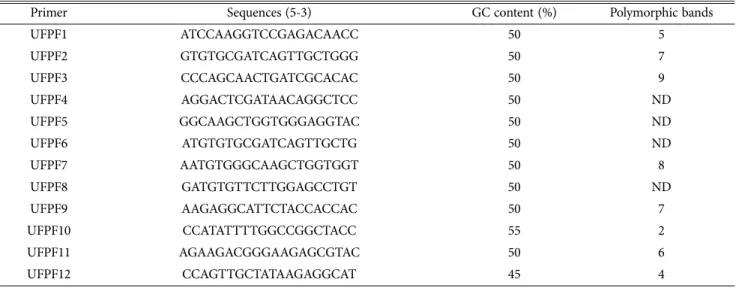
양송이계통을 포함한 Agaricus spp.의 PCR 다형성 분석 본 연구에서는 국내외에서 수집한 A. bisporus 45계통과 Agaricus spp. 19균주를 포함한 총 64 균주의 genomic DNA를 추출하고 UFPF primer (JK Biotech., Ltd.)를 사용 하여 PCR 다형성 분석을 실시하였다. 12종류의 UFPF primer를 사용하여 양송이 균주를 분석한 결과, UFPF1,
Table 2. PCR primers used in this study
Primer Sequences (5-3) GC content(%) Polymorphic bands
UFPF1 ATCCAAGGTCCGAGACAACC 50 5
UFPF2 GTGTGCGATCAGTTGCTGGG 50 7
UFPF3 CCCAGCAACTGATCGCACAC 50 9
UFPF4 AGGACTCGATAACAGGCTCC 50 ND
UFPF5 GGCAAGCTGGTGGGAGGTAC 50 ND
UFPF6 ATGTGTGCGATCAGTTGCTG 50 ND
UFPF7 AATGTGGGCAAGCTGGTGGT 50 8
UFPF8 GATGTGTTCTTGGAGCCTGT 50 ND
UFPF9 AAGAGGCATTCTACCACCAC 50 7
UFPF10 CCATATTTTGGCCGGCTACC 55 2
UFPF11 AGAAGACGGGAAGAGCGTAC 50 6
UFPF12 CCAGTTGCTATAAGAGGCAT 45 4
ND: Not detected.
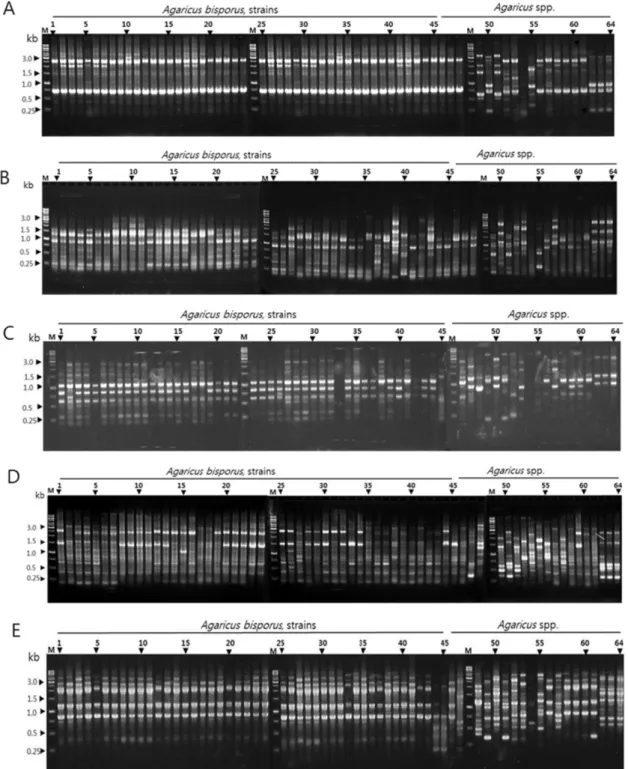
UFPF2, UFPF3, UFPF7, UFPF9, UFPF10, UFPF11, UFPF 12가 2개에서 9개의 PCR 다형성 밴드가 증폭되어 양송이 계통 간의 PCR 다형성 검출에 적용할 수 있는 것으로 판 단되었다(Table 2). UFPF primer중에서 URPF1와 UFPF3, UFPF7, UFPF11 primer는 A. bisporus의 종내 계통간 다 양한 PCR다형성밴드를 검출하여 매우 유용한 primer로 사료되었다. UFPF1, UFPF2, UFPF3, UFPF7, UFPF11에
의하여 검출된 양송이 종내 종간 64균주의 PCR 다형성밴 드를 관찰한 결과는 Fig. 1과 같다. A. bisporus계통 45균주 에는 국내에서 2010년에서 2012년 사이에 개발된 새아 (ASI1337), 새정(ASI1338), 새연(ASI1347), 새도(ASI1348) 를 포함한 13품종, 미국, 일본, 중국 유럽지역으로부터 수 집된 계통을 포함하고 있다. UFPF7 primer는 양송이 계통 간 가장 다양한 다형성 밴드를 생산하였다. UFPF7-PCR
Fig. 1 PCR polymorphisms of 45 Agaricus bisporus strains and 19 strains of other Agaricus spp. amplified by primers UFPF1(A) UFPF2(B), UFPF3(C), UFPF7(D) and UFPF11(E). Each number on lanes is identical to that of Table 1.
결과에서 최근에 개발된 국내품종인 새아, 새정, 새연, 새 도는 유사한 PCR다형성을 보였으나 다른 양송이 계통과는 구분되는 PCR특성을 보였다(Fig. 1). 그 외의 국내품종 ASI1001 ASI1018 ASI1019 ASI1021 ASI1022 ASI1124, ASI1216, ASI1229는 다른 미국, 유럽으로 도입된 품종과 유사한 PCR다형성양상을 보여 1960년 중 후반부터 미국 유럽지역으로 양송이 균주가 도입되었던 시점과 일치하여 균주간 유사성에의하여 나타난결과로 추정된다.
다른 Agaricus종과 A. bisporus계통 간에 PCR다형성비교 에서 A. marginell, A. potobella, A. rodmanii와 Agaricus sp.
인 국내균주 ASI1193, ASI1247, ASI1248는 A. bisporus와 유사한 PCR다형성이 관찰 되었으나 다른 Agaricus 종과는 뚜렷한 차이를 보였다. 특히, A. abruptibus와 A. augustus 는 모든 UFPF primer에서 같은 PCR다형성이 관찰되어 동 일한 종으로 사료되었다. 결론적으로 본 연구의 UFPF-PCR 다형성 분석은 양송이 종내 계통의 유전적 특성과 종간 유 전자원의 탐색 등에 유용하게 적용할 수 있을 것으로 사료 되었다.
A. bisporus계통의 PCR다양성 분석에 RAPD, SSR, ISSR 등이 적용되었다[1,5,7,13,14]. 양송이 microsatellite 염기서 열로부터 33종류의 SSR마커를 개발하여 28 양송이 계통의 PCR다형성분석에 적용한 결과 야생주 양송이계통은 성공 적으로 이용할 수 있었으나 재배품종간의 유전적 다양성검
출에는 한계가 있었다[5]. SRAP와 ISSR 분석으로 재배품 종과 야생주를 포함하는 305개의 양송이 수집균주를 대상 으로 DNA다형성을 조사한 결과 120계통의 DNA profile을 확인할 수 있었다고 하였다[14]. Yadav 등[10]은 양송이버 섯 22품종의 특성을 구분하고자 RAPD와 rDNA 염기서열 의 Single nucleotide polymorphism(SNP)분석을 수행하여 2개 cluster로 구분한 바 있다. 본 연구의 UFPF-PCR와 위 의 기존 연구와 비교할 때 상응 또는 보다 높은 DNA다형 성을 검출할 수 있을 것으로 사료되었다.
RAPD primer의 경우는 통상적으로 10 mer의 primer가 적용되고 있으며 수십 또는 수백 종류의 primer를 탐색하 여 유용 primer를 선발하여야 하며 PCR반응시에 35에서 36의 낮은 annealing온도에서 주형 DNA와 primer를 부착 하기 때문에 비 특이적인 밴드가 다수 증폭될 수 있어 재현 성이 문제점으로 지적되었다[5,10]. Microsatellite로부터 유 래된 ISSR, SSR marker는 선제적으로 염기서열 구조가 요 구되어 종이 다를 경우 사용에 한계점이 있다. URP primer 는 20 mer의 염기로 구성되어 있으며 55oC 이상의 annea- ling온도에서 PCR 반응을 수행할 수 있어 높은 재현성으로 PCR 다형성에 이용할 수 있으며[10], A. bisporus외에 다양 한 Agaricus 종에서도 적용할 수 있어 종간의 상호 연관분 석이 가능하다. URP primer를 이용하여 다양한 Pellinus 종 의 유연관계를 조사한 바 있으며 P. linteus종 특이 URP-
Fig. 2. Genetic relationship among 45 Agaricus bisporus strains. The numbers are same to those of Agaricus strains listed in Table 1.
PCR다형성 밴드를 이용하여 P. linteus 검출특이 SCAR primer를 재구성해 개발한 바 있다[15]. 따라서 계통 또는 종간 특이 UFPF-PCR산물은 교배조합의 기내 선발마커 등 육종효율을 증대시키는 데 유용하게 적용 가능할 수 있을 것으로 기대된다.
양송이 계통간 유전적 유연관계분석
본 연구에 공시한 A. bisporus계통 45균주의 유전적 유 사도를 분석하기 위하여 UFPF primer에의하여 증폭된 95 PCR 다형성밴드를 이용하여 band유무에 따라 NTSYS-pc 의 UPGMA program으로 dendrogram을 작성하였다(Fig.
2). 그 결과 3 cluster로 내에 8개의 세부 group으로 분류되 었으며 group 간에는 유사성 함수가 0.75에서 0.90의 유연 관계를 보였다. 한국에서 최근 개발된 새아, 새정, 새연, 새 도는 Group H에 포함되었으며 0.96에서 1.0의 유사성함 수로 밀접한 근연관계에 있었으며 영국 도입균주 ASI1119 와는 0.9의 유사성함수를 나타내었다. 그밖에 대부분 국내 양송이계통은 group E와 F에 속하였으며 group F는 중국 도입균 ASI1199과 ASI1179과 0.83의 유사성 함수를 보였 다. 미국균주는 ASI1115를 제외하고 Group B와 Group G 에 포함되고 있으며 네덜란드 양송이 계통(ASI1091)은 Group B에 포함하고 있으면서 미국계통ASI1074과 1.0의 유사성함수를 보여 같은 계통으로 추정할 수 있었다. 일본 균주(ASI1045, ASI1047)는 프랑스균주(ASI1048, ASI1049, ASI1054)와 0.95에서 0.97까지의 높은 유사성함수를 보였 다.
국내에서의 양송이 재배는 1966년에 일본으로부터 기술 을 도입하기 시작하여 1967년에 유럽식 양송이재배법이 도 입되면서 농가에서는 96% 이상이 국외도입 종균을 사용 되어 왔다. 최근 국내에서 교배품종으로 다향, 새아, 새정, 새연, 새도 등 국내고유 품종이 개발되어 27%가 국내품종 으로 대체되고 있다[4,16]. 유럽에서는 최초 교배종인 Horst
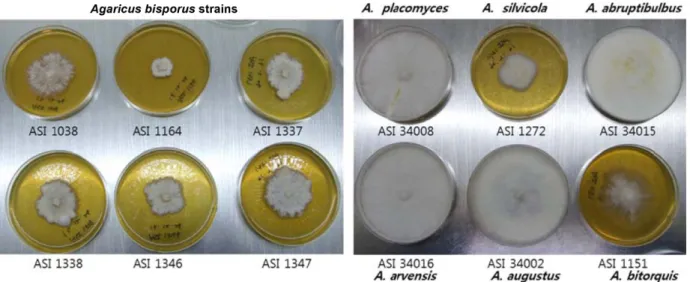
U1 개발된 이래로 동 품종으로부터 조직분리에 의한 복제 계통이 신규품종으로 개발되어 유전적 배경이 매우 유사하 여 형태적으로 구분하는데 한계가 있다[2]. 최근 연구에 따 르면 교배친 간의 상동성 염색체의 recombination없이 교 배종이 발생할 수 있으며 이핵포자는 염색체의 재분배로 인하여 표현형이 다를 수 있는 것으로 보고되고 있어 이핵 포자의 특성을 조사하여 독특한 표현형의 양송이를 선발 품종화하는 경우도 있다[2]. Fig. 3은 양송이 퇴비추출배지 에서 15일간 배양한 A. bisporus와 다양한 Agaricus종의 균 사체의 형태적 특징을 비교한 것으로 A. bisporus는 유사한 배양적 특성을 보였으나 다른 종과는 균사 생장율과 균사 체 특성이 다르게 나타났다. 따라서 형태적 관찰에 의한 양 송이 계통간 구분은 한계가 있으며 DNA 마커에 의한 양송 이 계통간 DNA profile이 유용하다는 것을 반증하고 있다.
본 연구는 UFPF primer로 양송이 계통간 또는 종간 PCR 다형성을 조사하였으며 양송이 종간 종내 유전적 다양성을 확인하였다. 향후 결과산물은 품종 또는 종 특이 DNA마커 개발을 위하여 적용할 수 있으며 궁극적으로는 MAS 또는 교배조합간 분자지도 연관마커 등에 이용하여 양송이버섯 의 분자육종효율을 증진할 수 있는 유용한 자료로 이용할 수 있을 것으로 기대된다.
적 요
본 연구에서는 국내외에서 수집한 A. bisporus 45계통과 Agaricus spp. 19균주를 포함한 64균주로부터 genomic DNA를 추출하고 12종류의 UFPF primer (JK Biotech., Ltd.)를 사용하여 PCR 다형성 분석을 실시한 바 양송이 계 통간 PCR다양성이 관찰되었다. 7종류의 UFPF primer에 의해 생성된 A. bisporus계통의 95 PCR다형성 밴드가 유 전적 유사도 산출에 이용되어 UPGMA cluster분석을 적용 dendrogram을 작성한 결과 A. bisporus의 계통군은 3 clu-
Fig. 3. Mycelial characteristics of Agaricus bisporus strains and different Agaricus spp. on compost extract media.
ster 내에 8개의 세부 group으로 분류되었으며 유사성 함수 가 0.75에서 0.90의 유연관계를 보였다. 한국에서 최근 개 발된 새아, 새정, 새연, 새도는 같은 group에 포함되었으며 0.96%에서 1.0%의 밀접한 근연관계에 있었으며 그밖에 한 국품종은 미국 유럽의 양송이 품종과 유전적 유연관계를 보였다.
감사의 글
본 연구는 농림축산식품부, 해양수산부, 농촌진흥청·산 림청 Golden Seed 프로젝트 사업(원예종자사업단, 과제번호 : 213-003-04-1-SBJ10)에 의해 이루어진 것임.
REFERENCES
1. Malekzadeh K, Banafsheh JMS, Ehsan M. Use of ISSR mar- kers for strain identification in the button mushroom, Agari- cus bisporus. In: Savoie JM, Foulongne-Oriol M, Largeteau M, Barroso G, editors, Proceedings of the 7th International Con- ference on Mushroom Biology and Mushroom Products, Ar- cachon, France; 2011. p. 3-34
2. Sonnenberg ASM, Johan JPB, Patrick MH, Brian L, Wei G, Amrah W, Jurriaan JM. Breeding and strain protection in the button mushroom Agaricus bisporus. In: Savoie JM, Foulongne- Oriol M, Largeteau M., Barroso G, editors, Proceedings of the 7th International Conference on Mushroom Biology and Mushroom Products, Arcachon, France; 2011. p. 7-15.
3. Fritsche G. Breeding Agaricus bisporus at the mushroom experimental station. Horst Mushroom J 1983;157:4-17 4. Oh YL, Jang KY, Jhune CS, Kong WS, Yoo YB, Shin PG, Seo
JS. Quality changes in Agaricus bisporus varieties due to period and temperature during their storage. J Mushroom Sci Prod 2013;11:137-144
5. Foulongne-Oriol M., Spataro C, Savoie JM. Microsatellite markers isolated in the white button mushroom Agaricus bisporus are suitable for genetic studies. Appl Microbiol Biotechnol 2009;84:1125-1135
6. Loftus M, Bouchti-King L, Robles C. Use of SCAR marker for cap color in Agaricus bisporus breeding programs. Mush Sci
2000;5:201-205.
7. Khush RS, Becker E, Wach M. DNA amplification polymor- phisms of the cultivated mushroom Agaricus bisporus. Appl Environ Microbiol 1992;58:2971-2977.
8. Yadav MC, Mahfooz S, Singh SK, Upadhyay RC. RAPD markers assisted selection of genetically diverse parents for hybridization in Agaricus bisporus. Mushroom Res 2003;12:
19-26.
9. Yadav MC, Challen MP, Singh SK, Elliott TJ. DNA analysis reveals genomic homogeneity and single nucleotide poly- morphism in 5.8S ribosomal RNA gene spacer region among commercial cultivars of the button mushroom Agaricus bis- porus in India. Curr Science 2007;93:1383-1391.
10. Kang HW, Park DS, Go SJ, Eun MY. Fingerprinting of diverse genomes using PCR with universal rice primers generated from repetitive sequence of Korean weedy rice. Mol Cells 2002;13:281-287.
11. Kang HW. Genetic divesity analysis of fungal species by uni- versal rice primer (URP)-PCR. Kor J Mycol. 2012;40:78-85.
12. Kang HW, Park DS, Park YJ, You CH, Lee BM, Go SJ. Geno- mic differentiation among oyster mushroom cultivars relea- sed in Korea by URP-PCR fingerprinting. Mycobiology 2001;
29:85-89.
13. Foulongne-Oriol M, Spataro C, Cathalot V, Monllor S, Savoie JM. An expanded genetic linkage map of an intervariental Agaricus bisporus var. bisporus x A. bisporus var. burnettii hybrid based on AFLP, SSR and CAPS markers sheds light on the recombination behaviour of the species. Fung Genet Biol 2010;47:226-236.
14. Wang ZS, Chen MY, Cai ZX, Liao JH, Li HR, Guo ZJ, Lu ZH.
DNA fingerprinting of genetic diversity of Agaricus bisporus.
In: Savoie JM, Foulongne-Oriol M, Largeteau M., Barroso G, editors, Proceedings of the 7th International Conference on Mushroom Biology and Mushroom Products, Arcachon, France; 2011. p. 1-8.
15. Kang HW, Park DS, Park YJ, Lee BM, Cho SM, Kim KT, Seo KS, Go SJ. PCR based detection of Phellinus linteus using specific primers Generated from Universal Rice Primer (URP) derived PCR polymorphic band. Mycobiology 2002;30:202- 207.
16. Kim HK, Ham IG, Lee KS, Lee BJ, Kim YG, Yang ES, Yoo YB, Kim HG. Characteristics of a new button mushroom variety Dahyang. J Mushroom Sci Prod 2011;9:17-21.