• 검색 결과가 없습니다.

A Fundamental Study for The Possibility of Charcoal as Green Infrastructure Materials

N/A
N/A
Protected

Academic year: 2021

Share "A Fundamental Study for The Possibility of Charcoal as Green Infrastructure Materials"

Copied!
9
0
0

로드 중.... (전체 텍스트 보기)

전체 글

(1)

1. INTRODUCTION

Charcoal has been used mainly as a fuel source all over the world, and also used as sev- eral different ways such as a source of thermal energy since the beginning of the steel industry.

However, charcoal could be a new material for Green Infrastrure (GI).

Generally less than 1% moisture is measured from Charcoal that is opened from kiln.

Charcoal rapidly adsorbs moisture from the hu-

midity and can hold moisture content about 5-10% in the ambient condition. The hygro- scopicity of the charcoal, both well-burned and un-properly burned, is increased and the natural or equilibrium moisture content can rise to 15%

or more (FAO, 1985).

Moisture content is not an important in- formation as research topics and for the char- coal industry and charcoal’s moisture content is also not serious problem for traditional usages.

However moisture related data are ironically

1 Date Received July 9, 2015, Date Accepted September 11, 2015

2 Department of Economics, Chungbuk National University, Cheongju 362-763, Republic of Korea

3 Department of Wood and Paper Science, Chungbuk National University, Cheongju 362-763, Republic of Korea

Corresponding author: Byung-Ro Kim (e-mail: [email protected])

A Fundamental Study for The Possibility of Charcoal as Green Infrastructure Materials 1

Jaehyuck Choi 2 ⋅Soo-Jeong Shin 3 ⋅Byung-Ro Kim 3,†

ABSTRACT

To evaluate the possibility of charcoal as Green Infrastructure (GI) materials, data such as moisture content, amount of adsorbed water, and amount of evaporation were collected. Some data from previous study were referenced to find out if correlations exist between results in this study and previous study. Only porosity was directly related to moisture content. Two mechanical charcoal had better abilities than traditional charcoal in all three categories. Mechanical black charcoal chips produced by National Forestry Cooperative Federation (NFCFC) adsorbed 333.3% of water in thirty minutes, 297.5% in five minutes, and evaporated around 75%

water in four days. This ability is much higher than other five charcoal. Even though results of test showed various degrees and NFCFC was the best as GI materials, data of charcoal were also within acceptable range based on generally accepted characteristics of GI materials.

Keywords : green infrastructure, materials, charcoal, moisture content, adsorbed water, evaporation

(2)

sensitive information to decide if wood charcoal can be used as GI materials.

The first official definition of GI is on the report from President’s Council on Sustainable Development; “A network of open space, air- sheds, watersheds, woodlands, wildlife habitat, parks, and other natural areas that provides many vital services that sustain life and enrich the quality of life” (PCSD, 1999). GI has its origin in two important concepts: (1) linking parks and other green spaces for the benefit of people, and (2) preserving and linking natural areas to benefit biodiversity and counter habitat fragmentation (Benedict and McMahon, 2006).

Two basic components were established from these concepts. The basic components of a GI network are ‘Hubs’ (natural) such as reserves, native landscapes, working lands, regional parks, and community parks, and ‘Links’

(connectivity) such as landscape linkages, con- servation corridors, greenways, greenbelts, and riparian floodplains (Randolph, 2004). In the united states, GI related federal law, ‘the Innovative Stormwater Infrastructure Act of 2015, H.R. 1175 and S. 896’, is in the process of enactment.

For the purpose of effective GI application, Low Impact Development (LID) techniques were used. LID techniques such as bioretention facilities, rain gardens, vegetated rooftops, rain barrels, and permeable pavements are generally used to implement GI. For the LID application, the usage of eco-friendly materials are man- datory and these materials should be unharmful for the environment.

According to US Environmental Protection Agency (EPA), environmental friendly or eco- friendly materials should be used to install and manage GI effectively in urban areas.

Therefore, natural and native materials or living things are the best sources for GI (Williamson, 2003). Furthermore, GI materials should not cause any kinds of contaminations during and after installation on, in and under the ground or surface, and should perform well when they are installed as a part of GI materials.

In the United states and EU, Industrial (private) sectors are cooperated with govern- ments, research centers and university labs to obtain useful data of GI related studies. Studies of GI materials are a part of these efforts, because prior research data were not directly applicable to GI and LID. Although wood materials are not good materials for GI at out- door, Charcoal has a lot of potential possibility as GI material.

Wood charcoal has many characters that can

satisfy required criteria as GI materials. char-

coal, including Mechanical charcoal (MC),

consists of only useful and unharmful minerals

such as K, Ca, Fe, P, Na, Mg, Al, and Si, so

charcoal is considered as eco-friendly materials

(Lee and Kim, 2010a). Wood charcoal is gen-

erally known as a good material that rapidly

adsorbs moisture and water in the air because

they have a lot of pore. However, non-studies

have implemented that provide data such as

how wood charcoal is good to adsorb water in

short period, which wood charcoal is better

than others, and how fast they can evaporate or

(3)

how long they can hold water. These kinds of data are very important to decide which specific charcoal is the best for specific GI application.

Even though GI is popular approach in the advanced countries, GI is still an emerging idea to generate benefits in cities using planning, design and management of natural resources and other eco-friendly materials (Wolf, 2003). The finding and developing GI materials are still a sort of blue ocean, and could be an opportunity for the shrinking charcoal industry in Korea.

Therefore, more science and professional practice is needed to find data that show wood charcoal is efficient materials. Moisture content, and amounts of adsorbed water and evaporation were measured to search the possibility of charcoal as GI materials in this study.

2. MATERIALS and METHODS 2.1. Materials

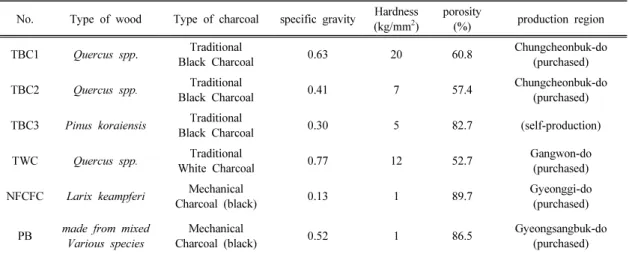
Six wood charcoal, same charcoal used at previous studies (Lee and Kim, 2010a; Lee and Kim, 2010b), were used (Table 1). Four tradi- tional charcoal are selected; three traditional black charcoal (TBC, sample 1, 2, and 3), one traditional white charcoal (TWC, sample 4), and two mechanical charcoal are also selected.

Sample three (TBC3) was produced at the labo- ratory in ChungBuk National University. The first mechanical charcoal (sample 5) had been produced by National Forestry Cooperative Federation (NFCF), and the second mechanical charcoal (sample 6) was made from particle- board (PB).

Eight samples for TBC1 and Six samples of each TBC2, TBC3, TWC, NFCFC, and PB

No. Type of wood Type of charcoal specific gravity Hardness (kg/mm

2

)

porosity

(%) production region

TBC1 Quercus spp. Traditional

Black Charcoal 0.63 20 60.8 Chungcheonbuk-do

(purchased)

TBC2 Quercus spp. Traditional

Black Charcoal 0.41 7 57.4 Chungcheonbuk-do

(purchased)

TBC3 Pinus koraiensis Traditional

Black Charcoal 0.30 5 82.7 (self-production)

TWC Quercus spp. Traditional

White Charcoal 0.77 12 52.7 Gangwon-do

(purchased)

NFCFC Larix keampferi Mechanical

Charcoal (black) 0.13 1 89.7 Gyeonggi-do

(purchased)

PB made from mixed Various species

Mechanical

Charcoal (black) 0.52 1 86.5 Gyeongsangbuk-do

(purchased) Note. TBC: Traditional Black Charcoal, TWC: Traditional White Charcoal, NFCFC: Mechnical black charcoal chips produced by National

Forestry Cooperative Federation, PB: Mechnical black charcoal from particleboard. This table was reorganized with previous studies of Lee and Kim (2010a; 2010b).

Table 1. Description of samples

(4)

were prepared for the test. Samples of TBC1, TBC2, TBC3, and TWC were cut sections (various diameters and shapes) to make all of samples 4 cm height. This depth was used as a layer of green roof at the previous study (Ling et al., 2011). NFCFC was produced as type of chips, so colanders were used to measure weight of NFCFC samples. PB samples were cut 4 × 4 cm. Prepared samples were stored in natural condition and used for the test.

2.2. Measurement of moisture content

Moisture content of samples were measured twice at start and after five days water im- mersion to see the difference between general condition and wet weather condition (i.e. storm- water) and which sample has higher moisture content than others. Moisture content was cal- culated using the equation (1)

M n = ( (W w - W d ) / W d ) × 100 ··· (1)

in which:

M n = moisture content (%) of material n W w = wet weight of the sample, and W d = weight of the sample after drying.

2.3. Measurement of the amount of adsorbed water

Charcoal are porous materials, therefore they rapidly adsorb moisture from the humidity, and could adsorb water at fast face as well. The amounts of water were measured at five minute

intervals between 0 and 30 minute. However, samples were measured every hour by an elec- tronic scale until six hours passed from the start to double-check if the rapid water adsorption happens only early minutes.

2.4. Measurement of the amount of evaporation

To measure the amount of evaporation, same samples which were used to measure the amount of adsorbed water were immersed in the water at least five days to maximize the amount of adsorbed water. Samples were held for several seconds until water did not drop and placed on the plate to measure weight by an electronic scale.

The unit of time is normally a day to meas- ure the amount of evaporation (WMO, 2003).

Basically samples were measured once a day, however, samples were measured at ten minute intervals for the first one hour and at one hour intervals from one to six hours to check if un- expected patterns exist. Measurement has been done for six days. Indoor temperature was 27.2 ℃∼29.8℃, and humidity was 49%∼

56% during evaporation test.

3. RESULTS and DISCUSSION 3.1. Moisture content

Wood charcoal is generally composed of

moisture content, volatile matter, ash content,

and fixed carbon. Traditional black charcoal has

(5)

5.7% moisture content on average, and tradi- tional white charcoal has 7.9% moisture content on average (Lee and Kim, 2010a). However, this data only describe charcoal’ properties, and are insufficient to support the possibility of charcoal. More data were needed to decide if charcoal are good GI materials.

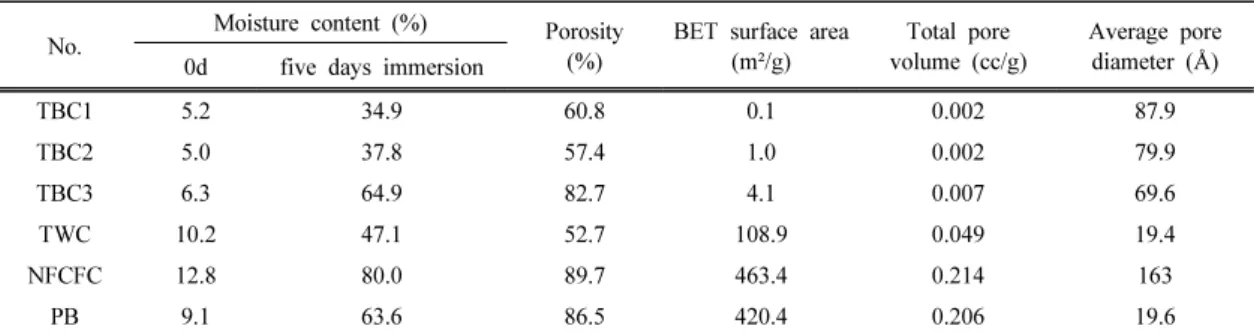
Moisture content of three TBCs were very similar to average value which was 5.7%, however, moisture content of TBC3 after five days immersion was almost 30% higher than moisture contents of TBC1 and TBC2. TWC had 10.2% moisture content which is 2.3%

higher than the average of TWCs. Test result showed that NFCFC had 80% moisture content and the highest rate of six samples. PB also had relatively high rate of moisture content, 63.6%. TBC3 and NFCFC had relatively higher moisture content than others. This results could be related with specific gravity (Table 2).

Moisture content after five days immersion and porosity only seem to have a correlation.

Data of BET surface area, total pore volume, and average pore diameter did not show any solid evidence related to the change of moisture

contents after five days immersion.

Charcoal can be produced from various kinds of woods and various kinds of carbonization systems. In general, all woods and all systems of carbonization can produce many different types of charcoal that fall within the commer- cial limits (FAO, 1985). BET surface area is strongly related to carbonisation temperature.

The higher carbonisation temperature can make the bigger BET surface area (Blankehorn et al., 1978; Pulido-Novicio, 2001). Therefore TBC1, TBC2, and TBC3 might be produced under the condition of low carbonisation temperature. As a result of that, small BET surface area and total pore volume did not influence on the moisture content change. Average pore diameter also did not show a correlation with moisture content. Even though sample numbers are small, porosity was the only factor that could provide resonable assumptions of which char- coal would have bigger moisture content than others. Two mechanical charcoal, NFCFC and PB, had better results in moisture content test that other charcoal.

No.

Moisture content (%) Porosity (%)

BET surface area (m²/g)

Total pore volume (cc/g)

Average pore diameter (Å) 0d five days immersion

TBC1 5.2 34.9 60.8 0.1 0.002 87.9

TBC2 5.0 37.8 57.4 1.0 0.002 79.9

TBC3 6.3 64.9 82.7 4.1 0.007 69.6

TWC 10.2 47.1 52.7 108.9 0.049 19.4

NFCFC 12.8 80.0 89.7 463.4 0.214 163

PB 9.1 63.6 86.5 420.4 0.206 19.6

Note. porosity, BET surface area, total pore volume, and average pore diameter were referenced from Lee and Kim, 2010a.

Table 2. Moisture content analysis and porosimetry analysis

(6)

3.2. Measurement of the amount of adsorbed water

Six charcoal were good water adsorption ma- terials as expected. Data clearly showed that charcoal rapidly adsorbed water at the first five minutes and percentage of water adsorption were obviously slowed down after five minutes.

An ability of rapid water adsorption is a key

factor of GI application (i.e. green roof and blue roof). This ability can help to mitigate flooding that is usually caused by stormwater in urban areas.

Mechanical charcoal had much better adsorp- tion ability than traditional charcoal. Especially NFCFC charcoal adsorbed 333.3% weights of water within thirty minutes. This result means that 1 g of NFCFC charcoal can adsorb and hold

TBC1 TBC2

TBC3 TWC

NFCFC PB

Fig. 1. The amount of adsorbed water within thirty minutes.

(7)

3.33 g of water, (total weight was 4.33 g) at the moment of a localized torrential downpour. The second best charcoal was PB. It could hold 117.3% of water. Two mechanical charcoal ad- sorbed water very quickly and slowed down the pace after five minute point.

TBC3 kept adsorbing water very slowly after five minute point and total amount of water was only 8.1% at thirty minute measurement and 14.1% after twenty four hours from the start.

There are no specific criteria for GI materials, however, water containing ability of TBC3 was the least acceptable for GI material, because TBC3 cannot adsorb and hold runoff water during stormwater in a short period of time.

Water adsorption rate of TBC1, TBC2, and TWC were also very low, comparing with NFCFC and PB. However these data can be used to decide which charcoal is perfect under given circumstances, because urban environment is unpredictable and keeps changing.

3.3. Measurement of the amount of evaporation

Samples were used to measure the amount of evaporation after five days immersion. Weight

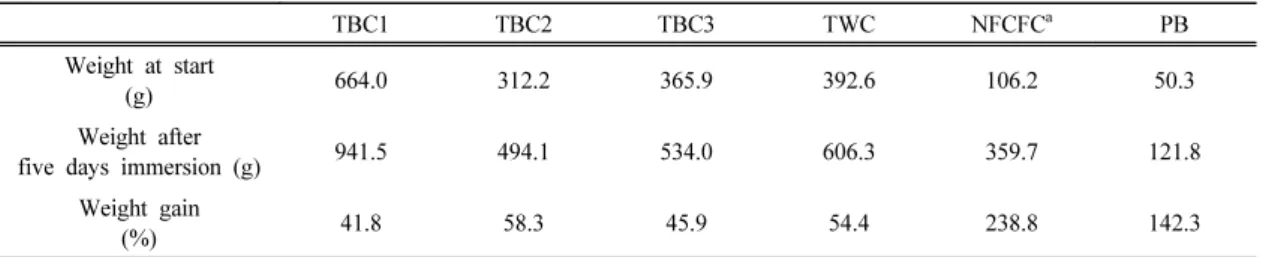
gain of traditional charcoal was very similar after five days (Table 3). Even TBC3 charcoal steadily adsorbed water and reached 45.9%.

This rate was even higher than TBC1. Based on this result, it is possible to assume that wa- ter adsorption ability of traditional charcoal is similar, but the elapsed time to reach to the maximum rate is various.

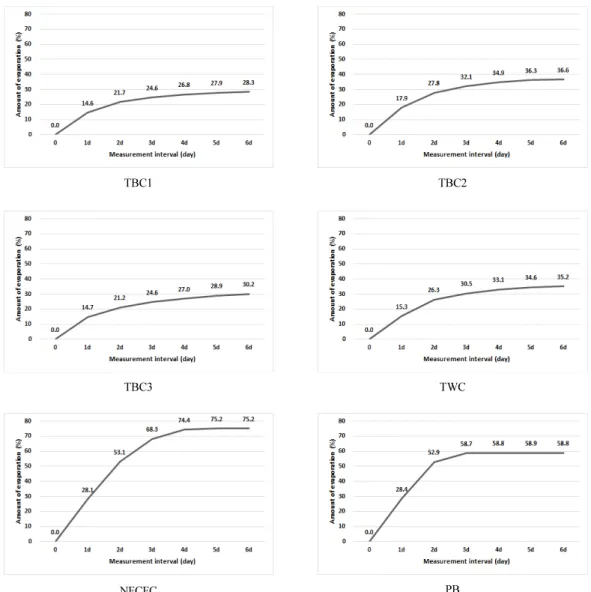
Water adsorption patterns of traditional char- coal were clearly different, however, results of evaporation test showed that traditional charcoal had very similar paces. Therefore, water adsorp- tion capability is more important indicator than other data to use traditional charcoal as GI materials. Two mechanical charcoal yielded good numbers. Both NFCFC and PB evaporated more than 50% of adsorbed water. NFCFC reached around 75% of evaporation at fifth day and PB reached 58.7% at fourth day. Both 75.2% of NFCFC and 58.8% of PB were their maximum evaporation rates. NFCFC was the best charcoal among six charcoal regard to evaporation and PB was also valuable charcoal as GI materials. Some of TBC1 samples were broken with cracking sounds during evaporation test. This state could be a hardness issue as GI

TBC1 TBC2 TBC3 TWC NFCFC

a

PB

Weight at start

(g) 664.0 312.2 365.9 392.6 106.2 50.3

Weight after

five days immersion (g) 941.5 494.1 534.0 606.3 359.7 121.8

Weight gain

(%) 41.8 58.3 45.9 54.4 238.8 142.3

Note.

a

Some of NFCFC chips were lost during five days and it caused weight loss after five days immersion. Actual weigh should be more than 359.7 g.

Table 3. The amount of adsorbed water after five days immersion

(8)

materials.

4. CONCLUSION

Samples have less than 0.77 specific gravity (Table 1), so they are good materials to use as a layer of green roof. Charcoal should be light enough to be used as GI materials if it is used

as GI materials on the roof. However, the in- formation how much water can be adsorb is also very important factor. GI Planners and de- signers always consider load limit of roof at any conditions. Therefore, accurate data is indispensable. Evaporation ability is another factor that must be carefully considered.

This study was a fundamental research to

TBC1 TBC2

TBC3 TWC

NFCFC PB

Fig. 2. The amount of evaporation using samples after five days immersion.

(9)

find out the possibility of charcoal as GI mate- rials and tested only six types of charcoal.

However, test data clearly indicate that charcoal could be used as useful GI materials. Even though results of test showed various degrees, all charcoal had proper abilities overall and two mechanical charcoal are very useful materials for GI. In conclusion, charcoal is unharmful to people and environment, and both NFCFC and PB adsorb and evaporate water very quickly.

Therefore, The possibility of charcoal as GI materials is sufficient. However, there were many uncertain factors such as carbonisation conditions, type of trees, and shape of char- coals, so further studies are needed to accumu- late new type of data to prove that charcoal is a good GI material.

REFERENCES

Benedict, M.A., McMahon, E.T. 2006. Green Infrastructure: Linking Landscapes and communities. Island Press, Washington D.C., USA.

Blankehorn, P.R., Barnes, D.P., Kline, D.E., Murphey. W.K. 1978. Porosity and pore size distribution of black cherry carbonized in an in- sert atmosphere. Journal of Wood Science 11(1):

23 ∼29.

FAO. 1985. Industrial Charcoal Making. FAO Forestry Paper 63, Forest Industries Division, FAO Forestry Department, Food and Agriculture Organization of the United Nations, Rome.

Lee, D.Y., Kim, B.R. 2010a. Adsorption Characteristics of Commercial Wood Charcoal ( Ⅰ). Journal of the Wood Science and

Technology 38(1): 27 ∼35.

Lee, D.Y., Kim, B.R. 2010b. Analysis of Functional Characteristics of the Commercial Wood Charcoal in Korea. Journal of the Wood Science and Technology 38(6): 480 ∼489.

Ling, P.I., Kawamura, M., Nakane, K. 2011. Effect on rooftop temperatures and heat fluxes of a bamboo charcoal sublayer in rooftop greening soil at a factory office. International Journal of Environmental Protection, 1(3): 15 ∼20.

President’s Council on Sustainable Development (PCSD). 1999. Towards a Sustainable America:

Advancing Prosperity, Opportunity, and Healthy Environment for the 21st Century. PCSD, Washington, DC, pp. 170.

Pulido-Novicio, L., Hata, T., Kurimoto, Y., Doi, S., Ishihara, S., Imamura, Y. 2001. Adsorption ca- pacities and related characteristics of wood char- coal carbonized using a one-step or two-step process. Journal of Wood Science 47: 48 ∼57.

Randolph, J. 2004. Environmental Land Use Planning and Management. Island Press, Washington D.C., USA.

Williamson, K.S. 2003. Growing with green infrastructure. Heritage Conservancy, Doylestown, USA.

World Meteorological Organization, 1994: Guide to Hydrological Practices. Fifth edition, WMO No.

168, Geneva.

World Meteorological Organization, 2003: Manual on the Global Observing System. Volume I, WMO No. 544, Geneva.

Wolf, K.L. 2003. Ergonomics of the city: green in-

frastructure and social benefits. In Engineering

Green: Proceedings of the 11th National Urban

Forest Conference. Washington DC: American

Forests Vol. 115.

수치

Table 1. Description of samples
Table 2. Moisture content analysis and porosimetry analysis
Fig. 1. The amount of adsorbed water within thirty minutes.
Table 3. The amount of adsorbed water after five days immersion
+2

참조

관련 문서