감마선 조사선량에 따른 버찌(Fruit of Prunus serrulata L. var.
spontanea Max. wils.) 에탄올 추출물의 항산화활성
김경희․조지은․이성아․육홍선†
충남대학교 식품영양학과
Antioxidative Properties of Ethanolic Extracts from Flowering Cherry ( Prunus serrulata L. var. spontanea Max. wils.) Fruit with Various Doses of Gamma Radiation
Kyung-Hee Kim, Ji-Eun Jo, Seong-A Lee, and Hong-Sun Yook† Dept. of Food and Nutrition, Chungnam National University, Daejeon 305-764, Korea
Abstract
This study investigated the antioxidant activity of ethanolic extracts of 1∼20 kGy-gamma irradiated flower- ing cherry fruit (Prunus serrulata L. var. spontanea Max. wils.). The total phenolic compound content was highest (30.35 mg/g) in the 10 kGy sample, but there was no consistent trend matching the increase or decrease of gamma irradiation. Radical scavenging activity using DPPH (2,2-diphenyl-1-picrylhydrazyl) showed that gam- ma-irradiated samples were better than non-irradiated samples and that the 10 kGy-gamma irradiated sample was the best (IC
50327.52 ppm). In reducing power, gamma-irradiated samples induced higher activities than non-irradiated samples at concentrations below 2.5 mg/mL, and the sample with the highest activity was the 20 kGy-gamma irradiated sample. In nitrite-scavenging ability, both gamma-irradiated and non-irradiated sam- ples showed high activity (73∼94%) at pH 1.2, 3.0, and 4.2. Also, the nitrite-scavenging ability of gamma-irradi- ated samples was significantly different from that of the control at pH 1.2. The FRAP value of the 3 kGy-irradi- ated sample also showed the highest value of 0.38 mM. Our results indicate that gamma irradiating the ethanolic extracts of flowering cherry fruit increases the antioxidant activity at some of the radiation doses. Therefore, it suggests that gamma irradiation could increase biological activity and be used effectively in food manufactur- ing and related industries.
Key words: fruit of flowering cherry (Prunus serrulata L. var. spontanea Max. wils.), antioxidative properties, gamma irradiation
†
Corresponding author. E-mail: [email protected]
†
Phone: 82-42-821-6840, Fax: 82-42-821-8887
서 론
버찌는 쌍떡잎식물 장미목 장미과 벚나무속 식물의 열매 로 핵과(核果)로서 둥글거나 심장형이며 지름은 약 2 cm이 고 노란빛을 띤 검붉은 색이다. 우리나라의 재래종 버찌는 일명 ‘흑앵(黑櫻)’이라고 불러왔으며, 과즙이 적고 색이 검정 에 가까울 정도로 짙다. 버찌에 함유된 당질로는 포도당이 가장 많으며 다음으로 과당, 서당의 순서로 분석되고 있다.
유기산으로는 주로 사과산이 함유되어 있고, 그밖에 호박산, 주석산, 구연산 등이 미량 존재한다. 또한 강력한 항산화 물 질이기도 한 안토시아닌과 quercetin이 염증을 해소시키는 작용을 하여 관절염 치료에도 효과가 있는 것으로 알려져 있다(1). 우리나라에서 최근 가로수 등으로 사용이 증가하고 있는 벚나무는 그 양이 증가하고 있으나 벚나무 열매인 버찌 는 성숙된 뒤 땅으로 떨어져 방치되거나 주위를 오염시키는 것은 물론 도시 미관을 해치는 요인으로 작용하고 있다. 최
근에는 이러한 버찌를 이용해 베이커리류(2-5), 요구르트 (6), 초콜릿(7), 젤리(8) 등의 가공식품에 접목하여 품질 및 관능적 특성을 연구한 바 있다. 또한 버찌에 함유된 적색색 소인 안토시아닌과 관련하여 붉은 무 안토시아닌의 특성에 관한 연구(9), 적포도주의 색소특성 및 안정화 연구(10), 각 종 과실가공품의 색소 안전성에 대한 연구(11) 및 색소특성 에 관한 연구(12)가 있으며, 적색색소 소재개발의 차원에서 유색미 색소에 관한 연구(13,14)와 자색고구마색소에 관한 연구(15,16) 등이 활발히 진행되고 있다.
한편 방사선 조사는 식품 및 소재의 부패방지, 제품의 안
전성 및 보존성 향상의 효과가 보고되어 식품뿐만 아니라
제약, 의료 및 화장품과 같은 공중보건산물에 널리 사용되며
(17-19), 감마선 조사기술은 식품 고유의 풍미와 생화학적
품질을 유지하면서 미생물을 선택적으로 살균할 수 있고,
포장상태에서도 살균 처리가 가능하여 제조공정에서의 2차
오염을 방지할 수 있는 특성을 가지고 있다(20,21). 특히 최
근에는 천연 추출물에 감마선 조사를 응용하여 첨가제 등으 로 사용하기에 바람직하게 색택을 밝고 투명하게 변화시키 면서 본래 가지고 있던 생리활성은 유지할 수 있다는 연구결 과가 보고되었으며, 이의 공중 보건 제품 소재로서 활용도 진행 중에 있다(22,23).
따라서 본 연구에서는 폐자원으로 버려지는 버찌의 활용 증대방안 모색 및 천연 추출물에 미치는 감마선 조사의 영향 을 알아보기 위해 버찌의 에탄올 추출물에 감마선 조사를 실시하고, 이에 따른 항산화활성의 비교를 실시하였다.
재료 및 방법
재료
본 실험에 사용한 버찌(
Prunus serrulataL. var.
spontaneaMax. wills.)는 경남 진해시 농업기술센터에서 수확한 버찌 를 제공받아 사용하였다.
추출 및 감마선 조사
씨를 제거한 버찌 열매 100 g에 70% ethanol 1 L를 가하여 3회 반복 추출 후 회전진공농축기(Eyela A-1000S, Tokyo Rikakikai Co., Tokyo, Japan)로 35
oC에서 1/9로 감압 농축 하였으며 이렇게 농축된 추출원액을 감마선 조사에 사용하 였다. 감마선 조사는 (주)그린피아 선원 878,000 Ci, Co60 감마선 조사시설(IR-149 gamma irradiator, MDS Nordion, Ottawa, ON, Canada)을 이용하여 실온에서 시간당 1, 3, 5, 10, 20 kGy의 총 흡수선량을 얻도록 하였고, 흡수선량의 확 인은 dosimeter(PMMA dosimeter, Harwell Dosimeter Ltd., Didcot, England)를 사용하였으며, 흡수선량의 오차는
± 0.2 kGy였다.
Total polyphenol 화합물 함량 분석
총 폴리페놀 화합물 함량은 Folin-Ciocalteu's의 방법(24) 에 따라 측정하였다. 추출된 각 시료는 10 mg/mL의 농도로 희석한 후 이 시료를 0.1 mL 취하고 증류수 8.4 mL와 50%
Folin-Ciocalteu's 시약(2 N) 0.5 mL을 첨가하고 20% Na
2CO
31 mL을 가하여 1시간 방치 후 725 nm에서 흡광도를 측정하 였다. 표준곡선은 gallic acid를 이용한 표준 검량식에 적용 하여 시료 중 총 폴리페놀 함량을 구하였다.
DPPH radical 소거능 분석
항산화 활성은 Blois의 방법(25)에 준한 DPPH radical 소 거능 측정방법을 이용하였다. 추출된 각 시료는 0.1~1 mg/
mL의 농도로 희석한 후 시료 0.1 mL에 60 μM DPPH 용액 3.9 mL를 가한 뒤 vortex mixer로 10초간 진탕하고 실온에 서 30분간 방치한 후 spectrophotometer(UV-1800 spectro- photometer, Shimadzu, Kyoto, Japan)로 517 nm에서 흡광 도를 측정하여 다음과 같은 계산식에 의해 환산하여, 대조군 에 대한 50% 흡광도의 감소를 나타내는 검체의 농도(IC
50)로 표시하였다.
Electron donating activity (%)=(1- A B )×100 A: absorbance of sample
B: absorbance of blank Reducing power 측정
Reducing power는 Oyaizu의 방법(26)에 따라 측정하였 다. 추출된 각 시료는 1, 2.5, 5, 10 mg/mL로 각각 제조한 후 시료 1 mL에 200 mM sodium phosphate buffer(pH 6.6) 0.25 mL와 1% potassium ferricyanide 0.25 mL를 넣어 50
oC 에서 20분간 반응시킨 후 10% trichloroacetic acid를 0.25 mL 첨가하여 교반시켜 3,000 rpm에서 5분간 원심분리 하였 다. 그 다음 상층액 0.5 mL과 증류수 0.5 mL, 0.1% ferric chloride 0.1 mL을 혼합한 후 700 nm에서 흡광도를 측정하 였다.
아질산염 소거능 측정
아질산염 소거능은 Kato 등(27)의 방법에 따라 1 mM NaNO
2용액 0.1 mL에 감마선 조사된 추출물을 5 mg/mL의 농도로 하여 시료 0.2 mL를 가하고 0.1 N HCl(pH 1.2), 0.2 M citrate phosphate buffer(pH 3.0, pH 4.2, pH 6.0)로 각각 pH를 보정한 다음 반응액의 부피를 1 mL로 조정한 후 이 용액을 37
oC에서 1시간 반응시킨 후 2% 초산 5 mL와 30%
초산에 용해한 Griess 시약(1% sulfanylic acid : 1% naph- thylamine=1:1) 0.4 mL를 가하여 15분간 방치한 다음 520 nm에서 흡광도를 측정하였다. 대조구는 증류수 0.4 mL를 가하여 상기와 동일한 방법으로 측정하여 잔존하는 아질산 양을 구하였으며, 양성대조군은 ascorbic acid를 사용하여 측정하였다. 아질산염 소거능은 시료를 첨가하기 전과 후의 아질산염 백분율(%)로 표시하였다.
N (%)= ( 1- A-C B ) × 100
N: nitrite scavenging ability
A: absorbance of 1 mM NaNO
2added sample after standing for 1 hr
B: absorbance of 1 mM NaNO
2C: absorbance of control FRAP value 측정
감마선 조사된 버찌 추출물의 FRAP value 측정은 Benzie
와 Strain의 방법(28)을 참고하여 측정하였다. FRAP re-
agent는 25 mL acetate buffer(300 mM, pH 3.6)를 37
oC에서
가온한 후, 40 mM HCl에 용해한 10 mM 2,4,6-Tris(2-
pyridyl)-s-triazine(TPTZ, Sigma Chemical Co., St. Louis,
MO, USA) 2.5 mL과 20 mM ferric sulfate(FeSO
4) 2.5 mL을
가하여 제조하였다. 제조된 0.9 mL FRAP reagent에 시료
0.03 mL과 증류수 0.09 mL을 넣은 후 37
oC에서 10분간 반응
시킨 후 593 nm에서 흡광도를 측정하였다. Control은 시료
대신 에탄올을 넣어 측정하였다. Ascorbic acid를 1 mg/mL
Table 1. Total polyphenol contents of irradiated 70% ethanol extract of flowering cherry fruit
Irradiation dose (kGy) Polyphenol contents (mg GAE/g
1)) 0
1 3 10 5 20
29.40±0.47
b2)3)29.23±0.26
b27.31±0.99
c28.77±0.14
b30.35±0.19
a29.56±0.33
ab1)
GAE: gallic acid equivalents.
2)
Values with different letter within a same column (a-c) differ significantly (p<0.05).
3)
Values are mean±SD (n=3).
Table 2. DPPH radical scavenging activity of irradiated 70%
ethanol extract of flowering cherry fruit
Irradiation dose (kGy) IC
50(ppm) 0 1
3 5 10 20
368.35±3.54
a1)2)363.39±8.49
ab351.41±12.50
bc345.18±7.40
c327.52±7.51
d348.73±6.42
bcAscorbic acid 6.76±0.01
1)
Values with different letter within a same column (a-d) differ significantly (p<0.05) except ascorbic acid.
2)
Values are mean±SD (n=3).
0 0.1 0.2 0.3 0.4 0.5 0.6
0 1 2.5 5 10
Conc. (mg/mL)
A b s . .
0 kGy 1 kGy 3 kGy 5 kGy 10 kGy 20 kGy
Fig. 1. Reducing power of irradiated 70% ethanol extract of flowering cherry fruit.
농도로 제조하여 대조군으로 사용하였고 계산은 0.025, 0.05, 0.1, 0.2, 0.5 및 1 mM의 농도로 반복하여 작성한 FeSO
4의 검량식에 대입하여 구하였다.
통계처리
실험 결과는 SPSS 17.0(Statistical Package for Social Sciences, SPSS Inc., Chicago, IL, USA) software를 이용하 여 분산분석을 실시하였으며, 유의적 차이가 있는 항목에 대해서 Duncan's multiple range test로 p<0.05 수준에서 유 의차 검정을 실시하였다.
결과 및 고찰
감마선 조사된 버찌의 total polyphenol 화합물 함량 식물계에 널리 존재하는 페놀성 화합물은 이차 대사산물 로 이들의 종류는 구조에 따라 분류하며 다시 세부적으로는 수산기의 위치에 따라 그리고 다른 치환기의 수와 위치에 따라 분류된다. 페놀성 화합물 중 가장 널리 분포하며 종류 가 다양한 플라보노이드는 주된 항산화 물질로 알려져 있다 (29). 감마선 조사가 총 페놀 화합물에 미치는 영향을 조사하 기 위하여, 70% ethanol로 추출한 버찌 추출물에 감마선 조 사를 실시하고 총 폴리페놀 함량을 측정한 결과는 Table 1에 나타내었다. 총 폴리페놀 함량은 10 mg/mL의 농도로 하여 측정하였으며, 그 결과 10 kGy 조사구가 30.35 mg/g으로 가 장 높고, 3 kGy 조사구가 27.31 mg/g으로 가장 낮게 나타났 다. 결과적으로 감마선 조사에 따른 일정한 증가나 감소의 경향은 나타내지 않았지만, Beaulieu 등(30)의 연구에서 양 송이에 2 kGy의 감마선을 처리한 경우 총 페놀 함량이 증가 한다고 보고하였으며, Kim 등(31)의 연구에서는 복분자 착 즙액 에탄올 추출물에 20 kGy의 감마선을 조사한 결과 총 폴리페놀 함량이 약간 감소하는 것으로 보고되어 조사선량 에 따른 활성물질의 증가와 감소정도가 다르게 나타나므로, 시료에 따른 적절한 선량의 감마선 조사 시에 생리활성물질 의 증가를 기대할 수 있을 것으로 사료된다.
감마선 조사된 버찌의 DPPH radical 소거능
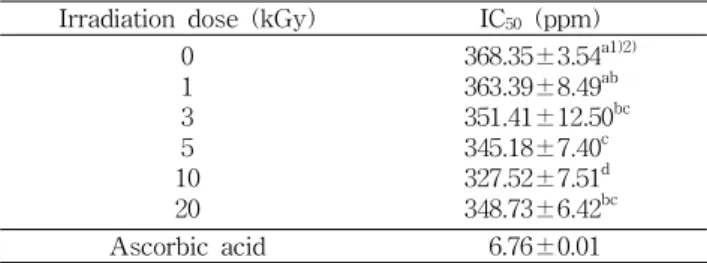
감마선 조사된 버찌 추출물의 DPPH radical 소거능을 측
정한 결과는 Table 2에 나타내었다. DPPH radical 소거능은 대조군에 대하여 50%의 저해능을 나타내는 농도인 IC
50값으 로 나타냈으며, 10 kGy조사구가 327.52 ppm으로 가장 낮은 IC
50값을 나타내 활성이 가장 좋고, 0 kGy 조사구가 368.35 ppm으로 가장 높은 IC
50값을 나타내 가장 활성이 낮았다.
조사선량에 비례한 활성의 증가는 없었지만 대체적으로 비 조사구보다는 조사구에서 낮은 IC
50값을 나타내어 감마선 조사에 따른 radical 소거능의 증가를 확인할 수 있었다.
Jeon 등(32)의 연구에서는 감마선 조사가 오미자의 생리 활성과 색상 변화에 미치는 영향을 조사한 결과, 10 kGy 감 마선 조사구에서 18% 정도의 전자공여능 증가를 나타내었 다. 또한 Jeong 등(33)의 연구에서는 감귤 과피에 공유결합 되어 존재하는 페놀 화합물을 원적외선이 절단하여 유리되 어 페놀 함량이 증가되면서 DPPH radical 소거능의 증가에 영향을 준다고 보고하고 있다.
감마선 조사된 버찌의 reducing power
항산화 반응은 reductones가 제공하는 수소원자가 free radical 사슬을 분쇄함으로써 시작되는데 환원력은 철 이온 의 환원력(Fe
3+가 Fe
2+로 변화)에 대한 대상 물질의 항산화력 을 측정하는 것으로서 항산화 능력의 중요한 지표가 된다(34).
감마선 조사된 버찌 추출물의 환원력은 시료를 1~10 mg/
mL까지 농도를 달리하여 측정한 결과를 Fig. 1에 나타내었
Table 3. Nitrite scavenging activity of irradiated 70% ethanol extract of flowering cherry fruit
Irradiation dose (kGy) Nitrite scavenging activity (%)
pH 1.2 pH 3.0 pH 4.2 pH 6.0
0 1 3 5 10 20
94.43±3.19
a1)2)90.72±1.03
b90.43±0.72
b89.20±1.26
b88.27±1.79
b88.15±0.92
b90.85±0.86
a89.81±3.88
ab89.66±2.28
ab85.45±2.52
c87.19±3.49
ab87.86±2.02
ab79.76±4.06
ab81.91±1.95
a76.92±0.97
bc73.35±1.68
c78.64±1.43
ab73.07±1.86
c52.75±2.25
a51.45±0.56
a45.90±0.98
b38.55±0.57
c40.84±1.68
c34.43±2.82
dAscorbic acid 100.00±0.00 99.07±2.03 97.23±1.14 89.33±0.42
1)
Values with different letter within a same column (a-d) differ significantly (p<0.05) except ascorbic acid.
2)
Values are mean±SD (n=3).
Table 4. FRAP value of irradiated 70% ethanol extract of flowering cherry fruit
Irradiation dose (kGy) FRAP value (mM) 0 1
3 10 5 20
0.34±0.01
ab1)2)0.35±0.03
ab0.38±0.07
a0.32±0.02
ab0.34±0.02
ab0.31±0.01
bAscorbic acid 4.99±0.14
1)
Values with different letter within a same column (a,b) differ significantly (p<0.05) except ascorbic acid.
2)
Values are mean±SD (n=3).
다. 측정결과 5 mg/mL 이하의 농도에서는 비조사구에 비해 조사구에서 높은 활성을 나타내었고 전체적으로는 20 kGy 조사구에서 대체적으로 높은 환원력 곡선을 나타내었다. 0
~20 kGy로 감마선 조사된 아가리쿠스 버섯의 환원력 측정 결과, 0.5~7.5 mg/mL 농도에서 5 kGy 조사구에 비해 0, 2.5, 10, 15 및 20 kGy 조사구에서 유의적으로 높은 활성을 나타내었다고 보고하고 있으며(35), Ahn 등(36)은 phytic acid의 환원력이 감마선 조사에 의해 유의적으로 증가하였 다고 보고하였다.
감마선 조사된 버찌의 아질산염 소거능
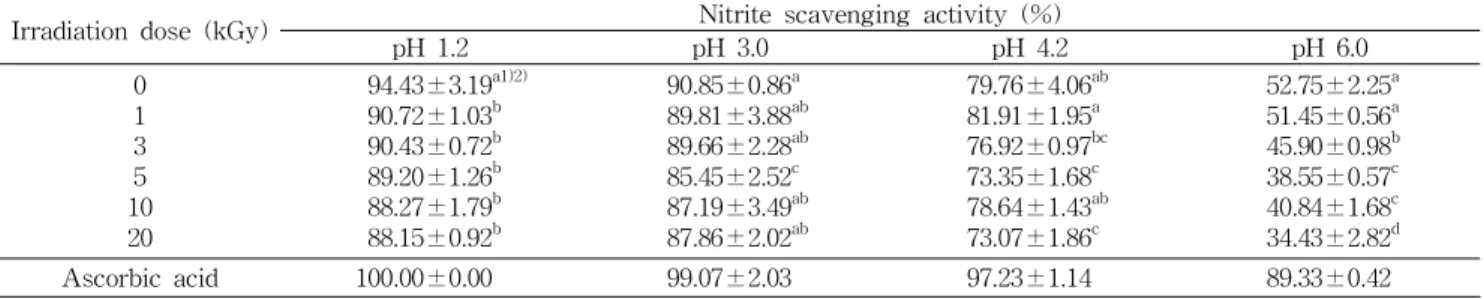
아질산염은 식품의 가공 및 저장 특히 수산물이나 식육제 품에 첨가하여 독소생성억제와 발색, 산패방지제로 널리 이 용되지만 그 자체가 독성을 나타내어 과량 섭취 시 혈액중의 헤모글로빈이 산화되어 methemoglobin을 형성하여 meth- emoglobin증 등 각종 중독을 일으키는 것으로 알려져 있으 며 아민류와 아질산염이 반응하면 발암성 물질인 nitros- amine을 생성하는데 이 과정은 pH가 낮은 조건에서 쉽게 일어나는 것으로 알려져 있다(37). 감마선 조사에 따른 버찌 추출물의 아질산염 소거능을 알아보기 위해 추출물의 농도 를 5 mg/mL로 하고, 인체 내의 pH 범위를 고려하여 pH를 1.2~6.0으로 달리한 뒤 활성을 측정하였다(Table 3). 그 결 과 pH 1.2 및 pH 3.0에서 0 kGy(비조사구)의 활성이 각각 94.43% 및 90.85%로 가장 높은 활성을 나타내었다. pH 4.2 에서는 1 kGy 조사구가 81.91%로 가장 높은 활성을 나타내 었으며 pH 6.0에서는 0 kGy 및 1 kGy 조사구가 51.45~
52.75%로 가장 높은 아질산 소거능을 나타내었다. 실험결과 버찌 추출물의 아질산염 소거능은 감마선 조사에 의한 활성 증가는 나타나지 않았으며, 쉽게 아질산염이 생성된다고 판 단되는 낮은 pH조건인 pH 4.2 이하의 pH에서 조사구 및 비조사구 모두 5 mg/mL의 농도에서 73~94% 이내의 높은 소거능을 나타내 pH 의존적인 아질산염 소거능을 보였다.
Kim 등(31)의 연구에서 본 연구의 결과와 유사하게 복분자 에탄올 추출물의 아질산염 소거능이 감마선 조사에 따른 유 의적 차이는 없었으나 위내 pH 조건과 비슷한 pH 1.2에서 높은 활성을 나타내어 생체 내에서 효과적으로 아질산염 소 거작용을 할 것으로 추측하였다. 또한 Byun 등(38)은 감마
선 조사된 물 및 에탄올 추출 한약재의 아질산염 소거능 측 정결과 10 kGy 의 감마선 조사에 의해 유의적 차이를 나타내 지 않았다고 보고하고 있다. Liu 등(39)의 연구에서 단버찌 적색색소의 아질산염 소거효과를 측정한 결과 최대 96.45%
의 높은 활성을 나타내었다고 보고와 본 연구결과를 토대로, 버찌추출물의 효과적인 아질산염 소거작용을 기대할 수 있 을 것으로 사료된다.
감마선 조사된 버찌의 FRAP value
FRAP 방법은 총 항산화능을 측정하는 방법으로 낮은 pH 에서 환원제에 의해 ferric tripyridyltriazine(Fe
3+-TPTZ) 복 합체가 ferrous tripyridyltriazine(Fe
2+-TPTZ)으로 환원되 는 원리를 이용한 것으로 대부분의 항산화제가 환원력을 가 지고 있다는 점에 착안하여 고안되어진 방법이다(28). 감마 선 조사에 따른 버찌 추출물의 FRAP value를 시료 농도를 1 mg/mL로 하여 측정하였다(Table 4). 그 결과 3 kGy 조사 구에서 0.38 mM로 가장 높은 값을 나타내었고 20 kGy 조사 구에서는 0.31 mM로 가장 낮은 FRAP값을 나타내었다.
Song 등(40)은 연구에서 야채주스에 감마선 조사를 실시
한 결과 3 kGy를 조사한 당근주스의 FRAP 값이 931.3 μM
에서 1047.3 μM로 비조사구보다 116 μM만큼 증가하였고,
5 kGy 조사구에서는 3 kGy 조사구보다는 낮으나 비조사구
보다는 높은 FRAP값을 나타내었다고 보고하고 있으며,
Ahn 등(41)의 연구에서도 배추에 감마선 조사를 실시한 결
과 0.5 kGy 조사구에서 비조사구보다 높은 FRAP값을 나타
내었다고 보고하고 있다.
요 약
본 연구는 폐자원으로 버려지는 버찌의 활용 증대방안 모 색을 위한 기초자료 마련을 위해 버찌의 에탄올 추출물에 0~20 kGy 선량으로 감마선 조사를 실시하고, 이에 따른 항 산화활성 변화를 측정하였다. 총 폴리페놀 함량 측정결과, 10 kGy 조사구에서 30.35 mg/g으로 가장 높은 값을 나타내 었으나 감마선 조사에 따른 일정한 증가나 감소의 경향은 나타내지 않았다. DPPH radical 소거능 측정결과 10 kGy 조사구에서 327.52 ppm으로 가장 낮은 IC
50값을 나타내 가장 높은 활성을 나타내었으며 대체적으로 비조사구보다는 조 사구에서 높은 활성을 나타내었다. 환원력 측정 결과, 2.5 mg/mL 이하 농도에서 비조사구에 비해 조사구에서 높은 활성을 나타내었고 20 kGy 조사구에서 대체적으로 높은 환 원력을 나타내었다. 아질산염 소거능을 측정한 결과 pH 4.2 이하의 pH에서 조사구 및 비조사구 모두 73~94% 이내의 높은 소거능을 나타내 pH 의존적인 아질산염 소거능을 보였 으나 조사에 따른 활성 증가는 나타내지 않았다. FRAP value를 측정결과 3 kGy 조사구에서 0.38 mM로 가장 높은 활성을 나타내었다. 결론적으로 버찌 에탄올 추출물에 대한 감마선 조사는 일부 선량에서 추출물의 항산화 활성 증가를 나타내며, 사용목적에 따른 적정 선량의 감마선 조사는 생리 활성물질의 증가를 유도하여 산업적인 면에서 효율적으로 이용될 수 있을 것으로 사료된다.
감사의 글
이 논문은 2010년 정부(교육과학기술부)의 재원으로 한국 연구재단의 지원을 받아 수행된 연구[NRF-355-2010-1- F00042]의 일부로 이에 감사드립니다.
문 헌