건설장비 안전사고 저감을 위한 위험성평가
전현우․정인수
*․ 이찬식
†인천대학교 도시건축학부․*한국건설기술연구원 (2013. 7. 16. 접수 / 2013. 10. 15. 채택)
Risk Assessment for Reducing Safety Accidents caused by Construction Machinery
Hyun Woo Jeon․In Su Jung
*․Chan Sik Lee
† Division of Architecture and Urban Design, Incheon National University*Korea Institute of Construction Technology (Received July 16, 2013 / Accepted October 15, 2013)
Abstract : Construction machinery has been utilized to carry out construction works effectively. Using construction machinery enables a builder to reduce the time and the cost needed for the construction, but the fatal accident caused by it has been increased. This study is intended to identify risk magnitude of accident by kind of construction machinery through interviews with experts. Construction machineries surveyed in this research are excavator, tower crane, lift, mobile crane and forklift, those are the machinery which accident occurs more often than the other machinery. To evaluate the risk of the accidents identified, risk category was determined according to the US DOD system safety program (MIL-STD-882B) considering the risk degree and intensity. As a result, accident occurred in the process of material transport
& handling was found to be the most dangerous. On the other hand, the accidents caused by the defective machinery and the poor safety gear were considered to be less dangerous relatively. The risk category by type of construction machinery suggested in this study is expected to provide the basic data in developing the safety guidance for construction project.
Key Words : risk assessment, construction machinery, safety accidents
†Corresponding Author: Chan Sik Lee, Tel: +82-32-835-8477, E-mail: [email protected]
1. 서 론
1.1.
연구의 배경 및 목적최근 건설 산업은 기술 및 공법의 눈부신 발달로 고층 화․대형화 추세가 강하며, 효율적인 사업관리를 위해서 대형 건설장비를 이용한 작업이 증가하고 있다. 건설장비의 증가로 생산성 향상, 공기단축, 원가절감 등의 효과를 가져 왔지만 근로자가 불안전한 상태에 노출은 심해지고 있으 며, 사고사례도 많아지고 있다1).
한국산업안전보건공단의 2011년 산업별 재해 발생현황 을 보면, 전체 산업재해 사망자는 총 2,114명이고, 그 중 건 설업에서 사망자가 621명으로 나타났다. 최근 5년간(2007 년~2011년) 기인물에 의한 사망자 1,689명 중 327명(19.36%) 이 각종 건설장비로 인한 것으로 나타났다. 건설현장은 높 은 곳에서 작업이 많이 이루어지고 각종 건설장비를 사용 함으로써 수많은 재해발생요인이 잠재되어 있으며, 재해가 일단 발생하면 중대재해로 이어질 가능성이 커서 건설장 비에 대한 철저한 안전관리는 매우 중요하다.
한국산업안전보건공단에서는 1999년 건설장비로 발생되 는 재해를 예방하기 위하여 “건설기계 표준안전 작업지침”
을 공표한 바 있다. 그러나 건설장비 재해 예방을 위한 노
력에도 불구하고 건설장비 재해는 매년 증가 추세에 있다.
이 연구에서는 건설장비로 인한 재해를 줄이는데 도움을 주고자 건설현장에서 발생한 재해사례 조사와 위험성 평 가를 통해 건설장비별 작업에 따른 각각의 위험성 등급을 평가하여 안전한 건설장비 운용을 위한 기초자료로 제공하 고자 한다.
1.2.
연구의 범위 및 방법이 연구에서는 산업재해 중 건설장비를 대상으로 최근 5년간(2007년~2011년) 발생된 중대재해사례 중 사망재해 를 조사, 분석하였다. 또한, 건설장비별 재해 발생 가능성과 심각성을 규명하기 위해 위험성 평가를 실시하였고, 그에 따른 위험도를 산정, 결정하고자 한다. 구체적인 연구방법은 다음과 같다.
첫째, 건설장비사고 관련 문헌과 재해통계자료를 분석 하여 연구의 방향을 수립한다.
둘째, 최근 5년간 사망 재해율이 비교적 높은 건설장비 (굴삭기, 타워크레인, 이동식크레인, 리프트, 지게차)를 선 정하여 특징을 조사한다.
셋째, 선행연구 및 건설장비 중대재해사례를 통하여 사 고유형을 도출하고 전문가 면담을 통해 사고유형의 적정
성을 확인한다.
넷째, 건설장비 운영에 따른 위험도를 결정하기 위해 서울․인천․경기지역의 15층 이상 규모 아파트 신축공 사현장 실무자 및 아파트 시공경험이 있는 현장관리자(현 장소장, 현장기사, 안전관리자 및 장비운전자 등)를 대상 으로 설문조사를 실시한다.
다섯 번째, 설문조사에서 도출된 위험발생 가능성과 심 각성을 통하여 위험성평가를 실시하고, 정량적인 위험등 급을 산정, 결정한다.
2. 이론적 고찰
2.1.
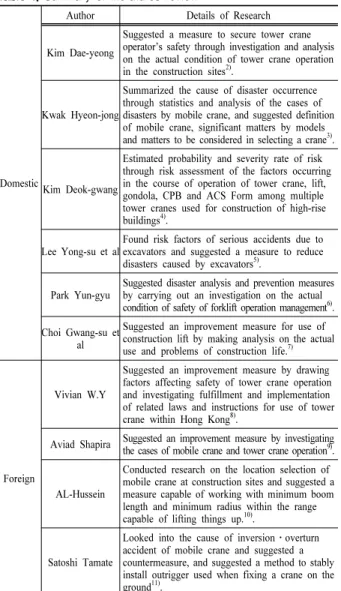
선행연구 고찰선행연구를 고찰한 결과 건설장비의 안전사고와 관련된 연구들은 장비 재해사례를 조사하고 원인을 분석하여 재해 예방 및 저감대책을 제시하고 있으나, 건설장비별 작업 위험의 빈도와 강도를 산정한 연구는 미흡한 실정이다.
Table 1. Summary of literatures review
Domestic
Author Details of Research
Kim Dae-yeong
Suggested a measure to secure tower crane operator’s safety through investigation and analysis on the actual condition of tower crane operation in the construction sites
2).
Kwak Hyeon-jong
Summarized the cause of disaster occurrence through statistics and analysis of the cases of disasters by mobile crane, and suggested definition of mobile crane, significant matters by models and matters to be considered in selecting a crane
3).
Kim Deok-gwang
Estimated probability and severity rate of risk through risk assessment of the factors occurring in the course of operation of tower crane, lift, gondola, CPB and ACS Form among multiple tower cranes used for construction of high-rise buildings
4).
Lee Yong-su et al
Found risk factors of serious accidents due to excavators and suggested a measure to reduce disasters caused by excavators
5).
Park Yun-gyu
Suggested disaster analysis and prevention measures by carrying out an investigation on the actual condition of safety of forklift operation management
6). Choi Gwang-su et
al
Suggested an improvement measure for use of construction lift by making analysis on the actual use and problems of construction life.
7)Foreign
Vivian W.Y
Suggested an improvement measure by drawing factors affecting safety of tower crane operation and investigating fulfillment and implementation of related laws and instructions for use of tower crane within Hong Kong
8).
Aviad Shapira Suggested an improvement measure by investigating the cases of mobile crane and tower crane operation
9).
AL-Hussein
Conducted research on the location selection of mobile crane at construction sites and suggested a measure capable of working with minimum boom length and minimum radius within the range capable of lifting things up.
10).
Satoshi Tamate
Looked into the cause of inversion․overturn accident of mobile crane and suggested a countermeasure, and suggested a method to stably install outrigger used when fixing a crane on the ground
11).
2.2.
건설장비의 특징2.2.1. 굴삭기
국토교통부의 건설기계관리법 시행령은 굴삭기는 무한 궤도 또는 타이어식으로 굴삭장치를 가진 자체 중량 1톤 이상의 것을 일컫는다.
2.2.2. 크레인
국토교통부의 건설기계관리법 시행령은 크레인을 “훅 이나 기타의 달기기구를 사용하여 화물의 권상과 이송을 목 적으로 일정한 작업 공가나 내에서 반복적인 동작이 이루 어지는 기계” 라고 정의하고 있다. 크레인은 Table 1과 같이 타워크레인(T형, L형), 이동식크레인, 천장식 크레인으로 나뉜다12).
2.2.3. 리프트
산업안전보건기준에 관한 규칙 제132조(양중기)는 “리 프트 란 동력을 사용하여 가이드 레일을 이용하여 상하로 움직이는 운반구를 의미하며 사람이나 화물을 운반하는 것을 목적으로 하는 기계 설비로서 건설용 리프트 및 간 이리프트를 말한다.” 로 규정하고 있다(Table 3 참조).
2.2.4. 지게차
국토교통부의 건설기계관리법 시행령은 지게차를 “타 이어식으로써 들어 올리는 장치를 가진 것” 이라고 규정 되어 있다. 지게차는 차체의 앞에 화물적재용 포크와 포크 승강용 마스트를 갖추고 포크 위에 화물을 적재하여 운반 하고, 포크의 승강작용을 이용하여 적재 또는 하역작업을 하는 운반기계이다.
2.3.
재해관련용어 정리2.3.1. 산업재해
“산업재해” 라 함은 근로자가 업무에 관계되는 건설
Table 2. Type of crane and definition
Type Definition
Tower crane
T A rotating-boom crane with horizontal jib on top of vertical tower
L A rotating-boom crane with Luffing jib on top of vertical tower
Mobile crane
A crane, without need of fixed gravity runway for safety, which runs, hoists or puts down and combines with the mast (tower assembly)
Overhead crane A jib crane moving along the bridge or with load adjustment device hung on hoist or crab
Table 3. Type of lift
Kind Definition
for construction
The power machinery to transport the cargo with the carrier which moves vertically along the rail or others with similar structure and function for construction
Temporary
Those for transporting small cargo with the structure similar
with elevator and the floor area shall be 1m or less and the
ceiling height 1.2m or less
물․설비․원재료․가스․증기․분진 등에 의하거나 작업 기타업무에 기인하여 사망 또는 부상하거나 질병에 이환 되는 것을 말한다.
2.3.2. 중대재해
“중대재해”라 함은 산업재해 중 사망 등 재해 정도가 심 한 것으로 고용노동부령에서 정한 재해로써, 사망자가 1인 이상 발생한 재해, 3개월 이상의 요양이 필요한 부상자가 동시에 2명이상 발생한 재해, 부상자 또는 직업성질병자 가 동시에 10명 이상 발생한 재해를 말한다.
2.4.
재해사례 분석2.4.1. 건설재해현황
한국산업안전보건공단에서는 분기별로 발생한 산업재 해를 발표하고 있으며, Table 4는 2007년부터 2011년까지의 건설업 업무상사고 내용이다.
건설업의 연평균 재해자수는 21,161명이며, 연평균 사 망자는 627명으로 나타났다. 2009년에 사망자 수가 다소 감소하였지만 그 이후 다시 꾸준히 증가하고 있다.
2.4.2. 기인물별 산업재해 현황
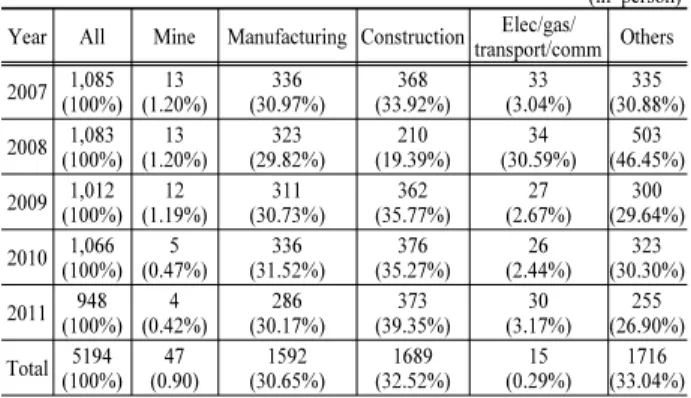
최근 5년간(2007년~2011년) 기인물에 따른 사망재해 현 황은 Table 5와 같다.
여기서, 건설업에서 기인물에 의한 사망재해자 1,689명 중 건설장비에 의한 사망재해자는 327명으로 전체 건설 사망 재해의 19.36%으로 나타났다. 건설장비별 재해현황은 Table 6과 같다.
Table 4. Accident occurred in construction work Year Total No of
victim Death toll Variation
Total(%) Death toll(%)
2007 19,050 630 - -
2008 20,473 669 7.47 6.19
2009 20,998 606 2.56 -9.42
2010 22,504 611 7.17 0.83
2011 22,782 621 1.24 1.64
mean 21,161 627 - -
Table 5. Number of accident causing death
(in person) Year All Mine Manufacturing Construction Elec/gas/
transport/comm Others 2007 1,085
(100%) 13 (1.20%)
336 (30.97%)
368 (33.92%)
33 (3.04%)
335 (30.88%) 2008 1,083
(100%) 13 (1.20%)
323 (29.82%)
210 (19.39%)
34 (30.59%)
503 (46.45%) 2009 1,012
(100%) 12 (1.19%)
311 (30.73%)
362 (35.77%)
27 (2.67%)
300 (29.64%) 2010 1,066
(100%) 5 (0.47%)
336 (31.52%)
376 (35.27%)
26 (2.44%)
323 (30.30%) 2011 948
(100%) 4 (0.42%)
286 (30.17%)
373 (39.35%)
30 (3.17%)
255 (26.90%) Total 5194
(100%) 47 (0.90)
1592 (30.65%)
1689 (32.52%)
15 (0.29%)
1716 (33.04%)
Table 6. Accidents by construction machinery
(Number of accident) Year Excavator Mobile
crane Lift Tower
crane Forklift Total
2007 0 24 2 15 7 48
2008 2 3 2 1 10 18
2009 10 12 1 5 2 30
2010 13 15 2 4 3 37
2011 10 10 1 6 3 30
Total 35 64 8 31 25 163
Table 7. Accidents by type of accident category
(Number of accident) Category Excavator Mobile
crane Lift Tower
crane Forklift Total
Fall 5 20 5 10 2 42
Overturn 6 14 - 7 10 37
Collision
Bump 14 9 1 4 8 36
Fall Fly - 13 1 6 - 20
Trapped
Wrapped 7 5 1 1 5 19
Collapse
Destroyed 1 - - 2 - 3
Others 2 3 - 1 - 6
Total 35 64 8 31 25 163
2.4.3. 건설장비 재해사례 분석
최근 5년간(2007년~2011년) 한국산업안전보건공단에서 발표한 163건의 중대재해사례를 기반으로 재해발생형태를 분석하였다(Table 7 참조).
재해발생 형태별로는 추락이 42건으로 가장 많았으며, 다음으로 전도․전복 37건, 충돌․접촉 36건순으로 발생 되었다.
2.5.
건설장비의 위험성평가 방법2.5.1. 평가방법에 대한 고찰
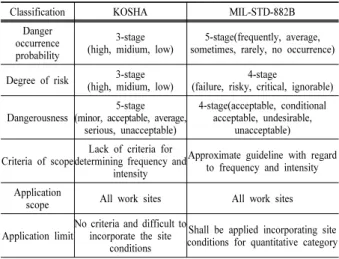
Table 7은 한국과 미국의 대표적인 위험성평가 방법을 정리한 것이다. 한국산업안전보건공단의 “안전보건경영시 스템 구축에 관한 지침(한국산업안전보건공단, 2012)의 위 험도 산정방식은 모든 사업장을 대상으로 적용 가능하지만, 발생빈도 및 발생강도에 대한 구분이 미흡하여 옥외작업이 많고 복합공종이 대부분인 점을 반영하지 못한다. 미 국 방성 시스템 안전프로그램인 MIL-STD-882B는 빈도와 강도 의 개략적 기준을 제시하고 있다. 건설현장의 위험도를 정 학하게 산정하기 위해서는 각 현장의 특성에 맞는 정의와 기준이 요구된다13).
이 연구에서는 2개의 방법 중, 과거의 재해사례 자료를 통계적으로 이용할 수 있고, 위험 강도 및 발생가능성을 세부적으로 구분하고 있는 미 국방성 시스템 안전프로그 램인 MIL-STD-882B이 건설장비에 따른 위험성 평가에 적절하다고 판단하여 이를 적용하였다.
2.5.2. 위험성평가 방법 개요
14)MIL-STD-882B는 건설장비 등의 위험성을 평가하기 위해 서 위험강도와 위험발생확률을 다음과 같이 규정하고 있다.
① 위험강도(Hazard severity)
위험강도는 재해 발생의 결과를 피해 손상 정도로 구 분한 것으로서 다음과 같이 4단계로 나눈다.
첫째, 파국(Catastrophic)은 환경, 사람의 과오, 절차의 결함, 설계의 특성 및 서브시스템(sub-system)이나 요소의 고장 또는 기능불량 등 시스템의 성능을 저하시켜, 사람의 사망 또는 장치의 손실을 초래하여 그 기능을 상실시키는 상태를 의미한다.
둘째, 중대(Critical)는 시스템의 성능을 저하시키지만 사 람의 부상 및 시스템의 중대한 손상을 초래하지 않고 대처 또는 제어할 수 있는 상태를 의미한다.
셋째, 경미(Marginal)는 시스템의 성능을 저하시키지만 사 람의 부상 및 시스템의 중대한 손상을 초래하지 않고 대처 또는 제어할 수 있는 상태를 의미한다.
넷째, 무시(Negligible)는 시스템의 성능을 그다지 저하시 키지도 않고, 시스템의 기능, 손해 및 사람의 부상도 초래 하지 않는 상태를 의미한다.
② 위험발생확률(Hazard Probability)
위험발생확률은 위험으로 인해 사고가 발생할 수 있는 가능성으로, 사고 빈도를 의미한다. Table 8은 4단계의 위 험강도와 5단계의 위험발생확률을 매트릭스화한 것이다.
Table 8. Comparison of risk evaluation method
Classification KOSHA MIL-STD-882B
Danger occurrence probability
3-stage (high, midium, low)
5-stage(frequently, average, sometimes, rarely, no occurrence)
Degree of risk 3-stage (high, midium, low)
4-stage
(failure, risky, critical, ignorable)
Dangerousness
5-stage (minor, acceptable, average,
serious, unacceptable)
4-stage(acceptable, conditional acceptable, undesirable,
unacceptable)
Criteria of scope
Lack of criteria for determining frequency and
intensity
Approximate guideline with regard to frequency and intensity Application
scope All work sites All work sites
Application limit
No criteria and difficult to incorporate the site
conditions
Shall be applied incorporating site conditions for quantitative category
Table 9. Risk assessment matrix Intensity
Probability Failure Risky Minor Ignorable
Frequently 1 1 1 3
Average 1 1 2 3
Sometimes 1 2 3 4
Rarely 2 2 3 4
No occurrence 3 3 3 4
Risk class 1 : Unacceptable Risk class 2 : Undesirable
Risk class 3 : Acceptable with review Risk class 4 : Acceptable without review
3. 건설장비에 대한 위험성평가
3.1.
건설장비에 대한 위험성평가이 연구에서는 건설장비의 운행에 따른 위험성 평가를 실 시하기 위해 국내․외 문헌과 최근 5년간(2007년~2011년)의 중대재해 사례를 분석하여 총 54개의 건설장비별 사고 유 형을 식별하였다. 최종 사고유형을 도출하기에 앞서 1차적 으로 식별한 사고유형에 대한 적정성을 검증하기 위해 전문 가 면담을 실시하였다. 면담조사는 2013년 3월 18일부터 동 년 4월 18일까지 시공업체 안전관리 및 교육담당자 2명과 한국산업안전보건교육원 교수 3명을 대상으로 실시하였다.
전문가 면담 결과, 굴삭기의 경우 ‘굴삭기 버켓이 연결 부에서 탈락되면서 낙하’ 와 ‘굴삭기 버켓 후크 해지장치 미설치로 달기로프 이탈로 자재 낙하’ 사고유형은 의미가 중 복되어 ‘작업 전 시운전 및 기계장치 미 점검으로 인한 작업 중 주변근로자 충돌, 협착’ 사고유형으로 통합하였다. 타워 크레인의 경우 ‘화물 인양 시 시운전을 하지 않고 작업 중 기계고장으로 인양물 낙하’ 와 ‘타워크레인 안전장치 고 장으로 자재 인양 중 낙하’ 사고유형은 의미가 중복되어
‘작업 전 무부하 시험 및 기계장치 미 점검으로 인한 자재 낙하’ 사고유형으로 통합하였다. 이동식크레인의 경우 ‘과 부하방지장치 고장으로 자재 인양 중 붐대 파단’ 유형은
‘인양 전 기계장치 미 점검으로 인한 자재 낙하’ 사고유형 과 의미가 중복되어 삭제하였다. 리프트의 경우 ‘안전장치 고장으로 인한 탑승구 상승 중 마스트를 넘어 이탈 및 낙하’
사고유형은 ‘리프트 안전장치 고장으로 운행 중 운반구 낙하’ 사고유형과 의미가 중복되어 삭제하였다.
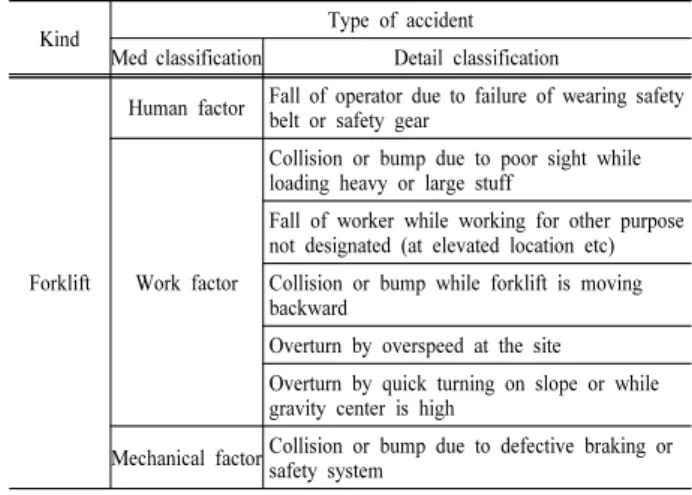
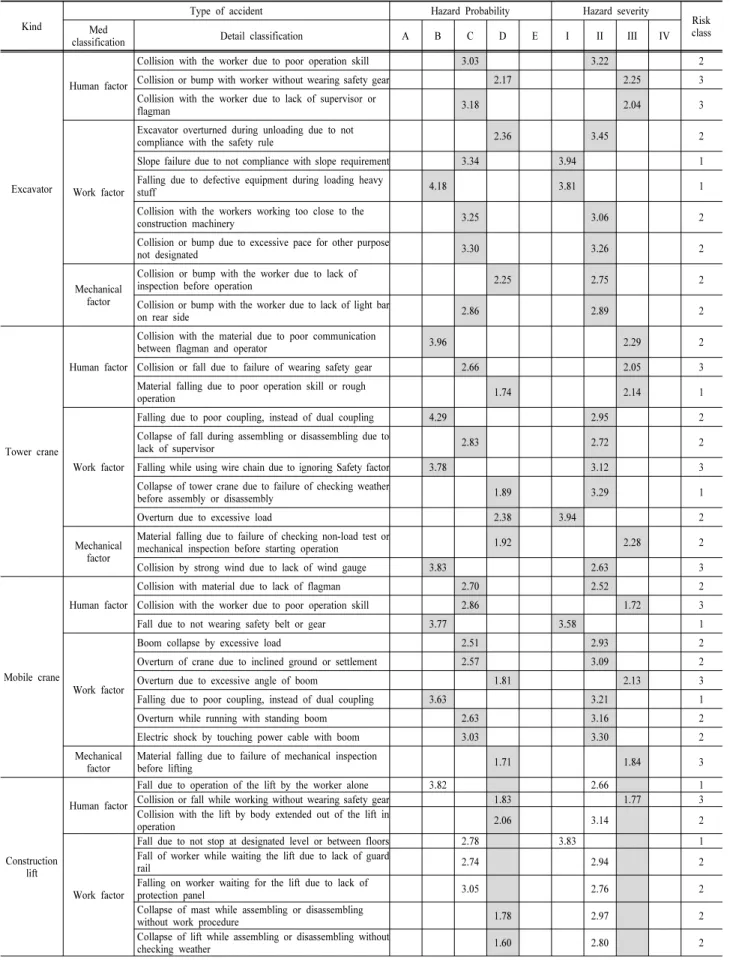
전문가 면담을 통해 최종적으로 선정된 50개의 사고유형 들은 요인의 성격을 고려하여 Table 10과 같이 구분하였다.
Table 10. Accidents by type of construction machinery
Kind Type of accident
Med classification Detail classification
Excavator
Human factor
Collision with the worker due to poor operation skill
Collision or bump with worker without wearing safety gear
Collision with the worker due to lack of supervisor or flagman
Work factor
Excavator overturned during unloading due to not compliance with the safety rule
Slope failure due to not compliance with slope requirement
Falling due to defective equipment during loading heavy stuff
Collision with the workers working too close to the construction machinery
Collision or bump due to excessive pace for other purpose not designated
Mechanical factor
Collision or bump with the worker due to lack of inspection before operation
Collision or bump with the worker due to lack
of light bar on rear side
Table 10. Accidents by type of construction machinery(continued)
Kind Type of accident
Med classification Detail classification
Tower crane
Human factor
Collision with the material due to poor communication between flagman and operator Collision or fall due to failure of wearing safety gear
Material falling due to poor operation skill or rough operation
Work factor
Falling due to poor coupling, instead of dual coupling
Collapse of fall during assembling or disassembling due to lack of supervisor Falling while using wire chain due to ignoring Safety factor
Collapse of tower crane due to failure of checking weather before assembly or disassembly
Overturn due to excessive load
Tower
crane Mechanical factor
Material falling due to failure of checking non-load test or mechanical inspection before
starting operation
Collision by strong wind due to lack of wind gauge
Mobile crane
Human factor
Collision with material due to lack of flagman Collision with the worker due to poor operation skill
Fall due to not wearing safety belt or gear
Work factor
Boom collapse by excessive load Overturn of crane due to inclined ground or settlement
Overturn due to excessive angle of boom Falling due to poor coupling, instead of dual coupling
Overturn while running with standing boom Electric shock by touching power cable with boom
Mechanical factor Material falling due to failure of mechanical inspection before lifting
Construction lift
Human factor
Fall due to operation of the lift by the worker alone
Collision or fall while working without wearing safety gear
Collision with the lift by body extended out of the lift in operation
Work factor
Fall due to not stop at designated level or between floors
Fall of worker while waiting the lift due to lack of guard rail
Falling on worker waiting for the lift due to lack of protection panel
Collapse of mast while assembling or disassembling without work procedure Collapse of lift while assembling or disassembling without checking weather
Mechanical factor
Falling due to failure of safety device Falling of carrier due to deformation of master caused by inappropriate interval of wall or support
Forklift Human factor
Fall of worker due to standing on inappropriate location
Fall due to poor operation by unauthorized person (without license)
Collision with the worker due to lack of flagman
Table 10. Accidents by type of construction machinery(continued)
Kind Type of accident
Med classification Detail classification
Forklift
Human factor Fall of operator due to failure of wearing safety belt or safety gear
Work factor
Collision or bump due to poor sight while loading heavy or large stuff
Fall of worker while working for other purpose not designated (at elevated location etc) Collision or bump while forklift is moving backward
Overturn by overspeed at the site Overturn by quick turning on slope or while gravity center is high
Mechanical factor Collision or bump due to defective braking or safety system
Table 11. Survey summary
Classification Description
Period 2013. 4. 15 ∼ 2013. 5. 16
Region Seoul, Incheon and Gyeonggi area
Interviewees
10 site managers 17 site engineers 17 safety managers 21 construction machinery operators
career 3 ∼ 20 years
3.2.
위험등급 결정아파트 신축공사 경험이 있는 실무자 65명을 대상으로 설문조사를 실시하여 위험강도 및 위험발생확률을 산정 하였다. Table 9에 기술한 바와 같이, 위험발생확률은 A~E 의 5개 등급으로, 위험강도는Ⅰ~Ⅳ의 4개의 등급 중에서 판단하도록 하였다.
설문조사는 서울․인천․경기지역의 15층 이상 규모의 아파트 신축공사현장 실무자 및 아파트 시공경험이 있는 현장관리자를 대상으로 수행하였다(Table 11 참조).
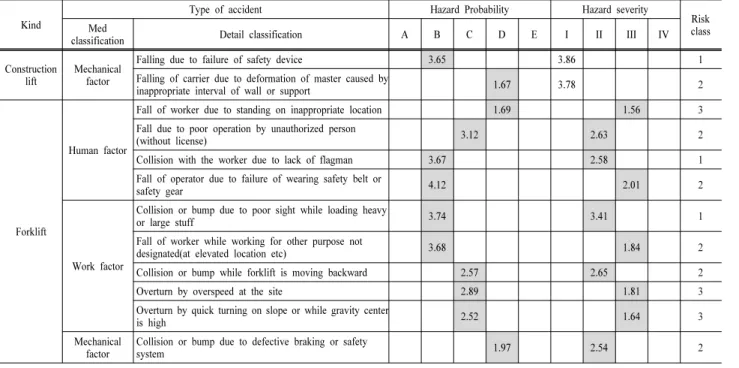
설문지는 e-mail 및 직접 방문을 통해 90부를 배포하여 65부를 회수하였다(회수율 72.2%). 미 국방성 시스템 안 전프로그램인 “MIL-STD-882B”를 근간으로 2.5절에 기술 한 방법과 절차에 따라 위험발생확률과 위험강도를 기재 하도록 하였다. 회수한 65부의 설문지를 분석 정리한 결 과는 Table 12와 같다.
4. 건설장비에 대한 위험성분석
4.1.
위험등급1
굴삭기의 경우 위험발생확률 3.34, 위험강도 3.94로 평 가된 ‘굴착법면의 굴착구배 미준수로 인한 법면 붕괴’ 사 고와 위험확률 4.18, 위험강도 3.81로 평가된 ‘중량물 인 양 시 불량한 달기구 사용으로 인한 낙하’ 사고는 위험발 생확률이 보통 이상이며, 위험강도는 파국(I)과 중대(II) 수준인 것으로 나타나 굴삭기의 사고 유형 중 가장 위험 한 것으로 분석되었다.
Table 12. Risk Assessment of construction machinery Kind
Type of accident Hazard Probability Hazard severity
Risk class Med
classification Detail classification A B C D E I II III IV
Excavator
Human factor
Collision with the worker due to poor operation skill 3.03 3.22 2
Collision or bump with worker without wearing safety gear 2.17 2.25 3
Collision with the worker due to lack of supervisor or
flagman 3.18 2.04 3
Work factor
Excavator overturned during unloading due to not
compliance with the safety rule 2.36 3.45 2
Slope failure due to not compliance with slope requirement 3.34 3.94 1
Falling due to defective equipment during loading heavy
stuff 4.18 3.81 1
Collision with the workers working too close to the
construction machinery 3.25 3.06 2
Collision or bump due to excessive pace for other purpose
not designated 3.30 3.26 2
Mechanical factor
Collision or bump with the worker due to lack of
inspection before operation 2.25 2.75 2
Collision or bump with the worker due to lack of light bar
on rear side 2.86 2.89 2
Tower crane
Human factor
Collision with the material due to poor communication
between flagman and operator 3.96 2.29 2
Collision or fall due to failure of wearing safety gear 2.66 2.05 3
Material falling due to poor operation skill or rough
operation 1.74 2.14 1
Work factor
Falling due to poor coupling, instead of dual coupling 4.29 2.95 2
Collapse of fall during assembling or disassembling due to
lack of supervisor 2.83 2.72 2
Falling while using wire chain due to ignoring Safety factor 3.78 3.12 3
Collapse of tower crane due to failure of checking weather
before assembly or disassembly 1.89 3.29 1
Overturn due to excessive load 2.38 3.94 2
Mechanical factor
Material falling due to failure of checking non-load test or
mechanical inspection before starting operation 1.92 2.28 2
Collision by strong wind due to lack of wind gauge 3.83 2.63 3
Mobile crane
Human factor
Collision with material due to lack of flagman 2.70 2.52 2
Collision with the worker due to poor operation skill 2.86 1.72 3
Fall due to not wearing safety belt or gear 3.77 3.58 1
Work factor
Boom collapse by excessive load 2.51 2.93 2
Overturn of crane due to inclined ground or settlement 2.57 3.09 2
Overturn due to excessive angle of boom 1.81 2.13 3
Falling due to poor coupling, instead of dual coupling 3.63 3.21 1
Overturn while running with standing boom 2.63 3.16 2
Electric shock by touching power cable with boom 3.03 3.30 2
Mechanical factor
Material falling due to failure of mechanical inspection
before lifting 1.71 1.84 3
Construction lift
Human factor
Fall due to operation of the lift by the worker alone 3.82 2.66 1
Collision or fall while working without wearing safety gear 1.83 1.77 3
Collision with the lift by body extended out of the lift in
operation 2.06 3.14 2
Work factor
Fall due to not stop at designated level or between floors 2.78 3.83 1
Fall of worker while waiting the lift due to lack of guard
rail 2.74 2.94 2
Falling on worker waiting for the lift due to lack of
protection panel 3.05 2.76 2
Collapse of mast while assembling or disassembling
without work procedure 1.78 2.97 2
Collapse of lift while assembling or disassembling without
checking weather 1.60 2.80 2
Table 12. Risk Assessment of construction machinery(continued) Kind
Type of accident Hazard Probability Hazard severity
Risk class Med
classification Detail classification A B C D E I II III IV
Construction lift
Mechanical factor
Falling due to failure of safety device 3.65 3.86 1
Falling of carrier due to deformation of master caused by
inappropriate interval of wall or support 1.67 3.78 2
Forklift
Human factor
Fall of worker due to standing on inappropriate location 1.69 1.56 3
Fall due to poor operation by unauthorized person
(without license) 3.12 2.63 2
Collision with the worker due to lack of flagman 3.67 2.58 1
Fall of operator due to failure of wearing safety belt or
safety gear 4.12 2.01 2
Work factor
Collision or bump due to poor sight while loading heavy
or large stuff 3.74 3.41 1
Fall of worker while working for other purpose not
designated(at elevated location etc) 3.68 1.84 2
Collision or bump while forklift is moving backward 2.57 2.65 2
Overturn by overspeed at the site 2.89 1.81 3
Overturn by quick turning on slope or while gravity center
is high 2.52 1.64 3
Mechanical factor
Collision or bump due to defective braking or safety
system 1.97 2.54 2
타워크레인의 경우 위험확률 4.29, 위험강도 2.95로 평 가된 ‘인양물을 2줄걸이로 체결하지 않아 인양 중 흔들리 면서 낙하’ 사고와 위험확률 3.83, 위험강도 2.63으로 평 가된 ‘운전석에 풍속계 미설치로 작업 중 강풍에 의한 충돌’
사고는 자재 인양 시 보통 이상으로 발생되는 사고유형으로 위험강도 수준도 중대 이상인 것으로 나타났다.
이동식크레인의 경우 위험확률 3.77, 위험강도 3.58로 평가된 ‘고소작업자 안전대 미착용으로 인한 추락’ 사고는 위험발생확률이 보통 이상으로 발생되는 것으로 나타났 으며 위험강도 수준도 파국으로 평가되어 가장 위험한 사 고유형인 것으로 분석되었다.
건설용 리프트의 경우 위험확률 2.78, 위험강도 3.83으로 평가된 ‘각층 슬래브의 높이에 맞게 멈추지 않은 상태에서 탑승 중 추락’ 사고는 위험발생확률이 가끔 발생되는 것을 나타났으나, 위험강도수준은 파국으로 높게 평가되어 가 장 위험한 사고유형으로 분석되었다.
지게차의 경우 위험확률 3.67, 위험강도 2.58로 평가된
‘신호수 미 배치로 인한 작업 중 근로자와 충돌’ 사고는 위 험발생확률이 보통 이상인 것으로 나타났으나, 위험강도는 중대한 수준으로 나타났으며 ‘대형자재 적재 시 전방시야 불량으로 인한 충돌, 협착’ 사고유형은 위험확률 3.74, 위 험강도 3.41로 평가되어 다른 사고유형 보다 위험발생확 률과 위험강도 수준이 비교적 높게 나타나 지게차의 사고 유형 중 가장 위험한 것으로 분석되었다.
위험등급 1은 가장 우선적으로 안전한 운영 및 관리가 수행되어야 할 유형으로 시급한 해결책 마련이 요구될 사 고유형이다.
4.2.
위험등급2
굴삭기의 경우 위험발생확률 2.25, 위험강도 2.75로 평 가된 ‘작업 전 시운전 및 기계장치 미 점검으로 인한 주변 근로자 충돌, 협착’ 사고는 다른 사고유형 보다 위험발생 확률이 낮지만 사고발생 시 중대한 수준의 사고가 발생하는 것으로 분석되었다.
타워크레인의 경우 위험발생확률 2.38, 위험강도 3.94로 평가된 ‘정격하중 초과사용으로 인한 전도’ 사고는 위험발 생확률은 낮지만, 사고발생 시 중대한 수준의 사고가 발 생하는 것으로 분석되었다.
이동식크레인의 경우 위험발생확률 3.03, 위험강도 3.30으 로 평가된 ‘전력선 근처에서 작업 중 붐대가 전력선에 걸 리면서 감전’ 사고는 위험발생확률이 가끔 발생되는 것으 로 나타났으나, 위험강도 수준은 파국으로 높게 평가되었다.
건설용 리프트의 경우 위험발생확률 1.78, 위험강도 2.97 로 평가된 ‘설치․해체작업 시 작업계획서 미 작성 상태에 서 작업 중 마스트 붕괴’ 사고와 ‘설치․해체작업 전 기상 상태 미확인으로 리프트 붕괴’ 사고는 위험발생확률은 낮 지만, 사고발생 시 중대한 수준의 사고가 발생하는 것으로 분석되었다.
지게차의 겨우 위험발생확률 4.12, 위험강도 2.01로 평 가된 ‘안전벨트 및 보호장비 미착용으로 인한 운전자 추 락’ 사고는 위험발생확률이 보통 이상인 것으로 나타났으나, 사고발생 시 중대한 수준의 사고가 발생하는 것으로 분석되 었다. 위험발생확률 1.97, 위험강도 2.54로 평가된 ‘작업 시 제동장치 및 안전장치 결함으로 인한 근로자 충돌, 협착’
사고는 위험발생확률은 낮지만, 사고발생 시 중대한 수준의 사고가 발생하는 것으로 분석되었다.
위험등급 2는 바람직하지 못한 위험한 상태로 위험도를 줄이기 위한 활동이 계속적으로 이루어져야 하며, 작업절
차서 및 위험저감 대책을 수립하고 작업을 실시할 필요가 있다.
4.3
위험등급3
굴삭기의 경우 위험발생확률 2.17, 위험강도 2,.25로 평 가된 ‘작업지휘자 및 유도자 미 배치로 인한 근로자 충돌’
사고는 위험발생확률이 보통 이상인 것으로 나타났으며, 위 험강도 수준도 경미한 것으로 분석되었다.
타워크레인의 경우 위험발생확률 1.92, 위험강도 2.28 로 평가된 ‘작업 전 무부하 시험 및 기계장치 미 점검으로 인한 자재 낙하’ 사고는 위험발생확률과 위험강도 수준이 비교적 낮게 평가되어 위험등급 3으로 산정되었다.
이동식크레인의 경우 위험발생확률 1.81, 위험강도 2.13 으로 평가된 ‘붐의 각도를 과하게 올리거나 내리던 중 전도’
사고는 위험발생확률이 거의 발생하지 않을 것으로 나타 났으며, 위험강도 수준도 경미한 것으로 분석되었다.
건설용 리프트의 경우 위험발생확률 1.83, 위험강도 1.77 로 평가된 ‘개인보호구 미착용으로 인한 작업 중 부딪히 거나 추락’ 사고는 가 건설현장마다 근로자 개인보호구에 관련된 교육이 잘 수행되어져, 위험발생확률과 위험강도 수준이 낮게 분석되었다.
지게차의 경우 위험발생확률 1.69, 위험강도 1.55로 평 가된 ‘운전석 이외의 근로자 탑승으로 인한 근로자 추락’
사고는 위험발생확률이 거의 발생하지 않는 것으로 나타 났으며 위험강도 수준도 경미한 것으로 분석되었다.
위험등급 3은 통제아래 수용 가능한 사고유형으로써 위험을 줄이기 위한 노력을 일정 기준 한도 내에서 계속적 으로 실시하고 위험성 평가를 계속 실시하여 피해의 발생 가 능성을 더 구체적으로 파악하여 관리해야 할 사고유형이다.
5. 결 론
건설사업이 대형화 복잡화됨에 따라 기계화 시공을 통 한 효율적인 사업관리를 위하여 여러 종류의 다양한 건설장 비가 사용되고 있다. 건설기계화에 따라 경제성은 향상되고 있지만, 근로자의 위험노출은 점차 심해지고 있으며 사고 사례 또한 증가하고 있다.
이 연구에서는 선행연구를 고찰하여, 최근 5년간(2007년~
2011년) 중대재해사례 중 사망 재해율이 비교적 높은 건 설장비 중 굴삭기, 타워크레인, 이동식크레인, 건설용 리 프트 및 지게차로 인한 사고유형을 식별하였다. 식별된 사 고유형은 전문가 면담조사를 통해 적정성을 검증하였으며, 최종 확정된 사고유형에 대한 위험성평가를 실시하였다.
위험성평가 결과 건설장비별로 가장 위험한 사고유형은 다음과 같다.
굴삭기의 경우 ‘중량물 인양 시 불량한 달기구 사용으로 인한 낙하’ 사고, 타워크레인의 경우 ‘인양물을 2줄걸이로 체결하지 않아 인양 중 흔들리면서 낙하’ 사고 등이 가장 위 험한 것으로 나타났다.
이동식크레인의 경우 ‘고소작업자 안전대 미착용으로 인한 추락’ 사고, 건설용 리프트의 경우 ‘안전장치 고장으
로 운행 중 운반구 낙하’ 사고 등이 가장 위험한 것으로 나 타났다.
지게차의 경우 ‘대형자재 적재 시 전방시야 불량으로 인한 충돌, 추락’ 사고 등이 가장 위험한 것으로 나타났다.
향후에는 위험등급별 사고유형을 분석하여 재해를 저감 하기 위한 적절한 대안을 제시할 필요가 있다. 이러한 연구 한계점에도 불구하고 이 연구는 건설장비의 작업 위험도 를 객관적으로 분석하였다는데 의미가 있다.
감사의 글: 이 연구는 인천대학교 2012년도 자체연구비 지원에 의하여 수행되었음.
References
1) J. M. Seo and S. K. Kim, “The Study on Measures for Reducing Safety Accidents of Excavator”, Journal of the Korea Institute of Building Construction, Vol. 8, No. 3, pp.127~133, 2008.
2) D. Y. Kim, “A Fundamental Study on Safety Management for High-rise Building Tower Crane Operators”, Journal of Architectural Institute of Korea, Vol. 28, No. 2, pp.59~66, 2013.
3) H. Y. Kwak, “A Study on the Mobile Crane a Accident Case through the Analysis of Safety Measures”, Department of Industrial and Management Engineering, Graduate School, Myongji University, 2013.
4) T. K. Kim, “A Study on the Risk Assessment of Lifting Equipments using in the High-rise Building Constriction Work”, Department of Industrial and Management Engineering, Graduate School, Seoul National University of Science and Technology, 2013.
5) Y. S. Lee, Y. T. Gang, J. S. Kim and C. E. Kim, “The Study on the Accidents analysis and preventive Measures form a excavator”, Journal of Korea Safety Management & Science, Vol. 12, No. 3, pp.81~91, 2010.
6) Y. K. Park, “A Study on the Analysis and Prevention of Industrial Accident for Forklift”, Department of Industrial Engineering, Graduate School, Myongji University, 2003.
7) K. S. Choi, H. K. Kim and Y. S. Kim, “A Study on the Practical use Status and Problem Analysis of Construction Lifts”, Journal of Architectural Institute of Korea, Vol. 22, No.
2, pp.479~482, 2002.
8) V. W. Y. Tam and I.W. H. Fung, “Tower Crane Safety in the Construction Industry : A Hong Kong Study”, Journal of Safety Science Vol. 49, Science Direct, pp. 208~215, 2011.
9) A. Shapira, Gunnar Lucko and Clifford J. Schexnayder,
“Cranes for Building Construction Project”, Journal of Construction Engineering and Management, Vol. 131, No. 6, ASCE, pp. 690~700, 2007.
10) M. A. Hussein, S. Alkass and O. Moselhi, “Optimization Algorithm for Selection and Site Location of Mobile Cranes”, Journal of Construction Engineering and Management, Vol.
131, No. 5, ASCE, pp. 579~590, 2005.
11) S. Tamate, N. Suemasa and T. Katada “Analyse of Instability in Mobile Cranes due to Ground Penetration by Outrigger”, Journal of Construction Engineering and Management, Vol.
131, No. 6, ASCE, pp. 689~704, 2005.
12) H. H. Kim and G. Lee, “An Analysis of the Accident Types and Causes of Construction Cranes”, Journal of the Korea Institute of Building Construction, Vol. 7, No. 1, pp.109~112, 2007.
13) H. S. Kim, H. S. Lee and M. S. Park “Quantitative Risk Assessment Methodology for Construction Site”, Journal of Korea Institute of Construction Engineering and Management, pp.463~466, 2008.
14) Department of Defense “System Safety Program Requirements MIL-STD-882B”, 1977.