JKSCI
BST-IGT Model: Synthetic Benchmark Generation Technique Maintaining Trend of Time Series Data
★
Kyung Min Kim*, Jong Wook Kwak*
*Student, Dept. of Computer Engineering, Yeungnam University, Gyeongsan, Korea
*Professor, Dept. of Computer Engineering, Yeungnam University, Gyeongsan, Korea
[Abstract]
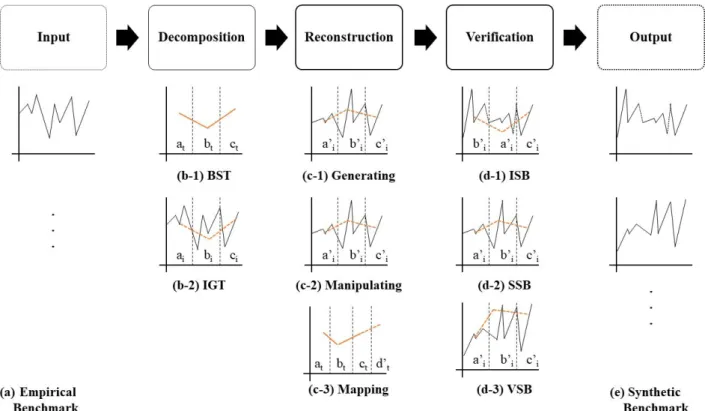
In this paper, we introduce a technique for generating synthetic benchmarks based on time series data. Many of the data measured on IoT devices have a time series characteristic that measures numerical changes over time. However, there is a problem that it is difficult to model the data measured over a long period as generalized time series data. To solve this problem, this paper introduces the BST-IGT model. The BST-IGT model separates the entire data into sections that can be easily time-series modeled, collects the generated data into templates, and produces new synthetic benchmarks that share or modify characteristics based on them. As a result of making a new benchmark using the proposed modeling method, we could create a benchmark with multiple aspects by mixing the composite benchmark with the statistical features of the existing data and other benchmarks.
▸Key words: time series data generation, IoTs, performance evaluation, benchmark, ARIMA
[요 약]
본 논문에서는 시계열 데이터를 기반으로 합성 벤치마크를 생성하는 기법을 소개한다. IoT 기 기에서 측정되는 많은 데이터는 시간에 따른 수치 변화를 측정하는 시계열적 특성이 있다. 하지 만 긴 기간 동안 측정되는 데이터를 일반화된 시계열 데이터로 모델링하기 힘든 문제점이 존재한 다. 이런 문제를 개선하기 위해 본 논문에서는 BST-IGT 모델을 소개한다. BST-IGT 모델은 전체 데이터를 시계열 모델링이 쉬운 구간으로 분리하여 생성 데이터를 템플릿으로 수집하고 이를 기 반으로 특성을 공유하거나 변형되는 새로운 합성 벤치마크를 생성한다 . 제안된 모델링 기법을 이 용하여 신규 벤치마크를 생성한 결과, 기존 데이터의 통계적 특성을 유지하는 합성 벤치마크와 다른 벤치마크와의 혼합으로 여러 특성을 가지는 벤치마크의 생성을 수행할 수 있었다.
▸주제어: 시계열 데이터 생성, 사물인터넷, 성능 평가, 벤치마크, ARIMA
First Author: Kyung Min Kim, Corresponding Author: Jong Wook Kwak
*Kyung Min Kim ([email protected]), Dept. of Computer Engineering, Yeungnam University *Jong Wook Kwak ([email protected]), Dept. of Computer Engineering, Yeungnam University
∙Received: 2020. 01. 28, Revised: 2020. 02. 10, Accepted: 2020. 02. 11.
Copyright ⓒ 2020 The Korea Society of Computer and Information http://www.ksci.re.kr pISSN:1598-849X | eISSN:2383-9945