WTK 개발 환경 기반에서의 J2ME 3차원 모바일 응용구현
1)주 헌 식*, 이 송 원**, 홍 성 수***
Applied Implementation of J2ME 3D Mobile Based on WTK Development Environment
Heon Sik Joo *, Song-Won Lee**, Sung-Soo Hong***
요 약
모바일 게임은 PC 게임, TV 게임, 손바닥 게임 이후 4번째로 독립된 산업 영역으로 중요한 플랫폼이 될 것이 다. 모바일 게임은 플랫폼, 이동, 습관 등 여러 이유에서 차이점이 있다. 전 세계의 모바일 게임 플레이어의 시장 자료에 의하면 모바일 게임은 2007년 7억 8000만에서 2010년에는 18억6000만까지 증가할 것으로 보인다. 또한 수입은 421억달러에서 870억달러로 증가를 지속 될 것이다. 3차원 게임은 우리의 생활에서 중대한 게임으로 즐겨 왔다. 수준 높은 게임으로 사용자의 필요성을 충족해 왔고, 강력한 시각적 효과와 3차원 디자인 플레이어로 사람들 에게 더 매력적으로 성장해 왔다. 강력한 시각 효과와 애니메이션 효과가 너무 지대하여 아무리 강조해도 지나치지 않다. 본 논문에서는 J2ME(자바 2 마이크로 버전) 기반의 3차원 응용 설계를 나타내었고 WTK(무선 툴킷) 시뮬 레이션으로 3차원 화면에서 모바일 장치에 의한 키보드로 반응하는 3차원 물체의 자유로운 움직임을 나타내었다.
Abstract
Mobile games will be one of independent industries on game areas and take the fourth standing in the important platform since PC Games, TV Games, and Palm Games. There are several reasons why mobile games will differ in their platform, behaviors, and habits. According to the data of market consultation about the figure of mobile-game players throughout the world, the Mobile game will increase steadily from 780 million in 2007 to 1860 million in 2010. Also, market income will mount up from $42,100 million to $87,000 million. 3D games have been playing important roles in our lives. Satisfying users' needs in high-quality games, they have been growing and attracting more people with their powerful visual effects and the three-dimensional design player. We cannot emphasize their tremendous visual impacts and animation effects too much. This paper displays how to design 3D application based on J2ME (Java 2 Micro Edition) and shows free movement of 3D objects receiving and responding to the keyboard of mobile devices with WTK (Wireless ToolKit) simulator on the 3D screen.[3] [6]
▸Keyword : J2me, WTK (Wireless ToolKit), Mobile, 3D, m3g, Application Game
∙제1저자 : 주헌식
∙접수일 : 2008. 10. 7, 심사일 : 2008. 10. 28, 심사완료일 : 2008. 11. 26.
* 삼육대학교 컴퓨터학부 부교수 ** 호서대학교 컴퓨터공학과 박사과정 ** 호서대학교 컴퓨터공학과 교수
그림1. 모바일 전화의 발전 Fig 1. Development of mobile phones
Ⅰ. INTRODUCTION
In 1997, NOKIA released a new kind of mobile device. It offered a low memory mobile game, viz., Snake. Similar to earlier period games which circulated on other platforms, Snake is a simple mobile game, and an increasing number of people became addicted to it. Because it circulated on a mobile device, Snake was the most well known at that time. By the end of 1997, WAP Union released Wireless Access Protocol 1.0. The aim of WAP was to provide mobile content for users who still use drop behind mobile devices in the West. With the rapid growth of investment in the Internet, many companies make some amount of profit and expect that WAP will develop the Internet into Wireless Networks in the West. But because of the available venture capital for the Internet, numerous companies in the WAP alliance declared bankruptcy in 2001, after the collapse of telecom and Internet telecom.
In February,1999, the NTT DoCoMo company, JapanreleasedI-mode,whichwasamobileservice,andsel ected users receive low volume data via the DoCoMo wireless network. In January, 2001, DoCoMo released I-appli, enabling downloaded software to be executed on its devices, so some video games were released for the first time. Since the summer of 2002, Sprint and Verizon have operated a mobile
games service and numerous contents and proceeds mode were according to DoCoMo. In autumn of the same year, the ATT company started operating their own service. This illustrated that market competition was officially beginning. [4] In May, 2003, Sprint declared that they had sold 20 million single and multiplayer games, since August of 2002.
By the end of April, 2003, users had downloaded 8.5 million mobile entertainment applications, according to the Verizon company. At that time, Jamdat declared that five of their games had sold 100 thousand copies. Recently, continuously expanding global contents systems have been built. The most well known are Sega Mobile and THQ Wireless.
Electronic Arts, Activision, Microsoft studios and Atari have researched mobile games. The video frequency game of the Japanese company, Dwango and many other companies have entered the mobile game market of the U.S.andEurope. Com2uS and the GameVI L company, Korea are developing mobile games into a global market[4].
There are three periods of development in mobile phones, viz.,1G, 2G and 3G period .In the 1G period of mobile phones, users could only make or receive phone calls, with out any other services. In the 2G period, users could not only make or receive phone calls from other users, but also could also send or receive messages to each other via the Internet.
Currently, in the 3G period, which supports Java ,developers can use J2ME(Java2 Micro Edition) to develop the wireless Internet, mobile games, mobile
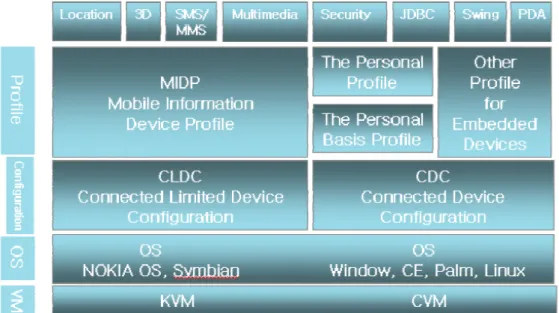
Fig 2 Architecture of Java platforms 그림 2. 자바 플랫폼의 구조 device soft ware and other service Apps. With the
fast development of the 3G environment, the next generation mobile gaming platform includes enhanced 3D game graphics capabilities and user-friendly searching, purchasing, sharing and installation of rich, high-quality games, as well as connected gaming with instant access to the global gaming mobile community. [3]
Ⅱ. PLATFORM FOR 3D MOBILE GAMES
The Java platform is a computing environment developed by Sun Microsystems, which can execute applications developed via the Java programming language and associated set of development tools. In this case, the platform is an execution engine called a virtual machine, and a set of standard libraries, which provide common functionality.
TheJavaplatformincludestheJavaStandardEdition(Ja vaSE),theJavaEnterpriseEdition(JavaEE),andtheJav aMicroEdition(JavaME). Specifications for Java SE, Java EE, and Java ME are developed under the
aegis of the Java Community Process (JCP). A Java specification beginsas a Java Specification Request (JSR). Every JSR is assigned a number. [2]
Java ME is a set of technologies and specifications developed for small devices such as pagers, mobile phones, and set-top boxes. The J2ME platform is composed of Configuration and Profile.
are specifications that detail a virtual machine and a base set of class libraries, which provide the necessary APIs. They provide the base functionality for a particular range of devices that share similar characteristics, such as network connectivity and memory footprints. The virtual machine is either a full Java Virtual Machine (JVM), as described in the specification, or some subset of the full JVM. The set of APIs is customarily a subset of Java SE APIs.
Currently, there are two Java ME configurations:
Connected Limited Device Configuration (CLDC) and Connected Device Configuration (CDC). [1]
CLDC is a fundamental component of the J2ME architecture. J2ME technology is delivered in API bundles called configurations, profiles, and optional packages. A J2ME application environment includes both a configuration such as CLDC and a profile
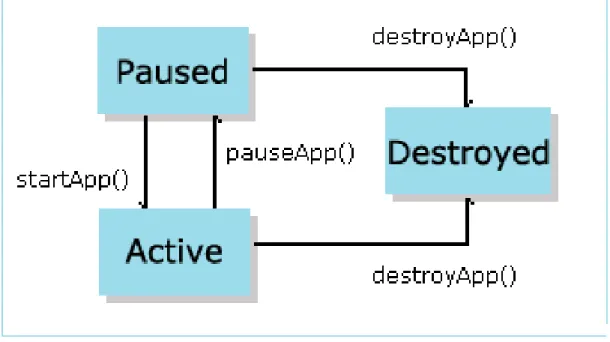
Fig 3. Application flow for Algorithm 그림3. 알고리즘을 위한 응용 플로우 such as MIDP.
MIDP is a key element of J2ME. When combined with CLDC, MIDP provides a standard Java runtime environment for the most currently popular mobile information devices, such as cell phones and mainstream personal digital assistants(PDAs).
Optional packages provide capabilities in specific areas of functionality, such as wireless messaging and multimedia capture and playback. The ability to choose from among the various bundles enables product designers and developers to very closely match software capabilities to hardware capabilities.
They can use APIs that provide easy access to the actual components of a particular kind of device, without the overhead of APIs designed for capabilities unsupported by the device. [7]
Ⅲ. METHOD AND ALGORITHM
If a user is using MIDP1.0 to execute a user interface compiler program, the user can choose from two methods; one is to use an advanced UI class,
and another is to edit
The first choice is always impossible, that is why game editors have to develop their own 3D engines for their deluxe games. Doubtless, that requires a great deal of time and effort. But CLDC 1.0, which lacks floating point support, can hardly resolve the problem.
In MIDP2.0, there is a software package viz., mobile 3Dgraphics API (Application Program Interface) or JSR 184. 3D graphics APIs have both high-level and low-level modes. The former is called mediate-mode and the latter is called immediate-mode. In mediate-mode, a developer using scene graphics can enable the object in the scene to apply color automatically according to the position of the virtual camera and light.
Immediate-mode enables direct drawing of an object by applications. It is possible to use both kinds of mode in a single application. However, the immediate-mode of JSR 184 is very slow and complicated to realize, as the developer has to manually create all 3D objects, and the corner pixels of objects in the application must be independently
INPUT: User selects the start option to load 3D World contents and the exit option to stop the connection loading.
OUTPUT: Starts or ends the application.
STEP1: Modeling, design of an M3G-format 3D model.
STEP2: Use the load() method to load the 3D world, which belongs to the loader class.
STEP3: Use the find() method, which is in getObjects() in 3D World, to get a model object, and execute setupAspectRatio() to tune the aspect ratio.
STEP4: Use KeyEvent() to control what happens, and MoveActor() to implement events.
STEP5: Create ExampleCanvas (the name of the Canvas in this example) to implement the Runnable application programming interface.
[Table 1] Modules for Algorithm 표1. 알고리즘에 대한 모듈
Module Description
Example3D The name of the object used in the scene
startApp() Start the application
setupAspectRatio()
getObjects() Get the animation object
GoActor() Go backwards or forwards
CheckWorldEdge() Avoid going off the edge(world)
TurnActor() Turn the actor
AnimateActor() Hopping animation loops correctly
MoveActor() Act on key presses and collision detections, to move the actor
pauseApp() Pause the application
DestroyApp() Stop and release the application
paint(Graphics g) Draw the animation object on the screen
KeyEvent() MIDlet keyEvent method
CommandAction() Handle commands
RefreshTask Refresh the screen
ExampleCanvas Name of the Canvas class
[Table 2] Example 3D algorithms of Algorithm 3 표2. 알고리즘 3의 3D 알고리즘의 예 edited in the array. The high-level mode viz.,
mediate-mode, enables the developer to use 3D Max
Studio, which is the 3D modeling software for designing main scenes and objects used in the
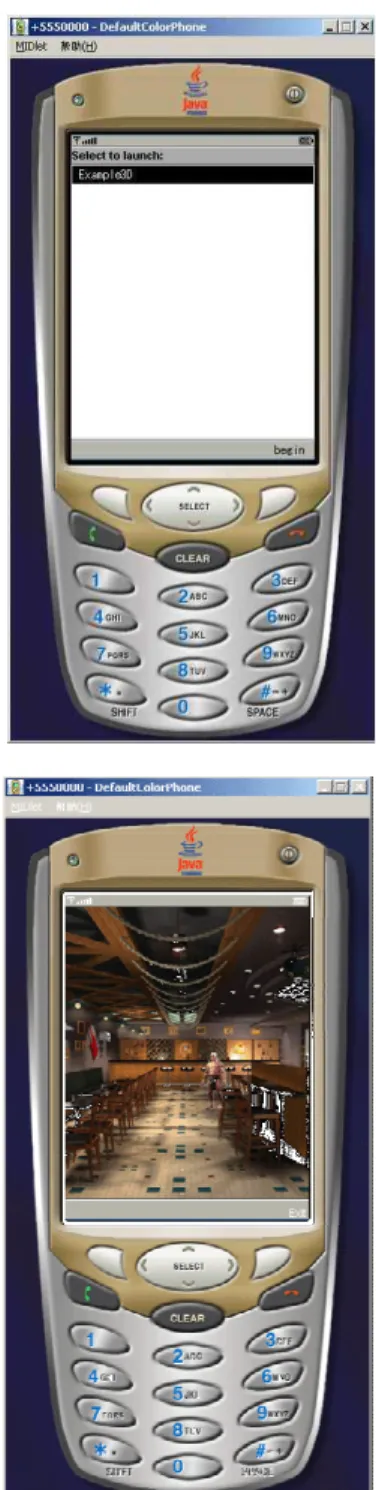
Fig 4. Output of Algorithm 그림4. 알고리즘 출력
application. This software supports output to a M3G(Mobile3DGraphic)formatdocument,anditistheex
그림5. C/C++ 코드 대 모바일에서의 자바 Fig 5 Native (C/C++) code vs Java in mobile clusiveappointmentformatinJSR184.
Ⅳ. ALGORITHM 3-1 IMPLEMENTATION
Currently, advanced Internet developers in the 3Gglobalmarketareprovidingincreasinglyspecializedm obilephones,whichcanrealize3Dgraphicswithhardware With mobile games, consumer interfaces, navigation services and 3D animation, much content with real 3-dimensional functionality has been provided in some current devices, by the six most advanced global developers. The most effective game developer is enthusiastically demonstrating a series of new generation 3D technology for 3Gmobilephones. “Next generation mobile phones will utilize advanced mobile games, which implement 3D functionality, and high quality3D graphics on mobile phones is becoming increasingly important”, stated Masahiro Inoue, who is a senior assistant to the CEO & Manager of Japan KDDI product engineering, and in fact this is an inevitable general trend. Nevertheless, mobile phones are not only
game devices for game players. 3D games for mobile phones have faced a series of technological challenges. For example, some problems are unavoidable (ie. volume, heat, energy inefficiency etc.) because of separate 3D graphic chips in mobile phones; requirements for higher resolution than PC monitors, due to low elements of mobile phone display and varying distance between eyes and mobile phone during use; conflicts between the low memory of mobile phones and sampling technology.
Therefore, 3D mobile phone realization cannot be considered as part of the PC industry. On the contrary, the development experiences from practical realization are more critical.
In this paper, mobile 3D graphic APIs for J2ME MID2.0 realizes 3D animation. These figures show the output after execution of the WTK virtual machine.
As the Fig 5 show you, getting across the relative speed of native code, CLDC, Jazelle, and KVM, can make a conclusion of the relative speed in vertex transformation and image downsampling in using methods above. KVM(kernel virtual machine) have the best speed in both vertex transformation
API Contents
M3G
(Mobile 3D Graphic) OpenGL(ES)
(Open Graphics labrary) Java 3D API
JSR
certification JSR 184 JSR 239 JSR 926
Application
Rendering 3D graphic in retained mode and immediate
mode
Development of 2D and 3D graphics application
Parent project for all Java 3D-related sub-projects on
java CLDC
MIDP support
Fit together Fit together Not fit together
Level High-level Low-level High-level
Size of
API Small Medium Bloated
Difficulty of
Code Easy Hard Hard
[Table 3] Comparison of mobile 3D method 표3. 모바일3D 방법 비교
and image downsampling and native code which implement by using C/C++ is almost 20 times of KVM.
As shown In the Table 3, there are three methods to achieve the 3D effect in mobile device, they are M3G(Mobile 3D Graphic), OpenGL(Open Graphics Application) and Java 3D. You can find the different among the methods above and which is the best method by comparison of contents that in the left column of table.
Ⅴ. CONCLUSION
With diverse game characters, mobile phone games are more readily accepted by consumers. With more striking graphics, and more kinds of game, the numbers of mobile phone users will increase consistently. Therefore, games will evolve step-by-step. Some popular games from the past, such as Snake, Gobang, Black&White Chess etc., would be boring to consumers now, but since then, action Internet games have increasingly included high-quality graphics. It is not enough to be content
with being merely effective; Now, mobile phone game technology is developing into the most advanced 3D technology. And, the optimistic outlook for the mobile phone 3D game market should be credited to the development of 3D graphics technology. In this paper, we utilized JSR 184(3D API) to create graphics to realize 3D programming.
In the Remain module, 3D environments and objects that are written to M3G files are all created by 3D creation tools. Mean while, this enables the drawing of the 3D scene on the screen.
참고문헌
[1] Eberly , David H. 3D game engine architecture [2] Seun-Juong Zoo “3D Game Programing”
http://game.yesky.com/
http://www.onjava.com/java/WirelessJava [3] Addison Wesley “Micro Java Game Development”
[4] James Keogh “The complete Reference J2ME”
[5] Martin J.Wells,Thomson Course Technology, 2004
“J2ME Game Programing”
[6] 이르판 칸 , 홍성수 MObile contents based on Nokia System
[7] Timothy Appnel [email protected] ”Introducing MIDP 2.0” http://www.onjava.com/topics/java/
Wireless_Java
저 자 소 개 Heon Sik Joo
Heon Sik Joo received the BE degree in Computer engineering from Hoseo University of Korea in 1992, the MS, degree in Computer Science from Hoseo University of Korea in 1994, and the PH.D degree in Computer engineering from Ajou University of Korea in 2005. He is currently an associate professor in the department of Computer Science and engineering at Sahmyook University. His research areas are Computer Graphics, Multimedia, Image Processing, Mobile Computing.
Sung Soo Hong
Sung Soo Hong received the BE degree in electrical engineering from Kwang Woon University of Korea in 1979, the MS, degree in electrical engineering from Kwang Woon University of Korea in 1983,and the PH.D degree in electrical engineering from Kwang Woon University of Korea in 1990. He is currently an professor in the department of Computer engineering at Hoseo University. His research areas are software algorithm, mobile contents, mobile software robots system and embeded controllers.
Song Won Lee Song Won Lee received the BE degree in electrical engineering fromHoseo University. of Korea in 2007, the MS, degree in electrical engineering fromHoseo University. of Korea in 2007,and the PH.D degree in electrical engineering from Hoseo University of Korea in 2008.
His research areas are software algorithm, mobile contents, mobile software and mobile game.