490
JOURNAL OF KOREAN FOREST SOCIETY ISSN 0445-4650(Print), ISSN 2289-0904(Online) http://e-journal.kfs21.or.kr
단기소득임산물 재배 소득분석
− 주요 수실류를 중심으로 − 강학모1·장철수2·최수임3*
1전북대학교 산림환경과학과, 2한국농촌경제연구원 산림정책연구부,
3순천대학교 산림자원학과
Analysis of Standard Income Regarding the Cultivation of Non-Timber Forest Products
− Focused on major nuts and fruits −
Hag Mo Kang
1, Cheol Su Chang
2and Soo Im Choi
3*1Department of Forest Environmental Science, Chonbuk National University, Chonju 516-756, Korea
2Department of Forest Policy Research, Korea Rural Economic Institute, Seoul 130-710, Korea
3Department of Forest Resources, Sunchon National University, Suncheon 540-950, Korea
요 약: 본 연구는 은행, 머루, 다래, 복분자, 산딸기 등 주요 수실류에 대한 재배공정을 조사하여 소득을 분석함으 로써 임산물 손실에 대한 보상 기준 및 임업경영진단 등을 위한 합리적인 정책수립에 필요한 기초자료 제공을 목적 으로 하였다. 조사결과, 품목별 재배형태는 크게 노지재배와 산지재배로 구분되었다. 품목별 단위면적당(3.3 m2) 연 간 평균소득은 은행 노지재배가 1,060원, 은행 산지재배가 618원, 머루 노지재배가 5,891원, 다래 산지재배가 8,113원, 복분자 노지재배가 14,701원, 산딸기 노지재배가 17,482원 수준으로 복분자와 산딸기의 연간 평균 소득이 타 품목에 비해 매우 높은 것으로 분석되었다. 특히, 산딸기의 경우 생산이 식재 후 2년차부터 이루어진다는 점과 수확작업 시 많은 노동력을 자가노동에 의존하고 있어 고용노동 비용 지출이 적은 것으로 분석되었다. 그리고 대부분의 수실류 재배 시 시설비, 묘목 등 초기 투자비용이 경영비에서 차지하는 비중이 평균 30% 내외로 높은 것으로 분석되어 재 배 활성화를 위해 정부의 적절한 지원이 필요할 것으로 판단된다.
Abstract: This study investigates the cultivation processes of major nuts and fruits such as Ginkgo biloba L., Vitis coignetiae, Actinidia arguta Planch, Rubus coreanus Miq., and Rubus crataegifolius and analyzes standard income in order to provide foundational data necessary to make reasonable policies related with the criteria of compensating the loss of forest products or diagnosis of forestry management. According to the research results, the types of cultivation by items can be largely divided into open field culture and mountainous culture. Regarding the average annual income per unit area (3.3) by items, the open field culture of Ginkgo biloba L. was 1,060 Won, mountainous culture of Ginkgo biloba L. was 618 Won, open field culture of Vitis coignetiae was 5,891 Won, mountainous culture of Actinidia arguta Planch was 8,113 Won, open field culture of Rubus coreanus Miq. was 14,701 Won, and open field culture of Rubus crataegifolius was 17,482 Won or so; thus, the average annual income of Rubus coreanus Miq. and Rubus crataegifolius was very higher than that of the other items. In particular, because the production of Rubus crataegifolius starts two years after the planting and they rely on family labor mainly for the cultivation, the expenses for employment and labor were analyzed to be low. In addition, the analysis shows that at most of the nuts and fruits cultivation, initial investment costs for facilities or seedlings occupy a great part as about 30% averagely out of the management cost, so it is thought that the government should provide proper support to vitalize the cultivation.
Key words: nuts and fruits, cultivation processes, analysis of standard income, management cost
서 론
국민생활수준의 향상과 식생활의 다양화, 고급화와 더
불어 웰빙에 대한 사회적 요구가 증가함에 따라 단기소득 임산물의 소비가 증가하고 있으며, 이들 수요에 맞추어 임 가의 소득향상을 위한 생산이 증가하고 있다. 한 해 동안 생산되는 임산물의 생산량을 통일된 기준과 방법에 따라 조사하여 발표한 산림청 임산물생산통계조사에 의하면,
*Corresponding author E-mail: [email protected]
2012년도 기준 단기소득임산물인 수실류, 산나물, 버섯류 등의 총생산액은 각각 7,619억원, 3,886억원, 2,871억원 등 으로 2008년도 대비 9.8%, 16.4%, 1.5%씩 매년 증가추세 에 있다(Korea Forest Service, 2013c).
그러나 이러한 단기소득임산물에 대한 수요 증가를 감 안할 경우 임산물의 생산기반 등 정책지원을 위한 표준소 득정보가 현저히 부족한 상황이다. 농축산물소득조사의 경우 30년 이상의 역사를 가지고 있으며, 농장경영진단 및 설계 등 경영개선지도와 농업경영연구를 위한 기초자료 가 제공되고 있다. 반면, 임산물은 대표적인 단기소득 품 목인 호두, 대추, 밤, 떫은감, 표고, 더덕 등은 2009년부터 산림청에서 임산물생산비조사 사업을 통해 표준 소득정 보가 본격적으로 제공되고 있고(Korea Forest Service, 2010; 2011; 2012; 2013a), 또한 개별적인 연구를 통해서 일부 품목 재배에 대한 소득정보(Choi et al., 2006; Kim et al., 2007; Kim et al., 2010) 등이 제공되고 있다. 그러 나 그 이외 단기소득임산물에 대한 소득정보는 전혀 연구 및 조사가 실시되지 않고 있는 상황이다. 단, 산지약용자 원에 대해서는 국립산림과학원을 중심으로 소득정보에 대 해 일부 연구 및 조사 실시되었다(Park et al., 2009; Park et al., 2010; Park et al., 2011).
최근 들어 국내 임업은 대내·외적으로 개방화 및 국제 화의 가속화로 국가 간 무역 장벽이 무너지고 거대한 세 계시장이 형성되고 있으며, 특히 FTA와 DDA 등으로 글 로벌 스탠다드의 개방적 시장경제 질서에 의한 경쟁은 국 내 임업인에게 큰 부담으로 작용하고 있다. 향후 단기소 득임산물에 대한 수요는 증가하나 가격 경쟁력 약화 등으 로 국내 생산량은 대체로 감소하고 수입량은 점차 증가할 것으로 전망하고 있다. 특히, 한-중 FTA가 체결될 경우 우 리나라 단기소득임산물분야에는 약 3,266억원(2015년 체 결, 2016년 발효)의 생산액 감소피해가 발생할 것으로 예 상되고 있다(Korea Forest Service, 2013b).
이러한 상황에서 임업환경의 변화에 따라 임업정책도 다양한 방식으로 수립되고 추진되어야 할 필요성이 제기 되고 있다. 이 과정에서 임업정책의 근간이 되는 각종 임 업통계에 대한 수요도 커지고 있는 실정이다. 보다 효율 적이고 합리적인 임업진흥 정책 수립의 방향성 설정 및
귀농·귀촌 그리고 현재 단기소득임산물을 재배하고 있 는 임가들에게 다양한 정보를 제공하기 위해서라도 단기 소득임산물 재배에 대한 소득분석이 필요한 상황이다.
따라서 본 연구는 국내에서 생산되는 단기소득임산물 중 가장 많은 생산액을 차지하고 있는 주요 수실류 품목 에 대해 재배공정을 조사하여 소득을 분석함으로써 임산 물 손실에 대한 보상 기준 및 임업경영진단, 설계 등 임업 경영환경 개선을 위한 합리적인 정책수립에 필요한 기초 자료를 제공하고 평가하는데 그 목적이 있다.
연구 방법
1. 조사지역 및 대상
본 연구의 조사대상 품목은 단기소득임산물 중 생산 액이 가장 많은 수실류를 대상으로 하였다. 수실류는 밤, 호두, 대추, 잣, 떫은감, 은행, 산딸기, 분분자, 머루, 다 래 등을 포함하고 있다. 그러나 이 가운데 밤, 호두, 대 추 등은 선행조사 및 연구 등을 통해 어느 정도 소득에 대한 기초자료 및 통계가 공표 또는 제공되었기 때문에 본 연구에서는 은행, 머루, 다래, 복분자, 산딸기 등 5개 품목에 한정하였다. 조사지역은 산림청 임산물생산통계 의 주요산지를 대상으로 하여 총 52개 임가를 조사하였 다(Table 1).
2. 조사방법
조사는 특정인을 대상으로 한 추적식 현장방문 면접조 사를 채택하여 2013년 8월 1일부터 10월 30일까지 실시 하였다. 조사대상 명부는 산림청에서 선정한 품목별「보 물산을 가꾸는 임업인」명부, 시·군에서 확보하고 있는 선도임가 명부, 산림복합경영인협회 명부, 산림조합중앙 회 특화품목지도원이 확보하고 있는 품목별 임가명부 등 을 활용하였다.
사례조사 표본의 경우 임가 및 주산지를 중심으로 한 추 적식 조사에 의존함에 따라 일부 품목의 경우 다양한 지역 에서 조사가 이루어지지 못하고 한 지역에서 거의 대부분 의 조사가 이루어진 경우가 발생하였다. 이는 산림청에서 90개 품목을 지원대상 품목으로 지정하여 운영하고 있
Table 1. Major survey area and number of forest households surveyed.
Item Major Producer
Ginkgo biloba L., (10) Yesan in Chungcheongnam-do (5), Imsil in Jeollabuk-do (5)
Vitis coignetiae (15) Muju in Jeollabuk-do (7), Paju in Gyeonggi-do (4), Sancheok in Gangwon-do (4) Actinidia arguta Planch (8) Wonju in Gangwon-do (5), Gwangyang in Jeollanam-do (3)
Rubus coreanus Miq., (10) Gochang (6), Jeongeup (4) in Jeollabuk-do Rubus crataegifolius (9) Jangseong in Jeollanam-do (9)
Total 52 forest households
으나, 사실상 정부 보조가 일부 품목에 한정됨에 따라 재 배를 포기하거나 또는 농업기술센터나 시·군 농정과의 도 움을 받아 재배하는 경우가 많아 서로 정보 공유가 되지 않 기 때문이다. 또한, 산림청 통계 자체가 재배인지 채취인지 가 불분명하여 주요산지라고 하더라도 생산이 많은 것이지 재배가 많다고 할 수 없기 때문에 조사 표본을 선정하기가 대단히 어려운 실정이었다. 그리고 자료의 조사 및 분석은
지역별 사례조사를 중심으로 수행하였다.
수실류 재배에 대한 소득분석
1. 조사대상 임가의 일반적 특성
수실류의 조사대상 품목은 은행, 머루, 다래, 복분자, 산 딸기 등 총 5개 품목으로서 임가의 평균 연령은 58~70세, Table 2. Case study of nuts and fruits
Item
Average Age (Year)
Average Operation Period (Year)
Average Survey Area
(Pyeong)
Average Production Period (Year)
Annual Average Rent (Won/Pyeong)
Average Personnel Expenses (Won/Day)
Cultivation Type Male Female Open Field Mountain
Ginkgo biloba L., 70 17 1,587 17 880 106,000 67,000
Vitis coignetiae 60 12 1,337 10 1,320 92,200, 53,846
Actinidia arguta Planch 61 6 413 6 975 101,250 64,275
Rubus coreanus Miq., 68 11 1,095 11 1,770 100,000 52,000
Rubus crataegifolius 58 4 289 4 1,000 94,444 55,000
Table 3. Case of Open Field Cultivation of Ginkgo biloba L., and Cultivation in Mountain by Forest Household.
Open Field Cultivation (Basic Unit: 10a, Project Period: 5 Years)
Mountain Cultivation (Basic Unit: ha, Project Period: 15 Years)
Year Work Details Year Work Details
1
Fertilizer Application
before Developing
the Field
•
Work Period: March•
Work Details: Application of Compost (Press Cake) and Fertilizer (Composite)− Compost: 26 bags (521.7 kg)
− Fertilizer: 2.6 bags (52.2 kg)
− Number of Workers: 0.3 Men
1
Land Preparation
•
Work Period: March•
Work Details: Application of Compost and Fertilizer− Compost: 300 bags (6,000 kg)
− Composite Fertilizer: 18 bags (360 kg)
•
Work Details: Land Preparation− Heavy Equipment (Forklift) Work
Planting (Seedling)
•
Work Period: Mid March~End of April•
Work Details:− Planting of Seedling (15-year-old seedling)
− Number of Seedling: 13
− Number of Workers: 1.3 Men
Planting (Seedling)
•
Work Period: Mid March•
Work Details:− Watering of Grafts (Use 3-year-old Grafts)
− Number of Seedling: 420
− Number of Workers: 8 Men
2~5
Fertilizer Application
•
Work Period: March•
Work Details: Application of Compost (Press Cake) and Fertilizer (Composite)− Compost: 39 bags (582.6 kg)
− Fertilizer: 1.6 bags (31.3 kg)
− Number of Workers: 0.1 Men, 0.1 Women
Weeding
•
Work Period: May~September•
Work Details: Weeding and Scraping:once a year
− Number of Workers: 2 Men
Weeding
•
Work Period: April~June•
Work Details:− Weeding: 0.3 times a year
− Number of Workers: 0.3 Women
2~15
Fertilizer Application
•
Work Period: August•
Work Details: Compost and Fertilizer Application Cycle− Fertilizer: 4 bags (72 kg)
− Number of Workers: 0.6 Men
Harvest
•
Work Period: September~October•
Work Details:− Harvest: once a year
− Yield: 4,952/year in average
− Number of Workers: 3.7 Men, 3.7 Women
Weeding
•
Work Period: 5~September•
Work Details: Weeding and Scraping Cycle: once a year− Number of Workers: 2 Men
4~15 Harvest
•
Work Period: 10~November•
Work Details:− Harvest: once a year
− Yield: 90,300/year in average
− Number of Workers: 6 Men, 13 Women Source: Survey of Case of Open Field Cultivation of Ginkgo biloba L., and Cultivation in Mountain by Forest Household
평균 종사기간은 4~17년이었다. 은행, 머루, 복분자는 비 교적 생산기간이 길고 재배경험도 많은 반면, 다래와 산 딸기는 생산기간과 재배경험도 많지 않아 최근에 재배가 실시되고 있는 것으로 나타났다(Table 2).
평균 조사면적은 289~1,587평, 평균 임대료는 평당 882~1,770원 정도로 조사되었다. 각 품목별 재배형태는 은 행은 노지재배와 산지재배, 다래는 산지재배, 그리고 머루, 복분자, 산딸기는 각각 노지재배인 것으로 나타났다.
2. 소득분석을 위한 전제조건
수실류 재배에 대한 임가의 소득분석을 실시하기 위해 다음과 같은 몇 가지 전제조건을 설정하였다. 생산자의 재 배 및 생산을 위해 투입되는 모든 비용은 전년도 가격으 로 적용하며 토지는 임차하여 재배하는 것으로 하였다.
한편, 소득분석에서 사업(재배)기간의 설정은 연평균 소 득을 결정하는 매우 중요한 인자로 작용한다. 본 연구에 서는 품목별 사업기간을 재배기간이 다년도의 경우 생산 자의 재배기간까지를 사업기간으로 설정 하였다. 또한 품 목별 수확물에 대한 판매가격은 생산자 판매가격으로 하 였다.
시설비, 묘목대(종근 등), 퇴비나 비료의 경우 지역마다 보조금이 상이하여 구매가격에 차이가 있으므로 보조금 이 없는 가격을 사용하였으며, 인건비의 경우 부대비용
(밥이나 참으로 제공하는 국수, 담배 등)을 모두 포함한 가 격으로 산정하였다. 또한, 작업인원의 1일 노동시간은 8 시간으로 하였다.
품목별 작업공정 및 소득분석결과는 품목의 생리적 특 성과 재배지의 환경 등에 따라 다양하므로 재배사례를 중 심으로 조사하였기 때문에 작업방식이나 수확방식 및 수 확량, 소득 등은 지역에 따라서 그리고 임가의 재배기술 등에 따라 각각 차이가 발생한다고 할 수 있다.
3. 재배공정 및 소득분석 1) 은행
은행(Ginkgo biloba L.)은 제주도 및 해변을 제외한 전국에 분포하고 있다. 은행의 재배형태는 노지와 산지 로 구분되며, 노지재배의 경우 재배면적은 2,300평, 사 업기간은 5년, 산지재배 경우 재배면적은 3,000평, 사업 기간 15년으로 조사되었다. 노지재배는 은행나무 15년 생 묘목을 식재하기 전 재배지조성 작업으로 시비와 식 재 등이 실시되고, 식재한 이후부터는 제초작업, 시비가 매년 이루어지고 수확도 식재 2년차(은행나무 16년생) 부터 이루어진다(Table 3).
은행의 산지재배는 노지재배와 비교하여 재배환경 및 어린묘목을 식재해야하기 때문에 많은 작업공정이 요구 된다. 식재는 3년생 접목묘를 사용하고, 식재 전 재배지조
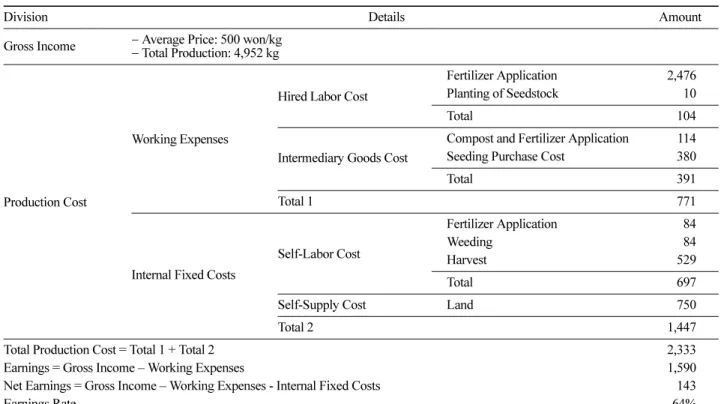
Table 4. Average Production Cost and Earnings in the Open Field Cultivation of Ginkgo biloba L., by Forest household.
(Unit: 1,000 won/10a)
Division Details Amount
Gross Income − Average Price: 500 won/kg
− Total Production: 4,952 kg
Production Cost
Working Expenses
Hired Labor Cost
Fertilizer Application 2,476
Planting of Seedstock 10
Total 104
Intermediary Goods Cost
Compost and Fertilizer Application 114
Seeding Purchase Cost 380
Total 391
Total 1 771
Internal Fixed Costs
Self-Labor Cost
Fertilizer Application 84
Weeding 84
Harvest 529
Total 697
Self-Supply Cost Land 750
Total 2 1,447
Total Production Cost = Total 1 + Total 2 2,333
Earnings = Gross Income – Working Expenses 1,590
Net Earnings = Gross Income – Working Expenses - Internal Fixed Costs 143
Earnings Rate 64%
Note: “Average Price” refers to the price when the maidenhair tree fruits with the skin attached. When peeled, the 4:1 ratio of unpeeled fruit to peeled fruit is applied excluding the cost for peeling.
Table 5. Average Production Cost and Earnings in the Mountain Cultivation of Ginkgo biloba L., by Forest household.
(Unit: 1,000 won/10a)
Division Details Amount
Gross Income − Average Price: 500 won/kg
− Total Production: 90,300 kg 45,150
Production Cost
Working Expenses
Hired Labor Cost
Fertilizer Application 100
Plowing 450
Planting 700 Weeding 1,500
Harvest 11,540
Total 14,290
Intermediary Goods Cost
Compost and Fertilizer Cost 944 Grafted Seedings Purchase Cost 2,100
Total 3,044
Total 1 17,334
Internal Fixed Costs
Self-Labor Cost
Fertilizer Application 940
Planting 100
Weeding 1,500
Harvest 6,140
Total 8,680
Self-Supply Cost Land 13,500
Total 2 22,180
Total Production Cost = Total 1 + Total 2 39,514
Earnings = Gross Income – Working Expenses 27,816
Net Earnings = Gross Income – Working Expenses − Internal Fixed Costs 5,636
Earnings Rate 62%
Note: “Average Price” refers to the price when the maidenhair tree fruits with the skin attached. When peeled, the 4:1 ratio of unpeeled fruit to peeled fruit is applied excluding the cost for peeling.
성 작업으로 시비, 땅고르기(웅덩이파기, 덮기 등)가 실시 된다. 식재한 이후부터는 제초작업, 시비가 매년 이루어지 고 수확도 식재 4년차(은행나무 7년생)부터 이루어지기 때문에 은행나무가 성숙할수록 많은 수확량을 기대할 수 있다.
한편, 은행 재배에 대한 경영성과(10a 기준)를 살펴보 면, 노지배재의 경우 조수입은 2,476천원이었으며, 경 영비는 고용노동비 114천원, 중간재비 771천원을 포함 하여 총 886천원으로 조사되었다. 노지재배의 경우 15 년생 묘목을 식재하기 때문에 묘목구입비가 높은 비중 을 차지하고 있었다. 자가노동비는 소득분석 시 포함되 지는 않지만 총 생산비의 29.9%를 차지할 정도로 투자 비중이 높은 것으로 조사되었다. 은행 노지재배 평균소 득은 10a당 1,590천원으로 사업기간 5년으로 환산할 경 우 연평균 소득은 10a당 318천원 수준으로 분석되었다 (Table 4).
다음으로 은행 산지재배에 대한 경영성과(1 ha 기준)를 살펴보면, 조수입은 45,150천원이었으며, 경영비는 고용 노동비 14,290천원, 중간재비 3,044천원을 포함하여 17,334 천원으로 조사되었다. 이에 따라 은행 산지재배 평균소득
은 1 ha 당 27,816천으로 사업기간 15년으로 환산할 경우 연평균 소득은 1 ha당 1,854천원 수준으로 분석되었다 (Table 5).
2) 머루
머루(Vitis coignetiae)는 야생 상태에서 잘 자라는 식 물이지만, 생산을 위해서는 집약적인 관리가 필요하다.
머루 재배기술은 독농가의 노력으로 인근에 보급되고 있 으며, 여러 가지 형태로 분화되어 정착하고 있다. 머루 의 재배형태는 노지재배로서 재배면적은 1,900평, 재배 기간은 10년으로 조사되었다. 머루재배는 1차 년도에 재 배지조성 전 시비, 땅고르기, 식재, 지주설치, 차광막 설치, 관수작업 등을 실시한다. 재배지조성은 트랙터로 땅고르 기 작업 후 식재는 묘목으로 하며 평당 50본 정도를 식 재하는 것으로 조사되었고, 이들 작업은 모두 11월 중에 실시된다.
2년차부터 10년차까지는 제초작업, 시비, 병충해 방제 그리고 수확작업이 매년 반복적으로 이루어진다. 정식 후 5~9월까지 제초작업을 하게 되며, 이후 밑거름으로 우분, 계분 등으로 만든 퇴비를 살포한다. 제초작업의 경우 2~5
Table 6. Case of Open Field Cultivation of Vitis coignetiae by Forest Household.
Cultivation on Open Field (Basic Unit: 10a, Project Period: 10 Years)
Year Work Details Year Work Details
1
Fertilizer Application before
Developing the Field
•
Work Period: November•
Work Details: Application of Compost (Press Cake) and Fertilizer (Composite), insecticide− Compost: 39.5 bags (789.5 kg)
− Fertilizer: 1.6 bags (31.6 kg)
− Insecticide: 2.4 kg
− Number of Workers: 0.3 Men, 0.3 Women
2~10
Weeding
•
Work Period: May ~September•
Work Details:− 2~5th Year
·Weeding: 0.8 times a year
·Number of Workers: 3.2 Men, 3.2 Women
− 5~10th Year
·Weeding: 0.5 times a year
·Number of Workers: 2.4 Men, 2.4 Women
Land Preparation
(Plowing)
•
Work Period: November•
Work Details:− Plowing + Rotary + Levee + Tractor
Fertilizer Application
•
Work Period: February•
Work Details: Compost and Fertilizer− Compost: 49.9 bags (997.9 kg)
− Fertilizer: 3 bags (60 kg)
− Number of Workers: 0.3 Men, 0.2 Women
Planting
•
Work Period: November•
Work Details:− Planting of Seedling
− Number of Seedling: 150
− Number of Workers: 0.6 Men, 0.2 Women
Watering
•
Work Period: March~September•
Work Details:− Watering: 1.6 times a year
− Number of Workers: 1.6 Men
Installation of Support Systems
•
Work Period: November•
Work Details:− Installation of Support Systems: 150
− Number of Workers: 0.6 Men
Topping and Trimming
•
Work Period: June~August•
Work Details:− Topping and Trimming: 2.4 times a year
− Number of Workers: 2.4 Men, 2.4 Women
Installation and Removal of Shading Net
•
Work Period: August•
Work Details:− Number of Workers: 1.1 Men
※Subsidy for Installation Cost: 10,000 won/pyeong
Disease and Insect Pest
Control
•
Work Period: 5~August•
Work Details:− Disease and Insect Pest Control: 0.6 times a year
− Number of Workers: 0.6 Men, 0.6 Women
Watering
•
Work Period: March•
Work Details:− Watering: 0.5 times a year
− Number of Workers: 1.4 Men
Harvest
•
Work Period: September•
Work Details:− Harvest: once a year
− Yield: 712.6 kg/year in average
− Number of Workers: 11.4 Women Source: Survey of Case of Open Field Cultivation of Vitis coignetiae by Forest Household
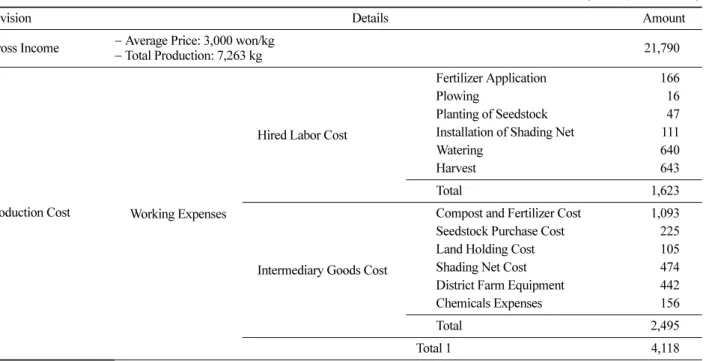
Table 7. Average Production Cost and Earnings in the Open Field Cultivation of Vitis coignetiae by Forest household
(Unit: 1,000 won/10a)
Division Details Amount
Gross Income − Average Price: 3,000 won/kg
− Total Production: 7,263 kg 21,790
Production Cost Working Expenses
Hired Labor Cost
Fertilizer Application 166
Plowing 16
Planting of Seedstock 47
Installation of Shading Net 111
Watering 640
Harvest 643
Total 1,623
Intermediary Goods Cost
Compost and Fertilizer Cost 1,093
Seedstock Purchase Cost 225
Land Holding Cost 105
Shading Net Cost 474
District Farm Equipment 442
Chemicals Expenses 156
Total 2,495
Total 1 4,118
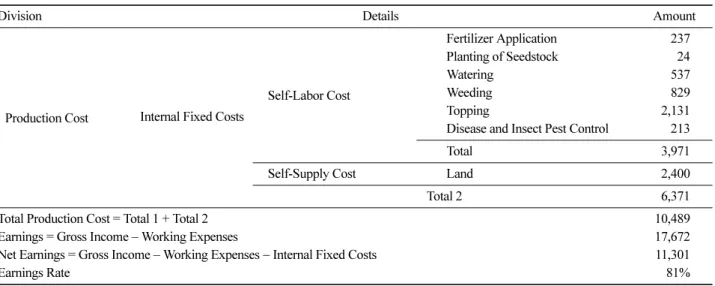
Table 7. Continued.
Division Details Amount
Production Cost Internal Fixed Costs
Self-Labor Cost
Fertilizer Application 237
Planting of Seedstock 24
Watering 537
Weeding 829
Topping 2,131
Disease and Insect Pest Control 213
Total 3,971
Self-Supply Cost Land 2,400
Total 2 6,371
Total Production Cost = Total 1 + Total 2 10,489
Earnings = Gross Income – Working Expenses 17,672
Net Earnings = Gross Income – Working Expenses − Internal Fixed Costs 11,301
Earnings Rate 81%
Note: The production of Vitis coignetiae begins in the second year after the planting.
Table 8. Case of Mountain Cultivation of Actinidia arguta Planch by Forest Household.
Open Field Cultivation (Basic Unit: 1 ha, Project Period: 4 Years)
Year Work Details Year Work Details
1
Fertilizer Application
before Developing the
Field
•
Work Period: Beginning of April•
Work Details:− Fertilizer Application: 10 times a year, 2 Tons of Compost in Average
− Number of Workers: 10 Men, 10 Women
2~4
Weeding
•
Work Period: June~August•
Work Details:− Weeding: 30 times a year
− Number of Workers: 30 Men, 30 Women
Land Preparation
(Plowing)
•
Work Period: Beginning of April•
Work Details:− Plowing + Rotary + Levee + Tractor Watering
•
Work Period: August•
Work Details:− Watering: 10 times a year
− Number of Workers: 10 Men
Installation of Support Systems
•
Work Period: Toward the end of April•
Work Details:− Installation of Support Systems
− Number of Workers: 50 Men
※Consignment: 10,000,000 Won/300 Pyeong
Fertilizer Application
•
Work Period: Beginning of April•
Work Details:− 2nd Year
·Fertilizer Application: 10 times a year, 6 tons of compost in average
·Number of Workers: 10 Men, 10 Women
− 3rd Year
·Fertilizer Application: 10 times a year, 10 tons of compost in average
·Number of Workers: 10 Men, 10 Women
− 4th Year
·Fertilizer Application: 10 times a year, 20 tons of compost in average
·Number of Workers: 10 Men, 10 Women
Planting (Seedling)
•
Work Period: Toward the End of April•
Work Details:− Planting of Seedling: 1-year-old Seedlings
− Number of Seedling: 400
− Number of Workers: 10 Men, 10 Women
Disease and Insect Pest
Control
•
Work Period: Beginning of June•
Work Details:− Disease and Insect Pest Control: 10 times a year
− Number of Workers: 10 Men, 10 Women
Watering
•
Work Period: August•
Work Details:− Watering: 10 times a year
− Number of Workers: 10 Men
Harvest
•
Work Period: August~September•
Work Details:− Harvest: 100 times a year
− Yield: 8,000 kg/year in average
− Number of Workers: 200 Men, 200 Women
※1 Person harvests 200 kg in average per day
Weeding
•
Work Period: June~August•
Work Details:− Weeding: 30 times a year
− Number of Workers: 30 Men, 30 Women
Source: Survey of the Case of Mountain Cultivation of Actinidia arguta Planch by Forest Household
년차에 연 5회, 그리고 머루가 완전히 정착된 이후인 5~10 년차까지 매년 3회씩 작업을 하는 것으로 조사되었다. 수 확은 2년차부터 이루어지며 4~7년차에는 가장 많은 생산 이 이루어지는데 평당 3 kg정도 까지 생산되는 것으로 조 사되었다(Table 6).
머루 재배에 대한 경영성과(10a 기준)를 살펴보면, 조수 입은 21,790천원이었으며, 경영비는 고용노동비 1,623천 원, 중간재비 2,495천원을 포함하여 총 4,118천원으로 조 사되었다. 이에 따라 평균소득은 10a당 17,672천원으로 사 업기간 10년으로 환산할 경우 연평균 소득은 1,767천원 수준으로 분석되었다. 머루재배 역시 은행재배와 비슷하 게 자가노동비가 총 생산비의 37.9%를 차지할 정도로 투 자비중이 높은 것으로 조사되었다(Table 7).
3) 다래
다래(Actinidia arguta Planch)는 다래나무과에 속하는 낙 엽활엽 덩굴식물로서 우리나라 각 도의 산지에 자라고 있 고, 이를 집약적으로 재배하기 위해 현재 국립산림과학원 에서 관련 재배기술을 농가에 보급하고 있다.
다래의 재배형태는 산지재배로서 재배면적은 300평이 고 재배기간은 4년으로 조사되었다. 다래재배는 1년차에
재배지조성 전 시비, 땅고르기, 지주설치, 식재, 관수작업, 제초작업 등을 실시한다. 재배지조성은 트랙터로 땅고르 기 작업 후 식재는 묘목으로 하며 100평당 13주 정도를 식재하는 것으로 나타났고, 이들 작업은 4월 중에 이루 어진다. 지주설치의 경우 설치위탁 비용의 일부를 정부 에서 보조해주는 것으로 조사되었다. 2년차부터 4년차 까지 제초작업 및 비료주기, 관수작업, 그리고 3년차부 터 매년 수확작업이 이루어진다. 시비작업의 경우 묘목 이 성숙함에 따라서 퇴비의 양이 매년 증가하는 것으로 나타났다(Table 8).
한편, 다래재배에 대한 경영성과(1 ha 기준)를 살펴보면, 조수입은 240,00천원이었으며, 경영비는 고용노동비 32,500 천원, 중간재비 110,150천원을 포함하여 총 142,650천원 으로 조사되었다. 이에 따라 평균소득은 1 ha당 97,350천 원으로 사업기간 4년으로 환산할 경우 연평균 소득은 24,337천원/ha 수준으로 분석되었다. 다래 산지재배의 경 우 투입비용이 가장 높은 항목은 중간재비 중 지주설치에 따른 지주 구입비용으로 총 경영비의 70.1%를 차지하고 있는 것으로 분석되었다. 또한, 지주설치를 제외한 대부분 의 작업이 자가노동에 의존하여 실시되고 있는 것으로 조 사되었다(Table 9).
Table 9. Average Production Cost and Earnings in the Mountain Cultivation of Actinidia arguta Planch by Forest household.
(Unit: 1,000 won/ha)
Division Details of Work Amount
Gross Income − Average Price: 15,000 won/kg
−Total Production: 16,000 kg 240,000
Production Cost t
Working Expenses
Hired Labor Costs
Installation of Support Systems 31,500
Plowing 1,000
Total 32,500
Intermediary Goods Cost
Compost and Fertilizer Cost 7,350 Seedstock Purchase Cost 2,800
Land Holding Cost 100,000
Total 110,150
Total 1 142,650
Internal Fixed Costs
Self-Labor Cost
Fertilizer Application 7,500
Hole Treatment 1,500
Planting of Seedstock 1,500
Weeding 18,000
Harvest 16,800
Total 52,800
Self-Supply Cost Land 6,000
Total 2 58,800
Total Production Cost = Total 1 + Total 2 201,450
Earnings = Gross Income – Working Expenses 97,350
Net Earnings = Gross Income – Working Expenses − Internal Fixed Costs 38,550
Earnings Rate 44%
Note: The production of Actinidia arguta Planch begins in the 3th year after the planting.
4) 복분자
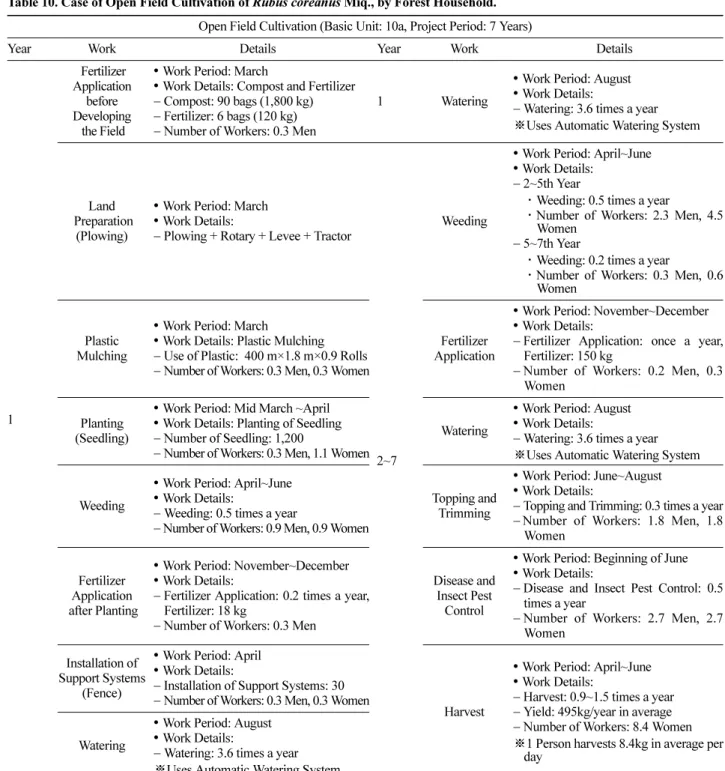
복분자(Rubus coreanus Miq.)는 줄기의 수(髓)가 60~90%를 차지하고 있어 겨울철에 가지가 얼어 죽거나 말라죽는 경우가 많아 기온이 급격히 내려가는 지역에 서는 재배가 어렵다. 본 연구에서 조사한 복분자의 재배 형태는 노지재배로서 재배면적은 2,000평, 재배기간은 7 년으로 나타났다. 복분자 재배는 1년차에 재배지조성 전 시비, 땅고르기, 비닐멀칭, 식재, 제초작업, 지주설치, 정
식 후 비료주기 등을 실시하며, 2년차부터 7년차까지 제 초작업, 시비, 관수 작업, 병충해 방제, 그리고 동일한 기 간 동안 매년 수확작업이 이루어진다. 재배지조성 전 시 비로서 퇴비를 주로 사용하는 것으로 나타났으며, 트랙 터로 땅고르기 작업 후 식재는 묘목형태로 실시되는 것 으로 조사되었다. 수확은 2년차부터 이루어지며 5~6년 차에 가장 많이 생산되는데 평당 2~2.2 kg까지 생산되는 것으로 조사되었다(Table 10).
Table 10. Case of Open Field Cultivation of Rubus coreanus Miq., by Forest Household.
Open Field Cultivation (Basic Unit: 10a, Project Period: 7 Years)
Year Work Details Year Work Details
1
Fertilizer Application
before Developing
the Field
•
Work Period: March•
Work Details: Compost and Fertilizer− Compost: 90 bags (1,800 kg)
− Fertilizer: 6 bags (120 kg)
− Number of Workers: 0.3 Men
1 Watering
•
Work Period: August•
Work Details:− Watering: 3.6 times a year
※Uses Automatic Watering System
Land Preparation
(Plowing)
•
Work Period: March•
Work Details:− Plowing + Rotary + Levee + Tractor
2~7
Weeding
•
Work Period: April~June•
Work Details:− 2~5th Year
·Weeding: 0.5 times a year
·Number of Workers: 2.3 Men, 4.5 Women
− 5~7th Year
·Weeding: 0.2 times a year
·Number of Workers: 0.3 Men, 0.6 Women
Plastic Mulching
•
Work Period: March•
Work Details: Plastic Mulching− Use of Plastic: 400 m×1.8 m×0.9 Rolls
− Number of Workers: 0.3 Men, 0.3 Women
Fertilizer Application
•
Work Period: November~December•
Work Details:− Fertilizer Application: once a year, Fertilizer: 150 kg
− Number of Workers: 0.2 Men, 0.3 Women
Planting (Seedling)
•
Work Period: Mid March ~April•
Work Details: Planting of Seedling− Number of Seedling: 1,200
− Number of Workers: 0.3 Men, 1.1 Women
Watering
•
Work Period: August•
Work Details:− Watering: 3.6 times a year
※Uses Automatic Watering System
Weeding
•
Work Period: April~June•
Work Details:− Weeding: 0.5 times a year
− Number of Workers: 0.9 Men, 0.9 Women
Topping and Trimming
•
Work Period: June~August•
Work Details:− Topping and Trimming: 0.3 times a year
− Number of Workers: 1.8 Men, 1.8 Women
Fertilizer Application after Planting
•
Work Period: November~December•
Work Details:− Fertilizer Application: 0.2 times a year, Fertilizer: 18 kg
− Number of Workers: 0.3 Men
Disease and Insect Pest
Control
•
Work Period: Beginning of June•
Work Details:− Disease and Insect Pest Control: 0.5 times a year
− Number of Workers: 2.7 Men, 2.7 Women
Installation of Support Systems
(Fence)
•
Work Period: April•
Work Details:− Installation of Support Systems: 30
− Number of Workers: 0.3 Men, 0.3 Women
Harvest
•
Work Period: April~June•
Work Details:− Harvest: 0.9~1.5 times a year
− Yield: 495kg/year in average
− Number of Workers: 8.4 Women
※1 Person harvests 8.4kg in average per Watering day
•
Work Period: August•
Work Details:− Watering: 3.6 times a year
※Uses Automatic Watering System
Source: Survey of Case of Open Field Cultivation of Rubus coreanus Miq., by Forest Household
복분자 재배에 대한 경영성과(10a 기준)를 살펴보면, 조 수입은 37,125천원이었으며, 경영비는 고용노동비 4,080 천원, 중간재비 2,204천원을 포함하여 총 6,284천원으로 조사되었다. 이에 따라 평균소득은 10a당 30,842천원으로 사업기간 7년으로 환산할 경우 연평균 소득은 4,406천원 수준으로 다른 품목에 비해 높은 소득을 올리는 것으로 분석되었다.
한편, 복분자 재배는 자가노동보다 고용노동에 대한 의 존도가 매우 높은 것으로 분석되었다. 총 경영비에 차지 하는 고용노동비용의 비율이 42.5%로 나타났다(Table 11).
5) 산딸기
산딸기(Rubus crataegifolius)는 우리나라 산과 들에서 흔 히 자라는 식물이지만, 최근 집약적인 생산을 위해 노지
재배가 실시되고 있다. 본 연구에서 조사한 산딸기의 재 배형태는 노지로서 재배면적은 600평, 재배기간은 6년으 로 조사되었다.
산딸기는 복분자와 마찬가지로 1년차에 재배지조성 전 시비, 땅고르기, 비닐멀칭, 식재, 제초작업, 관수, 순자르기 등을 실시한다. 2년차부터 6년차까지 제초작업 및 비료주 기, 관수작업, 그리고 매년 수확이 이루어진다. 재배지조 성은 트랙터로 땅고르기작업 후 식재는 묘목으로 하며 평 당 1본 정도를 식재하는 것으로 조사되었다. 정식후 제초 작업을 하게 되며, 이후 밑거름으로 우분, 계분 등으로 만 든 퇴비와 비료를 살포한다. 제초작업의 경우 1~3년차까 지는 연 3회, 그리고 산딸기가 완전히 정착된 이후인 4~6 년차에는 연 1회씩 작업을 하는 것으로 나타났다. 수확은 2년차부터 이루어지며 5~6년차에는 가장 많이 생산되는 Table 11. Average Production Cost and Earnings in the Open Field Cultivation of Rubus coreanus Miq., by Forest household.
(Unit: 1,000 won/10a)
Division Details of Work Amount
Gross Income − Average Price: 12,500 won/kg
− Total Production: 2,970 kg 37,125
Production Cost
Working Expenses
Hired Labor Costs
Fertilizer Application 24
Plowing 90
Plastic Mulching 20
Planting of Seedstock 57
Weeding 194
Harvest 3,695
Total 4,080
Intermediary Goods Cost
Compost and Fertilizer Cost 1,307
Plastic Mulching 108
Seedstock Purchase Cost 180
Installation of Support Systems Cost 450
Watering Cost 105
Agricultural Pesticides Cost 54
Total 2,204
Total 1 6,284
Internal Fixed Costs
Self-Labor Cost
Fertilizer Application 186
Plastic Mulching 20
Planting of Seedstock 20
Topping 234
Weeding 409
Disease and Insect Pest Control 351
Total 1,220
Self-Supply Cost Land 2,100
Total 2 3,320
Total Production Cost = Total 1 + Total 2 9,604
Earnings = Gross Income – Working Expenses 30,842
Net Earnings = Gross Income – Working Expenses − Internal Fixed Costs 27,522
Earnings Rate 83%
Note: The production of Rubus coreanus Miq., begins in the second year after the planting.
데 평당 2.5~3.7 kg까지 생산되는 것으로 조사되었다 (Table 12).
한편, 산딸기 재배에 대한 경영성과(10a 기준)를 살펴보 면, 조수입은 39,060천원이었으며, 경영비는 고용노동비 4,525천원, 중간재비 3,068천원을 포함하여 총 7,593천원 으로 조사되었다(Table 13). 이에 따라 평균소득은 10a당 31,468천원으로 사업기간 6년으로 환산할 경우 연평균 소 득은 5,244천원 수준으로 본 연구에서 조사한 5개 품목 중 가장 많은 소득을 올리는 것으로 분석되었다. 산딸기 재배 는 현재 전라북도와 전라남도 일부지역에서 시범사업 단 계를 거쳐 일부 생산이 이루어지고 있기 때문에 향후 재 배과정 등이 어느 정도 정착된다면 생산량 증대와 생산비 감소로 인해 소득은 더욱 향상될 것으로 예상된다.
결 론
본 연구는 주요 수실류에 대한 재배공정을 조사하여 표 준소득을 분석함으로써 임산물 손실에 대한 보상 기준 및 임업경영진단·설계 등 임업경영환경 개선을 위한 합리 적인 정책수립에 필요한 기초자료 제공을 목적으로 하였 다. 특히, 본 연구에서 조사한 은행, 머루, 다래, 복분자, 산 딸기 등 5개 수실류 품목은 2008년 산림청의 산지 약용식 물 산업화 대책의 90개 지원 대상 품목에 포함되어 왔으 나(Korea Forest Service, 2008), 사실상 정부 보조가 일부 품목에 한정되어 지원되어옴에 따라 재배임가들은 산림 청과 산림조합보다는 농업기술센터나 시·군 농정과의 도움을 받아 재배가 이루어지고 있기 때문에 임업분야 뿐 Table 12. Case of Open Field Cultivation of Rubus crataegifolius by Forest Household.
Open Field Cultivation (Basic Unit: 10a, Project Period: 6 Years)
Year Work Details Year Work Details
1
Fertilizer Application
before Developing the
Field
•
Work Period: March•
Work Details: Compost and Fertilizer− Compost: 100 bags (2,000 kg)
− Fertilizer: 3 bags (60 kg)
− Number of Workers: 1 Man
2~6
Weeding
•
Work Period: May ~July•
Work Details:− 2~4th year
·Weeding: 1.5 times a year
·Number of Workers: 13.5 Men
− 5~6th year
·Weeding: 0.5 times a year
·Number of Workers: 1 Man, 1 Woman
Land Preparation
(Plowing)
•
Work Period: March•
Work Details:− Plowing + Rotary + Levee + Tractor
Fertilizer Application
•
Work Period: March•
Work Details: Compost and Fertilizer− Compost: 100 bags (2,000 kg)
− Fertilizer: 3 bags (60 kg)
− Number of Workers: 1 Man
Plastic Mulching
•
Work Period: March•
Work Details: Plastic Mulching− Use of Plastic: 400 m×1.8 m×0.9 Rolls
− Number of Workers: 1 Man
Watering
•
Work Period: April~July•
Work Details: -2~3rd year·Watering: 5 times a year
·Number of Workers: 10 men
− 4~6th year
·Watering: 1.5 times a year
·Number of Workers: 4.5 men
Planting (Seedling)
•
Work Period: March•
Work Details: Planting of seedling− Number of Seedling: 300
− Number of Workers: 1 Man, 2.5 Women
Topping and Trimming
•
Work Period: June•
Work Details:− Topping and Trimming: 2.5 times a year
− Number of Workers: 2.5 men
Weeding
•
Work Period: May ~July•
Work Details:− Weeding: 1.5 times a year
− Number of Workers: 4.5 Men
Disease and Insect Pest
Control
•
Work Period: April, July•
Work Details:− Disease and Insect Pest Control: Once a year
− Number of Workers: 10 men
Watering
•
Work Period: April~July•
Work Details:− Watering: 5 times a year
− Number of Workers: 5 Men
Harvest
•
Work Period: June~July•
Work Details:− Harvest: 5~7 times a year
− Yield: 65 kg/year in average
− Number of Workers: 51 Men, 51 Women
※1 Person harvests 20 kg in average per day
Topping and Trimming
•
Work Period: June•
Work Details:− Topping and trimming: 0.5 times a year
− Number of Workers: 0.5 Men
Source: Survey of Case of Open Field Cultivation of Wild Berry by Forest Household
만 아니라 농업분야에서도 경영진단 등의 기초자료로 활 용할 수 있을 것으로 판단된다. 단, 본 연구에서 조사한 임 가 수는 규모자체가 일반화 할 정도로 충분하지 않다는 한계점이 있다.
조사결과, 수실류 재배 임가의 평균 연령은 58~70세, 평 균 종사기간은 4~17년으로 나타났으며, 다래와 산딸기는 최근에 재배가 이루어져 생산기간이 비교적 짧은 것으로 나타났다. 재배형태는 크게 노지와 산지에서 재배되고 있 었다.
품목별 연간 소득분석은, 노지재배(10a)와 산지재배(ha) 의 단위면적당 분석기준이 다르기 때문에 이를 동일한 기 준으로 환산할 경우 연간 평당(3.3 m3) 소득은 은행 노지 재배 1,060원, 은행 산지재배 618원, 머루 노지재배 5,891 원, 다래 산지재배 8,113원, 복분자 노지재배 14,701원, 산
딸기 노지재배 17,482원 수준으로 복분자와 산딸기의 단 위면적당 연간 소득이 타 품목에 비해 매우 높은 것으로 분석되었다. 특히, 산딸기의 경우 수확이 식재 후 2년차부 터 이루어진다는 것과 수확작업 시 많은 노동력을 자가노 동에 의존하고 있어 고용노동비 지출이 적었기 때문으로 판단된다.
한편, 소득분석 결과 대부분의 수실류 재배 시 시설비, 종근, 묘목 등 초기 투자비용이 경영비에서 차지하는 비 중이 평균 30% 내외로 높은 것으로 분석되었다. 향후 재 배의 활성화를 위해서는 부처소관 품목에 따라 지원이 차 등으로 이루어지기 보다는 임산물과 농산물 구분 없이 정 부의 일원화된 지원전략이 필요할 것으로 판단된다.
그리고 현재 다래와 산딸기 재배의 경우 최근 들어 재 배가 실시되고 있어 대부분 재배 임가들이 기술과 재배 Table 13. Average Production Cost and Earnings in the Open Field Cultivation of Rubus crataegifolius by Forest household.
(Unit: 1,000 won/10a)
Division Details of Work Amount
Gross Income − Average Price: 12,000 won/kg
− Total Production: 3,255 kg 39,060
Production Cost
Working Expenses
Hired Labor Costs
Fertilizer Application 270
Plowing 90
Plastic Mulching 45
Planting of Seedstock 145
Weeding 1,620
Harvest 1,905
Disease and Insect Pest Control 450
Total 4,525
Intermediary Goods Cost
Compost and Fertilizer Cost 1,755
Seedstock Purchase Cost 1,200
Disease and Insect Pest Control Cost 113
Total 3,068
Total 1 7,593
Internal Fixed Costs
Self-Labor Cost
Fertilizer Application 270
Planting of Seedstock 70
Watering 1,755
Plastic Mulching 45
Topping 270
Weeding 420
Disease and Insect Pest Control 450
Harvest 1,905
Total 5,185
Self-Supply Cost Land 1,800
Total 2 6,985
Total Production Cost = Total 1 + Total 2 14,578
Earnings = Gross Income – Working Expenses 31,468
Net Earnings = Gross Income – Working Expenses − Internal Fixed Costs 24,483
Earnings Rate 81%
Note: The production of Rubus crataegifolius begins in the second year after the planting.
경험이 부족하고 네트워킹이 잘 되어 있지 않아 재배에 상당한 어려움을 겪고 있는 것으로 나타났다. 관련 전문 가 D/B구축과 기술교본 등을 만들어 보급하는 것이 필요 하며 특히 선도 임가들을 잘 활용하여 이들이 현장에서 제대로 역할을 수행 할 수 있도록 지원이 필요할 것으로 사료되었다.
References
Choi, S.I., Kim, J.S., Joo, R.W., and Kim, C.S. 2006. A study on the economic analysis of chestnut cultivation in Korea. Journal of Korean Forest Society 95(3): 274-281.
Kim, J.S., Joo, R.W., and Choi, S.I. 2007. An economic anal- ysis of oak mushroom cultivation in Korea. Journal of Korean Forest Society 96(4): 440-451.
Kim, J.S. and Lee, U. 2010. Analysis of production cost of walnut tree cultivation in major cultivating regions, Jour- nal of Korean Forest Society 99(4): 611-617.
Korea Forest service. 2008. Industrialization of mountain medical plant.
Korea Forest Service. 2010. 2009 Forestry production cost survey report.
Korea Forest Service. 2011. 2010 Forestry production cost survey report.
Korea Forest Service. 2012. 2011 Forestry production cost survey report.
Korea Forest Service. 2013a. 2012 Forestry production cost survey report.
Korea Forest Service. 2013b. The fifty national forest plan (2013~2017).
Korea Forest Service. 2013c. Statistical yearbook of forestry.
Park, Y.B., Kim, J.S., and Jung, B.H. 2009. Production and marketing analysis of mountain medical plant resource (I). Korea Forest Research Institute.
Park, Y.B., Kim, J.S., and Kim, K.D. 2010. Production and marketing analysis of mountain medical plant resource (II). Korea Forest Research Institute.
Park, Y.B., Kim, K.D., and Lee, H.S. 2011. Production and marketing analysis of mountain medical plant resource (III). Korea Forest Research Institute.
(2014년 5월 8일 접수; 2014년 7월 5일 채택)