http://dx.doi.org/10.7236/JIIBC.2016.16.5.143
JIIBC 2016-5-22
IoT 기반의 실시간 유해 화학물 관리 시스템 개발
Development of IoT-based real-time Toxic Chemical management System
강민수
*, 임춘화
**, 정용규
***, 이민호
****Min-Soo Kang
*, Chunhwa Ihm
**, Yong-Gyu Jung
***, Minho Lee
****요 약 최근 독극물로 인한 사고가 빈번하게 발생하여 사회적인 문제가 발생하고 있어 독극물관리를 철저히 해야 할 필요성이 대두되고 있다. 2010년 기준으로 국내에는 약 10만 여종의 독극물이 유통되어 사고 시 중증 중독환자 혹은 대량으로 환자를 발생시킬 수 있고 국제적으로도 NBC에 의한 대량 재해의 심각성이 대두되고 있다. 그래서 생산지에 서 부터 관리 할 수 있도록 독극물이 들어 있는 유리병에 13.56MHz 대역의 RFID 시스템을 사용하였고, 인식된 태그 데이터는 IEEE 802.15.4 기반의 통신으로 메인 시스템에 데이터를 전송한다. 전송 된 데이터는 스마트 디바이스를 통 하여 독극물의 상태를 실시간으로 모니터링 할 수 있는 시스템을 구현하였다. 그러나 독극물을 관리하는 시스템의 고 장은 예측 할 수 없는 결과를 발생시킨다. 그래서 고장의 원인이 되는 오류를 하드웨어 여분을 이용한 방법으로 검출 하였고 검출된 오류가 전체 시스템에 영향을 주지 않도록 이중화 시스템을 제시하였다.
Abstract
Recent accidents caused by toxic chemicals and the social problems caused by frequent. As of 2010, there are more than 100,000 types of deadly toxic chemicals being distributed throughout Korea, and severely intoxicated patients along with an enormous number of patients can be induced at the time of an accident involving deadly toxic chemicals. Internationally, the seriousness of large-scale disasters due to a NBC disaster (nuclear, biologic and chemical disaster) is being highlighted as well. So, we obtain the information of the RFID tag attached to a glass bottle with containing the toxic chemical to transfer the data to the smart device has been studied a system that can monitor the status of the toxic chemical in real time. The proposed system is the information was sent to the main system using a zigbee communication by recognizing the tag vial containing the toxic chemical with the 13.56MHz bandwidths good permeability. User may check the information in real time by utilizing the smart device. However, the error of the system for managing the toxic chemical generates a result that can not be predicted. Failure of the system was detecting the error by using a comparator as this can cause an error. And the detected error proposed a duplex system so that they do not affect the overall system.Key Words :
Duplex system, Fault tolerant, RFID, Toxic chemical management.*정회원, 을지대학교 의료IT마케팅학과 교수
**정회원, 을지대학교 의학과 교수(교신저자)
***종신회원, 을지대학교 의료IT마케팅학과 교수
****정회원, 을지대학교 식품외식산업학과 교수
접수일자 : 2016년 8월 2일, 수정완료 : 2016년 9월 2일 게재확정일자 : 2016년 10월 7일
Received: 2 August, 2016 / Revised: 2 September, 2016 / Accepted: 7 October, 2016
**Corresponding Author: [email protected] Dept. of Medicine, Eulji Univ. Korea
I. Introduction
The need to exhaustively manage deadly toxic
chemicals is emerging due to the recent occurrence of
social issues arising from frequent occurrences of
accidents involving deadly toxic chemicals. As of 2010,
there are more than 100,000 types of deadly toxic chemicals being distributed throughout Korea, and severely intoxicated patients along with an enormous number of patients can be induced at the time of an accident involving deadly toxic chemicals.
Internationally, the seriousness of large-scale disasters due to a NBC disaster (nuclear, biologic and chemical disaster) is being highlighted as well. However, information on deadly toxic chemicals is not being systematically managed in Korea and information on some of the deadly toxic chemicals is being managed by each of the various government organizations. If such information on deadly toxic chemicals is monitored in real time from the stage of manufacturing, it would not only be possible to prevent abuse or accidents involving deadly toxic chemicals in advance.
Systems that allow for ICT-based real-time monitoring are necessary for efficient management. For ICT-based management of deadly toxic chemicals, technology that enables real-time monitoring of the deadly toxic chemicals by utilizing IoT-based RFID technology must be applied. IoT is a technology for the provision of intelligent services through the mutual communication between people and objects (physical or virtual) and between an object and objects, and the combination of the situation of recognition-based knowledge through the network via which intelligent objects are interconnected. The Seoul Asan Medical Center executed the task of confirming whether the medical staff were promptly able to collect the information by attaching the tags onto the patients or mock patients intoxicated by the deadly toxic chemicals and by composing a DB system frame on the key information for each of the tags.
[1][2]The hazardous materials management system utilizing RFID is the Hazardous Materials Management system of NASA for the management of the chemical substances or toxic substances used in research conducted at the Dryden Flight Research Center in California.
[3][4]This system attaches the RFID tag on container for hazardous materials to track and manage the location and
movement path of such substances, and allows only those with authority over the hazardous materials to handle them through the integration of the entry/exit management system through the existing smart card system. However, it has the limitation that it can only execute the tracking of the location and management of the hazardous materials within the boundary of the warehouse that stores the hazardous materials. In this Study, all the objects in the world will be closely interconnected on the basis of IoT, including new computing and situation recognition capabilities of the objects by endowing computing capabilities to objects, rather than a simple glass bottle for deadly toxic chemical. Closely interconnected IoT technology will ultimately become the core of a hyper-connected society with a focus on the objects, data, process, time and space, and knowledge centered-on human beings.
II. High reliability system design
The general methods of enhancing reliability include Fault Avoidance and Fault Tolerant which executes the stipulated algorism even if a fault occurs.
[5][6]Fault Avoid involves minimizing the possibilities of a fault by using highly reliable parts or by redesigning based on stringent experiments while Fault Tolerant makes continuous functions to operate properly even if a fault occurs by using redundancy parts or information. In this study, Fault Avoidance was done in basic because it was a toxic chemical monitoring but assuming that there was a problem with the hardware, the hardware redundancy was developed to enable a fault.
1. Method of using Redundancy
In order to operate the stipulated algorism even if a
fault occurs, the reliability of the system has to be
enhanced and as a way of enhancing the reliability,
redundancy was used. When using redundancy, it is
classified into hardware redundancy, software
redundancy, information redundancy and time
redundancy. Hardware redundancy is Provided by incorporating extra hardware into the design to either detect or override the effects of a failed component. For example, instead of having a single processor, we can use two or three processors, each performing the same function.
2. Duplex system design
Duplex system was designed to compare the output value of 2 equivalent systems and to masking the value of the module in case of a fault, ensuring that the effects of the fault would not be carried forward to the next stage.
[7]Figure 1 shows that the comparator was combined with the Duplex system and in case the output value of the 2 modules were different, the output of the comparator became the high value, causing a fault signal. If a fault signal is generated by the main system sends an fault signal.
그림 1. 이중화 시스템 설계
Fig. 1. Duplex System Block Diagram
3. Reliability Evaluation
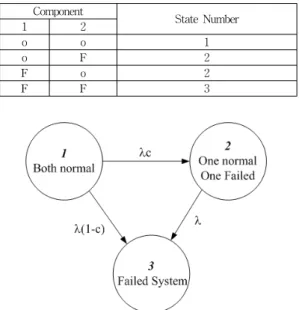
Markov Model was used for the reliability evaluation. Markov Model offers a stochastic system evaluation model that exhibits the status the system can have. In other words, each status can be expressed in operable module in order to demonstrate the reliability of the designed system. Each model in the system has operable status and fault status and with N number of modules, the models have
. In this dissertation, it deals with 1 spare so it has 4 states.
The change of status is demonstrated in a Markov chain Figure 2.
Component
State Number
1 2
o o 1
o F 2
F o 2
F F 3
표 1. 이중화 시스템의 마코브 모델의 상태
Table 1. state of a Markov model of a Duplex system
그림 2. 이중화 시스템을 위한 마코브 체인 Fig. 2. Markov Chain For Duplex System
Duplex system has a single active processor and a single standby spare that is connected only when a fault has been detected in the active unit. Let be the fixed failure rate of each of the processors (when active) and let be the coverage factor.
[8][9]Note that because the integers assigned to the different states are arbitrary, we can assign them in such a way that they are meaningful and thus easier to remember. In this example, the state represents the number of normal processors (0, 1, or 2, with the initial state being 2 normal processors). The differential equations describing this Markov chain are:
(1)
Solving eq. 1 with the initial conditions
(2)
as a result,
(3)
III. Management system for toxic chemical control
1. System configuration
In order to efficiently manage deadly toxic chemicals, accurate information needs to be acquired. The RFID system was applied in order to acquire accurate information under the poor environment of the presence of deadly toxic chemicals.
[10][11]The RFID system has characteristics such as semi-permanent use (passive type) as long as there is no breakage due to its outstanding environment resistance, recognition with the possibility of penetrating through a non-metallic object, location tracking and recognition of multiple numbers of tags, etc.
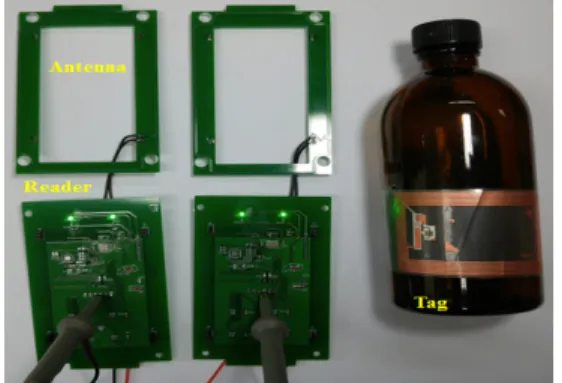
[12]Showed same two RFID system in Figure 3.
그림 3. 이중화된 RFID리더와 유리병에 붙은 태그
Fig. 3. RFID reader duplex system with glass on the tag
In this study, we compare the output values using the two readers, was determined to be wrong if the error value is compared. If it is determined that any one of the two error were so that it can send an error message to the main system.
The tag was composed to enable the recognition of the ID value including the types and properties of the deadly toxic chemical and to transmit the accurate location information of the bottle containing the deadly toxic chemicals to the Gateway.
2. Network configuration
In order to collect the data on the deadly toxic chemicals and to transmit them to the administrator in real-time, IoT-based technology is necessary. IoT technology is defined by the object-space connecting network that forms intelligent relationship including sensing, networking and information processing through mutual cooperation without the explicit interference of human beings on the 3 dispersed environmental factors, namely, human beings, objects and services. Reader is able to transmit the tag information to Gateway through Zigbee communication in order to acquire the information of deadly toxic chemicals in real time.
[13]The Gateway is composed to transmit the received tag information to the main system.
[14]In addition, it was composed to send the received information to a smart device. A system composed in this manner is designed on a mobile base to enable two-way communication, thereby enabling real-time management of the deadly toxic chemicals.
그림 4. RFID 시스템과 연계된 전체 네트워크
Fig. 4. RFID system and Linked Total Network
IV. Test of toxic chemical management system
The RFID system used to acquire accurate information of the deadly toxic chemicals transmits the acquired tag information to the Gateway through the IEEE 802.15.4-based Zigbee communication, which is then transmitted to the main system through Ethernet communication. The main system can manage the deadly toxic chemicals in real time and data can be transmitted to the smart devices (smart phone, i-Pad and Tab, etc.) in accordance with the instruction of the administrator. However, if the RFID reader fails to operate, it would in fact cause an accident due to the wrong signals. To mask the default, 2 equivalent modules were used to compare the output values and if a wrong value was incurred, the default signal was triggered. Figure 5 shows that oscilloscope was used to measure the module in normal and error operation.
(a) 일반적인 상태 (a) Normal state
(b) 결함이 발생한 상태 (b) Occurred fault signal
그림 5. 오실로스코프를 사용한 RFID 리더 출력신호 측정 Fig. 5. Measured RFID reader output using oscilloscope
Figure 5.(a) shows the normal output because the output value of M_1 and M_2 are the same and the error signal is also indicated as low. Figure 5.(b) indicates that the value of M_1 and M_2 modules become different at the mid-point of the wave so the error value shows high output and in the output wave, it shows that nothing is being output. Therefore, in case a fault occurs in any one of module M_1 and M_2, error signal occurred and it can be determined from the experiment that the output was masked.
V. Conclusion
Numerous social issues are occurring due to the frequent manifestation of accidents due to deadly toxic chemicals in recent years. Accordingly, research on a system for monitoring the status of deadly toxic chemicals was done by acquiring information on the deadly toxic chemicals by attaching RFID tag on glass bottles containing the deadly toxic chemicals stored in a storage room and then transmitting such data to a smart device. However, the error of the system is to result in an unexpected result. So, it was applied to the system to ensure the high reliability. Tolerant system is essential in order to realize a highly reliable system.
However, even if reliable parts are used for high reliability, the effect of a malfunction cannot be completely eliminated. So, it was designed using the hardware redundancy and the comparator is used to defect faults which have incurred and by masking the fault, the error signal is not output. Therefore, the information of the tag acquired will be able to monitor the status of deadly toxic chemicals in real-time by utilizing IoT-based technology and enable the securement of stability through the mobile-based real-time management of the deadly toxic chemicals.
And such a system realized on the basis of IoT can be
used not only in the management of the deadly toxic
chemicals but also in the management of radioactive
substances and guns, etc. Also be able to use such a
system will only toxic chemical control and reliability,
as well as the need to ensure radioactive material, firearms developed for IoT-based management.
References
[1] Asan Medical center, “Basic research for the unification of poison information systems,” Ministry of Health and Welfare,” 2007.
[2] J. H. Jun, “International success of Oracle RFID solutions,” ORACLE KOREA MAGAZINE, 2005.
[3] Manzari, S.; Marrocco, G.; Catini, A.; Di Natale,
”Experimental analysis of selectivity and dynamic ranges of passive UHF-RFID chemical sensors,”
Microwave Conference (EuMC), 2014 44th European, pp.263 – 266, 2014.
[4] Soyoung Hwang, Yunju Baek, “Fault Tolerant Clock Management Scheme in Sensor Networks”, KICS, Vol.31 No.9A, pp.868-877, 2006.
[5] M. S. Kang, Y. G. Jung, J. H. Lee, "Development of reader for non-metallic permeability Enhancement on 134KHz bandwidth, Information, Vol.18, No.
6(A), pp.2443-2448, 2015
[6] M. S. Kang, Y. G. Jung, M.H.Kim, K. Ahn,
"Development of sensor nodes based on fault tolerance", Int. J. Security and Networks, Vol. 9, No. 4, pp.190-195, 2014.
[7] J. M. Park, S. H. Cho, "Development of IoT based Sensor Node to Improve Reliability of V2X Communication", Information, Vol.18, No.10, pp.4305-4310, 2015 [8] Fiddes, L. K.; Yan, N.,”RFID tags for wireless
electrochemical detection of volatile chemicals,”, Sensors and actuators. B Chemical, Vol.186, pp.817-823, 2013.
[9] Vergara, A.; Llobet, E.; Ramirez, J. L.; Ivanov, P,
”An RFID reader with onboard sensing capability for monitoring fruit quality,” Sensors and actuators. B Chemical, Vol. 127, pp.143-149, 2007.
[10] Potyrailo, R.A.; Surman, C.; Morris, W.G., ”Combinatorial Screening of Polymeric Sensing Materials Using RFID Sensors: Combined Effects of Plasticizers and Temperature,” AMERICAN CHEMICAL SOCIETY, Vol. 11, No. 4, pp.598-603, 2009.
[11] Sang-ju Park, Hyeon-Kyeong Seong, “A Study on Design of Dual-Polarized Microstrip Patch Antenna for RFID,” Journal of Korean Institute of Information Technology, Vol. 9, No.3, pp.139-145, 2011.
[12] Daiki Min, “System Development for Tracking a UHF Passive RFID Tag in an Outpatient Clinic,”
The Jounal of Society for e-Business Studies, Vol.
16, No.3, pp. 113-127, 2011.
[13] Hye-bin Park, Jinoo Joung, "An Energy Efficient Reclustering Algorithm in Wireless Sensor Networks, The Journal of The Institute of Internet Broadcasting and Communication, Vol. 15 No. 3, pp. 155-161, 2015
[14] SuYeol Choi, ChangHee Lee, “A Study on Multi-function Implementation using Single Sensor”, The Journal of The Institute of Internet Broadcasting and Communication, Vol. 16 No. 4, pp. 133-137, 2016
저자 소개
강 민 수(정회원)
∙1993 : Kwangwoon Univ.,Dept. of Control & Instrumentation Eng., B.S.
∙1995 : Kwangwoon Univ.,Dept. of Control & Instrumentation Eng., M.S.
∙2003 : Kwangwoon Univ.,Dept. of Control & Instrumentation Eng., Ph.D.
∙2013 ∼ : Eulji Univ., Dept. of Medical IT Marketing <Research area : AI, Medical IoT>
임 춘 화(정회원)
∙1993 : Chunhnam National University, Dept of Medicine, B.S.
∙2000 : Chunhnam National University, Dept of Medicine, M.S.
∙2004 : Chunhnam National University, Dept of Medicine, Ph.D.
∙2002 ∼ : Eulji Univ., School of Medicine
<Research area : Transfusion Medicine, biobank, molecular genetics>
※ (R0002888) This research was supported by the Ministry of Trade, Industry & Energy(MOTIE), Korea Institute for Advancement of Technology (KIAT) through the Encouragement Program for The Industries of Economic Cooperation Region.
정 용 규(종신회원)
∙1981 : Seoul National Univ. Dept. of Physics Education, B.S.
∙1994 : Yonsei Univ. Dept. of computer science, M.S
∙2003 : Kyonggi Univ., Dept. of computer science, Ph. D
∙2013 ∼ : Eulji Univ., Dept. of Medical IT Marketing
<Research area : Data Mining, HIS>
이 민 호(정회원)
∙1997 : Sangji Univ., Dept. of Agronomy, B.S.
∙1999 : KyungHee Univ., Dept. of Agronomy, M.S.
∙2003 : KyungHee Univ., Dept. of Agronomy, Ph.D.
∙2013 ∼ : Eulji Univ., Dept. of Food Science
<Research area : Healthcare Science>