ABSTRACT
Purpose: Sodium is an essential nutritional electrolyte that affects growth. A low serum sodium concentration in healthy premature infants beyond 2 weeks of life is called late- onset hyponatremia (LOH). Here, we investigated the association between LOH severity and growth outcomes in premature infants.
Methods: Medical records of premature infants born at ≤32 weeks of gestation were reviewed.
LOH was defined as a serum sodium level <135 mEq/L regardless of sodium replacement after 14 days of life. Cases were divided into two groups, <130 mEq/L (severe) and ≥130 mEq/L (mild). Characteristics and growth parameters were compared between the two groups.
Results: A total of 102 premature infants with LOH were included. Gestational age ([GA] 27.7 vs. 29.5 weeks, p<0.001) and birth weight (1.04 vs. 1.34 kg, p<0.001) were significantly lower in the severe group. GA was a risk factor of severe LOH (odds ratio [OR], 1.328, p=0.022), and severe LOH affected the development of bronchopulmonary dysplasia (OR, 2.950, p=0.039) and led to a poor developmental outcome (OR, 9.339, p=0.049). Growth parameters at birth were lower in the severe group, and a lower GA and sepsis negatively affected changes in growth for 3 years after adjustment for time. However, severe LOH was not related to growth changes in premature infants.
Conclusion: Severe LOH influenced the development of bronchopulmonary dysplasia and developmental outcomes. However, LOH severity did not affect the growth of premature infants beyond the neonatal period.
Keywords: Growth; Hyponatremia; Premature infant
INTRODUCTION
Sodium, the main cation of extracellular fluid, can reflect the whole-body fluid balance.
Newborn infants lose extracellular fluid during the first few days of life, which can cause imbalances between sodium and body fluid. Hyponatremia and hypernatremia are common in term and preterm infants with diverse medical conditions, including asphyxia and septic
Original Article
Received: Jan 29, 2020 1st Revised: Apr 6, 2020 2nd Revised: May 13, 2020 Accepted: May 16, 2020 Correspondence to Chan-Hoo Park
Department of Pediatrics, Gyeongsang National University School of Medicine, 15 Jinju-daero 816beon-gil, Jinju 52727, Korea.
E-mail: [email protected]
Copyright © 2020 by The Korean Society of Pediatric Gastroenterology, Hepatology and Nutrition
This is an open-access article distributed under the terms of the Creative Commons Attribution Non-Commercial License (https://
creativecommons.org/licenses/by-nc/4.0/) which permits unrestricted non-commercial use, distribution, and reproduction in any medium, provided the original work is properly cited.
ORCID iDs Ji Sook Park
https://orcid.org/0000-0002-4704-2246 Seul-Ah Jeong
https://orcid.org/0000-0002-9597-366X Jae Young Cho
https://orcid.org/0000-0002-3654-067X Ji-Hyun Seo
https://orcid.org/0000-0002-0691-3957 Jae Young Lim
https://orcid.org/0000-0001-5205-202X Hyang Ok Woo
https://orcid.org/0000-0001-8849-9341
Ji Sook Park ,1,3 Seul-Ah Jeong ,1 Jae Young Cho ,1,3 Ji-Hyun Seo ,1,3 Jae Young Lim ,1,3 Hyang Ok Woo ,1,3 Hee-Shang Youn ,1,3 and
Chan-Hoo Park 2,3
1 Department of Pediatrics, Gyeongsang National University School of Medicine and Gyeongsang National University Hospital, Jinju, Korea
2 Department of Pediatrics, Gyeongsang National University School of Medicine and Gyeongsang National University Changwon Hospital, Changwon, Korea
3Institute of Health Sciences, Gyeongsang National University, Jinju, Korea
Risk Factors and Effects of Severe Late- Onset Hyponatremia on Long-Term
Growth of Prematurely Born Infants
Hee-Shang Youn
https://orcid.org/0000-0002-5498-838X Chan-Hoo Park
https://orcid.org/0000-0001-8979-1467 Conflict of Interest
The authors have no financial conflicts of interest.
shock. Serum sodium concentration is also affected by many therapeutic factors, including fluid therapy and furosemide usage.
Historically, hyponatremia has been delineated as early- or late onset. Early-onset hyponatremia occurs in the first week of life, while late-onset hyponatremia (LOH) occurs in the latter half of the first month of life [1]. LOH in premature infants is usually caused by inadequate sodium intake and renal salt wasting [1,2]. Although differentiating between early- and LOH in premature infants may be less relevant because individual neonatal clinical conditions are so diverse, neonatologists often experience LOH in relatively stable prematurely born infants, especially those with a lower gestational age (GA) [3-5].
Sodium is an essential nutritional electrolyte, and its deficiency can impair growth.
Delayed replacement in sodium-deficient rodents partially restored weight growth [6].
The mechanisms of impaired growth in sodium deficiency propose the action of a Na+-H+ antiporter. Sodium deficiency inhibits hydrogen extrusion via the Na+-H+ antiporter, leading to a decrease in intracellular pH and thus impairing growth receptor function [7]. Sodium intake could promote weight gain in premature infants during early life [8]. Several studies have reported on sodium and growth in surgical infants [9,10], whereas few have reported on the long-term growth of premature infants with LOH.
This study aimed to investigate the incidence of LOH in premature infants, the associated clinical characteristics according to LOH severity, and its effect on the long-term growth of premature infants.
MATERIALS AND METHODS
Subjects
The medical records of premature neonates admitted to the neonatal intensive care unit (NICU) of our hospital between January 2011 and March 2018 were retrospectively reviewed.
Subjects met the following criteria:
1) ≤32 weeks of gestation at birth;
2) <2.5 kg at birth;
3) Hospital stay longer than 14 days after birth;
4) Serum sodium concentration measured at least once from day 14 until discharge; and 5) Hyponatremia (serum sodium <135 mEq/L) [11].
Premature infants who met the criteria were included and grouped into severe (<130 mEq/L serum sodium) and mild (130–134.9 mEq/L serum sodium) LOH according to the lowest serum sodium level during the hospital stay. Premature infants who were discharged or transferred to another hospital during the 2 weeks after birth were excluded.
Nutrition and fluid practice
Enteral nutrition (EN) was initiated in premature infants without gastrointestinal obstruction after stabilization within 24 hours together with parenteral nutrition (PN). EN included breast milk (BM), standard cow's milk formula or preterm formula, and hydrolysate or amino acid-based formula. When preterm formula was fed initially, the formula was discontinued when the weight exceeded 2.0 kg or the corrected GA was reached at 36 weeks.
PN was supplied until the premature infant could be fed enterally up to 70% of the target volume and calories. The target amount of enteral feeding in premature infants was defined as the volume needed to achieve the desired weight gain (10–15 g/kg/day), which was defined as about 150 mL/kg/day at this NICU. Human milk fortifier was supplied to infants who were fed BM 150 mL/kg/day or more but did not gain weight properly (<10 g/kg/day); we used Maeil HMF (Maeil, Seoul, Korea) before 2016 or Enfamil (Mead Johnson Nutrition, Evansville, IN, USA).
Intravenous fluid therapy was initiated with 40–80 mL/kg/day on days 1 and 2, a relatively smaller amount of water than is usually recommended [1], and was advanced slowly to over 140 mL/kg/day on days 7–28 depending on the premature infant's clinical situation. Sodium was supplied parenterally at 2–4 mEq/kg/day when diuresis began on day 3 or 5 after birth.
When hyponatremia occurred in premature infants, we tried to evaluate the possible underlying clinical condition, such as fluid overload, renal disorder, cardiopulmonary disorder, necrotizing enterocolitis (NEC), or sepsis. Additional sodium was administered as 2 M NaCl via an enteral or parenteral route and/or free water was restricted. The amount of sodium supplementation was decided based on the serum sodium concentration, total amount of sodium intake from the enteral and parenteral routes, total fluid volume of enteral and parenteral fluids, urinary sodium excretion volume, and total urinary output from the previous day.
Data collection
The clinical characteristics that this study investigated were as follows:
1) Prolonged premature rupture of the membranes (PPROM), rupture of amniotic membrane over 18 hours before birth;
2) Maternal hypertensive condition such as essential hypertension, pregnancy-induced hypertension, eclampsia, or preeclampsia;
3) Respiratory distress syndrome of the newborn (RDS) manifesting as ground glass opacity of the lungs on a chest X-ray with tachypnea and/or desaturation;
4) Patent ductus arteriosus (PDA), left to right shunt from the aorta to the pulmonary arteries.
Prophylactic ibuprofen or indomethacin was used in preterm neonates with RDS born at
≤32 weeks of gestation after echocardiography at this NICU. When PDA caused heart failure despite the use of ibuprofen or indomethacin, ligation was performed;
5) Intraventricular hemorrhage (IVH), greater than grade 2 on brain ultrasonography on day 3 after birth;
6) Sepsis, the use of antibiotics and growth of any bacteria or fungus from patient's specimens, including blood, urine, cerebrospinal fluid, and the removed central catheter;
7) NEC, stage 2 or higher based on modified Bell's classification [12];
8) Bronchopulmonary dysplasia (BPD) criteria and severity were defined based on a June 2000 National Institute of Child Health and Human Development/National Heart, Lung, and Blood Institute Workshop [13];
9) Retinopathy of prematurity (ROP) diagnosed as zone I–III, stage I–V and plus by ophthalmologic examinations according to the screening guideline for detecting ROP at 3 or 4 weeks after birth [14];
10) Late-onset circulatory collapse (LCC), abruptly occurring volume and catecholamine- resistant hypotension requiring a stress dose of hydrocortisone to recover the previous mean blood pressure after 2 weeks of life [15];
11) Hypothyroidism in premature infants when the thyroid stimulation hormone level was
≥20 mIU/L;
12) Having taken furosemide at any age during the hospital stay;
13) BM fed exclusively or in a mixed diet with >1/2 BM on the day hyponatremia was diagnosed;
14) Total duration of intravenous fluid including PN;
15) Developmental delay assessed by pediatricians or rehabilitation doctors within the first 2 years of life adjusted for GA using the Denver Development Screening test, Korean Developmental Screening test for Infants and Children, or Bailey Scales of Infant Development;
16) Mortality as death after 2 weeks of life during the hospital stay or follow-up period; and 17) Growth parameters of weight, length or height, and head circumference (HC) were
checked at 6, 12, 18, and 36 months of age.
Statistical analysis
Statistical analyses were performed using IBM SPSS Statistics ver. 25.0 software (IBM Co., Armonk, NY, USA). The continuous values are presented as mean and standard deviation.
An independent t-test or Mann-Whitney U-test according to the satisfaction of normality assumption was used to compare the continuous variables between the severe and mild LOH groups. The categorical data are presented as number and proportion (%), while the differences in proportions between the two groups were assessed by the chi-square test or Fisher's exact test. Univariate or multivariate logistic regression analyses were used to assess the adjusted risk factors of severity of LOH. On the multivariate analysis, the statistically significant factors on univariate analysis were included for adjustment. We also checked the multicollinearity between the factors for adjustment using correlation coefficients and excluded one when the coefficient was more than 0.7. Differences of linear growth between the two groups and relating factors of linear growth during the follow-up period (at birth and at 6, 12, 18, and 36 months) were investigated using a generalized linear mixed effect model (GLMM) adjusted with GA and time, which was a repeated-measures covariance pattern model with unstructured covariance within subjects. A p-value of less than 0.05 was considered statistically significant.
Ethics statement
The study protocol was reviewed and approved by the Institutional Review Board of Gyeongsang National University Hospital (GNUH 2019-12-017), which waived the need for informed consent due to its retrospective nature.
RESULTS
A total of 367 neonates born at ≤32 weeks of gestation and weighing less than 2.5 kg were admitted to our hospital's NICU between January 2011 and March 2018. Of them, 340 premature infants stayed at the hospital for more than 14 days after birth (Fig. 1). Mean GA was 28.6±2.3 weeks and mean birth weight was 1.19±0.35 kg. There were 41 female infants (40.2%).
Incidence of LOH
LOH occurred in 102 of 340 (30.0%) premature infants at least once after 14 days of age; the other 238 did not experience LOH during the hospital stay (Fig. 1). The shorter the gestational period, the more common LOH occurred. LOH was observed in 8.9% (15/169) of premature infants born at 31–32 weeks, 31.3% (36/115) of infants born at 29–30 weeks, and in 91.1%
(51/56) of infants born at ≤28 weeks of gestation (Fig. 2).
Of the 102 premature infants with LOH, the mean serum sodium concentration was 129.3±3.4 mEq/L and the mean serum osmolality was 274.8±9.0 mOsm/kg at the time of hyponatremia. LOH was detected at a mean 29.6±2.2 days postnatally and lasted for a mean 7.2±6.5 days.
Comparisons of clinical characteristics in premature infants with LOH by hyponatremia severity
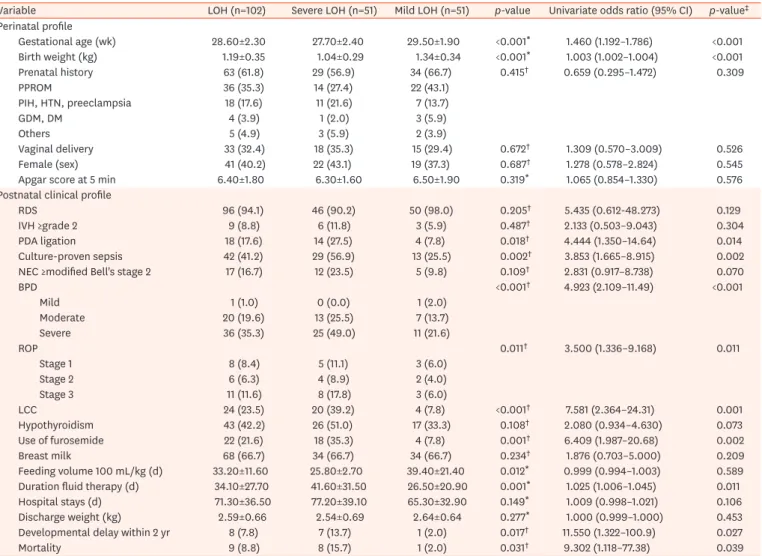
Severe LOH (serum sodium <130 mEq/L) occurred in 51 patients, whereas mild LOH occurred in 51 patients. Mean GA (27.7±2.4 weeks vs. 29.5±1.9 weeks, p<0.001) and birth weight (1.04±0.29 kg vs. 1.34±0.34 kg, p<0.001) were significantly lower in premature infants with severe LOH than in those with mild LOH. PPROM was the most common prenatal problem in both groups (27.4% in severe LOH, 43.1% in mild LOH). The history of obstetrical problems did not differ between the two groups (p=0.415). There were 22 females (43.1%) in the severe LOH group versus 19 (37.3%) in the mild LOH group (p=0.687). The occurrence of RDS, IVH
≥grade 2, NEC ≥stage 2, and hypothyroidism did not differ between the two groups. PDA ligation, sepsis, BPD, ROP, and LCC occurred more frequently in the severe LOH group than in the mild LOH group (p<0.05). Furosemide was more frequently used in the severe LOH
Preterm neonates born at <32 weeks of gestation and 2.5 kg of birth weight
(n=367)
Infants without LOH (n=238) Infants with LOH
(n=102)
Serum Na 130 134.9 mEq/L (n=51)
Serum Na <130 mEq/L (n=51)
Exclusions (n=27) 1. Deaths in 2 weeks of life (n=8) 2. Discharges or transfers in 2 weeks
of life (n=19)
Fig. 1. Inclusion criteria and number of subjects in the present study. LOH: late-onset hyponatremia.
<28 29 30 31 32
200
150
100
50
Number
Weeks of gestation 0
LOH No_LOH
51 5
36
79
15
154
Fig. 2. Incidence of late-onset hyponatremia by gestational age (p<0.001, Kruskal-Wallis test). LOH: late-onset hyponatremia.
group than in the mild LOH group (35.3% vs. 7.8%, respectively, p=0.001). The number of BM feedings did not differ between the two groups. It took less time to reach a feeding of more than 100 mL/kg enterally in the severe LOH group than in the mild LOH group (25.8±2.7 days after birth vs. 39.4±21.4 days after birth, respectively, p=0.012). The mean duration of fluid therapy including PN (41.6±31.5 days after birth vs. 26.5±20.9 days after birth, p=0.001) was longer in severe LOH group than in mild LOH group, respectively. Total hospital stay was longer in the severe LOH group than in the mild LOH group, but the difference was statistically insignificant (77.2±39.1 days after birth vs. 65.3 ±32.9 days after birth, p=0.149).
Developmental delay within 2 years after birth (13.7% vs. 2.0%, p=0.017) and mortality (15.7% vs. 2.0%, p=0.031) occurred more frequently in the severe LOH group than in the mild LOH group (Table 1).
Table 1. Comparisons of clinical characteristics and risk ratios of premature infants with late-onset hyponatremia according to the severity of hyponatremia Variable LOH (n=102) Severe LOH (n=51) Mild LOH (n=51) p-value Univariate odds ratio (95% CI) p-value‡ Perinatal profile
Gestational age (wk) 28.60±2.30 27.70±2.40 29.50±1.90 <0.001* 1.460 (1.192–1.786) <0.001
Birth weight (kg) 1.19±0.35 1.04±0.29 1.34±0.34 <0.001* 1.003 (1.002–1.004) <0.001
Prenatal history 63 (61.8) 29 (56.9) 34 (66.7) 0.415† 0.659 (0.295–1.472) 0.309
PPROM 36 (35.3) 14 (27.4) 22 (43.1)
PIH, HTN, preeclampsia 18 (17.6) 11 (21.6) 7 (13.7)
GDM, DM 4 (3.9) 1 (2.0) 3 (5.9)
Others 5 (4.9) 3 (5.9) 2 (3.9)
Vaginal delivery 33 (32.4) 18 (35.3) 15 (29.4) 0.672† 1.309 (0.570–3.009) 0.526
Female (sex) 41 (40.2) 22 (43.1) 19 (37.3) 0.687† 1.278 (0.578–2.824) 0.545
Apgar score at 5 min 6.40±1.80 6.30±1.60 6.50±1.90 0.319* 1.065 (0.854–1.330) 0.576
Postnatal clinical profile
RDS 96 (94.1) 46 (90.2) 50 (98.0) 0.205† 5.435 (0.612-48.273) 0.129
IVH ≥grade 2 9 (8.8) 6 (11.8) 3 (5.9) 0.487† 2.133 (0.503–9.043) 0.304
PDA ligation 18 (17.6) 14 (27.5) 4 (7.8) 0.018† 4.444 (1.350–14.64) 0.014
Culture-proven sepsis 42 (41.2) 29 (56.9) 13 (25.5) 0.002† 3.853 (1.665–8.915) 0.002
NEC ≥modified Bell's stage 2 17 (16.7) 12 (23.5) 5 (9.8) 0.109† 2.831 (0.917–8.738) 0.070
BPD <0.001† 4.923 (2.109–11.49) <0.001
Mild 1 (1.0) 0 (0.0) 1 (2.0)
Moderate 20 (19.6) 13 (25.5) 7 (13.7)
Severe 36 (35.3) 25 (49.0) 11 (21.6)
ROP 0.011† 3.500 (1.336–9.168) 0.011
Stage 1 8 (8.4) 5 (11.1) 3 (6.0)
Stage 2 6 (6.3) 4 (8.9) 2 (4.0)
Stage 3 11 (11.6) 8 (17.8) 3 (6.0)
LCC 24 (23.5) 20 (39.2) 4 (7.8) <0.001† 7.581 (2.364–24.31) 0.001
Hypothyroidism 43 (42.2) 26 (51.0) 17 (33.3) 0.108† 2.080 (0.934–4.630) 0.073
Use of furosemide 22 (21.6) 18 (35.3) 4 (7.8) 0.001† 6.409 (1.987–20.68) 0.002
Breast milk 68 (66.7) 34 (66.7) 34 (66.7) 0.234† 1.876 (0.703–5.000) 0.209
Feeding volume 100 mL/kg (d) 33.20±11.60 25.80±2.70 39.40±21.40 0.012* 0.999 (0.994–1.003) 0.589
Duration fluid therapy (d) 34.10±27.70 41.60±31.50 26.50±20.90 0.001* 1.025 (1.006–1.045) 0.011
Hospital stays (d) 71.30±36.50 77.20±39.10 65.30±32.90 0.149* 1.009 (0.998–1.021) 0.106
Discharge weight (kg) 2.59±0.66 2.54±0.69 2.64±0.64 0.277* 1.000 (0.999–1.000) 0.453
Developmental delay within 2 yr 8 (7.8) 7 (13.7) 1 (2.0) 0.017† 11.550 (1.322–100.9) 0.027
Mortality 9 (8.8) 8 (15.7) 1 (2.0) 0.031† 9.302 (1.118–77.38) 0.039
Values are presented as mean±standard deviation or number (%).
LOH: late-onset hyponatremia, CI: confidence interval, PPROM: prolonged premature rupture of membrane, PIH: pregnancy-induced hypertension, HTN:
hypertension, GDM: gestational diabetes mellitus, DM: diabetes mellitus, RDS: respiratory distress syndrome, IVH: intraventricular hemorrhage, PDA: patent ductus arteriosus, NEC: necrotizing enterocolitis, BPD: bronchopulmonary dysplasia, ROP: retinopathy of prematurity, LCC: late circulatory collapse.
*p-values were obtained by independent t-test or Mann-Whitney U-test. †p-values were obtained by the chi-square test or Fisher's exact test. ‡p-values were obtained by univariate linear or nonlinear regression analysis.
Risk factors and influence of severe LOH in premature infants
GA, birth weight, PDA ligation, sepsis, BPD, ROP, LCC, use of furosemide, duration of fluid therapy, and duration of LOH were risk factors of severe LOH on univariate analysis (p<0.05;
Table 1). When multivariate logistic regression analysis was performed of statistically
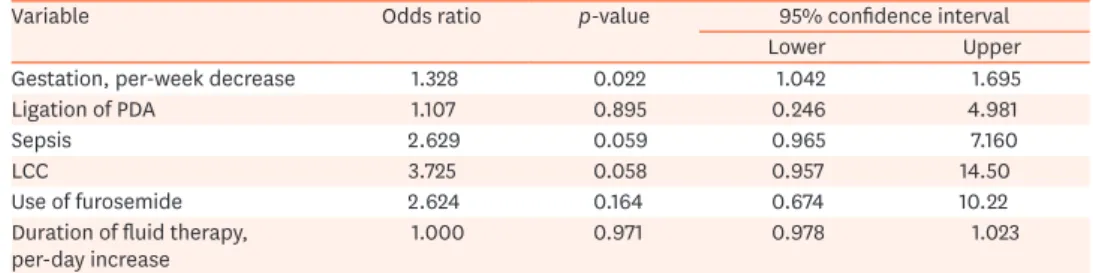
significant factors from the univariate analysis, GA was a risk factor of severe LOH (odds ratio [OR], 1.328, p=0.022, Table 2). Birth weight was not considered a risk factor because of its high collinearity with GA (r=0.767, p<0.001). Severe LOH influenced the development of BPD (OR, 2.950, p=0.039) and developmental delay within 2 years after birth (OR, 9.339, p=0.049) after the adjustment for GA (Table 3).
Growth and affecting factors in premature infants with LOH
Mean weight (1.04±0.29 kg vs. 1.34±0.34 kg, p<0.001), length (36.5±4.6 cm vs. 39.7±3.9 cm, p<0.001) and HC (25.1±2.3 cm vs. 27.2±1.9 cm, p<0.001) at birth were significantly lower in premature infants with severe LOH than in those with mild LOH because of GA (27.7±2.4 weeks vs. 29.5±1.9 weeks, p<0.001). However, the final weight (13.8±1.77 kg in severe LOH and 13.3±1.83 kg in mild LOH, p=0.464), height (93.2±3.9 cm in severe LOH and 94.5±3.2 cm in mild LOH, p=0.370), and HC (50.0 cm in both LOH groups) at 3 years of age were not significantly different between the two groups.
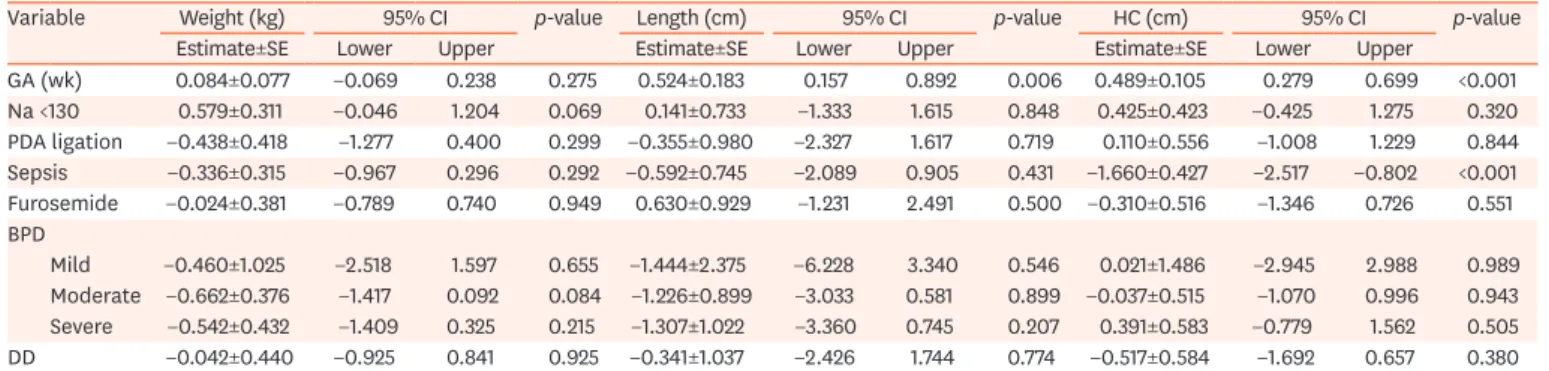
Changes in growth parameters for 3 years after birth and the affecting factors were analyzed among statistically significant variables between the two groups using a GLMM adjusted for time due to the loss of follow-up data. GA affected length (0.524±0.183 cm/week increase, p=0.006), while GA and sepsis affected HC (GA: 0.489±0.105 cm/week increase, p<0.001;
and sepsis: −1.660±0.427 cm, p<0.001; Table 4). However, severe LOH did not affect poor growth outcomes for 3 years, gaining of weight (0.579±0.311 kg, p=0.069), length or height (0.140±0.733 cm, p=0.848), or HC (0.425±0.423 cm, p=0.320) compared to the reference for each growth parameter in the mild LOH group (Fig. 3, Table 4).
Table 2. Risk factors of perinatal clinical factors for severe LOH (serum sodium <130 mEq/L) in premature infants with LOH using multivariate logistic regression analysis
Variable Odds ratio p-value 95% confidence interval
Lower Upper
Gestation, per-week decrease 1.328 0.022 1.042 1.695
Ligation of PDA 1.107 0.895 0.246 4.981
Sepsis 2.629 0.059 0.965 7.160
LCC 3.725 0.058 0.957 14.50
Use of furosemide 2.624 0.164 0.674 10.22
Duration of fluid therapy,
per-day increase 1.000 0.971 0.978 1.023
LOH: late-onset hyponatremia, PDA: patent ductus arteriosus, LCC: late circulatory collapse.
Table 3. Influences of severe hyponatremia (<130 mEq/L) on clinical outcomes of premature infants with LOH using multivariate nonlinear logistic regression analyses adjusted for gestational age
Variable Odds ratio p-value 95% confidence interval
Lower Upper
BPD 2.950 0.039 1.056 8.239
ROP 1.476 0.500 0.476 4.576
Hospital stay >70 d 1.084 0.870 0.414 2.839
Developmental delay within 2 yr 9.339 0.049 1.008 86.499
Mortality 4.439 0.192 0.474 41.596
LOH: late-onset hyponatremia, BPD: bronchopulmonary dysplasia, ROP: retinopathy of prematurity.
Table 4. Factors influencing growth parameters in prematurely born infants during 3 years after birth adjusted with time
Variable Weight (kg) 95% CI p-value Length (cm) 95% CI p-value HC (cm) 95% CI p-value
Estimate±SE Lower Upper Estimate±SE Lower Upper Estimate±SE Lower Upper
GA (wk) 0.084±0.077 −0.069 0.238 0.275 0.524±0.183 0.157 0.892 0.006 0.489±0.105 0.279 0.699 <0.001 Na <130 0.579±0.311 −0.046 1.204 0.069 0.141±0.733 −1.333 1.615 0.848 0.425±0.423 −0.425 1.275 0.320 PDA ligation −0.438±0.418 −1.277 0.400 0.299 −0.355±0.980 −2.327 1.617 0.719 0.110±0.556 −1.008 1.229 0.844 Sepsis −0.336±0.315 −0.967 0.296 0.292 −0.592±0.745 −2.089 0.905 0.431 −1.660±0.427 −2.517 −0.802 <0.001 Furosemide −0.024±0.381 −0.789 0.740 0.949 0.630±0.929 −1.231 2.491 0.500 −0.310±0.516 −1.346 0.726 0.551 BPD
Mild −0.460±1.025 −2.518 1.597 0.655 −1.444±2.375 −6.228 3.340 0.546 0.021±1.486 −2.945 2.988 0.989 Moderate −0.662±0.376 −1.417 0.092 0.084 −1.226±0.899 −3.033 0.581 0.899 −0.037±0.515 −1.070 0.996 0.943 Severe −0.542±0.432 −1.409 0.325 0.215 −1.307±1.022 −3.360 0.745 0.207 0.391±0.583 −0.779 1.562 0.505
DD −0.042±0.440 −0.925 0.841 0.925 −0.341±1.037 −2.426 1.744 0.774 −0.517±0.584 −1.692 0.657 0.380
CI: confidence interval, HC: head circumference, SE: standard error, GA: gestational age; PDA: patent ductus arteriosus, BPD: bronchopulmonary dysplasia, DD:
developmental delay.
p-values were obtained using generalized linear mixed-effect models adjusted for time.
0 15.0
10.0
5.0
0.0
36
Weight(kg)
Months of age 130 134.9
<130 Serum Na (mEq/L)
6 12 18 0
100.0 90.0 80.0 70.0 60.0 50.0 40.0 30.0
36
Length(cm)
Months of age 130 134.9
<130 Serum Na (mEq/L)
6 12 18
0 60.0
50.0
40.0
30.0
20.0
36
HC(cm)
Months of age 130 134.9
<130 Serum Na (mEq/L)
6 12 18
A B
C
Fig. 3. Changes and 95% confidence interval of (A) weight, (B) length or height, and (C) HC from birth to 36 months of age in premature infants with late-onset hyponatremia by severity using a GLMM. Intergroup comparisons of growth parameters for 3 years were adjusted for gestational age. (A) Weights over 3 years were not significantly different between the two groups (p=0.096, continuous predictors were fixed at 28.84 weeks of gestation). (B) Lengths over 3 years were not significantly different between the two groups (p=0.970, continuous predictors were fixed at 28.77 weeks of gestation). (C) HC for 3 years were not significantly different between the two groups (p=0.705, continuous predictors were fixed at 28.63 weeks of gestation). HC: head circumference, GLMM: generalized linear mixed-effect model. The p-values were obtained using the GLMM.
DISCUSSION
The main finding of this study was that the growth of premature infants for 3 years was not affected by LOH severity. Although weight, length, and HC at birth of premature infants with severe LOH were significantly lower than those of infants with mild LOH because of GA, the final growth parameters were not significantly different between the two groups (Fig. 3). A causal relationship between sodium deficiency and impaired growth was suggested previously [11], and LOH of premature infants could reportedly influence extrauterine growth retardation [4]. In previous reports, the duration of hyponatremia could impair growth during the neonatal period, and delayed supplementation of sodium could partially restore growth. We found that LOH itself among the 340 premature infants in this study (estimated change of weight, 0.295±0.154 kg, 95% confidence interval [CI], −0.008 to 0.598, p=0.057; estimated change of length, −0.029±0.455 cm, 95% CI,
−0.925 to 0.867, p=0.949; estimated change of HC, −0.005±0.252 cm, 95% CI, −0.501 to 0.490, p=0.983; all compared to the references of premature infants without LOH) and hyponatremia severity in 102 premature infants with LOH did not deteriorate growth when GLMM was adjusted for GA (Table 4). Early sodium supplementation in cases of hyponatremia could reportedly increase weight gain in very premature infants [8]. Prompt sodium supplementation in premature infants with severe LOH might have positively influenced infantile growth in the present study. However, evidence of prophylactic sodium supplementation is still lacking in terms of efficacy, safety, dosing, duration of therapy, and potential adverse effects [8].
The incidence of LOH is reportedly 20% and 30.4% despite the definitions of hyponatremia and inclusion criteria differing in previous studies [4,8]. In this study, the incidence of LOH was 30.0% among premature infants born at ≤32 weeks of gestation under the definition of hyponatremia of a serum sodium level <135 mEq/L.
A lower GA was considered a risk factor of LOH [3,4]. In this study, GA affected hyponatremia severity among premature infants with LOH (Table 2). LOH often occurs in premature infants, especially in very low birth weight infants, after 2 weeks of life and is caused by a low sodium intake, insufficient intestinal sodium balance, and excessive sodium loss, unlike early-onset hyponatremia [1,2,16]. The use of diuretics and inappropriate fluid therapy can induce hyponatremia, but furosemide and fluid therapy did not affect LOH severity in this study. The time to a 100 mL/kg/day feeding volume was shorter in the severe LOH group than in the mild LOH group (25.8±2.7 days vs. 39.4±21.4 days, p=0.012), but the duration of fluid therapy was longer in the severe LOH group than in the mild LOH group (41.6±31.5 days vs.
26.5±20.9 days, p=0.001; Table 1). The longer duration of fluid therapy in the severe LOH group was affected by sepsis (13.58±4.968 days longer, p=0.007) and NEC (18.49±7.031 days longer, p=0.010) when the multivariate linear logistic regression analysis was adjusted for GA.
The development of sepsis or NEC after the achievement of a 100 mL/kg/day feeding volume could have contributed to the longer duration of fluid therapy in the severe LOH group than in the mild LOH group. The earlier achievement of a 100 mL/kg/day feeding volume and longer duration of fluid therapy in the severe LOH group could contribute to the relatively greater water volume than that in the mild LOH group; however, the duration of fluid therapy itself did not affect hyponatremia severity.
BM feeding is a reported risk factor for LOH in premature infants, and the use of human milk fortifier and its increased sodium content were suggested as well [4,5]. However, the
rates of BM feeding were not significantly different between patients with and those without LOH among the 340 premature infants (74.7% vs. 82.5%, p=0.122) and were not significantly different between the severe and mild LOH groups in this study (66.7% in both groups, Table 1). The sodium content of BM varies depending on lactating mothers' nutrition and supplement uses [2,17]. Although we unfortunately could not analyze the sodium content of BM in this study, it must vary regionally or nationally, and the sodium content in BM may affect the development of LOH in premature infants [17,18].
Severe LOH affected the development of BPD and developmental delay in the first 2 years of life (Table 3). BPD could be a risk factor or consequence of LOH due to its treatment by fluid restriction or the use of diuretics [4]. We analyzed BPD as a consequence of LOH because of its diagnostic timing [13].
Growth parameters at birth were significantly lower in the severe LOH group than in the mild LOH group because of GA. On adjustment for time, the factors affecting growth parameters of premature infants during the first 3 years after birth were GA and sepsis (Table 4). GA at birth affected length (0.524±0.183 cm/week increase, p=0.006) and HC (0.489±0.105 cm/week increase, p<0.001). The development of sepsis affected HC (−1.660±0.427 cm, p<0.001; Table 4). Severe LOH in premature infants did not deteriorate growth after the neonatal period, and the growth parameters did not significantly differ in terms of LOH severity unlike previous reports [4,9,10]. The final weight, height, and HC at 3 years of age in the severe LOH group did not differ significantly from those in the mild LOH group (Fig. 3). Growth parameters were monitored for 3 years because the authors tried to investigate the effect of LOH on the long-term growth of prematurely born infants after the period of catch-up growth.
The monitoring of serum sodium levels after 2 weeks of life and appropriate adjustment of sodium or fluid therapy may help prevent negative effects on growth.
This study had several limitations. First, it was a retrospective study performed at a single hospital. Second, the follow-up rate until 36 months of age was low (32.4%), and we excluded premature infants who were transferred to other hospitals within 2 weeks, which might have caused selection bias. Other limitations included the lack of diverse objective scaled tools for evaluating long-term developmental status and a lack of nutritional information after discharge. Although the growth parameters of prematurely born infants were monitored and analyzed at chronological rather than corrected ages of 0, 6, 12, 18, and 36 months, it was meaningful that there was no significant difference in infant growth by chronological age according to LOH severity.
LOH often occurs in premature infants. Although severe LOH did not affect the growth of premature infants in this study, it could affect BPD development and result in poor developmental outcomes (Table 3). Therefore, more detailed monitoring of serum sodium and a treatment strategy would be necessary. Further multicenter studies with a larger cohort are necessary.
ACKNOWLEDGEMENTS
The statistical analyses in this study were supported by the medical research statistics of Gyeongsang National University Hospital. This work was supported by Gyeongsang National University Fund for Professors on Sabbatical Leave, 2016.
REFERENCES
1. Dell KM. Fluid, electrolytes, and acid-base homeostasis. In: Martin RJ, Fanaroff AA, Walsh MC, eds. Fanaroff and Martin's neonatal-perinatal medicine: diseases of the fetus and infant. 10th ed.
Philadelphia: Elsevier Saunders, 2015:613-29.
2. Sulyok E. Renal aspects of sodium metabolism in the fetus and neonate. In: Oh W, Guignard JP, Baumgart S, eds. Nephrology and fluid/electrolyte physiology: neonatology questions and controversies. 2nd ed.
Philadelphia: Elsevier Saunders, 2012:31-59.
3. Kloiber LL, Winn NJ, Shaffer SG, Hassanein RS. Late hyponatremia in very-low-birth-weight infants:
incidence and associated risk factors. J Am Diet Assoc 1996;96:880-4.
PUBMED | CROSSREF
4. Kim YJ, Lee JA, Oh S, Choi CW, Kim EK, Kim HS, et al. Risk factors for late-onset hyponatremia and its influence on neonatal outcomes in preterm infants. J Korean Med Sci 2015;30:456-62.
PUBMED | CROSSREF
5. Gokçe İK, Oguz SS. Late onset hyponatremia in preterm newborns: is the sodium content of human milk fortifier insufficient? J Matern Fetal Neonatal Med 2020;33:1197-202.
PUBMED | CROSSREF
6. Aviv A, Kobayashi T, Higashino H, Bauman JW Jr, Yu SS. Chronic sodium deficit in the immature rat: its effect on adaptation to sodium excess. Am J Physiol 1982;242:E241-7.
PUBMED
7. Haycock GB. The influence of sodium on growth in infancy. Pediatr Nephrol 1993;7:871-5.
PUBMED | CROSSREF
8. Isemann B, Mueller EW, Narendran V, Akinbi H. Impact of early sodium supplementation on hyponatremia and growth in premature infants: a randomized controlled trial. JPEN J Parenter Enteral Nutr 2016;40:342-9.
PUBMED | CROSSREF
9. Wassner SJ, Kulin HE. Diminished linear growth associated with chronic salt depletion. Clin Pediatr (Phila) 1990;29:719-21.
PUBMED | CROSSREF
10. Mansour F, Petersen D, De Coppi P, Eaton S. Effect of sodium deficiency on growth of surgical infants: a retrospective observational study. Pediatr Surg Int 2014;30:1279-84.
PUBMED | CROSSREF
11. Bischoff AR, Tomlinson C, Belik J. Sodium intake requirements for preterm neonates: review and recommendations. J Pediatr Gastroenterol Nutr 2016;63:e123-9.
PUBMED | CROSSREF
12. Bell MJ, Ternberg JL, Feigin RD, Keating JP, Marshall R, Barton L, et al. Neonatal necrotizing enterocolitis. Therapeutic decisions based upon clinical staging. Ann Surg 1978;187:1-7.
PUBMED | CROSSREF
13. Jobe AH, Bancalari E. Bronchopulmonary dysplasia. Am J Respir Crit Care Med 2001;163:1723-9.
PUBMED | CROSSREF
14. Fierson WM; American Academy of Pediatrics Section on Ophthalmology; American Academy of Ophthalmology; American Association for Pediatric Ophthalmology and Strabismus; American Association of Certified Orthoptists. Screening examination of premature infants for retinopathy of prematurity. Pediatrics 2013;131:189-95.
PUBMED | CROSSREF
15. Kawai M. Late-onset circulatory collapse of prematurity. Pediatr Int 2017;59:391-6.
PUBMED | CROSSREF
16. Wilkins BH. Renal function in sick very low birthweight infants: 3. Sodium, potassium, and water excretion. Arch Dis Child 1992;67:1154-61.
PUBMED | CROSSREF
17. Kim H, Jung BM, Lee BN, Kim YJ, Jung JA, Chang N. Retinol, α-tocopherol, and selected minerals in breast milk of lactating women with full-term infants in South Korea. Nutr Res Pract 2017;11:64-9.
PUBMED | CROSSREF
18. Yamawaki N, Yamada M, Kan-no T, Kojima T, Kaneko T, Yonekubo A. Macronutrient, mineral and trace element composition of breast milk from Japanese women. J Trace Elem Med Biol 2005;19:171-81.
PUBMED | CROSSREF