78 https://doi.org/10.9713/kcer.2019.57.1.78
PISSN 0304-128X, EISSN 2233-9558
Carboxylic acid 이성분계의 고-액 상평형과 과잉물성, 굴절률 및 점도 편차
구지은 · 오하영 · 박소진† 충남대학교 응용화학공학과 34134 대전광역시 유성구 대학로 99
(2018년 10월 30일 접수, 2018년 11월 21일 수정본 접수, 2018년 11월 26일 채택)
Solid-Liquid Equilibria and Excess Molar Volumes, Refractive Indices and Deviation in Viscosity for Binary Systems of C
3-C
6Carboxylic Acids
Ji-Eun Gu, Ha-Young Oh and So-Jin Park†
Department of Chemical Engineering and Applied Chemistry, College of Engineering, Chungnam National University, 99, Daehak-ro, Yuseong-gu, Daejeon, 34134, Korea
(Received 30 October 2018; Received in revised form 21 November 2018; accepted 26 November 2018)
요 약
최근 지속 가능형 에너지로 바이오 부탄올(bio-butanol)에 관한 연구가 활발히 진행되고 있으나, 이의 상업화에는 저 렴한 바이오메스 개발 및 경제적 분리 방법 등 선결해야 할 문제들이 있다. 전통적인 ABE 바이오부탄올 발효공정은 아세톤, 부탄올, 에탄올과 함께 유기산(organic acid)과 같은 부산물을 생성한다. 따라서 이들의 상호분리를 위해 아세 톤, 부탄올, 에탄올 및 아세틱 산에 대한 상평형 데이터 등은 많이 발표되었으나, 탄소수가 큰 유기산에 대한 상평형 및 혼합물성 데이터는 매우 부족한 실정이다. 따라서 본 연구는 C3-C6 유기산 조합의 이성분계 혼합물에 대한 고-액 상 평형과 혼합물성으로 과잉부피(VE), 굴절율 편차(ΔR) 그리고 점도 편차(Δv)를 298.15 K에서 실험적으로 측정하였다.
측정된 고-액 상평형 데이터는 NRTL, UNIQUAC식을 이용하여 상관시켰으며 RMSD, 0.5 K이하로 잘 상관되었다. 또 한 동일 이성분계 혼합물에 대한 VE, ΔR 및 Δv의 혼합물성 데이터는 Redlich-Kister 다항식을 이용해 매개변수를 상 관하였으며 약 0.004 이하의 표준편차로 잘 상관됨을 확인하였다.
Abstract − Recently, bio-butanol is being promoted as environmentally friendly sustainable energy. However, some problems are still obstacle for commercialization of bio-butanol: the development of cheap biomass and enhancement of fermentation ratio and preparation of economical separation process for fermented products. In the conventional ABE biobutanol fermentation process, organic acids with acetone, butanol, and ethanol are produced. Therefore, it is necessary to study phase equilibrium data and mixture properties for the design and operation of separation process. However, there is lack of design data for organic acids except acetic acid contained system. In this study, therefore, binary solid-liquid equilibria (SLE) and mixture properties: the excess molar volumes (VE), molar refraction deviation (ΔR) and deviation of viscosity (Δv) at 298.15 for C3-C6 organic acid were reported. The experimental SLE data were correlated with the NRTL and UNIQUAC activity coefficient model with less than 0.5 K of root mean square deviation (RMSD). In addition, VE, ΔR and Δv for the same binary systems were satisfactorily fitted using the Redlich-Kister polynomial with less than ca. 0.004 standard deviation.
Key words: Solid-liquid equilibria, Organic acid, Excess molar volume, Molar refraction deviation, Deviation in viscosity 1. 서 론
화석연료는 자원의 편중이 심하기 때문에 우리나라와 같이 자원이 풍족하지 않은 나라에서는 가격과 공급 면에서 항상 불안정한 요소를
가지고 있다. 또한 대기 환경오염의 원인물질로써 악영향을 끼칠 뿐만 아니라 자원의 고갈에 따른 근원적인 문제로 지속 가능한 형 태의 에너지원을 모색해야 할 필요성이 있다. 바이오 에너지는 환 경문제를 저감시킬 수 있는 지속 가능한 신재생에너지로서 최근 들 어 바이오 에너지로 수송용 연료를 대체하려는 연구에 대한 관심이 증가하고 있다[1]. 바이오 연료 중에 바이오부탄올은 가솔린을 대 체할 수 있는 물질로서 기존에 연구되어온 에탄올에 비해 가솔린의 성질과 매우 유사하여 주목을 받고 있다. 즉, 바이오부탄올은 에탄 올에 비해 탄소 수가 많기 때문에 더 높은 에너지 밀도를 가지고 있
†To whom correspondence should be addressed.
E-mail: [email protected]
‡이 논문은 충남대학교 강용 교수님의 정년을 기념하여 투고되었습니다.
This is an Open-Access article distributed under the terms of the Creative Com- mons Attribution Non-Commercial License (http://creativecommons.org/licenses/by- nc/3.0) which permits unrestricted non-commercial use, distribution, and reproduc- tion in any medium, provided the original work is properly cited.
고, 낮은 증기압과 높은 인화점, 점도가 높다는 점에서 에탄올보다 우수하다. 또한 흡습성과 부식성이 낮고 기존 유통시설이나 가솔린 엔진을 별도의 수정없이 사용 가능하다는 장점이 있다[2,3]. 보편적 으로 바이오부탄올은 식물자원의 clostridium 균주를 이용한 혐기 발효 공정을 통해 제조된다. 전통적 ABE 발효 공정을 통해서는 부 탄올, 아세톤, 에탄올이 생성되며, 이 외에 소량의 isoamyl alcohol, hexanol, 유기산(organic acid) 등이 포함된 발효 산물이 발생한다 [1,4]. 그러나 아세톤, 부탄올, 에탄올 및 C1-C2저 탄소 수의 유기산 에 대한 상평형 자료는 비교적 많이 연구된 반면에 [5-8], 고 탄소 수의 유기산에 대한 상평형 및 혼합물성자료는 아직까지 매우 미흡 한 실정이다. 발효공정의 생산물을 최적으로 분리하거나, 경제적인 에너지 절감형 분리공정으로 개수하기 위해서는 해당 혼합물에 대 한 제반 상평형 데이터와 혼합 물성 데이터 등이 필수적이다. 따라 서 본 연구에서는 ABE 바이오부탄올 발효공정에서 발생하는 부산 물 중 유기산에 관한 고-액 상평형(solid-liquid equilibria)과 다양한 혼합물성을 실험적으로 측정 제시하였다. 즉, C3-C6카르복실산 (carboxylic acid)의 이성분 혼합계로 {propionic acid + hexanoic acid}, {butyric acid + hexanoic acid} 및 {valeric acid + hexanoic acid}
혼합계에 대한 고-액 상평형을 실험적으로 측정하고, 또한 동일 혼 합계에 대한 과잉 몰부피(VE)와 몰 굴절률 편차(ΔR) 및 점도 편차 (Δv)를 298.15 K에서 결정한 후에 각 각의 실험 값을 모델식에 상 관시켜 데이터를 환원시켜 보았다. 고액 상평형 데이터는 활동도계수 모델식인 NRTL (Non-Random-Two-Liquid) [9], UNIQUAC (UNIversal QUAsi Chemical) [10] 식에 상관시켜 매개변수를 추산하였고, 환 원된 데이터와의 RMSD (root mean square deviation)를 계산하여 식의 적합도를 판단하였다. 또한 VE와 ΔR 및 Δv에 대한 측정 값은 Redlich-Kister식을 이용하여 상관하였다[11].
2. 실 험 2-1. 시약
실험에 사용한 시약은 SAMCHUN pure chemical사의 propionic acid (99.0%), Junsei Chemical사의 butyric acid (99.0%), Alfa Aesar사 의 valeric acid (99.0%)와 hexanoic acid (98+%) 시판 시약으로써 분자체(3Å, Fluka)로 건조 후 더 이상의 전처리 없이 실험에 사용 하였다. 사용시약의 순도는 가스크로마토그라피(GC)로 분석한 순 도(wt%)와 밀도 및 굴절률 값을 측정하여 문헌 값과 비교함으로써 간접적으로 재 확인하였으며, 사용된 각 화합물의 물성측정값과 GC 분석 값을 문헌 값 [5,12,13]과 함께 Table 1에 비교하여 나타내 었다.
2-2. 장치 및 실험방법
고-액 상평형 실험은 자체 제작한 평형셀인 융점 측정 장치와 저온 항온조를 사용하여 수행하였다. 평형 셀은 단열을 위하여 진공 셀, 냉각수 순환 셀, 시료가 주입되는 평형 셀의 3중관으로 구성되어 있다. 혼합물의 융점 측정은 기지의 조성인 혼합물시료를 평형 셀 안에 주입하고, 이 시료를 액체 질소를 이용하여 결정화 시킨 후 교 반(TFN Spinbar, 2.5 cm) 시키며 평형 셀 내의 미소 결정이 완전 용 해되어 최종적으로 사라지는 온도를 그 조성혼합물의 융점으로 측 정하는 방법으로 수행하였다. 이 과정에서 항온조(FTS, MC480A1)의 온도는 0.1 K씩 높여가면서 평형 셀 내 시료의 온도를 thermo couple (NAMAS, T100-250-1D)과 정밀온도 측정장치(AΣΛ, F250, UK) 로 측정하였다. 재현성과 연관된 융점측정 온도의 불확도는 0.05 K 이었다.
이성분계 혼합물의 과잉 몰부피 결정을 위한 밀도(ρ) 측정은 digital vibrating U-tube densitometer (Anton Paar model DMA 4500) 를 사용하여 수행하였다. Anton Paar가 제시한 장치의 측정 오차는
±5 × 10⁻⁵g·cm-3이며 U-tube내의 온도는 0.02 K의 정확도로 조절된 다. N개의 밀도 측정에 대해 표준 불확도 u(ρ)는 다음 식 (1)로 계 산 하였다.
(1) 여기서, Sρ는 표준 편차, uγ는 밀도계의 정확도, ui는 밀도계로 측정 한 밀도 값의 범위, uT는 측정된 온도의 불확도이다. 본 실험에서 u(ρ)는 ±5.4 × 10⁻⁵ g cm-3미만으로 계산되었다 [14]. 밀도측정에 사 용한 혼합 시료는 측정하고자 하는 몰 조성에 따른 각 성분의 질량을 microbalance (A&D, Japan)로 ±1 × 10⁻⁵g의 정밀도로 평량하여 제 조하였다. 혼합물의 정확한 밀도 측정을 위하여 U-tube에 기포가 생 기지 않도록 주의하여 시료를 채우면, 시료의 온도가 설정 온도에 도달한 후 자동으로 진동주기가 측정되며, 3회 반복 측정한 평균값을 밀도로 취하였다.
굴절율(nD) 측정은 digital precision refractometer (KEM, model RA-520N, Kyoto, Japan)로 수행하였다. 굴절계의 측정정확도는 1.32-1.40 범위에서 ±5 × 10⁻⁵, 1.40~1.58 범위에서 ±1 × 10⁻⁴이며, 온도는 0.05 K의 정확도로 유지된다. 3회 반복 측정한 굴절율의 표 준 불확도는 1.5 × 10⁻⁴로 추산되었다[15].
점도 측정은 항온조(Lauda, MD 20)와 일반적으로 유기용매 혼 합물의 점도범위에서 사용되는 Ubbelohde 점도계를 사용하였다.
실험에 사용된 Ubbelohde 점도계는 kapillar viskosimeter (SI Analytics GmbH, model 530 03, Typ. Nr 285400304, Oc, Germany)로써 측
u( )ρ 1
N----Sρ2+uγ2+ui2+uT2
=
Table 1. Purity and physical properties of the chemicals
Substance Purity (wt.%) ρ/g cm-3 at 298.15 Ka nD at 298.15 Kb
Experimental Literature Experimental Literature
Propionic acid >99.9 0.99162 0.98945c 1.3859 1.3850d
Butyric acid >99.9 0.95489 0.95349c 1.3969 1.3963d
Valeric acid >99.9 0.93471 0.93400d 1.4067 1.4062d
Hexanoic acid >99.6 0.92301 0.92300e 1.4150 1.4156d
aStandard uncertainties u(ρ) = 5.4 × 10⁻⁵ g·cm-3, u(T) = 0.02 K.
bStandard uncertainties u(nD) = 1.5 × 10⁻⁴, u(T) = 0.05 K.
cRef. [5].
dRef. [12].
eRef. [13].
정 범위는 0.5~3.0 (mm2·s-1) 이고, 항온조의 온도는 ±0.1 K의 정확 도로 조절되었다. 실험은 Ubbelohde 점도계에 약 15 cm3의 샘플을 주입 후 온도가 평형에 도달할 때까지 30분 이상 항온조내에서 정 치 시킨 후 시료가 점도계의 모세관을 통해 일정 구간을 흐르는 시 간을 측정하여 이를 점도 값으로 환산하였다. 측정은 3회 반복 실 험하여 평균값을 취하였으며 불확도는1 × 10⁻³mm2·s-1 (cSt)로 추산 되었다.
3. 결과 및 고찰
상기한 대로 C3-C6 유기산 이성분계 조합의 고-액 상평형 측정은 {propionic acid + hexanoic acid}, {butyric acid + hexanoic acid}
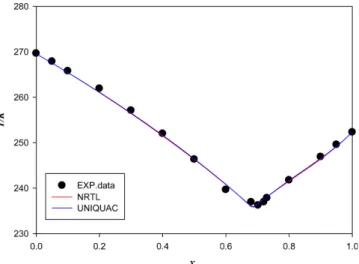
그리고 {valeric acid + hexanoic acid} 총 3 계의 시스템에 대하여 진행하였으며, 정적방법에 의해 대기압하에서 융점을 측정하는 방 법으로 수행하였다. 측정된 모든 이성분계에서 단순공융점이 발견 되었으며, {propionic acid + hexanoic acid} 계의 경우 공융점은 propionic acid 조성 x1= 0.7019에서 236.25 K, {butyric acid + hexanoic acid} 계의 경우 공융점은 butyric acid 조성 x1= 0.5600에서 241.68 K, {valeric acid + hexanoic acid} 계의 경우 공융점은 valeric acid 조성 x1= 0.7499에서 229.85 K이었다. Table 2에 이들 세 이성분계에 대 한 고-액 상평형 측정 데이터를 나타내었고, Fig. 1-3에는 이를 도 시하여 나타내었다. 측정한 고액 상평형 데이터는 활동도계수 모델 식인 NRTL식과 UNIQUAC 식으로 상관하였다. 그 중 {valeric acid + hexanoic acid} 계는 NRTL 식에 근소하게 더 잘 상관되었 으며, 이를 제외한 두 계에서는 NRTL과 UNIQUAC 식에 의한 상 관 결과가 거의 동일하였다. 상관된 NRTL, UNIQUAC 모델 매개 변수와 RMSD값을 Table 3에 나타내었다. RMSD는 식 (2)로 구하 였으며, 상첨자 exp.는 실험값을 cal.은 활동도계수 모델식 매개변 수에 의해 재계산된 계산값을 나타낸다. 식 (2)로부터 계산된 값과
실험값의 RMSD는 {propionic acid + hexanoic acid}, {butyric acid + hexanoic acid} 및 {valeric acid + hexanoic acid}계에서 각 각 0.5 K, 0.2 K, 0.4 K이내로써, 모든 시스템에서 약 0.5 K이하의 작은 편차로 잘 일치함을 보였다.
RMSD = (2)
동일한 유기산 이성분계에 대해 298.15 K에서 ρ와 nD를 측정하 고, 이로부터 결정된 과잉 몰부피(VE)와 몰 굴절율 편차(ΔR)를 Table 4에 나타내었다. VE는 식 (3)을 이용 하여 순수 및 혼합물의 ρ로 부터 계산하였다.
ΣiΣαΣk(Xikα exp( )–Xikα cal( )) ---6N
1/2
Table 2. Solid-liquid equilibrium data for {propionic acid (1) + hexanoic acid (2)}, {butyric acid (1) + heptanoic acid (2)} and {valeric acid (1) + hexanoic acid (2)}binary systems
Systems X1 T/K X1 T/K
{Propionic acid (1) + Hexanoic acid (2)}
0.0000 0.0500 0.1000 0.2000 0.3001 0.4001 0.5001 0.6000
269.67 267.90 265.79 261.93 257.11 252.02 246.35 239.68
0.6800 0.7019 0.7201 0.7300 0.8000 0.9000 0.9500 1.0000
236.95 236.25 236.95 237.85 241.77 246.91 249.59 252.33
{Butyric acid (1) + Hexanoic acid (2)}
0.0000 0.0504 0.1000 0.2001 0.3000 0.4000 0.5000 0.5199
269.67 267.28 265.28 261.45 256.57 251.43 245.75 243.95
0.5600 0.5800 0.6000 0.7001 0.8001 0.9000 0.9500 1.0000
241.68 242.05 243.39 250.45 257.25 262.10 264.75 268.01
{Valeric acid (1) + Hexanoic acid (2)}
0.0000 0.0501 0.1002 0.2061 0.3000 0.4013 0.4999
269.67 267.48 265.75 261.65 257.56 252.17 246.95
0.6000 0.7000 0.7499 0.8000 0.9001 0.9500 1.0000
240.35 233.35 229.85 232.90 235.75 237.65 239.35 Standard uncertainties u(x) = 0.0005, u(T) = 0.05 K
Fig. 1. The experimental SLE for the system {propionic acid (1) + hexanoic acid (2)}(●).
(3)
위의 식에서 xi, Mi, ρi, 그리고 ρm은 각 성분의 조성, 분자량, 순수 성분의 밀도, 그리고 혼합물의 밀도를 나타낸다. ΔR은 각각의 순수 성분의 굴절율(Ri)과 혼합성분의 굴절율(Rm)로부터 식 (4)-(7)로 부 터 계산하였다[15].
(4)
(5)
(6)
(7)
여기서 φi, nD, nD,i 그리고 Vi는 혼합물 속 순수 성분의 부피 분율, 혼합물의 굴절율, 순수 성분의 굴절율, 그리고 순수 성분의 몰 부피 를 각각 나타낸다. Fig. 4-5는 각 이성분계에 대한 298.15 K에서의
VE/cm3⋅mol–1 ΣixiMi ρm --- Σi
xiMi ρi --- –
=
ΔR/cm3⋅mol–1=Rm–ΣiφiRi
Ri nD2–1 nD2+2 --- ΣixiMi
ρm
---
=
Ri nD i2, –1 nD i2, +2 --- Mi
ρi
---
=
φi xiVi ΣjxjVj ---
=
Fig. 2. The experimental SLE for the system {butyric acid (1) + hexa- noic acid (2)}(●).
Fig. 3. The experimental SLE for the system {valeric acid (1) + hexanoic acid (2)}(●).
Table 3. The adjustable model parameters and the RMSD for each binary system
Models Systems Aij/cal·mol-1 Aji/cal·mol-1 α RMSD (K)
NRTL
{Propionic acid (1) + Hexanoic acid (2)}
{Butyric acid (1) + Hexanoic acid (2)}
{Valeric acid (1) + Hexanoic acid (2)}
909.224 -214.143 92.2900
-337.370 304.872 62.7507
0.33 0.30 0.30
0.50 0.17 0.24 UNIQUAC
{Propionic acid (1) + Hexanoic acid (2)}
{Butyric acid (1) + Hexanoic acid (2)}
{Valeric acid (1) + Hexanoic acid (2)}
301.883 -149.039 371.362
-143.230 199.470 -219.342
- - -
0.49 0.17 0.39 Fig. 4. VE (cm3·mol-1) for the binary systems at 298.15 K; (●), {propionic
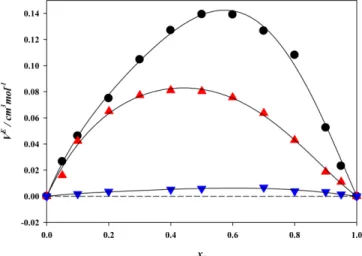
acid (1) + hexanoic acid (2)}; (▲), {butyric acid (1) + hexanoic acid (2)}; (▼), {valeric acid (1) + hexanoic acid (2)}; solid curves were calculated data from the Redlich-Kister parameters.
Fig. 5.ΔR (cm3·mol-1) for the binary systems at 298.15 K; (●), {propi- onic acid (1) + hexanoic acid (2)}; (▲), {butyric acid (1) + hexa- noic acid (2)}; (▼), {valeric acid (1) + hexanoic acid (2)}; solid curves were calculated data from the Redlich-Kister parameters.
VE와 ΔR 값을 보여준다. Fig. 4에서 보는 바와 같이 결과적으로 혼 합에 따른 부분 몰성질이 커져 VE값은 모두 양의 편차 값을 보였 는데, 이는 자기 회합을 하는 유기산의 단량체와 다량체 사이에서 분자내 수소결합이 끊어짐 현상에 기인된 것으로 추측된다. 또한 acid가 가지고 있는 카르복실기(-COOH)에 의한 영향보다는 알킬 및 알킬렌기에 의한 영향을 더 많아 약한 극성을 띄게 되어 양의 편 차를 나타내는 것으로도 설명될 수 있을 것이다. Fig. 5에는 ΔR 값 을 나타내었다. 그림에서와 같이 ΔR의 경우 VE와 반대로 동일한 이 성분계에 대해 모두 음의 편차를 보였다. Table 4에서 보면 hexanoic acid와 혼합된 유기산(C3-C5)의 탄소 수 증가에 따른 굴절율의 차이 는 미소하게 증가하나 전체적으로 큰 차이가 없음을 보여준다. 그러 나 Fig. 5에서와 같이 몰 굴절율편차 ΔR은 굴절율 차이에 비해 더 큰 편차를 보이며 propionic acid > butyric acid > valeric acid 의 순서로 음의 편차를 보였다. 이는 Iglesias-Otero 등 [16]의 주장대로 양의 VE값은 용액에서는 이상용액보다 더 큰 free-volume을 갖게 되어, 매체에서 빛의 속도가 더 빠르게 되므로 이상용액보다 더 낮은 굴절율을 보이는 것으로 해석할 수 있다.
이성분 액상혼합계의 점도 편차인 Δv는 Table 5와 Fig. 6에 나타 내었다. 기체와 달리 액체의 점도는 기체 점도 추산에 비견되는 이 론에 근거한 추산식이 없으므로 실험 데이터는 더한 중요성을 갖는 다. Δv 측정값은 Fig. 6에서 보는 바와 같이 ΔR과 같이 모두 음의
편차를 보였고, 음의 편차의 정도도 propionic acid > butyric acid
> valeric acid로 커지는 경향을 보였다. 이는 분자간의 작은 인력도 점도에 큰 영향을 미칠 뿐만 아니라 분자구조의 차이에 민감하게 Table 4. Densities, excess molar volumes, refractive indices and molar refraction deviation for {propionic acid (1) + hexanoic acid (2)}, {butyric
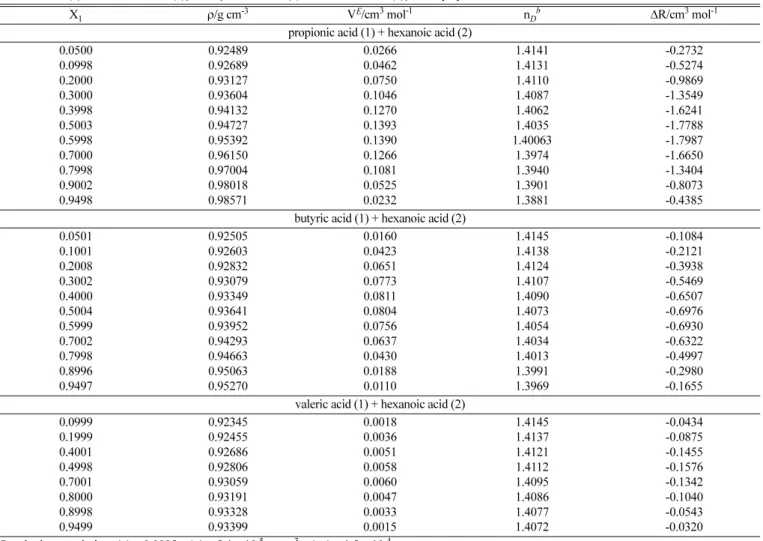
acid (1) + hexanoic acid (2)} and {valeric acid (1) + hexanoic acid (2)} binary systems at 298.15 K
X1 ρ/g cm-3 VE/cm3 mol-1 nDb ΔR/cm3 mol-1
propionic acid (1) + hexanoic acid (2) 0.0500
0.0998 0.2000 0.3000 0.3998 0.5003 0.5998 0.7000 0.7998 0.9002 0.9498
0.92489 0.92689 0.93127 0.93604 0.94132 0.94727 0.95392 0.96150 0.97004 0.98018 0.98571
0.0266 0.0462 0.0750 0.1046 0.1270 0.1393 0.1390 0.1266 0.1081 0.0525 0.0232
1.4141 1.4131 1.4110 1.4087 1.4062 1.4035 1.40063
1.3974 1.3940 1.3901 1.3881
-0.2732 -0.5274 -0.9869 -1.3549 -1.6241 -1.7788 -1.7987 -1.6650 -1.3404 -0.8073 -0.4385 butyric acid (1) + hexanoic acid (2)
0.0501 0.1001 0.2008 0.3002 0.4000 0.5004 0.5999 0.7002 0.7998 0.8996 0.9497
0.92505 0.92603 0.92832 0.93079 0.93349 0.93641 0.93952 0.94293 0.94663 0.95063 0.95270
0.0160 0.0423 0.0651 0.0773 0.0811 0.0804 0.0756 0.0637 0.0430 0.0188 0.0110
1.4145 1.4138 1.4124 1.4107 1.4090 1.4073 1.4054 1.4034 1.4013 1.3991 1.3969
-0.1084 -0.2121 -0.3938 -0.5469 -0.6507 -0.6976 -0.6930 -0.6322 -0.4997 -0.2980 -0.1655 valeric acid (1) + hexanoic acid (2)
0.0999 0.1999 0.4001 0.4998 0.7001 0.8000 0.8998 0.9499
0.92345 0.92455 0.92686 0.92806 0.93059 0.93191 0.93328 0.93399
0.0018 0.0036 0.0051 0.0058 0.0060 0.0047 0.0033 0.0015
1.4145 1.4137 1.4121 1.4112 1.4095 1.4086 1.4077 1.4072
-0.0434 -0.0875 -0.1455 -0.1576 -0.1342 -0.1040 -0.0543 -0.0320 Standard uncertainties u(x) = 0.0005, u(ρ) = 5.4 × 10⁻⁵ g·cm-3, u(nD) = 1.5 × 10⁻⁴
Fig. 6.Δv (mm2·s-1) for the binary systems at 298.15 K; (●), {pro- pionic acid (1) + hexanoic acid (2)}; (▲), {butyric acid (1) + hexanoic acid (2)}; (▼), {valeric acid (1) + hexanoic acid (2)}; solid curves were calculated data from the Redlich-Kis- ter parameters.
작용하므로, C3-C5유기산 중에 카르복실기의 수소결합이 가장 크 고 분자간 구조의 차이가 큰 C3 유기산과의 혼합계인 propionic acid+ hexanoic acid 혼합계에서 가장 큰 음의 편차를 보이는 것으 로 추측된다. 식 (8)은 측정된 혼합물의 점도와 각 순수성분의 점도 및 조성으로부터 구해진 이성분혼합계의 Δv 계산식이다.
(8) 여기서 v, vi는 혼합물의 점도와 혼합물 중의 순수성분 i의 점도를 나타낸다.
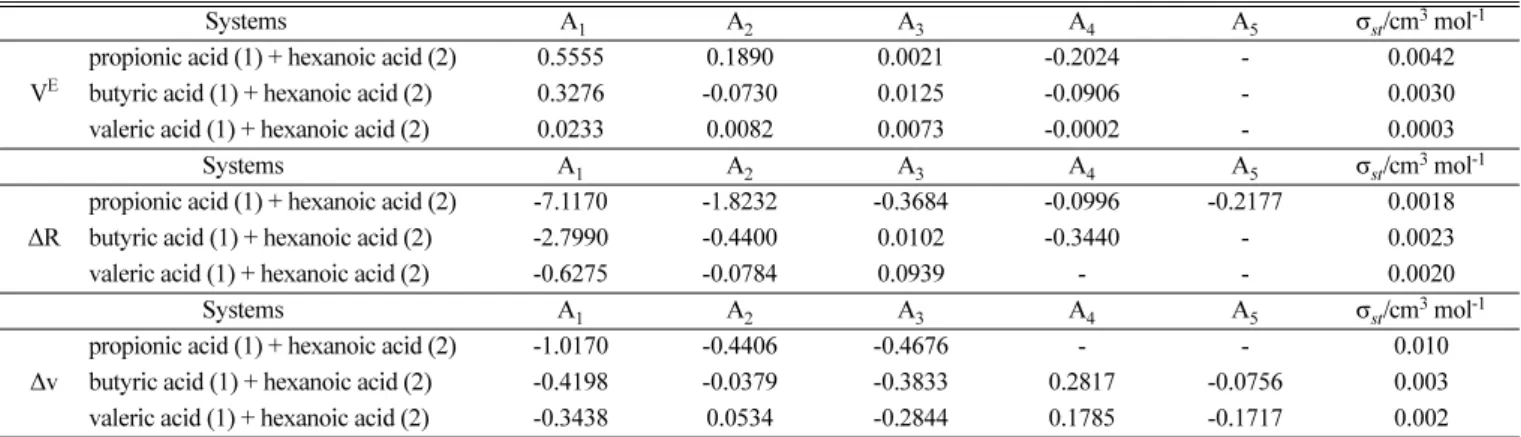
298.15 K에서 측정된 각 이성분 혼합계의 VE, ΔR 및 Δv는 Redlich- Kister다항 식 (9)를 이용하여 상관하였으며, 상관된 Redlich-Kister 매개변수와 표준편차(σst)를 Table 6에 나타 내었다. 식 (9)에서 Ai는 Redlich-Kister 다항식의 매개변수이고, n은 매개변수의 수를 의미 한다. 실험 값과 Redlich-Kister 매개변수에 의한 계산 값과의 σst는
식 (10)을 이용하여 계산하였다. N은 해당 혼합계의 실험 데이터 수를 나타내고 E는 관련 물성을 나타낸다. Table 6에서 보는 바와 같이 상관된 매개변수를 이용하여 재계산한 결과와 실험값은 약 0.004 이하의 표준 편차로 잘 일치하였다.
(9)
(10)
4. 결 론
C3-C6유기산 혼합물로 {propionic acid + hexanoic acid}, {butyric acid + hexanoic acid} 및 {valeric acid + hexanoic acid} 이성분계의 고액상평형을 측정하였다. 측정계 모두에서 단순 공융점이 있었으 Δv/mm2⋅s–1=v–(v1x1+v2x2)
VE,ΔR or Δv=x1x2∑i 1n= Ai(x1–x2)i 1– σst ∑Ni(Eicalc–Eiexp)
N n–
( )
---
=
Table 5. Kinematic viscosities, and deviations in viscosity for {propionic acid (1) + hexanoic acid (2)}, {butyric acid (1) + hexanoic acid (2)} and {valeric acid (1) + hexanoic acid (2)} binary systems at 298.15 K
X1 v/mm2·s-1 Δv/ mm2·s-1 X1 v/mm2·s-1 Δv/ mm2·s-1
propionic acid (1) + hexanoic acid (2) 0.0000
0.0500 0.1002 0.1999 0.3001 0.4000 0.5000
3.005 2.872 2.736 2.488 2.269 2.051 1.835
0.000 -0.042 -0.086 -0.153 -0.189 -0.226 -0.260
0.6000 0.7000 0.8000 0.9001 0.9500 1.0000
-
1.643 1.468 1.313 1.230 1.169 1.184
-
-0.269 -0.262 -0.236 -0.137 -0.107 0.000
- butyric acid (1) + hexanoic acid (2)
0.000 0.0500 0.1001 0.2001 0.3000 0.4000 0.5000
3.005 2.889 2.789 2.628 2.481 2.337 2.196
0.000 -0.046 -0.074 -0.095 -0.102 -0.105 -0.106
0.6000 0.7001 0.8000 0.9000 0.9500 1.000
-
2.056 1.921 1.793 1.683 1.644 1.598
-
-0.104 -0.099 -0.087 -0.056 -0.024 0.000
- valeric acid (1) + hexanoic acid (2)
0.0000 0.0501 0.0999 0.2000 0.3001 0.3999 0.5000
3.005 2.923 2.849 2.745 2.655 2.568 2.483
0.000 -0.039 -0.069 -0.085 -0.089 -0.089 -0.087
0.6001 0.7000 0.8000 0.9000 0.9500 1.0000
-
2.401 2.321 2.244 2.181 2.155 2.135
-
-0.082 -0.075 -0.065 -0.041 -0.024 0.000
- Standard uncertainties u(v) = 1 × 10⁻³ mm2·s-1, u(T) = 0.1 K
Table 6. Fitted parameters for the Redlich-Kister equation and standard deviations of VE, ΔR and Δv for the binary systems at 298.15 K
Systems A1 A2 A3 A4 A5 σst/cm3 mol-1
VE
propionic acid (1) + hexanoic acid (2) 0.5555 0.1890 0.0021 -0.2024 - 0.0042
butyric acid (1) + hexanoic acid (2) 0.3276 -0.0730 0.0125 -0.0906 - 0.0030
valeric acid (1) + hexanoic acid (2) 0.0233 0.0082 0.0073 -0.0002 - 0.0003
Systems A1 A2 A3 A4 A5 σst/cm3 mol-1
ΔR
propionic acid (1) + hexanoic acid (2) -7.1170 -1.8232 -0.3684 -0.0996 -0.2177 0.0018
butyric acid (1) + hexanoic acid (2) -2.7990 -0.4400 0.0102 -0.3440 - 0.0023
valeric acid (1) + hexanoic acid (2) -0.6275 -0.0784 0.0939 - - 0.0020
Systems A1 A2 A3 A4 A5 σst/cm3 mol-1
Δv
propionic acid (1) + hexanoic acid (2) -1.0170 -0.4406 -0.4676 - - 0.010
butyric acid (1) + hexanoic acid (2) -0.4198 -0.0379 -0.3833 0.2817 -0.0756 0.003
valeric acid (1) + hexanoic acid (2) -0.3438 0.0534 -0.2844 0.1785 -0.1717 0.002
며, NRTL, UNIQUAC식에 의해 0.5 K 이하의 융점 편차로 잘 상 관됨을 확인하였다. 동일혼합계에 대한 물성으로 298.15 k에서 밀 도, 굴절율과 점도를 측정하여 과잉 및 편차성질인 VE, ΔR및 Δv을 결정하였다. 측정한 모든 혼합계에서 VE는 양의 편차를 보였으며, 이는 유기산 용액에서 카르복실기의 수소결합 일부가 파괴되거나 늘어나 상대적으로 무극성인 탄화수소의 영향을 더 받은 결과로 해 석된다. VE가 양의 편차를 보임에 따라 용액의 자유부피는 커지고, 따라서 빛의 투과속도가 빨라져 ΔR은 음의 편차를 보였으며, Δv도 점도가 낮은 온도에서 구성분의 구조나 적은 인력에 큰 영향을 받 는 특성에 따라, 이상용액으로부터 음의 편차를 보이는 것으로 추 측된다. 과잉 및 편차성질은 Redlich-Kister 다항식을 이용하여 상 관하였으며, 거의 모두 0.004이하의 표준편차로 비교적 잘 상관되 었다.
감 사
이 연구는 충남대학교 학술연구비에 의해 지원되었으며, 연구비 지원에 감사드립니다.
사용기호
Ai : Adjustable parameter for the Redlich-Kister equation Aij, Aji : parameter used in NRTL and UNIQUAC equations VE : Excess molar volume (cm3·mol-1)
ΔR : Deviation in refractive indices (cm3·mol-1) Mi : Molar mass of the pure component i (g·mol-1) Rm : Molar refractivity of mixture [i]
Ri : Molar refractivity of pure component [i]
nD : Refractive index of the mixture [i]
nD,i : Refractive index of the pure component [i]
Vi : Molar volume of the pure component [i]
n : Number of parameters [Ai] N : Number of experimental data points 그리스 문자
u(ρ) : Standard uncertainty [g·cm-3]
Sρ : Standard deviation of the average [g·cm-3] uγ : Resolution of the instrument [g·cm-3]
ui : Varied response of the instrument with the density range [g·cm-3]
uT : Uncertainty in the measured temperature [g·cm-3] v : Kinematic viscosity [mm2·s-1]
Δv : Deviation in viscosity [mm2·s-1] ρi : Density of the pure component i [g·cm-3] ρm : Density of the mixture [g·cm-3]
σst : Standard deviation
Reference
1. Ryu, B. H., Chang, B. J., Kim, J. H. and Kim, W. N., “Pervapo- rative Recovery of Bio-butanol through Dense- and Composite-
type PDMS Membranes,” Membrane Journal, 19(2), 157-158 (2009).
2. Sang, B. I. and Kim, Y. H., “Bio-butanol Production Technol- ogy as Next Generation Transportation Fuel,” News & Informa- tion for Chemical Engineers, 26(6), 704-709(2008).
3. Gunter, W. Festel, “Biofuels - Economic Aspects,” Chem. Eng.
Technol., 31(5), 715-720(2008).
4. Rogers, P. and Palosaari, N., “Clostridium Acetobutylicum Mutants That Produce Butyraldehyde and Altered Quantities of Solvents,” Appl. And Environ. Microbiol., 53, 2761-2766(1987).
5. Lee, K. H., Gu, J. E., Oh, H. Y. and Park, S. J., “Solid-liquid Phase Equilibria, Excess Molar Volume, and Molar Refraction Deviation for the Mixtures of Ethanoic Acid with Propanoic, Butanoic, and Pentanoic Acid,” Korean J. Chem. Eng., 35(8), 1710-1715(2018).
6. Bahadur, I., Singh, S., Deenadayalu, N., Naidoo, P. and Ramjuger- nath, D., “Influence of Alkyl Group and Temperature on Thermo- physical Properties of Carboxylic Acid and Their Binary Mixtures,”
Thermo. Acta, 590, 151-159(2014).
7. Bahadur, I., Naidoo, P., Singh, S., Ramjugernath, D., Deenadayalu, N., “Effect of Temperature on density, Sound Velocity, Refractive Index and Their Derived Properties for the Binary Systems (hepta- noic acid + propanoic or butanoic acids),” J. Chem. Thermodyn., 78, 7-15(2014).
8. Bahadur, I., Deenadayalu, N., Naidoo, P., Ramjugernath, D., “Den- sity, Speed of Sound, and Refractive Index Measurements for the Binary Systems (butanoic acid + propanoic acid or 2-methyl- propanoic acid) at T = (293.15 to 313.15) K,” J. Chem. Thermo- dyn., 57, 203-211(2013).
9. Renon, H., Prausnitz, J. M., “Local Compositions in Thermody- namic Excess Functions for Liquid Mixtures,” AIChE. J., 14(1), 135-144(1968).
10. Abrams, D. S. and Prausnitz, J. M., “Statistical Thermodynamics of Liquid Mixtures: A New Expression for the Excess Gibbs Energy of Partly or Completely Miscible Systems,” AIChE. J., 21(1), 116- 128(1975).
11. Redlich, O. and Kister, A. T., “Algebraic Representation of Thermo- dynamic Properties and the Classification of Solutions,” Ind. Eng.
Chem., 40(2), 345-348(1948).
12. B-Gii, G., Esqulvel, M. and Ribeiro, A., “Densities and Refractive Indies of pure Organic Acids as a Function of Temperature,” J.
Chem. Eng. Data., 35, 202-204(1990).
13. Riddick, J. A., Bunger, W. B. and Sakano, T. K., “Organic Solvents:
Physical Properties and Methods of Purification,” Wiley-Interscience, New York (1986).
14. Lee, K. H. and Park, S. J., “Isothermal Vapor-liquid Equilibria, Excess Molar Volume and the Deviation of Refractive Indices for Binary Mixtures of 1-butanol, 1-hexanol, 3-methyl-1-butanol and Butyl Acetate,” Fluid Phase Equilibria, 436, 47-54(2017).
15. Hang, I. C. and Park, S. J., “Isothermal Vapor-Liquid Equilibria at 333.15 K and Excess Molar Volumes and Refractive Indices at 303.15 K for the Mixtures of Propyl vinyl ether + Ethanol + Ben- zene,” Korean J. Chem. Eng., 49, 56-61(2011).
16. Iglesias-otero, M. A., Troncoso, J., Carbello, E. and Romani, L.,
“Density and Refractive Index in Mixtures of Ionic Liquids and Organic Solvents: Correlations and Predictions,” J. Chem. Ther- modyn., 40, 949-956(2008).