A Study on the Type of Welfare Service for Strengthening Tenant’s Housing Welfare in Permanent Affordable Housing
Sang-Youn Roh
1, Young-Ho Yoon
2, Young-Tae Cho
3, Ji-Eun Lee
4and Yong-Kyung Cho
5(Received January 6, 2012 / Revised January 17, 2012 / Accepted January 26, 2012)
ABSTRACT
Since the provision of Permanent Affordable Housing in the early 1990’s, it is confronted with the need to strengthen its welfare service due to aging of its facilities and the declining welfare system for its tenants. In addition, the aging population of tenants is on the rise, increasing the group of tenants that are in need of care. The local social community center has entered into the community of permanent affordable housing and takes partial responsibility in the tenant’s social welfare. However, social community center is mainly responsible for providing welfare service to its local residents and thus limited in its ability to satisfy welfare service to tenants of permanent affordable housing. Therefore, it is required to renew the existing welfare system to better suit social demands of tenants according to its specific social group and the characteristics of housing complex. This study aims to propose methods that can strengthen welfare service and analyze the characteristics of welfare service by investigating the existing conditions of welfare system for the tenants in permanent affordable housing complex. For this purpose, this study presents with categories of service standards, by breaking down and codifying welfare service and propose applicable mixed-use service in pre-existing permanent affordable housing.
Keywords: Permanent Affordable Housing, Welfare Service Characteristic, Type of Welfare Service, Housing Welfare, Mixed-use Service
* This study is part of LHI strategies report “The Construction Method of the Affordable Rental Housing and the housing welfare reinforcement by the Remnent Site with the Affordable Rental Housing Complex in the Downtown”(2011).
1) Researcher, Land & Housing Institute (Main author: [email protected])
2) Executive Research Fellow, Land & Housing Institute (Corresponding author: [email protected]) 3) Research Fellow, Land & Housing Institute
4) Associated Research Fellow, Land & Housing Institute 5) Researcher, Land & Housing Institute
http://lhi.lh.or.kr
1. Introduction
The local governments and Korea Land and Housing Cooperation (LH) and etc. has been providing Permanent Affordable Housing (hereon abbreviated as PAH) in late 1980’s within the public realm. As a part of this housing policy, 1.5 million units of Bogeumjari Housing will be expected to be provided additionally by year 2018. The ultimate goal of PAH is to supply the required quantity of housing unit and the need to secure facility has been gradually accomplished. The PAH is especially planning to establish Social Community Center to provide Housing Welfare Service considering its housing environment. However, the PAH provided in early 1990s was nearly twenty years ago; its out-dated facilities and building codes poses limitations on the effective space utilization as well as quality and quantity of service provided. In addition, as tenant population has aged within twenty years, an argument is proposed that there is a need to reconstruct pre-existing PAH that is occupied
by vulnerable group such as the elderly and the disabled etc.
On the other hand, it is possible to provide welfare service to the pre-existing elderly tenants of long-term PAH on the basis of [Act on the Support for Improving the Quality of Lives of Tenants in Long-Term Public Rental Housing] enacted since January 1, 2011. This means that aside from social welfare provided through community center, there is legal basis to strengthen new welfare service for the realization of “Housing welfare” enhancing the quality of tenant’s residential environment and the community, supplementing service function to the residential structure. Nevertheless, the studies focused on the appropriate welfare service and its characteristics in long-term PAH are hard to find and are rarely in progress. Therefore, this study aims to classify all welfare service to reinforce the “Housing Welfare” and propose welfare service types and applicable methods for the PAH.
For the purpose of suggesting the type of welfare service, this
study examines related research, analyze various case studies and
perform managerial and tenant group surveys.
In detail the contents of study are as follows:
First, the standard for classification is prepared through the analysis of existing status and welfare service upon investigating related findings and research.
Second, to determine course that can strengthen welfare service by investigating the existing status and standards of domestic facility and examining characteristics found within case studies abroad.
Third, survey targeting managerial professionals and tenants are performed in order to analyze demands of welfare service and examine applicability of additional welfare service.
Finally, the course in which welfare service will be reinforced is presented and the type of applicable mixed-use welfare service is suggested accordingly.
2. Examining Housing Welfare and Welfare Service Concept
Recently there have been many discussions regarding “Housing Welfare” after it was introduced in the housing policy. After the standards of Minimum Housing were stated on the Housing Act in 2003, the Bureau of Housing Welfare Planning was established in the Ministry of Construction and Transportation (currently renamed as Ministry of Land, Transportation and Maritime Affair). Since then, many NGO regarding Housing welfare was established and has actively participated in social movement focused on guaranteeing minimum residential environment for the low income group.
Examining the concept of “Housing Welfare” through previous research, Jang (1999)
1)defined it as “it is security that public including nation guarantee the minimum residential status for every member of society in terms of public welfare”and explained that it was including both physical residential environment and the derivation of social-cultural safety through cultivation of solidarity and belonging.
On the other hand, Kim (2006)
2)defined that “it is status that the social member lives in the more than an appropriate size of house suitable for residential elements and prosecute the community life without isolation” and asserted that the goal of housing policy should be derived from the necessity in terms of the relationship between housing, tenants and tenant’s social position.
Based on these existing study, “Housing Welfare” means not only a physical house supplied but also having the minimal quality of life being secured by providing the social and cultural service required for every member of society.
1) Jang, S. H. (1999), “Democracy and Housing Welfare in the Third World Developing Countries”, Urban Studies, Korea Center for City and Environmental Research.
2) Kim, Y. T. (2006), Theoretical Overview of Housing Welfare and Future Policy Issues.
In this point of view, social and cultural service should be included in Housing Welfare Hong (2008) asserted that the objective indicators of Housing Welfare should contain community facilities space per person. In this study, the “community facilities space per person” means that the space of all the local community facilities that one who register as resident in local government is able to use service (social community center, tenants community center, tenants fitness center, public library, cultural center, public health center and etc.). Ha (2008) stated that Housing Welfare Service means the trial to enrich the tenant’s well being through housing including traditional housing management service
3).
This study, therefore, aims to investigate beyond the classification of social welfare and housing welfare, but rather examine all status of services targeted towards tenant’s qualify of life and categorize its types.
3. Characteristic of Welfare Service in Permanent Affordable Housing
3.1 Existing Status of Welfare Service in Permanent Affordable Housing
Most of welfare service in PAH is provided through Social Community Center. By the Act for Promotion of housing Construction in 1989, it has become mandatory to construct a certain size of Social Community Center when Permanent Affordable Housing is developed. Therefore, there are social community center and tenant welfare facilities in most PAH complex of greater than 100 units. These facilities under the possession of LH and its operation entrusted to its autonomy (20 years of free use). This trial is to secure the tenant’s quality of life, by connecting welfare service to affordable housing.
However, the Social welfare facilities in PAH are mainly focused on the local residents rather than the tenants in PAH and this means that there are limitations in the extent to which it can fully support tenants. Although there are some differences in the social welfare service depending on region and housing complex, still, the vulnerable tenants and its rising rate of elderly in PAH have not been supplied with required needs.
As of October 2011, LH owed Social Welfare Center installed in 123 out of the 126 in PAH. Three places without Social Welfare Center are Sannam 2-2 Chungju, Suklim3 and Burley Sahcheon Housing. In these housing, nursery center and tutoring center are replaced in the space for its social community center because the Local Community Center exist near the complex close enough to make common use. Ultimately, of the 30% out of
3) Ha (2008) categorized that the housing welfare service should include all support programs for tenants when he analyzed the tenant’s welfare business operated by Korea Housing Management. [Korea Housing ManagementㆍKorea Urban Institute, A study on the Social Value Assessment of Housing Welfare Service in the public affordable Housing Complex, Korea Housing Management]
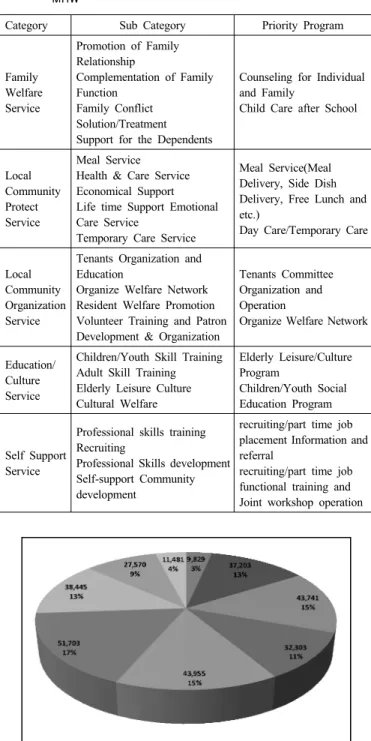
Table 1. Contents & program of community center suggested by MHW
Category Sub Category Priority Program
Family Welfare Service
Promotion of Family Relationship
Complementation of Family Function
Family Conflict Solution/Treatment Support for the Dependents
Counseling for Individual and Family
Child Care after School
Local Community Protect Service
Meal Service
Health & Care Service Economical Support Life time Support Emotional Care Service
Temporary Care Service
Meal Service(Meal Delivery, Side Dish Delivery, Free Lunch and etc.)
Day Care/Temporary Care
Local Community Organization Service
Tenants Organization and Education
Organize Welfare Network Resident Welfare Promotion Volunteer Training and Patron Development & Organization
Tenants Committee Organization and Operation
Organize Welfare Network
Education/
Culture Service
Children/Youth Skill Training Adult Skill Training Elderly Leisure Culture Cultural Welfare
Elderly Leisure/Culture Program
Children/Youth Social Education Program
Self Support Service
Professional skills training Recruiting
Professional Skills development Self-support Community development
recruiting/part time job placement Information and referral
recruiting/part time job functional training and Joint workshop operation
Fig. 1. Pie chart of the tenant’s age in PAH the 400 Social Welfare Center in South Korea, 123 centers are
located within PAC owned by LH. It means two things: the role of the regional social welfare is given to the Social Welfare Center in PAH by the central government and there is an outstanding amount of unsatisfied social welfare needs by PAH tenants. Henceforth, this implies the necessity and possibility of providing social welfare service on the basis of PAH.
3.2 Classification of Welfare Service
As it was mentioned, Welfare Service in PAH are mainly offered at social community center but there are neither special facilities nor programs to serve tenants. Some housing welfare service like maintenance and replacement are provided by management office and only in a few number of complex include self-support services for in-house business, job placement, and professional skills training provided by local governments and private sectors.
The operation of Social Community Welfare Service targets all local residents who desire welfare service and the priority of target residents are as follows
1. Low-income residents including National Basic Livelihood Security beneficiaries, the next higher layer and etc.
2. Vulnerable residents including disabled, the elderly and single-parent home
3. Residents who need vocational training, part time jobs and job placement
4. Residents who need the protection and education of infant, child or youth
5. Residents who deemed to need other emergency support Ministry of Health and Welfare (MHW) recommend that the business of Social Welfare Center should be autonomously decided on the basis of the local communities’ characteristics and tenant’s welfare service needs. MHW also suggests that the appropriate welfare program suitable for each housing status should be selected among categorized priority program shown at [Table 1]. For the target residents, eight of priority program should be selected and served, but more than one program of each category must be included. In this case, separate business or program will be able to develop and provide when head of municipality approve to process in consideration of local properties.
However these suggestions from MHW are classified by program function which was required from local communities rather than PAH tenants as the Social Community Center plays the role of local welfare base.
It is reasonable that the service for tenants in PAH should be categorized by the characteristics of tenants and is necessary to prepare the provision of welfare service standard in the future.
As it is mentioned before, the current PAH tenants are mostly vulnerable, low income class. And the majority of tenants are elderly, disabled and are single parents etc. Especially the age rate of aged tenants rapidly increasing that 26% of tenants are
over 60 years old. Non-beneficiary families mostly constitute 1 to 2 members whereas there are a portion of families with more than 5 members in some housing. It is assumed that most of families in PAH are constituted with either too small or too large of number of members.
On one hand, the management related service and communities’
autonomy support services essentially accompany other welfare
service in PAH. It is additionally important because through
self-support related service for vulnerable low income tenants it
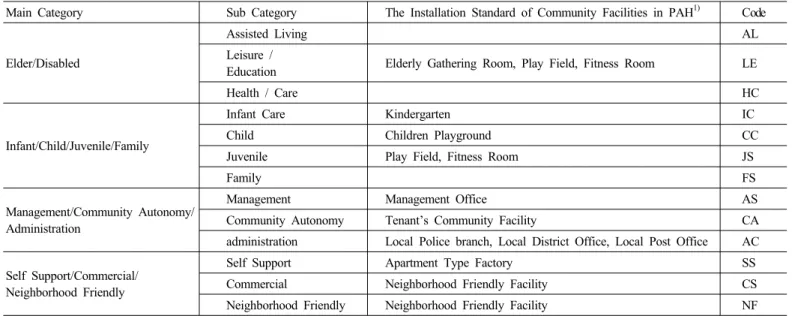
Table 2. Welfare service categories and code
Main Category Sub Category The Installation Standard of Community Facilities in PAH1) Code
Elder/Disabled
Assisted Living AL
Leisure /
Education Elderly Gathering Room, Play Field, Fitness Room LE
Health / Care HC
Infant/Child/Juvenile/Family
Infant Care Kindergarten IC
Child Children Playground CC
Juvenile Play Field, Fitness Room JS
Family FS
Management/Community Autonomy/
Administration
Management Management Office AS
Community Autonomy Tenant’s Community Facility CA
administration Local Police branch, Local District Office, Local Post Office AC Self Support/Commercial/
Neighborhood Friendly
Self Support Apartment Type Factory SS
Commercial Neighborhood Friendly Facility CS
Neighborhood Friendly Neighborhood Friendly Facility NF
1) PAH (Permanent Affordable Housing), The Construction Standards for Labor Housing and Permanent Affordable Housing and the Installation Standards of the Welfare Facilities in Labor Housing and PAH [Amendment 2008.9.25.].
Table 3. North American affordable housing case study and analysis
Case Target
Tenant Mixed Use Type
Assisted Living Health/Care Leisure/Education Commercial/Neigh
borhood Friendly
Personal Assistance Food Service Barber/Beauty Bath Assist Nursing Hospital Companion Service Transportation Support Counseling Laundry Service MD Visiting Service Physical Therapy Intensive Care 24hr Nursing Emergency Contact Day Care Dementia Care Alcohol/Drug Care Community Space Leisure/game Language Class Sports Music Class Dance Class Painting Class Pottery/craft Class Computer Class Swimming Pool Library referral Theater Supermarket Mini Mart Tenants Meeting Administration
Angelus
Plaza Senior Building : Residential
+ Welfare + Commerical◯ ◎ ◎ ◎ ◎ ◎ ◎ ◎ ◎ ◎ ◯ ◯ ◎ ◎ ◯ ◯ ◯ ◯ ◎ ◯ ◎ ◎ ◯ ◯ ◯ ◯ ◎ ◎ ◎ ◎ ◎
Pioneer
Tower Senior Housing : Residential
+ Welfare ◯ ◎ ◎ ◎ ◎ ◎ ◎ ◯ ◎ ◎ ◎ ◎ ◯ ◎ ◎ ◎ ◎ ◎ ◯ ◎ ◯ ◎ ◯ ◯ ◯ ◎ ◯ ◎ ◎
Madrona studio
Social Mix
Building : Residential
+ Welfare + Commerical◯ ◎ ◎ ◎ ◎ ◎ ◎ ◯ ◯ ◎ ◯ ◯ ◯ ◯ ◎ ◎ ◯ ◯ ◯ ◯ ◯ ◎ ◯ ◯ ◎
Armstrong
place Senior Building : Residential
+ Welfare + Commerical◎ ◎ ◎ ◎ ◎ ◎ ◎ ◎ ◎ ◎ ◯ ◎ ◎ ◎ ◎ ◎ ◎ ◎ ◎ ◎ ◎ ◎ ◯ ◯ ◯ ◯ ◎ ◎ ◎ ◎
Walker
Place Senior Building : Residential
+ Welfare ◯ ◎ ◎ ◯ ◎ ◎ ◎ ◎ ◯ ◎ ◎ ◎ ◎ ◯ ◯ ◯ ◎ ◎ ◯ ◎ ◎ ◯ ◯ ◯ ◎ ◯ ◎ ◎ ◎
Patton Park
Social Mix
Building : Residential
+ Welfare ◎ ◎ ◯ ◯ ◎ ◎ ◎ ◯ ◎ ◎ ◯ ◯ ◎ ◯ ◯ ◎ ◎ ◯ ◯ ◯ ◯ ◎ ◎ ◎ ◎ ◯ ◎
Louise Station
Social Mix
Building : Residential
+ Welfare + Commerical◎ ◎ ◎ ◎ ◎ ◎ ◎ ◎ ◎ ◎ ◎ ◎ ◎ ◎ ◎ ◎ ◎ ◎ ◎ ◯ ◯ ◯ ◯ ◯ ◯ ◯ ◯ ◯ ◯ ◯ ◎ ◎ ◎
Manchester Social Mix
Building : Residential
+ Welfare + Commerical◯ ◎ ◎ ◎ ◎ ◯ ◎ ◯ ◯ ◯ ◯ ◯ ◯ ◯ ◯ ◯ ◯ ◯ ◯ ◎ ◎ ◎ ◎ ◎ ◎ ◎ ◯ ◎ ◎ ◎ ◎ ◎ ◎
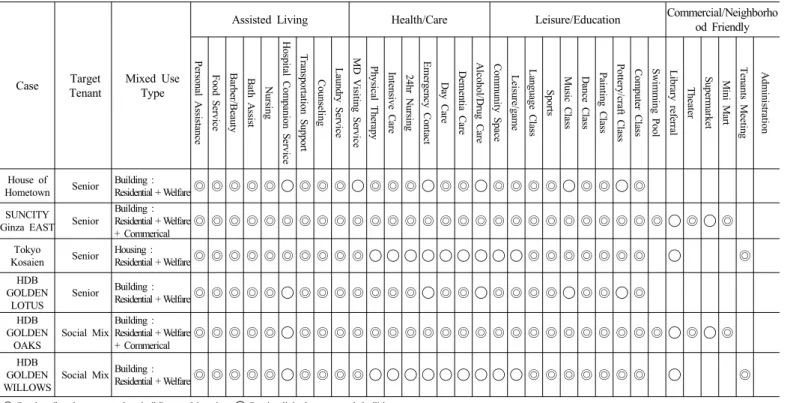
◎ Service directly connected to building and housing, ◯ Service linked to external facilities.
provides aid in employment, part time job placement, in-housing business for profit, social enterprise, and urban agricultural in housing etc. This self-support and profitable service not only is deemed to help the economy for the sustainability of welfare service but also assist tenant’s living.
The comparison of welfare service and “the Installation Standard of Welfare Facilities”in PAH is shown on Table 3.
There are neither healthcare related facilities nor assisted living
facilities. There is an underlying meaning of which welfare
facility and services for the aging tenants in PAH are not enough
to satisfy their welfare needs. In addition, the chart also reflects
that the tenants must use local welfare service outside the PAH
for family related services and facilities as shown absent on the
installation standards.
Each of the features and services can be supplied in consideration of the various types in conjunction with the regional characteristics and housing traits. If the features not states in “the Installation Standard of Welfare facilities” are provided closely to the tenant’s needs, it may bring the positive effects of strengthening tenant’s welfare service and enriching quality of tenant’s life.
4. Case Study and Analysis of Welfare Service in Foreign Public Affordable Housing
It is difficult to categorize welfare service because there are many cases of PAH and types of welfare service. However the cases regarding the elderly and disabled were selected and analyzed, considering that the domestic tenants are typically the vulnerable class and growing in age.
In North America, there are various welfare services for the vulnerable social class in affordable housing because of its diverse and spacious regional properties. In metropolitan area, it has shown that mixed-use affordable housing supply has significantly increased because the low-income families are losing their homes after the Sub-Prime Mortgage Crisis. As families without homes are increasing, the demands for affordable housing in urban area are rapidly rising and social vulnerable groups such as the elderly and disabled have particularly grown even more. Thus, the development of affordable housing in downtown is spreading and has been undertaken by local government
4)with the economical support from the federal service
5)for affordable housing.
The recent characteristics of senior PAH development in US reveals the following:
First, senior affordable housing is developed as a housing complex rather a single building.
Second, assisted living services are increasing in order to support for the tenants in both affordable housing and single family house according to the “aging in place” trends.
Third, the mix-use senior housing and the mix-use affordable housing are actively supplied for the urban vulnerable group and both intend to merge, having the self-support element mix in with the residential function.
In the local cities of state of California, where population is growing (LA, San Francisco, San Diego, and etc) there are many Infill Project in progress as a part of “Smart City Growth”Policy to fill in empty space with affordable housing.
As it is mentioned earlier, mixed-use affordable housing is in progress to be supplied through adaptive reuse of existing
4) (PHA: Public Housing Authorities) When the land of housing compartment was performed, the site of senior housing and affordable housing are considered in schematic phase.
5) HUD (Department of Housing and Urban Development) is under federal government in US and responsible for the preparation of law, institute and policy. HUD takes a control tower role of public affordable housing policy to deal with the financing for policy and to control and mediate between local government and private sector. [http://www.hud.gov]
building or addition of new mixed-use building through private investment and donations under the campaign like “central city concern”, and “making LA more livable”. It creates a much more livable environment for the local community and strengthens the welfare for the low-income vulnerable residents in downtown.
In Canada, it is similar with the US in that the land for affordable housing is planned by the local government and the housing in conjunction with investment form private sector is developed according to the affordable housing policy from the local government. The operation of welfare service in the affordable housing is undertaken by the private social welfare organization except for some of non-profit local welfare organization connected with local government. These social welfare organizations expand their business range to specialize it in the service for the elderly and disabled and take charge of service and management.
In the downtown of some metropolitan area such as Calgary, Vancouver, Toronto
6), it is confirmed that the local government develops the provision of affordable housing by themselves.
The characteristic of Canada’s welfare service is that mixed-use have two different functions. Residential functions are combined with welfare function, administration function or commercial function. There are some outstanding cases in Louis Station and Manchester where administration office such as Healthcare administration office, fire station, emergency call center have cooperated with affordable housing.
This is a representation of various services provided not only through the combination of residential and welfare function but utilizing commercial and educational mechanisms nearby. Some of these cases are operated by local government but most are managed by private welfare organization with local government’s financial support to sustain ensure quality of welfare service.
In Europe their general tendency is to carry out both development and operation of affordable housing through the government’s pension and support.
Also the research in the urban affordable housing has been quite active and thus, development of mixed-use method and functional operation has progressed in great measures its affects revitalizing supply of PAH.
Welfare service of affordable housing in U.K. has nursing and assisted living service besides its housing security service (shelter housing, house repair and improvement, pension for housing, reverse mortgage and etc.). Mostly, it is intended that public affordable housing is provided with the investment from private sector and local government once the government drafts guidelines, financing and private organization for policy like CABE
7)in
6) Seniors Programs and Services (2011), Information Guide, Government of Alberta, Canada.
7) CABE was created to help decision-makers and professionals to create great buildings, places and spaces, and inspire public demand for good design. It works as a consultant to give a advice and to help policy- making and feasibility study for public affordable housing from schematic phase of design.
Table 4. European affordable housing case study and analysis
Case Target Tenant
Mixed Use Type
Assisted Living Health/Care Leisure/Education Commercial/Neighbor hood Friendly Personal Assistance Food Service Barber/Beauty Bath Assist Nursing Hospital Companion Service Transportation Support Counseling Laundry Service MD Visiting Service Physical Therapy Intensive Care 24hr Nursing Emergency Contact Day Care Dementia Care Alcohol/Drug Care Community Space Leisure/game Language Class Sports Music Class Dance Class Painting Class Pottery/craft Class Computer Class Swimming Pool Library referral Theater Supermarket Mini Mart Tenants Meeting Administration
Brunswick
Centre Senior Building : Residential
+ Welfare ◎ ○ ○ ○ ○ ○ ○ ○ ◎ ◎ ◎ ◎ ◎ ◎ ◎ ◎ ◎ ◎ ◎
Holly
Street tower Senior Building : Residential
+ Welfare ◎ ○ ○ ○ ○ ○ ○ ◎ ◎ ○ ◎ ◎ ◎ ○ ◎
Darwin
Court Social MixBuilding : Residential
+ Welfare ○ ◎ ○ ◎ ◎ ◎ ◎ ◎ ○ ◎ ◎ ○ ◎ ◎ ◎ ◎ ◎ ◎ ◎ ◎ ◎ ◎ ◎ ◎
Patching
Lodge Senior Building : Residential
+ Welfare ◎ ◎ ◎ ◎ ◎ ◎ ◎ ◎ ◎ ◎ ◎ ◎ ◎ ◎ ◎ ◎ ◎ ○ ○ ○ ○ ○ ◎ ◎ ◎ ◎
Sankt
Antonius Senior Building : Residential
+ Welfare ◎ ◎ ◎ ◎ ◎ ◎ ◎ ◎ ◎ ◎ ◎ ◎ ◎ ◎ ◎ ◎ ◎ ◎ ○ ○ ○ ○ ○ ○ ○
Lingham
Court Senior Building : Residential
+ Welfare ◎ ◎ ◎ ◎ ◎ ◎ ◎ ◎ ◎ ◎ ◎ ◎ ◎ ◎ ◎ ◎ ◎ ◎ ◎ ◎ ○ ◎ ○ ○ ○
◎ Service directly connected to building and housing, ◯ Service linked to external facilities
Table 5. Asian affordable housing case study and analysis
Case Target Tenant
Mixed Use Type
Assisted Living Health/Care Leisure/Education Commercial/Neighborho od Friendly
Personal Assistance Food Service Barber/Beauty Bath Assist Nursing Hospital Companion Service Transportation Support Counseling Laundry Service MD Visiting Service Physical Therapy Intensive Care 24hr Nursing Emergency Contact Day Care Dementia Care Alcohol/Drug Care Community Space Leisure/game Language Class Sports Music Class Dance Class Painting Class Pottery/craft Class Computer Class Swimming Pool Library referral Theater Supermarket Mini Mart Tenants Meeting Administration
House of
Hometown Senior Building :
Residential + Welfare◎ ◎ ◎ ◎ ◎ ◯ ◎ ◎ ◎ ◯ ◎ ◎ ◎ ◯ ◎ ◎ ◯ ◎ ◎ ◎ ◎ ◯ ◎ ◎ ◯ ◎
SUNCITY Ginza EAST Senior
Building : Residential + Welfare + Commerical
◎ ◎ ◎ ◎ ◎ ◎ ◎ ◎ ◎ ◎ ◎ ◎ ◎ ◎ ◎ ◎ ◎ ◎ ◎ ◎ ◎ ◎ ◎ ◎ ◎ ◎ ◎ ◯ ◎ ◯ ◎ Tokyo
Kosaien Senior Housing :
Residential + Welfare◎ ◎ ◎ ◎ ◎ ◎ ◎ ◎ ◎ ◎ ◯ ◯ ◯ ◯ ◯ ◯ ◯ ◯ ◯ ◎ ◎ ◎ ◎ ◎ ◎ ◎ ◯ ◎
HDB GOLDEN
LOTUS
Senior Building :
Residential + Welfare◎ ◎ ◎ ◎ ◎ ◯ ◎ ◎ ◎ ◎ ◎ ◎ ◎ ◯ ◎ ◎ ◯ ◎ ◎ ◎ ◎ ◯ ◎ ◎ ◯ ◎
HDB GOLDEN
OAKS Social Mix Building : Residential + Welfare
+ Commerical ◎ ◎ ◎ ◎ ◎ ◯ ◎ ◎ ◎ ◎ ◎ ◎ ◎ ◎ ◎ ◎ ◎ ◎ ◎ ◎ ◎ ◎ ◎ ◎ ◎ ◎ ◎ ◯ ◎ ◯ ◎
HDB GOLDEN WILLOWS
Social MixBuilding :
Residential + Welfare◎ ◎ ◎ ◎ ◎ ◯ ◎ ◎ ◎ ◎ ◯ ◯ ◯ ◯ ◯ ◯ ◯ ◯ ◯ ◎ ◎ ◎ ◎ ◎ ◎ ◎ ◯ ◎
◎ Service directly connected to building and housing, ◯ Service linked to external facilities
planning for the affordable housing. Some of the public affordable housing (Holly Street Tower, Darwin Court) in urban areas show that some of mixed-use affordable housing is supplied as an
“Infill Project” at a purchased low-FAR (Floor Area Ratio) site.
The function of welfare service provides assisted living and
healthcare for the elderly and is directly referenced to a specialized building unit.
In Germany the private care service are well developed for
elderly and disabled and the program for their health are
following a growth trend. It is shown that the affordable housing
for elderly and disabled is increasing and the welfare services focusing on tenants are composed within residential units.
The social welfare facilities are provided in the elderly focused affordable housing has dementia care and intensive care services tied to affordable housing. These facilities are operated by local welfare organization (Spitzenverband) with appropriately paid cost(Lim, 2005). It seems possible that it is the well to do government pension that disburse and pay expense for welfare service.
In Asia, there is a difference in the characteristics of affordable housing based on different natural/physical environment and cultural properties. However, the most different compared to North America and Europe is that the central government takes the leading role in affordable housing policy. In the case for Japan and Singapore that have confronted urgent problem of fast growing aged residents, the central government intervenes to supply affordable housing to seniors.
Japan is inclined to focus on securing private housing for the senior based on the “Act on the secure of living for elderly” in 2001. It is also shown that the private care service for elderly are actively developed and well prepared both in terms of policy and institute. In addition to this, Japan is also responding to provide dementia care.
The initial solution in providing a home is to supply a new housing. However, problem emerged when elderly or disabled group must leave their residential environment and must face difficulties of adapting to the new environment. Thus, Japan now focuses instead on home improvement in order to continue their living in existing homes and region for the elderly and disabled (Cho, 2000).
For the city-state Singapore, HDB (Housing Development Board) has attempted to supply Public Affordable Housing as part of its public policy.
In case of Singapore, the consideration on the policies and systems of the elderly housing began early due to the rapid aging society. By taking into an account that people tend to live with elderly or in close proximity, the government recommend that the second generation can take care of their parents through the referral service of the senior housing in the same housing or block.
In the elderly studio apartment housing based on Studio Apartment Scheme, elderly welfare services are offered from either local community welfare center under supervision of government of social welfare organization on basis of religion.
These services are located either of residential building unit or in the housing complex supporting tenants in close proximity. For the aging apartment or the apartment without the application of barrier-free design, the elderly /disabled housing improvement (Project LIFE) are under progress with linkage to assisted living service and healthcare service.
Overall, its foreign PAH attempts to diversify both supply models like housing for the elderly and for single tenants (social
mix) based on trends that society is rapidly aging and birth-rate is decreasing.In particular, welfare function is either mixed with residential building or connected to outside community center healthcare facility, its social welfare center and etc. is equipped to provide person care in assisted living according to age and location.
Generally, the affordable housing is supplied through “Infill”
development and adaptive reuse (hotel, office, e.g. Madrona Studio) with mixed-use of welfare elements, as a result of housing shortage in cities.
The tendency of providing service required by tenants is supplied mixing various service elements with the residential function for diverse service in close proximity.
Notable examples are found in Alberta, Canada. PAH has become the base of local welfare service center as the functions of health system and administration combined with residential element.
Some of public affordable housing in US (e.g. Angelus Plaza, Armstrong Place) and Europe (e.g. Brunswick Centre, Holly Street Tower) illustrate the devotion of social-mix and the revitalization of housing, attaching commercial element like shopping mall, retail shop and etc to residential buildings. These commercial-related services are found in large housing complex, more than 1,000 units. In the elderly/disabled oriented housing, there exist small commercial element (retail, supermarket and etc.). This, there should be a consideration for the appropriate standards of commercial related service.
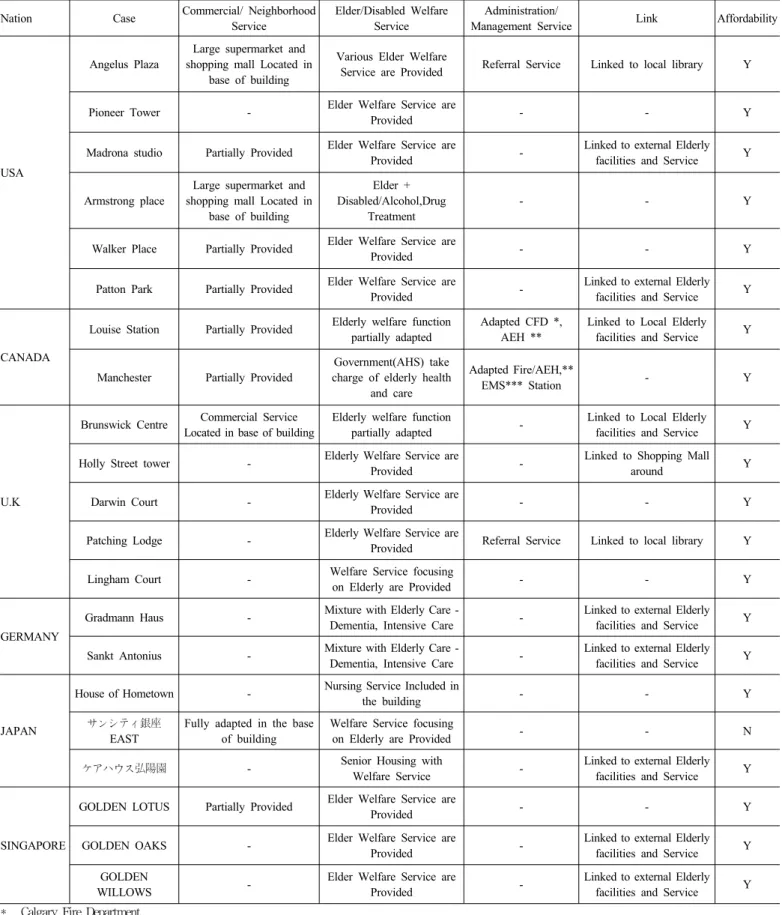
In summary, the characteristics of Welfare Service in Foreign Public Affordable Housing through case studies are as follows:
First it is inclined to provide residential function mixed with welfare function, especially the elderly/disabled related services which are served in close proximity with the residential building.
Among these services, Emergency call system and elderly/disabled free meal service (Senior Dining) are provided as an essential element in most cases.
Second, upon execution, variety of services can be closely used as multiple welfare functions are combined with residential function.
Third, there are some attempts to mingle various administrative and cultural services like library branch, theater, and etc in residential building and housing for the purpose of diversification of tenant group (social mix).
Fourth, the welfare services commonly associates with outside community center, healthcare and welfare facilities in order to strengthen the welfare service of PAH.
Furthermore, it is confirmed that there is tendency to strengthen
the welfare system to revitalize public affordable housing through
either by grouping senior only housing or the diversification of
tenants (social-mix). In addition, most of assisted living services
are required to be provided either inside the housing or associated
with outside service center.
Table 6. Case study of Mixed Welfare Service in foreign country
Nation Case Commercial/ Neighborhood
Service
Elder/Disabled Welfare Service
Administration/
Management Service Link Affordability
USA
Angelus Plaza
Large supermarket and shopping mall Located in
base of building
Various Elder Welfare
Service are Provided Referral Service Linked to local library Y
Pioneer Tower - Elder Welfare Service are
Provided - - Y
Madrona studio Partially Provided Elder Welfare Service are
Provided - Linked to external Elderly
facilities and Service Y
Armstrong place
Large supermarket and shopping mall Located in
base of building
Elder + Disabled/Alcohol,Drug
Treatment
- - Y
Walker Place Partially Provided Elder Welfare Service are
Provided - - Y
Patton Park Partially Provided Elder Welfare Service are
Provided - Linked to external Elderly
facilities and Service Y
CANADA
Louise Station Partially Provided Elderly welfare function partially adapted
Adapted CFD *, AEH **
Linked to Local Elderly facilities and Service Y
Manchester Partially Provided
Government(AHS) take charge of elderly health
and care
Adapted Fire/AEH,**
EMS*** Station - Y
U.K
Brunswick Centre Commercial Service Located in base of building
Elderly welfare function
partially adapted - Linked to Local Elderly facilities and Service Y Holly Street tower - Elderly Welfare Service are
Provided - Linked to Shopping Mall
around Y
Darwin Court - Elderly Welfare Service are
Provided - - Y
Patching Lodge - Elderly Welfare Service are
Provided Referral Service Linked to local library Y
Lingham Court - Welfare Service focusing
on Elderly are Provided - - Y
GERMANY
Gradmann Haus - Mixture with Elderly Care -
Dementia, Intensive Care - Linked to external Elderly facilities and Service Y Sankt Antonius - Mixture with Elderly Care -
Dementia, Intensive Care - Linked to external Elderly facilities and Service Y
JAPAN
House of Hometown - Nursing Service Included in
the building - - Y
サンシティ銀座 EAST
Fully adapted in the base of building
Welfare Service focusing
on Elderly are Provided - - N
ケアハウス弘陽園 - Senior Housing with
Welfare Service - Linked to external Elderly facilities and Service Y
SINGAPORE
GOLDEN LOTUS Partially Provided Elder Welfare Service are
Provided - - Y
GOLDEN OAKS - Elder Welfare Service are
Provided - Linked to external Elderly
facilities and Service Y GOLDEN
WILLOWS - Elder Welfare Service are
Provided - Linked to external Elderly
facilities and Service Y
* Calgary Fire Department
** Alberta Emergency Health Services
*** Emergency Medical Services
Fig. 2. The degree of existing welfare service usage
Fig. 3. The usage status of existing welfare service by categories
Fig. 4. The needs of existing welfare service
5. Welfare Service Needs By Category
More than 300 managerial heads of long-term public rental housing and 126 PAH tenants and managers were surveyed in order to identify Welfare Service Needs from PAH tenants (December, 2011).
Survey for managers were distributed on 300 targets through email and collected at the workshop from the managerial heads.
Survey for tenants were performed in the way where it is handed out and taken back via managerial offices of ten representative tenants in each 126 PAH nationwide.
The contents of survey is to understand service needs from the manager and tenant categories of elderly/disabled, infant/child/
juvenile/family, management/communities autonomy/administration, and self-support/commercial/neighborhood friendly. The results of survey were analyzed by average distribution analysis (t-Test) with separation between tenants and manager.
On the questions of usage about the existing welfare services, the manager group replied that is used actively more than on average. This result suggests that welfare service appears to be utilized actively in the managers’ opinion because many welfare service users are from the outside the complex. Although tenants are taking some advantage of the existing service, this implies that there are blind-spots that exist in the welfare system. This also reflects that there is a limit in providing service to tenants via existing social welfare center.
On the usage status of existing welfare service by categories (figure 3), both tenants and managers respond that the most used are services related to the elderly/disabled, management/administration next in line and neighborhood/ commercial services followed behind.
Meanwhile, there is a great disparity between tenants and manager regarding Infant/Child/Juvenile/Family related services which represents that theses services are not widely used by tenants within the overall usage rate because it is mostly used by residents outside the PAH.
In addition, it also reflects that the tenants in PAH are advancing in age and its number of infants, children and youth are decreasing.
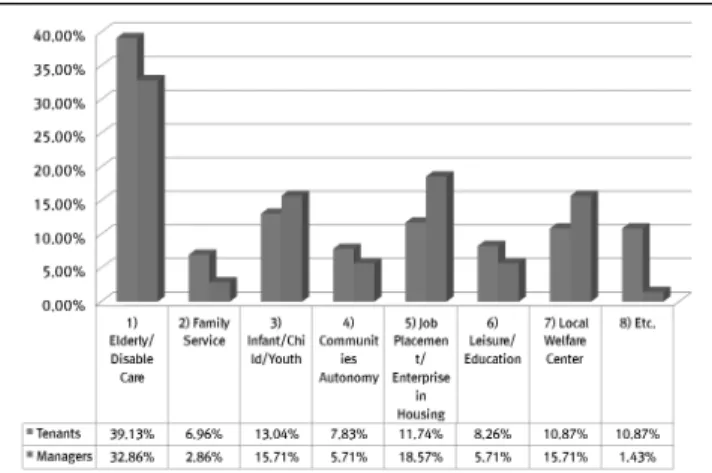
On the need base from existing welfare service (Figure 4), the most required service is the health related, under “elderly/disabled”
category. This is followed by “job placement/enterprise establishing in housing”, “infant/child /juvenile service” (a local welfare base),
“autonomy/family counseling” (tenant’s communities) and “education/
hobbies”, in an order most required to the least.
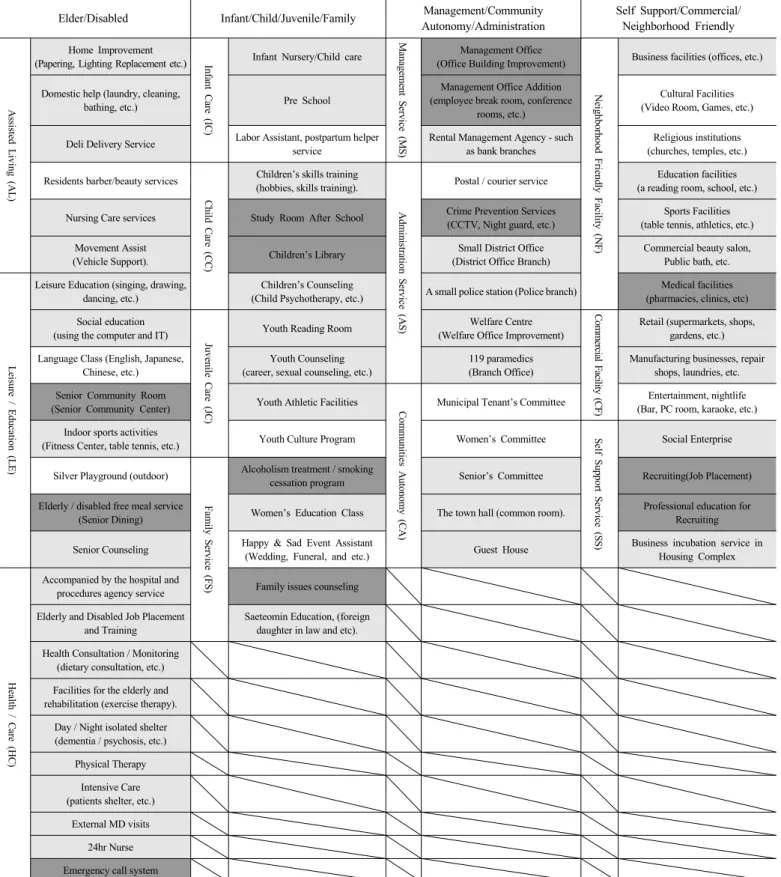
On the needs of welfare service by sub-categories in detail (table 7), the “elderly/disabled” are essential part of service to be provided. Under the “elderly/disabled”, the most required services are as indicated as such:
Emergency call system > elderly/disabled free meal service (senior dining) > senior community room (senior community center)
The least favorite services are as follows:
Language class (English, Japanese, Chinese, etc.) < Residents barber/beauty services < silver playground (outdoor)
Under the “Infant/Child/Juvenile/Family” group in Table 7, the most necessary services appear to be “alcoholism treatment/
smoking cessation program.” The needs for the “Infant/Child/
Juvenile/Family” are shown as below:
Table 7. Welfare program based on tenants/manager needs
Elder/Disabled Infant/Child/Juvenile/Family Management/Community Autonomy/Administration
Self Support/Commercial/
Neighborhood Friendly
Assisted Living (AL)
Home Improvement
(Papering, Lighting Replacement etc.) Infant Care (IC)
Infant Nursery/Child care
Management Service (MS)
Management Office (Office Building Improvement)
Neighborhood Friendly Facility (NF)
Business facilities (offices, etc.)
Domestic help (laundry, cleaning,
bathing, etc.) Pre School
Management Office Addition (employee break room, conference
rooms, etc.)
Cultural Facilities (Video Room, Games, etc.)
Deli Delivery Service Labor Assistant, postpartum helper service
Rental Management Agency - such as bank branches
Religious institutions (churches, temples, etc.)
Residents barber/beauty services
Child Care (CC)
Children’s skills training (hobbies, skills training).
Administration Service (AS)
Postal / courier service Education facilities (a reading room, school, etc.)
Nursing Care services Study Room After School Crime Prevention Services
(CCTV, Night guard, etc.)
Sports Facilities (table tennis, athletics, etc.) Movement Assist
(Vehicle Support). Children’s Library Small District Office
(District Office Branch)
Commercial beauty salon, Public bath, etc.
Leisure / Education (LE)
Leisure Education (singing, drawing, dancing, etc.)
Children’s Counseling
(Child Psychotherapy, etc.) A small police station (Police branch) Medical facilities (pharmacies, clinics, etc) Social education
(using the computer and IT) Juvenile Care (JC)
Youth Reading Room Welfare Centre
(Welfare Office Improvement)
Commercial Facility (CF)
Retail (supermarkets, shops, gardens, etc.) Language Class (English, Japanese,
Chinese, etc.)
Youth Counseling (career, sexual counseling, etc.)
119 paramedics (Branch Office)
Manufacturing businesses, repair shops, laundries, etc.
Senior Community Room
(Senior Community Center) Youth Athletic Facilities Communities Autonomy (CA)
Municipal Tenant’s Committee Entertainment, nightlife (Bar, PC room, karaoke, etc.) Indoor sports activities
(Fitness Center, table tennis, etc.) Youth Culture Program Women’s Committee Self Support Service (SS)
Social Enterprise
Silver Playground (outdoor)
Family Service (FS)
Alcoholism treatment / smoking
cessation program Senior’s Committee Recruiting(Job Placement)
Elderly / disabled free meal service
(Senior Dining) Women’s Education Class The town hall (common room). Professional education for
Recruiting
Senior Counseling Happy & Sad Event Assistant
(Wedding, Funeral, and etc.) Guest House Business incubation service in
Housing Complex
Health / Care (HC)
Accompanied by the hospital and
procedures agency service Family issues counseling Elderly and Disabled Job Placement
and Training
Saeteomin Education, (foreign daughter in law and etc).
Health Consultation / Monitoring (dietary consultation, etc.) Facilities for the elderly and rehabilitation (exercise therapy).
Day / Night isolated shelter (dementia / psychosis, etc.)
Physical Therapy Intensive Care (patients shelter, etc.)
External MD visits 24hr Nurse Emergency call system
* The more items are shaded, the more they are required by managers and tenants.
Alcoholism treatment/smoking cessation program > after-school tutoring > children’s library > family counseling
The least required services from the “Infant/child/juvenile/
family” are:
Labor assistant/postpartum helper service < youth culture program < Happy & Sad Event Assistant (wedding, funeral etc)
Overall, the “management/administration/community” related services are highly demanded. Particularly, there is a higher demands in Management office (office building improvement), and Management office addition (employee break room, conference rooms etc). Crime prevention services (CCTV, night guard, etc) are also identified as an urgent need. The least required services are as accordingly:
Municipal tenant’s committee < women’s committee < Postal/
courier service
On the needs of self support/commercial/neighborhood Friendly (table 7), the level of its necessity is evident. Response proposed that services should be available in the following order:
Medical facilities (pharmacies, clinics, etc) > recruiting (job placement) > professional education for recruiting
Whereas, the most unnecessary service is listed in the following order:
Entertainment/nightlife (PC room, karaoke, etc) > religious institution (churches, temples, etc) > cultural facilities (video room, games, etc)
In brief, both managers and tenants responded that it is necessary to mix the elderly/disabled related to the residential function to strengthen its environment. The needs for each service under sub-categories are summarized in [Table 7].
In detail, survey responded that emergency call system, senior dining and senior community center are an essential service to the
“elderly/disabled.” Also under the “Infant/child/juvenile/family”
category, “alcoholism treatment/smoking cessation” program deemed most required. For the “Management/ community Autonomy/Administration category” category, space reorganization of management office was most required. On the other hand, urban agriculture, recruiting (job placement) and professional education under self-support service were responded through survey as a requirement in order to revitalize the housing complex rather than entertainment and religious facilities. This result reflects on a problem that the service should concentrate on tenants advancing in years on the vulnerable group but also represent that services must consider unqualified tenants of an alcoholic. It also identifies that service for child and juvenile must be included for the social-mix tenants.
6. Suggestion of Mixed-Use Welfare Service
As a result of case study and manger/tenant feedback, the proximity of services through the mixture of four welfare functions suggested previously should be considered with importance in order to enhance the welfare services of PAH. Meanwhile, the methods for mixture of functions can be presented in various ways such as the type of building in housing, the type of linear link between residential and welfare service building but also the type of vertical connection between residential and the welfare element.
These should be determined by considering all the elements such as the characteristics and needs of the residents in PAH, existing social welfare center, the availability and the possibility of providing mixed-use complex, as well as the possibility of linking local community welfare service.
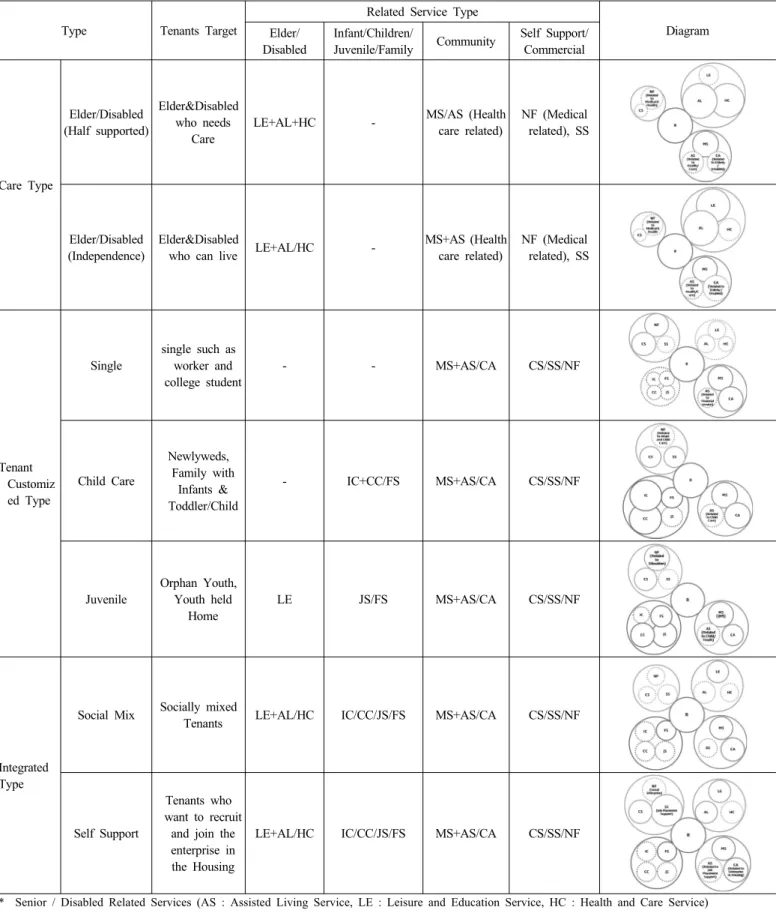
Because there exist a variation in the tenant group, regional and environmental features of housing, the mixed-use type and category of welfare service to be provided may be diverse however, is able to be classified into three main categories: Care type, Tenant customized type, and Integrated type. There are also seven detail types that can be presented as a sub-category as below (Table 8):
1) “Elderly/disabled half support type” is suitable for PAH, including a large number of elderly and disabled who need direct care. It is essential to provide the care (Healthcare service) and to mix with assisted living. However it may make sense to limit the tenants as a half supported group with the possibility of mobility and to regulate the healthcare service to healing rather than medical treatment, as it is difficult to give medical service identical to hospital treatment. Hospital treatment is difficult to mix with residential function in PAH.
2) “Elderly/Disabled Stand alone type” is also appropriate to PAH with a large amount of elderly and disabled population.
It generally provides the health service including monitoring to check personal health and leisure/education component for elderly. With this, it is possible to compound or to link assisted living with the residential function in PAH.
3) “Single family type” is for the housing with many single tenants such as college student, or single worker who slow the marriage pattern in the city. It seems suitable for the provision of affordable housing in the city and is adequate that commercial and administration function is additional mixed nearby.
4) “Childcare type” is advantageous to the housing with the residents such as newlyweds, family with infants and children or homes of a single parent. It may be applicable to housing like Bogeumjari provided recently near schools, kindergarten, and child nursing center. Generally, services related to infants and children are in a composite with existing housing.
5) “juvenile type” is beneficial to the housing consisting of many orphan youth and juvenile. This type will be suitable for housing located on the site with many school and tutoring institute, similarly to the “child care type.”
6) “Social-mix type” is suitable for the housing with a variety
of tenants. This mixed-use service type is adequate to the
housing where is already socially mixed (e.g. national
public affordable housing and bogeumjari housing). On the
other hand, it is also applicable to the housing with
emerging problems of the vulnerable class to induce
diversification of tenants in PAH. This type might revitalize
Table 8. Type of mixed welfare service in permanent affordable housing
Type Tenants Target
Related Service Type
Diagram Elder/
Disabled
Infant/Children/
Juvenile/Family Community Self Support/
Commercial
Care Type
Elder/Disabled (Half supported)
Elder&Disabled who needs
Care
LE+AL+HC - MS/AS (Health
care related)
NF (Medical related), SS
Elder/Disabled (Independence)
Elder&Disabled
who can live LE+AL/HC - MS+AS (Health care related)
NF (Medical related), SS
Tenant Customiz ed Type
Single
single such as worker and college student
- - MS+AS/CA CS/SS/NF
Child Care
Newlyweds, Family with
Infants &
Toddler/Child
- IC+CC/FS MS+AS/CA CS/SS/NF
Juvenile
Orphan Youth, Youth held
Home
LE JS/FS MS+AS/CA CS/SS/NF
Integrated Type
Social Mix Socially mixed
Tenants LE+AL/HC IC/CC/JS/FS MS+AS/CA CS/SS/NF
Self Support
Tenants who want to recruit
and join the enterprise in the Housing
LE+AL/HC IC/CC/JS/FS MS+AS/CA CS/SS/NF
* Senior / Disabled Related Services (AS : Assisted Living Service, LE : Leisure and Education Service, HC : Health and Care Service)
Child / children / youth / family-related services (IC : Infant Care Service, CC : Child Care Service, JS : Juvenile Service, FS : Family Service) Management / Communities / administration-related services (MS: Management Services, CA: government-related services, AS: Administration Related Services)
Self-Support / Neighborhood / Commercial-related services (SS: Self-Support services, NF: Neighborhood Friendly Facilities and Services, CS: Commercial services)
** Dot Line in the diagram means that it can be either tied in affordable housing or linked to outside service.