• 검색 결과가 없습니다.

Dystrophin Degradation in Skeletal Muscles with Lipid Enrichment in Cattle

N/A
N/A
Protected

Academic year: 2021

Share "Dystrophin Degradation in Skeletal Muscles with Lipid Enrichment in Cattle"

Copied!
11
0
0

로드 중.... (전체 텍스트 보기)

전체 글

(1)

Dystrophin Degradation in Skeletal Muscles with Lipid Enrichment in Cattle

Sung-Hwan Jeon

1†

, Ah-Young Kim

1,2†

, Eun-Mi Lee

1,2

, Eun-Joo Lee

1,2

, Il-Hwa Hong

1

, Ok-Kyung Hwang

1

and Kyu-Shik Jeong

1,2

*

1

Department of Veterinary Pathology, College of Veterinary Medicine, Kyungpook National University, Daegu 702-701, Korea

2

Stem Cell Therapeutic Research Institute, Kyungpook National University, Daegu 702-701, Korea Received January 13, 2016 /Revised February 2, 2016 /Accepted February 2, 2016

This study investigated the muscular dystrophin levels in freely moving Australian cattle mainly fed grass, freely moving Korean cattle fed mainly a grain diet, and Korean cattle fed a grain diet but housed in a relatively limited space of a cow house. The total skeletal muscle specimens of 244 cattle were collected and immediately fixed in 10% neutral formalin. The same area was biopsied from the cattle in both countries. The findings showed that fatty infiltration is highly correlated with mem- brane-associated protein degradation in skeletal muscle, and that among several membrane-associated proteins, dystrophin showed the most significant reduction in expression in the cattle with fatty infiltration. Similarly, CD36 was more highly expressed in the cattle with fatty infiltration of skeletal muscle. Various breeding factors, such as oxidative stress; the presence of oxidized lipids in the diet;

and environmental factors such as exercise, temperature and amount of time spent, may have critical effects on the degradation of normal cytoskeleton proteins, which are required for maintaining normal skeletal muscle architecture. Among the sarcolemma membrane-associated proteins, dystrophin is the most sensitive membrane protein that is involved muscular dystrophy and muscular degeneration.

Thus, the present findings may be useful for studies on muscular dystrophy in humans or the patho- genesis of muscular diseases in animal models.

Key words : Cattle, dystrophin, dystrophy, lipid, muscle

†Authors contributed equally.

*Corresponding author

*Tel : +82-53-955-5975, Fax : +82-53-950-5955

*E-mail : [email protected]

This is an Open-Access article distributed under the terms of the Creative Commons Attribution Non-Commercial License (http://creativecommons.org/licenses/by-nc/3.0) which permits unrestricted non-commercial use, distribution, and reproduction in any medium, provided the original work is properly cited.

Journal of Life Science 2016 Vol. 26. No. 5. 592~602 DOI : http://dx.doi.org/10.5352/JLS.2016.26.5.592

Introduction

Muscular dystrophy has been noted on progressive and degenerative diseases due to the degeneration of skeletal muscles, and it is also a debilitating X-linked disease with limited treatment options [23]. Until now many different genes have been linked with muscular dystrophy [5].

Mutations of the dystrophin-glycoprotein complex (DGC) cause autosomally inherited muscular dystrophy, indicating the importance of this complex in the maintaining normal muscle architectures. The lack of those proteins cause mem- brane destabilization and the activation of multiple patho- logical cellular cascades, most likely intracellular Ca

2+

ion accumulation, which further leads to cellular degeneration, apoptosis, and necrosis resulting in the replacement of mus-

cle parenchyma by adipose tissue and connective tissue, fi- nally completion of muscular fibrosis.

Muscular dystrophin related diseases can occur and are

reported worldwide. Its incidence varies, as some forms are

more common than others. Its most common form in chil-

dren is Duchenne and Becker muscular dystrophy as it af-

fects approximately 1.38 in every 10,000 males 5 through 24

years of age [24]. The muscle fiber membrane contains a

group of proteins called the dystrophin-glycoprotein com-

plex which prevents damage as muscle fibers contract and

relax [4]. Loss of the dystrophin-glycoprotein complex

(DGC) or a subset of its components can lead to muscular

dystrophy. However, the patterns of symptoms differ de-

pending on which proteins are affected. The absence of dys-

trophin leads to loss of the entire dystrophin glycoprotein

complex and is associated with susceptibility to contractile

injury. In contrast, muscles lacking gamma-sarcoglycan

(gamma-SG) display little mechanical fragility and still de-

velop severe pathology [4]. Once the muscle fiber membrane

is damaged, it begins to leak the muscle protein creatine kin-

ase, which is needed for the chemical reactions that produce

energy for muscle contractions and uptake on excess cal-

cium, which causes further muscular damage [4].

(2)

Although affecting several tissues and very likely all or- gans, it most prominently affects the integrity of muscle fibers. Individuals affecting muscular dystrophy could not control muscle strength and tendon reflexes due to the loss and replacement of muscle parenchyma with connective tis- sues by fatty change, inflammation and fibrosis [2, 4, 15].

Among muscular dystrophies, Duchenne type is most common as it accounts for approximately 50 percent of all clinical cases [2, 4, 12, 20, 27]. Progressive weakness and muscle wasting caused by degenerating muscle fibers begins in the upper legs and pelvis before spreading into the upper arms. The wasting muscles, in particular the calf and deltoid muscles might be enlarged by an accumulation of fat and connective tissue, causing them to look larger and healthier called pseudohypertrophy. As the disease progresses, the muscles in the diaphragm that assist in breathing and cough- ing might show progressive weakness. Patients may experi- ence breathing problem and respiratory infections. Bone thinning and scoliosis are also commonly observed symp- toms [2, 4, 12, 20, 27].

Therefore, Duchenne muscular dystrophy (DMD), the most common form of muscle-wasting diseases in child- hood, has been studied intensively since the dystrophin pro- tein was identified. The most significant obstacle in develop- ment of an effective treatment is the large size of the dystro- phin gene because its cDNA is 14 kb [20].

Recently, systemic corticosteroids treatment, exon skip- ping, nonsense suppression, viral gene therapy and utrophin modulation have been applied to cure DMD [10, 28], but those cannot be a perfect remedy yet.

Even though lots of researchers have attempted to devel- op a method of intervention in muscular dystrophy, so far, animal disease models for human are limited and need to be developed and intensively researched. So far, muscular dystrophy naturally occurred in skeletal muscles of large an- imals such as cow, horse and other wild lives have not been studied much and therefore this work focused on muscle biopsies using bovine skeletal muscles to give valuable in- formation which would be applicable to human beings in the near future.

Especially, two different breeding conditions were used comparing mainly grass-fed freely moving cows in Australia versus mainly grain-fed cows limited free movement due to the narrow space of an cattle shed in Korea.

This study aims not only to reveal the correlation between the lipid infiltration and dystrophin constitutions to develop

pathological protein markers for early proteolytic processes, but also to identify the effects that breeding environment and diet have on skeletal muscular architectures.

Materials and Methods

Specimens information

Australian cattle used in this experiment were raised in area of near Brisbane, Queensland of Australia. That area is located at South 27’ 23’’ latitude and East 153’ 07’’

longitude. Based on average climatological data of this area collected for the past 43 years from www.weatherbase.com, yearly average temperature is 20℃ with fluctuation between 15℃ and 25℃. Those cattle were raised in grassland at pasture. Experimental samples were collected from the same, designated part of frozen Australian cattle skeletal muscles. The Australian cattle were mainly fed with the grass such as Black spear grass (Heteropogon contortus), Queensland blue grass (Dichanthium insculptum, Dichanthi- um sericeum), Australia native sorghum, Rhodes grass (Chloris gayana), Pangola (Digitaria decumbens), and Kikuya (Pennisetum clandestinum). Grass and water were ad libitum without a restraint in movement. Breed of the cat- tle was Charolais.

Meanwhile, Korean cattle used in this experiment were raised in an area near Daegu, Kyungpook of Korea. That area is located at North 35’ 52’’ latitude and East 128’ 37’’

longitude. Based on average climatological data of this area collected for the past 85 years from www.weatherbase.com, yearly average temperature is 12℃ with fluctuation between -1℃ and 26℃. Those cattle were raised in the relatively nar- row and limited space of a cow house. Experimental samples were collected from the same, designated part of Korean cat- tle skeletal muscle under 4℃. The Korean cattle were mainly fed a grain diet and the different diet sources of 5 grain meals are corn, wheat, soybean meal, wheat bran and coco- nut oil meal. Breed of the cattle was Korean Native cattle.

Total skeletal muscle specimens from 244 cattle were

collected. Among them, 126 specimens were from Koryung

slaughter house in Korea and they were immediately fixed

at the 10% neutral formalin. In another set of collected speci-

mens, 118 specimens were from Imported Australian cattle

(Angus, Hereford, Charolais). This group was also fixed at

the 10% neutral formalin for histopathology and immun-

ohistochemical analysis. Exactly the same area was biopsied

from both countries from M. Serratus Ventralis (collected

(3)

from ‘chuck roll’) and M. Latissimus Dorsi (collected from

‘short rib’).

Histopathology

Tissue samples from the skeletal muscles of both Korean native cattle and imported Australian cattle were rapidly re- moved and fixed in 10% neutral buffered formalin, proc- essed routinely and embedded in paraffin wax. Sections were cut to 4-6 μm in thickness. The sections were stained with hematoxylin and eosin (H-E).

Immunohistochemistry

For immunohistochemistry, sections of tissue were depar- affinized in xylene, and rehydrated in a graded alcohol series and endogenous peroxidase activity was inhibited using 3%

hydrogen peroxide for 40 min and executed a microwave antigen process in 10 mmol/l citrate and proteinase K and incubated in a solution of 3% hydrogen peroxide in meth- anol for 30 min and microwaved at 750 W for 10 min in 10 mmol/l citrate buffer, pH 6.0. Slides were washed with PBS, and then immunostained with primary antibodies from the mouse monoclonal antibodies. The antibodies  used for immunostaining were as follows: Dystrophin (Novocastra, Laboratories, New Castle Upon Tyne, UK), α- dystroglycan (Upstate cell signaling solution, Lake Placid, New York), β -dystroglycan (Novocastra, Laboratories, New Castle Upon Tyne, UK), Dysferin (Novocastra, Laboratories, New Castle Upon Tyne, UK), Caveolin-3 (Transduction laboratories, Lexington, Kentucky, USA), CD36 (Cascade Bioscience, Winchester, MA, USA). The antigen-antibody complex was visualized by using an Histostain-plus Bulk kit (Zymed Laboratories Inc., San Francisco, CA, USA) with 3,3-diamino benzidine (DAB, Zymed Laboratories Inc., San Francisco, CA, USA). Slides were then rinsed in distilled water and counterstained with Mayers hematoxylin. For negative con- trol, the primary antibody was replaced by normal mouse IgG.

Statistical analysis

All values are expressed as means ± SD. Statistical analy- ses were performed using the Student's t-test. Statistical sig- nificance was assumed when p<0.05.

Results

Histopathology

At microscopic examination in H&E stain, although there

were no specific lesions, fat infiltration was mainly observed replacing skeletal muscle cells in Korean cattle (Fig. 1A-B).

As the result of grading the degree of fat infiltration, 34 of the 126 samples showed fat infiltrations in skeletal muscles of Korean cattle. Therefore, 27% of skeletal muscles were appeared with fat infiltration in Korean cattle (Fig. 1D) how- ever, there was only one of the 118 samples fat infiltrations in Australian cattle observed (Fig. 1E). Skeletal muscles of Australian cattle showed freezing injury such as shrunken myofibers by freezing and thawing process (Fig. 1C), indicat- ing physical myofiber damages.

Immunohistochemistry

For the immunoistochemical analysis of dystrophin in cat- tle skeletal muscles, we randomly selected 10 specimens re- spectively from both normal and fat infiltrated muscles and immunohistochemistry for dystrophin was executed. Dy- strophin is a subsarcolemmal actin-binding protein, it en- sures a link between the actin cytoskeleton and the ex- tracellular matrix with glycoprotein complex [9]. Normal muscle of Korean native cattle showed normal sarcolemmal localization for dystrophin. However, fat infiltrated muscles showed a deficiency of dystrophin staining. Dystrophin staining appeared clearly and abundantly on sarcolemma of normal muscle, however, sarcolemma of fat infiltrated mus- cles showed dystrophin stainining non-continuously and faintly (Fig. 2A-B). Dystrophin expression significantly de- creased in fat infiltrated muscles (Fig. 2D). In correlation analysis, it is observed that increase of fat infiltration grade decreases the dystrophin expression by acceleration of dys- trophin protein degredation (Fig. 3).

In Australian cattle, they showed a general decrease of dystrophin expression (Fig. 2C). It might be due to the speci- mens of Australian cattle were only received 5 months since slaughter, therefore dystrophin may have been destroyed gradually over a long time (Fig. 2E).

For the immunihistochemical analysis of CD36 in cattle

skeletal muscles, we randomly selected 10 specimens re-

spectively from both normal and fat infiltrated muscles and

executed immunohistochemistry for CD36. CD36 is a human

leukocyte differentiation factor and it is highly homologous

to the 88 kDa integral membrane protein fatty acid translo-

case (FAT), therefore, CD36 antibody is used to detect FAT

[9]. CD36 antibody has been reported to express in the small

capillaries, representing the presence of FAT in vascular en-

dothelium, however, the cascade bioscience CD36 antibody

(4)

Fig. 1. Histopathological findings in skeletal muscles of Korea Native cattle (A, B, D) vs. Australian cattle (C, E). A: Skeletal muscles of Korean Native cattle showed normal architecture. B: Fat infiltrated into parenchyma and replaced skeletal muscle cells of Korean Native cattle. C: Skeletal muscles of Australian cattle showed normal architecture although they showed freezing injury such as shrunken myofibers by physical freezing and thawing process. H&E. Original magnifications: ×50 (A-C), ×200 (insets of A-C) D: Fat infiltration rate in skeletal muscle of Korean Native cattle. 34 of the 126 samples showed fat infiltrations in skeletal muscles. Therefore, 27% of skeletal muscles appeared with fat infiltration in Korean Native cattle. E: Fat infiltration rate in skeletal muscle of Australian cattle. Fat infiltration was observed in only one of the 118 samples in Australian cattle.

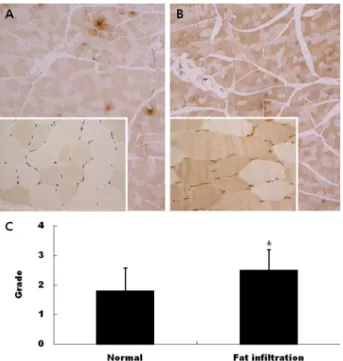
revealed a strong intracellular signal in fibers indentified by myosin heavy chain 1 (MCH1) staining [9]. Therefore CD36 positive vascular endothelium was regarded without pos- itive myofibres in immunohistochemical analysis. In this ex- periment, CD36 expression was observed abundantly in fat- ty infiltrated muscles and its expression increased sig- nificantly in fatty infiltrated muscles (Fig. 4A-C).

For the immunihistochemical analysis of α-dystroglycan in cattle skeletal muscles, we randomly selected 5 specimens respectively from both normal and fat infiltrated muscles and executed immunohistochemistry for α-dystroglycan. α- dystroglycan expressed normally at sarcolemma of skeletal muscles. In this experiment, the amount of expression was very low, irrespective of normal and fat infiltrated muscles (Fig. 5A-C).

For the immunihistochemical analysis of β-dystroglycan in cattle skeletal muscles, we randomly selected 10 speci-

mens respectively from both normal and fat infiltrated mus- cles and executed immunohistochemistry for β-dystroglycan.

Dystroglycan is a non-integrin adhesion molecule and piv- otal component of the dystrophin-glycoprotein complex as- sociated with the cytoskeleton composed of two subunits, α and β [9]. β-dystroglycan expressed normally at sarco- lemma of skeletal muscles. In this experiment, normal mus- cles of Korean native cattle showed normal sarcolemmal lo- calization for β-dystrogly can and fat infiltrated muscles showed mild decrease of β-dystroglycan expression, but there was no significant difference (Fig. 5D-F)

For the immunihistochemical analysis of caveolin-3 in cat-

tle skeletal muscles, we randomly selected 10 specimens re-

spectively from both normal and fat infiltrated muscles and

executed immunohistochemistry for caveolin-3. Caveolin-3

is the principal structure protein of caveolar membrane do-

mains in skeletal muscle cell type and localized to the

(5)

Fig. 2. Immunohistochemical analysis of dystrophin in skeletal muscles of Korean Native cattle vs. Australian cattle. A: Normal muscle of Korean Native cattle showed normal sarcolemmal localization for dystrophin. B: Fat infiltrated muscles of Korean Native cattle showed a deficiency of dystrophin staining non-continuously and faintly. C: Normal muscle of Australian cattle showed general decrease of dystrophin expression due to freezing-thawing damage. Immunostaining for dystrophin (A-C), Original magnifications: ×50(A-C), ×200 (insets of A-C) D: Expression of Dystrophin in skeletal muscles of Korean Native cattle. Dystrophin expression significantly decreased in fat infiltrated muscles. *: p<0.05 compared with normal muscles.

E: Expression of dystrophin in skeletal muscles of Australian cattle. Only 3 of the 20 species expressed dystrophin faintly.

Fig. 3. Correlation analysis between dystrophin expression and fat infiltration in randomly selected ten muscle speci- mens of Korean Native cattle. It is observed that an in- dividual showing the increase of fat infiltration grade also displayed decreased dystrophin expression. Pear- son’s correlation coefficient r=-0.609, p=0.031

sarcolemma. In this experiment, the sarcolemma expressed caveolin-3 irrespective of normal and fat infiltrated muscles

(Fig. 5G-I).

For the immunihistochemical analysis of dysferin in cattle skeletal muscles, we randomly selected 10 specimens re- spectively from both normal and fat infiltrated muscles and executed immunohistochemistry for dysferin. Dysferin is not an integral component of the dystrophin-glycoprotein com- plex, but it is suggested that dysferin has a direct or indirect functional association with the dystrophin-glycoprotein complex [3]. Dysferin expressed normally at sarcolemma of skeletal muscles. In this experiment, sarcolemma expressed dysferin irrespective of normal and fat infiltrated muscles (Fig. 5J-L).

Discussion

Diverse animal models for human muscular diseases have

been intensively studied for developing new therapeutic

technologies including gene therapy and stem cell therapy

(6)

Fig. 4. Immunohistochemical analysis of CD36 in skeletal mus- cles of Korean native cattle. CD36 antibody express in the small capillaries, representing the presence of FAT in vascular endothelium. A: Some capillaries expressed CD36 in normal muscles. B: CD36 expression was ob- served abundantly in fatty infiltrated muscles. Immunos- taining for CD36 (A-B), Original magnifications: ×50 (A-B), ×400(insets of A-B). C: Morphometrically, CD36 expression increased significantly in fatty infiltrated muscles.

in muscular dystrophy. So far, there are lots of studies using small animal model such as mice, but very limited studies for intervention have been reported due to the shortage of large animal models. Excluding rodents, an animal model specifically reproducing the alterations in the dystrophin gene and the full spectrum of human pathology has been reported in only golden retriever dogs, showing a single mu- tation in intron 6, resulting in complete absence of the dys- trophin protein, and early and severe muscle degeneration with nearly complete loss of motility and walking ability [25].

In this study, the muscular dystrophin protein levels of Korean cattle, which bred in limited environment and grain fed condition, versus Australian cattle, which freely bred on the grass and ad libitum grass fed, were surveyed. This was done to investigate whether industrial animals can be uti- lized as large animal models for muscle dystrophy and also analyze the effect of breeding conditions on muscularity as comparing stress conditions and freely movable conditions without control.

Clinically, sensitive indicators of the damage to muscular architecture were the enzymes aspartate aminotransferase (AST), alanine aminotransferase (ALT), and mainly creatine kinase (CK): the activities of these enzymes increased sig- nificantly after the heifers had been driven to pasture. Some reported that nutritional supplements such as vitamin E and selenium can be use to block any leakage of muscle break down enzymes [14]. However, these serological markers are applicable only when animals are alive. Therefore, new his- tological markers, which can be applicable on meat status, are required with consideration of practicality of large ani- mals as muscle dystrophy models. There have been several researches related with large animals and muscular degener- ation on histopathology, and these gave a clue to find the new histological markers.

In one case of bovine fetus, lipomatous masses were pres- ent within the cervical vertebral canal, compressing the spi- nal cord. Microscopically, the prominent muscular enlarge- ment was result from massive adipose and fibrous con- nective tissue accumulation which are substituting atrophic muscles [17].

Meanwhile, two Japanese Black bull calves from a dam showed muscular weakness and became recumbent after birth. At necropsy, skeletal muscles, including face, neck, body and proximal and distal forelimb and hind limb were extremely pale in color and edematous. Histopathological examination of skeletal muscles revealed degenerative changes as follows: replacement of muscle with fat, variation in muscle fiber diameter, internal nuclei, central core-like structures, and vacuolar and hyaline degeneration of muscle fibers. Those symptoms were all common histological abnor- malities shown in muscular dystrophy, and these cases seem to be classified as congenital myopathy based on patho- logical alterations and age of onset [30].

There is also an unusual congenial nutritional muscular dystrophy case in a newborn calf. A 13-hour-old Aberdeen- Angus was involuntarily recumbent since birth. It showed increased serum creatine kinase, and decreased serum vita- min E and selenium levels. Recovery followed after suppor- tive therapy and parenteral vitamin E and selenium. [1].

Generally, dystrophin, a cytoskeletal actin-binding pro-

tein, is a relevant in situ marker for muscular proteolysis,

the immunodetection of dystrophin can allow the monitor-

ing of early proteolysis. Using anti-dystrophin antibodies

di-rected toward the carboxy-terminal region, a highly sensi-

tive domain exposed to calpain activity, it was shown that

(7)

Fig. 5. A-B. Immunohistochemical analyses of α-dystroglycan (A-C), β-dystroglycan (D-F), caveolin-3 (G-I) and dysferin (J-L) in skeletal muscles of Korean Native cattle. The left figures (A, D, G, J) are the representative images of normal muscle, and the right figures (B, E, H, K) are their fat infiltrated counterpart. A-C: α-dystroglycan normally expressed on sarcolemma, the amount of expression was very low irrespective of normal and fat infiltrated muscles. Immunostaining for α-dystroglycan (A-B), Original magnifications: ×50(A-B), ×200(insets of A-B). There was no observed difference of expression between normal and fat infiltrated muscles due to general low expression. D-F: Normal muscles showed normal sarcolemmal localization for β -dystroglycan. Fat infiltrated muscles showed slight decrease of β-dystroglycan expression, but there was no significance.

Immunostaining for β-dystroglycan (D-E), Original magnifications: ×50(D-E), ×200(insets of D-E). β-dystroglycan expression

decreased slightly more in fat infiltrated muscles than normal muscles, but there was no significant difference. G-I: Caveolin-3

expressed normally at sarcolemma of skeletal muscles. The sarcolemma expressed caveolin-3 irrespective of normal and fat

infiltrated muscles. Immunostaining for caveolin-3 (G-H), Original magnifications: ×50(G-H), ×200(insets of G-H). There was

no observed difference of expression between normal and fat infiltrated muscles because of caveolin-3 expression in

sarcolemma. J-L: Dysferin expressed normally at sarcolemma of skeletal muscles. The sarcolemma expressed dysferin irre-

spective of normal and fat infiltrated muscles. Immunostaining for dysferin (J-K), Original magnifications: ×50(J-K), ×200(insets

of J-K). There was no observed difference of expression between normal and fat infiltrated muscles because dysferin expression

was almost observed in sarcolemma.

(8)

proteolysis kinetics were strongly influenced by the muscu- lar lipid contents and also coincided with degradation of muscular dystrophin protein. This data was also matched with former reports regarding that muscular proteolysis was accelerated during the first 8 hours of storage at 0℃ with the high-fat diet when comparing low-fat diets as a caloric proportion of 11.3% lipid and high-fat diets as caloric pro- portion of 30% lipid [6]. This faster proteolysis is possibly due to the activation or translocation of calpains, related to lipid accumulation in muscle fibers and cytoskeleton alter- ations [6].

In case of dystrophin deficiency, which is well-established in mdx mice, hind limb muscles of mdx mice undergo ne- crosis at the time of weaning when the motor activity of the mice greatly increases and muscle energy metabolism becomes more dependent on insulin and carbohydrates [19, 29]. Null mutation of any one of several members of the dystrophin protein complex can cause progressive, and pos- sibly fatal, muscle wasting. Although these muscular dystro- phies arise from the mutation of a single gene that is ex- pressed primarily in muscle, the resulting pathology is com- plex and multi-systemic, which shows a broader disruption of homeostasis than would be predicted by deletion of a sin- gle-gene product.

Current evidence indicates three general routes through which free radical production can be disrupted in dystro- phin deficiency to contribute to the ensuing pathology. The specific disruptions of free radicals that underlie major fea- tures of muscular dystrophy have been reported to develop more targeted and successful therapeutic approaches [26].

Duchenne muscular dystrophy is a progressive muscle- wasting disease resulting from lack of the sarcolemmal pro- tein dystrophin. However, the mechanism leading to this be- coming fatal is not fully understood. Several lines of evi- dence suggest a role for nuclear factor (NF)-kappa B in mus- cle degeneration as well as regeneration in DMD patients and mdx mice via inhibition experiments by using lipid per- oxidation inhibitor IRFI-042 treatment [31]. Increased fore- limb strength normalized to weight and decreased fatigue reported. Reduced serum creatine kinase level also reported, indicating that oxidative stress/lipid peroxidation might be represented as one of the mechanisms activating NF-kappa B and the consequent pathogenetic cascade in mdx mice [18].

Due to dystrophin, playing a key role for in a cytoskeletal cellular function at the inner surface of skeletal and cardiac muscle fibers, MAPK kinase signalling pathway has been

much focused on and studied in diaphragm muscle fibers from dystrophin-deficient mdx mice. Activation of ex- tracellular signal-regulated kinase 1/2 (ERK1/2) but not c-Jun N-terminal kinase-1 or p38 MAP kinase has been noted in the mdx muscle [16]. High fat diet during the farming has also been reported as a faster proteolytic factor, possibly by activation of calpain-related lipid accumulation in mus- cle fibers with cytoskeletal alterations [6].

These reports were also highly correlated with lipid in- filtration and dystrophin degradation in both Korean cattle and Australian cattle, indicating fed diets and environmental atmosphere might be associated with stress condition such as production of free radicals and accumulation of intra- cellular Ca

2+

ions, those are all related with cellular damages and degeneration. These cascades recruit inflammatory events and finally replace muscle parenchyma with con- nective tissues. Stress, high muscular activity and hypoxia were described to increase muscular ischemia [11], and high- er level of muscular fatty change observed in Korean cattle might be ascribed to its confined breeding condition.

Meanwhile, CD36 is unique and highly expressed both in adipocytes and mammary gland secretory epithelial cells, those are actively involved in fatty acid uptake with syn- thesis, storage and secretion of triacylglycerol [13]. CD36 is an important regulator of lipid metabolism in vivo due to its role in the facilitated uptake of long-chain fatty acids.

Tissues such as muscle, which normally express high levels of CD36, shift to high glucose utilization in CD36 deficiency, are possibly involved with peroxisome-proliferator-activated receptor (PPAR) mediated fatty acids metabolism [7].

Currently the adipogenetic involvement through the perox-

isome-proliferator-activated receptor γ (PPARγ) is being in-

tensively studied by using primary mesenchymal stem cells

derived from adipose tissues. Especially, peroxisome-pro-

liferator-activated receptor γ (PPARγ) agonists might be as-

sociated with activation of myoblast and chondrogensis,

skipping adipogenesis. For that reason, peroxisome-pro-

liferator-activated receptor γ (PPARγ) agonists regulated

protein levels via two-dimensional gel elctrophoresis are be-

ing searched for. At the stage of stress condition induced

by carbon tetrachloride treatment, hepatic stellate cells,

which are responsible for making connective tissues that

leads to fibrosis and further fatal organ dysfunction, got con-

tain lipid accumulation. Simultaneously, upregulation of

peroxisome-proliferator-activated receptor γ was identified

in protein levels, indicating the involvement of adipogenesis

(9)

[22]. So here it can be assumed to have a strong involvement of peroxisome-proliferator-activated receptor γ for lipid ac- cumulation on diverse organs such as the liver and muscles.

Among many organs, peripheral muscles are the major tar- get for glucose uptake for utilization. So muscles are much more interesting target tissue for lipid infiltration to see reg- ulation of adipogenesis via peroxisome-proliferator-acti- vated receptor γ.

Fatty infiltration is highly correlated with dystrophin pro- tein degradation based on the present study. There are sim- ilar literatures reporting fatty acid composition and choles- terol contents of muscle and adipose tissue from mature cat- tle [8]. Also, the effect of stress on tissue alpha-tocopherol was investigated in fed a corn/corn silage-based diet in the presence and absence of supplemental vitamin E. According to the data, the stress increased serum cortisol, creatine kin- ase, and urea and supplemental vitamin E reduced the crea- tine kinase relative to those not supplemented with vitamin E [21].

In the present study, dystrophin was significantly reduced in the group of fatty infiltration skeletal muscle and this re- duction was highly correlated with the fatty infiltration in skelatal muscles. CD36, which is known as a fat transporter, is more highly expressed in the fat infiltration skeletal mus- cle cells, indicating that fatty acid involves in inhibition of dystrophin protein expression. Various breeding factors such as oxidative stress, oxidized lipid from the diets and environmental factors such as exercise, temperature and amount of free time spent might be critical points affecting skeletal muscular architectures and cytoskeletal proteins.

Taken together, dystrophin is the most sensitive mem- brane protein involving muscular dystrophy and muscular degeneration. Therapeutic approaches can be applied in terms of three potential goals: improvement of dystrophic phenotype; expression of dystrophin; and overexpression of utrophin, because utrophin exhibits 80% homology with dystrophin and is able to perform similar functions. Pharma- cological strategies designed to overexpress utrophin appear promising and may circumvent many obstacles to gene and cell-based therapies.

Besides, the histopathological markers such as CD36 can be newly applied to the study of muscular dystrophy in hu- mans and pathogenesis of muscular diseases in animal mod- els in the future and the data were also very informative in the attempts to extend muscular diseases pathogenesis, intervention, and therapeutic approaches by suggesting new

potentiality of industrial animals as spontaneous occurring large animal models for muscular dystrophy.

Acknowledgement

This work was supported by Agricultural Biotechnology Development Program (312062-5) of iPET (Korea Institute of Planning and Evaluation for Technology in Food, Agricul- ture, Forestry and Fisheries), Mistry of Agriculture, Food and Rural Affairs, Republic of Korea.

References

1. Abutarbush, S. M. and Radostits, O. M. 2003. Congenital nutritional muscular dystrophy in a beef calf. Can. Vet. J.

44, 738-739.

2. Al-Ruwaishid, A., Vajsar, J., Tein, I., Benson, L. and Jay, V. 2003. Centronuclear myopathy and cardiomyopathy re- quiring heart transplant. Brain Dev. 25, 62-66.

3. Bansal, D. and Campbell, K. P. 2004. Dysferlin and the plas- ma membrane repair in muscular dystrophy. Trends Cell Biol. 14, 206-213.

4. Barton, E. R. 2006. Impact of sarcoglycan complex on me- chanical signal transduction in murine skeletal muscle. Am.

J. Physiol. Cell. Physiol. 290, C411-9.

5. Blake, D. J., Weir, A., Newey, S. E. and Davies, K. E. 2002.

Function and genetics of dystrophin and dystrophin-related proteins in muscle. Physiol. Rev. 82, 291-329.

6. Bonnal, C., Raynaud, F., Astier, C., Lebart, M. C., Marcilhac, A., Coves, D., Corraze, G., Gelineau, A., Fleurence, J., Roustan, C. and Benyamin, Y. 2001. Postmortem degrada- tion of white fish skeletal muscle (sea bass, Dicentrarchus labrax): fat diet effects on in situ dystrophin proteolysis dur- ing the prerigor stage. Mar. Biotechnol. (NY). 3, 172-180.

7. Drover, V. A. and Abumrad, N. A. 2005. CD36-dependent fatty acid uptake regulates expression of peroxisome pro- liferator activated receptors. Biochem. Soc. Trans. 33, 311-315.

8. Eichhorn, J. M., Coleman, L. J., Wakayama, E. J., Blomquist, G. J., Bailey, C. M. and Jenkins, T. G. 1986. Effects of breed type and restricted versus ad libitum feeding on fatty acid composition and cholesterol content of muscle and adipose tissue from mature bovine females. J. Anim. Sci. 63, 781-794.

9. Ervasti, J. M. and Campbell, K. P. 1993. Dystrophin and the membrane skeleton. Curr. Opin. Cell Biol. 5, 82-87.

10. Fairclough, R. J., Wood, M. J. and Davies, K. E. 2013.

Therapy for Duchenne muscular dystrophy: renewed opti- mism from genetic approaches. Nat. Rev. Genet. 14, 373-378.

11. Ferrari, R., Merli, E., Cicchitelli, G., Mele, D., Fucili, A. and Ceconi, C. 2004. Therapeutic effects of L-carnitine and pro- pionyl-L-carnitine on cardiovascular diseases: a review.

Ann. N. Y. Acad. Sci. 1033, 79-91.

12. Freund, A. A., Scola, R. H., Arndt, R. C., Lorenzoni, P. J.,

Kay, C. K. and Werneck, L. C. 2007. Duchenne and Becker

(10)

muscular dystrophy: a molecular and immunohistochemical approach. Arq. Neuropsiquiatr. 65, 73-76.

13. Keizer, H. A., Schaart, G., Tandon, N. N., Glatz, J. F. and Luiken, J. J. 2004. Subcellular immunolocalisation of fatty acid translocase (FAT)/CD36 in human type-1 and type-2 skeletal muscle fibres. Histochem. Cell Biol. 121, 101-107.

14. Kovac, G., Mudron, P., Prosbova, M. and Pasteka, J. 1987.

Clinical and biochemical response in the prevention of nu- tritional myodystrophy in heifers. Vet. Med. (Praha). 32, 81- 92.

15. Kuehn, B. M. 2007. Studies point way to new therapeutic prospects for muscular dystrophy. JAMA 298, 1385-1386.

16. Kumar, A., Khandelwal, N., Malya, R., Reid, M. B. and Boriek, A. M. 2004. Loss of dystrophin causes aberrant me- chanotransduction in skeletal muscle fibers. FASEB J. 18, 102- 113.

17. Langohr, I. M., Stevenson, G. W. and Valentine, B. A. 2007.

Muscular pseudohypertrophy (steatosis) in a bovine fetus.

J. Vet. Diagn. Invest. 19, 198-201.

18. Messina, S., Altavilla, D., Aguennouz, M., Seminara, P., Minutoli, L., Monici, M. C., Bitto, A., Mazzeo, A., Marini, H., Squadrito, F. and Vita, G. 2006. Lipid peroxidation in- hibition blunts nuclear factor-kappaB activation, reduces skeletal muscle degeneration, and enhances muscle function in mdx mice. Am. J. Pathol. 168, 918-926.

19. Mokhtarian, A., Lefaucheur, J. P., Even, P. C. and Sebille, A. 1995. Effects of treadmill exercise and high-fat feeding on muscle degeneration in mdx mice at the time of weaning.

Clin. Sci. (Lond). 89, 447-452.

20. Muntoni, F. and Wells, D. 2007. Genetic treatments in mus- cular dystrophies. Curr. Opin. Neurol. 20, 590-594.

21. Nockels, C. F., Odde, K. G. and Craig, A. M. 1996. Vitamin E supplementation and stress affect tissue alpha-tocopherol content of beef heifers. J. Anim. Sci. 74, 672-677.

22. Park, J. K., Ki, M. R., Lee, H. R., Hong, I. H., Ji, A. R., Ishigami, A., Park, S. I., Kim, J. M., Chung, H. Y., Yoo, S.

E. and Jeong, K. S. 2010. Vitamin C deficiency attenuates liver fibrosis by way of up-regulated peroxisome pro- liferator-activated receptor-gamma expression in senescence

marker protein 30 knockout mice. Hepatology 51, 1766-1777.

23. Rodino-Klapac, L. R., Chicoine, L. G., Kaspar, B. K. and Mendell, J. R. 2007. Gene therapy for duchenne muscular dystrophy: expectations and challenges. Arch. Neurol. 64, 1236-1241.

24. Romitti, P. A., Zhu, Y., Puzhankara, S., James, K. A., Nabukera, S. K., Zamba, G. K., Ciafaloni, E., Cunniff, C., Druschel, C. M., Mathews, K. D., Matthews, D. J., Meaney, F. J., Andrews, J. G., Conway, K. M., Fox, D. J., Street, N., Adams, M. M., Bolen, J. and MD STARnet. 2015. Prevalence of Duchenne and Becker muscular dystrophies in the United States. Pediatrics 135, 513-521.

25. Sampaolesi, M., Blot, S., D'Antona, G., Granger, N., Tonlor- enzi, R., Innocenzi, A., Mognol, P., Thibaud, J. L., Galvez, B. G., Barthelemy, I., Perani, L., Mantero, S., Guttinger, M., Pansarasa, O., Rinaldi, C., Cusella De Angelis, M. G., Torrente, Y., Bordignon, C., Bottinelli, R. and Cossu, G. 2006.

Mesoangioblast stem cells ameliorate muscle function in dystrophic dogs. Nature 444, 574-579.

26. Tidball, J. G. and Wehling-Henricks, M. 2007. The role of free radicals in the pathophysiology of muscular dystrophy.

J. Appl. Physiol. (1985). 102, 1677-1686.

27. Voisin, V. and de la Porte, S. 2004. Therapeutic strategies for Duchenne and Becker dystrophies. Int. Rev. Cytol. 240, 1-30.

28. Wein, N., Alfano, L. and Flanigan, K. M. 2015. Genetics and Emerging Treatments for Duchenne and Becker Muscular Dystrophy. Pediatr. Clin. North Am. 62, 723-742.

29. Wineinger, M. A., Abresch, R. T., Walsh, S. A. and Carter, G. T. 1998. Effects of aging and voluntary exercise on the function of dystrophic muscle from mdx mice. Am. J. Phys.

Med. Rehabil. 77, 20-27.

30. Yamada, M., Takashima, H., Takizawa, T., Mizuno, K., Nakamura, K., Furuoka, H. and Masegi, T. 2004. Congenital myopathy in Japanese Black calves. J. Vet. Med. Sci. 66, 997- 1001.

31. Zust, J., Hrovatin, B. and Simundic, B. 1996. Assessment of selenium and vitamin E deficiencies in dairy herds and clin- ical disease in calves. Vet. Rec. 139, 391-394.


(11)

초록:지방 침착률이 높은 식용소에서 나타난 골격근의 디스트로핀 소실

전성환

1†

․김아영

1,2†

․이은미

1,2

․이은주

1,2

․홍일화

1

․황옥경

1

․정규식

1,2

*

(

1

경북대학교 수의과대학 수의학과 수의병리학교실,

2

경북대학교 줄기세포치료기술연구소)

풀사료를 주식으로 하며 자유롭게 방목되는 호주산 소와 곡물사료를 주식으로 하며 상대적으로 제한된 면적의

축사에서 사육되는 한국산 소의 두 가지 근육에서 디스트로핀 단백질 발현 수준을 비교하였다. 총 244 두의 식용

소 도체로부터 양국에서 같은 부위의 골격근 조직을 채취하고 10% 중성 포르말린을 이용해 고정하였다. 본 연구

에서 지방 침착률이 골격근 막 관련 단백질들의 소실과 밀접한 연관이 있다는 점을 발견하였는데, 특히 디스트로

핀이 지방이 침착된 골격근에서 가장 유의적으로 감소하는 것을 확인하였다. 이와 동시에 CD36이 지방이 침착된

골격근에서 가장 풍부하게 발현하는 것도 확인하였다. 이렇게 정상 골격근의 구조를 유지하는 데 필요한 세포골

격 단백질들의 소실에는 산화적 스트레스에서부터 사료의 종류에 따른 산화 지질 및 운동, 기후, 성장 기간 등의

환경에 이르기까지 다양한 사육 조건들이 영향을 미쳤을 것으로 여겨졌다. 디스트로핀은 근형질막 관련 단백질들

중에 근이영양증이나 근육 변성과 관계된 가장 민감한 막 단백질이다. 그러므로 본 연구는 사람의 근이영양증

관련 연구를 비롯해 동물모델을 이용하여 근육질환의 기전을 찾는 연구에도 중요한 초석이 될 것으로 보이며,

나아가 근이영양증 기전 규명을 위한 기초연구뿐만이 아니라 치료를 위한 실용화 연구에도 응용될 수 있을 것으

로 사료된다.

수치

Fig.  1.  Histopathological  findings  in  skeletal  muscles  of  Korea  Native  cattle  (A,  B,  D)  vs
Fig.  2.  Immunohistochemical  analysis  of  dystrophin  in  skeletal  muscles  of  Korean  Native  cattle  vs
Fig.  4.  Immunohistochemical  analysis  of  CD36  in  skeletal  mus- mus-cles  of  Korean  native  cattle
Fig.  5.  A-B.  Immunohistochemical  analyses  of  α-dystroglycan  (A-C),  β-dystroglycan  (D-F),  caveolin-3  (G-I)  and  dysferin  (J-L)  in  skeletal  muscles  of  Korean  Native  cattle

참조

관련 문서