The Experimental Study on the Low-temperature Combustion Characteristics of DME Fuel in a Compression Ignition Engine
Seung Hyun Yoon
†Key Words: Low-temperature combustion (LTC), Exhaust gas recirculation (EGR), Dimethyl ether (DME), Diesel engine, Nitrogen oxides (NO
x), Start of energizing (SOE)
Abstract
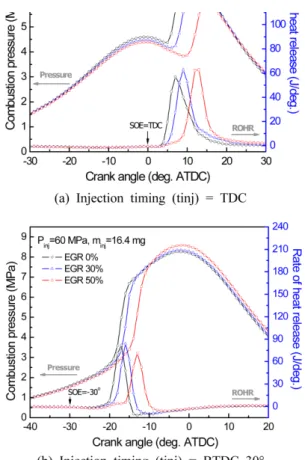
The aim of this work is to investigate the combustion and exhaust emission characteristics of low-temperature combus- tion (LTC) at various EGR test conditions using a single cylinder common-rail diesel engine. In high EGR rate combus- tion mode with DME fuel, 30% (Φ = 0.61) and 50% (Φ = 0.86) of EGR were respectively examined, and then the combustion, exhaust emissions, nano-particle characteristics of each cases were measured. From these results, it revealed that The ignition delay and combustion duration are prolonged as the increase of EGR rate. In addition, at an advanced injection timing (BTDC 30°), ignition delays were fairly increased because the dilution effect of EGR and also low charge in-cylinder temperature created a lean mixture, thus decreased the peak release rate.
1. Introduction
Compression ignition (CI) engine, as a typical rep- resentation of diesel engine, is widely used as power source for automobile due to their high thermal effi- ciency, excellent fuel economy and low regulated emissions of unburned hydrocarbon (HC), carbon monoxide (CO) and carbon dioxide (CO
2) compared to those of spark ignition (SI) engine
(1-2).
However, the in-cylinder temperature in a conven- tional diesel engine is about 2700 K, which leads to a larger amount of NOx emissions. In addition, in the high fuel concentration regions, a large amount of soot is formed because of the absence of O
2. For die- sel engines, a trade-off relationship between these two emissions is observed, and their problem is how to break through the compromise between NOx and
PM (particulate matter) emissions. The regulations for PM and NOx emissions from diesel engines have strengthened and reductions in CO
2, which is green- house gas, emissions are also raised the important issues from environmental problems. For these rea- sons, alternative fuels have been subject to intensive research work all over the world because they are extraordinarily attractive alternative fuels that can be substituted for petroleum fuels for the internal com- bustion engines
(3-4).
Dimethyl ether (DME, CH
3OCH
3) is a representa- tive alternative fuel for diesel engine which can be synthesized from natural gas, coal, crude oil, as well as from non-fossil fuel feed-stocks, such as biomass and waste products. DME fuel is advantageous in compression ignition (CI) engines, with an oxygen- ated molecular structure composed of an oxygen atom (about 35% by volume) between two methyl radicals (CH
3). Due to the absence of direct carbon- carbon (C-C) bonding, DME can drastically reduce or suppress the formation and development of soot during combustion while still providing conventional diesel-like thermal efficiency. In addition, DME has
(Recieved: 13 Nov 2017, Recieved in revised form: 13 Dec 2017, Accepted: 19 Dec 2017)
†