정기간행영문지_ 29권 1호 · 2021년 1월
2,4-Dichlorophenoxyacetic acid (2,4-D)-loaded chitosan and chitosan-starch beads were prepared as controlled pesticide release formulations. Their crosslinked counterparts exhibited reduced water uptake and pesticide release capabilities in both acidic and basic media. The release of 2,4-D from both the un-crosslinked and crosslinked beads was best described by zero-order kinetics, and followed non-Fickian diffusional release.
COVER PAPER
Controlled Release Formulations of 2,4-Dichlorophenoxyacetic Acid with Ecofriendly Matrices for Agricultural and Environmental Sustainability
Ozioma Udochukwu Akakuru and Ikenna Onyido*
Vol. 29, No. 1, pp 40-53 (2021)│JAN 25, 2021│DOI 10.1007/s13233-021-9004-9
REVIEW
Peptide Materials for Smart Therapeutic Applications Jeonghun Lee and Chulhee Kim*
Macromol. Res., 29, 2 (2021)
Myriad peptides have been reported for utilization as key motives in design of smart therapeutic materials due to their capabilities for selective binding, self-assembly, and bioresponsiveness. In this review, we describe various therapeutic applications of peptides, their derivatives, and their assemblies by employing the bioresponsive characteristics. Peptide materials have been developed for specific targeting or deep tissue penetration. Amphiphilic peptides and their self-assembled materials also have been adopted for the development of therapeutic materials. Furthermore, triggered structural transformation of the self-assemblies of peptides in response to various stimuli in biological environments facilitates diverse therapeutic applications of peptide materials.
ARTICLES
Effects of Nucleating Agent on the Thermal Conductivity and Creep Strain Behavior of Rigid
Polyurethane Foams Blown by an Environment-Friendly Foaming Agent
Robin Jang, Yeongbeom Lee, Kwang Ho Song,
and Woo Nyon Kim*
Macromol. Res., 29, 15 (2021)
The methoxynonafluorobutane under the trade name of NOVEC likely acted as a nucleating agent during the formation of polyurethane (PU) foams. When NOVEC was added in the amount of 3 parts per hundred polyol by weight (php), the cell size of the foam was minimal, and the cell size distribution was relatively uniform.
At the NOVEC content of 3.0 php, the thermal conductivity of the PU foams was also minimal. This decrease in thermal conductivity was due to the smaller cell size of the foams lowering their thermal conductivity.
Synthesis, Polymerization Kinetics and Thermal Properties of Benzoxazine Resin Containing ortho-Maleimide Functionality
Boran Hao, Yuqi Liu, Xinye Yu, and Kan Zhang*
Macromol. Res., 29, 24 (2021)
A mono-benzoxazine with ortho-maleimide functionality has been synthesized using ortho-maleimide functional phenol, aniline and paraformaldehyde as starting materials, and its apparent activation energy value is calculated to be 72.43 kJ/mol based on the Starink method. The resulting polybenzoxazine shows excellent thermal stability (Tg of 247 ℃; Td5 of 333℃), evidencing its great potential application in high-performance fields.
Preparation of High-Performance Polyethersulfone/Cellulose Nanocrystal Nanocomposite Fibers via Dry-Jet Wet Spinning
Sung Min Son, Jung-Eun Lee, Joonho Jeon, Sung In Lim, Hyuk Taek Kwon, Youngho Eom*, and Han Gi Chae*
Macromol. Res., 29, 33 (2021)
Polyethersulfone (PES)/cellulose nanocrystal (CNC) nanocomposite fibers were fabricated via dry-jet wet spinning and their mechanical properties were investigated in terms of the filler content. To maximize the reinforcing effect and tensile properties of the fibers, the CNC dispersion time and spinning/post-drawing conditions were optimized. As a result, PES/CNC-1 wt% nanocomposite fibers exhibited tensile strength, modulus, and toughness of 240 MPa, 4.7 GPa, and 51.8 J/g, respectively.
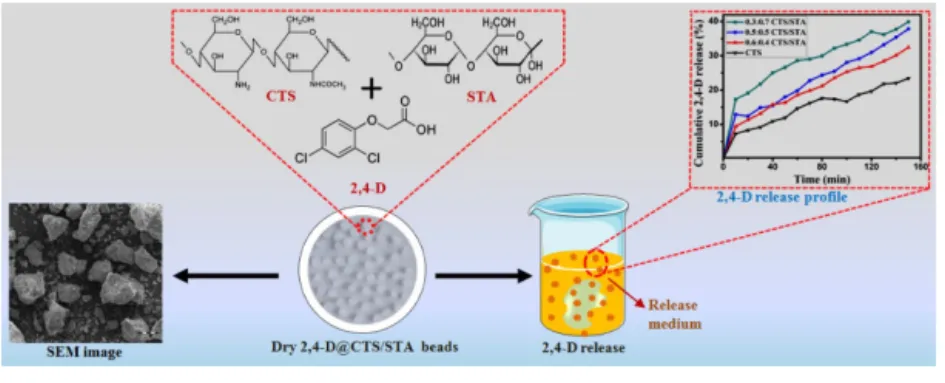
Controlled Release Formulations of 2,4-Dichlorophenoxyacetic Acid with Ecofriendly Matrices for Agricultural and Environmental Sustainability
Ozioma Udochukwu Akakuru and Ikenna Onyido*
Macromol. Res., 29, 40 (2021) Cover Paper
2,4-Dichlorophenoxyacetic acid (2,4-D)-loaded chitosan (CTS) and CTS-starch (CTS-STA) beads were prepared as controlled pesticide release formulations.
Their crosslinked counterparts exhibited reduced water uptake and pesticide release capabilities in both acidic and basic media. The release of 2,4-D from both the un-crosslinked and crosslinked beads was best described by zero-order kinetics, and followed non-Fickian diffusional release.
Assessment of pH Responsive Delivery of Methotrexate Based on PHEMA-st-PEG-DA
Nanohydrogels
Javad Farzanfar, Fatemeh Farjadian*, Amir Roointan,
Soliman Mohammadi-Samani*, and Lobat Tayebi
Macromol. Res., 29, 54 (2021)
The principal purpose of this project is to synthesize a biocompatible nanohydrogel (NH) consisting of poly-(hydroxyethyl)methacrylate (HEMA) with poly(ethyleneglycol) diacrylate (PEG-DA) as cross-linker by using reversible addition-fragmentation chain-transfer (RAFT) method, with the potential to carry methotrexate (MTX) into breast cancer cell lines (MCF-7). The pH-sensitive delivery for MTX using the synthesized final formula can be considered as an innovation in this design. Due to enhanced permeability and retention (EPR) effect the NH could accumulate in tumor site and release MTX through pH changes.
Direct Electrochemistry and Photoelectro-Catalysis on Oxygen Reduction Reaction of Titanium Dioxide Nano-Tubes Sensitized by Meso-Tetrakis
(4-carboxyphenyl) Porphine with Laccase Accommodation
Min Zhang, Mi Zhang, Shu Wei Zhang, and Han Zeng*
Macromol. Res., 29, 62 (2021)
Illustration in preparation procedure of TiO2-Tcpp nano-composite with Lac molecules integration via synergy of covalent coupling and adjacent ligation as well as impact of mutual interactions between element of nano-complex and Lac molecule on physiochemical properties of nano-composite with Lac attachment.
Optimal Design of PEDOT:PSS Polymer-Based Silver Nanowire Electrodes for Realization of Flexible Polymer Solar Cells
Young Un Kim, Su Hong Park, Nguyen Thanh Nhan, Mai Ha Hoang, Min Ju Cho*, and Dong Hoon Choi*
Macromol. Res., 29, 75 (2021)
The sandwiched silver nanowire (AgNW) electrode between the poly(3,4- ethylenedioxythiophene):polystyrene sulfonate (PEDOT:PSS) layers fabricated on the flexible polyethylene 2,6-naphthalate (PEN) substrate was successfully prepared, which exhibited the sheet resistance of 22 Ω/□ and the transmittance of 82% at the wavelength of 550 nm. This electrode can be easily employed as an anode, and when it is applied as an electrode in a polymer solar cell, it reveals a comparable performance to that of indium tin oxide-based devices. This simple and effective fabrication of flexible conductive electrodes is envisaged to contribute immensely to future research on flexible electronics and optoelectronics.
Production of Uniform Microspheres Using a Simple Microfluidic Device with Silica Capillary
Guk Young Ahn, Inseong Choi, Minju Song, Soo Kyung Han, Kangho Choi, and Sung-Wook Choi*
Macromol. Res., 29, 82 (2021)
We fabricated the microfluidic device using by silica capillary with 50 μm inner diameter and 150 μm outer diameter. This device can easily regulate the size of the oil-in-water (O/W) emulsion droplets by changing the flow rate of the continuous phase. The generated emulsion droplets can be reduced to a size of about 75 μm, and produced in uniform size with a coefficient of variation (CV) of 2.6%.
Impact of Intermolecular Interactions Between a Diketopyrrolopyrrole-Based Conjugated Polymer and Bromobenzaldehyde on Field-Effect Transistors
Dong Geon Koo, Dabin Lee, Juran Noh, Yong Hyun Lee, Seohyeon Jang, Inho Nam, Tae Joo Shin, and Juhyun Park*
A diketopyrrolopyrrole (DPP)-based conjugated polymer widely used in organic field effect transistors (OFETs), was assembled using 2-bromobenzaldehyde (2-BBA) and used as an active layer for OFETs. The intermolecular interactions resulting from the addition of 2-BBA contributed to the two-fold enhancement of the hole mobility, two-order increase in magnitude of the current on/off ratio, and 50% decrease in the threshold voltage of the OFETs based on PDPP-DPP.
Enhanced Performance of Triboelectric Nanogenerator by Controlled Pore Size in
Polydimethylsiloxane Composites with Au Nanoparticles
Merreta Noorenza Biutty and Seong Il Yoo*
Macromol. Res., 29, 98 (2021)
Porous polydimethylsiloxane (PDMS) elastomers with different pore sizes have been prepared as efficient materials for triboelectric nanogenerators (TENGs). By decorating the surface of porous PDMS with Au nanoparticles, the dielectric constant and the corresponding capacitance of PDMS composites could be engineered to enhance the output performance of TENGs in a pore-size dependent manner.
Antibreast Cancer Activity of Aspirin-Conjugated Chalcone Polymeric Micelles
Do Young Lee, Kang Pa Lee, Suji Beak, Ji Su Park, Young Jin Kim, Kil-Nam Kim, Song-Rae Kim, and Myeong Sik Yoon*
Macromol. Res., 29, 105 (2021)
Aspirin conjugated-chalcone polymeric micelle shows that it is reliable drug delivery system by the observation of significantly diminished the cell viability of 4T1 cells in a concentration-dependent manner. In tumor regression and biodistribution studies in 4T1-luc cell bearing mice, AS-DK143 polymeric micelles were shown to selectively target cancer cells and significantly reduce tumor size.
정기간행영문지_ 29권 2호 · 2021년 2월
Novel N-butyl cyanoacrylate glue (EG glue) was developed for arterial embolization. The EG glue showed similar physical properties and embolic efficiency as conversion adhesives. The newly developed biomedical adhesive in this study could be a promising alternative embolic material for treating various diseases.
COVER PAPER
Newly Developed N -butyl Cyanoacrylate (EG glue) for Arterial Embolization: A Preclinical Study in Rabbit Renal Artery
Young Chul Cho, Wooram Park, Jeon Min Kang, Dae Sung Ryu, Yubeen Park, Jae-Won Seo, Young Gook Koh, Jung-Hoon Park*, and Ji Hoon Shin*
Vol. 29, No. 2, pp 178-184 (2021)│FEB 25, 2021│DOI 10.1007/s13233-021-9022-7
ARTICLES
Enhancing Proton Conduction of Poly(benzimidazole) with
Sulfonated Titania Nano Composite Membrane for PEM Fuel Cell Applications
K. Selva Kumar and M. Ramesh Prabhu*
Macromol. Res., 29, 111 (2021)
The polymer composite preparation process is employed with two steps. At the first step, TiO2 is converted sulfonated TiO2 by sulfonation process. At the second step, the sulfonated TiO2 is added with polybenzimidazole (PBI) polymer powder and dissolved in N,N-dimethyl acetamide (DMAc) solvent and the mixture is continuously stirred and vacuum dried to obtain the polymer electrolyte film.
Electrostatic and Hydrogen Bond Immobilization of Trypsine onto pH-Sensitive N-Vinylpyrrolidone and 4-Vinylpyridine Radical co-Grafted Chitosan Based on Hydrogel
Shamo Zokhrab Tapdiqov*
Macromol. Res., 29, 120 (2021)
The hydrogen bond formed between -NH2, -CH2OH, >C=O, nitrogen atom in pyridine ring, -OH, and -NH- functional groups of chitosan (CS)-g-poly-N- vinylpyrrolidone (PVPr)-co-poly-4-vinylpyridine (P4VP)-10% N,N'-methylen- bis-acrylamide (MBAA) hydrogel and -NH2, -COOH, -OH, >C=O, -NH-, disulfide bridge, ester groups of trypsine. The electrostatic interaction of CS-g-PVPr- co-P4VP-10%MBAA hydrogel with trypsin in the pH = 5-8 range can be schematically shown as following. This pH sensitive well-defined protein-CS- g-PVP-co-P4VP-10%MBAA conjugates may be relevant to biosensors, diagnosties, enzyme process and targeted drug delivery.
Influence of UV Polymerization Curing Conditions on Performance of Acrylic Pressure Sensitive Adhesives
Eun Seon Kim, Jae Heung Lee, Dong Hack Suh, and Woo Jin Choi*
Macromol. Res., 29, 129 (2021)
Emphasis was placed on elucidating the effects of curing condition and UV intensities of the curing process on polymer network features and adhesive performances of acrylic pressure sensitive adhesives (PSAs) by rheological analysis.
Preparation of Self-Healable and Spinnable Hydrogel by Dynamic Boronate Ester Bond from Hyperbranched Polyglycerol and Boronic Acid-Containing Polymer
Ho-Sung Yang, Seungwan Cho, Youngho Eom, Seul-A Park, Sung Yeon Hwang, Hyeonyeol Jeon*, Dongyeop X. Oh*, and Jeyoung Park*
Macromol. Res., 29, 140 (2021)
Low-molecular-weight hyperbranched polyglycerol (LMPG) is synthesized by cationic ring-opening polymerization of glycidol from citric acid. From LMPG-containing alkaline solution, 4-vinylphenyl boronic acid and acrylamide are polymerized in situ to prepare hydrogel by dynamic boronate ester bonds.
Reversible boronate ester bonds led to extraordinary extensibility (41,600%). The hydrogel-based fibers showed high tensile strength of 128 MPa due to boronate ester acting as multi-cross-point.
Introducing an Organic Hole Transporting Material as a Bilayer to Improve the Efficiency and Stability of Perovskite Solar Cells
Veera Murugan Arivunithi, Ho-Yeol Park,
Saripally Sudhaker Reddy, Yeongju Do, Hyungjin Park, Eun-Sol Shin, Yong-Young Noh, Myungkwan Song*, and Sung-Ho Jin*
Macromol. Res., 29, 149 (2021)
A simple organic hole transporting material (AFpPPI) as a bilayer in perovskite solar cells. It improves the morphology of the 2,2',7,7'-tetrakis(N,N'-di-p- methoxyphenylamine)-9,9'-Spirobifluorene (Spiro-OMeTAD) layer, reduces the pinholes and creates the smooth hole transport layer (HTL) film as demonstrated.
The power conversion efficiency also improved from 18.1% to 19.9% with high VOC (1.14 V) in perovskite solar cells with an improved stability.
Conductive and Stable Crosslinked Anion Exchange Membranes Based on Poly(arylene ether sulfone)
Joseph Jang, Min-Kyoon Ahn, Su-Bin Lee, Cheong-Min Min, Beom-Goo Kang*, and Jae-Suk Lee*
Macromol. Res., 29, 157 (2021)
Crosslinked poly(acrylene ether sulfone)-triazole-hydroxide membrane (cPAES-TA-OH) is fabricated by in-situ casting & crosslinking. While the crosslinked network structure is formed the triazole groups convert to triazolium cations. The additional cations increase the ion exchange capacity, water uptake, and hydroxide conductivity. The alkaline stability is also improved owing to the crosslinked network structure. Therefore, the crosslinking strategy is beneficial to enhance both the membrane performance and the stability.
Novel Positive Working
Photosensitive Polyimide-Carbon Black (PSPI-CB) Composites Containing Triphenylene Vinyl Ether (TP-VE) Monomers
Sun Jung Do, Young-Beom Seo, Yun Ho Kim, Jong Chan Won,
We demonstrated the positive working photosensitive polyimide-carbon black (PSPI-CB) composite. It was confirmed that triphenylene vinyl ether (TP-VE) monomers could be used as novel crosslinking agents. TP-VE monomers can improve CB dispersion due to enhanced π-π interaction. Besides, it is expected that PSPI-CB composite is a potential candidate as a black pixel defining layer (B-PDL).
Large-Scale and High-Resolution Patterning Based on the Intense Pulsed Light Transfer of Inkjet-Printed Light-Emitting Materials
Youngwoo Lee, Young Joon Han, Kuk Young Cho*, Kwan Hyun Cho*, and Yong-Cheol Jeong*
Macromol. Res., 29, 172 (2021)
In this study, we present a hybrid fabrication method using the intense pulsed light transfer of inkjet-printed light-emitting materials for large-scale and high- resolution patterning. The surface morphology of inkjet-printed thin film is improved by introducing a newly synthesized non-sublimable additive to the conventional light-emitting materials. Finally, we also demonstrate successful photothermal transfer from a light-to-heat-conversion donor substrate to the target device substrate with a 1000 PPI resolution pattern.
Newly Developed N-butyl Cyanoacrylate (EG glue) for Arterial Embolization: A Preclinical Study in Rabbit Renal Artery
Young Chul Cho, Wooram Park, Jeon Min Kang, Dae Sung Ryu, Yubeen Park, Jae-Won Seo, Young Gook Koh, Jung-Hoon Park*, and Ji Hoon Shin*
Macromol. Res., 29, 178 (2021) Cover Paper
It is reported here that the effectiveness and safety of the newly developed N-butyl cyanoacrylate (NBCA) glue (i.e., EG glue) compared to conventional glue (Histoacryl) for transcatheter arterial embolization (TAE) in rabbit renal arteries.
The newly developed biomedical glue in this study could be a promising alternative embolic material for treating various diseases.
Enhancement in Surface Property via In-Mold Coating Process Chul Kang and Young Seok Song*
Macromol. Res., 29, 185 (2021)
Polycarbonate (PC) plates was fabricated via injection molding, and then a coating layer was generated on the top of the plate in the mold cavity. The in-mold coating process was simulated numerically. To look into the effect of the coating, we prepared three different samples including pure, bar-coated, and in-mold coated PCs and analyzed their physico-chemical properties.