Print ISSN: 2288-4637 / Online ISSN 2288-4645 doi:10.13106/jafeb.2021.vol8.no5.0413
Measurements of Service Quality of Islamic Banking in Malaysia:
A Non-Malaysian Customers’ Perspective
Abdo Yousef Qaid SAAD
1, Amer M Alhusini ALSHEHRI
2Received: January 15, 2021 Revised: March 21, 2021 Accepted: April 01, 2021
Abstract
The study aims to measures the service quality of Islamic banking in Malaysia from non-Malaysian customers’ perspective based on the six different dimensions of the SERVQUAL model, namely, Shariah, assurance, reliability, tangibles, empathy and responsiveness. This study surveyed 100 non-Malaysian respondents from 25 different countries who have first-hand experience with Islamic banking services in Malaysia. The collected data were analysed by using the SPSS v23 for reliability analysis and descriptive statistics. The results indicates that customers’ impressions of Islamic banks’ service quality in Malaysia did not meet their standards. The independent variables, namely, compliance, assurance, reliability and empathy have positively affected customer satisfaction, while two dimensions, namely, tangibility and responsiveness does not significantly influence non-Malaysian customer satisfaction in the Islamic banking system in Malaysia. The findings of the study suggested that the Islamic banks should develop and obey the customer perception’s policy by following customers’ expectations and the results are also expected to include recommendations for improving the level of satisfaction of the Islamic banking system’s foreign clients in Malaysia. Since this study was limited to Islamic banks in Malaysia, the findings may not be applicable to other traditional banks.
Keywords: Services Quality, Islamic Banking, Customer Satisfaction, Assurance, Malaysia JEL Classification Code: M00, M31, G1, G2, G21
Islamic banks play the same role as the conventional banks except that they must comply with the Shariah (Henry &
Wilson, 2004). and the payment of interest is forbidden in accordance with Islamic values (Khattak, 2010). However, currently, Worldwide, there are more than 300 Islamic banks and financial institutions and their assets are valued at about US$300 billion (Henry & Wilson, 2004; Pollard &
Samers, 2007).
Obviously, since its formation in 1983, Islamic banks have contributed to the growth of the Malaysian economy (Mittal & Kamakura, 2001). Since then, Malaysia has become the fastest-growing Islamic banking in the financial industry, Nevertheless, they face stiff competition from conventional banks (Othman & Owen, 2001). The Islamic banking industry needs to understand their customers’
expectations of their business operations to increase the market share, particularly the quality of service provided to increase customer satisfaction (Wajdi Dusuki & Irwani Abdullah, 2007).
This study measures the client experience of Islamic banking services in Malaysia from a non-Malaysian perspective. Increasing the level of quality of the performance would lead to Islamic banking growth and
1
First Author. Department of Islamic Economics and Finance, Institute of Social Sciences, Istanbul University, Istanbul, Turkey.
Email: [email protected]
2
Corresponding Author. Assistant Professor, Department of Accounting, College of Business, King Khalid University, Kingdom of Saudi Arabia [Postal Address: Guraiger, Abha 62529, Saudi Arabia]
Email: [email protected]
© Copyright: The Author(s)
This is an Open Access article distributed under the terms of the Creative Commons Attribution Non-Commercial License (https://creativecommons.org/licenses/by-nc/4.0/) which permits unrestricted non-commercial use, distribution, and reproduction in any medium, provided the original work is properly cited.
1. Introduction
In developed and developing countries, the banking
sector is considered to be one of the most important
economic sectors (Mittal & Kamakura, 2001). Likewise,
in addition to providing many other financial services, they
play a key role as a financial intermediary between savers
and investors. However, due to their significant role in
the national economy, the establishment of Islamic banks
has seen rapid growth over the past four decades and has
secured a global presence in both Muslim and non-Muslim
countries (Iqbal & Molyneux, 2005; Zeithaml et al., 1990).
sustainability (Govender, 1996). According to (Parasuraman et al., 2004), deficiency in service quality in Islamic banking sectors is the disparity between customer expectations and real service perceptions. Therefore, this study adopted the SERVQUAL model by Parasuraman et al. (2004) to examine the relationship between five dimensions of service quality including tangibles (physical components), reliability (accuracy of performance), responsiveness (promptness and helpfulness), assurance (knowledge and courtesy of employees) and empathy (caring, individualized attention the firm gives its customers) and customer perspectives in Malaysian Islamic banking sector. A sixth dimension, however, is introduced, reflecting the degree to which Islamic banks are committed to the values of Islamic law and their ability to provide Islamic goods and services (Othman
& Owen, 2001).
2. Literature Review 2.1. Service Quality
Literature indicates that service quality is found to be a significant factor for measuring the success of the banking industry (Kemal Avkiran, 1994; Mersha & Adlakha, 1992;
Parasuraman et al., 1985). Despite its broad definition, perhaps the most common definition of service quality is the result of the relationship between customer expectations of the service and their perception about performance (Mersha & Adlakha, 1992; Parasuraman et al., 1985; Zeithaml, 1988). Therefore, many companies consider service quality as a significant factor for their competitive feature, as it is the key component for improving their level of competitiveness. Similarly, it’s also considered as a pivotal factor for the significant growth of Islamic banking and for their customers who can expect to receive superior services from the banking sector (Parasuraman et al., 1985). The banking sector seeks to understand customer perceptions about service quality in order to determine their needs and seeks to identify its strengths and weaknesses for improved service quality (Khattak, 2010).
2.2. Customers’ Perception
Customers’ perception of performance depends on their experience (Parasuraman et al., 2004). Prior studies have shown that the overall impression of service by consumers is focused on their perception of the performance (Othman
& Owen, 2001). Perceived quality is related but not identical to satisfaction as a type of behaviour and is based on the interaction between performance, expectation, and perception (Parasuraman et al., 1985). Moreover, a deep understanding of the behaviour of customers can help decide how service quality is viewed in the Islamic banking sectors and how it can enhance their service quality. Therefore, this
study hypothesised the relationship between six dimensions of the service quality and perception of customers in the Islamic banking sector in Malaysia.
2.3. Measuring Service Quality and SERVQUAL Model
In comparison to Razak et al. (2013) conceded that the SERVQUAL model is the most detailed attempt to measure the quality of service, given the various methods for measuring service quality. However, the model is widely used to measure service quality (Baber, 2019).
This model (SERVQUAL) was developed as a generic instrument by Parasuraman et al., (1988) to measure the quality of services based on the focused group. Since its introduction, a multitude of researchers has utilized the 22-item questionnaire to analyse service quality with the inclusion of financial institutions in different sectors of the service industry (Alam & Al-mari, 2020; Baber, 2019;
Gounaris et al., 2003; Parasuraman et al., 1988). Therefore, this study adopts SERVQUAL to measure service quality in the Malaysian Islamic banking sector.
SERVQUAL is based on rational and helps to explore how consumers’ perspective is considered to measure the standard of service by testing its relationship between the perceptions of customers and the service provided, based on the assumption that customers will judge the quality of service they receive in relation to their expectations. The literature is relatively conclusive: Parasuraman et al. (2005) and a broad range of study studied (Al-Tamimi & Al-Amiri, 2003; Stamenkovic et al., 2006) with six service quality features; tangible features consisting of physical facilities, equipment, and personal appearance; reliability implies the ability to deliver the promised service in a reliable and precise manner; sensitive features consisting of physical facilities, equipment, and staff appearance.
While researchers with prior experience with the software have been unable to agree on a single dimension, a number of measurements taken by SERVQUAL and how the customers expect it to work have been an issue of contention.
As a consequence, all of the sectors have an inconsistent factorial structure and unproven invariance. Furthermore, this supports the conclusions of Babakus and Boller (1992) who concluded that measurement of service quality is a big job. As well as, it is sufficient to say that the results related to the SERVQUAL’s validity are not rigorous enough as the findings from other studies mentioning the results related to SERVQUAL’s dimensionality and other studies that provide a comparative analysis of works that have used the SERVQUAL model identify consumer prospects (Al-Tamimi & Al-Amiri, 2003; Ghasemi & Zahediasl, 2012;
Islam et al., 2015; Yavas & Benkenstein, 2007; Zulfiqar
et al., 2020).
2.3.1. Compliance with Shariah
Adding Shariah compliance is necessary to measure service quality in the Islamic banking sector (Amin & Isa, 2008; Tran & Le, 2020).As well as, Othman and Owen (2001) modified the SERVQUAL model by adding this dimension which they defined as the ability of a firm to meet Shariah requirements and operate under Islamic banking rules.
2.3.2. Assurance
Assurance takes into consideration employees’ ability and knowledge, as well as their ability to inspire trust (Parasuraman et al., 1985). It includes efficiency to perform the service, respecting customers, and providing financial advice (Fitzsimmons & Fitzsimmons, 2000).
2.3.3. Tangibles
Fitzsimmons and Fitzsimmons (2000) defined tangibles as the appearance of personnel, physical facilities, equipment, as well as materials, while (Ananth et al., 2011)
summarised tangibles as modern looking equipment, well- dressed employees, and visually appealing materials.
2.3.4. Reliability
Punctual service delivery is the ability to keep promises with the customer and performing services accurately. It is a crucial factor in the provision of banking services (Yang &
Fang, 2004).
2.3.5. Responsiveness
Employee responsiveness is described as the ability of employees to provide services that involve minimal waiting.
It includes understanding customers’ needs and safety in transactions (Kumar, Tat Kee, & Taap Manshor, 2009).
2.3.6. Empathy
Empathy is the act of being concerned for others and it is indivi dualized attention to customers. (Ananth et al., 2011) des- cribes empathy as giving individual attention, suitable operating hours, personal attention, and understanding customer’s needs.
Compliance
Assurance
Reliability
Responsiveness Empathy Tangibles
CUSTOMER SATISFACTION
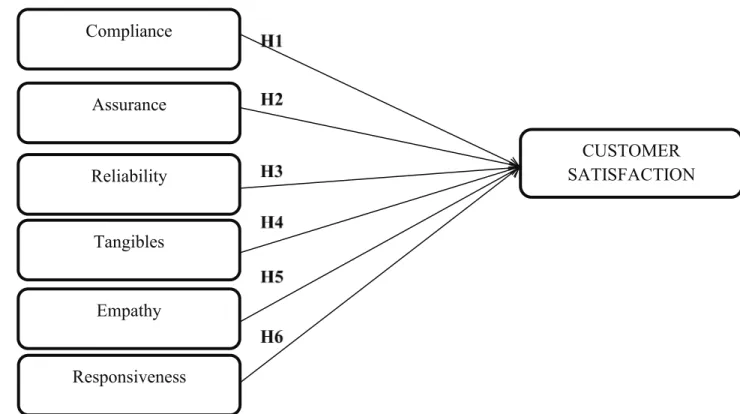
Figure 1: Theoretical Framework was Developed from SERVQUAL (Parasuraman, 1998)
2.4. Theoretical Framework
Table 1: Respondents Profile
Variable Frequency Percentage
(%) Bank Account Held
Bank Islam 30 40.5
Bank Muamalat 25 33.8
CIMB Islamic 8 10.8
Am Islamic Bank 7 9.5
KFH Malaysia 1 1.35
May bank 1 1.35
HSBC 1 1.35
Alrajhi 1 1.35
Total 74 100
Gender
Male 48 64
Female 26 36
Total 74 100
Age
Less than 20 years 0 0
20–29 50 67.6
30–39 18 24.3
40–49 6 8.1
50 and above 0 0
Total 74 100
Education
Bachelor 26 35.1
Master 33 44.6
PhD 15 20.3
Total 74 100
Race
Yemeni 14 18.92
Algerian 7 9.5
Somali 5 6.8
Afghani 5 6.8
Saudi 3 4.1
Palestinian 3 4.1
Indonesian 4 5.4
Indian 3 4.1
Syrian 4 5.4
American 2 2.7
Kuwaiti 1 1.3
3. Methodology
To accurately meet the study aims (see Figure 1), it was decided that a quantitative method would be most suitable, as Islamic banking in Malaysia will be studied to assess the quality of its services. The data was collected by using questionnaires to decide the perception and satisfaction of customers about the services offered by Islamic banks in Malaysia. The questionnaire has three sections. The first section focuses on the SERVQUAL dimensions. Compliance with Shariah, assurance, reliability, tangibles, empathy and responsiveness have 34 items. The second section, customer’s satisfaction, has 3 items. The third section is personal information. The 5-pint Likert scale was adopted to measure the data ranging from
“not important” to “very important”. Our respondents are non- Malaysian students at International Islamic University Malaysia (IIUM) with an account in Islamic banks in Malaysia. One hundred questionnaires were distributed to participants. From the number, 83 questionnaires were returned to the researcher with 74 usable questionnaires, as 8 were omitted (see Table 1).
All distribution data was analysed using SPSS software.
The results of this study comprise from the different sections of data analysis. In the first section, this study performs descriptive analysis for the respondent’s demographic information, who have taken part in the study.
The second section of the article focuses on the credibility and consistency of the instrument of research. Furthermore, third part of the study measures the gap between the six dimensions of the quality of the services in Islamic banking and the perceptions of the customers in Malaysia. Finally, with the coefficient of correlation, the fourth segment of this study contrasts beliefs and perceptions about the standard of Islamic banking in Malaysia.
4. Results
4.1. Respondents’ Profile
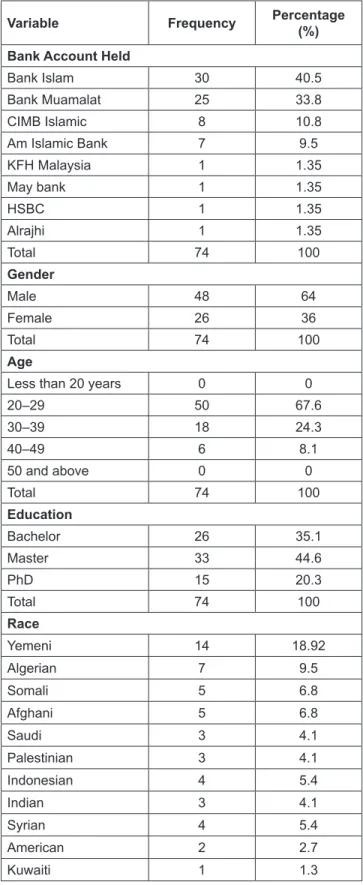
One of the sections of the questionnaire was designed to collect the respondents’ personal information. This section included questions related to the name of the bank, gender, age, current qualification, nationality of the respondents, and years as a customer of the Islamic bank. The following table presents the respondents’ profile.
Personal information provides an overall view of customer characteristics. As shown in Table 4.1, 74 respondents were selected. 62.2% were male participants and 37.8% were female participants. The above table also indicates the age of the participants. 67.6% were aged between 20 to 29 years, 24.3%
aged between 30 to 39 years, and 8.1% aged between 40 to
49 years. All respondents are educated. Most of the respondents
hold a master’s degree 44.6%, followed by a bachelor’s degree
35.1% as well as 15 respondents with PhD degree. Respondents
Variable Frequency Percentage (%)
Iraqi 2 2.7
Iranian 2 2.7
Russian 2 2.7
Turkish 3 4.1
Bangladeshi 3 4.1
Omani 1 1.3
Kazakhstani 1 1.3
Chadian 1 1.3
Sudanese 2 2.7
Guinean 2 2.7
Nigerian 1 1.3
Libyan 1 1.3
Serbian 1 1.3
Australian 1 1.3
Total 74 100
Years as a Customer in the Islamic Banks
Under one year 6 8.1
1–4 Years 50 67.6
5–9 Years 15 20.3
10 and above 3 4
Total 74 100
Table 1: (Continued)
were from 25 different countries with Yemenis comprising the majority with 18.9%. 8.1% of respondents were customers with Islamic banks for less than a year, 67.6% opened accounts four years ago, and 20.3% opened accounts nine years ago. The other three respondents have been customers of Islamic banks for at least 10 years (4%).
4.2. Reliability Analysis
Reliability measurement was conducted to assess consistency and stability. Cronbach’s Alpha is a reliability coefficient through which values for the seven dimensions were calculated, as presented in Table 2. The closer the Alpha value is to 1, the more accurate each measure’s internal accuracy is. Cronbach’s Alpha was used to measure the reliability analysis which is suggested that all valued for variables are greater than 0.6, which is commonly considered to be the standard for internal consistency representation. It shows that respondents answered the questions critically and without biases (Bahia & Nantel, 2000). The results of the reliability analysis are Shown in Table 2.
Table 2: Reliability Analysis
Service Quality Dimensions Cronbach’s Alpha
Compliance 0.655
Assurance 0.864
Reliability 0.875
Tangibles 0.783
Empathy 0.846
Responsiveness 0.833
Table 3: Descriptive Analysis
Construct Main Std. Deviation
Compliance 3.98 0.629
Assurance 3.69 0.92
Reliability 3.85 0.898
Tangibles 3.62 0.77
Empathy 3.777 0.697
Responsiveness 3.878 0.786
Table 2 shows that all variables are higher than 0.6.
Cronbach’s Alpha for compliance is 0.655 which is considered in the moderate range and therefore is the lowest variable compared to others. The tangible variable measured 0.783 which is in the range of good, and the highest independent variable is reliability with 0.875 which is considered particularly good. In Assurance, Empathy, and Responsiveness scored 0.864, 0.846, and 0.833, respectively.
The last variable is the satisfaction comprising threw items.
The Alpha value for the three items was 0.788 which is exceptionally good.
4.3. Descriptive statistics
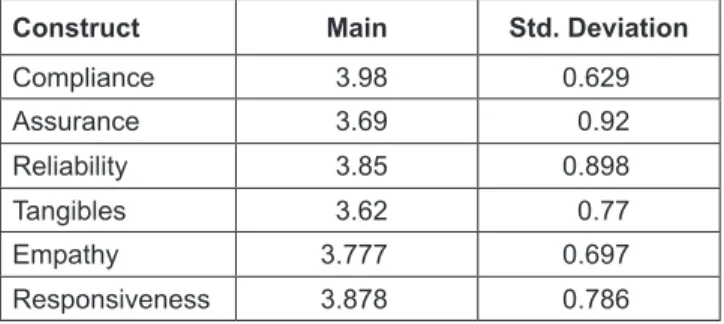
According to Razak et al. (2013), descriptive statistics is a powerful and valuable tool explaining and interpreting data. Table 3 presents the descriptive statistics of non- Malaysian customers’ perception of all six dimensions of service quality in Islamic banks in Malaysia.
Table 3 shows that the mean values of Shariah compliance of services quality provided by Islamic banks in Malaysia have the highest mean in the range (M = 3.98, STD = 0.629) to constitute the most dominant service quality provided by Islamic banks in Malaysia. This is followed by Responsiveness (M = 3.878, STD = 0.786), Reliability (M = 3.85, STD = 0.898) and Empathy (M = 3.777, STD = 0.697) rated as having a moderate influence on the customers’
satisfaction. However, Assurance (M = 3.T69, STD = 0.92)
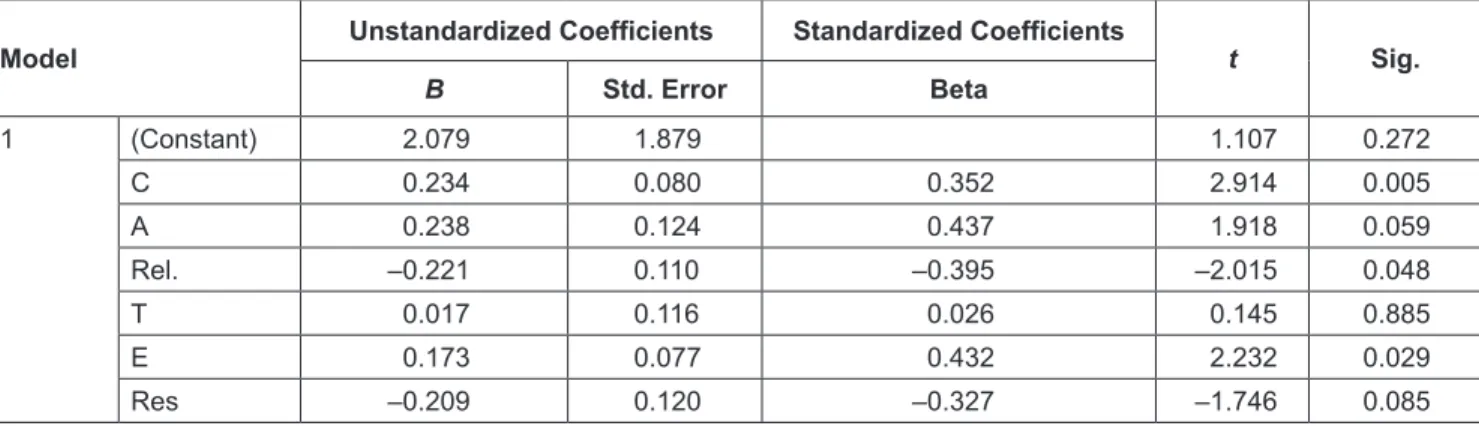
Table 6: Correlation Coefficients
Model Unstandardized Coefficients Standardized Coefficients
t Sig.
B Std. Error Beta
1 (Constant) 2.079 1.879 1.107 0.272
C 0.234 0.080 0.352 2.914 0.005
A 0.238 0.124 0.437 1.918 0.059
Rel. –0.221 0.110 –0.395 –2.015 0.048
T 0.017 0.116 0.026 0.145 0.885
E 0.173 0.077 0.432 2.232 0.029
Res –0.209 0.120 –0.327 –1.746 0.085
a. Dependent Variable: S.
Table 5: Model Summary
Model R R-Square Adjusted R-Square Std. Error of the Estimate
1 0.554
a0.307 0.244 2.18674
a