Print ISSN: 2288-4637 / Online ISSN 2288-4645 doi:10.13106/jafeb.2021.vol8.no4.0797
The Relationship Between Internal Auditors’ Personality Traits, Internal Audit Effectiveness, and Financial Reporting Quality:
Empirical Evidence from Jordan
Ibrahim Emair ALBAWWAT
1, Mohammad Eid AL-HAJAIA
2, Yaser Saleh AL FRIJAT
3Received: December 20, 2020 Revised: March 07, 2021 Accepted: March 15, 2021
Abstract
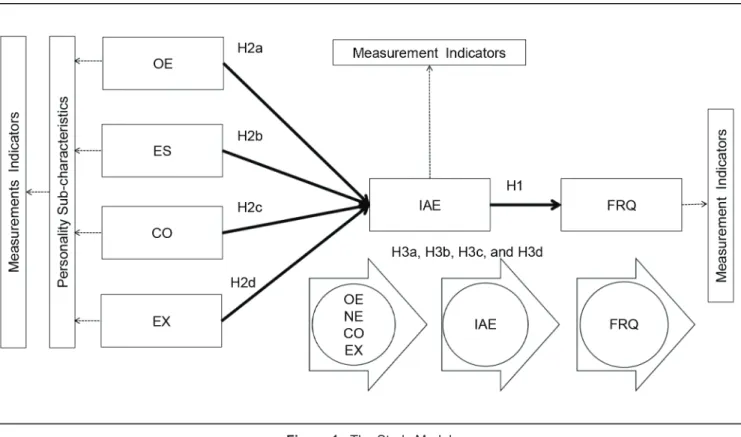
This study examines the interaction between internal auditors’ personality traits and the internal audit function effectiveness. It also investigates the effect of such interacted variables on financial reporting quality. This study employed a questionnaire survey to collect data from 193 internal auditors of Jordanian companies listed on the Amman Stock Exchange. The study model is validated and tested using the partial least squares structural equation modelling. The results reveal that all the examined personality traits of internal auditors significantly impact internal audit function effectiveness except for the extraversion trait. The results also show that personality traits have indirect effects on financial reporting quality via internal audit function effectiveness. These results suggest that internal auditors with high scores on openness to experience, emotional stability, and conscientiousness traits can be among the most significant contributors to the internal audit function effectiveness. The results also suggest that internal auditors’ personality traits can be regarded as an internal audit function intangible resource that enhances effectiveness. The study’s findings might be of interest to many different parties interested in enhancing internal audit function effectiveness and boosting the financial reporting quality, such as external and internal auditors, auditees, human resource departments, and Chief Internal Audit Executives.
Keywords: Personality Traits, Internal Audit Function Effectiveness, Internal Auditors, Financial Reporting Quality JEL Classification Code: M42, M41, M40, M12, C12
accurately assess a company’s performance and make wise decisions (Pavlopoulos, Magnis, & Iatridis, 2019). Hence, financial reporting quality is connected to the reported financial information usefulness (Nobes & Stadler, 2015). The International Accounting Standards Board (IASB) explains the qualitative characteristics that make financial information useful through its financial reporting framework (Barker, Penman, Linsmeier, & Cooper, 2020; Dennis, 2018). The IASB’s conceptual framework for financial reporting shows that information to be useful must have the fundamental qualities (i.e. relevance and faithful representation). It also introduces the enhancing qualities (i.e. verifiability, timeliness, understandability, and comparability) that impact the financial information degree of usefulness (IASB, 2018).
The world financial scandals of the early years of this century have put more pressure on companies to sustain robust control mechanisms that improve financial reporting quality and, therefore, meet the interested parties’ expectations and needs (Camfferman & Wielhouwer, 2019; Morris, 2011). In this regard, corporate governance is an integrated system with the
1
First Author and Corresponding Author. Assistant Professor, Department of Accounting, College of Business, Tafila Technical University, Jordan [Postal Address: P.O. Box 179, Tafila 66110, Jordan] Email: [email protected]
2
Assistant Professor, Department of Accounting, College of Business, Tafila Technical University, Jordan.
Email: [email protected]
3
Associate Professor, Department of Accounting, College of Business, Tafila Technical University, Jordan.
Email: [email protected]
© Copyright: The Author(s)
This is an Open Access article distributed under the terms of the Creative Commons Attribution Non-Commercial License (https://creativecommons.org/licenses/by-nc/4.0/) which permits unrestricted non-commercial use, distribution, and reproduction in any medium, provided the original work is properly cited.