Print ISSN: 2288-4637 / Online ISSN 2288-4645 doi:10.13106/jafeb.2020.vol7.no11.1049
Application of Total Quality Management in Developing Quality Assessment Model: The Case of Vietnamese Higher Education*
Quyen Le Hoang Thuy To NGUYEN
1, Du Van NGUYEN
2, Ngoc Nguyen Mong CHU
3, Van Hong TRAN
4Received: August 01, 2020 Revised: October 11, 2020 Accepted: October 15, 2020
Abstract
The shift from elite education to mass education in Vietnam has met the demand for education for everybody as well as for quality human resource talent for an emerging nation. Under the resource constraint, understanding the quality dimensions of education and its priority level is important for effective and efficient policies. This study was carried out using both qualitative and quantitative methodologies to develop quality criteria and a ranking model. Two rounds of in-depth interviews were conducted with fifteen experts in the field, who were rectors, employers, and recruitment specialists to develop the quality framework applied in Vietnamese universities under total quality management (TQM), starting from the input of the senior secondary school leavers, through a teaching process to the output. The first round of interviews were unstructured questionnaires designed to explore the main factors in quality assessment model. The second round affirmed the experts’
agreement on the assessment model. Then, fuzzy logic was applied to rank eight criteria in the quality assessment model into priority order:
cost, teaching and administrative staff, leadership, curriculum, student-related factors, internationalization, admissions, and campus. The results are critical for identifying the necessary actions to enhance the education quality and to further research on the optimal quality model.
Keywords: Decision-Making, Education Management, Fuzzy Logic, Quality Assessment Model, Total Quality Management JEL Classification Code: A22, C60, M10
nation (Altuwaijri & Kalyanaraman, 2020; Marquez- Ramos & Mourelle, 2019). Traditional education, especially higher education, has been evaluated as very successful in knowledge transition to the community, meeting the essential needs of daily life, and professional careers of the learners (Duong et al., 2020). However, the social development trends of the 21st century of democratization, globalization, and information communication technology have challenged the role of education (Fan & Popkewitz, 2020; Pham et al., 2019). It needs to be transformed to introduce new ideas, which meet the needs in the contemporary context (Durkheim, 2013; Huckle et al., 1996).
“Democracy” stems from the Greek word, “people.”
Under democracy, the respect for citizenship is the priority.
In education, democratization emphasizes equal access to education (Kanwar, 2012). This concept has been analyzed and enlarged by UNESCO, from equality of enrollment opportunities to educational resources access to educational outcomes and finally, to the free selection of educational options, so learners can meet their individual needs.
Globalization was experienced in the economy and has spread around the world to fields including, politics, culture, and education (Levitt, 1993). Economic globalization has
*Acknowledgements:
This research is funded by the Ministry of Education and Training, Vietnam and Ho Chi Minh City Open University under the grant number B2020-MBS-01.
1
First Author and Corresponding Author. Assistant Professor, Deputy Director, Office of Cooperation and Research Management, Ho Chi Minh City Open University, Vietnam [Postal Address: 97, Vo Van Tan Street, District 3, Ho Chi Minh City, 724000, Vietnam]
Email: [email protected]
2
Assistant Professor, School of Government, University of Economics Ho Chi Minh City, Vietnam. Email: [email protected].
3
Lecturer, School of Economic Mathematics and Statistics, University of Economics Ho Chi Minh City, Vietnam.
Email: [email protected]
4
Dean, Faculty of Accounting and Auditing, University of Finance – Marketing, Ho Chi Minh city, Vietnam, [email protected]
© Copyright: The Author(s)
This is an Open Access article distributed under the terms of the Creative Commons Attribution Non-Commercial License (https://creativecommons.org/licenses/by-nc/4.0/) which permits unrestricted non-commercial use, distribution, and reproduction in any medium, provided the original work is properly cited.
1. Introduction
Education is considered the foundation for the
development and growth of the individual and for the
led to internationalization, popularization, competition, and cooperation in higher education. Technological innovation and change have been the driver of social progress. Artificial intelligence has impacted human competency education requirements towards emotion and attitudes in intensive jobs (Karacay, 2018). Four major trends have shaped education from the perspective of the two orientations:
equity and four educational pillars. These are: (i) learning to know, (ii) learning to do, (iii) learning to live together, and iv) learning to be. Mass education, one of the features of higher education, is considered as an optimal means to meet these goals. However, developing a quality education is key (Lomas, 2002; Pham & Starkey, 2016).
In recent decades, the higher education system in Vietnam has been profoundly changing in terms of scale, ownership, and training methods. Diversification has shifted elite education to mass education, with a rapid increase in the number of universities and enrolled students. Recent statistics show that 235 universities nationwide have a student population totaling over 1,707 thousand in 2017, compared to 125.5 thousand in 1991. Along with the rapid growth of universities, education quality has become a matter of social concern, taking priority in the Communist Party Resolution (Resolution No. 29-NQ/TW).
Quality is a multi-dimensional concept, which depends on context and stakeholders’ views. The definition, furthermore, has changed and been modified over time to match the customers’ needs and demands. Educational quality is no exception. Such definitions are, moreover, subject to the judgment of people’s uncertainty and vagueness. Arslan Namli and Senkal (2018) have confirmed the reliability and flexibility of the fuzzy logic approach in evaluation and decision-making. This method addresses the accuracy of the input data, allowing the proper evaluation of education quality (Jaukovic Jocic et al., 2020; Kiet et al., 2020) Generally, this is an evaluation approach that has been embraced by the research community, given two outstanding advantages. Firstly, the assessment and ranking are objective and exclude emotional factors. Secondly, the score of each criterion is not a static number, but volatility, which promptly reflects the changes in human thinking.
Therefore, this study aims to develop a model to assess the quality of Vietnamese higher education using the theoretical basis of fuzzy numbers as a remedy for ambiguous factors in the human judgment process.
2. Literature Review
Quality is the major focus because it is key to productivity and cost reduction (Nguyen et al., 2018). However, it is a multi-dimensional and contextual concept (Luong et al., 2018). Therefore, quality characteristics need to be detailed to be improved. For education, previous researchers have
defined quality based on stakeholders’ views. According to Welzant et al. (2015), education stakeholders can be divided into four groups: (i) providers (government agencies, funding institutions, and educational providers); (ii) service users (learners); (iii) outcome users (employers), and (iv) industry employees (professionals and administrators). At the market approach, the four groups can be further categorized into two subgroups: providers and customers. Though such a classification makes quality definition simpler, diverse human needs still exist.
Quality initiatives originated in industry, but they are widely applied in other sectors including education (Deming, 2018). The conventional concept of quality is excellence. A quality product is the one that has been perfected. Rare and expensive materials are associated with a quality product. However, quality and excellence are not interchangeable. Excellence only refers to one quality status, i.e., bad, good, excellent (Kiauta, 2012). In higher education, rankings have used this perspective with clarifications in management, research, teaching, and student performance (Brusoni et al., 2014). The same criteria cannot be applied universally because the absolute quality approach shall challenge mass and equity education. “Conformance to requirements” with the same level is another approach to the concept of quality (Crosby, 1979). It means that the product is evaluated as a quality one when it is within the range of certain specifications. This definition may be more valuable to higher education providers because quality can be improved by setting quality standards as guidelines to the path of achieving quality. Crosby’s philosophy on quality is doing the right thing from the start. Thus, preventative action is emphasized in all processes, including thinking, planning, analyzing, and taking action. Any errors should have been foreseen and eliminated. This approach has value for education, given its special products, the learners.
Having errors in education is not acceptable. Moreover, it is too costly. This view challenges the conventional approach between price and quality. With Crosby, when the quality increases, cost decreases. Low quality and cheap education are only excuses. Therefore, efficiency and effectiveness are included in this definition. However, the specifications, requirements, or standards are questionable.
Deming (2018) expanded on Crosby’s view by focusing on customer satisfaction as a price to be paid when defining quality. This view was also shared by Juran and Gryna (1988) in his definition of quality as “fitness for use” for both the provider and customer. Thus, a purpose is specified and developed. For example, if higher education aims to provide a trained workforce to society, then quality is the degree to which undergraduates fit into the labor market.
If the course’s quality is evaluated, it will be interpreted
in terms of the knowledge, skills, and attitudes achieved
by learners after finishing. Fitness for use or purpose may
including meeting the requirements of all the stakeholders.
It also includes satisfying or overcoming pre-defined standards. It even mentions the requirements of the output perfection, effectiveness, and efficiency. Defining the purposes of education is key to its quality. Recent research has also confirmed the value of transformation in education (Leal Filho et al., 2018). Transformation is learners’ growth in their “minds” and heart.” Thus, the intellectual, emotional, and social development of learners at the center of quality.
In short, the literature review on the definition of quality incorporates the following education quality dimensions: (i) achieving perfection, (ii) reaching certain thresholds, (iii) complying with requirements, (iv) realizing effectiveness and efficiency, (v) attaining fitness for purpose, (vi) having zero errors, and (vii) transformation. These dimensions reflect the evolution of the definition of quality. In the 1980s, quality referred to the perfection and excellence of elite education.
When mentioning quality, the 1990s witnessed a shift in the orientation toward the customer. Entering the 21st century, education quality had reached the four pillars (Carneiro, 2015). Quality education, thus, satisfies basic learning needs and helps to enrich the lives and experiences of learners. It gave leaners two benefits that enhanced their experience and empowered them.
Similar to quality, quality assurance is also a context- dependent concept with different approaches. It has been defined as a set of inside and outside arrangements, strategies, frameworks, and practices designed by the organization to attain, keep up, and improve quality (Berdahl & Universitatum, 2011). The main purpose of quality assurance is to serve quality improvement and accountability. Accountability is the driver to gain education quality and is normally connected to public judgment about the fitness and the satisfaction level of the specified education goals (Smith & Benavot, 2019; Yan, 2019). In education, accountability refers to the records of educational processes, consisting of input, processes, outputs, and goals that are used for institutional evaluation. Similar to accountability, improvement relates to a variety of perspectives. It aims to enhance future execution instead of focusing on past performance. Accountability and improvement seem to be mutual exclusively. The conflict between the two concepts has been discussed in the research, though they appear as a
pair for the purpose of quality assurance. Quality assurance has several models: (i) quality control, (ii) quality assurance, (iii) quality assurance (internal value and external audit), and (iv) total quality management (TQM).
Quality control denotes the elimination of defective, unsatisfactory products (Arndt et al., 2019; Park & Kim, 2019). This approach may create waste because it only the last step after the product has been created. On the other hand, the quality assurance model focuses on preventative action on error products (Dimou & Kameas, 2016). This is a process that occurs before and during execution, from the very start to the end of the process. Thus, deficiencies can be avoided. To achieve high efficiency in this approach, transparency needs to be ensured, particularly in how things are organized and run. Moreover, an organization’s mission and vision needs are well communicated to its employees. A difference between the internal and external audit of quality assurance is also suggested. Two typical styles of quality assurance were presented by the French and the British. While the French empower quality control over external agencies, the British pursues the autonomous community. In practice, the combination of the two styles is ideal. Internal quality review targets truth and knowledge. External quality audits provide a service to society. However, customer satisfaction is the top priority in the market. Therefore, total quality management (TQM), initiated by Deming then developed by Crosby, Ishikawa, and Juran has been considered the superior approach (Crawford & Shutler, 1999; Mukhopadhyay, 2020). Not only input and process quality management but also quality culture are stressed in TQM so that customers can experience a continuous enhancement of quality.
Figure 1 shows a traditional diagram of the higher education process with the input of senior secondary school leavers. They undergo the teaching process with a final exam before entering the labor market or further education (graduate education). Those who fail on the final exam can resit. The consequence of this conventional approach is that, as Crosby noted, it increases costs. To properly cured the problem, TQM calls for the investigation of failure. Furthermore, such examination is being utilized as a demonstrative tool for continuous improvement because no examination failures (zero defects) do not mean the fitness for the labor market demand, especially in this technology-driven era.
Figure 1: A mimic of the higher education process
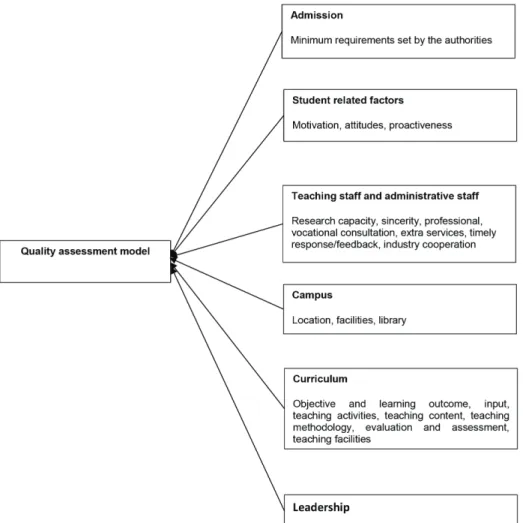
TQM is a framework for steady quality advancement that incorporates all workers from the top management to employees. The orientation toward the expectation of customers is always respected. Moreover, wastage or unnecessary costs are prevented and quality culture is nurtured. Tsinidou et al. (2010) recommended the application of quality function deployment (QFD), a branch of TQM for a quality assessment model that has learners as the starting point of the analysis. In the education process, exam failure is considered a milestone for remedial action. Inputs, teaching processes, and outputs as indicated in Figure 1 are the basis for quality evaluation. These factors were further deconstructed into subgroups of admission, students’ performance, teacher- related factors, institution’s characteristics, and program (Grundey, 2008; Johnston, 1994). Entry requirements have been conventionally considered as the driver of quality based on the “garbage in, garbage out” prejudice. As a result, minimum intake requirements are regulated by the authorities. The recruitment of initial teacher education (ITE) in various countries is a typical illustration of such belief (Parker, 2018). Furthermore, related factors such as students’ motivation, attitudes, proactivity also contribute to educational achievements (Harvey et al., 1993).
Sarrico and Alves (2016) asserted that teaching staff is among the key indicators of education quality. In TQM, quality commitment and understanding from employees within the organization are also crucial (Sahney, 2016).
Therefore, the qualifications for teaching and administrative staff, or human resources, including research capacity, sincerity, professionalism, vocational consultation, extra services, timely response and feedback, industry cooperation are required (Zineldin et al., 2011). Vazzana et al. (2000) further demonstrated the interconnectivity of different factors in quality enhancement, in particular great teachers empowered by good teaching and learning processes together with an environment that is conducive to learning. Zineldin et al. (2011) developed an educational service quality model based on industry. It had two pillars:
(i) hardware (facilities) and (ii) software (operation).
Tsinidou et al. (2010) provided a set of criteria under these two pillars: campus location, facilities, library, material base, and educational program. The role of the curriculum in transforming learners and providing them with competencies to apply to the labor market has been empirically proven (Machalow et al., 2020; Stabback, 2016). Various components of the curriculum such as objective and learning outcomes, inputs, teaching activities, teaching content, teaching methodologies, evaluations, and assessment, teaching facilities have been shown to impact learners’ competences (Amin et al., 2020). Leadership is the backbone of continuous quality improvement because it
creates a quality culture in the institute through inspiration (Bouranta, 2020; Darling, 1992; Sfakianaki et al., 2018).
It can start with the organization’s vision and go through all the processes with those involved. It is the guideline for managing resources and addressing value and responsibility towards society with the focus on customers’ demands.
Effective leadership determining successful TQM is found in diversified research fields, including education (Levin, 1993). A summary of this chapter can be seen in the following six factors in a quality assessment model using TQM is below in Figure 2.
3. Research Methodology
As discussed above, there are many different views on quality. Therefore, to give a unified definition of higher education quality is difficult. In this study, the pragmatic approach was adopted Harvey et al., 1992). Quality is determined based on its dimensions (Lee et al., 2016).
Some institutions may achieve a high score in one criterion but score low in another. The assessment depends on the expectations of the stakeholders.
Given this methodology, the following steps were carried out. Firstly, in-depth interviews were conducted with fifteen experts in the field (employers, rectors, recruitment specialists) to get some agreement on the higher education quality criteria in the Vietnamese context. The next step was developing the quality assessment model using the fuzzy logic approach to rank the criteria. Fuzzy logic is an artificial intelligence algorithm that uses mathematical logic to solve the problem of incorrect input values in order to reach exact conclusions (Nguyen et al., 2019; Phong et al., 2017). This is more practical, since people also find it difficult to express their decision clearly. We used the following CoA procedure for defuzzifying the fuzzy weights (Nguyen & Nguyen, 2020):
[( ) ( )] / 3
i i i i i i
w w w w w w