- 441 -
Analysis and comparison of general compositions, amino acids, fatty acids and collagen of abalone harvested in three different regions in Korea
Jinglei Li, Bo-Sub Kim, Seong-Gook Kang*
Department of Food Science and Technology, Mokpo National University, Muan 534-729, Korea
한국에서 생산되는 전복의 영양성분 비교 분석
이정뢰․김보섭․강성국*
전라남도 무안군 국립목포대학교 식품공학과
Abstract
In this study, the general compositions, amino acids, fatty acids and collagen content of three abalones, which were harvested in Wando, Heuksando and Jeju Island in Korea, were analyzed and compared. The abalone body and viscera were separated from each other and the physicochemical properties were investigated. The moisture and protein contents of the viscera were lower than that of the body; while the lipid, carbohydrate, and mineral contents were higher. The general compositions and mineral contents also presented fluctuation among the three abalone groups. The amino acid content via hydrolysis in the abalone viscera ranged from 93.16 to 127.02 mg/g, which was lower than the amino acid content of the abalone body of approximately 145 mg/g. However, the free amino acids level in the abalone viscera ranged from 16.81 to 20.10 mg/g, which was higher than that of the abalone body level of approximately 7.90 to 10.59 mg/g. The fatty acid analysis revealed that while the saturated fatty acid percentages in the abalone body were higher than in the abalone viscera, the percentages of the monoenoic and polyenoic fatty acids of the body were significantly lower. The body of the abalone harvested in Wando contained the highest level of collagen (2.26±0.46 mg/g), followed by the abalone harvested in Jeju Island and Heuksando.
The abalone viscera contained much lower collagen, which ranged from 0.37±0.15 mg/g to 0.20±0.03 mg/g. The results of this study will provide useful information for the future research of abalone.
Key words :abalone body, abalone viscera, amino acids, fatty acids, collagen
Introduction
1)
Abalone is an important aquatic economic species widely cultured in East Asia, Australia, America and many other regions (1). The production of abalone has increased greatly in the recent two decades with the introduction of farm aquaculture system (1). It is estimated the world total output of abalone is more than 30,000 metric tonnes per year (1).
Abalone is a seafood delicacy, famous for its unique color, texture and flavor (2). In Korea, Japan, China and many other Asian countries, abalone has been used as a traditional medicine and tonics (3,4). In the oriental medicine books,
*Corresponding author. E-mail:[email protected] Phone:82-061-450-2429, Fax:82-061-454-1521
such as ‘Dongui Bogam’, ‘Mingyi Bielu’ and ‘Haiyao Benlun’, abalone was recorded as a useful medicine for the eye, lung and liver (5). In recent years, several research articles have been published on the nutritional and pharmacy values of abalone. González M et al. (6) examined the nutritional value of abalone and the effects on serum cholesterol concentration in rats. Maoka T and his coworkers (7) studied the characteristics of carotenoid pyropheophorbide A esters obtained from abalone. Peng WD et al. (8) investigated the learning and memory improving ability of abalone extracts on mice. Li G et al. (9) purified a glycosaminoglycan-like polysaccharide from abalone whose anticoagulant activity was investigated in vitro .
Generally, the visceral part of abalone is not regarded as
edible by the producers as well as customers (10). The viscera is treated as by-product and most of them is discarded directly or used as fish silage (10,11). However, the nutritional and health value of the visceral part of abalone should not be overlooked since more researchers have paid attention to the bio-activities and health promoting activities of the abalone viscera. Sun L et al. (12) discussed the activities of a sulphated polysaccharide obtained from the abalone viscera. Ping K and Qiukuan W (13) studied the potential application of the enzyme extract of abalone viscera. Several other articles mentioned the antioxidant potential of polysaccharide extracted from abalone viscera (14,15). The application of abalone viscera as the food ingredient has also been researched (3). Our previous study has discussed the anti-skin-ageing activities of extract from abalone viscera (16). The results indicate that abalone viscera possess very high nutritional and functional value, suggesting its widely application possibility.
As mentioned above, Korea is the main abalone producer and the main consumer as well (1). The primary abalone aquiculture area in Korea located in the south coastal region, especially Wando, Heuksando and Jeju Island (1). In this study, we analyzed and compared the chemical constituents, amino acids, fatty acids and collagen content of the abalone produced in Wando, Heuksando and Jeju Island. We also examined and compared the difference between the abalone body and viscera. Since the similar researches on this topic are rare, this study will be meaningful to the related researches.
Materials and methods
Chemical and reagents
The abalone was obtained from the local aquatic market of Wando, Heuksando and Jeju Island respectively in February 2012. All the abalone was shucked and eviscerated.
After that, the abalone body and viscera was gathered and homogenized and stored at -20℃ in refrigeratory until use.
BF3-methanol reagent, chloramine T, perchloric acid, collagen from calf skin and p-dimethylaminobenzaldehyde was purchased from Sigma-Aldrich Co. (St. Louis, MO, USA). All other reagents used in the experiments in this study were reagent grade chemicals.
Analysis of the general compositions and mineral element Moisture content, crude protein content, crude lipid and
ash content of abalone body and viscera were analyzed in accordance with the AOAC methods (17). Conversion factor for the examination of protein content was 6.25. Minerals include Ca, Cu, Fe, Zn, K and Na presented in abalone body and viscera were analyzed with an atomic absorption spectroscopy (Spectra AA-220FS, Verian, Australia).
Phosphorus content (P) was measured by a spectrophotometer (Agilent 8453, Agilent, Santa Clara, CA, USA) at 650 nm according to the molybdenum blue method described previously (18,19).
Analysis of hydrolysis amino acid compositions
All the samples were hydrolyzed with 6 M hydrochloric acid for 22 hr at 110℃. After the hydrolysis, the hydrolysate was concentrated in vacuum and diluted by 0.02 M hydrochloric acid (10 v/v). The samples were filtered with 0.45 μm membrane filter for the amino acid composition analysis using the Hitachi L-8800 amino acid analyzer (Tokyo, Japan) according to the method described previously (20,21).
Analysis for free amino acid composition
The free amino acid of abalone body and viscera was extracted with twice of 5% trichloroacetic acid solution for 24 hr. Once extracted, the solution was centrifuged at 10,000g for 10 min. The supernatant was neutralized by three times 0.05 M hydrochloric acid and then diluted with five times of distilled water. All the samples were filtered with 0.45 μ m membrane filter and the free amino acid composition was analyzed by the same amino acid analyzer stated above.
Analysis for fatty acids composition
The total lipid of all the samples was extracted according
to the method recorded by Bligh and Dyer with some
modifications (22). To a certain quality of sample contained
1 g water, added 3.75 mL of a mixture prepared with
chloroform, methanol, 0.88% KCl solution (5/10/4 by volume)
and then homogenized for 30 sec. After homogenization, 1.25
mL chloroform and 0.88% KCl solution (5/4 by volume)
was added to the sample solution and homogenized for 30
s before centrifuged at 2,500g for 20 min. The lower phase
was collected, desiccated and evaporated. The lipid extract
was then transferred to a test tube, filled with nitrogen gas
and stored at 4℃. The fatty acids was methylated using the
AOCS Official Method (23). To 1 g fatty acids, 24 mL of
0.5 N methanolic NaOH was added to a round-bottomed flask
and the mixture was heated and boiled for 20 min until all
the lipid globules went into solution. After that, the flask was heated at 80℃ for 10 min. About 28 mL of BF
3-methanol reagent was added to the flask and the flask was boiled for 2 min before 20 mL of hexane was added and the mixture was boiled again for 1 min. After cooling to the room temperature, about 25 mL of saturated sodium chloride solution was added to the flask and shook the solution vigorously for 15 sec. A small amount of hexane was transferred to a test tube with appropriate amount of anhydrous sodium sulfate. The dry hexane solution was injected into a gas chromatograph for fatty acid analysis.
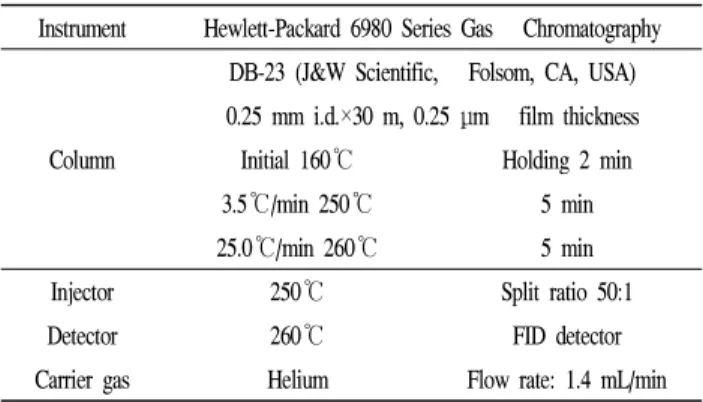
The gas chromatography working conditions were listed in Table 1.
Table 1. The working conditions of the gas chromatography for the fatty acids
Instrument Hewlett-Packard 6980 Series Gas Chromatography
Column
DB-23 (J&W Scientific, Folsom, CA, USA) 0.25 mm i.d.×30 m, 0.25 μm film thickness Initial 160℃ Holding 2 min
3.5℃/min 250℃ 5 min
25.0℃/min 260℃ 5 min
Injector 250℃ Split ratio 50:1
Detector 260℃ FID detector
Carrier gas Helium Flow rate: 1.4 mL/min
Collagen content
We measured the collagen content in abalone body and viscera using the Woessner’s method (24) with some modifications. All the samples were grinded and 10 mg of sample was mixed with 1 mL of 6 N HCl solution in a glass test tube. The test tube was heated at 100℃ for 24 hr before several drops of 0.02% methyl red was added to it. Added 2.5 N NaOH solution to neutralize the test sample until the color changed to faint yellow. After centrifugation at 1,000g for 10 min, 1 mL of the supernatant was mixed with 1 mL of distilled water and 1 mL of chloramine T into a test vial.
The mixture was vortexed for about 1 min and then the solution was allowed to stand for 20 min before 1 mL of perchloric acid solution was added. After 5 min of standing, the solution was mixed with 1 mL of p-dimethylaminoben- zaldehyde, vortexed, incubated at 60℃ in a water bath for 20 min. Collagen from calf skin which was used as the standard was treated under the same procedures. The collagen content was measured at 557 nm by the same spectrophotometer listed above.
Results and Discussions
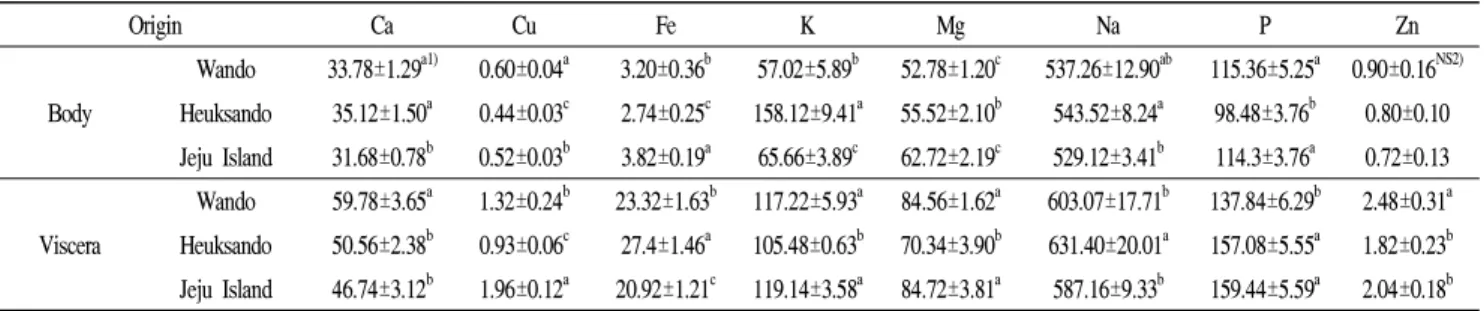
Analysis of the general compositions and mineral elements The general compositions of abalone body and viscera is influenced by the abalone species, harvested regions, harvested time, feed, abalone age and several other factors, as have been mentioned in the previous studies (25-28). The results of the general compositions and mineral elements are presented in Table 2 and 3 respectively. As we can see from the Table 2, the protein, lipid and carbohydrate content of body part of abalone produced in Wando, Heuksando and Jeju Island show no significant difference. The moisture content of abalone body produced in Wando and Jeju Island is higher than that of Heuksando. While abalone body produced in Heuksando possess significant higher crude ash content than that of the other two groups. The general compositions of abalone viscera show that the moisture and
Table 2. The proximate composition of abalone body and viscera (%)
Origin Wando Heuksando Jeju Island
Abalone body
Moisture 80.80±0.36
b1)81.16±0.45
ab81.48±0.55
aProtein 11.06±0.34
NS2)10.44±0.37 11.10±0.66 Lipid 0.26±0.05
NS0.32±0.04 0.27±0.02 Carbohydrate 6.06±0.66
NS5.76±0.75 5.40±0.97 Ash 1.82±0.08
b2.32±0.47
a1.77±0.07
bAbalone viscera
Moisture 77.82±0.68
NS78.16±0.54 77.60±0.46 Protein 4.88±0.33
a4.08±0.24
b4.62±0.37
aLipid 2.97±0.16
ab3.06±0.06
a2.88±0.09
bCarbohydrate 9.51±0.55
NS9.54±0.31 10.16±0.46 Ash 4.82±0.08
b5.16±0.12
a4.75±0.06
b1)
Mean±SD (n=3) in the same row with different superscripts are significantly different at p<0.05.
2)
Not significantly different in the same row at p<0.05.
carbohydrate content had no significant difference among the
three groups. Abalone viscera produced in Wando and Jeju
Island present higher amount of protein but lower amount
of lipid and crude ash. When comparing between the body
and visceral part of abalone produced in the same region,
the moisture (77.82±0.68, 78.16±0.54 and 77.60±0.46
respectively for Wando, Heuksando and Jeju Island) and
protein (4.88±0.33, 4.08±0.24 and 4.62±0.37 respectively in
the same region sequence as above) content of viscera are
relatively lower than that of body (80.80±0.36, 81.16±0.45,
81.48±0.55 and 11.06±0.34, 10.44±0.37 and 11.10±0.66 for
moisture and protein content with the same region sequence)
but the other components are higher than that of body part, even though the statistical comparison was not undertook in this study. The general compositions show the difference between the visceral and the body part of abalone as well as the influence of the different origin regions. The mineral compositions also suggest the same trend between body and viscera of abalone (listed in the Table 3). Except for the potassium, the abalone viscera showed significant higher level of the mineral elements examined in this study than that of abalone body. The body part of abalone produced in Heuksando presented nearly three times of potassium content than the other two groups. And the calcium and sodium level was also higher than the abalone body produced in Wando and Jeju Island. At the same time, the visceral part of abalone produced in Heuksando presented higher ferrum and sodium content than the other ones. The compositions difference between the body and visceral part of abalone can be attributed to the different functions of the two part. The body part, in fact the foot muscle, is the main edible part according to the conventional view. However, the visceral part of the abalone contain significant amount of digested and partial digested brown seaweeds such as Alaria esculenta, Laminaria digitata and several red seaweeds which may contribute to the difference of the chemical composition between abalone body and viscera (29). As to the three abalone groups the variations may be attributed to the regions, feed, weather and several other factors.
Analysis of hydrolysis amino acid composition
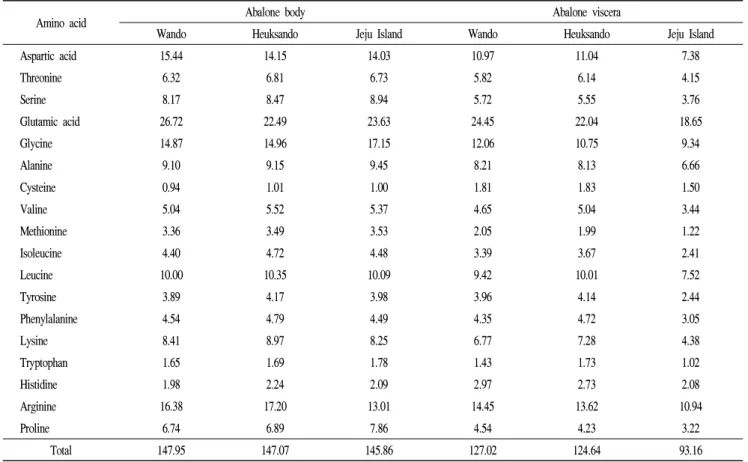
Abalone has long been regarded as a rich source of protein which can provide human with balanced and ample amino acids (30). The hydrolysis amino acids and free amino acids contents of body and visceral part of the three abalone harvested in three different regions are listed in Table 4 and 5 respectively. The hydrolysis amino acids and free amino
Table 3. Mineral content of abalone body and viscera
(mg/100 g)
Origin Ca Cu Fe K Mg Na P Zn
Body
Wando 33.78±1.29
a1)0.60±0.04
a3.20±0.36
b57.02±5.89
b52.78±1.20
c537.26±12.90
ab115.36±5.25
a0.90±0.16
NS2)Heuksando 35.12±1.50
a0.44±0.03
c2.74±0.25
c158.12±9.41
a55.52±2.10
b543.52±8.24
a98.48±3.76
b0.80±0.10 Jeju Island 31.68±0.78
b0.52±0.03
b3.82±0.19
a65.66±3.89
c62.72±2.19
c529.12±3.41
b114.3±3.76
a0.72±0.13 Viscera
Wando 59.78±3.65
a1.32±0.24
b23.32±1.63
b117.22±5.93
a84.56±1.62
a603.07±17.71
b137.84±6.29
b2.48±0.31
aHeuksando 50.56±2.38
b0.93±0.06
c27.4±1.46
a105.48±0.63
b70.34±3.90
b631.40±20.01
a157.08±5.55
a1.82±0.23
bJeju Island 46.74±3.12
b1.96±0.12
a20.92±1.21
c119.14±3.58
a84.72±3.81
a587.16±9.33
b159.44±5.59
a2.04±0.18
b1)
Mean±SD (n=3) in the same column with different superscripts are significantly different at p<0.05.
2)
Not significantly different in the same column at p<0.05.
acids compositions fluctuate along with several factors such as abalone species, ages, harvested regions and others (26,31).
The total hydrolysis amino acids content of the abalone body showed little difference among the three groups. The most abundant amino acids in the abalone body are glutamic acid, aspartic acid, arginine, glycine and leucine which range from 10 to 26 mg/g of the abalone body. Both the body and the viscera of the abalone contain all the essential amino acids for human; hence both of them are high quality protein sources. The total content of hydrolysis amino acid of the visceral part of abalone is relatively lower than that of the body part since the viscera possesses lower crude protein content. Aspartic acid, glutamic acid, glycine and arginine are the most abundant amino acids in the abalone viscera.
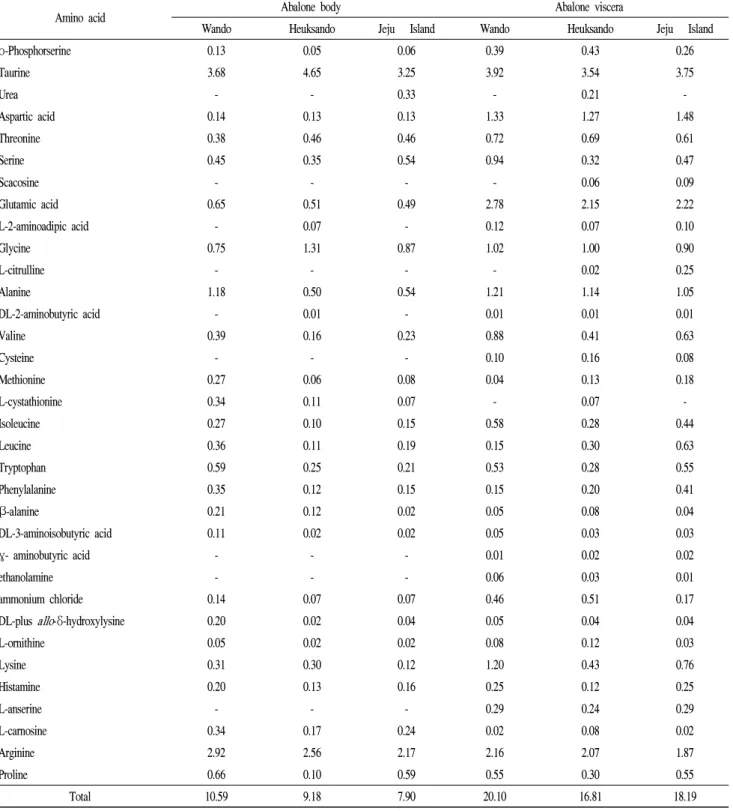
In the free amino acids analysis, 27 and 34 kinds of free amino acids had been detected in the body and visceral part of abalone respectively. The abalone viscera also contained much more free amino acids in quantity than that of abalone body. Among the free amino acids, taurine is the most abundant one both in the body and viscera which ranged from 3 to 4 mg/g and which is nearly 10 times than the content of most of the other free amino acids. As have been pointed out by several researchers, taurine has many physiological roles in human and is crucial to maintain human health (32,33). On the other hand, the free amino acids are the main contributor to the characteristic flavor of the abalone (34). As the results indicate, both the body and the viscera of abalone are very good sources of amino acids for human.
Fatty acids composition of abalone
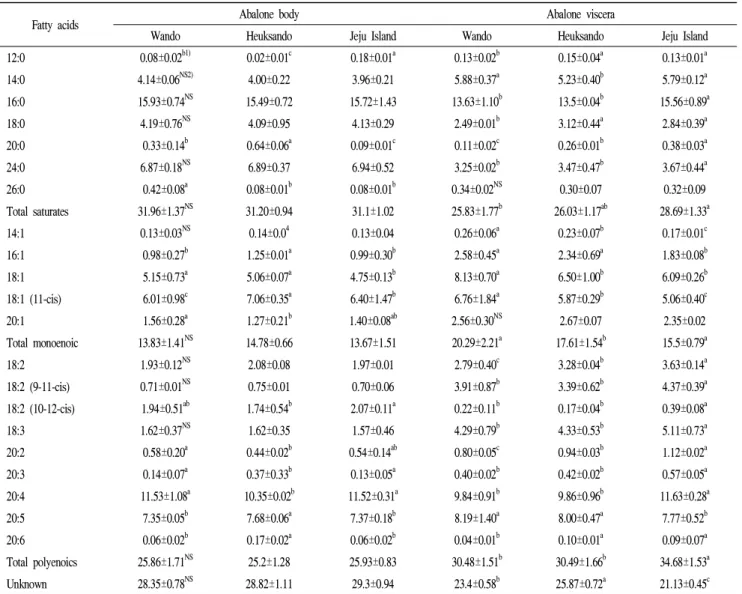
The fatty acids composition of abalone body and viscera was analyzed by gas chromatography the working condition of which was listed in the Table 1. As indicated in the Table 2, abalone body and viscera contained approximately 0.28%
and 3.00% of crude lipid respectively. In Table 6, the fatty
Table 4. The hydrolysis amino acids composition of abalone body and viscera
(mg/g)
Amino acid Abalone body Abalone viscera
Wando Heuksando Jeju Island Wando Heuksando Jeju Island
Aspartic acid 15.44 14.15 14.03 10.97 11.04 7.38
Threonine 6.32 6.81 6.73 5.82 6.14 4.15
Serine 8.17 8.47 8.94 5.72 5.55 3.76
Glutamic acid 26.72 22.49 23.63 24.45 22.04 18.65
Glycine 14.87 14.96 17.15 12.06 10.75 9.34
Alanine 9.10 9.15 9.45 8.21 8.13 6.66
Cysteine 0.94 1.01 1.00 1.81 1.83 1.50
Valine 5.04 5.52 5.37 4.65 5.04 3.44
Methionine 3.36 3.49 3.53 2.05 1.99 1.22
Isoleucine 4.40 4.72 4.48 3.39 3.67 2.41
Leucine 10.00 10.35 10.09 9.42 10.01 7.52
Tyrosine 3.89 4.17 3.98 3.96 4.14 2.44
Phenylalanine 4.54 4.79 4.49 4.35 4.72 3.05
Lysine 8.41 8.97 8.25 6.77 7.28 4.38
Tryptophan 1.65 1.69 1.78 1.43 1.73 1.02
Histidine 1.98 2.24 2.09 2.97 2.73 2.08
Arginine 16.38 17.20 13.01 14.45 13.62 10.94
Proline 6.74 6.89 7.86 4.54 4.23 3.22
Total 147.95 147.07 145.86 127.02 124.64 93.16
acids composition of abalone body and viscera was expressed as the percentage of respective total lipid content. The saturate fatty acids of abalone body was about 31% of the total lipid while the abalone viscera contained relatively lower percentage of saturate fatty acids which was about 26%. In the saturate fatty acids, palmitic acid (16:0) is the most abundant fatty acid and followed by lignoceric acid (24:0), stearic acid (18:0) and myristic acid (14:0) both in the body and viscera. The monoenes account for about 14% of the abalone body lipid but the range for abalone viscera is from 15% to 20%. The monoenes contents show no significant difference among the three abalone body groups. But the viscera of abalone produced in Wando possess highest monoenes content which is followed by Heuksando and Jeju Island. The oleic acid (cis-9 18:1) and vaccenic acid (cis-11 18:1) are the most abundant fatty acids both in the abalone body and viscera. The polyenes in the abalone body also shows no significant difference among the three groups which is about 25% of the total lipid. At the same time, abalone viscera contains higher percentage of polyenes than that of abalone body, ranged from 30% to 34%. The arachidonic acid (20:4) and eicosapentaenoic acid (20:5) are the most
abundant fatty acid both in the abalone body and viscera.
The distribution of the fatty acids in the abalone body and viscera is confirmed by several previous researches (22,27,35). While the viscera possess relatively lower percentage of saturate fatty acids compared with that of body, the unsaturated fatty acids content in viscera is higher than that of body part. As is well known, monoenoic and polyenoics can raise the HDL concentration and reduce the LDL concentration and related with tumorigenesis, diabetes, coronary heart disease (36-38). The fatty acids compositions in the abalone body show little variation among the three abalone groups. However, the viscera compositions present variation which may be influenced by the different harvested regions.
The collagen content
It was reported that two types of fibril-forming collagen
have been examined in abalone (39). In the present study,
the collagen content in the abalone body and viscera was
investigated and the result was listed in Figure 1. Compared
to the viscera, abalone body possesses much larger amount
of collagen which ranges from 1.85±0.06 to 2.26±0.05 mg/g.
Table 5. The free amino acids composition of abalone body and viscera
(mg/g)
Amino acid Abalone body Abalone viscera
Wando Heuksando Jeju Island Wando Heuksando Jeju Island
ο -Phosphorserine 0.13 0.05 0.06 0.39 0.43 0.26
Taurine 3.68 4.65 3.25 3.92 3.54 3.75
Urea - - 0.33 - 0.21 -
Aspartic acid 0.14 0.13 0.13 1.33 1.27 1.48
Threonine 0.38 0.46 0.46 0.72 0.69 0.61
Serine 0.45 0.35 0.54 0.94 0.32 0.47
Scacosine - - - - 0.06 0.09
Glutamic acid 0.65 0.51 0.49 2.78 2.15 2.22
L-2-aminoadipic acid - 0.07 - 0.12 0.07 0.10
Glycine 0.75 1.31 0.87 1.02 1.00 0.90
L-citrulline - - - - 0.02 0.25
Alanine 1.18 0.50 0.54 1.21 1.14 1.05
DL-2-aminobutyric acid - 0.01 - 0.01 0.01 0.01
Valine 0.39 0.16 0.23 0.88 0.41 0.63
Cysteine - - - 0.10 0.16 0.08
Methionine 0.27 0.06 0.08 0.04 0.13 0.18
L-cystathionine 0.34 0.11 0.07 - 0.07 -
Isoleucine 0.27 0.10 0.15 0.58 0.28 0.44
Leucine 0.36 0.11 0.19 0.15 0.30 0.63
Tryptophan 0.59 0.25 0.21 0.53 0.28 0.55
Phenylalanine 0.35 0.12 0.15 0.15 0.20 0.41
β -alanine 0.21 0.12 0.02 0.05 0.08 0.04
DL-3-aminoisobutyric acid 0.11 0.02 0.02 0.05 0.03 0.03
γ - aminobutyric acid - - - 0.01 0.02 0.02
ethanolamine - - - 0.06 0.03 0.01
ammonium chloride 0.14 0.07 0.07 0.46 0.51 0.17
DL-plus allo -δ-hydroxylysine 0.20 0.02 0.04 0.05 0.04 0.04
L-ornithine 0.05 0.02 0.02 0.08 0.12 0.03
Lysine 0.31 0.30 0.12 1.20 0.43 0.76
Histamine 0.20 0.13 0.16 0.25 0.12 0.25
L-anserine - - - 0.29 0.24 0.29
L-carnosine 0.34 0.17 0.24 0.02 0.08 0.02
Arginine 2.92 2.56 2.17 2.16 2.07 1.87
Proline 0.66 0.10 0.59 0.55 0.30 0.55
Total 10.59 9.18 7.90 20.10 16.81 18.19
Abalone body produced in Wando contains the highest collagen level and is followed by abalone produced in Jeju Island and Heuksando. Abalone viscera shows much lower collagen level which ranged from 0.20±0.03 to 0.37±0.15 mg/g. Collagen is the main component of connective tissue
and the most abundant protein in the human body. It is crucial
for skin health since its degradation is one of the incentives
of the wrinkle and skin ageing. Our previous work revealed
the beneficial effects of abalone extracts on the skin and
collagen synthesis in the human dermal fibroblasts (16).
Fig. 1. Collagen content of abalone body and viscera.
Bars with different superscripts are significantly different at p<0.05.
Table 6 Fatty acids composition of abalone body and viscera
(area %)
Fatty acids Abalone body Abalone viscera
Wando Heuksando Jeju Island Wando Heuksando Jeju Island
12:0 0.08±0.02
b1)0.02±0.01
c0.18±0.01
a0.13±0.02
b0.15±0.04
a0.13±0.01
a14:0 4.14±0.06
NS2)4.00±0.22 3.96±0.21 5.88±0.37
a5.23±0.40
b5.79±0.12
a16:0 15.93±0.74
NS15.49±0.72 15.72±1.43 13.63±1.10
b13.5±0.04
b15.56±0.89
a18:0 4.19±0.76
NS4.09±0.95 4.13±0.29 2.49±0.01
b3.12±0.44
a2.84±0.39
a20:0 0.33±0.14
b0.64±0.06
a0.09±0.01
c0.11±0.02
c0.26±0.01
b0.38±0.03
a24:0 6.87±0.18
NS6.89±0.37 6.94±0.52 3.25±0.02
b3.47±0.47
b3.67±0.44
a26:0 0.42±0.08
a0.08±0.01
b0.08±0.01
b0.34±0.02
NS0.30±0.07 0.32±0.09
Total saturates 31.96±1.37
NS31.20±0.94 31.1±1.02 25.83±1.77
b26.03±1.17
ab28.69±1.33
a14:1 0.13±0.03
NS0.14±0.0
40.13±0.04 0.26±0.06
a0.23±0.07
b0.17±0.01
c16:1 0.98±0.27
b1.25±0.01
a0.99±0.30
b2.58±0.45
a2.34±0.69
a1.83±0.08
b18:1 5.15±0.73
a5.06±0.07
a4.75±0.13
b8.13±0.70
a6.50±1.00
b6.09±0.26
b18:1 (11-cis) 6.01±0.98
c7.06±0.35
a6.40±1.47
b6.76±1.84
a5.87±0.29
b5.06±0.40
c20:1 1.56±0.28
a1.27±0.21
b1.40±0.08
ab2.56±0.30
NS2.67±0.07 2.35±0.02
Total monoenoic 13.83±1.41
NS14.78±0.66 13.67±1.51 20.29±2.21
a17.61±1.54
b15.5±0.79
a18:2 1.93±0.12
NS2.08±0.08 1.97±0.01 2.79±0.40
c3.28±0.04
b3.63±0.14
a18:2 (9-11-cis) 0.71±0.01
NS0.75±0.01 0.70±0.06 3.91±0.87
b3.39±0.62
b4.37±0.39
a18:2 (10-12-cis) 1.94±0.51
ab1.74±0.54
b2.07±0.11
a0.22±0.11
b0.17±0.04
b0.39±0.08
a18:3 1.62±0.37
NS1.62±0.35 1.57±0.46 4.29±0.79
b4.33±0.53
b5.11±0.73
a20:2 0.58±0.20
a0.44±0.02
b0.54±0.14
ab0.80±0.05
c0.94±0.03
b1.12±0.02
a20:3 0.14±0.07
a0.37±0.33
b0.13±0.05
a0.40±0.02
b0.42±0.02
b0.57±0.05
a20:4 11.53±1.08
a10.35±0.02
b11.52±0.31
a9.84±0.91
b9.86±0.96
b11.63±0.28
a20:5 7.35±0.05
b7.68±0.06
a7.37±0.18
b8.19±1.40
a8.00±0.47
a7.77±0.52
b20:6 0.06±0.02
b0.17±0.02
a0.06±0.02
b0.04±0.01
b0.10±0.01
a0.09±0.07
aTotal polyenoics 25.86±1.71
NS25.2±1.28 25.93±0.83 30.48±1.51
b30.49±1.66
b34.68±1.53
aUnknown 28.35±0.78
NS28.82±1.11 29.3±0.94 23.4±0.58
b25.87±0.72
a21.13±0.45
c1)
Mean±SD (n=3) in the same column with different superscripts are significantly different at p<0.05.
2)