Vol. 27, No. 5 (2017)
289
화학적 공정을 이용한 Y 2 Ti 2 O 7 분말과 후막 제조 및 특성
이원준·최연빈·배동식
†국립 창원대학교 신소재 공학과
Fabrication and Characterization of Y
2Ti
2O
7Powder and Thick Film by Chemical Processing
Won-Joon Lee, Yeon-Bin Choi and Dong-Sik Bae
†School of Nano & Advanced Materials Engineerin, Changwon National University, 20 Changwon 51140, Republic of Korea
(Received March 1, 2017 : Revised April 5, 2017 : Accepted April 5, 2017)
Abstract
Y2Ti2O7 nanoparticles (0.3 mol%) have been successfully synthesized by the co-precipitation process. The samples, adjusted to pH7 with ammonia solution as catalyst and calcined at 700~900oC, exhibit very fine particles with close to spherical shape and average size of 10-30 nm. It was possible to control the size of the synthesized Y2Ti2O7 particles by manipulating the conditions. The Y2Ti2O7 nanoparticles were coated on a glass substrate by a dipping coating process with inorganic binder.The Y2Ti2O7 solution coated on the glass substrate had excellent adhesion of 5B; pencil hardness test results indicated an excellent hardness of 6H. The thickness of the thick film was about 30µm. Decomposition of MB on the Y2Ti2O7 thin film shows that the photocatalytic properties were excellent.
Key words
Y2Ti2O7, co-precipitation, thick film, methylene blue, photocatalytic, coating.1.
서 론광촉매는 태양광이나 자외선을 흡수하여 전자와 정공 을 형성한다. 이중 형성된 정공은 강력한 산화작용을 하 는 수산화기(OH
−기)와 산화환원 쌍인 H
+/1/2 와 H
2를 형 성하여 폐수 속의 유기물을 분해한다.
1)이러한 광촉매에 의한 수질정화에는 TiO
22)소재를 응용한 재료가 넓게 사 용되고 있다. 그러나 가혹한 폐수 정화조건에서는 보다 뛰어난 소재가 필요한데, 이러한 조건을 만족하는 재료 로는 pyrochlore 구조의 소재들이 활발히 연구되고 있다.
Pyrochlore 구조에는 대표적으로 Ca
2Ta
2O
73)과 Y
2Ti
2O
7가 있다. 이중에서 Y
2Ti
2O
7는 3.5ev의 밴드갭 에너지를 지 니며 pyrochlore라는 특별한 구조적 특성으로 인하여 우 수한 기계적 특성,
4-5)높은 화학적 안정성,
6)높은 열적 안정성
7)그리고 뛰어난 이온 전도도
8)를 가진다. 이러한
Y
2Ti
2O
7의 응용으로는 물을 수소로 분해하는 차세대 광 촉매 소재,
1,9-10)핵폐기물 보관용기,
11-12)세라믹 안료,
13-14)발광체의 모재,
15-16)산소이온 전도체,
17-18)산화물분산강화 (Oxide Dispersion Strengthened)
19-20)등에 응용되고 있다.
기존에는 물리적 여과인 다기공성 멤브레인을 통하여 폐 수를 정화하였으나,
21)최근에는, 멤브레인 표면에 기능성 나노입자를 부착하여 물리적 정화와 동시에 화학적 기 능을 추가하여 정화의 효율을 극대화하는 연구가 활발 히 진행되고 있다.
22)Y
2Ti
2O
7를 합성하는 방법에는 여러 가지가 있는데, 전통적인 방법인 고상법,
23)전구체를 동 시에 침전시키는 공침법,
24)알콕사이드기를 이용하는 졸
겔법,
25-27)겔 연소법
28)그리고 수열합성법 / 용매열합성
법
4,29)방법 등이 있다. 이러한 방법 중 공침법은 공정
이 간단하고 대량 생산에 유리하며 가격이 저렴하다는 장점을 가지고 있다. 본 연구에서는 기존의 물리적 폐
†Corresponding author
E-Mail : [email protected] (D. S. Bae, Changwon Nat'l Univ.)
©Materials Research Society of Korea, All rights reserved.
This is an Open-Access article distributed under the terms of the Creative Commons Attribution Non-Commercial License (http://creative- commons.org/licenses/by-nc/3.0) which permits unrestricted non-commercial use, distribution, and reproduction in any medium, provided the original work is properly cited.
수정화 시스템에 화학적 기능을 추가하기 위해, Y
2Ti
2O
7분말을 공침법을 이용하여 열처리 온도에 따라 합성하 였으며, 합성된 분말의 특성을 평가하였다. 그리고 합성 된 Y
2Ti
2O
7분말의 코팅특성을 알아보기 위해 무기 바인 더(SiO
2) 를 혼합하여 유리기판에 코팅을 실시하였다. 그 리고 유기 오염물질 분해를 확인하기 위해, 메틸렌블루 (Methylene Blue, MB) 에 UV(F15T8BLB, 352 nm, SANKYO DENKI) lamp 를 조사하여 광촉매 특성을 평 가하였다.
2.
실 험2.1 Y
2Ti
2O
7합성방법
공침법을 이용하여 Y
2Ti
2O
7분말을 합성한 뒤, 합성된 분말을 무기 바인더와 혼합하여 Y
2Ti
2O
7후막을 제조하는 실험 방법을 Fig. 1에 도식화하여 나타내었다. 0.3 mol 농도의 Y(NO
3)
3(Yttrium(III) nitrate hexahydrate, 99.99
%, SAMCHUN) 수용액에 NH
4OH(Ammonium hydroxide, 25~28 %, DAEJUNG) 를 첨가하여 pH7로 적정하였다. 그 리고 0.3 mol 농도의 TiCl
4(Titanium(IV) chloride, 99.9
%, SIGMA-ALDRICH) 수용액에 NH
4OH(Ammonium hydroxide, 25~28 %, DAEJUNG) 를 첨가하여 pH7로 적 정하였다. 이후 두 용액을 혼합하고 250rpm에서 10분간 교반을 해준 뒤 증류수를 사용하여 5회 세척하였다. 얻 어진 침전물은 건조로를 사용하여 100
oC 에서 24시간 동 안 건조를 한 뒤 박스로에 넣어 5
oC/min 의 승온속도로 700~900
oC 에서 열처리 한 뒤, 유발기에서 곱게 분쇄하 여 Y
2Ti
2O
7분말을 회수하였다. 합성된 Y
2Ti
2O
7분말을 무 기바인더(SiO
2) 와 1:10비율로 혼합한 후, 알루미나 볼을
이용하여 200rpm에서 6시간동안 볼밀을 실시하여 코팅용 액을 제조한 뒤, 유리기판에 딥코팅을 실시하여 Y
2Ti
2O
7후막을 제조하였다.
2.2 Y
2Ti
2O
7분말 특성
Y
2Ti
2O
7의 결정구조는 X선 회절 분석기(Model Mini- FluxII; Rigaku Co., Tokyo, Japan) 을 이용하여 확인하였 고, 미세구조는 전계방사주사전자현미경(FE-SEM)(MIRA II LMH) 을 이용하여 관찰하였다. 유리기판에 코팅을 실 시한 뒤 부착력을 알아보기 위하여 테이프평가(ASTM D3359-02) 와 연필경도시험(ASTM D 3363)을 하였다.
2.3 메틸렌블루 광분해 실험
유리 슬라이드 기판에 코팅된 광촉매 특성을 알아보기 위하여 메틸렌블루 광분해 실험(KS L ISO 10678)을 실 시하였다. 광촉매 효과를 확인하기 위해 자외선-가시광선 분광광도계(UV-vis spectrometer, SCINCO S-4100)를 사 용하였다. MB 0.2 ml를 99.8 ml의 증류수와 섞어 20ppm 수용액을 만들었다. 제조한 수용액은 알루미늄 호일로 감 싸 암실에서 보관하였다. 100 ml의 20ppm MB 수용액 을 암실에서 교반해 주면서 15, 30, 60, 120, 180분마다 용액을 주사기로 각각 3 ml를 취하여 UV Cell에 넣고 UV 분광(500~800 nm)을 얻었다. 동일한 방법으로 UV lamp 를 켜고 광반응을 한 샘플의 UV 분광을 얻었다.
100 ml 의 20ppm MB 수용액을 암실에서 교반해 주면서 Y
2Ti
2O
7분말으로 코팅을 실시한 유리기판을 비커에 담근 뒤 UV lamp를 켜고 15, 30, 60, 120, 180분마다 용액 을 주사기로 각각 3 ml를 취하여 UV Cell에 넣고 UV 분광(500~800 nm)을 얻었다.
Fig. 1. Preparation procedure of Y2Ti2O7 via co-precipitation method and Y2Ti2O7 coating on glass substrate.
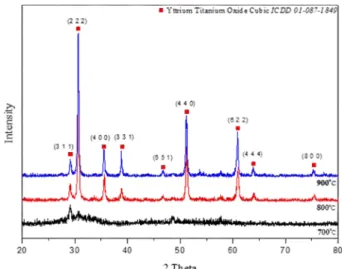
Fig. 2. X-ray Diffraction pattern of the synthesized Y2Ti2O7 calcined at 700~900oC by co-precipitation process at pH7.
3.
결과 및 고찰Fig. 2 는 합성된 Y
2Ti
2O
7의 결정성을 알아보기 위한 열 처리 온도에 따른 XRD 분석 결과이다. 분석 결과 전 형적인 Y
2Ti
2O
7픽(peak)이 확인되었다. 700
oC 에서 비정 질의 픽이 확인되었으며 800
oC 부터 결정성의 Y
2Ti
2O
7픽 이 확인되는데, 이것은 Y
2Ti
2O
7결정이 성장하는 것으로 판단되며,
25)열처리 온도가 증가할수록 Y
2Ti
2O
7픽의 강 도가 강해지는 것을 알 수 있었다. 이는 반응온도가 증 가함에 따라 결정크기가 증가하는 것을 알 수 있다. Fig.
3 은 FESEM을 이용하여 합성된 Y
2Ti
2O
7의 미세구조를 관찰한 결과이다. 10~30 nm 크기의 구형의 미세한 입자 들이 합성된 것을 관찰할 수 있었으며 열처리 온도가 증 가할수록 입자 크기가 증가하는 경향성을 관찰할 수 있 었다. Fig. 4은 합성된 Y
2Ti
2O
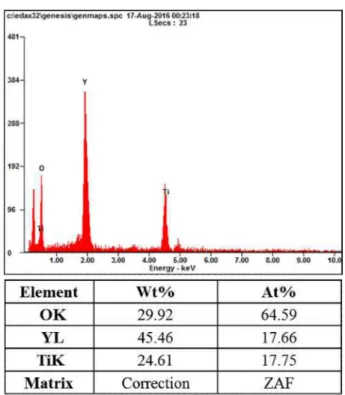
7의 EDS 분석결과이다.
Y
2Ti
2O
7의 이론적 화학양론비는 Y:Ti:O = 2:2:7인데, EDS 분석결과 성분비는 화학양론비와 유사하게 확인되었으 며, 특별한 불순물은 검출되지 않았다. Fig. 5는 pH7조 건 900
oC 에서 열처리하여 합성된 Y
2Ti
2O
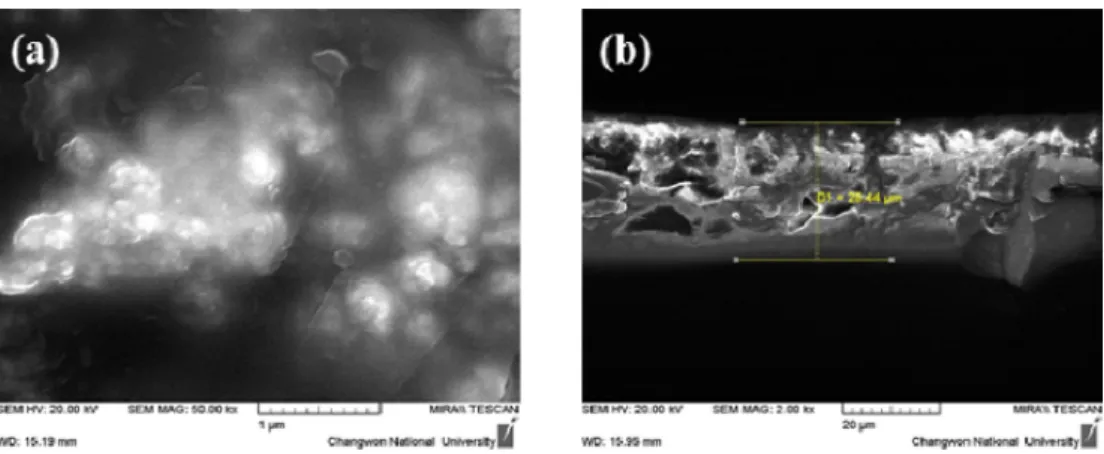
7분말을 무기 바인더와 혼합하여 유리기판에 코팅을 실시한 샘플의 표 면과 절단면의 미세구조를 FESEM을 이용하여 관찰한 결 과이다. Fig. 5(a)의 표면 이미지에서 Y
2Ti
2O
7가 무기 바 인더와 잘 섞여 골고루 분포하고 있는 것을 확인할 수 있었으며 사진상의 흰 구형의 입자는 EDS분석 결과 Y
2Ti
2O
7임을 확인할 수 있었다. Fig. 5(b)는 절단면의 이 미지에서 코팅층의 두께는 28.44 µm로 확인되었으며, 전 체적으로 균일하였다. Fig. 6은 유리기판 위에 무기 바 인더와 Y
2Ti
2O
7분말을 혼합하여 코팅을 실시한 뒤, 테이 프평가와 연필경도시험을 실시한 결과이다. 유리기판에 코 팅된 Y
2Ti
2O
7용액은 5B의 아주 우수한 부착력을 가지 고 있었고, 연필경도시험결과 6H의 우수한 경도 값을 확 인할 수 있었다. Fig. 7은 pH7, 800
oC 조건에서 열처리 하여 합성한 Y
2Ti
2O
7분말을 유리기판에 코팅한 뒤 광촉 매 분해 실험을 실시한 UV 분광 분석결과이다. UV를 조사한 시간이 증가함에 따라 메틸렌 블루의 흡수피크 가 감소하고 있음을 확인할 수 있는데 이는 광촉매 효
과에 의해 메틸렌블루가 분해되면서 농도가 감소하고 있 음을 나타낸다.
4.
결 론공침법을 이용하여 열처리 온도에 따라 Y
2Ti
2O
7분말을 합성하였으며, 합성된 Y
2Ti
2O
7분말과 무기 바인더를 혼 합하여 유리기판에 코팅하고 광촉매 분해 실험을 실시 하였다. 합성된 분말은 전형적인 Y
2Ti
2O
7픽의 결정성을 나타내었으며, 700
oC 와 800
oC 사이에서 결정성장을 확인 할 수 있었다. Y
2Ti
2O
7의 형상은 구형의 10~30 nm 크기 의 아주 미세한 분말이었으며, 이론적 화학양론비를 충 족하는 것을 확인할 수 있었다. 무기 바인더를 이용하 여 합성된 Y
2Ti
2O
7분말을 유리기판에 코팅을 실시한 결 과, 5B의 우수한 부착력과 6H의 우수한 경도값을 갖는
Fig. 3. FE-SEM image of the Y2Ti2O7 calcined at different temperature by co-precipitation process at pH7; (a) 700oC, (b) 800oC and (c) 900oC.
Fig. 4. EDS analysis of the Y2Ti2O7 calcined at 900oC by co- precipitation process at pH7.
것을 확인하였으며, 코팅의 두께는 28.44 µm로 균일한 코 팅 두께를 가지고 있었다. 광촉매 분해 실험결과 메틸 렌 블루가 분해되면서 농도가 감소하였으며, 이를 통해 광촉매 특성을 확인할 수 있었다.
Acknowledgement
This research was financially supported by the Ministry
of Trade, Industry, and Energy (MOTIE), Korea, under the
“Public Institution Linkage Regional Industry Develop- ment Program” supervised by the Korea Institute for Advancement of Technology (KIAT) (R0004917).
References
1. O. Merka, D. W. Bahnemann and M. Wark, ChemCatChem., 4, 1819 (2012).
2. A. L. Linsebigler, G. Lu and J. T. Yates Jr, Chem. Rev., 95, 735 (1995).
3. S. Ikeda, M. Fubuki, Y. K. Takahara and M. Matsumura, Appl. Catal. A, 300, 186 (2006).
4. L. F. He, J. Shirahata, T. Nakayama, T. Suzuki, H.
Suematsu, I. Ihara, Y. W. Bao, T. Komatsud and K.
Niihara, Scripta Mater., 64, 548 (2011).
5. N. Sellami, G. Sattonnay, C. Grygiel, I. Monnet, A.
Debelle, C. Legros, D. Menut, S. Miro, P. Simon, J. L Bechade and L. Thomé, Nucl. Instrum. Methods Phys.
Res. Sect. B, 365, 317 (2015).
6. P. Holtappels, F. W. Poulsen and M. Mogensen, Solid State Ionics., 135, 675 (2000).
7. M. B. Johnson, D. D. James, A. Bourque, H. A.
Dabkowska, B. D. Gaulin and M. A. White, J. Solid State Chem., 182, 725 (2009).
8. J. K. Gill, O. P. Pandey and K. Singh, Solid State Sci., Fig. 5. FE-SEM image of the Y2Ti2O7 calcined at 900oC coating on glass substrate; (a) Surface of the Y2Ti2O7 coating on glass substrate and (b) Cross section of the glass substrate.
Fig. 6. Optical image, Tape test and Pencil hardness test of Y2Ti2O7 coating on glass substrate.
Fig. 7. Photocatalyst characteristics of the Y2Ti2O7 calcined at 800
oC coating on glass substrate.
13, 1960 (2011).
9. R. Abe, M. Higashi, K. Sayama, Y. Abe and H.
Sugihara, J. Phys. Chem. B, 110, 2219 (2006).
10. G. Ravi, S. Mansouri, S. Palla and M. Vithal, Indian J.
Chem., 54, 20 (2015).
11. S. Pace, V. Cannillo, J. Wu, D. N. Boccaccini, S. Seglem and A. R. Boccaccini, J. Nucl. Mater., 341, 12 (2005).
12. R. C. Ewing, W. J. Weber and J. Lian, J. Appl. Phys., 95, 5949 (2004).
13. N. Pailhe´, M. Gaudon and A. Demourgues, Mater. Res.
Bull., 44, 1771 (2009).
14. S. Ishida, F. Ren and N. Takeuchi, J. Am. Ceram. Soc., 76, 2644 (1993).
15. Z. Chen, W. Gong, T. Chen, S. Li, D. Wang and Q.
Wang, Mater. Lett., 68, 137 (2012).
16. E. Pavitra, G. S. R. Raju and J. S. Yu, Phys. Status Solidi (RRL), 3, 224 (2013).
17. L. G. Shcherbakova, J. C. C. Abrantes, D. A. Belova, E.
A. Nesterova, O. K. Karyagina and A. V. Shlyakhtina, Solid State Ionics, 261, 131 (2014).
18. B. J. Wuensch, K. W. Eberman, C. Heremans, E. M.
Ku, P. Onnerud, E. M. E. Yeo, S. M. Haile, J. K. Stalick and J. D. Jorgensen, Solid State Ionics, 129, 111 (2000).
19. T. Liu, L. Wang, C. Wang, H. Shen and H. Zhang, Mater.
Des., 88, 862 (2015).
20. C. L. Chen and Y. Zeng, Int. J. Refract. Met. Hard Mater., 56, 104 (2016).
21. M. Ebrahimi, D. Willershausen, K. S. Ashaghi, L.
Engel, L. Placido, P. Mund, P. Bolduan and P. Czermak, Desalination, 250, 991 (2010).
22. L. Liu, C. Zhao and F. Yang, Water Res., 46, 1969 (2012).
23. J. K. Gill, O. P. Pandey and K. Singh, Solid State Sci., 13, 1960 (2011).
24. A. F. Fuentes, K. Boulahya, M. Maczka, J. Hanuza and U. Amador, Solid State Sci., 7, 343 (2005).
25. A. L. Hector and S. B. Wiggin, J. Solid State Chem., 177, 139 (2004).
26. Z. S. Chen, W. P. Gong, T. F. Chen and S. L. Li, Bull.
Mater. Sci., 34, 429 (2011).
27. X. Changrong, C. Huaqiang, W. Hong, Y. pinghua, M, Guangyao and P. Dingkun, J. Membr. Sci., 162, 181 (1999).
28. K. M. Lin, C. C. Lin, C. Y. Hsiao and Y. Y. Li, J. Lumin., 127, 561 (2007).
29. Y. Zhang, M. Wang, Z. Le, G. Huang, L. Zou and Z.
Chen, Ceram. Int., 40, 5223 (2014).