• 검색 결과가 없습니다.

A Study on the Characteristics of Tourism Flow of Independent Tourists from China to South Korea Based on Tourists' Digital Footprint

N/A
N/A
Protected

Academic year: 2021

Share "A Study on the Characteristics of Tourism Flow of Independent Tourists from China to South Korea Based on Tourists' Digital Footprint"

Copied!
9
0
0

로드 중.... (전체 텍스트 보기)

전체 글

(1)

A Study on the Characteristics of Tourism Flow of Independent Tourists from China to South Korea Based on Tourists’ Digital

Footprint

Chun-Yan Wang

1

, Phil-sik Jang

2

, Hyung-Ho Kim

2*

1

Associate Professor, Faculty of Tourism Management, Jilin Engineering Normal University

2

Professor, Dept. of Air Transport and Logistics, Sehan University

디지털 여행기록 기반 중국 개별 관광객의 한국 관광경로 특성 분석

왕춘염

1

, 장필식

2

, 김형호

2*

1

길림공정사범학원 관광관리학부 교수,

2

세한대학교 항공교통물류학과 교수

Abstract This study takes Chinese independent tourists to South Korea as the research object, mines the data of tourists’ digital footprints from online travel notes, and analyzes the characteristics of the tourism flow of Chinese independent tourists to South Korea by using the method of quantitative statistics and social network analysis(SNA). The results show that Seoul, Jeju Island, Busan and Daegu are the important tourist destinations for Chinese independent tourists entering South Korea. In addition, Qingdao, Tianjin, Shenyang, Hong Kong, Foshan and Macao are crucial hubs for Chinese independent tourists to visit South Korea. In future studies, the number of sample data should be increased. The time span of data collection should be extended for studying the annual variation characteristics of tourism flow and the trend of tourism hot spots.

Key Words : SNA, Chinese Independent Tourist, Tourism Flow, Digital Footprint, Degree Centrality 요 약 본 연구에서는 한국을 방문한 개별 여행자들의 디지털 기록을 수집하여 정량적 통계 분석과 소셜 네트워크 분석(SNA)을 통해 한국을 방문하는 개별 중국 여행자들의 한국 관광 경로의 특징을 분석하였다. 연구결과 서울, 제주 도, 부산 및 대구는 한국을 찾는 중국 여행자들의 주요 방문 장소이며, 중국의 청도, 천진, 심양, 홍콩, 포산 및 마카오는 한국을 찾는 중국 개별 여행자들의 주요 중계지 임을 알 수 있었다. 본 연구는 한국을 찾는 중국 개별 여행자들의 표본 특성과 각 여행 노드의 기능적 위치설정을 정확히 확인함으로써 정밀한 관광 마케팅과 관광 노선 개발에 활용할 수 있는데 의의가 있다. 향후 본 연구에 사용된 데이터의 추출 기간을 확대하고 더 많은 샘플을 확보하여 관광 경로의 연간 변동특성과 주요 방문지의 변동 특성을 분석할 필요가 있다.

주제어 : 소셜 네트워크 분석, 중국인의 개별 한국여행, 관광 여정, 온라인 여행노트, 중심성

*This paper was supported by the Sehan University Research Fund in 2020.

*Corresponding Author : Hyung-Ho Kim([email protected])

Received November 5, 2019 Revised December 15, 2019

Accepted January 20, 2020 Published January 28, 2020

(2)

1. Introduction

The rapid development of information technology has provided convenient conditions for tourists to obtain travel information, purchase travel products and share travel experiences online. Therefore, a large number of

"digital footprints" have been left on the Internet to reflect the activities of tourists. These "digital footprints" are rich in content and provide a new perspective for tourism research. R esearchers can directly extract basic data such as tourist number, travel time and travel preference, which to some extent makes up for the limitations of traditional data sources and saves the cost of data collection in the early stage of tourism research. In addition, the digital footprint clearly shows the tour routes for tourists to move between different tourist destinations, which also provides an opportunity to study the interactivity of tourism flow and the presentation of network structure characteristics.

1.1 Research Objectives

In order to understand the characteristics of the Chinese independent tourists and tourism flows, this study takes Chinese independent tourists to South Korea as the research object, and mines the tourists’ digital footprints from the online travel notes. It applies the quantitative statistical method and social network analysis to analyze the sample characteristics of Chinese independent tourists to South Korea and the network structure of tourism flows. To clarify the functional positioning of each travel node of Chinese independent tourists entering South Korea, it has important practical value for precision marketing and tour route design in tourism.

1.2 Research Methods

This study uses the quantitative statistical method to analyze the sample characteristics of

Chinese independent tourists to South Korea from the terms of travel time, stay days, travel cost and companion mode. Then, by using social network analysis, it analyzes the network structure characteristics of tourism flows of Chinese independent tourists to South Korea.

Since this study mainly involves the origin, transit and first destination of Chinese independent tourism flows to South Korea, while the direction of the tourism flows is one-way, so the tourism flows is mainly studied from the perspective of centrality. In this study, the degree of centrality and betweenness centrality are selected as the main indexes to evaluate the network structure of Chinese independent tourism flows to South Korea and to reflect the characteristics of network structure.

1.3 Data Sources

The research data mainly comes from the collection of travel notes and photos on the travel notes website, and the extraction of information such as travel time, travel route and travel cost from the travel notes, and the comparison with the photos to verify the authenticity and rationality of the text content, so as to ensure the accuracy and reliability of the research. In order to ensure sufficient sample quantity, two major travel nodes websites mafengwo.com (https:// www.mafengwo.cn) and Qyer (https://www. qyer.com) in China were selected as the main sources of data collection.

Both of sites are social networking sites centered

on UGC in China that focus on independent

travel service. The travel notes of Chinese

independent tourists to South Korea on the

websites from January 2018 and December 2018

were screened by using web crawler. In order to

clarify the sample characteristics of Chinese

independent tourists, we conducted an advanced

screening of 1065 travel notes data collected. The

data selection criteria were as follows: first,

(3)

travel notes should be no less than 400 words and be able to indicate the exact travel time, and must be accompanied by photos; second, the stay days in South Korea for 2 days or more, and have information of travel cost; third, the content of travel notes should be a complete record of the travel itinerary, especially the cities from China, transit cities and the first travel node when arriving in South Korea; fourth, eliminate the same travel notes published by the same tourist on different travel websites. Finally, only 429 online travel notes that meet these standards were selected.

Screening to conform to the standard 429 online travel notes, on the basis of the user information, this study use Excel to input some travel information, such as travel time, stay days, travel cost, companion mode, tourism node, in which the tourism nodes are according to the actual tourists travel path of editing, such as:

“Guangzhou, Hong Kong, Seoul”, collected 1019 tourism nodes.

2. Theoretical Background 2.1 Tourism Flow

Domestic and foreign scholars' research on tourism flow mainly focuses on influencing factors and prediction. The concept of Relative Acceptance Index is firstly put forward to calculate the tourism flow[1]. Hong et al.

discussed the relationship between tourism destination network and tourism flow[2]. Li and Cao predicted the direction and flow of tourism flow[3]. G. De Vita studied the impact of exchange rate system on international tourism flows[4]. Cellini and Cuccia assessed the causal relationship between tourism flow and the attendance of staff in tourist attractions[5].

2.2 Network Structure of Tourism Flow

The method of social network analysis has been applied earlier in the study of tourism flow.

The researchers mainly analyze the network structure characteristics of tourist flow in the tourism destinations by using social network analysis, such as the movement of the foreign tourist cities in the United States and the role position of cities in the tourist flow network[6], the four different types of internal network structure characteristics in Australia[7], the network structure characteristics of self-driving tourist flow in some areas[8], and the analysis of the network connection degree of tourist flows around the world[9].

2.3 Digital Footprint Application in Tourism Flow Research

Foreign scholars began to use digital footprints to explore the spatial and temporal characteristics of tourists. For example, studied the spatio temporal distribution of tourist flows in Florence and Rome by using digital footprints[10]. H. Kim studied the perception and preference of potential tourists to tourist destinations by using photos posed by tourists themselves[11]. S. Choi studied the image of tourist destinations which is perceived by tourists according to the online blog posts[12].

Garcia-palomares analyzed the tourist hot spots in eight European cities according to geo-tagged photos[13]. Salas studied the spatial behavior of urban tourists through digital footprints [14].

There are some studies in domestic that explore the network structure characteristics of tourism flow by using digital footprints, such as using online travel notes to study the network structure characteristics of tourism flow of Chinese individual tourists in different seasons in South Korea[15].

On the whole, the theory for studying tourism

flow at home and abroad is relatively mature, but

the research theme mainly focus on the

discussion of regional characteristics. Research

(4)

methods have gradually shifted from qualitative to quantitative. In recent years, social network analysis method often has been widely used in literature research [16,17], but someone has applied it to the study of tourism flow. That has become a trend to discuss the characteristics of tourism flow based on "relationship". Since it is relatively difficult to collect tourism flow data, scholars mostly use panel data and questionnaire survey to obtain tourism flow data. However, with the development of information technology, the accessibility of tourism digital footprint provides data support for in-depth research on tourism flow.

3. Analysis on the Sample Characteristics 3.1 Travel Time

According to the sample analysis, Chinese independent tourists mainly visit South Korea in February, September and October, followed by April (shown in Fig. 1).

Fig. 1. Travel time of Chinese independent tourists to South Korea in 2018

For Chinese tourists, there are Spring Festival holidays in February and National Day holidays in late September and early October, both of which are paid seven-day holidays, which provide sufficient time guarantee for Chinese tourists to travel abroad for a long distance. In

addition, there are three paid holidays for Qingming festival in April. After the peak of the golden week in October, the tourism flow of Chinese independent tourists to South Korea began to fall. Overall, the change in the number of Chinese independent tourists to South Korea is closely related to the timing of China's legal holidays.

3.2 Duration of Stay

The number of days Chinese independent tourists stay in South Korea determines the travel cost to some extent. The longer a tourist stays in the tourist destination, the more he/she will spend on traveling. In addition, the longer the tourists stay in the tourism destination, the higher the perception of tourism experience and the higher the satisfaction. According to the sample statistics, the majority of Chinese independent tourists stay in South Korea for 5-8 days, and the largest number stay for 7 days (shown in Fig. 2). The stay day of majority of Chinese tourists visiting South Korea is more than one week, which is mainly related to the length of China's legal holidays and paid holidays.

Fig. 2. Stay days of Chinese independent tourists to South Korea in 2018

3.3 Travel Cost

The travel cost of Chinese independent

tourists during their tour in South Korea reflects

the consumption level of tourists. According to

the sample analysis, the tourists who spend

between 4001-6000 RMB are the most, followed

(5)

Fig. 4. Companion mode of Chinese independent tourists to South Korea in 2018

by those who spend between 6001-8000 RMB and 9001-10000 RMB (shown in Fig. 3).

According to the statistics of National Bureau of Statistics of China, per capita consumption expenditure of Chinese residents in 2018 was 19853 RMB. Compared with the average Chinese consumer spending levels, the travel cost of Chinese independent tourists in South Korea is moderate. From the content of online travel notes, Chinese independent tourists to South Korea mainly aim at sightseeing experience, while the number of tourists who mainly aim at shopping is small, so the overall tourism consumption level is not high.

Fig. 3. Travel cost per person of Chinese independent tourists to South Korea in 2018

3.4 Companion Mode

According to content and photographs showed in online travel notes, companion mode during the whole travelling is divided into four categories in this study, which are to travel alone, to travel with friends, to travel with family and to travel with couple. Among all the online travel notes, 55.73% of Chinese independent tourists to South Korea were accompanied by friends, 19.17% by family, 15.02% by couples, and 10.08% travel alone(see Fig. 4).

It can be seen that Chinese independent tourists to South Korea often choose to travel with friends, accounting for up to 55.73% of the total, followed by family members or couples, and the least traveling alone. The reason why

most tourists choose to travel with friends may be that it takes a long time to travel in a foreign country, the freedom of the route is large. If they choose some trusted friends to accompany them, it is easy to form tourism consensus and improve their satisfaction of the tourism experience.

4. Analysis on the Network Structure Characteristics of Tourism Flow

By building the network structure of tourist flow for Chinese independent tourists to South Korea, this study identifies key tourism node, finds the tourist sources, transit nodes in China and first tourism destination in South Korea, and analyzes the network structure characteristics of tourism flow of Chinese independent tourists to South Korea. Through analyzing the characteristic of main tourism nodes are further summarized.

4.1 Construction of the Network for Tourism Flow

Firstly, the travel nodes data which were

collected in Excel file was converted into TXT

file. Then, the text file was imported into

KHCoder3, and the network structure diagram of

tourism flow of Chinese independent tourists to

Korea was constructed by KHCoder3 (shown in

Fig. 5). The 53 nodes in Fig. 5. represent the main

travel nodes of the tourism flow of independent

(6)

Fig. 5. Network structure of Chinese independent tourists to South Korea (from Jan. 1st to Dec. 31st, 2018) tourists from China to South Korea. Among them, the larger the circular area of the node, the larger the number of visitors visiting the node.

The closer the connection between the nodes, the more connections between the nodes, that is, the more frequent the flow of tourists. As shown in figure 5, the node with the largest circular area is Seoul, which is the largest tourist destination for Chinese independent tourists entering South Korea, followed by Jeju Island, Busan and Daegu, which constitute the main destination of Chinese independent tourism flow to South Korea and are important travel nodes for Chinese independent tourists entering South Korea. The major travel nodes of Chinese independent tourists to South Korea in China include Hong Kong, Guangzhou, Shanghai, Beijing, Macao, Shenzhen, Tianjin, Chengdu, Xiamen and Chongqing. The more connections through a certain node, the higher the intermediary centrality of the node, that is, the more times the tourists arrive or transfer here. Qingdao, Seoul, Busan, Tianjin, Jeju Island, Foshan, Shenyang, Hong Kong, Macao are the travel nodes which has higher medium centricity. Apart from Seoul, Busan and Jeju Island which located in South Korea as tourism destination, the travel nodes where Chinese independent tourists to South Korea are easier to pass through are Qingdao,

Tianjin, Shenyang, Foshan, Hong Kong and Macao, which are located in China. They are an important intermediary node for Chinese independent tourists to South Korea.

4.2 Network Structure Characteristics of Tourism Nodes

In order to show the status and function of each tourism node more clearly, this study used KHCoder3 and R version3.4.4 software to calculate the tourism node data. This study is to analyze the cities of tourism flow in travel notes as the key words. Considering the characteristics of the analysis objects, this study mainly analyzes centrality, among which degree centrality and betweenness centrality are two main analysis indicators.

4.2.1 Degree Centrality

Degree centrality is an index that measures the degree of direct connection between one node and other nodes. In one network, if a node has more connections with other nodes, its central position in the network is higher, which also means that it has greater "power" in the network and plays a core role. Degree centrality reflects the agglomeration and radiation ability of a certain tourism node to tourism flow. That is to say, in the network structure, the node with higher degree centrality is an important tourist destination or distribution center of tourist flow.

From the degree centrality index analysis (see

Table 1), the value of degree centrality of Seoul

(10), Qingdao (10), Hong Kong (8), Jeju Island (8),

Busan (8), Macao (6), Tianjin (6), Guangzhou(5),

Xiamen (5), Beijing (4), Shanghai (4), Shenyang (4)

are greater than the average of 3.333. Among

them, Seoul, Jeju Islandand, Busan in South

Korea are the first destination for Chinese

independent tourists to visit South Korea, so

there is no doubt that they play a cohesive role

in network structure of tourism flows. Qingdao,

Hong Kong, Macao, Tianjin, Guangzhou, Xiamen,

(7)

Beijing, Shanghai and Shenyang in China are the main tourism source and distribution center for Chinese independent tourists to Korea.

Tourism Nodes Deg. Tourism Nodes Deg. Tourism Nodes Deg.

Seoul 10 Chendu 3 Taiyuan 2

Qingdao 10 Foshan 3 Yangzhou 2

HongKong 8 Nanjing 3 Dongguan 1

JejuIsland 8 Jinan 3 Dalian 1

Busan 8 Shenzhen 2 Zhenzhou 1

Macao 6 Chongqing 2 Changsha 1

Tianjin 6 Hangzhou 2 Daegu 1

Guangzhou 5 Wuhan 2 Wenzhou 1

Xiamen 5 Kunming 2 Guiyang 1

Beijing 4 Shunde 2 Harbin 1

Shanghai 4 Nanning 2 Ningbo 1

Shenzhen 4 Xi'an 2 Zhuhai 1

Mean value 3.333

Notes: Degree Centrality (Deg.)

Table 1. Degree centrality of tourism nodes

4.2.2 Betweenness Centrality

Betweenness Centrality is an important indicator to measure the degree of control one node has over the connections between other nodes. In network structure, if a node is on the path between many other two nodes, it can be considered to be in an important position because of its ability to control the connection between the other two nodes. Betweenness centrality reflects the degree to which a tourism node controls the tourism flow among other tourism nodes in terms of tourism flow relationship.

That is to say, in the network structure, the node with high betweenness centrality is an important transit node of tourism flows.

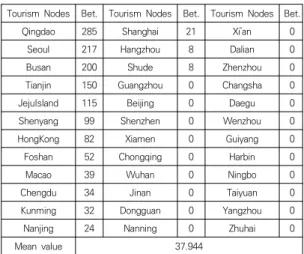
According the analysis of betweenness centrality (shown in Table 2), it can be seen that the betweenness centrality value of Qingdao (285), Seoul (217), Busan (200), Tianjin (150), Jeju Island (115) , Shenyang (99), Hong Kong (82), Foshan (52), and Macao (39) are all greater than the average of 37.944. Except for Seoul, Busan and Jeju Island which are important tourist destinations for Chinese independent tourists to South Korea, Qingdao, Tianjin, Shenyang, Hong

Kong, Foshan and Macao are important nodes for Chinese independent tourists to South Korea.

These nodes to other nodes control are strong, mainly because they are important transit nodes for Chinese independent tourists to South Korea.

Tourists from the northern China mainly use Qingdao, Tianjin and Shenyang as a transit node.

While tourists are mainly from southern China, they often use Foshan, Hong Kong and Macau as their main tourism hub. The role of the tourism hub makes the above-mentioned cities have a strong control over other tourism nodes. From the analysis of content of online travel notes, the main reason is that there are flights directly from China to South Korea in the above-mentioned cities, and the air tickets are cheap, especially in Hong Kong and Macao. Cheap air tickets to South Korea have attracted a large number of independent tourists from these cities to South Korea.

Tourism Nodes Bet. Tourism Nodes Bet. Tourism Nodes Bet.

Qingdao 285 Shanghai 21 Xi'an 0

Seoul 217 Hangzhou 8 Dalian 0

Busan 200 Shude 8 Zhenzhou 0

Tianjin 150 Guangzhou 0 Changsha 0

JejuIsland 115 Beijing 0 Daegu 0

Shenyang 99 Shenzhen 0 Wenzhou 0

HongKong 82 Xiamen 0 Guiyang 0

Foshan 52 Chongqing 0 Harbin 0

Macao 39 Wuhan 0 Ningbo 0

Chengdu 34 Jinan 0 Taiyuan 0

Kunming 32 Dongguan 0 Yangzhou 0

Nanjing 24 Nanning 0 Zhuhai 0

Mean value 37.944

Notes: Beteweenness Centrality (Bet.)

Table 2. Betweenness centrality of tourism nodes

5. Conclusions and Discussions

Based on the data mining of online travel

notes of independent tourists from China to

South Korea, this study analyzes the sample

characteristics of Chinese independent tourists to

(8)

South Korea, constructs the network structure for tourism flow, and conducts in-depth research on the characteristics of network nodes, and draws the following conclusions.

First, from the perspective of sample characteristics, Chinese independent tourists who go to South Korea mainly travel to South Korea in February, September and October, and stay in South Korea for 5-8 days, among which 7 days are the most. Travel time and stay days are closely related to the time and length of China's legal holidays. Chinese tourists who travel independently to South Korea often choose to travel with their friends, with the most tourists spending between 4001-6000 RMB per person. It can be seen that the marketing activities aimed at Chinese independent tourists should fully consider the regular Chinese legal holidays and the important influence of tour companions on independent tourists.

Second, from the perspective of the network structure characteristics of tourism flow, Seoul is the largest tourist destination for Chinese independent tourists to South Korea, followed by Jeju Island, Busan and Daegu. Hong Kong, Guangzhou, Shanghai, Beijing, Macao, Shenzhen, Tianjin, Chengdu, Xiamen and Chongqing are important tourism sources of Chinese independent tourists to South Korea. In addition, Qingdao, Tianjin, Shenyang, Hong Kong, Foshan and Macao are important transit nodes for Chinese independent tourists to visit South Korea, because these cities have or are close to low-cost air routes from China to South Korea.

As the choice of tourist routes is greatly affected by traffic conditions, so the influence of tourist traffic factors on tourists should be fully considered in the process of tourism marketing.

Unlike the data source based on questionnaire survey in previous studies, this study uses the digital footprints of Chinese independent tourists from online travel notes as the data source. The research value of digital footprints from online travel notes in tourism research is verified again.

The research results can enable Korean tourism service enterprises or departments to understand the characteristics of the tourism flow of Chinese independent tourists, such as travel time, travel cost, duration of stay, etc., and have a certain guiding role for tourism enterprises in China's tourism market development, precision marketing and tourism route design. Due to personal ability is limited, this paper has some disadvantages: in terms of data collection, this paper selected the more representative of the online travel websites in China, because of the virtual network, the information of digital footprints is incomplete and with overall small sample sizes, so that it is not able to do precise statistics to independent tourism; in terms of research methods, this study only uses the degree centrality and betweenness centrality from the social network analysis method, and does not uses the structural hole analysis. In future studies, the number of sample data should be increased. The time span of data collection should be extended for studying the annual variation characteristics of tourism flow and the trend of tourism hot spots. The structural hole analysis in social network analysis method is used to deeply analyze the network structure characteristics of tourism flow.

REFERENCES

[1] A. V. Williams & W. Zelinsky. (1970). On some patterns in international tourism flows. Economic Geography, 46(4), 549-567.

https://www.jstor.org/stable/142940

[2] T. Hong, T. Ma & T. C. Huan. (2015). Network behavior as driving forces for tourism flows. Journal of Business Research, 68(1), 146-156.

DOI : 10.1016/j.jbusres.2014.04.006

[3] Y. F. Li & H. Cao. (2018). Prediction for Tourism Flow based on LSTM Neural Network. Procedia Computer Science , 129, 277-283.

DOI : 10.1016/j.procs.2018.03.076

[4] G. De Vita. (2014). The long-run impact of exchange

rate regimes on international tourism flows. Tourism

Management , 45, 226-233.

(9)

DOI : 10.1016/j.tourman.2014.05.001

[5] R. Cellini & T. Cuccia. (2012). Museum and monument attendance and tourism flow: a time series analysis approach. Applied Economics , 45(24), 3473-3482.

DOI : 10.1080/00036846.2012.716150

[6] Y. H. Hwang, U. Gretzel & D. R. Fesenmaier. (2006).

Multicity trip patterns: Tourists to the United States.

Annals of Tourism Research , 33(4), 1057-1078.

DOI : 10.1016/j.annals.2006.04.004

[7] N. Scott, C. Cooper & R. Baggio. (2008). Destination networks: Four Australian cases. Annals of Tourism Research , 35(1), 169-188.

DOI : 10.1016/j.annals.2007.07.004

[8] H. Y. Shih. (2006). Network characteristics of drive tourism destinations: An application of network analysis in tourism. Tourism Management, 27(5), 1029-1039.

DOI : 10.1016/j.tourman.2005.08.002

[9] J. I. L. Miguéns & J. F. F. Mendes. (2008). Travel and tourism: Into a complex network. Physica A Statistical Mechanics & Its Applications, 387(12), 2963-2971.

DOI : 10.1016/j.physa.2008.01.058

[10] F. Girardin, F. Dal Fiore, C. Ratti, & J. Blat. (2008).

Leveraging explicitly disclosed location information to understand tourist dynamics: A case study. Location Based Services , 2(1), 41-56.

DOI : 10.1080/17489720802261138

[11] H. Kim & S. Stepchenkova. (2015). Effect of tourist photographs on attitudes towards destination: manifest and latent content. Tourism Management , 49, 29-41.

DOI : 10.1016/j.tourman.2015.02.004

[12] S. Choi, X. Y. Lehto & A. M. Morrison. (2007).

Destination image representation on the web:

Content analysis of Macau travel related websites.

Tourism Management , 28(1), 118-129.

DOI : 10.1016/j.tourman.2006.03.002

[13] J. C. García-Palomares, J. Gutiérrez & C. Mínguez.

(2015). Identification of tourist hot spots based on social networks: A comparative analysis of European metropolises using photo-sharing services and GIS.

Applied Geography, 63, 408-417.

DOI : 10.1016/j.apgeog.2015.08.002

[14] M. H. Salas-Olmedo, B. Moya-Gómez, J. C.

García-Palomares & J. Gutiérrez. (2018). Tourists' digital footprint in cities: Comparing Big Data sources. Tourism Management, 66, 13-25.

DOI : 10.1016/j.tourman.2017.11.001

[15] C. Y. Wang, P. S. Jang & H. H. Kim. (2019). A Study on the Characteristics of the Seasonal Travel Path of Individual Chinese Travellers in Korea. Korea Convergence Society , 10(7), 23-31.

DOI : 10.15207/JKCS.2019.10.7.023

[16] S. C. Song, T. H. Nguyen, S. H. Park & G. T. Yeo.

(2018). Research Trends Analysis on Port Hinterland Using SNA Method. Journal of Digital Convergence, 16(11), 17-27.

DOI : 10.14400/JDC.2018.16.11.017

[17] B. B. Delgado, H. M. Ma, J. G. Oh & G. T. Yeo. (2018).

The Study on the research trend about Europe ports:

focus on Baltic Sea using Keyword network. Journal of Digital Convergence, 16(2), 139-149.

DOI : 10.14400/JDC.2018.16.2.139

왕 춘 염(Chun-Yan Wang) [정회원]

․ 2004년 7월 : 하얼빈사범대학교 관광 관리학과(관리학학사)

․ 2010년 7월 : 려오닝사범대학교 교육 학과(교육학석사)

․ 2018년 5월 ~ 현재 : 세한대학교 경영 학과 박사과정

․ 2018년 9월 ~ 현재 : 길림공정기술사 범대학교 관광관리학과 교수

․ 관심분야 : 관광, 교육

․ E-Mail : [email protected]

장 필 식(Phil-Sik Jang) [정회원]

․ 1990년 2월 : 서울대학교 조선해양공 학과(공학사)

․ 1992년 2월 : KAIST 산업공학과(공학 석사)

․ 1998년 8월 : KAIST 산업공학과(공학 박사)

․ 1997년 9월 ∼ 현재 : 세한대학교 항 공교통물류학과 교수

․ 관심분야 : 빅데이터분석, HCI, 감성공학

․ E-Mail : [email protected]

김 형 호(Hyung-Ho Kim) [정회원]

․ 1989년 2월 : 경희대학교 전자계산공 학과(공학사)

․ 1992년 8월 : 경희대학교 전자계산공 학과(공학석사)

․ 2018년 2월 : 인천대학교 동북아물류 대학원(물류학박사)

․ 1998년 3월 ∼ 현재 : 세한대학교 항 공교통물류학과 교수

․ 관심분야 : 신경회로망, 항공운송, System Dynamics

․ E-Mail : [email protected]

수치

Fig. 1. Travel time of Chinese independent tourists to  South  Korea  in  2018
Fig.  3.  Travel  cost  per  person  of  Chinese  independent tourists  to  South  Korea  in  2018
Fig. 5. Network structure of Chinese independent tourists to South Korea (from Jan. 1st to Dec
Table  2.  Betweenness  centrality  of  tourism  nodes

참조

관련 문서