44(1) : 70∼ 74 (2013)
70
곤달비 메탄올 추출물의 진통 효과
차동석·전 훈∗
우석대학교 약학대학
Anti-nociceptive Activity of Methanol Extracts from Ligularia stenocephala
Dong Seok Cha and Hoon Jeon
*
College of Pharmacy, Woosuk University, Jeonbuk 565-701, Korea
Abstract − Ligularia stenocephala has been widely used as a traditional medicine for the treatment of lots of diseases such as asthma, arthritis, and jaundice. In this study, we evaluated the anti-nocicepitve activities of methanolic extract of L. steno- cephala (MLS) using various pain models including thermal nociception as well as chemical nociception methods. MLS showed significant increase in latency time in the tail immersion test and hot-plate test. In addition, the number of acetic acid- induced abdominal constrictions was decreased by MLS. MLS also attenuated paw licking time in the formalin test. The com- bination test using naloxone revealed that the anti-nociceptive properties of MLS was not associated with opioid receptor acti- vation. The present results demonstrate that MLS may possibly used as valuable analgesic agent for the treatment of nociceptive pain.
Key words − Ligularia stenocephala, Pain, Anti-nociception
통증이란 실제적 또는 잠재적 조직 손상에 따라 수반되는 불쾌한 감각적, 정서적 경험을 의미한다.1)통증의 원인으로 는 외상 및 기타 물리적 요인에 의한 신경세포 손상, 면역 반응 및 기관이나 조직에 도달하는 혈류의 이상 등이 있으 며, 감각을 전달하는 신경자체에 문제가 있는 경우에도 통 증이 발생한다고 알려져 있다. 인체의 이상상태를 알리는 통증은 조직을 손상시킬 수 있는 위협을 감지하여 2차 손 상을 방지하거나 그 정도를 최소화 할 수 있는 인체의 방어 기전이다.2)
그러나 통증의 정도가 지나치거나 손상된 조직의 치료가 완료되었음에도 불구하고 계속되는 경우 또는 암과 같은 질 병으로 기인하거나 원인불명의 만성 통증의 경우에는 인간 의 삶의 질을 심각하게 떨어뜨릴 수 있으므로 과도하고 지 속적인 통증은 효과적으로 조절될 필요가 있다. 현재까지 진 통제로서 널리 사용되고 있는 아스피린을 포함한 비스테로 이드성 소염제(non-steroidal anti-inflammatory drug, NSAID) 는 상부 위장관의 점막 염증과 출혈, 그에 따른 천공을 일 으키는 부작용이 있음이 보고 된 바 있으며 대표적인 opioid 계 진통제인 morphine의 경우 중독성과 의존성을 비롯하여
여러 가지 중추신경계통의 이상을 초래한다고 보고되고 있
다.3,4) 따라서 상대적으로 부작용이 적은 진통제 개발이 필
요하다고 할 수 있으며, 최근에는 많은 과학자들이 천연물 이 가지고 있는 가능성에 주목하여 활발한 연구가 진행 중 에 있으며 실제로 다양한 천연물로부터 뛰어난 진통 효능 이 확인되었다.5)
본 연구에 사용된 시료인 곤달비(Ligularia stenocephala) 는 국화과(compositae)의 식물로 전통적으로 천식이나 관절 염, 관절 통증의 치료에 한국과 중국 등에서 민간 약재로 널 리 사용되어 왔다. 현재까지 알려진 곤달비의 주요 성분은 terpenoids, caffeoylquinic acid, benzofuran 등과 관련 화합 물 등이 있으며,6-9)보고된 약리작용으로는 메탄올 추출물의 암전이 억제 효과와10) caffeoylquinic acid 화합물의 항궤양 효과 등이 있다.7) 그러나 현재까지 곤달비의 약리활성에 대 한 연구는 많이 부족한 실정이며, 이에 본 연구에서는 다양 한 통증모델을 이용하여 곤달비의 진통효능을 살펴보았다.
구체적으로는 tail immersion test와 hot-plate test를 통해 곤 달비의 중추성 통증 억제능을, 초산법을 이용해 말초성 통 증 억제능을 검증하였고 formalin test을 통해 중추성과 말 초성 통증에 대한 곤달비의 진통효능을 확인하였다. 또한 naloxone 전처리를 통해서 곤달비의 통증 억제 기전에 있어
*교신저자(E-mail):[email protected] (Tel): +82-63-290-1577
서 opioid receptor의 관련여부를 조사하였다.
재료 및 방법
실험재료 − 실험에 사용된 약재는 2012년 8월 강원 원주 소재의 강원약초에서 구입하였다. 건조과정을 통한 약재 시 료는(WH074) 우석대학교 약학대학 한약학과에 보관되었다.
건조된 샘플 600 g은 9000 mL의 100% 메탄올을 사용해 세 번 추출되었다. 추출은 50oC를 유지한 상태에서 초음파 추 출기를 통해 이루어졌다. 메탄올 추출물은 회전식 농축기를 이용하여 33 g(수율:5.5%)으로 농축되었으며 이 시료는 동 결 건조된 후 -20oC에서 보관되었다.
기기 및 시약 − Indomethacin과 naloxone은 Sigma-Aldrich (CA, USA)에서 구입하였다. Acetic acid, formalin은 Samchun Chemical(Korea)에서 구입하였다. Hot-plate apparatus(JD-A- 10A, Jungdo BNP, Korea)와 항온수조는 열성 자극에 의한 통증 억제 실험을 위해 사용되었다.
실험 동물 − ICR mice(5주령, 수컷)는 한국 대전 소재의 다물 사이언스에서 구입하였으며 22 ± 1oC의 온도, 자연광 상태에서 사육되었다. 또한 일정한 양의 사료와 식수를 주 기적으로 공급하였다. 본 연구에서 수행된 진통 실험은 국 제통증연구협회 및 우석대학교에서 규정하는 동물실험 윤 리규정을 준수하였다.11) 실험동물은 10마리에서 12마리를 무작위로 선택되어 구획하였다. 각각의 실험에서 곤달비는 증류수를 용매로 하여 구강을 통해 투여되었고 음성대조군 에서는 같은 양의 증류수를 투여하였다. 양성대조군으로 사 용된 약물인 tramadol(15 mg/kg)과 indomethacin(5 mg/kg)은 증류수에 녹여서 사용하였으며, 각각 복강과 경구를 통해 투여하였다.
Tail Immersion Test− ICR mouse의 꼬리 절반을 50 ± 0.2oC의 온도가 유지되는 water bath 안에 담근 후 꼬리를 다시 들어 올리는 시간을 측정하였다.12)시간 측정은 곤달 비(250, 500 mg/kg)와 tramadol(15 mg/kg) 투여 후 0, 30, 60, 90, 120 분이 지난 뒤에 시행되었다. 또한 조직 손상을 피하기 위해 측정시간은 20초를 최대로 하였다.
Hot-plate Test− ICR mouse를 각 군으로 구획한 후, hot- plate를 55 ± 1oC에서 유지시킨 상태에서 실험동물을 그 위 에 올려놓은 뒤 통증 반응(앞발 물기, 뒤로 가기, 제자리 뛰 기)을 보일 때까지의 시간을 측정하였다.13)시간 측정은 곤 달비(250, 500 mg/kg)와 tramadol(15 mg/kg) 투여 후 0, 30, 60, 90, 120 분이 지난 뒤에 시행되었다. 또한 조직 손상을 피하기 위해 측정시간은 30초를 최대로 하였다.
Acetic Acid-induced Writhing Test− ICR mouse의 복 강에 생리 식염수를 용매로 초산(0.8%)을 주사한 후 나타나 는 writhing motion의 횟수를, 투여 후 5분 뒤부터 20분간 측정하였다. 초산을 복강 주사하기 60분 전에 곤달비(250,
500 mg/kg)는 증류수를 용매로 하여 경구 투여 하였고 음성 대조군은 같은 양의 증류수를 투여하였다. 양성대조군으로 는 indomethacin(5 mg/kg)을 사용하였다.
Formalin Test− 생리 식염수를 용매로 한 formalin (1.5%, 20 ul)을 ICR mouse의 족부에 투여하였을 때 실험동 물은 주사부위를 핥는 행동을 보이는 통증 반응을 formalin 주사 직후 5분간 (first phase), 또한 주사 후 25-40분 간 (second phase) 2회 측정하였다.14)곤달비(250, 500 mg/kg) 는 증류수를 용매로 하여 formalin 투여 60분 전에 구강을 통해 투여하였고 음성대조군에서는 같은 양의 증류수를 투 여하였다. 양성대조군으로 사용된 약물 중 tramadol(15 mg/
kg)은 formalin 투여 30분 전에 복강주사 하였고, indomethacin (5 mg/kg)은 formalin 투여 60분 전 경구 투여 하였다. 또한 opioid receptor와의 관련여부를 조사하기 위해서 naloxone (5 mg/kg)을 약물투여 15분 전에 복강주사 하였다.
통계 분석 모든 자료는 mean±S.E.M.으로 표시 하였으며 통계적 의미는 Student's t-test를 이용하여 평가하였다. p- values 값이 0.05 미만인 경우 신뢰할 수 있는 데이터로 간 주하였다.
결과 및 고찰
통증은 전달경로와 기전에 따라 중추성 통증과 말초성 통 증으로 구분할 수 있다. 중추성 통증은 대뇌 피질과 척수가 직접 통증 자극의 주체가 되며 기계적, 열 자극에 의한 통 증인 반면, 말초성 통증은 특정 신경 섬유에 인접해 있는 조 직에 부분적 손상이 일어남으로써 생기며 염증성, 화학적 자극으로 인한 통증이다.15) 본 연구에서는 다양한 통증모델 을 사용하여 곤달비의 중추성 및 말초성 통증에 대한 진통 효과를 조사하였다.
먼저 곤달비의 중추성 통증 억제능을 확인하기 위해서 tail immersion test와 hot-plate test를 수행하였다. Tail immersion test 결과, 곤달비 투여에 의해서 농도 의존적으로 열 자극 에 견디는 시간이 증가하는 것을 알 수 있었다(Fig. 1). 비 교 대조군으로 사용된 tramadol은 morphine과 같은 opioid 계 약물과 비슷하게 약물 투여 30분 뒤에 가장 좋은 진통 효과를 보여준 반면에(76.77%), 곤달비는 저농도와 고농도 모두 약물 투여 60분 뒤에 가장 좋은 효과가 관찰되었다 (39.22%, 64.22%). 다음으로 곤달비의 중추성 진통효능을 재검정하기 위해서 hot-plate test를 수행하였으며, Fig. 2에 서 보는 바와 같이 tail immersion test와 유사한 결과를 얻 을 수 있었다. 곤달비는 저농도와 고농도의 실험군 모두에 서 약물 투여 후 60분이 지났을 때 가장 좋은 진통효과를 나타내었고(30.00%, 47.93%), 양성 대조군인 tramadol은 투 여 후 30분에 가장 강력한 진통효과(56.17%)를 보여주었다.
각각의 실험에서 약물투여 후 최대 효과가 나타나는 시간
이 다른 이유는 약물의 투여방법 혹은 대사 과정의 차이에 서 기인한 것으로 사료된다.
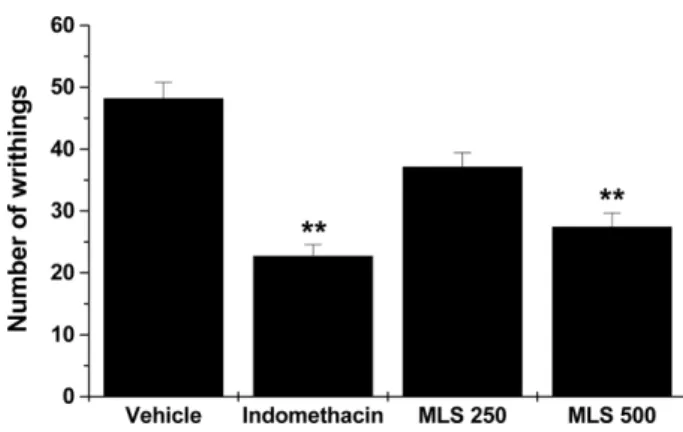
말초성 통증에서의 곤달비의 진통 효과는 약물의 중추성 및 말초성 통증 억제효과를 검증할 때 흔히 사용되는 방법 인 초산법(acetic acid-induced writhing test)16)를 통해 확인 되었다. 초산법은 복막 유동체 내의 prostaglandin E2(PGE2) 의 증가와 밀접한 관련이 있으며17) 염증성 통증을 유도하는 실험모델이다.18) NSAID 계 약물은 이러한 PG 합성을 효과 적으로 저해시켜 말초성 통증을 억제한다고 알려져 있으며, 본 연구에서 비교대조군으로 사용된 indomethacin은 ICR mouse의 writhing motion을 뚜렷하게 감소시켰다(52.82%).
또한 곤달비 역시 고농도에서 유의적인 감소율을 보였다 (40.06%) (Fig. 3).
초산법은 중추성 통증과 구분지어 말초성 통증 억제능만 을 확인하는데는 한계가 있기 때문에, formalin test를 수행 하였다. 말초성 유해 자극원인 formalin을 피하주사하게 되 면 두 가지 통증 메커니즘을 통해 통증반응을 유도하게 된 다. 먼저 C 섬유를 통한 직접적인 자극으로 인한 first phase 의 반응은 신경성 통증 반응으로서 morphine과 같은 opioid 혹은 그 유사체에 의해 저해될 수 있다. 한편, second phase 는 염증성 통증 반응으로서 말초 조직 내에서 PGs, serotonin, histamine 등과 같은 염증 매개체의 영향을 받게 된다.19,20) 본 실험에서 비교대조군으로 사용된 중추성 진통제인 tramadol은 first phase와 second phase 모두에서 뛰어난 진 통효과를 보인반면에 NSAIDs 계열 약물인 indomethacin은 second phase에서만 진통 효과를 나타내었다. 이러한 결과 는 중추신경계에 작용하는 약물은 formalin test의 두 phase 에 모두 작용하는 반면, 말초신경계에 작용하는 스테로이드 나 NSAIDs 계열 약물은 first phase에서 거의 효과가 나타 나지 않는다는 기존의 보고들과 일치한다.21)본 연구에서 곤 달비는 first phase와 second phase에서 유도된 반응 모두를 효과적으로 감소시켰으며 이는 곤달비가 중추성 통증과 말 초성 통증에 진통효과가 있음을 보여준다(Table I).
다음으로 opioid 길항제인 naloxone을 전처리를 통해서 곤 달비의 진통 효능이 opioid receptor와 관련이 있는지 알아 보았다. Tramadol은 naloxone의 전처리에 의해 진통작용이 다소 감소하였으며 이는 tramadol이 부분적으로 opioid recpetor에 영향을 줌과 동시에 다른 기전으로도 진통 효능 을 나타냄을 의미한다.22)반면에 indomethacin은 second phase에서 naloxone에 의한 별다른 진통 효능 감소가 보이 지 않았으며, 곤달비 역시 naloxone의 전처리에도 불구하고 Fig. 1. Anti-nociceptive effect of MLS in the tail immersion
test. The mice were treated with tramadol (15 mg/kg; i.p.), MLS (250, 500 mg/kg; p.o.). Values expressed as mean±S.E.M.
and units are in seconds (n = 10-12). Differences between groups were statistically analysed by Student-t test. *p<0.05 and **p<0.01 compared to vehicle-treated group.
Fig. 2. Anti-nociceptive effect of MLS in the hot-plate test.
The mice were treated with tramadol (15 mg/kg; i.p.), MLS (250, 500 mg/kg; p.o.), or distilled water. Values expressed as mean±S.E.M. (n = 10-12). Differences between groups were statistically analysed by Student-t test. **p<0.01 compared to vehicle-treated group.
Fig. 3. Anti-nociceptive effect of MLS in the acetic acid- induced writhing test. The mice were treated with indomethacin (5 mg/kg; i.p.), MLS (250, 500 mg/kg; p.o.), or distilled water. Values expressed as mean±S.E.M. (n = 10-12).
Differences between groups were statistically analysed by Student-t test. **p<0.01 compared to vehicle-treated group.
두 phase에서 모두 진통 효능의 변화가 관찰되지 않았다 (Table I). 이러한 결과를 통해서 곤달비가 opioid receptor와 는 다른 기전으로 중추성 및 말초성 통증을 억제한다는 것 을 확인하였다. 그러나 곤달비의 통증 억제 기전을 밝히기 위해서는 추가적인 연구가 필요할 것으로 사료된다.
결 론
본 연구에서는 곤달비 메탄올 추출물의 진통효능을 알아 보았다. Tail immersion test와 hot-plate test의 결과 곤달비 는 효과적인 중추성 통증 억제능을 나타내었다. 또한 acetic acid-induced writhing test에서 곤달비는 효과적인 말초성 통 증 억제능을 나타내었다. 마지막으로 formalin test를 통해 곤달비의 중추성 및 말초성 통증 억제능을 재차 확인 하였 으며 naloxone의 전처리를 통해 곤달비가 opioid receptor와 상이한 경로를 통해 진통 효능을 보임이 확인되었다.
사 사
이 논문은 우석대학교 산학협력선도대학(LINC) 사업단의 지원을 받아 연구되었으며 이에 감사드립니다.
인용문헌
1. IASP (1979) The need of a taxonomy. Pain 6: 247-252.
2. Lynn, B., Winlow, W. and Holden, A. V. (1984) The neu- robiology of pain: Symposium of the northern neurobiology group.
3. Kim, H. J., Chung, W. C., Lee, K. M., Paik, C. N., Jung, S.
H., Kim, J. D., Jung, S. H. and Kwak, J. W. (2009) Multiple Gastrointestinal Drug Induced Ulcers Associated with Aspi- rin and Non-steroidal Anti-inflammatory Drugs: A Case
Report and Review of the Literature. The Korean Journal of Gastrointestinal Endoscopy 39: 379-383.
4. Soledad, M. C., Hernando, A., Olga, M. and Daniel, B. C.
(2004) Addition of ultralow dose naloxone to postoperative morphine PCA : unchanged analgesia and opioid requirement but decreased incidence of opioid side effects. Pain 107: 41- 46.
5. Calixto, J. B, Beirith, A., Ferreira, J., Snatos, A. R., Filho, V.
C. and Yunes, R. A. (2000) Naturally occurring antinoci- ceptive substances from plants. phyther Res. 14: 401-418.
6. Yaoita, Y., Kikuchi, M. and Machida, K. (2012) Terpenoids and related compounds from plants of the family Compositae (Asteraceae). Nat. Prod. Commun. 7: 533-538.
7. Lee, B. I., Nugroho, A., Bachri, M. S., Choi, J., Lee, K. R., Choi, J. S., Kim, W. B., Lee, K. T., Lee, J. D. and Park, H.
J. (2010) Anti-ulcerogenic effect and HPLC analysis of the caffeoylquinic acid-rich extract from Ligularia stenocephala.
Biol. Pharm. Bull. 33: 493-497.
8. Toyoda, K,, Yaoita, Y. and Kikuchi, M. (2005) Three new dimeric benzofuran derivatives from the roots of Ligularia stenocephala MATSUM. et KOIDZ. Chem. Pharm. Bull. 53:
1555-1558.
9. Yan, F. L., Wang, A. X. and Jia, Z. J. (2005) Three new poly- meric isopropenyl benzofurans from Ligularia stenocephala.
Pharmazie., 60: 155-159.
10. Lee, D. K., Kim, J. K., Kim, J. S., Park, K. J., Cha, D. S. and Jeon, H. (2012) Inhibitory Effect of Ligularia Stenocephala on the Cancer Metastasis Natural Product Sciences 18: 89- 96.
11. Zimmermann, M. (1983) Ethical guidelines for investigations of experimental pain in conscious animals. Pain 16: 109-110.
12. Wang, Y. X., Gao, D., Pettus, M., Phillips, C. and Bowersox, S. S. (2000) Interactions of intrathecally administered ziconotide, a selective blocker of neuronal N-type voltage- sensitive calcium channels, with morphine on nociception in Table I. Anti-nociceptive effect of MLS in the formalin test
Treatment Dose (mg/kg)
Naloxone (5mg/kg)
Early Phase (05 min) Late Phase (2035 min) Licking time (s) Inhibition (%) Licking time (s) Inhibition (%)
Vehicle - - 123.51±6.75 - 151.31±10.16 -
Tramadol 15 - 55.78±6.44** 54.84 61.72±6.33** 59.20
Tramadol 15 + 108.34±5.06## 12.28 130.61±10.74## 13.68
Indomethacin 5 - 118.47±7.31 4.08 92.92 ± 11.20* 38.59
Indomethacin 5 + 120.33±9.9 2.58 92.57±12.04* 38.83
MLS 250 - 100.71±6.74* 18.17 114.04±7.48* 24.63
MLS 500 - 88.29±4.99** 28.52 92.35±7.00** 38.97
MLS 500 + 91.19±8.15** 25.17 97.04±6.44* 35.86
Values expressed as mean±S.E.M. (n = 10-12)
Differences between groups were statistically analysed by Student-t test.
*p<0.05 and **p<0.01 compared to vehicle-treated group, while ##p<0.01 compared to naloxone-untreated group.
rats. Pain 84: 271-281.
13. Franzotti, E. M., Santos, C. V., Rodrigues, H. M., Mourão, R.
H., Andrade, M. R. and Antoniolli, A. R. (2000) Anti-inflam- matory, analgesic activity and acute toxicity of Sida cordifolia L. (Malva-branca). Journal of Ethnopharmacology 72: 273- 277.
14. Santos, A. R. S. and Calixto, J. B. (1997) Further evidence for the involvement of tachykinin receptor subtypes in formalin and capsaicin models of pain in mice. Neuropeptides 31: 381- 389.
15. Li, S. and Tator, C. H. (2000) Action of locally administered NMDA and AMPA/kainate receptor antagonists in spinal cord injury. Neurological Research 22: 171-180.
16. Fukawa, K., Kawano, O., Hibi, M., Misaki, N., Ohba, S. and Hatanaka, Y. (1980) A method for evaluating analgesic agents in rats. J Pharmacol Methods 4: 251-259.
17. Derardt, R., Jougney, S., Delevalcee, F. and Falhout, M.
(1980) Release of prostaglandins E and F in an algogenic reaction and its inhibition. European Journal of Pharma- cology 51: 17-24.
18. Bley, K. R., Hunter, J. C., Eglen, R. M. and Smith, J. A.
(1998) The role of IP prostanoid receptors in inflammatory pain. Trends Pharmacol. Sci. 19: 141-147.
19. Hunskaar, S., Fasmer, O. B. and Hole K. (1985) Formalin test in mice, a useful technique for evaluating mild analgesics.
Journal of Neuroscience Methods 14: 69-76.
20. Amaral, J. F., Silva, M. I. G., Neto, M. R. A., Neto, P. F. T., Moura, B. A., Melo, C. T. V., Araújo , F. L. O., DeSousa, D.
P., Vasconcelos, P. F., Vasconcelos, S. M. and Sousa, F. C. F.
(2007) Antinociceptive effect of the monoterpene R-(-)- limoneneinmice. Biol. Pharm. Bull. 30: 1217-1220.
21. Vontagu, H., Abbah, J., Nagazal, I. E., Kunle, O. F., Chindo, B. A., Otsapa, P. B. and Gamaniel, KS. (2004) Anti-noci- ceptive and anti-inflammatory activities of the methanolic extract of Parinari polyandra stem bark in rats and mice.
Journal of Ethnopharmacology 90: 115-121.
22. Yalcin, I. and Aksu, F. (2005) Involvement of potassium channels and nitric oxide in tramadol antinociception. Phar- macol Biochem Behav. 80: 69-75.
(2013. 3. 4 접수; 2013. 3. 11 심사; 2013. 3. 12 게재확정)