Fruit Set and Fruit Characteristics of Highbush Blueberries (Vaccinium corymbosum cvs. Bluecrop, Coville, and Northland) in an Open Field and
a Rain Shelter
Su Jin Kim
1*, Jin Gook Kim
2, Myung Sang Ryou
1, Kyo-Sun Park
3and Hong-Lim Kim
41
Fruit Research Division, National Institute of Horticultural & Herbal Science, RDA, Suwon 440-706, Korea
2
Department of Horticultural Science, Gyeongsang National University, Jinju 660-701, Korea
3
Agricultural Research Center for Climate Change, National Institute of Horticultural & Herbal Science, RDA, Jeju 690-150, Korea
4
Namhae Sub-Station, National Institute of Horticultural & Herbal Science, RDA, Namhae 668-812, Korea
Abstract - Three highbush blueberries (Vaccinium corymbosum cvs. Bluecrop, Coville, and Northland) grown in an open
field and in a rain shelter were compared to evaluate the potential benefits of rain-sheltering systems on growth and fruit quality. Shrubs grown in rain shelter flowered 5-14 days earlier and were in full bloom earlier than those in the open field.
All three cultivars set fruit by nearly 90% of flowers when they were grown in the open field, but was markedly reduced when they were grown in the rain shelter, to approximately 50% for ‘Bluecrop’ and ‘Coville’. Fruit sets ratio of ‘Northland’
grown in the in the rain shelter was 14.5. Fruit from greenhouse-grown ‘Northland’ were larger, heavier, and had more seeds per berry. Soluble sugar content (SSC) of fruits varied both with the cultivars and growing conditions. SSC of fruits grown in the greenhouse was higher in ‘Bluecrop’ compared to that grown in the field, but this pattern was reversed in ‘Northland’.
Titratable acid was significantly higher in fruits from rain shelter-grown shrubs of both ‘Bluecrop’ and ‘Northland’ than in fruits from open field-grown shrubs (P < 0.05), although there was no difference in TA with respect to growing conditions for ‘Coville’. The number of seed per fruit, fruit length and diameter, weight, SSC, and TA were similar in ‘Coville’ shrubs grown in the open field and the rain shelter. Fruit firmness of ‘Bluecrop’, ‘Coville’, and ‘Northland’ was higher in the rain shelter than in the open field. ‘Coville’ and ‘Northland’ fruits harvested in the open field had higher blue chroma than those harvested in the rain shelter. However, this pattern was reversed for ‘Bluecrop’. On the whole, sheltering from rain affected most fruit characteristics of the three cultivars differently. Therefore, suitable blueberry cultivars for the rain shelter should be chosen by purpose.
Key words -
Firmness, Flowering, Fruit size, Soluble sugar content, Yield*Corresponding author. E-mail : [email protected]
Introduction
Yield and quality of blueberry fruit are often reduced by unfavorable environmental conditions such as high or low temperatures and flooding. Especially, heavy rains can ruin much of fruits of field-grown plants. Harvest season of many highbush blueberry cultivars in Korea is the rainy season.
Rain occasionally causes to make a crack of blueberry fruits and reduce a yield and storage periods (Peet, 1992). Protecting blueberries from the heavy summer rains may enhance yield and fruit quality (Tamada and Ozeki, 2012). Consumer’s
demand for fresh blueberries is increasing and commercial growers need to increase productivity to meet this demand.
Some growers are interested in rain shelter to protect from severe weather conditions and early and high fruit yield with quality fruits (Tamada and Ozeki, 2006, 2009). Generally, fruits in rain shelter have early ripening characteristics which are useful for producing fruit for an early, more profitable market (Kim et al., 2011a; Tamada and Ozeki, 2012).
Recently, rain shelter cultivation of blueberry has been studied in Japan (Tamada, 2008), Portugal (Baptista et al., 2006), Spain (Ciordia et al., 2002, 2006), and USA (Ogden and Iersel, 2009). However, there were a few reports about physiological and environmental responses of blueberries in
Original Research Article
Fig. 1. Photosynthetic photon flux density in the open field and rain shelter during June and July, 2012. Vertical bars are standard errors of the means (n = 30).
Korea (Kim et al., 2011a, 2011b).
In the present study, highbush blueberries were grown in an open field and in a rain shelter. Fruit set and fruit characteristics of three blueberry cultivars were compared to evaluate the possible benefits of rain-sheltering systems on fruit quality and yield.
Materials and Methods
Plant material
The research was conducted on 5-year-old highbush blueberry shrubs (Vaccinium corymbosum cvs. Bluecrop, Coville, and Northland) in an open field and in a rain shelter at the experimental orchard of the National Institute of Horticultural and Herbal Science, Rural Development Adminstration, Suwon (126° 58’ E, 37° 18’ N). These cultivars represent the early (‘Northland’), mid (‘Bluecrop’), and mid-late season (‘Coville’) blueberries. Therefore, these cultivars were the main cultivars in Korea.
The shrubs were spaced 1.5 × 1.5 m apart. The rain shelter protected the shrubs from rain but did not provide temperature adjustment. The shrubs were irrigated by drip irrigation system.
Measurement of light intensity and air temperature The photosynthetic photon flux density (PPFD) was measured every 2 hrs with a light meter (LI-250A, Li-Cor Co., Inc., Lincoln, NE, USA) on sunny days during June to July. Air temperature was monitored with a datalogger (WatchDog 450, Spectrum Technologies, Inc., IL, USA) during June to July.
Growth characteristics
Flowering time of each shrubs was recorded daily from April to May during its entire flowing period. Full bloom was measured to 80% flowering time. Fruit set was expressed as the ratio of the total number of harvested fruit to the number of florets per shrubs. Ripe fruits were weekly harvested from June to July.
Fruit characteristics
Berry weight, diameter, and length were measured as soon
as possible after harvest. Seeds per berry were counted individually on 30 berries. Skin color of berry was expressed as L*, a*, b* with a colorimeter (CR-200, Minolta Co., Tokyo, Japan). Soluble sugar content (SSC) and titratable acidity (TA) were measured from juice extracted in thirty berries randomly selected from each cluster. The SSC of the juice was measured using a digital pocket refractometer (PAL-1, Satato, Tokyo, Japan). TA was estimated with an automatic titrator (TitroLine
®easy, Schott, Germany) titrating with 0.1 N NaOH to pH 7.0 and expressed as citric acid equivalents. Fruit firmness was measured with a digital material tester with a 1 ㎜ diameter probe (LF Plus, Lloyd Instrument Ltd., West Sussex, UK).
Statistical analysis
Statistical differences were assessed via analysis of variance with the SAS 9.2 software package (SAS Institute Inc., Cary, NC, USA). The data was employed to variance analysis and means were compared by Tukey test at 5%
significance level.
Results and Discussion
The diurnal pattern of PPFD on sunny days during June
was different in the open field and the rain shelter (Fig. 1). In
full sunlight, outdoor PPFD rapidly increased during the
morning and decreased rapidly after midday. PPFD was 760
Fig. 2. Air temperature in the open field and rain shelter during June and July, 2012. Vertical bars are standard errors of the means (n = 30).
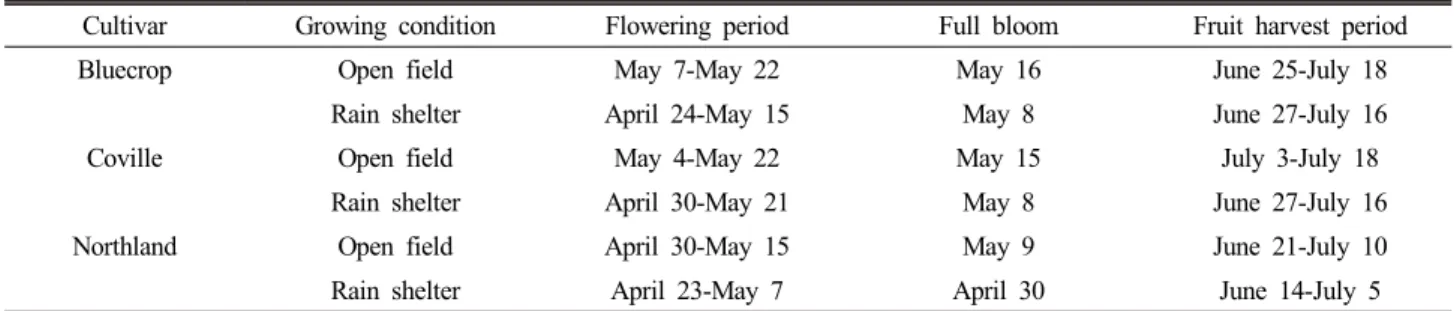
Table 1. Flowering and fruit harvest periods of ‘Bluecrop’, ‘Coville’, and ‘Northland’ highbush blueberry cultivars grown in an open field and in a rain shelter
Cultivar Growing condition Flowering period Full bloom Fruit harvest period
Bluecrop Open field May 7-May 22 May 16 June 25-July 18
Rain shelter April 24-May 15 May 8 June 27-July 16
Coville Open field May 4-May 22 May 15 July 3-July 18
Rain shelter April 30-May 21 May 8 June 27-July 16
Northland Open field April 30-May 15 May 9 June 21-July 10
Rain shelter April 23-May 7 April 30 June 14-July 5
Table 2. Fruit set and yield of ‘Bluecrop’, ‘Coville’, and
‘Northland’ highbush blueberry cultivars grown in an open field and in a rain shelter
zCultivar Growing condition
Fruit set (%)
Yield /shrub (g)
Estimated yield/10a
(kg) Bluecrop Open field 86.3 3,583 1,074.9
Rain shelter 41.0 1,206 361.8
Significance * *
Coville Open field 84.9 2,976 892.8 Rain shelter 59.6 1,116 334.8
Significance * *
Northland Open field 89.2 3,198 959.4 Rain shelter 14.5 617 185.1
Significance ** **
zValues represent the means of 10 replications (n = 10).
*, **indicate nonsignificant and significant differences at P <
0.05 or P < 0.01 by t-test, respectively.
μmol·m
-2·s
-1at 10:00, 1,430 μmol·m
-2·s
-1at midday, and less than 800 μmol·m
-2·s
-1after 16:00 (Fig. 1). In the rain shelter, however, PPFD slowly increased in the morning and slowly decreased after midday (Fig. 1). The PPFD in the rain shelter at midday was 65% of that in the open field. The air temperature was approximately 2-3℃ higher in the rain shelter than in the open field (Fig. 2).
All three cultivars began flowering and reached full bloom about one week earlier in the rain shelter than in the open field (Table 1). The elevated temperature (Fig. 2) can affect the earlier flowering and subsequent fruit ripening. Most of rain-sheltering culture has reported that fruit ripened earlier in shrubs grown in an unheated greenhouse than in ones grown in an open field (Gough, 1994; Mainland, 2002; Kim et al., 2011b). The flower buds hastens flower opening (Adams et al., 2001) and the time to maturity of fruit shortened (De Koning, 1989) by higher temperature of greenhouse (Table 1).
‘Coville’ and ‘Northland’ fruits were harvested 7 days earlier in the rain shelter. However, ‘Bluecrop’ fruits in the open field were harvested 2 days earlier than those of rain shelter in the present study. Effects of rain shelter may show the different results depending on the blueberry cultivar.
However, there was no difference in harvest period among three cultivars between open field and rain shelter (Table 1).
Nearly 100% of the florets of all three cultivars opened (data not shown). All three cultivars set fruit by nearly 90% of flowers when shrubs were grown in the open field, but was markedly reduced when shrubs were grown in the rain shelter (Table 2), to approximately 50% for ‘Bluecrop’ and ‘Coville’.
Fruit sets ratio of ‘Northland’ grown in the rain shelter was
14.5 (Table 2). Fruit yield was reduced about 1.77~5.18 times
Table 3. Fruit characteristics of ‘Bluecrop’, ‘Coville’, and ‘Northland’ highbush blueberry cultivars grown in an open field and in a rain shelter
zCultivar Growing condition
No. of seeds per berry
Length (㎜)
Diameter (㎜)
Length/
Diameter ratio
Weight (g)
SSC
(oBrix) TA (%) Firmness (N/φ1 ㎜)
Chromaticity
L* a* b*
Bluecrop Open field 66.5 13.1 17.2 0.8 2.92 11.5 0.23 2.25 38.0 0.75 -6.82
Rain shelter 68.4 12.3 17.4 0.7 2.75 12.8 0.31 2.91 41.3 0.36 -7.17
Significance ns *** ns *** ns ** * *** *** *** ns
Coville Open field 79.5 10.6 14.2 0.7 1.66 13.4 0.24 2.57 28.5 1.16 -6.00
Rain shelter 79.4 10.8 14.4 0.8 1.64 13.0 0.22 3.02 29.1 1.11 -5.68
Significance ns ns ns ns ns ns ns *** ns ns ns
Northland Open field 32.2 9.4 12.6 0.7 1.15 14.1 0.24 2.70 35.3 0.68 -6.58
Rain shelter 45.3 12.1 15.5 0.8 1.95 13.2 0.31 3.31 33.3 0.79 -5.85
Significance
Cultivar ** *** *** * *** ** * *** ** ns ***
Condition *** *** *** *** *** *** *** *** *** *** ***
Cultivar
×condition *** *** *** *** *** *** *** ns *** *** ***
zValues represent the means of 30 replications (n = 30).
ns, *, **, ***indicate nonsignificant and significant differences at P < 0.05, P < 0.01 or P < 0.001 by t-test, respectively.