1. INTRODUCTION
Because of the increasing demand for mobile da- ta [1], radio bandwidth needs to be used more efficiently. The underlay mode of device-to-device (D2D) communication is designed to reuse the spectrum of the traditional cellular communication.
In this communication mode, interference is a sig- nificant problem due to spectrum sharing. Two common approaches to deal with interference are power control and channel allocation. However, when these approaches are utilized separately, the joint effects between them are ignored. In this pa- per, we jointly consider them in a unified game theoric framework to improve the network-wide performance.
Join power control and channel allocation has the nature of a combinatorial problem. If we formulate
a mix-integer problem, we need to deal with high complexity. Coalition formation game provides a cooperative framework which can be used to for- mulate the channel sharing problem. Moreover, to avoid the exponential growth of coalition partition, we use probability distribution to represent the possibility that a coalition merges with others. In this way, each user does not need to enumerate all the possible partitions of the network when making its decision.
In this paper, we jointly consider power control and channel allocation for D2D communication. We propose a merge-and-split algorithm for the user equipments (UEs) to form coalitions and share spectrum, then based on the coalition partition, the D2D users (DUs) decide their transmit power. We use coalition formation game in order to improve network-wide performance since this game be-
Performance Enhancement for Device-to-Device Underlaying Cellular Network Using
Coalition Formation Game
Amr Radwan
†, Hoon Kim
††ABSTRACT
Interference in device-to-device (D2D) communication underlaying cellular network needs to be elaborately investigated because of channel sharing. The objective is to improve the quality of D2D communications while maintaining high performance for cellular users. In this paper, we solve the above problem by jointly considering channel allocation and power control using coalition formation game. Our cooperative game theoric approach allows to enhance network-wide performance. We design a merge-and-split algorithm to deal with the complexity of the combinatorial structure in coalition formation problem. The analytical and numerical results show that our algorithm converges to a stable point which achieves high network performance.
Key words: Device-to-device, Power Control, Channel Allocation, Wireless Network.
※ Corresponding Author : Hoon Kim, Address: (10380) Juhwa-ro 170, Ilsanseo-gu, Goyang-si, Gyeonggi-do, Korea, TEL : +82-31-910-7119, FAX : +82-31-910-7188, E-mail : [email protected]
Receipt date : May 20, 2016, Revision date : Aug. 16, 2016 Approval date : Aug. 22, 2016
††
Dept. of Information & Communication Eng., Inje University
(E-mail : [email protected])
††
Dept. of Emergency Medicine, Inje University Ilsan
Paik Hospital
longs to cooperative approach with non-selfish players. In other words, the players consider the system performance when making their own decision.
The summary of our contributions in this paper is expressed as follows
∙ We formulate a game theoric framework for joint power control and channel allocation in D2D underlaying cellular network. This framework ad- dresses the general scenario when multiple DUs can share the same channel.
∙ We propose a coalition formation algorithm and prove that it converges to a stable solution.
This algorithm is shown to enhance the quality of D2D communications while maintaining high per- formance of cellular users (CUs).
2. RELATED WORKS
There are several studies of channel allocation and power control in D2D underlaying cellular network. In [2] and [12], the coalition formation al- gorithms are developed for spectrum allocation of D2D communications. However, power control is not considered in these works. In [3], [4] and [5], the authors also used coalition formation algorithm for D2D resource allocation. The authors in [3]
considered spectrum resource sharing with fixed transmit power. In [4], the transmit power of CUs is predefined by eNB and the transmit power of DUs is equally assigned on each channel. The au- thors in [5] supposed that the base station (BS) and the transmitters of the D2D pairs transmit with fixed power, and the transmit power that the BS allocated to each resource block for cellular data transmission is equal.
Some other approaches for jointly considering channel allocation and power control in D2D un- derlaying cellular system are [6], [7], [8] and [9].
The studies in [6] and [7] adopt bipartite matching while those in [8] use Stackelberg game and those in [9] utilize column generation. The authors in [8]
adopted Stackelberg game which is non-coopera- tive approach while we use cooperative approach.
In [9], a joint channel and power allocation problem is formulated as a mixed integer programming which has high complexity.
In this paper, we jointly consider power control and channel allocation for D2D underlaying cellular system using coalition formation game. We pro- pose a merge-and-split algorithm which intends to improve the quality of D2D communications while maintaining high performance for CUs. We prove that this algorithm converges to the point that ach- ieves high network performance.
3. NETWORK MODEL
In this paper, the term DU can be used to refer to a DU pair. In our D2D underlying cellular sys- tem, one CU can share channel with multiple DUs, on the other hands, one DU can reuse channel of at most one CU. Channel allocation and power of CU are predefined since in this system, the power control first intends to control the transmission power of DUs such that the interference from DUs to CUs can be throttled [10].
Channel state is assumed to be fixed in the time interest. We assume that the BS has channel state information of the network and feedbacks to DUs.
We also assume a fully loaded cellular network scenario where the active CUs occupy all orthogo- nal channels in the cell and there is no spare spectrum. We consider uplink scenario since UEs are less capable of dealing with co-channel inter- ference than BSs.
4. JOINT CHANNEL ALLOCATION AND PO- WER CONTROL COALITIONAL GAME
4.1 Game Formulation
We denote as the set of cellular users and as the set of D2D pairs. A coalition is denoted as
while a coalition partition is denoted by . We
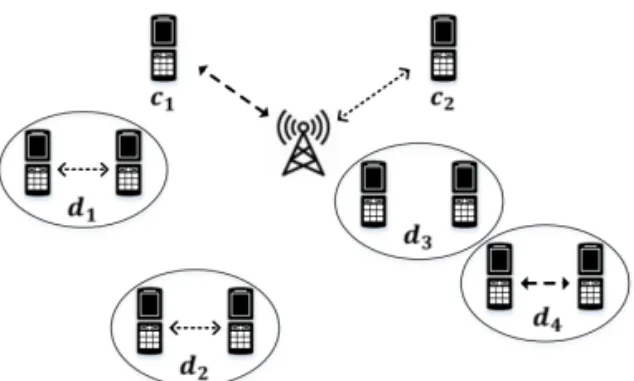
Fig. 1. An example of a partition with 2 coalitions:
and
.
denote
as the set of coalitions, each has one CU and zero or multiple DUs,
as the set of sin- gleton coalitions of one DU. Fig. 1 is an example of a partition with two coalitions. In order to avoid the exponential growth of combinatorial coalition formation, we proposed to use probability dis- tribution to represent the possibility that a coalition merges with others.
In this paper, the coalition value/utility is repre- sented by the SIR measurement. We first define the constructive and destructive power ratio which are used later in the definition of coalition value.
Definition 1
The constructive power ratio of in is the SIR of as
′ ∊
′ ≠
′
′
′
,
where the merging probability
denotes the probability that merges with ;
and
are the power of in , power of in , respectively;
the symbols
and
′denote the channel gain of D2D pair , gain from CU to the receiver of
and gain from the transmitter of ′ to the receiver of , respectively. The destructive power ratio of
to in is defined as
∊
∊
′
where
are gain from and to BS, re-
spectively; the destructive power ratio of to other DUs in is defined as
′ ∊
′ ∊
≠ ′
′
′∊ ′
≠ ′
′
′′′′
where ′ ∪ .
We can understand that the constructive power ratio represents the contribution of to the coali- tion . In our game model, this contribution is measured by SIR of the DU in coalition . In contrast, destructive power ratio of to CU and to other DUs represent interference of to CU and to other DUs, respectively. The intuition of the for- mulation of , and is shown in the Proposition 1 of the Section IV.B.
The value of the coalition is defined as the total value of users in this coalition. That value is given as
∊
where
∊
Initialize singleton coalitions: each user is a coalition for each ∊
for each ∊
Initialize
∝
∊
end for
end for
while is not
-stable do
Uniformly randomly select a DU ∊
Uniformly randomly select a coalition ∊
if then
←∪
end if
Uniformly randomly select a coalition ∊
and a DU ∊
if then
←\
←
∪
end if Update
′ ∊
′ ≠
′
′
′
end while
and
Algorithm 1. Proposed merge-and-split algo- rithm
We can see that the value represents the overall constructive and destructive power ratio of
in .
Definition 2
Merge rule: will merge with if . Split rule: an inside will split with if
.
The intuition behind the coalition game is that each user keeps on forming a coalition that gives a higher contribution to the system payoff of sum rate. The joint channel allocation and power control coalition formation algorithm is summarized in Alg. 1. Since this algorithm is performed at the base station (BS) in a centralized manner, we need to design an algorithm with low complexity. If the merge-and-split process is enumerated, the num- ber of partitions will increase exponentially with the increase of UE's quantity. In a large network, the complexity will become intractable. We pro- pose to use the merging probability
in order to avoid this complexity. In the algorithm, this proba- bility is first initialized in proportion with the value
. This means each DU tends to merge with the coalition that provides high utility. In each iter- ation, a pair of coalitions ∈
and ∈
are randomly selected. The merge condition on these two coalitions is verified and performed. Similarly, a pair of coalitions is selected for split operation.
After merge and split operations, the merging probability and transmit power are updated ac- cording to the new coalition partition. We note that
is the power threshold of in the coalition ; it is the maximum DUs' power that does not de- grade cellular performance. In the algorithm, each
∊
tries to merge with a cellular coalition in
, each ∊ ∊
tries to split with .
4.2 Property Analysis
Proposition 1: The following expression is maximized within the last stage of Alg. 1
∊
(1)
Proof:
We denote ′ as the value of after merges with .
∙ Merge case
After the merge-and-split process converges, we have that for all pair ∊
and ∊
, there is no merge action, which means ′ ≤ . We will prove that is maximized within the last stage, that is ∊
is maximized.
In fact, for each pair ∊
and ∊
, we have
′ ≤
or
′ ′ ′ ≤ (2) Based on the formulation of ,
and in the Definition 2, we also have
′ ′ ′
∊
′
′
∊
∊′
∊
∊≠
∊′≠
′
∊
∊
∊
∊ ≠
∊ ≠
′
∊
∊
∊
∊
≠
∊
≠