바실러스 미생물을 이용한 고농도 유가공 폐수처리에 있어서 유기물질과 영양염류의 동시제거에 대한 평가
Evaluation for the simultaneous Removal of Organic Matters and Nutrients by the RBC and tapered Aeration Processes with Bacillus sp. for the high Strength of Dairy Wastewater
이상호*
Sang Ho Lee*
상명대학교 환경공학과
(2010년 3월 5일 접수 ; 2010년 4월 5일 수정 ; 2010년 4월 9일 채택)
Abstract
The evaluation of organic matters and nutrients removal was investigated for the synthetic wastewater and the high strength of dairy wastewater. Two different systems were performed for this research. System A composing of a single RBC with tapered aeration was fed with the synthetic wastewater for 74 days with 173L/day of influent, 200% of internal return and 100% of sludge return for the period 1 and 2. The feed conditions were maintained 346L/day of influent, 50% of internal return and sludge return for the period 3. The dairy wastewater was introduced to evaluate treatment efficiency for system B composing of dual RBCs and tapered aeration tanks for 50 days of experimental run time, in which hydraulic rates were maintained at the constant ratios of 346L/day, 50% of internal return and 50% of sludge return. The spiral string media made of nylon fibre was attached by Bacillus sp. in RBC for both systems. The specific area of string media was 1.4m2/m and biomass was maintained at the concentrations of 23g/m. The synthetic wastewater was supplied by 1,800mg/L of glucose, 500mg/L of NH4Cl, and 500mg/L of KH2PO4 to system A. The dairy wastewater was supplied to system B from dairy production plant. The average influent concentrations were 1,334mg/L of BOD, 2,014mg/L of CODcr, 160mg/L of T-N, and 12mg/L of T-P in system A. The average influent concentrations of parameters were 1,006 mg/L for BOD, 1,875mg/L for CODcr, 51.6mg/L for T-N and 8.9mg/L for T-P in system B. Results indicated that removal efficiencies of BOD and CODcr were more than 90% however, the removal efficiency of T-N was 87%, and that of T-P was 82% for system A. Removal efficiencies were 98.5% of BOD, 91.3% of nitrogen and 89% of phosphorus for system B. The removal efficiencies of organic matters, T-N and T-P were higher in system B than in system A. The effluent quality issued by the stringent national legislations for the discharge of the high strength of dairy products wastewater can be improved using sequential RBCsand tapered aeration reactors rather than a single RBC and tapered aeration reactors with Bacillus sp.
Key words : Bacillus sp., high strength of dairy wastewater, removal of nutrients, sequential RBC process, tapered aeration, 주제어 : 바실러스 미생물, 고농도 유가공폐수, 점감포기, 유기물과 영양염류 동시제거
*Corresponding author Tel:+82-41-550-5308, Fax:+82-41-550-5012, E-mail: [email protected](Lee, S. H.)
1. INTRODUCTION
Wastewater treatment processes are characterized by the fact that active microorganisms are applied in the suspended state as well as in the attached state such as Rotating Biological Contactors (RBC). The suspended biomass can be usually in the form of small floc however, the attached biomass can be established on the solid surface or in the soft fibre bundle (CAO and Alaerts, 1996). Most of research papers pursued to remove organics and nutrients with activated sludge. A number of processes to remove nutrients including nitrification and denitrification have been applied with mixed cultures.
However, a special attention was recently given into using Bacillus sp. as microorganisms in the biological treatment because it is worth noticing of nitrogen removal (Liu, et. al., 2008), metal removal (Zheng, et.
al., 2008; Quintelas, et. al., 2008) and flocculation (Lian, et. al., 2008, Kolehmainen, et. al., 2009). Nitrogen can be removed upto 60% efficiency under the low concentration of dissolved oxygen and ammonia can be also removed without accumulation of nitrite (Helmer, et al., 1998). Simultaneous removal of organics and nutrients was tried with recycling in RBC system (Klees and Silverstein, 1992; Watanabe, et. al., 1995 Gupta and Gupta, 1999). The effect of recirculation and step-feed was investigated to remove organic matters and nutrients with conducting RBC (Ayoub and Salkaly, 2004). The methods to improve the nutrient removal efficiencies include step-feeding, supplemental aeration and recycling. However, limited study has conducted to evaluate the simultaneous removal efficiencies of organic matters and nutrients with sequential RBCs with Bacillus sp. for the high strength of dairy wastewater. Ammonia can be oxidized to nitrate near the biofilm surface into the anoxic layer such as Anammox process (Wouter, et.
al., 2007). Several new nitrogen removal processes have been developed to treat high strength of wastewaters.
Ammonia is autotrophically oxidized to nitrogen gas with nitrite as the electron acceptor under oxygen limited conditions (Kuai and Verstraete, 1998 Windey, Bo and Verstraete, 2005). A number of conventional or alternative nitrification and denitrification schemes to remove nitrogen have been proposed and most of them
are already applied in real treatment plants (Marazioti, et. al., 2003). Nitrogen removal with simultaneous nitrification and denitrification process accompanied by carbon removal was performed in a single and multi-stage RBC biofilm (Gupta and Gupta, 1999). Early works have been performed to remove carbon and nitrogen in muti-stage RBC systems (Weng and Molf, 1974, Pano and Middlebrooks, 1983). The objectives of this research were to evaluate predominant role of the quantitative and comparable removal of organic matters, nitrogen and phosphorus. Two systems were performed in order to evaluate the removal efficiencies, in which one system composed of a single RBC fed with synthetic wastewaterand the other system composed of dual RBC fed with a dairy wastewater. The significant role of tapered aeration and biomass with Bacillus sp. was also compared with two different systems.
2. METHODS
Preparation of microorganisms: A freeze-dried pellet of Bacillus sp. was obtained from a wastewater treatment plant. The agar solution was prepared with 20g of dissolved tryptic soy agar, 0.25g of NaCl, 0.15g of MgSO4 and 1.5g of K2HPO4 in 1L of distilled water.
The solution was sterilized at 105oC for 30 minutes in an autoclave. The dissolved agar solution was poured in several Petri dishes. The pellet was rehydrated and sterilized in order to select only Bacillus sp. at 80oC for 30 minutes in a shaking water bath. The sterilized solution was poured and incubated on Petri dishes at 37.5oC for 24 hours in an incubator. The bacterial growth on the surface of Petri dishes was transferred in order to grow in the nutrient broth solution. The nutrient broth was prepared with nutrient broth, K2HPO4, CaCl2 and MgSO4in 1L of distilled water. The solution was maintained at 121oC for 15 minutes.
Several times of inoculation was performed to use microorganisms in the experiment. It is interesting to note that Bacillus sp. in the string media was activated in RBC and 1st aeration tank but those microorganisms were turned out spores in the anoxic state of 2nd and 3rd aeration tanks by the oxygen limitation. The spores were germinated in both BRC and the 1st aeration tank.
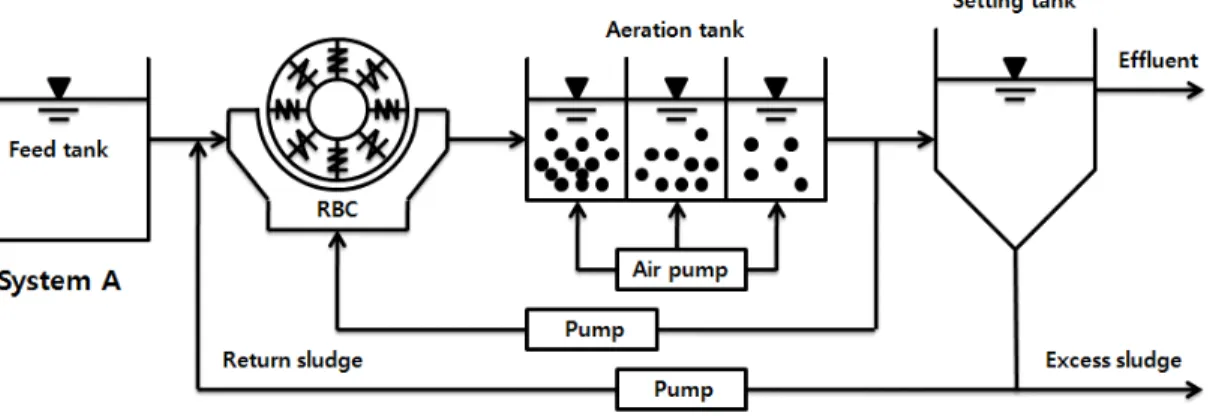
Fig. 2 Schematic diagram of the experimental setups, System A for a single RBC with three tapered aeration tanks was fed with the synthetic wastewater.
Fig. 1 Microscopic image of Bacillus sp. microorganisms in RBC (left) and spores in the 3rd aeration tank (right) at 1,000x magnification.
The grown up microorganisms in the RBC and spores in the 3rd aeration tank were confirmed through the microscopic method during experimental days as shown in Fig. 1.
Experimental setups and operating conditions: The processes used in this experimental study are divided into two different processes. System A was composed of a single RBC with 80L capacity followed by three tapered aeration tanks with 70 L each as shown in Fig.
2. RBC is composed of 4 disks with string type media that allows penetrating synthetic wastewater through RBC disks. Total length of string type media was 8.9m in four disks, total surface area of media was 12.4m2 and the total amount of attached MLSS was 203g. The specific surface area is 1.4m2/m and the unit MLSS of the string media was 23g/m. For system A with the synthetic wastewater, the influent flow rate was maintained at 173L/day with 200% of internal return and 100% of sludge return for the experimental run
period 1 and period 2. The rate of internal return and sludge return condition changed to 50% for 32 days after adaptation period 1 and 2. The dissolved oxygen concentration was maintained about 1.8 to 2.0mg/L to germinate Bacillus sp. in the 1st aeration tank. The dissolved oxygen concentrations for the aeration tanks were controlled in order to make spores for Bacillus sp. about 0.7mg/L for the 2nd tank and 0.4mg/L for the 3rd tank. The concentration of MLSS in RBC and the aeration tanks were maintained from 3,100mg/L to 3,300mg/L throughout the experimental days. The hydraulic retention times of each reactor are 2.8 hrs for RBC, 3.4 hrs for aeration tank and 4.7 hours for settling tank respectively. The experimental runs were differentiated by three periods, the period 1 for the adaptation of microorganisms was run for 29 days, the period 2 for the stabilization of the microorganisms for 13 days, and the period 3 was maintained to confirm the steady state for 32 days.
Parameters System A System B
Range Average Range average
BOD 1,204-1,462 1,334 602-1,358 1,006
CODcr 1,097-2,476 2,014 1,235-2,552 1,875
T-N 143-180 160 28.5-65.7 51.6
T-P 6.3-16.4 12 6.6-13.7 8.9
Table 1 Influent characteristics of synthetic wastewater for system A and dairy wastewater for system B.
Fig. 3 Schematic diagram of the experimental setups, System B was fed with dairy wastewater for dual RBCs with three tapered aeration tanks.
The other process composing of dual RBCs with three tapered aeration tanks for system B is shown in Fig.
3. Each RBC has four disks in which the diameter of the disks is 43 cm with a diameter of 3.5cm string media made of fine nylon fibre. Total length of the media in a RBC is 21.4m, the specific surface area per unit length is 1.4m2/m, then the total surface area of string is 30m2 and the attached biomass per unit length is 23g/m, then total amount of Bacillus sp. attached on the string media for a RBC is 493g. The volumetric capacities of system are 1,000L of feed tank and 43L of RBC with 48%
submergence of the disk surface area, the total volume of two RBC is 86L with 20rpm as close as system A, 70L of each aeration tank and 73L of settling tank. For system B as shown in Figure 3, influent flow rate was 346L/day and the hydraulic retention time is 2.8 hours for RBC, 3.4 hours for each aeration tank and 3.4 hours for settling tank, respectively. The rate of the internal return and return sludge was same as 50% of flow rate, respectively. Several peristaltic pumps were operated to fit the hydraulic retention time. The real dairy
wastewater was supplied for system B. The dissolved oxygen concentration of each aeration tank was maintained as same conditions as system A. The effect of dissolved oxidation for a gradual anoxic state on the inactivation of Bacillus sp. spores in the aeration tanks was confirmed with microscopic method after Gram stain.
Characteristics of the influent: T he system A was continuously fed with the synthetic wastewater composing 1,800mg/L of glucosefor carbon source, 500mg/L of NH4Cl for T-N, and 500mg/L of KH2PO4
for T-P. The system B was fed from wastewater of a dairy products plant after stabilization period. Dairy products as yoghurt, fruit products and other milk products are produced from the factory. The characteristics of influent are shown in Table 1. The individual parameters of nutrients for inorganic nitrogen and phosphorus are not analyzed because national regulations control total nitrogen and total phosphorus and the organic matters are regulated as BOD instead of individual organic matter for the effluent.
Time (days)
0 10 20 30 40 50 60 70
BOD(mg/L)
0 200 400 600 800 1000 1200 1400 1600
Removal Efficiency (%)
0 10 20 30 40 50 60 70 80 90 100
Influent RBC AerationTank 1 AerationTank 2 AerationTank 3 Effluent Removal rate
Period 1 Period 2 Period 3
(A)
0 5 10 15 20 25 30 35 40 45 50
BOD (mg/L)
0 200 400 600 800 1000 1200 1400 1600
Removal Effciency (%)
0 10 20 30 40 50 60 70 80 90 100
Influent RBC 1 RBC 2 Aeration tnak Effluent Removal Efficiency
Time (days) (B)
Fig. 4 Removal performance of organic matters as BOD in two systems over the experimental period using Bacillus sp.: System A for a single RBC and System B for dual RBC.
Time (days)
0 10 20 30 40 50 60 70
CODCr (mg/L)
0 500 1000 1500 2000 2500 3000
Removal Efficiency (%)
0 10 20 30 40 50 60 70 80 90 100
Influent Effluent Removal rate
Period 1 Period 2 Period 3
(A)
Time(day)
0 5 10 15 20 25 30 35 40 45 50
CODCr (mg/L)
0 500 1000 1500 2000 2500 3000
Removal Efficiency (%)
0 10 20 30 40 50 60 70 80 90 100
Influent RBC 1 RBC 2 Aeration Effluent Removal Efficiency
(B)
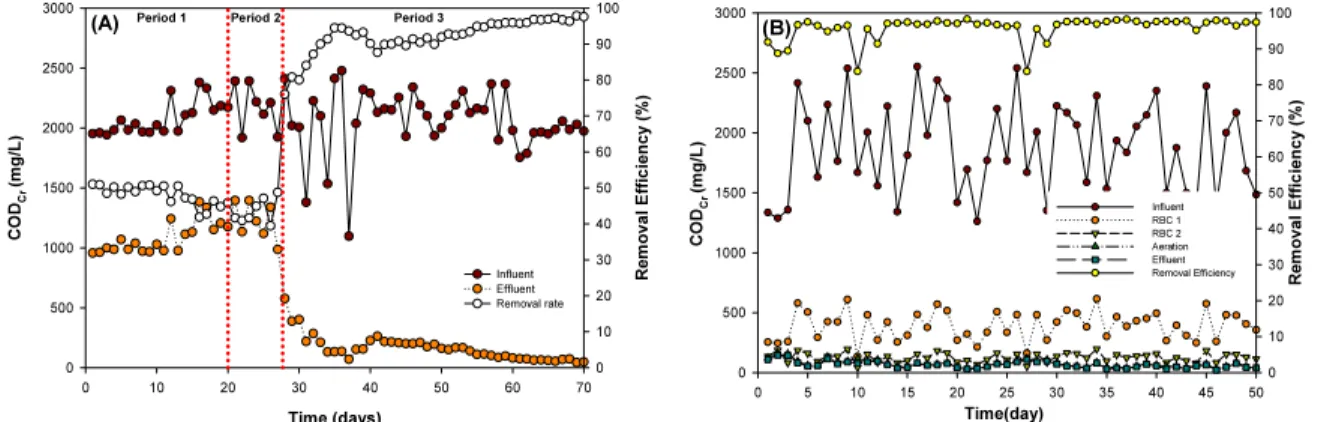
Fig. 5 Removal performance of organic matters as CODcr in two systems over the experimental period using Bacillus sp.: System A for a single RBC and System B for dual RBC.
3.RESULTS AND DISCUSSION
3.1. Removal of organic matters
The influent concentrations for synthetic wastewater of BOD were from 1,462mg/L as the maximum to 1,204mg/L as the minimum through the experimental period for system A. Results of organic matter removal as BOD were obtained 90% removal for system A, which are shown in Fig. 4(A). The BOD of influent variation were 1,006mg/L as average, 602mg/L as the minimum and 1,358mg/L as the maximum in system A.
The daily influent concentrations much fluctuated caused by dairy wastewater characteristics which may be explained by daily changing products. Therefore the fluctuation of influent was greater than the synthetic
wastewater. However the final removal efficiency of BOD was 98.5% at the end of experimental days in system B shown in Fig. 4(B). The ranges of influent concentration for synthetic wastewater as CODcr were 2,014 mg/L as average, 1,097mg/L as the minimum and 2,476mg/L as the maximum for system A. The total removal efficiencies of CODcr were performed at 96%
in system A. The influent concentration for the dairy wastewater is illustrated in Table 1. The removal efficiency of CODcrwas as low as 50% through the period 2, however the total removal efficiency of CODcr
was obtained 96.7% at the end of experimental days shown in Fig. 5. The microorganisms of returned sludge may be germinated in the RBC reactor and 1st aeration tank, which recycled from the sedimentation tank. The
Time (days)
0 10 20 30 40 50 60 70
T-N (mg/L)
0 20 40 60 80 100 120 140 160 180 200
Removal Efficiency (%)
0 10 20 30 40 50 60 70 80 90 100
Influent Effluent Removal rate
Period 1 Period 2 Period 3
(A) (B)
Time (days)
0 5 10 15 20 25 30 35 40 45 50
T-N (mg/L)
0 20 40 60 80 100
Removal Efficiency (%)
0 10 20 30 40 50 60 70 80 90 100
Influent RBC 1 RBC 2 Aeration Tank Effluent Removal Efficiency
(B)
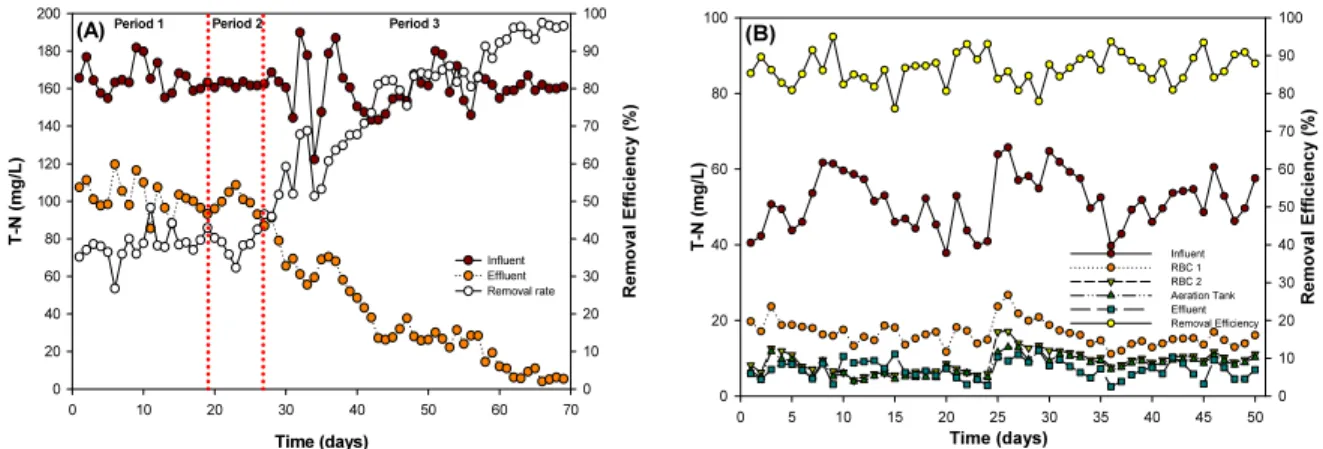
Fig. 6 Comparable results of the nitrogen removal as T-N through the experimental period in System A and System B.
Bacillus sp. can be activated by returning from sedimentation tank and the end of RBC reactor for internal recycle. Germination was occurred in the RBC reactor and the 1st aeration tank. The microscopic evidence already presented in Figure 1. The removal of organic matter was mainly revealed in the 1st RBC and 1staeration tank. The 2nd and 3rd aeration tanks played an important role on sporulation of Bacillus sp.
and the supplemental removal of organic matters. The sporulation was happened in the tapered aeration tank because the tapered aeration might give the extreme stress to the microorganisms. However, the suspended process for Bacillus sp. also played an important role to remove organic matters in RBC and the tapered aeration tanks. The total removal efficiency of CODcr
reached 98.5% for System B. The mechanism of biological luxury uptake is known that microorganisms to remove phosphorus may use organic matters during accumulate PHB as carbohydrates (Barnard, 1974).
The removal efficiency of organic matter was more than 80 % in the 1st RBC the rest of organic matter was removed in the 2nd RBC. This result was coincident with the previous experimental result (Gupta and Gupta, 1999).
3.2. Removal of nitrogen
The removal efficiencies in steady-state operating conditions in system A and resulting effluent concentration for nitrogen as T-N are shown in Fig.
6. The influent concentrations of nitrogen as T-N for
the single RBC system were at the range from 28.5mg/L to 65.7mg/L and 51.6mg/L as the average concentration. Removal efficiency of nitrogen was 87%
and the effluent concentration was 6.6mg/L in System A. The influent concentrations of nitrogen as T-N for the sequential RBCs were from 65.7mg/L to 28.5mg/L and 54.3mg/L as the average concentration. Removal efficiency of nitrogen was 91.3% with 4.7mg/L as effluent concentration in System B. The figures shown in Fig. 4 depict the different role between a single RBC and a dual RBC for the removal of nitrogen. High removal efficiency obtained from the RBC reactors with Bacillus sp. may be explained that nitrogen was assimilated in the form of organic nitrogen rather than inorganic nitrogen by Bacillus sp. The discharge standard for nitrogen is regulated at 20mg/L for the year of 2013 whatever influent concentration is from the industrial wastewater in Korea. The effluent cannot be satisfied for the regulation with a single RBC and tapered aeration system however, a sequential RBC and tapered aeration system can satisfy the national regulated standards. In general nitrification and denitrification process in order to remove nitrogenas nitrogen gas, however high dissolved oxygen concentration should be maintained for nitrification but low level of dissolved oxygen condition must be in order to keep up the anoxic state. Therefore nitrification or denitrification process is not necessary in this system.
For system A fed with synthetic wastewater the operation conditions were unstable caused by
Time (days)
0 10 20 30 40 50 60 70
T-P (mg/L)
0 4 8 12 16 20
Removal Efficiency (%)
0 10 20 30 40 50 60 70 80 90 100
Influent Effluent Removal rate
Period 1 Period 2 Period 3
(A)
Time (days)
0 5 10 15 20 25 30 35 40 45 50
T- P (mg/L)
0 4 8 12 16 20
Removal Efficiency (%)
0 10 20 30 40 50 60 70 80 90 100
Influent RBC 1 RBC 2 Aeration Tank Effluent Removal Efficiency
(B)
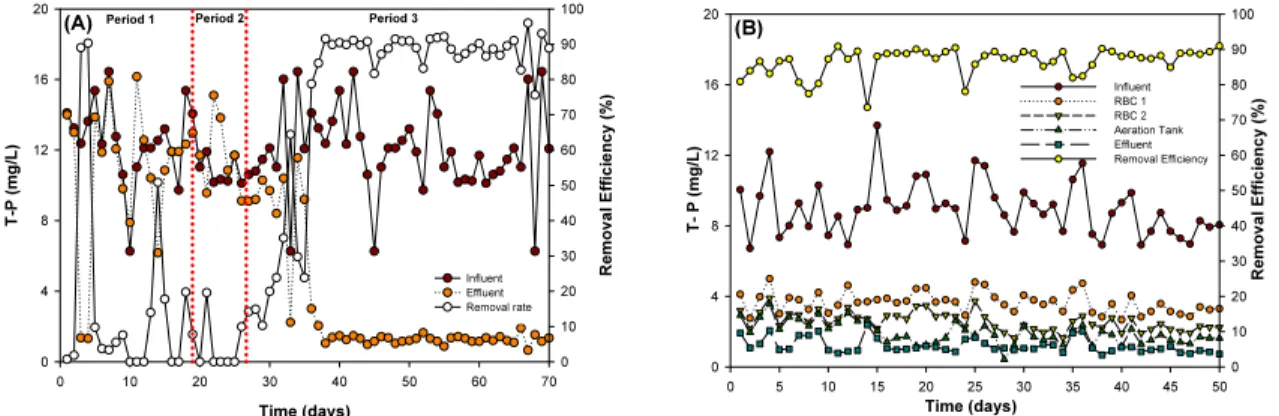
Fig. 7. Variation of influent, effluent of T-P concentration and removal efficiencies in system A and system B.
insufficient MLSS, therefore the effluent quality was unsatisfied for the period 1 and 2. After period 1, MLSS was maintained stable for 2 weeks. Period 2 was stabilization period. For more than 40 days of experimental run system A was maintained stable condition then at the end of run period 3 the removal efficiency of BOD was up to 95%. System B was fed with real dairy waste water to dual RBC and tapered aeration tanks with the experience of system A. the nitrogen removal was not satisfied with the 1st RBC even if the influent concentration of nitrogen was low in system B. Then the dissolved oxygen concentration was maintained as low as 0.4 mg/L which leads to anoxic condition in order to make spores in three aeration tanks. It is interesting to note that the real dairy wastewater contains organic nitrogen then the condition was simulated as anammox condition in the anoxic condition.
3.3. Removal of Phosphorus
The T-P concentration of influent and the effluent concentration for each reactor were shown for a single RBC in Fig. 7(A) and for sequential RBCs in Fig. 7(B), respectively. The influent concentrations of T-P were from 16.4mg/L to 6.3mg/L and 12mg/L as the average concentration for system A. The effluent concentration of T-P was 1.6mg/L throughout the experimental period in system A. The removal efficiency of T-P was 82%.
In system B with a sequential RBC the influent concentrations of T-P were from 13.3mg/L to 6.6mg/L
and 8.9mg/L as the average concentration of T-P. The removal efficiency of T-P was 89%. It is interesting to note that the removal efficiency of T-P was highly improved using a sequential RBC rather than a single RBC with Bacillus sp. The luxury uptake was occurred in two RBCs because the dissolved oxygen concentration was maintained 1.8mg/L and the role of 2nd and 3rd aeration tank is sporulation of Bacillus sp by the gradual reduced oxygen supply. The conventional treatment to remove phosphorus adopt anaerobic or anoxic condition phosphorus release then luxury uptake in the aerobic condition. However, dissolved oxygen concentration was maintained as low as 0.5 mg/L and high MLSS was maintained in this system.
4. CONCLUSIONS
The results of our study demonstrate that the more improved treatment efficiency was obtained by operating of dual sequential RBC with Bacillus sp. rather than a single RBC following tapered aeration processes. In both systems high levels of removal efficiencies for organic matters and those of nutrients were mainly occurred simultaneously by Bacillus sp. in RBC. The removal efficiencies of organic matters were up to 90%, 87% for nitrogen and 82% for phosphorus, respectively in system A. However, removal efficiencies were 98.5% of BOD, 91.3% of nitrogen and 89% phosphorus for system B.
The supplementary removal efficiency was gained in the tapered aeration tanks however,it was not that much. The
high removal efficiency confirms that the organic matters and nitrogen can be removed simultaneously by activated state of Bacillus sp. in the RBC reactor. Tapered aeration induces that the deadly low concentration of dissolved oxygen makes spores for the enhancement of sedimentation. The characteristics of Bacillus sp. help the high removal of nitrogen as organic nitrogen form instead of individual inorganic nitrogen. The results obtained in this research RBC process using Bacillus sp.
may indicate to eliminate nitrification and denitrification process. The sequential RBC reactors and tapered aeration system can be used for the stringent effluent standards. The removal efficiency of organic matter and nitrogen and phosphorus was simultaneously obtained.
The removal of nitrogen was happened without nitrification and denitrification process. Also the removal of phosphorus was taken in the tapered aeration tanks.
REFERENCES
Ayoub, G.M. and Saikaly, P. (2004) The combined effect of step-fed and recycling on RBC performance, Water Research, 38, pp.3009-3016.
Barnard, J.L. (1974) Cut P and N without chemicals Part 1 and 2, Water Waste Eng., 11, pp.33-41.
CAO, Y.S. and Alaerts, G.J. (1996) A model for oxygen consumption in aerobic heterotrophic biodegradation in dual-phase drainage systems, Water Research, 30(4), pp.1010-1022.
Gupta, A.B. and Gupta, S.K. (1999) Simultaneous carbon and nitrogen removal in a mixed culture aerobic RBC biofilm, Water Research, 33(2), pp.555-561.
Helmer, C., Kunst, S., Juretschko, S., Schmid, M.C., K.H. and Wagner, M. (1998) Nitrogen loss in a nitrifying biofilm system, Water Science and Technology, 39(7), pp.13-21.
Klees, R. and Silverstein, J. (1992) Improved biological nitrification using recirculation in rotating biological contactors, Water Science and Technology, 26, pp.545-553.
Kolehmainen, R.J., Korpela, J.P. Munster, U. and Puhakka, J.A.
(2009)Extracellular enzyme activities and nutrient availability during artificial groundwater recharge, Water Research, 43, pp.405-416.
Kuai, L.P. and Verstraete, W. (1998) Ammonium removal by the oxygen-limited autotrophic nitrification- denitrification system, Appl. Environ. Microbiol., 64 (11), pp.4500-4506.
Lian, B, Chen, Y., Zhao, J., Teng, H.H., Zhu, L. and Yuan, S.
(2008) Microbial flocculation by Bacillus mucilaginosus:
Applications and mechanisms, Biosource Technology, 99, pp.4825-4831.
Liu, S., Gong, Z., Yang, F., Zhang, H., Shi, L. and Furukawa, K. (2008) Combined process of urea nitrogen removal in anaerobic Anammox co-culture reactor. Bioresource Technology, 99, pp.1722-1728.
Marazioti, C., Kornaros, M. and Lyberatos, G. (2003) Kinetic modelling of a mixed culture of Pseudomonas Denitrificants and Bacillus subtilis under aerobic and anoxic operating conditions, Water Research, 37, pp.1239-1251.
Pano, A. and Middlebrooks, E.J. (1983) Kinetics of carbon and nitrogen removal in RBCs, J. Wat. Pollut. Control Fed., 55(7), pp.956-965.
Quintelas, C., Fernandes, B., Castro, J., Figueiredo, H. and Tavares, T. (2008) Biosorption of Cr(VI) by a Bacillus coagulans biofilm supported on granular activated carbon (GAC), Chemical Engineering Journal, 136, pp.195-203.
Watanabe, Y., Okabe, S., Hirata, K. and Musuda, S.(1995) Simultaneous removal of organic materials and nitrogen by micro-aerobic biofilms, Water Science and Technology, 31, pp.195-203.
Weng, C.N. and Molof, A.H. (1974) Nitrification in the biological fixed film rotating disk system, J. Wat. Pollut.
Control Fed., 46(7), pp.1675-1685.
Windey, K., Bo, I.D. and Verstraete, W. (2005) Oxygen-limited autotrophic nitrification-denitrification (OLAND) in a rotating contactor treating high-salinity wastewater, Water Research, 39, pp.4512-4520.
Wouter, R.L., Star, v.d., Abma, W.R., Blommers, D., Mulder, J., Tokutomi, T., Strous, M., Picioreanu, C. and Loosdrecht, M.C.M. (2007) Startup of reactors for anoxic ammonium oxidation: Experiences from the first full-scale anammox reactor, Water Research, 41, pp.
4149-4163.
Zheng, Y., Fang, X., Ye, Z, Li, Y. and Cai, W. (2008) Biosorption of Cu(II) on extracellular polymers from Bacillus sp. F19, J. of Environmental Science, 20, pp.1288-1293.