• 검색 결과가 없습니다.

Uncertainty of Hydro-meteorological Predictions Due to Climate Change in the Republic of Korea

N/A
N/A
Protected

Academic year: 2021

Share "Uncertainty of Hydro-meteorological Predictions Due to Climate Change in the Republic of Korea"

Copied!
11
0
0

로드 중.... (전체 텍스트 보기)

전체 글

(1)

韓國水資源學會論文集 第47卷 第3號 2014年 3月 pp. 257~267

기후변화에 따른 우리나라 수문 기상학적 예측의 불확실성

Uncertainty of Hydro-meteorological Predictions Due to Climate Change in the Republic of Korea

은코모제피 템바 * / 정 상 옥 **

Nkomozepi, Temba / Chung, Sang-Ok

...

Abstract

The impact of the combination of changes in temperature and rainfall due to climate change on surface water resources is important in hydro-meteorological research. In this study, 4 hydro-meteorological (HM) models from the Rainfall Runoff Library in the Catchment Modeling Toolkit were used to model the impact of climate change on runoff in streams for 5 river basins in the Republic of Korea. Future projections from 2021 to 2040 (2030s), 2051 to 2070 (2060s) and 2081 to 2099 (2090s), were derived from 12 General Circulation Models (GCMs) and 3 representative concentration pathways (RCPs). GCM outputs were statistically adjusted and downscaled using Long-Ashton Research Station Weather Generator (LARS-WG) and the HM models were well calibrated and verified for the period from 1999 to 2009. The study showed that there is substantial spatial, temporal and HM uncertainty in the future runoff shown by the interquartile range, range and coefficient of variation. In summary, the aggregated runoff will increase in the future by 10~24%, 7~30% and 11~30% of the respective baseline runoff for the RCP2.6, RCP4.5 and RCP8.5, respectively. This study presents a method to model future stream-flow taking into account the HM model and climate based uncertainty.

Keywords : climate change, uncertainty, water resources, GCM ensemble, rainfall-runoff model

...

요 지

기후변화에 따른 기온과 강수량의 변화가 지표수자원에 미치는 영향은 수문기상학 연구에서 매우 중요하다. 본 연구에 서는 기후변화가 우리나라 5대강 유역의 유출량에 미치는 영향을 분석하기 위하여 Catchment Modeling Toolkit의 네 가지 수문기상 모형을 사용하였다. 세 가지 RCP 시나리오에 대하여 12개 GCM 모형으로부터 미래 2021에서 2040까지(2030s), 2051에서 2070까지(2060s) 및 2081에서 2099까지(2090s) 기간에 대한 기후자료를 추출하였다. 이들 자료는 LARS-WG 방법 으로 상세화하였으며, 수문기상 모형들은 1999부터 2009까지의 관측자료를 이용하여 보정 및 검정하였다. 본 연구에서 미래 의 유출량은 사분위 범위, 전체 범위 및 변동계수 값이 시공간적으로 및 수문기상 모형에 따라서 큰 불확실성을 나타내었다.

종합적으로 볼 때 미래의 유출량은 기준년도에 비하여 RCP2.6, RCP4.5 및 RCP8.5 시나리오에 대하여 10~24%, 7~30%

및 11~30% 증가할 것으로 예상되었다. 본 연구는 수분기상모형과 기후변화 예측의 불확실성을 고려한 미래의 유출량을 모의할 수 있는 방법을 제시하였다.

핵심용어 : 기후변화, 불확실성, 수자원, GCM ensemble, 강우-유출 모형

...

* 전 경북대학교 농업토목공학과 박사과정 (e-mail: [email protected])

Former Ph.D. Student, Department of Agricultural Engineering, Kyungpook National University

** 교신저자, 경북대학교 농업토목공학과 교수 (e-mail: [email protected], Tel: 82-53-950-5734) Corresponding Author, Department of Agricultural Engineering, Kyungpook National University

J. KOREA WATER RESOURCES ASSOCIATION Vol. 47, No. 3:257-267, March 2014 http://dx.doi.org/10.3741/JKWRA.2014.47.3.257

pISSN 1226-6280 • eISSN 2287-6138

(2)

1. Introduction

The combination of changes in temperature and rainfall due to climate change have been predicted to have adverse effects on surface water supplies, riparian habitats and soil moisture levels resulting in an altered water balance, thus affecting hydrological resources and agriculture (Rivarola Sosa et al., 2011; Gardner, 2009).

The potential increase in the water demand for agricul- ture can be addressed by exploiting new sources of supply and reducing consumption to maintain sustain- able utilization of water resources (Shi et al., 2013). In any case, it is important to assess the impacts of climate change on water resources to better understand the potential effects and possible adaptation and mitigation measures. The possible effects of climate change on stream flow have been successfully estimated based on multivariate regressions between runoff and climate parameters in specific river basins (Gardner, 2009).

However, theoretical and practical challenges lie in the use of statistical methods because the changes in flow over time have a complex relationship with the indi- vidual river basin characteristics (e.g. basin geology and elevation) such that future climate scenarios may lie outside the ranges where the relationships are valid.

The climate change impacts on a river basin’s hydro- logy can be investigated using hydrological models forced by the rainfall and evaporation data derived from General Circulation Model (GCM) outputs corresponding to specific climate change scenarios (Chen et al., 2012).

Generally, future meteorological data such as tempera- ture, rainfall, wind speed, relative humidity, etc. are derived from GCM outputs which are then altered (i.e.

downscaled, statistically adjusted and bias corrected) to resolve the spatial resolution challenge (Eum et al., 2010). The structural complexity of the hydrological model to be selected is warranted by the objective of the assessment and available input data. Velázquez et al. (2013) noted that conceptual models can be used to rapidly assess the impact of different climate scenarios while physically based models can be used to assess the combined impacts of land-use and climate change.

Kim et al. (2013a) examined the impacts of climate

change and land use on the stream flow in the Hoeya River Basin, Republic of Korea using two Representa- tive Concentration Pathways (RCPs) and the Soil and Water Assessment Tool (SWAT), a physically based and semi-distributed model. In their study, the changes in stream flow under future conditions of climate and land use change were consistent with those in which only the climate changed. Alternatively, Lee et al. (2012) used the Stream flow Synthesis and Reservoir Regula- tion (SSARR) model, a conceptual rainfall-runoff model, to carry out a sensitivity analysis of the parameters related to the basin runoff in the Han River basin.

Deterministic assessments based on only one GCM or scenario are incomplete, but rather multiple climate or hydrological model scenarios should be used to obtain less uncertain results (Kling et al., 2012). By the same token, instead of selecting the “best” among the multiple scenarios, studies have shown that it is more comprehensive and more reliable to aggregate the fore- casts (Kim et al., 2006). The uncertainty of the impact of climate change reported in literature arises from the spatial disparities and the diversity of runoff modeling approaches. Bae et al. (2011) analyzed the uncertainty of the impacts of climate change on runoff in the Chungju Basin using 13 GCMs, 3 semi-distributed hydrological models, 7 ET methods and 3 SRES scenarios. The study showed significant uncertainty in runoff even under the same climate change simulations due to the different hydrological and ET models. Jeong et al. (2013) used one GCM and two Special Report on Emissions Scenarios (SRES) scenarios and predicted modest increases in runoff of 2.2% to 4.8% in the Chungju Basin with changes in potential evapotranspiration (ET) and soil moisture of +7.6 to +15.3% and -2.1% to -1.8%, respectively, for the 2080s. In another study, Sohn et al. (2014) used 3 GCMs and one SRES scenario and reported changes in runoff from -35% to +40% by the 2080s in Korea. Kim et al.

(2013b) used a weighting method, 4 GCMs and 3 SRES scenarios and reported monthly runoff increases of up to 58% in July and August and decreases of up to -66%

in October for the 2080s in Korea.

In summary, most of the recent studies predicted

runoff to increase as a result of climate change. However,

(3)

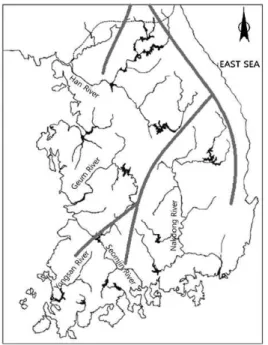
Fig. 1. Map of Mountain Ranges (thick line) and Major Rivers in Korea (Chung, 2013)

River Basin

Drainage area (km

2

)

Basin average slope (%)

Shape

factor Circularity

ratio Elongation

ratio Drainage density

Channel segment frequency

altitude Max (m)

Han* 23,293 18.81 1.95 0.23 0.35 1.73 2.55 1,710

Nakdong 23,702 32.26 1.62 0.25 0.34 2.91 4.13 1,912

Geum 9,914 16.74 1.12 0.23 0.29 2.51 4.84 1,609

Seomjin 4,914 32.57 1.37 0.14 0.35 1.62 1.78 1,646

Yeongsan 3,470 20.91 1.15 0.23 0.49 1.44 1.44 1,177

*Excluding the area in North Korea. Source: www.wamis.go.kr

Table 1. Physical Characteristics of 5 Basins

the magnitudes of change differ significantly depending on modeling methodology including GCMs, downscaling, hydrological models etc. The objective of this study is to assess the contribution of hydrological models and GCMs to the uncertainty of the impact of climate change on runoff in the 5 major river basins in Korea. The study will use multiple plausible estimates of climate change with 4 hydrological models, a 12 GCM ensemble and 3 state of the art greenhouse gas concentration projectiles.

2. Material and methods 2.1 Study area

Korea lies in the Far East (Fig. 1) and there are five

major river systems in Korea that play an important role as a water resource for agriculture, industry and municipalities (Table 1). The average annual rainfall in Korea is 1,245 mm (ca. 1.4 times the global average).

However, due to the high population, average rainfall per capita is only 2,591 m

3

(ca. 0.13 times the global average). In addition, 65% of the land is mountainous and the channel slopes of rivers are steep therefore Korea suffers significant seasonal, annual and regional variations of rainfall and runoff. Only ca. 58% of the total volume of water resources of 1,240 million m

3

per annum is runoff in streams which is utilized in stream water, dam and groundwater usage. A large portion of the runoff (ca. 31%) flows to the West, South and East Seas (Ministry of Environment, http://http://eng.me.go.

kr/). Overall, about 99% of the inflow into the multi- purpose dams was discharged downstream within the same year over the period from 1999 to 2009 (Oh, 2013).

2.1 Study data

Daily climate data including temperature and rainfall for 1971 to 2009 were collected from the Korean Meteo- rological Administration database (www.kma.go.kr).

Daily runoff data from 1999 to 2009 for the 5 basins

were extracted from the Water Management Informa-

tion System (WAMIS) database courtesy of the Korea

Water Resources Corporation and the Ministry of Land,

Infrastructure and Transport. The period from 1971 to

2000 represents the baseline (reference period) and data

from 1999 to 2009 were used in the calibration and veri-

fication of the hydro-meteorological (HM) models. The

calibration and verification period was selected because

(4)

Model Modeling Center

ACCESS1.0 CSIRO (Commonwealth Scientific and Industrial Research Organisation, Australia), and BOM (Bureau of Meteorology, Australia)

BCC-CSM1 Beijing Climate Center, China Meteorological Administration CCSM4 National Center for Atmospheric Research

CNRM-CM5 Centre National de Recherches Meteorologiques / Centre Europeen de Recherche et Formation Avancees en Calcul Scientifique

FGOALS-G2 LASG, Institute of Atmospheric Physics, Chinese Academy of Sciences GFDL-CM3 Geophysical Fluid Dynamics Laboratory

GISS-E2 NASA Goddard Institute for Space Studies

HADGEM-ES Met Office Hadley Centre, Instituto Nacional de Pesquisas Espaciais, Korea Meteorological Administration

INMCM4 Institute for Numerical Mathematics IPSL-CM5A Institut Pierre-Simon Laplace

MIROC5 Atmosphere and Ocean Research Institute (The University of Tokyo), National Institute for Environmental Studies, and Japan Agency for Marine-Earth Science and Technology MRI-CGCM3 Meteorological Research Institute

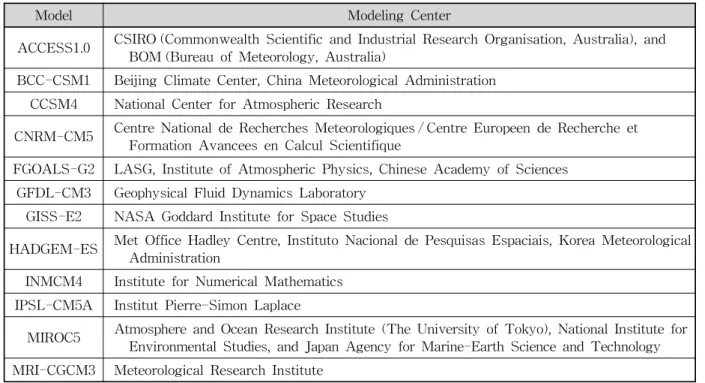
Table 2. Selected GCMs

it represents the latest continuous time series dataset of at least 10 years with observed runoff. Thereafter, data from 12 General circulation models (GCMs) and 3 Representative concentration pathways (RCPs) for 1971

~2000 (1985s), 2021~2040 (2030s), 2051~2070 (2060s) and 2080~2100 (2090s) were extracted from an online database courtesy of the World Climate Research Pro- gram’s Working Group on Coupled Modeling (CMPI5). 12 out of a possible 60 GCMs were selected for this study (Table 2). GCMs with sufficient historical and future datasets of the representative concentration pathways (RCPs) family were selected. The uncertainty and dis- parities between the different GCMs warrant the use of a multi-GCM and multi RCP ensemble for impact assessments (Zhang et al., 2011). The selected number allows sufficient assessment of uncertainty without exacerbating the computational demands of the study.

The 3 RCPs were selected for this study because they generally cover the range of radiative forcing and green- house gas concentration trajectories examined by the climate modeling community. RCP4.5 and RCP6.0 are both medium stabilization scenarios but only RCP4.5 was used in this study. RCP4.5 has more output data- set availability and is more commonly used in literature

than RCP6.0 (Van Vuuren, 2011; Moss et al., 2010).

Evapotranspiration (ET) data were computed from maxi- mum temperature, minimum temperature, average wind speed, average humidity, and average solar radiation/

sunshine hours using a modified Microsoft Excel sprea- dsheet (ET

o

-PM) for computing the reference eva- potranspiration (ET

o

) that uses the Penman- Monteith equation (Lupia, 2013).

The output from different GCMs is provided at coarse

spatial resolution scales and needs to be adjusted to be

applicable to local conditions. In Korea, various tech-

niques including statistical and dynamic downscaling,

bias correction and weather generators etc. have been

employed to address the resolution challenge. The Long

Ashton Research Station weather generator (LARS-

WG) was used in this study. The mean of the absolute

(for temperature) and relative differences (rest of para-

meters) between the GCM baseline and future scenarios

were used to perturb the observed baseline using

LARS-WG. LARS-WG simulates rainfall occurrence

using a two state, first-order Markov chain: rainfall

amounts on wet days using a gamma distribution and

temperature and radiation components using first order

tri-variate auto-regression conditional on rainfall occur-

(5)

rence. The gamma distribution is used in the LARS- WG because it matched the observed data better than other exponential models used in the development of the weather generator (Nkomozepi and Chung, 2014).

2.2 Hydrological models

Four widely utilized conceptual rainfall-runoff models contained in the Rainfall Runoff Library (RRL) (Podger, 2004) in the Catchment Modeling Toolkit were used to generate runoff in this study. The models were selected because (1) they have been successfully tested and applied across a wide range of different climate and locations (2) they all use a reasonably low number of parameters that are convenient for quick calibration and verification and (3) they have user friendly graphic user interfaces that make it easy to provide input data and extract output data (Schreider et al., 2002). The models are SIMHYD (Chiew and Siriwardena, 2005), Sacramento Soil Moisture Accounting model (SAC-SMA) (Burnash et al., 1973), Australian Water Balance Model (AWBM) (Boughton, 2004) and Soil Moisture Accounting and Routing with Groundwater component model (SMARG) (Vaze et al., 2011).

The AWBM is a water balance model that estimates the base-flow recharge and surface runoff from 3 surface storages where rainfall is added and ET subtracted.

Consequently, the total runoff is calculated from the base-flow storage and surface runoff routing storage.

AWBM utilizes 8 parameters including the 3 surface storages, base-flow index, initial moisture in base-flow and surface runoff storage, and the base-flow and surface runoff recession constants. In the SAC-SMA model, water is distributed within hypothetical zones of a soil column. Initially, rainfall either enters the upper tension zone or directly becomes runoff if it falls on impervious surfaces. Thereafter free water is distributed to the interflow or percolation (which becomes base- flow) and finally the runoff is estimated. SAC-SMA estimates ET losses from both the lower and upper tension water, upper free zone water and from the channel. In addition, losses from deep percolation are also subtracted from the base flow and channel. SAC- SMA utilizes 11 parameters.

In SIMHYD, rainfall either fills the interception stor- age or directly becomes runoff from impervious sur- faces. The excess rainfall infiltrates and runoff is esti- mated from infiltration excess runoff, interflow, satura- tion excess runoff and base-flow. ET is deducted from the interception, soil moisture and impervious runoff storages. SIMHYD utilizes 9 parameters namely base- flow coefficient, impervious threshold, infiltration coef- ficient, infiltration shape, interflow coefficient, pervious fraction, rainfall interception storage capacity, recharge coefficient and the soil moisture store capacity. Finally in SMARG, rainfall is partitioned to infiltration and direct runoff. The runoff is then estimated from the rainfall and moisture in excess of the infiltration capa- city with the aid of a groundwater linear reservoir. ET is deducted from soil moisture and direct runoff.

SMARG utilizes 9 parameters. The input data into all of the 4 models are daily rainfall, ET and observed flow (Vaze et al., 2011). More detailed descriptions and illustrations of these models are available in Podger (2004).

2.3 Hydro-meteorological model calibration and verification

The HM models herein contain 37 parameters that

are not directly observable. To overcome this challenge,

warming up, calibration and verification are used to

derive the optimum parameters that will give the best

agreement between observed and simulated runoff

values. Observed daily rainfall, ET and runoff data from

1999 to 2006 were used for calibration while data from

2005 to 2009 were used for verification. In both calibra-

tion and verification, the first 4 months were to “warm

up” i.e. training to determine initial values for soil

moisture stores. The genetic algorithm optimization

method generally gave the best performance and was

used for optimization in this study. In addition, the

Nash-Sutcliffe and runoff difference (%) criterion were

used as the primary and secondary optimization objec-

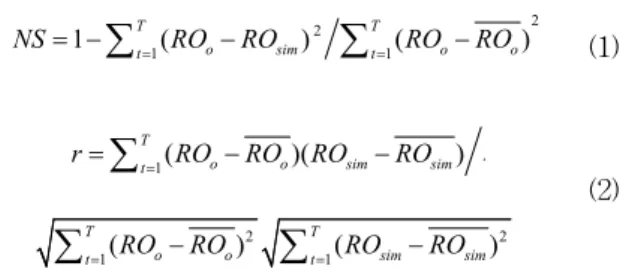
tives, respectively. The Nash-Sutcliffe efficiency (NS)

and correlation coefficients (r) given in Eqs. (1) and (2)

are the 2 efficiency measures used for the evaluation of

hydro-meteorological model performance herein.

(6)

Fig. 2. Projected Relative Annual Rainfall Change and Absolute Temperature Change

2 2

1 1

1

T

(

o sim

)

T

(

o o

)

t t

NS RO RO RO RO

= =

= - å - å - (1)

2 2

1

( )( )

1

( )

1

( )

T T T

o o sim sim o o sim sim

t t t

r RO RO RO RO RO RO RO RO

= = =

= å - - å - å -

(2)

2 2

1

( )( )

1

( )

1

( )

T T T

o o sim sim o o sim sim

t t t

r = å

=

RO - RO RO - RO å

=

RO - RO å

=

RO - RO

where RO

o

is the observed runoff, RO

sim

is the simu- lated runoff, bar represents mean, t is the daily time step and T is the total number of days from calibration or verification.

2.4 Projected climate and runoff analysis Analyses will be based on the annual mean runoff, a key hydrological indicator. Kim et al. (2006) established that aggregate predictions are more accurate therefore data in this study were combined to allow analyses for the baseline, near, mid and long term future periods referring to the 1985s, 2030s, 2060s and 2090s, respec- tively. The data were combined by taking an arithmetic average of the predictions in each scenario as shown in Eq. (3).
 

 

 

  

(3)

where i and T are the initial year and last year, respectively, in the given time period, 0.5 (i+T)s refers to rounded down median year for the respective time period (1985s, 2030s, 2060s and 2090s), v

t

is annual mean variable (i.e. rainfall, temperature evapotranspira- tion and runoff) for a year t in the given time period.

Changes in temperature are presented as the absolute differences of the projected and baseline temperatures.

On the other hand, the projected changes in rainfall, evapotranspiration and runoff are presented as relative changes with respect to the baseline (1970~2000) values as shown in Eq. (4).

relative v change = v

future

/ v

baseline

(4) where v is the variable (i.e. rainfall, evapotranspiration and runoff) for the respective future period, v

future

is the value variable for the future (i.e. 2030s, 2060s and 2090s) and v

baseline

is the value of the variable for the baseline (1971~2000).

For visualization and analysis purposes, the relative v changes (Eq. 4) for the future periods from the 12 GCM ensemble are presented in box and whisker plots for each scenario. The whiskers indicate the full data range, the box shows the interquartile-range and the line across the boxes represents the mean. The inter- quartile range represents 50% of the distribution and is a measure of the uncertainty along with the range. In the final analysis, the predictions from all the provinces and HM models are combined.

3. Results and discussion 3.1 Projected climate

The projected changes for the grid boxes that cover

Korea in the temperature and rainfall from the 12 GCMs

3 RCPs are shown in Fig. 2. The mean changes and the

respective coefficient of variation (CV) are given in

(7)

Variable RCP2.6 RCP4.5 RCP8.5

30s 60s 90s 30s 60s 90s 30s 60s 90s

Temperature

change (°C) 1.25

(0.39) 1.6

(0.42) 1.48

(0.44) 1.27

(0.42) 2.06

(0.36) 2.42

(0.35) 1.34

(0.34) 2.78

(0.31) 4.41 (0.27) Relative change

in rainfall 1.06

(0.05) 1.08

(0.06) 1.09

(0.10) 1.03

(0.05) 1.07

(0.06) 1.09

(0.09) 1.02

(0.07) 1.10

(0.05) 1.11 (0.10)

CV in parentheses ( )

Table 3. The Changes in the Mean Temperature and Relative Rainfall and Respective Coefficient of Variation

Fig. 3. Projected Relative ET Change Table 3 For the RCP2.6, temperature is projected to

increase in the 2030s, peak in the 2060s and decline in the 2090s. For the RCP4.5 and RCP8.5 temperature will increase for all periods in the future with higher in- creases in the RCP8.5. The temperature CV for the RCP2.6 is higher than that for the other RCPs; further- more, it increases in the future while that of the others decreases towards 2100. Rainfall and the respective CV on the other hand will increase in all the future periods.

In the 2090s for all three RCPs there is at least one GCM that gives an outlier (significantly higher) predic- tion of an increase in rainfall of about 30%. The mean, spread and other features of the climate are important in interpreting the patterns and trends in the projected runoff. Bae et al. (2008) found that the magnitude and variability in the rainfall affects that of runoff. The historical long term trends for the mean annual runoff in the 5 river basins addressed in Bae et al. (2008) were similar to those for annual rainfall.

Fig. 3 shows the projected changes in ET. The ET will continually increase in the future for the RCP4.5 and RCP8.5 while for the RCP2.6 ET will peak in the 2060s and slightly decline in the 2090s. The trend pattern in the ET is also similar to those in temperature

and ultimately in the radiative forcing of the respective RCPs. The largest increases in ET were projected for the Han River basin while the least increases were projected for the Nakdong River basin for all RCPs. The uncertainty (interquartile range and range) is highest for the RCP8.5 and lowest for the RCP2.6.

3.1 Hydro-meteorological model calibration and verification

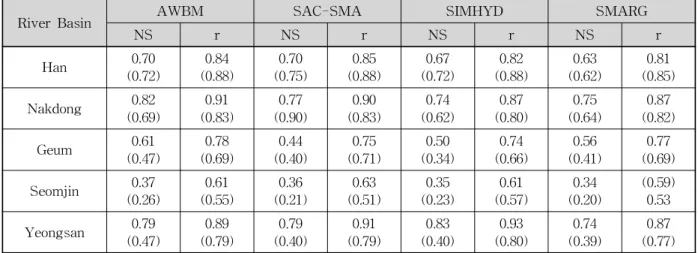
Table 4 shows the two efficiency measures used to

assess the HM model performance over the calibration

and validation periods. With the exception for the

Seomjin river basin for which the model performance

was barely acceptable, the HM models generally per-

formed well. The poorer performance for the Seomjin

river basin can be traced back to its much lower

compactness i.e. the circularity ratio of the basin in

comparison with the others (shown in Table 1). In other

research, the hydrological model efficiency was also

linked to basin characteristics i.e. factors such as

channel slope, shape and size (Nester et al., 2011). On

another note, the NS efficiency is poorer than r in all

cases. This is because that the NS efficiency is more

sensitive to peak flows than is r (Krause et al., 2005).

(8)

River Basin AWBM SAC-SMA SIMHYD SMARG

NS r NS r NS r NS r

Han 0.70

(0.72) 0.84

(0.88) 0.70

(0.75) 0.85

(0.88) 0.67

(0.72) 0.82

(0.88) 0.63

(0.62) 0.81 (0.85)

Nakdong 0.82

(0.69) 0.91

(0.83) 0.77

(0.90) 0.90

(0.83) 0.74

(0.62) 0.87

(0.80) 0.75

(0.64) 0.87 (0.82)

Geum 0.61

(0.47) 0.78

(0.69) 0.44

(0.40) 0.75

(0.71) 0.50

(0.34) 0.74

(0.66) 0.56

(0.41) 0.77 (0.69)

Seomjin 0.37

(0.26) 0.61

(0.55) 0.36

(0.21) 0.63

(0.51) 0.35

(0.23) 0.61

(0.57) 0.34

(0.20) (0.59) 0.53 Yeongsan 0.79

(0.47) 0.89

(0.79) 0.79

(0.40) 0.91

(0.79) 0.83

(0.40) 0.93

(0.80) 0.74

(0.39) 0.87 (0.77) Table 4. Nash-Sutcliffe Efficiency Coefficient (NS) and Correlation (r) for the Calibration (1999~2006) and Verification (2005~2009) Periods

Fig. 4. Hydro-meteorological Model Uncertainty A disadvantage of the NS is that the differences

between the observed and simulated values are squared therefore larger values in the time series strongly affect the NS whereas lower values are neglected.

Fig. 4 shows the hydro- meteorological model uncer- tainty over the calibration and validation period. The runoff data were converted from m

3

s

-1

to mm by dividing the flow by basin area to allow for spatial analysis. The observed aggregated mean annual runoff from 1999 to 2009 was 1181, 686, 709, 905 and 727 mm for the Han, Nakdong, Geum, Seomjin and Yeongsan river basins.

The highest runoff was shown in the Han River basin while the lowest was in the Nakdong River basin.

However, the highest uncertainty is shown in the Seomjin river basin while the lowest is shown for the Han River basin. With the exception of the Seomjin river basin, the mean observed runoff is generally higher

than the runoff simulated by the HM models. This can

be attributed to the flaw of the use of the NS as a primary

objective in the calibration and validation. By way of con-

trast, despite the efficiency measures NS and r being poor

for the Seomjin and Geum River basins, the combined

estimates of the four HM models for these river basins

were closest to the observed runoff (± 5%). According

to the efficiency measures AWBM had the best perfor-

mance and SMARG had the poorest, while according to

the accuracy (the mean closeness to the observed runoff)

SAC-SMA had the best performance and SIMHYD had

the worst. The disagreement in ranking of performance

based on accuracy and efficiency measures further

confirms that the NS and r are very sensitive to peak

flows. Fig. 4 also shows that the aggregated means of

the HM models generally gives better estimates of the

runoff than from each of the HM models.

(9)

Fig. 5. Projected Relative Change in the Mean Annual Runoff For the 5 River Basins

RCP Han Geum Nakdong Seomjin Yeongsan

30s 60s 90s 30s 60s 90s 30s 60s 90s 30s 60s 90s 30s 60s 90s

RCP2.6 1.25 (0.12) 1.24

(0.11) 1.29 (0.12) 1.06

(0.01) 1.06 (0.01) 1.10

(0.01) 1.05 (0.02) 1.05

(0.02) 1.08 (2) 1.07

(0.02) 1.08 (0.02) 1.09

(2) 1.02 (0.03) 1.03

(0.03) 1.07 (0.03) RCP4.5 1.24

(0.12) 1.33 (0.13) 1.36

(0.13) 1.05 (0.01) 1.12

(0.01) 1.14 (0.01) 1.06

(0.02) 1.10 (0.02) 1.17

(2) 1.06 (0.02) 1.12

(0.02) 1.13 (2) 1.00

(0.03) 1.08 (0.03) 1.09

(0.02) RCP8.5 1.25

(0.14) 1.36 (0.13) 1.34

(0.10) 1.07 (0.03) 1.17

(0.02) 1.15 (0.01) 1.05

(0.04) 1.15 (0.03) 1.19

(2) 1.07 (0.01) 1.13

(0.01) 1.20 (2) 1.02

(0.03) 1.11 (0.03) 1.14

(0.02) All 1.25

(0.11) 1.31 (0.12) 1.33

(0.11) 1.06 (0.02) 1.12

(.04) 1.13 (0.02) 1.06

(0.03) 1.10 (0.04) 1.14

(5) 1.07 (0.02) 1.11

(0.02) 1.14 (5) 1.01

(0.03) 1.07 (0.04) 1.10

(0.04)

CV in parentheses ( )

Table 5. Projected Relative Mean Runoff Change and CV 3.2 Projected runoff

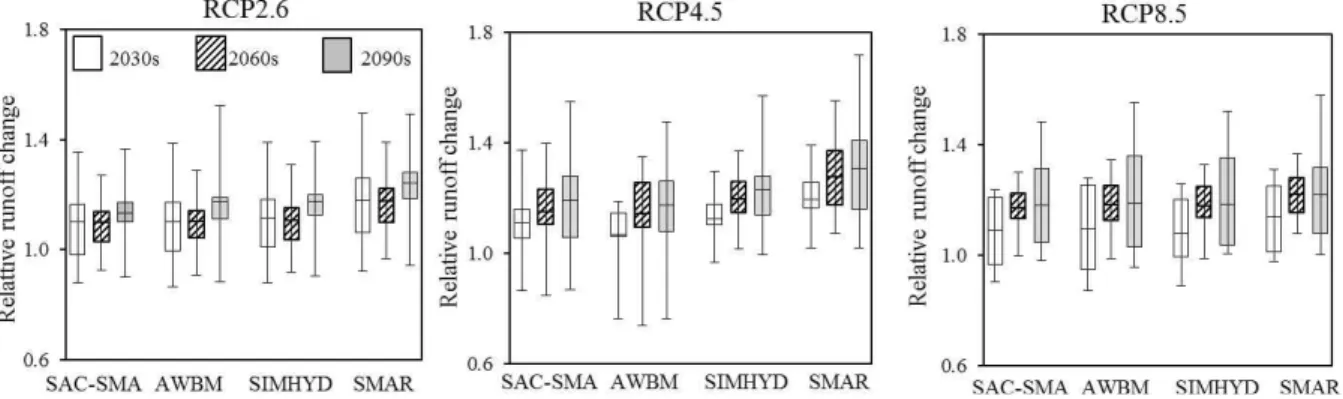
The simulated annual mean runoff over the baseline period was 940, 511, 434, 811 and 554 mm for the Han, Nakdong, Geum, Seomjin and Yeongsan river basins, respectively. The average of these is 650 mm. Fig. 5 shows that the mean annual runoff will increase by 10

~24%, 7~30% and 11~30% of the respective baseline runoff for the RCP2.6, RCP4.5 and RCP8.5, respectively.

For the RCP2.6 and RCP4.5, runoff was projected to increase for the 2030s, stabilize in the 2060s and climb again in the 2090s. For the RCP8.5 however, the mean runoff was projected to rise to a peak in the 2060s and then level or slightly decline in the 2090s. There is substantial uncertainty in the results noticeable by the interquartile ranges that range from 0.07 to 0.33 while the range varies from 0.33 to 0.71 (Fig. 5). For instance, for RCP 2.6 SAC-SMA 2030s, the interquartile range is 0.24 (of 650 mm) which represents 156 mm while the range is 0.50 (of 650 mm) which represents 325 mm. In

RCPs 4.5 and 8.5 the interquartile range slumps in the 2060s and is highest in the 2090s. The interquartile range is highest in the RCP8.5 and least for the RCP2.6.

However, the range is largest in RCP2.6 and least in the RCP8.5. Overall, the projected increase in runoff can be explained by the projected increases in rainfall. As highlighted by Velázquez et al. (2013), the results of this study also show that the selection of the GCM strongly affects the impacts of climate change on runoff. This study covers a wide range of plausible climate change (12 GCMs) and therefore our results differ significantly from those of previous studies in which less GCMs, greenhouse gas concentration pro- jectile and hydrological models are considered (Jeong et al., 2013; Kim et al., 2013b; Sohn et al., 2014).

3.3 Hydro-meteorological model uncertainty

Table 5 shows the projected relative change of mean

runoff and coefficient of variation (CV) when the

hydrological model predictions for a GCM for each HM

(10)

model are combined. Overall, the mean projected rainfall will increase to about 1.02 to 1.36 of the baseline runoff in the future. The CV ranges from 0.1 to 0.14. This shows that the combined GCM and HM uncertainty (CV) of runoff predictions lay close the uncertainty (CV) in the prediction of rainfall which ranged from 0.05 to 0.10 and were much less than those for temperature which ranged from 27 to 44%. Similarly, Kling et al. (2012) also linked the uncertainty in the climate change signals with the uncertainty in the projected runoff but a systematic relationship could not be determined.

This study looked at projecting the future changes in the annual mean runoff and the associated uncertainty.

Even though the results herein may differ when other statistical adjustment and downscaling methods, GCMs, RCPs and HM models are used, this study is valuable in that the simple approach used herein can be easily reproduced for any study area with minimum input data.

4. Conclusion

This study presented the projections of the impact of climate change on runoff from 5 major river basins in Korea that cover a combined area of 65,293 km

2

, using 12 GCMs, 3 RCPs and 4 hydrological models for the 2030s, 2060s and 2090s. Overall, the mean annual runoff will increase in the future by between 2 and 34%. The associated uncertainty is also substantial and the coef- ficient of variation ranges from 0.01 to 0.34. The most rapid increasing trends of the runoff are shown for the Han River basin for the RCP8.5 and RCP4.5. The substantial uncertainty in the runoff was attributed to the uncertainty in the projected rainfall, however; a direct relationship could neither be determined by river basin, nor RCP or time period. Overall, runoff will increase because the increases in rainfall were predicted to be larger than the increases in evapotranspiration demand over the study area.

References

Bae, D.H., Jung, I.W., and Chang, H. (2008). “Long term

trend of rainfall and runoff in Korean river basins.”

Hydrological Processes, Vol. 22, No. 14, pp. 2644- 2656.

Bae, D.H., Jung, I.W., and Lettenmaier, D.P. (2011).

“Hydrologic uncertainties in climate change from IPCC AR4 GCM simulations of the Chungju Basin, Korea.” Journal of Hydrology, Vol. 401, No. 1, pp.

90-105.

Boughton, W. (2004). “The Australian water balance model.” Environmental Modelling & Software, Vol.

19, No. 10, pp. 943-956.

Burnash, R.J.C., Ferral, R.L., and McGuire, R.A. (1973).

A Generalized Streamflow Simulation System-Con- ceptual Modelling for Digital Computers. US Depart- ment of Commerce, National Weather Service and State of California, Department of Water Resources, USA.

Chen, H., Xiang, T., Zhou, X., and Xu, C.Y. (2012). “Impacts of climate change on the Qingjiang Watershed’s runoff change trend in China.” Stochastic Environmental Research and Risk Assessment, Vol. 26, pp. 847-858.

Chiew, F.H.S., and Siriwardena, L. (2005). Estimation of SIMHYD parameter values for application in un- gauged catchments. In: MODSIM 2005 International Congress on Modelling and Simulation, Melbourne, December 2005, pp. 2883- 2889.

Chung, S.O. (2013). “Projecting future paddy irrigation demands in Korea.” Irrigation and Drainage, Vol. 62, pp. 297-305.

Eum, H.I., Simonovic, S.P., and Kim, Y.O. (2010). “Climate change impact assessment using k-nearest neighbor weather generator: case study of the Nakdong River basin in Korea.” Journal of Hydrologic Engineering, Vol. 15, No. 10, pp. 772-785.

Gardner, L.R. (2009). “Assessing the effect of climate change on mean annual runoff.” Journal of Hydrology, Vol. 379, pp. 351-359.

Jeong, H.-G., Kim, S.-J., and Ha, R. (2013). “Assessment of climate change impact on storage behavior of chungju and regulation dams using SWAT Model.”

Journal of Korea Water Resources Association, Vol.

46, pp. 1235 -1247.

Kim, C.-R., Kim, Y.-O, Seo, S.-B., and Choi, S.-W.

(11)

(2013b). “Water balance projection using climate scenarios in the Korean Peninsula.” Journal of Korea Water Resources Association, Vol. 46, pp. 807-809.

(in Korean)

Kim, J., Choi, J., Choi, C., and Park, S. (2013a). “Impacts of changes in climate and land use/land cover under IPCC RCP scenarios on streamflow in the Hoeya River Basin, Korea.” Science of the Total Environment, Vol.

452, pp. 181-195.

Kim, Y.O., Jeong, D., and Ko, I.H. (2006). “Combining rainfall-runoff model outputs for improving ensemble streamflow prediction.” Journal of Hydrologic Engi- neering, Vol. 11, No. 6, pp. 578-588.

Kling, H., Fuchs, M., and Paulin, M. (2012). “Runoff con- ditions in the upper Danube basin under an ensemble of climate change scenarios.” Journal of Hydrology, Vol. 424-425, pp. 264-277.

Krause, P., Boyle, D.P., and Bäse, F. (2005). “Comparison of different efficiency criteria for hydrological model assessment.” Advances in Geosciences, Vol. 5, No. 5, pp. 89-97.

Lee, S.J., Maeng, S.J., Kim, H.S., and Na, S.I., (2012).

“Analysis of runoff in the Han River basin by SSARR model considering agricultural water.” Paddy and Water Environment, Vol. 10, No. 4, pp. 265-280.

Lupia, F., 2013. ETo-PM version 0.9. Available on the internet. URL http://dspace.inea.it.

Moss, R.H., et al. (2010). “The next generation of scenarios for climate change research and assessment.” Nature, Vol. 463, No. 7282, pp. 747-756.

Nester, T., Kirnbauer, R., Gutknecht, D., and Blöschl, G.

(2011). “Climate and catchment controls on the per- formance of regional flood simulations.” Journal of Hydrology, Vol. 402, No. 3, pp. 340-356.

Nkomozepi, T., and Chung, S.-O. (2014). “The effects of climate change on the water resources of the Geumho River Basin, Republic of Korea.” Journal of Hydro-environment Research, pp. 1-9. (in press) Oh, B.-H. (2013). 2012 Modularization of Korea’s

Development Experience: Korea’s River Basin Mana- gement Policy. Ministry of Strategy and Finance, Sejong, Republic of Korea. 88pp.

Podger, G. (2004). RRL Rainfall Runoff Library users

guide. Cooperative Research Centre for Catchment Hydrology. Victoria. Australia.

Rivarola Sosa, J.M., Brandani, G., Dibari, C., Moriondo, M., Ferrise, R., Trombi, G., and Bindi, M. (2011).

Climate change impact on the hydrological balance of the Itaipu Basin. Meteorological Applications, Vol. 18, No. 2, pp. 163-170.

Schreider, S.Y., Jakeman, A.J., Letcher, R.A., Nathan, R.J., Neal, B.P., and Beavis, S.G. (2002). Detecting changes in streamflow response to changes in non- climatic catchment conditions: farm dam development in the Murray-Darling basin, Australia. Journal of Hydrology, Vol. 262, No. 1, pp. 84-98.

Shi, C., Zhou, Y., Fan, X., and Shao, W. (2013). A study on the annual runoff change and its relationship with water and soil conservation practices and climate change in the middle Yellow River basin. Catena, Vol.

100, pp. 31-41.

Sohn, K.-H., Bae, D.-H., and Ahn, J.-H. (2014).

Projection and analysis of drought according to future climate and hydrological information in Korea.

Journal of Korea Water Resources Association, Vol.

47, pp. 71-82. (in Korean)

Van Vuuren, D.P. (2011). The representative concentration pathways: an overview. Climate Change, Vol. 109, pp. 5-31.

Vaze, J., Post, D.A., Chiew, F.H.S., Perraud, J.M., Teng, J., and Viney, N.R. (2011). Conceptual rainfall-runoff model performance with different spatial rainfall inputs. Journal of Hydrometeorology, Vol. 12, No. 5, pp. 1100-1112.

Velázquez, J.A., et al. (2013). An ensemble approach to assess hydrological models' contribution to uncertainties in the analysis of climate change impact on water resources. Hydrological and Earth System Sciences, Vol. 17, pp. 565-578.

Zhang, X.-C., Liu, W.-Z., and Chen, J. (2011). Trend and uncertainty analysis of simulated change impacts with multiple GCMs and emission scenarios. Agricultural and Forest Meteorology, Vol. 151, pp. 1297-1304.

논문번호: 13-100 접수: 2013.12.13

수정일자: 2014.02.05 심사완료: 2014.02.05

수치

Fig. 1. Map of Mountain Ranges (thick line) and Major Rivers in Korea (Chung, 2013)
Table 2. Selected GCMs
Fig. 2. Projected Relative Annual Rainfall Change and Absolute Temperature Change22111T(osim)T(oo)ttNSRORORORO=== -å-å-(1)221()()1()1()TTT
Fig. 3. Projected Relative ET ChangeTable 3 For the RCP2.6, temperature is projected to
+3

참조

관련 문서