• 검색 결과가 없습니다.

A Study on improving the Performance of Transshipment Cargo System at the Port of Busan

N/A
N/A
Protected

Academic year: 2021

Share "A Study on improving the Performance of Transshipment Cargo System at the Port of Busan"

Copied!
8
0
0

로드 중.... (전체 텍스트 보기)

전체 글

(1)

A Study on improving the Performance of Transshipment Cargo System at the Port of Busan

Suk-Tae Bae

ABSTRACT

This study will examine the consolidation that is occurring in the shipping industry and its effects on Busan’s status as a key transshipment hub in Southeast Asia as well as what measures the port must implement to attract transshipment traffic. With this in mind heading forward, trends in transshipment cargo, problems facing the port, as well as the current status of transshipment volumes at the Port of Busan must be fully understood so that thorough research can be done into appropriate measures to stimulate growth and attract cargo traffic. In this study, We analyze the current problems and status of transshipment cargo at Busan Port and factors affecting the competitiveness of transshipment cargo at Busan New Port, Korea’s key import/export gateway, have been examined. We show the Strategies to Attract Transshipment Cargo at the Busan New Port which is to become a an optimal transshipment port, a port’s internal environment including the scale and location of its hinterland, facilities and tariffs as well as the external environment including global networks and logistics IT management must be carefully considered as they are all key actors affecting cargo volumes.

Key words: Transshipment Cargo System, Busan New Port, Performance.

※ Corresponding Author : Suk-Tae Bae, Address: (608- 711) 428 Sinseon-ro, Busan, Korea, TEL : +82-51-629- 1433, FAX : +82-51-629-1419, E-mail : [email protected] Receipt date : Dec. 16, 2014, Approval date : Dec. 17, 2014

Department of Port Logistics System, TongMyong University, Busan 608-711, Korea

※ This research was supported by TongMyong University (2013A060)

1. INTRODUCTION

Since 2000, development at the eight largest Chinese ports of Shanghai, Shenzhen, Qingdao, Ningbo, etc. has been the focus of much attention, with these ports now handling 80% of the nation’s total cargo traffic. Chinese ports are leading the global port market, and as such, exert a tremen- dous amount of influence over the port in- dustry(Rim et al., 2010; Kim, 2008; Kim et al., 2008). The most important port related issue this year was the rejection of the proposed P3 network by Chinese authorities, which was to include the top three global shipping lines of Maersk, MSC, and CMA-CGM(Wang, 2014). In reaction to this failed attempt, in June of 2014, Maersk and MSC joined forces to establish the 2M alliance. Later in September, CMA-CGM, the third largest shipping

line in the world behind Maersk and MSC re- spectively, partnered with the Middle East’s UASC and China’s CSCL to form the Ocean 3 alliance.

The inclusion of China’s CSCL in the group is ex- pected to lend strength to Chinese shipping routes.

Likewise, the continuous growth of Chinese ports

is ultimately having a substantial effect on Busan

Port including the increase of China-bound trans-

shipment cargo. As a result, this has acted as a

key factor to Busan’s rise to become a key trans-

shipment port in Southeast Asia. However, with

the recent expansion of infrastructure at Chinese

ports and through the marketing efforts of its port

authorities, the number of ships making direct sail-

ings to China is rising. Coupled with the Chinese

government’s pro-port policies, Chinese port

growth looks to continue heading forward while

Busan Port gets relatively smaller by comparison.

(2)

Busan Port recorded a year-over-year 5.5% in- crease in its handled cargo volume for a total of 12,193,000 TEU, while Ningbo Port boasted 11.3%

growth over the same period for a total of 13,030,000 TEU, pushing Busan Port to 6th in glob- al port rankings according to cargo handled(BPA, 2014). This puts Busan Port in a difficult position.

This study will examine the consolidation that is occurring in the shipping industry and its effects on Busan’s status as a key transshipment hub in Southeast Asia as well as what measures the port must implement to attract transshipment traffic.

With this in mind heading forward, trends in trans- shipment cargo, problems facing the port, as well as the current status of transshipment volumes at the Port of Busan must be fully understood so that thorough research can be done into appropriate measures to stimulate growth and attract cargo traffic.

2. Current Status of Global Transshipment Cargo and Reorganization of Shipping Alliances

2.1 Current status of transshipment cargo When looking at the 2011 global port handling volumes, the rapid economic growth in China and Southeast Asia has spurred demand resulting in Southeast Asian ports now dominating the rank- ings, occupying the first eight positions(Kim, 2011;

Lee et al., 2011; Song, 2011). Consequently, fierce competition is taking place between ports in the region. From 2000 to 2003 Busan Port maintained the status of the world’s third largest port by vol- ume, however, from 2003 the ports of Shanghai, Shenzhen, and Ningbo-Zhoushan, overtook Busan Port, forcing it to 6th in global port rankings in 2014.

The geographic characteristics and logistics centers of new ports entering the transshipment markets are geared towards using key locations that are ideally suited to lowering operating

expenses. In addition, with labor costs accounting for a large percentage of overall operating ex- penses, ports that are able to minimize labor ex- penditures can secure a competitive advantage when vying for transshipment cargo. Clearly, ports that are located at East-West and North-South trade route intersections are positioned for rapid growth, which can be seen at ports in Africa, South America, etc., that are connecting emerging mar- kets with buyers along the north-south routes. The current status of transshipment cargo volumes at major Asian ports is shown in Table 1(DMR, 2013;

MOF, 2014).

The top transshipment destination is Malaysia’s Tanjung Pelepas Port, where transshipment cargo accounts for 95.8% of port traffic followed by Singapore Port at 84%, Shanghai Port at 22%, Northern China’s Chengdu Port at 10% and the Ports of Tokyo and Yokohama at a negligible 8.8%.

In terms of total TEU’s handled, Singapore comes in first with 23,490,000.

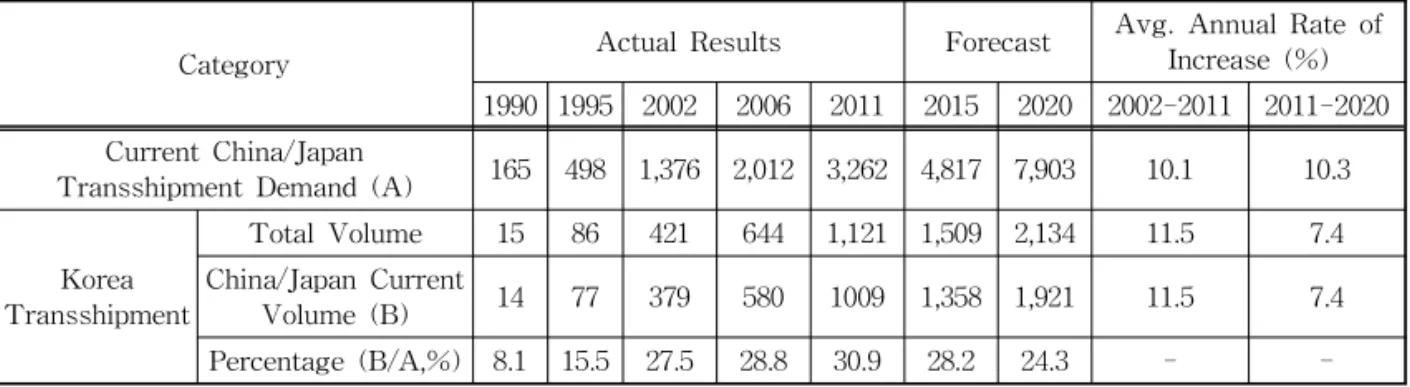
Table 2 shows transshipment volumes for China- bound and Japan-bound cargo, figures on overall demand as well as trends and forecasts of Korean transshipment traffic (DMR, 2013; MOF, 2014). As we can see, transshipment cargo bound for Chinese and Japanese ports accounts for 90% of total trans- shipment traffic at the Port of Busan. When looking at this situation, China-bound and Japan-bound transshipment cargo accounted for as much as 30.9% of total demand, however, by 2020 this figure is expected to drop to 24.3%.

2.2 Reorganization of strategic shipping alliances

Although the industry can breathe a sigh of re-

lief over the rejection of the proposed P3 Network

made up of the world’s largest three shipping lines,

the worry over the formation of similar alliances

is not over. Recently, the two leading shipping lines

in the world according to deployed capacity,

Maersk of Denmark and MSC of Switzerland, en-

tered into a 10-year arrangement to form a new

(3)

Table 1. Current status of domestic transshipment cargo (unit: thousands)

Country Port Total

Volume Transshipment

Cargo Volume Transshipment Percentage (%)

Singapore Singapore 27,965 23,491 84.0

China

Hong Kong 23,904 7,171 30.0

Shanghai 26,150 5,753 22.0

Chengdu 9,462 946 10.0

Ningbo 9,360 936 10.0

Korea Busan 13,261 5,809 43.8

Gwangyang 1.737 314 18.1

Japan Tokyo 4,124 363 8.8

Yokohama 3,182 280 8.8

Taiwan Kaohsiung 10,257 5,641 55.0

Taichung 1,250 281 22.5

Malaysia Tanjung Pelepas 5,500 5,269 95.8

Thailand Port Klang 7,120 3,738 52.5

Sri Lanka Colombo 3,382 2,536 75.0

Table 2. Outlook for transshipment container volumes in Northeast Asia region (unit: thousands)

Category Actual Results Forecast Avg. Annual Rate of

Increase (%) 1990 1995 2002 2006 2011 2015 2020 2002-2011 2011-2020 Current China/Japan

Transshipment Demand (A) 165 498 1,376 2,012 3,262 4,817 7,903 10.1 10.3

Korea Transshipment

Total Volume 15 86 421 644 1,121 1,509 2,134 11.5 7.4

China/Japan Current

Volume (B) 14 77 379 580 1009 1,358 1,921 11.5 7.4

Percentage (B/A,%) 8.1 15.5 27.5 28.8 30.9 28.2 24.3 - -

2M alliance covering the Asia–Europe and Pacific trade routes. The industry saw further con- solidation with the formation of the new Ocean 3 alliance, consisting of CMA CGM, UASC and China Shipping. This new group will command a 13% market share in the Asia–N.A. trade route and 20% in the Asia - Europe route. The combined fleet strength of the Ocean 3 alliance is 159 vessels offering a total capacity of 1.5 million TEU. The scope of its operations stretches across 93 ports with 199 weekly calls to port. The alliance is pay- ing particular attention to China and offers many direct sailings to eight different ports along the Chinese coast including six weekly calls to the Ports of Shanghai and Ningbo with plans to add

an additional four weekly calls to Yantian Port.

This increase in direct sailings to China is not only continuing to put downward pressure on trans- shipment cargo volumes at Busan Port but also has a direct negative effect on the port’s extensive feeder network. Although the Port of Busan serves as a major hub in the region, the establishment of large global alliances will force the port to continue to adjust its strategy to attract transshipment cargo.

Heading forward, fierce competition is expected

between the four major alliances of GG, CKYHE,

Ocean3 and 2M. Standing at the top of this group

are the 2M and Ocean 3 alliances which command

60% of the market. The GG alliance includes

(4)

Hyundai M.M and Hapag Lloyd of Germany, the 6th largest shipping line in the world, as well as the 9th, 10th, 11th, and 13th ranked. The CKYHE alliance is made up of Hanjin Shipping, Evergreen of Taiwan, as well as the 5th, 14th, and 16th largest shipping lines in the world. The 2M vessel sharing agreement covers a pool of 1,070 vessels with a combined capacity of 5,180,000 TEU while the G6 offers 629 ships for a capacity of 3,260,000 TEU and CKYHE commands a fleet of 607 ships for a combined capacity of 3,010,000 TEU. Through en- hanced economies of scale, these alliances will be in competition to reduce the number of routes as well as operating expenses. The domestic compa- nies of Hanjin Shipping and Hyundai M.M., have shown improved results through reductions in ex- penses, however, they continue to suffer loses. In the first quarter of 2014, Hanjin recorded a loss of KRW 62.2 billion compared to KRW 99.1 billion over the same quarter last year. Hyundai M.M. also showed improved quarter-over-quarter results posting a loss of KRW 67.0 billion in the first quar- ter of 2014 compared to KRW 128 billion over the same period last year.

3. Current Problems and Status of Trans- shipment Cargo at Busan Port

3.1 Current status of transshipment cargo at Busan Port

In 2015, for the first time in its history, trans- shipment cargo volume at the Port of Busan will surpass 10 million TEU. According to the Busan Port Authority (BPA), transshipment volume rose to 8,748,000 TEU in 2012 from 8,148,000 TEU the previous year, showing an increase of 7.4%.

Excluding the recent financial crisis in 2008 and 2009, transshipment cargo volume at the Port of Busan has been experiencing explosive growth over the past 10 years, and in the first half of this year achieved 7% growth. If this trend continues heading forward, transshipment cargo volume will

surpass that of exports for the first time in the port’s history. Although the outlook for transship- ment volumes in 2014 remains positive at 9,360,000 TEU, exports are forecast to show little movement at 9,070,000 TEU in 2014 from 8,933,000 TEU in 2013, a slight increase of 1.5% year-over-year.

3.2 Necessary site requirements to attract transshipment traffic to Busan New Port

Busan New Port is located 20 km southwest from the city center, and along with Jinhae Port, sits roughly halfway to Masan Port allowing it to serve as a hub for the region. When looking at site conditions of Busan New Port, the newly developed Gadeok area is one of the most important actors contributing to port growth. The area’s naturally occurring favorable tidal range affords easy access to vessels and also functions as part of the New Port’s hinterland. In addition, the area offers easy access by land, sea and air and also sits on the outskirts of the City of Busan, avoiding high den- sity traffic areas and reducing traffic bottlenecks, which allows for the expedited transportation of goods from the port. The shallow surrounding wa- ters of Gadeok also present ideal conditions for reclamation, thus making the process of securing optimal berthing depths less complicated.

Although currently, cargo volumes at Busan New Port are at less than desired levels, the port-hinterland development that has been simu- lated through the designation of the 31,710,000 pyoung Busan-Jinhae Free Economic Zone has significantly increased potential cargo volumes and will serve to position Busan Port as an economic gateway in Southeast Asia.

Due to Busan New Port’s continuous efforts to

reaffirm its position as a major logistics hub port

in Asia, competition between ports has become

fierce and the marketing efforts of Chinese ports

have intensified. Furthermore, rising trade volumes

between China and the US have sparked an in-

(5)

crease in direct sailings to the Chinese mainland which may ultimately reduce the demand of China-bound transshipment cargo. In the case of Busan New Port, if alternate measures can be found to reduce Korea’s dependence on foreign markets for its economic development, the port can exploit this opportunity to increase its influence in the logistics industry.

3.3 Problems facing transshipment traffic at Busan Port

Factors threatening transshipment traffic at the Port of Busan do not only extend to infrastructure and service levels, but also to considerable com- petitive measures instituted at the domestic Ports of Gwangyang, Incheon and Pyeongtaek(Seo et al., 2012; Jo et al., 2005). In addition, as direct sailings to China increase, more shipping lines are moving their bases of operation from Korea to China. This increasing trend of direct sailings to China is the largest threat facing Busan Port, and as America-bound and Europe-bound transshipment volumes decrease, large mega ships are reducing the number of port calls made to Busan Port which directly affects transshipment volumes.

Furthermore, the two port system currently be- ing operated between Busan Port and Gwangyang Port has been ineffective as investment in one port causes a decline in competitiveness at the other.

For this reason, integration and opportunities for development between Busan North Port and the New Port must happen organically. This coupled with Busan Port’s low productivity and inefficient operational systems is hurting the port’s com- petitiveness and have been identified as reasons for the port falling behind Hong Kong, Singapore, and other major global ports.

4. Strategies to Attract Transshipment Cargo at the Port of Busan

Busan Port, which was battered during the crisis

in the container shipment industry, has taken steps to ensure it retains its hub port status in Southeast Asia. These measures include a transshipment cargo oriented strategy of attracting traffic while at the same time making the best use of Busan New Port’s hinterland logistics base to create add- ed value. In order to survive during periods of mar- ket instability in the shipping industry, innovative transshipment systems must be pursued as well as measures put in place to attract next generation super container liners. In doing so, Busan Port will be able to attract additional cargo volumes, which must remain the ports primary focus. Although, Busan Port has a strong reliance on containers, to ensure continued growth, it must not only continue to attract container traffic, but also a variety of cargo types including lumber, grains, chemicals, and crude oil.

4.1 Infrastructure

When cargo is transferred at the same terminal, it is possible to be transported using YT’s without incurring any extra costs, however, goods must pass through the terminal gate and thus incur ad- ditional expenses in the form of outside trucks.

Until now, ship owners have been directly involved with the transport of goods as well as problems with directing traffic flow at the port. Accordingly, terminals must identify this operational need and setup a cooperative transport center in the sur- rounding area to control the flow of trucks which would allow Busan Port to cut costs and provide more convenience to customers. This kind of cen- tralized system to control truck dispatches could more efficiently manage the movement of empty containers thereby reducing the rate of vehicle traffic and transportation expenses. With this so- cial overhead capital, an aggressive reinforcement of financial investment in port facilities will enable Busan Port to secure the requirements necessary to become the import/export port of large vessels.

Through increased government funding Busan

(6)

Port can secure sufficient hinterland, related serv- ice facilities, and reduce construction times. In ad- dition, Busan Port must secure a sufficient CFS and strengthen port functions to connect the quay area which can serve as a logistics distribution complex for multinational corporations.

ITT(Inter Terminal Transportation) centers around the use of a common dispatch center that can easily deal with problems regarding transport costs that arise between terminals. When shippers move transshipment cargo at Busan New Port they incur a considerable burden due to the freight charges issued by individual terminal operators.

However, if ITT centers are established, the bur- den of freight charges is reduced. ITT centers in- crease cargo efficiency, and by reducing freight burdens, play an important role in attracting trans- shipment cargo to Busan Port. Since its opening in 2006, Busan Port has experienced rapid growth, and through its five terminal operators in 2013 handled 17,600,000 TEU of which 62% or 10,960,000 TEU was made up of transshipment cargo. Trans- shipment volumes continue to rise at Busan New Port, and in cases where transshipment cargo is moved through different terminals, each TEU re- ceives an additional KRW 20,000 trailer charge.

Within the quay of Busan New Port, transship- ment volumes yearly reach 4,500,000 TEU and en- counter problems regarding time and cost. This means that although in cases where transporting cargo inside the same terminal yields no additional costs through the use of YT cranes, transport to different terminals must be done through terminal gates which will ultimately result in an additional trailer charge and require the direct involvement of shippers to resolve dispatch problems. Shippers using Inter Terminal Transportation to control dispatches at Busan Port will achieve greater con- venience while also reducing costs. This type of exclusive dispatch control will also allow for a re- duction in the rate of empty trailers after cargo has

been transported as well as provide further cost savings.

4.2 Services

Busan Port is already a specialized container port and therefore should focus on attracting high value added cargo traffic. The port must also es- tablish ship repair facilities, oil supply sites, and a ship component center along with promoting di- versified services to be successful.

Additionally, the port should establish a custom- er service system targeted at collecting the opin- ions of users as well as resolving grievances. In addition, it should establish feeder networks, at- tract multinational as well as Japanese logistics firms to the city and lure the terminal operations of international companies.

Busan New Port should offer one stop service through the continuous development and applica- tion of information systems which can effectively increase berth turnover rate and productivity.

Additionally, the setup of regulations and control systems, can simplify report procedures for trans- shipment cargo.

New service and profit incentives should be set-

up to secure new business. These service in-

centives include agreements or contracts between

operators and customers that offer bonuses for fin-

ishing tasks inside a predetermined berthing win-

dow and are based on handling time or the amount

of cargo handled, while penalties are given for fin-

ishing tasks late. Profit sharing incentives are a

means to encourage terminal operations and ship-

ping lines to jointly reduce costs. In these cases,

there can be different views in deciding how cost

savings should be allocated and profit distribution

can vary depending on which party created the

savings. Therefore terminal operators and ship

owners must amicably come to an agreement that

stipulates the distribution of joint incentives.

(7)

5. CONCLUSIONS

In this study, factors affecting the competitive- ness of transshipment cargo at Busan Port, Korea’s key import/export gateway, have been examined.

Generally, to become a an optimal transshipment port, a port’s internal environment including the scale and location of its hinterland, facilities and tariffs as well as the external environment includ- ing global networks and logistics IT management must be carfully considered as they are all key ac- tors affecting cargo volumes. Below is a summary of how Busan Port can maximize its strategy to attract additional transshipment cargo in response to global strategic shipping alliances.

First, finding optimal routes for transshipment cargo being loaded or unloaded can facilitate the quick transportation of goods and after shipment occurs, control systems can track cargo in real time allowing operators to identify facility deficiencies as well as improve delays in transportation.

Second, when attracting transshipment cargo, focus must not only be given to the international competitiveness of shipping lines but also the po- tential benefits to shippers. Being selected as a transshipment base of operations by major ship- ping lines can be an important factor in reducing transshipment expenses as well as simplifying customs clearances and transshipment procedures.

By offering one stop service, establishing a feeder network, providing exclusive transshipment berths, building container yards, and increasing marketing efforts, Busan Port will be able to attract additional transshipment cargo.

Third, to respond to the enlargement of global shipping alliances and their oligopolistic tendencies as well as increase container volumes, port oper- ators, including Busan Port, must strengthen their bargaining power through combining berth oper- ations under one provider.

Fourth, as the enlargement of vessels is ex- pected to continue, investments in new efficient

cargo loading equipment to increase loading/un- loading productivity as well as diversified policies to attract transshipment volume must be pursued to ensure the continuous creation of new sources of transshipment cargo.

REFERENCES

[ 1 ] I.K. Rim, M.J. Kim, and K.M. Ahn, “A Study on the Attracting Strategy of Transshipment Cargo by Competitiveness Analysis between Busan & Chinese Port,” Journal of Korea Port Economic Association, Vol. 26, No. 3, pp. 175- 197, 2010.

[ 2 ] J.S. Kim, “A Development Strategy of Busan New Port by a Comparative Analysis on Singapore and Hong Kong Ports,” J ournal of Korea Economic Association, Vol. 24, No. 4, pp. 1-23, 2008.

[ 3 ] J.S. Kim, G.S. Shin, and H.S. Shin, “Challenges and Possible Ways to Facilitate Busan New Port Logistics,” J ournal of Korea Port Economic Association, Vol. 24, No. 3, pp. 79- 99, 2008.

[ 4 ] W.M. Wang, A Study on the Effects by Repeal of the Block Exemption in Liner Conferences, Master's Thesis of Kyungnam University, 2014.

[ 5 ] Busan Port Authority, http://www.busanpa.

com. (2014. 12.)

[ 6 ] J.S. Kim, “Determinants on Transshipments in the Busan Port,” J ournal of Korea P ort Economic Association, Vol. 27, No. 2, pp. 183- 194, 2011.

[ 7 ] K.W. Lee, M.K. Lee, and H.S. Bang, “An Empirical Study on Competitiveness of Busan Port on Attracting Transshipment Cargo,”

International Commerce and Information Review, Vol. 13, No. 1, pp. 97-120, 2011.

[ 8 ] G.E. Song, “A Study on Succeeding Together-

Busan North & New Port,” Journal of Korea

Port Economic Association, Vol. 27, No. 2, pp.

(8)

313-331, 2011.

[ 9 ] Drewry Maritime Research, Annual Container Market Review and Forecast, 2013.

[10] Ministry of Oceans and Fisheries, Shipping and Port Integrated Data Center, http://

www.spidc.go.kr. (2014. 12.)

[11] Y.J. Seo, D.K. Ryoo, and M.N. Aye, “An Analysis of Container Port Efficiency in ASEAN,” J ournal of Navigation and Port Research, Vol. 36, No. 7, pp. 535-544, 2012.

[12] Y.U. Jo, E.J. Lee, D.K. Kim, and K.R. Kwon,

"Service Information System(SIS) with Real Time Using RFID and X-Internet in Ubiquitous Environments," Journal of Korea Multimedia Society, Vol.8, No.10, pp. 1391- 1402, 2005.

Suk-Tae Bae

- 1995~Present Professor, Department of Port Logistics System, Tong- Myong University.

- Interests : Port Logistics

Equipment, Contain terminal

Operation.

수치

Table 2. Outlook for transshipment container volumes in Northeast Asia region                  (unit: thousands)

참조

관련 문서

Key words : sediment release, Yongwon channel, Busan New Port, water quality 주제어: 퇴적물 용출, 용원수로, 부산신항, 수질.. *Corresponding author : Tel.:

Y.(2018), “A Study on the Functional Distribution of Port Hinterland Construction and Management among Governments: Focused on the Busan New Port”, Journal of Korean Navigation

H.(2016), “A Study on the Service Quality Analysis and the Differnce Between User Groups in Bulk Terminals of Busan Port”, Journal of Navigation and Port Research,

As a result, both Busan port and Dalian port were found to have statistically significant influence on many of QOL indicators including general expenditure

It derived a concentration index (HHI) of cargo throughput in domestic ports by Yeosu-Gwangyang port docks, shipping companies, and abroad regions.. The

This paper focuses on the integration aspect of operators to determine an improvement strategy for the operating system to enhance competitiveness of Busan

According to the results, bilateral FTA, GDP and population have positive impacts on trade volume of bulk shipment at the port of Busan.. On the other

따라서 본 연구는 첫째, 부산항의 환적화물을 유치하는데 경쟁이 되는 중국항만의 개발 과 물류환경변화 추이를 평가하고, 둘째, 부산항을