Development of Amphoteric Polyacrylamide Retention System for ONP Recycled Pulp
Dong-Jin Son and Bong-Yong Kim
1†(Received October 5, 2010: Accepted December 15, 2010)
∙ Eyang Environmental Technology Institute, Eyang chemical co. ltd. 426-18, Yeocheondong, Nam-ku, Ulsan, 680-090, Korea, 1 Department of Wood Science and Technology, Kyungpook National University, 1370, Sankyukdong, Buk-gu, Daegu 702-701, Korea,
†Corresponding author : E-mail : bykim@ knu.ac.kr
ABSTRACT
Papermaking technology has drastically improved over the last 20 years to face new challenges. Because environmental regulations have become increasingly strict, papermaking systems have had to accommodate elevated recycled pulp content and an increased use of recycled process water. Process water in papermaking systems has become more dirtier and reduced polymer efficiency. Amphoteric PAM demonstrated a higher degree of stability in a high conductivity environment compared to cationic PAM. This was illustrated by the improved retention performance, particularly the ash retention. This amphoteric polymer can be used for board or newsprint production using recycled pulp, especially for the systems where polymer dissolving water is high in conductivity and degradation of cationic functional groups of cationic PAM can occur.
Keywords : Retention, Acrylamide, Amphoteric, Terpolymer, Flocculation
1. Introduction
Cationic polyacrylamide (C-PAM) has been applied to the retention program of the paper industry for a long time, because adjusting molecular weight and charge density is relatively easier than other polymers. However, traditional polyacrylamide can generate flocs too large and strong between pulp fibers (1). Therefore, new approaches to improve the performance of traditional cationic polyacrylamide have been tried by a few researchers. Xiao et al reported that the copolymer of acrylamide and polyethylene glycol macro monomers improve not
only retention characteristics but also storage stability and resistance to the shear increased with the mechanical pulp condition (2). This was followed by Gibbs et al who applied a new functional group of MPEGEMA (Methoxypolyehyleneglycolmethacrylate) with bentonite. He found good retention performances on the ONP(old newspaper) with PCC(precipitated calcium carbonate) filler condition (3). Polverari et al applied a new dendrimer form 1.4-diaminobutane- propylamine to furnishes for super calendared (SC) printing papers and found improvement of ash retention and fines retention (4). Liu et al tried to give positive charge characteristics to the anionic surface of
the bentonite, and it resulted in good efficiency for filler flocculation when it was utilized as a dual retention system of anionic polyacrylamide and cationic bentonite (5). Ovenden et al also tried to give a cationic charge to bentonite and found that a dual retention system of cationic bentonite micro particle and low-charge density, high molecular weight anionic polyacrylamide improves clay retention (6). In case of the application of new fuctional polyelectrolyetes with cationic polyacrylamide, Vaughan reported that a dual system of cationic high molecular weight polyacrylamide and modified lignosulfonate improved retention, drainage and formation in both alkaline and acidic papermaking conditions (7). Huber et al compared various retention systems on the fine papermaking condition and they found that an anionic trash collector (ATC), cationic starch and anionic silica multiple retention system was less sensitive to the flocculation of pulp fibers (8). Gaolas et al reported that a cationic starch and cationic polyacrylamide dual retention system improved not only retention characteristics but also strength properties of printed papers (9). Shin et al reported that highly branched cationic polyacrylamide was more efficient for forming uniform flocs than linear polyacrylamide.
Moreover it was shown that branched PAM gave better retention, formation and strength properties than linear polymer (10,11). Son et al, who published the result of a new multiple retention system using branched cationic polyacrylamide and anionic polyacrylamide, reported a new measuring technology of branch degree using color fluctuation during colloidal titration and retention, drainage and formation properties were expressed as a function of the degree of branching of the cationic polyacrylamide (12,13).
The purpose of the study was to confirm the effects of modification of ionic charges and the structure of polyacrylamide on the retention, drainage and formation characteristics. The motivation to develop a new polymer was to address the problem of hydrolysis of
the cationic functional groups on the cationic poly acrylamide which is a concern in paper mills that utilize recycling water and recycled pulp. In this study, an attempt was made to develop a new polyelectrolyte to protect a cationic functional group on the polymer to impart resistance to hydrolysis.
2. Materials and Methods 2.1. Materials
Nonionic monomer of acrylamide (50% active contents), anionic monomer of acrylic acid (100%
active contents) and cationic monomer of methyl chloride salt of dimethylaminoethylacrylate (80%
active contents) were commercial grade obtained from Eyang chemical co. Ltd. Korea.
Emulsifier of Span-80 (Sorbitan mono-oleate), inverting agent of Brij-96 (Oleyl alcohol) and mineral oil (Isopar-L) were commercial grade obtained from Uniquema, Korea.
Chain transferring agent of Na-formeate, initiator of ammonium persulfate, sodium hydrogen sulfite and AIBN (2,2'-Azobis Isobutyronitrile) were chemical grades. And deionized water was used in all processes of polymerization.
2.2. Methods 2.2.1. Polymerization
The synthesis method described by Son was used in the preparation of amphoteric and cationic poly carylamide polymers (12,13). The polymers were synthesized in three steps. First, hydrocarbon oil, monomers, surfactants, AIBN and deionized water were emulsified with a homogenizer. Second, after charging nitrogen gas sufficiently to remove dissolved oxygen, ammonium persulfate and sodium hydrogen sulfite catalysis were added to the reactor to start polymerization. They were synthesized at 60~70℃ for 2 hours in a nitrogen atmosphere. Finally, the reactor was cooled to room temperature after polymerization and high HLB (hydrophile-liphophile balance)
Fig. 1. Polymerization of amphoteric polyacrylamide.
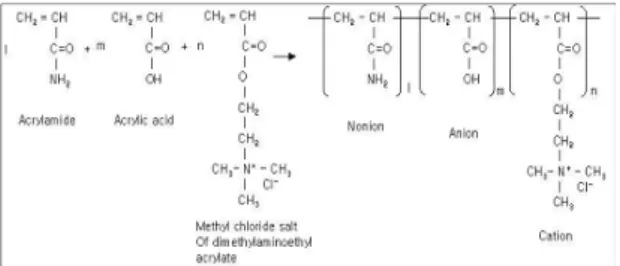
nonionic surfactants of Brij-96 as an inversing agent was added to increase solubility in water. Cationic polyacrylamide was a copolymer of acrylamide and methylchloride salt of dimethylaminoethylacrylate (DMAEA-MC) and amphoteric polyacrylamide was terpolymer of acrylamide, DMAEA-MC and acrylic acid as shown Fig. 1.
2.2.2. Analysis of Polymers 2.2.2.1. Solid contents
Solid content was measured using an I.R. desiccator with a condition of 160 ℃ and 16 minutes.
2.2.2.2. Solution viscosity
Viscosity, a parameter of molecular weight, was measured by Brookfield viscometer (LV-2 type) after preparing 0.5% (w/w) polymer solution under the room temperature of 25 ℃.
2.2.2.3. Solution pH
The pH level was measured using pH meter preparing 0.5% polymer solution.
2.2.2.4. Determination of charge density
Charge density was measured by using 0.0025N polyvinylsulfate-K (PVSK) titration after preparation of 100 ml of 0.005% polymer solution with addition of 2 drops of 0.1% Toluidine Blue (TB) indicator. For cationic charge measurement, it was titrated with polyvinylsulfate-K salt (0.0025N) after adjusting pH level to around 4 using HCl. In case of anionic charge measurement, it was also titrated with PVSK salt (0.0025N) after adjusting pH level to around 11 using NaOH after addition of 5ml of methlglycol chitosan solution (0.005 N). In this case, end point was
determined by a color change from blue to violet. and both cationic and anionic charge densities were calculated using Equation 1.
VPVSK = Volume of consumption of PVSK
VBLANK = Volume of consumption of PVSK without polymer
fPVSK = factor of PVSK (1)
2.2.3. Polymer stability test 2.2.3.1. Emulsion stability test
45 ml of emulsions were centrifuged at a speed of 3,700 rpm for 20 minutes. The thickness of the separated oil per total volume was checked visually.
When the stability of emulsion was improved, the thickness of separated oil per total volume would be decreased.
2.2.3.2. Solution stability test
Amphoteric polyacrylamide and traditional cationic polyacrylamide emulsion were dissolved to a 0.5% solution with various kinds of water which were made by mixing tap water and paper process water to adjust conductivity. Viscosity and charge density were checked every 3 hours. The pH level was adjusted with HCl at around 4 to 5.
2.2.4. Application test for papermaking 2.2.4.1. Stock and polymer preparation
Machine chest stock and silo white water was provided from J paper Co. The final consistency of stock was adjusted to match the headbox stock consistency by diluting thick stock with white water.
The cationic demand of the final stock was 1.5 ml by the titration of 0.001N polyDADMAC and the pH level of the stock was 7.0. Various polymer solutions were prepared by varying solution conductivity to follow the same procedures of 2.2.3.2 solution stability test.
Items Unit Cationic polyacrylamide Amphoteric polyacrylamide
Solid contents % 41.2 39.2
Cationic charge density meq/g 2.22 2.01
Anionic charge density meq/g 0.1 1.12
pH at 0.5% solution ~ 5.1 3.1
Viscosity at 0.5% solution cPs 1,448 1,106
Table 1. Characteristics of applied polyacrylamide
Fig. 2. Comparison of oil layer separation of emulsion after centrifugal machine at 3,700 rpm speed during 20 minutes 2.2.4.2. Retention, drainage and formation test
Retention and drainage tests were performed with a retention and drainage analyzer (RDA). The consistency of the stock was 0.18% and the volume of the stock sample was 1,000 ml. The vacuum condition for drainage evaluation was 200 mmHg at the main and sub tanks. FPR(first pass retention) was measured by filtering white water onto a filter paper using a Buchner funnel and the filtered material was dried for 8 hours at 105℃. Drainage was compared by drainage curves during the RDA test. Formation was deter mined by using a techpap 2D-F sensor with paper which was formed after the RDA test. The sequence of the test was the same as follows. At first, stock was introduced to the jar and stirred at 800 rpm for 5 seconds. And then, polyacrylamide was added with the dosage of 500 ppm per total dried pulp and let it stir at 1,000 rpm for 10 seconds.
3. Results and discussion
3.1. Characteristics of polymers
As shown in Table 1, the solid content of normal cationic polyacrylamide showed a little higher than amphoteric polyacrylamide because cationic poly acrylamide requires a higher concentration of surfactant to make W/O micelles. Cationic charge density of cationic polyacrylamide was a little higher than amphoteric polyacrylamide because the anionicity of the acrylic acid functional group of the amphoteric polyacrylamide reduces the overall cationic charge as measured using the colloidal titration. Cationic
polyacryamide showed no anionic charge density, but amphoteric polyacrylamide showed a relatively high anionic charge density of 1.12 meq/g, from the carboxylic acid anionic functional group. The pH of amphoteric polyacrylamide was fairly lower compared to cationic polyacrylamide because of the acidic acrylic acid functional group. The viscosity of amphoteric polyacrylamide was slightly lower than traditional cationic polyacrylamide because the reactivity of terpolymer of amphoteric polyacrylamide was lower than the copolymer of cationic poly acrylamide.
3.2. Stability of polymers
As shown in Fig. 2, amphoteric polyacrylamide was much more stable than traditional cationic poly acrylamide. This could be explained that cationic polyacrylamide consists of only cationic charges in the polymer and these cationic charges give repulsive power among polymers to make bigger W/O micelles.
Fig. 3. Change of 0.5% Solution viscosity using dissolving water of conductivity 500 μS/Cm by elapsed time
Fig. 5. Change of first pass ash retention using polymer with various dissolving water condition Fig. 4. Change of first pass retention using polymer
with various dissolving water condition However, amphoteric polyacrylamide consists of a cationic charge and an anionic charge in the polymer and these cationic and anionic charges attract each other to reduce the size of the W/O micelle a little bit.
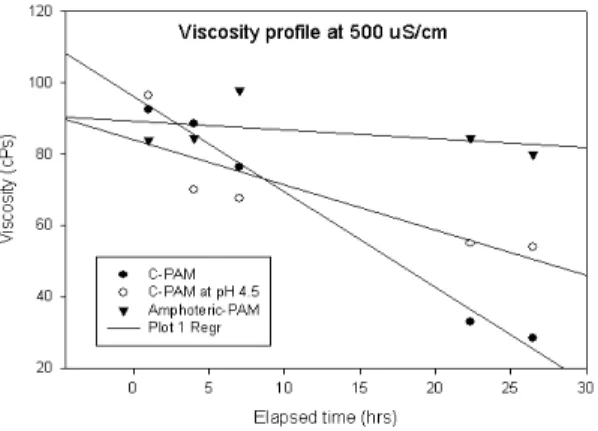
Normally smaller micelles are considered more stable than bigger micelles. Fig. 3 showed solution stability under the dissolving water condition of 500 μS/cm conductivity. Cationic polyacrylamide lost more than 60% of the initial viscosity in just 1 day stationing in the 30℃ water bath. Cationic polyacrylamide viscosity could be increased to add hydrochloric acid because hydrochloric acid reduces solution pH level and the rate of hydrolysis of the cationic functional group.
However, adding acid to the W/O emulsion was very
difficult because acid breaks W/O micelles. However, the stability of keeping the viscosity of amphoteric polyacrylamide increased dramatically and this acid functional group in the polymer chain was stable in the W/O micelle and prevented hydrolysis of cationic charge effectively.
3.3. Effects on retention, drainage and formation
As shown in Fig. 4 and 5, traditional cationic polyacrylamide showed the worst performance in total retention and ash retention at various conductivity of dissolving water. As dissolving water conductivity increased to 500 μS /cm, total retention and ash retention was increased but, with increasing con ductivity to 1,000 μS /cm, the retention was decreased again. It could be explained that the conductivity of dissolving water increases the reactivity of cationic polyacrylamide. On the contrary, too much conductivity affected retention characteristics negatively. And it was found that the improvement of retention and ash retention to decrease the pH level of dissolving water of cationic polyacrylamide to reduce hydrolysis.
Amphoteric polyacrylamide resulted in stable reten tion characteristics regardless of the conductivity of dissolving water. There was a possibility that the reactivity of amphoteric poly acrylamide was more stable than cationic polyacrylamide by conductivity
Fig. 6. Change of drainage using polymer with 500 μS/cm conductivity dissolving water condition
Fig. 7. Change of formation using polymer with water condition
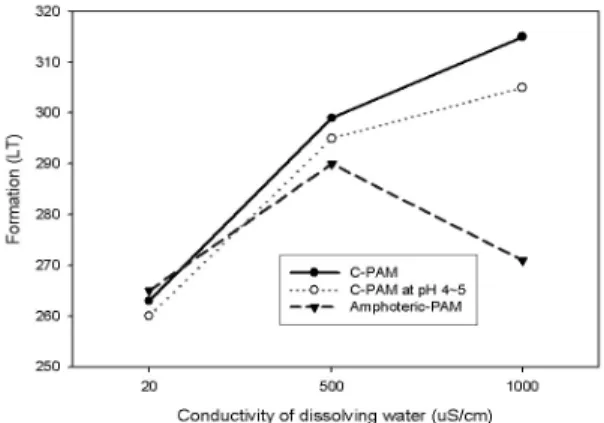
because cationic functional groups together produced stronger flocs than flocculation by a cationic functional group only. Ash retention with amphoteric polyacrylamide was a lot higher by an traditional cationic polyacrylamide because the anionic fun ctional group on the amphoteric poly acrylamide could be easily bonded with cationic group of inorganic materials like calcium carbonate particles by charge neutralization. As can be shown in Fig. 6, the drainage level of amphoteric polyacrylamide was much higher than traditional cationic polyacrylamides because amphoteric polyacrylamide made denser flocs by the flocculation of the cationic charge and the anionic charge in the polymer chain. Fig. 7 showed a formation profile of cationic polyacrylamides and amphoteric polyacrylamide. Adding acid to cationic polyacrylamide improved formation a little bit compared to cationic polyacrylamide. Amphoteric polyacrylamide showed better formation regardless of dissolving water con ductivity. It was the same with retention results and amphoteric polyacrylamide was less affected by the change of dissolving water conductivity.
4. Conclusions
Amphoteric polyacrylamide showed better charac teristics than normal cationic polyacrylamide. First of
all, amphoteric polyacrylamide emulsion showed stable characteristics not only polymer itself to reduce oil and polymer layer separation but also solution stability to reduce hydrolysis of cationic functional group. These phenomena can improve storage characteristics of the products and dissolved polymer for the application.
Even though molecular weight of the amphoteric polymer was slightly decreased to compare cationic polyacrylamide, retention, drainage and formation characteristics using amphoteric polyacrylamide were a lot better and especially, ash retention was significantly increased.
Literature Cited
1. Unbehend, J.E., Mechanisms of "soft" and " hard"
floc. formation in dynamic retention measurement, Tappi J., 59 (10):74-77 (1976).
2. Xiao, H., Novel retention aids for mechanical pulps, Tappi J., 79 (4) :129-135(1996).
3. Gibbs, A., Xiao, H., Deng, H. and Pelton, R., Flocculants for precipitated calcium carbonate in newsprint pulps, Tappi J., 80 (4):163-170 (1997).
4. Polverari, M., Hamel, J. Sithol, B. and Allen, L., A new retention aid for the production of SC printing grades: pilot paper machine results, Tappi J., 2 (9):3-8 (2003).
5. Liu, W., Ni, Y., and Xiao, H., Preparation and synergy
with anionic polymer in filler flocculation, J. of Pulp and Paper Sci., 29 (5) :145-149 (2003).
6. Ovenden, C., Xiao, H. and Wiseman, N., Retention aid systems of cationic microparticles and anionic polymer: experiments and pilot machine trials, Tappi J., 83 (3):80-85 (2000).
7. Vaughan, C. W., A new approach to wet-end drainage, retention, and formation technology, Tappi J., 79 (7):103-109 (1996).
8. Huber, P., Pierre, C., and Carre, B., Comparing the fi- ber flocculation behavior of several wet-end re- tention systems, Tappi J., 3 (4):19-24 (2004).
9. Gaiolas, C., Silva, M. S., Costa, P. and Belgacem, M.
N., Influence of the combined use of cationic starch and cationic polyacrylamide on the quality of print-
ing paper, Tappi J., 5 (6):3-8 (2006).
10. Shin, J. H., Han, S. H., Son, C. M. and Ow, S. K., Highly branched cationic polyelectrolytes: Filler flocculation, Tappi J., 80 (11) :179-185(1997).
11. Shin, J. H., Han, S. H., Son, C. M. and Ow, S. K., Highly branched cationic polyelectrolytes: Fines re- tetion, Tappi J., 80 (10):185-189(1997).
12. Son, D. J. and Kim, B. Y., New retention system using branched polymer, 2006 Panpacific conference pro- ceeding, Vol. 2, Korea TAPPI, Seoul, pp. 251, (2006).
13. Son, D. J.and Kim, B.Y., Effects of branch degree of CPAM for retention and drainage, 2007 Korea-Tappi fall proceeding, Korea TAPPI, Seoul, pp 21.