MIXED-MODE CRACK PROPAGATION BY MOVABLE CELLULAR AUTOMATA METHOD
Mikhail Pak *1, Choon Yeol Lee1, and Young Suck Chai1
1School of Mechanical Engineering, Yeungnam University Gyoungsan, 712-749, Korea
Abstract
Propagation of a mixed-mode crack in Soda-Lime silica glass using Movable Cellular Automata (MCA) method is demonstrated in this study. In MCA method, special fracture criterion is used to describe the process of crack initiation and propagation. Comparison between MCA and other crack initiation criteria results are made. The crack resistance curves and bifurcation angles under different loading angles are found. In comparisons with results of maximum circumferential tensile stress criterion, MCA result showed the sufficient agreement.
INTRODUCTION
Psakhie and his team introduced the new concept of the Movable Cellular Automata Method (MCA) which is based on the introducing of the state of the pair of automata (relation of interacting pairs of automata) in addition to the conventional one of the state of a separate automata [1,2]. It allows going from the net concept to the concept of neighbors. As a result, the automata have the ability to change their neighbors by switching the states of the pairs.
Study of crack propagation has been interest for several decades. Various fracture criteria have been proposed to describe the mechanism of crack growth based on the stress intensity factor, strain energy release rate, J-integral, crack tip opening displacement (CTOD), crack tip opening angle, strain energy density, void nucleation and so forth. The current work presents new type of fracture criteria based on Movable Cellular Automata (MCA) method approach and appears as attempt to explain crack growth process.
MCA BACKGROUND
The concept of the MCA method is based on the introduction of a state of the pair of automata in addition to the conventional state of separate automata. The incorporation
of this definition allows one to go from the net concept to that of neighbors. As a result, the automata acquire an ability to change their neighbors by switching the states of the pairs [1, 2]. There are two types of the pair states: linked and unlinked.
Hence the change of the state of pair relationships is controlled by relative movements of the automata and the medium formed by such pairs can be considered as bistable medium. The initial structure is formed by setting up certain relationships to each pair of the neighboring elements.
MCA Fracture Criterion
In MCA, stress intensity is used as a parameter for linked →unlinked switch. Stress intensity value for i-th automata in i-j pair is calculated as follows:
( ) ( )
2 2( )
2intij σijx σijy σxijσijy 3τij
σ = + − + (1)
where are σxij, σijy normal i-j pair stresses, τij is shear stress.
The ultimate strength σS is used as a threshold value:
Unlinked, when S
ij σ
σint ≥ (2)
CRACK INITIATION CRITERIA Maximum Circumferential Tensile Stress Criterion
Erdogan and Sih [3] presented the mixed-mode fracture initiation theory, the maximum circumferential tensile stress theory. MTS-criterion is based on the knowledge of the stress state near the tip of a crack, written in polar coordinates. The crack initiation angle can be found as follows:
1 2 sin
2 cos 3
cos3θ20− θ0 θ0=
IC II IC
I
K K K
K (3)
Maximum Energy Release Rate Criterion
Erdogan and Sih [4] noted that if we accept Griffith (energy) theory as the valid criterion which explains crack growth, then the crack will grow in the direction along which the elastic energy release per unit crack extension will be maximum and the crack
will start to grow then this energy reaches a critical value. Based on that criterion the angle prediction equation is found as:
1 ] ) cos 5 9 ( cos
sin 8 )
cos 3 1 [(
1 1 cos 3 4 1
2 2 0
0 2 0 2 2 0
0 2 0
2
0
⎟⎟ =
⎠
⎜⎜ ⎞
⎝
− ⎛
⎟+
⎟
⎠
⎞
⎜⎜
⎝ + ⎛
⎟⎟⎠
⎜⎜ ⎞
⎝ + ⎛
⎟⎟
⎟⎟
⎠
⎞
⎜⎜
⎜⎜
⎝
⎛
+
−
⎟⎠
⎜ ⎞
⎝
⎛
+ IC
II IC
II I IC
I
K K K
K K K
K θ θ θ
θ π
θπ θ θ
π θ
(4)
Minimum Strain Energy Density Criterion
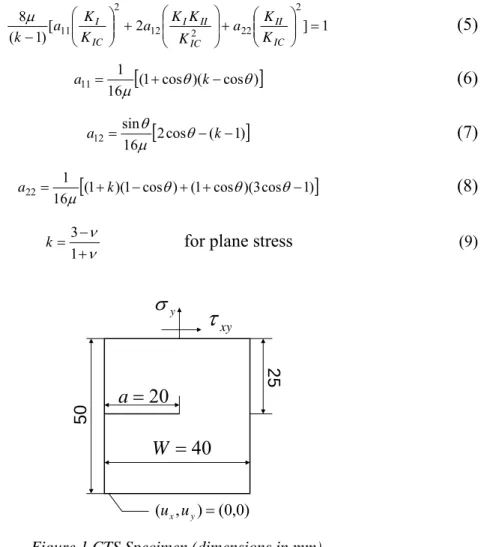
The minimum strain energy density theory, formulated by Sih [4], postulates that a fracture initiates from the crack tip in a directionθ0, along which the strain energy density at a critical distance is a minimum (i.e. crack propagates along path of minimum resistance). Minimizing strain energy density factor, the fracture locus is given by:
1 ] 2
)[ 1 (
8 2
2 22 12 2
11 ⎟⎟⎠ =
⎜⎜ ⎞
⎝ + ⎛
⎟⎟
⎠
⎞
⎜⎜
⎝ + ⎛
⎟⎟⎠
⎜⎜ ⎞
⎝
⎛
− ICI IICII KICII
a K K
K a K K
a K k
μ (5)
[
(1 cos )( cos )]
16 1
11 θ θ
μ + −
= k
a (6)
[
2cos ( 1)]
16 sin
12 = − k−
a θ
μ
θ (7)
[(1 )(1 cos ) (1 cos )(3cos 1)]
16 1
22= + − θ + + θ θ−
μ k
a (8)
ν ν +
= − 1
k 3 for plane stress (9)
σ
y) 0 , 0 ( ) , (ux uy =
τ
xy=20 a
=40 W
50 25
Figure 1 CTS Specimen (dimensions in mm)
NUMERICAL SIMULATION
To model the process of crack propagation, compact tension-shear (CTS) specimen was used (Fig. 1). Material considered in this study was Soda-Lime silica glass with following properties:E=68GPa, ν =0.19and σS =69MPa. Analysis has been done with MCA 2D Loading Test program based on Movable Automata Method approach. The plane-stress conditions were used. Increasing tensile and shear stresses were applied simultaneously with different combinations of
⎥⎥
⎦
⎤
⎢⎢
⎣
= ⎡
∞
− ∞
) (
) tan1 (
y xy
σ
ψ τ . As mentioned above, in
MCA space is represented by discrete elements of diameter d which is called automata.
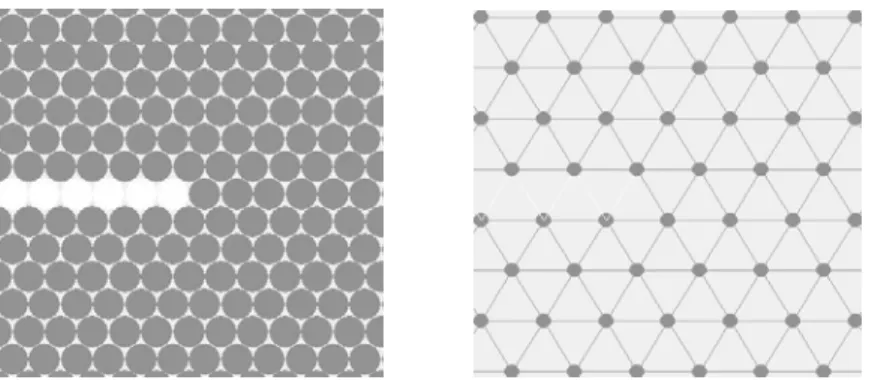
As shown in Fig. 2, every element is connected to the nearest neighbors around (linked elements), except elements lying on the crack line. Such automata do not have connection to the neighbors in the area of the crack line (they are unlinked). Under rising normal and shear stresses with constant ψ, local stress around crack tip is increasing until it reaches the critical value (Eq. 1) and first link on the crack tip will have been broken, that is defined as crack initiation. At that moment, critical tensile and shear stresses obtained from the MCA were substituted as input data for ANSYS finite element package in order to calculate the stress intensity factors for mixed mode loading.
Figure 2 MCA geometrical models zoomed in around the crack tip (automata and link view)
RESULTS AND DISCUSSION
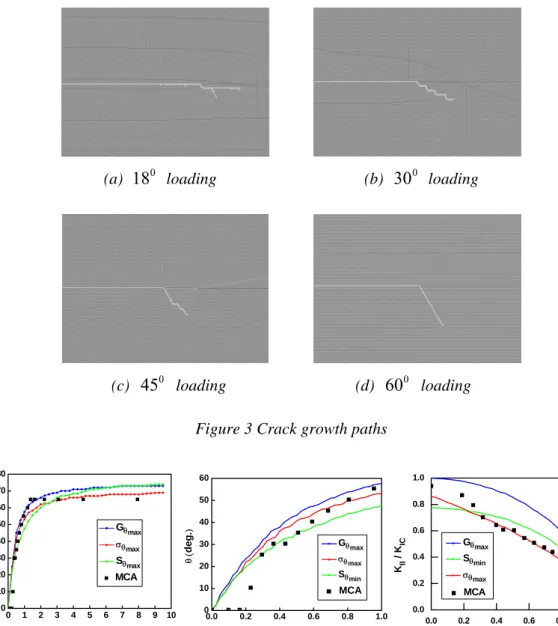
The crack growth paths obtained by MCA are shown on Fig. 3. The loading angles ψ are selected to be 180, 300, 450and 600.
Angle of crack propagation under mixed mode loading using different types of criteria combined with MCA result are depicted on Fig. 4. Results from the maximum circumferential tensile stress theory are the best to coincide with MCA.
However, when the loading angle is in range of00≤ψ ≤180, the crack does not kink from the interface. Therefore, crack growth path represents pure tension mode (Fig. 3a). For pure mode II(KI =0), it is found form MCA that θ0=640. Locus of fracture diagram under mixed mode loading is depicted on Fig. 4. Here, again, MCA results agree with results from the maximum circumferential tensile stress theory with a few differences in near pure shear mode.
(a) 180 loading (b) 300 loading
(c) 450 loading (d) 600 loading Figure 3 Crack growth paths
0 1 2 3 4 5 6 7 8 9 10
0 10 20 30 40 50 60 70 80
θ (deg.)
KII / KI Gθmax σθ
max
Sθmax MCA
0.0 0.2 0.4 0.6 0.8 1.0
0 10 20 30 40 50 60
Gθmax σθmax Sθmin
θ (deg.)
KII / KI
MCA
0.0 0.2 0.4 0.6 0.8 1.0
0.0 0.2 0.4 0.6 0.8 1.0
Gθmax Sθmin
σθmax
KI / KIC KII / KIC
MCA
Figure 4 Angle of crack propagation and locus of fracture diagram under mixed mode loading
CONCLUSIONS
In this work, bifurcation and the propagation of a mixed-mode crack in Soda-Lime
silica glass using Movable Cellular Automata method are investigated. A special fracture criterion is introduced (eq.1-2). According to this equation, the beginning of the crack propagation and then the crack bifurcation can be evaluated. The crack growth path and the bifurcation angle are found. MCA result of angle of crack propagation is compared with results of maximum circumferential tensile stress, maximum energy release rate and minimum strain energy density criteria. It shows a good agreement with results from maximum circumferential tensile stress criterion. Bifurcation angle for pure mode II case is found to be 640. There is a loading range, 00≤ψ≤180 such that the crack stays in the interface, while for ψ ≥180, the crack will kink from the interface.
After all, the MCA approach could be used as alternative method to simulate crack propagation.
ACKNOWLEDGEMENTS
This study was performed under the program of Basic Atomic Energy Research Institute (BAERI) which is a part of the Nuclear R&D Programs funded by the Ministry of Science & Technology (MOST) of Korea.
REFERENCES
[1] Popov V.L., Psakhie S.G., “Theoretical principles of modeling elastoplastic media by movable cellular automata method. I. Homogeneous media”, J. Phys. Mesomech., 4, 15~25 (2001).
[2] Psakhie S.G., Horie Y., Ostermeyer G.P., Korostelev S.Y., Smolin A.Y., Shilko E.V., Dmitriev A.I., Blatnik S., Spegel M., Zavsek S., “Movable cellular automata method for simulating materials with mesostructure”, J. Theoretical and Applied Fracture Mechanics, 37, 311~334 (2001).
[3] Erdogan F., Sih G.C., “On the crack extension in plates under plane loading and transverse shear”, Journal of Basic Engineering, 85, 519~527 (1963)
[4] Sih G., “Strain energy factors applied to mixed mode crack problems” Int. J Fracture (1974).