• 검색 결과가 없습니다.

Effect of Mixing Method on Mechanical Properties of Fiber Reinforced Concrete

N/A
N/A
Protected

Academic year: 2021

Share "Effect of Mixing Method on Mechanical Properties of Fiber Reinforced Concrete"

Copied!
7
0
0

로드 중.... (전체 텍스트 보기)

전체 글

(1)

J. Korea Inst. Build. Const., Vol. 15, No. 3

http://dx.doi.org/10.5345/JKIBC.2015.15.3.351 www.jkibc.org

Effect of Mixing Method on Mechanical Properties of Fiber Reinforced Concrete

Kim, Hyun Wook

1

Lee, Chang Joon

2*

Civil and Environment Research Group, POSCO, Yeonsu-Gu, Inchon, 406-732, Korea

1

Department of Architectural Engineering, Chungbuk National University, Seowon-Gu, Cheongju, 362-763, Korea

2

Abstract


Fiber reinforced concrete (FRC) has been successfully used to enhance the flexural toughness of concrete. As fibers are randomly oriented in FRC, they sometimes produce clumps that reduce the mechanical performance, and a properly chosen mixing protocol can be a way to minimize this problem. In this research, the effects of mixing method on the mechanical properties of FRC were investigated. The compressive strength, flexural strength, and flexural toughness were measured using three different mixing methods. It was shown from the results that the compressive strength and peak flexural load were not affected by changes in mixing method. However, in terms of flexural toughness, the changes in mixing method clearly affected the flexural toughness of FRC. The truck-mixed FRC outperformed two pan-mixed FRCs.

Keywords : fiber reinforced concrete, mixing method, flexural toughness

1. Introduction

Fiber reinforced concrete (FRC) has been in- troduced in order to increase the mechanical prop- erties (mostly flexural toughness) of concrete[1]. Li et al.[2,3,4,5,6] and other researchers[7,8,9] in- vestigated numerous cases and showed that FRC is a valuable structural material that can be used for civil infrastructures. When producing FRC, the fi- bers are randomly oriented, which means that they sometimes become entangled with each other, pro- ducing clumps in the mixtures[1]. Clumping gen- erally depends on the volume fraction of the fiber that is mixed within the concrete. Since the undis-

Received : March 19, 2015 Revision received : April 9, 2015 Accepted : April 23, 2015

* Corresponding author: Lee, Chang Joon [Tel: 82-43-261-2429, E-mail: [email protected]]

ⓒ2015 The Korea Institute of Building Construction, All rights reserved.

tributed fiber clump is unlikely to provide the de- sired mechanical properties of FRC, breaking the clumps during the mixing procedure is essential.

Therefore, proper control is necessary for the easy production of FRC.

It is well known that the rheological properties

(such as yield stress and viscosity) of ce-

ment-based material are very important for the

construction of buildings and civil engineering in-

frastructures[10]. The angularity and shape of ag-

gregates, total solid contents (represented by water

to cement ratio and the amount of aggregate), and

the surface area (cement and aggregate fineness

and the amount of hydration products) are the fac-

tors that affect the rheological properties most

significantly[11]. However, with FRC, the presence

of fibers often reduces workability due to their

bridging effect between solid particles (including

cement paste and aggregate). FRC with poor rheo-

logical properties often generates air-filled defects

(2)

Effect of Mixing Method on Mechanical Properties of Fiber Reinforced Concrete

with entangled fibers, which eventually has ad- verse effects on the structural integrity of FRC.

General approaches to modify such properties are to control the quality of the aggregate and to use retarder (reducing the speed of hydration) and/or superplasticizer (coating cement particle with the organic polymer to cause electric repelling force and/or to cause steric hindrance between par- ticles)[11]. However, in the case of FRC, the re- tarder and superplasticizer are not able to success- fully minimize the clumping of fibers because they mostly interact with cement particles, not with fi- bers or aggregates.

It is worth noting that the rheological properties can also be affected mechanically. Mechanical con- tribution to the rheology of concrete is related to the shear history of the fresh mixture[12,13].

Shear history includes the amount of shear force that is applied during mixing. The amount of mix- ing time, the presence of aggregates at the time of mixing, angularity of aggregates, the speed of mixing, etc. all affect the shear history of concrete.

In general, a higher shear rate provides better dis- tribution of solid particles in the fresh concrete, and the same thing can occur with reinforced fibers. Since the presence of entangled clumps in FRC can be effectively distributed with the proper shear history of the mixture[14], it is necessary to control such variables, and the selection of a proper mixing procedure is a way to achieve that goal.

In this research, the effects of the mixing method on the mechanical properties of FRC are investigated. The compressive strength and flexu- ral toughness are measured depending on the changes in mixing method of FRC. The purpose is to compare the performance of the FRC produced using a standard laboratory mixing procedure with FRC being produced by a ready-mix truck. The testing results will help to illuminate the mechan- ical performance differences between FRC produced

in a laboratory and FRC produced on a construction site.

2. Materials and Experimental Procedures

Table 1 shows the mixture proportions of the base concrete without fibers. ASTM type I Portland cement[15] was used to prepare concrete. Water to cement ratio (w/c) was 0.42. Base concrete (plain concrete without fibers) of 3.0 m

3

batch was pro- vided by a local ready mix concrete company.

Synthetic macro fibers from a commercial bender were used as fiber ingredient. Table 2 shows the properties of the fibers used. Fibers of 2.3kg/m

3

(volume fraction of 0.25%) were added separately to the base concrete using three different mixing methods.

The mixing methods were as follows: (#1) base concrete was poured into the pan, fibers were add- ed, and regular mixing time was applied for the pan mixing, (#2) base concrete was poured into the pan, fibers were added, and triple mixing time was applied for the pan mixing, and (#3) fibers were di- rectly added to the ready-mix truck for truck-mixing. Table 3 shows the details of the mixing methods. The fresh concrete properties, in- cluding unit weight, slump and air contents, were also measured for reference, according to ASTM C 138[16], ASTM C 143[17], and ASTM C231[18], respectively.

Four beam specimens (150×150×525mm) and three cylinders (100×200mm) were fabricated for each mixing method (mixture #1, #2, and #3) for flexural toughness measurements and uniaxial compressive strength tests, respectively. A vi- bration table was used to consolidate the concrete in the beam mold. The beams and cylinders were de-molded at the age of 1 day and stored in a 100%

RH (relative humidity) moisture chamber for addi-

(3)

mens were moved out of the 100% RH chamber and stored in a laboratory until the age of 14 days for ambient curing.

Beam specimens per each mixing method were tested according to JCI-SF4[19] and ASTM C1018[20] standard test methods. Note that the ASTM C1018 was withdrawn as of 2006 but the flexural toughness index from this specification still provides meaningful information in evaluating the performance of FRC. These test procedures are basically similar but they differ in a way to derive flexural toughness indices. JCI-SF4 measures the energy absorption of the material up to a certain value of deflection (the area underneath of the load-deflection curve up to δ = L/150), and ASTM C1018 measures first crack toughness (the area underneath of load-deflection curve up to the point of first-crack deflection). The details of deriving flexural toughness indices are well presented in other research[21].

Table 1. Mixture proportions of plain concrete Ingredient Weights in SSD (kg/m

3

)

Water 151

Type I Portland Cement 359

Limestone 1088

Sand 782

Table 2. Properties of fiber

Raw Material Polypropylene+Polyethylene

Shape Flat Rectangle

Length 40mm

Aspect ratio 90

Specific Gravity 0.92

Absorption None

Modulus of Elasticity 9.5GPa

Tensile Strength 620MPa

Table 3. Mixing methods for FRC

Mixture Mixing Method Mixer

#1 3-3-2 * Pan

#2 9-3-6 * Pan

#3 125 ** Truck

* represents the (time in minutes for initial mixing) – (time in minutes for rest) – (time in minutes for final mixing).

** represents the revolution of drum of ready-mix truck with speed of 10 revolution/min.

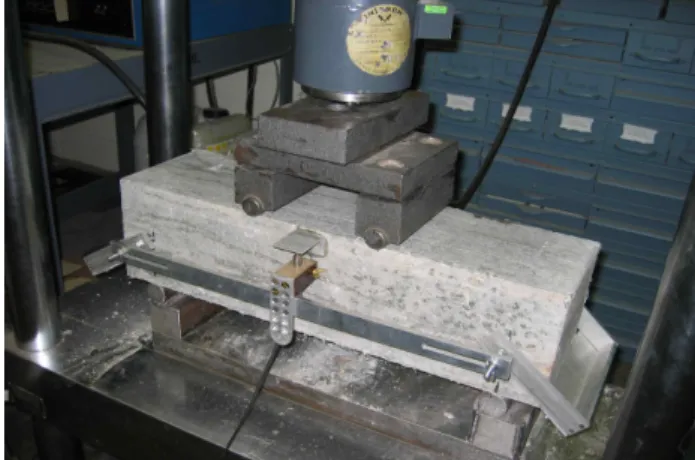
ness is presented in Figure 1. The span length be- tween supports was 450mm, and the vertical load was applied at the third points. The deflection was measured by the LVDT mounted on the yoke to avoid the influence caused by extraneous deforma- tion (crushing at the load points).

Figure 1. JCI-SF4 and ASTM C1018 testing setup

3. Results

3.1 Fresh Concrete Properties

The fresh concrete properties of FRC are pre- sented in Table 4. It was shown from Table 4 that the unit weight, slump, and air content of mixtures

#1, #2, and #3 were similar to each other. No sig- nificant differences in the fresh concrete properties of FRC were observed when the fiber mixing meth- od was changed.

Table 4. Fresh concrete properties of FRC Mixture Unit Weight

(kg/m

3

) Slump

(mm) Air Content (%)

#1 2419 89 1.3

#2 2419 76 1.3

#3 2403 89 1.4

3.2 Compressive Strength

Three cylindrical specimens of each mixture were

tested for compressive strength at the age of 14

days. Measured compressive strength values of

(4)

Effect of Mixing Method on Mechanical Properties of Fiber Reinforced Concrete

each specimen are shown in Table 5 and Figure 2.

The average compressive strength of mixture #1 showed higher compressive strength than #2 and

#3 specimens. However, the differences are within the range of standard deviation. In fact, as mixing method changes from #1 to #2 (#2 has longer mix- ing time), it reduced the standard deviation. When FRC was prepared in a ready-mix truck (mixture

#3), the standard deviation decreased even more.

These results indicate that mixing method #3 pro- vided the most reliable test results in the test of compressive strength.

Figure 2. The compressive strength values of mixtures #1, #2, and #3; note that the coefficient of variation (standard deviation divided by average in percent) for mixtures #1, #2,

and #3 is 14.5, 5.2, and 4.1%, respectively

Table 5. Uniaxial compressive strength at14day

Mixture Strength (MPa) Average

#1 30.1 39.2 31.6 33.6

#2 28.8 31.0 31.8 30.5

#3 27.8 30.0 29.6 29.2

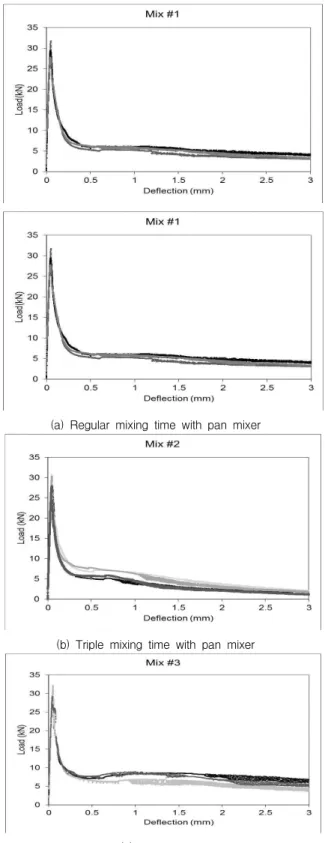
3.3 Load-Deflection Response of Flexural Test Figure 3 shows the load-deflection curves for mixtures #1, #2, and #3. Load-deflection response was measured until the deflection of 3mm. The shape of load-deflection curves was similar for each specimen, indicating that they behaved sim- ilarly under flexural load.

The peak loads of mixtures #1, #2, and #3 were observed at the deflection of around 0.05mm.

Measured peak load values shown in Table 6 varied from about 27 to 32kN, and the average peak loads of each mixture are presented in Figure 4.

(a) Regular mixing time with pan mixer

(b) Triple mixing time with pan mixer

(c) Truck mix

Figure 3. Load-deflection curves of mixtures #1, #2, and #3

(5)

range of standard deviation, indicating that there was no difference in peak load even though differ- ent mixing protocols were applied.

Table 6. Peak-Load of FRC

Mixture Peak load (kN) Average

#1 27.8 31.7 29.3 - 29.6

#2 27.8 30.2 28.1 30.7 29.2

#3 29.2 28.8 32.1 - 30.0

Figure 4. Peak loads of each specimen; note that the coefficient of variation for mixtures #1, #2, and #3 is 6.68, 5.07, and

5.95%, respectively)

3.4 Flexural toughness

The flexural toughness values can be calculated using the load-deflection curves shown in Figure 3. The calculated JCI-SF4 Flexural Toughness of FRC specimens are listed in Table 7 and presented in Figure 5. According to Figure 5, the flexural toughness values of pan-mixed specimens (mixture

#1 and #2) were not greatly different from each other, but specimens mixed in a drum-type mixer (ready-mix truck) showed higher flexural tough- ness values. The differences in flexural toughness between pan-mixed specimens and truck-mixed specimens were above the range of standard devia- tion (shown as the error bars in Figures 5), and thus the mixture #3 (mixed in ready-mix truck) clearly showed higher flexural toughness than pan-mixed specimens.

Figure 5. JCI-SF4 Flexural toughness of each specimen; note that the coefficient of variation for mixtures #1, #2, and #3 are

9.02, 17.97, and 12.95%, respectively

Table 7. JCI-SF4 Flexural Toughness Mixture Flexural Toughness (kN-mm) Average

#1 17.5 15.4 18.4 - 17.0

#2 11.6 15.5 12.0 16.7 14.0

#3 23.7 24.9 19.3 - 22.6

Figure 6. Flexural toughness indices of each specimen; note that the results were obtained using ASTM C 1018 procedure

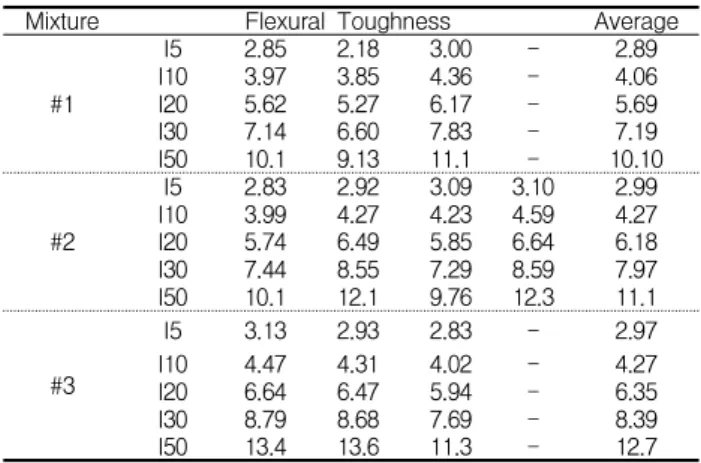
Table 8. ASTM C1018 Flexural Toughness

Mixture Flexural Toughness Average

#1

I5 2.85 2.18 3.00 - 2.89

I10 3.97 3.85 4.36 - 4.06

I20 5.62 5.27 6.17 - 5.69

I30 7.14 6.60 7.83 - 7.19

I50 10.1 9.13 11.1 - 10.10

#2

I5 2.83 2.92 3.09 3.10 2.99

I10 3.99 4.27 4.23 4.59 4.27

I20 5.74 6.49 5.85 6.64 6.18

I30 7.44 8.55 7.29 8.59 7.97

I50 10.1 12.1 9.76 12.3 11.1

#3

I5 3.13 2.93 2.83 - 2.97

I10 4.47 4.31 4.02 - 4.27

I20 6.64 6.47 5.94 - 6.35

I30 8.79 8.68 7.69 - 8.39

I50 13.4 13.6 11.3 - 12.7

(6)

Effect of Mixing Method on Mechanical Properties of Fiber Reinforced Concrete

ASTM C1018 toughness indices were also calcu- lated using the load-deflection curves shown in Figure 3. The calculated toughness indices are list- ed in Table 7 and presented in Figure 6. According to Figure 6 (the ASTM C1018 method), the I

5

values for all three materials are very similar, yet the I

20

, I

30

, and I

50

diverged somewhat. According to the ASTM C1018 I

50

toughness index, the #2 mix with longer mix times slightly outperformed the #1 mix.

The #3 mix (truck-mix) showed the highest flexu- ral toughness indices, outperforming the other two mixtures.

It is worth noting that the ASTM C1018 and JCI parameters provided somewhat different per- spectives on the performance differences. In the JCI-SF4 flexural toughness index, the #2 pan-mixed FRC was a little lower than the #1 mix.

This apparent contradiction results from the way the parameters are calculated. ASTM C1018 I

50

in- dex requires a load-deflection curve up to a de- flection of 25.5 times the first-crack deflection (approximately 1.25mm for our case). On the other hand, JCI-SF4 index requires the load-deflection curve up to a deflection of L/150 (3mm for our case), where L= the span length. Mixture #2 showed a relatively higher load resistance than Mixture #1, up to the deflection of 0.05 in.

Therefore the ASTM C1018 I

50

index of Mixture #2 showed a higher number than that of Mixture #1.

However, after the deflection of 1.25mm, the load resistance of Mixture #2 rapidly decreased com- pared to Mixture #1. Consequently, the area under the load-deflection curve of Mixture #2 became smaller than that of Mixture #1. Therefore, the JCI-SF4 index of Mixture #2 was lower than that of Mixture #1.

4. Discussion

The findings of this research indicated that the

fresh concrete properties (unit weight, slump, and air content), the cylinder compressive strengths, and beam peak loads of all three materials were about the same, but the flexural toughness of the three materials differed depending on the mixing method. Although these mixed results prevent us from reaching a clear conclusion on whether the long pan mixing time had any significant impact, they clearly demonstrated the difference between the truck-mixed FRC and the pan-mixed FRC.

Both the ASTM C1018 and JCI analyses found that the truck-mixed FRC (Mixture #3) outperformed the two pan-mixed FRC by 20-30% of the index values. Presumably, this advantage in flexural toughness occurs because the mixing action in the truck more effectively dispersed fiber clumps. It is also possible to consider that the truck mixing method can abrade the surface of fiber, creating rougher fiber surfaces that sustain higher loads during the fiber-pull-out stage of the test.

5. Conclusions

The flexural toughness of three FRC mixtures was tested in accordance with JCI-SF4 and ASTM C1018 standard testing method. Unit weight, slump, air content (fresh properties), and com- pressive strength were also measured. Load-de- flection diagrams were prepared and toughness in- dices were calculated to allow comparison of the performance of these mixtures. The following con- clusions can be drawn from the results.

1) No significant differences among the FRC mixtures were observed in freshness proper- ties, compressive strength, or peak load.

2) Truck-mixed FRC outperformed pan-mixed

FRC in terms of flexural toughness.

(7)

This research was supported by a grant from a Construction Technology Research Project (Development of impact/blast resistant HPFRCC and evaluation technique thereof, 13SCIPS02) funded by the Ministry of Land, Infrastructure, and Transport.

References

1. Bentur A, Mindess S. Fiber Reinforced Cementitious Composites.

London: Spoon Press; 2002. 449 p.

2. Chan YW, Li VC. Age Effect on the Characteristics of Fiber/Cement Interfacial Properties. Journal of Material Science. 1997 Oct;32(19):5287-92.

3. Li VC, Chan YW. Determination of Interfacial Debond Mode for Fiber-Reinforced Cementitious Composites. ASCE Journal of Engineering Mechanics. 1994 Apr;120(4):707-19.

4. Li VC. Postcrack Scaling Relations for Fiber Reinforced Cementitious Composites. ASCE Journal of Materials in Civil Engineering. 1992 Feb;4(1):41-57.

5. Li VC, Stang H, Krenchel H. Micromechanics of Crack Bridging in Fiber-Reinforced Concrete. Materials and Structures. 1993 Oct;26(8):486-94.

6. Li VC, Wu H–C, Maalej M, Mishra DK, Hashida T. Tensile Behavior of Cement-Based Composites with Random Discontinuous Steel Fibers. Journal of American Ceramic Society. 1996 Jan;

79(1):74-8.

7. Ding Y, Kusterle W. Compressive Stress-Strain Relationship of Steel Fiber-Reinforced Concrete at Early Age. Cement and Concrete Research. 2000 Oct;30(10):1573-79.

8. Gopalaratnam VS, Shah SP, Batson GB, Criswell ME, Ramakrishnan V, Wecharatana M. Fracture Toughness of Fiber Reinforced Concrete. ACI Materials Journal. 1991 Jul;88 (4):339-53.

9. Gopalaratnam VS, Gettu R. On the Characterization of Flexural Toughness in Fiber Reinforced Concretes. Cement and Concrete Composites. 1995 Jul;173:239-54.

10. Taylor HFW. Cement Chemistry. 2nd ed. London: Thomas Telford Publishing; 1997. 459 p.

11. Ferraris C, Francois de Larrard. Testing and Modeling of Fresh Concrete Rheology. Gaithersburg (MD): National Institute of Standards and Technology (US); 1998 Feb. 61p. Report No.:

12. Ferraris C. Measurement of the Rheological Properties of Cement Paste: A New Approach. In: Cabrera JG, Rivera-Villarreal RR., editors. Role of Admixtures in High Performance Concrete.

RILEM international symposium; 1999 Mar 21-26; Monterrey Mexico. RILEM Publications S.A.R.L.; 1999. p. 333-342.

13. Ferraris C. Measurement of the Rheological Properties of High Performance Concrete: A State of the Art Report. Journal of Research of the National Institute of Standards and Technology.

1999 (Oct);104(5): 461-478.

14. Soroushian P, Lee C–D. Distribution and Orientation of Fibers in Steel Fiber Reinforced Concrete. ACI Materials Journal. 1990 (Sep);87(5):433-9.

15. American Society for Testing and Materials, Annual Book of ASTM Standards. West Conshohocken; ASTM International;

c2012. Vol. 04. 01. (C 150) ASTM Standard Specification for Portland Cement.

16. American Society for Testing and Materials, Annual Book of ASTM Standards. West Conshohocken; ASTM International;

c2012. Vol. 04. 02. (C 138) ASTM Standard Test Method for Density (Unit Weight), Yield, and Air Content (Gravvimetric) of Concrete.

17. American Society for Testing and Materials, Annual Book of ASTM Standards. West Conshohocken; ASTM International;

c2012. Vol. 04. 02. ASTM Standard Test Method for Slump of Hydraulic-Cement Concrete.

18. American Society for Testing and Materials, Annual Book of ASTM Standards. West Conshohocken; ASTM International;

c2012. Vol. 04. 02. ASTM Standard Test Method for Air Content of Freshly Mixed Concrete by the Pressure Method.

19. Japan Concrete Institute, JCI Standards for Test Methods of Fibre Reinforced Concrete; Tokyo; Japan Concrete Institute;

c1983. SF4 Method of Test for Flexural Strength and Flexural Toughness of Fibre Reinforced Concrete.

20. American Society for Testing and Materials, Annual Book of ASTM Standards. West Conshohocken; ASTM International;

c1997. Vol. 04. 01. ASTM Standard Test Method for Flexural toughness and First-Crack Strength of Fiber-Reinforced Concrete (Using Beam with Third-Point Loading.

21. Lee CJ, Lange DA, Lee JY, Shin SW. Effects of Fiber Volume

Fraction and Water/Cement Ratio on Toughness Development

of Steel Fiber Reinforced Concrete. Journal of the Korea Institute

of Building Construction. 2013 (Feb); 13(1):20-8.

수치

Table 1. Mixture proportions of plain concrete Ingredient Weights in SSD (kg/m 3 )
Figure 2. The compressive strength values of mixtures #1, #2, and #3; note that the coefficient of variation (standard deviation divided by average in percent) for mixtures #1, #2,
Figure 6. Flexural toughness indices of each specimen; note that the results were obtained using ASTM C 1018 procedure

참조

관련 문서

In order to evaluate mechanical properties and carbonation resistance of concrete with water-soluble sulfur, compressive strength test, flexural strength test, bonding strength

Soroushian and Bayasi ( 1991 ) experimentally investigated the effect of steel fiber shape on the mechanical properties of concrete, and found that the use of hooked steel fibers

Soroushian and Bayasi ( 1991 ) experimentally investigated the effect of steel fiber shape on the mechanical properties of concrete, and found that the use of hooked steel fibers

Engineering properties of permeable polymer concrete for pavement using powdered waste glass and recycled coarse aggregate, Journal of the Korean Society of Agricultural

Keywords : high fluidity concrete, waste marble powder, slump flow, flow ability, filling ability, compressive strength.. 이러한 단위시멘트량의 증가는 수화열 발생과

To evaluate the mechanical properties and carbonation resistance of concrete, slump, air amount, air-dried unit volume weight, compressive strength, and carbonation depth are

In this study, mechanical properties and structural flexure behavior experiments of slag, recycled PET fiber, and Hwang-toh added concrete are carried out...

To evaluate the reinforcement effect of RPET fiber in concrete member, experimental tests were performed, such as mechanical property tests (compressive strength,