Minimally Invasive Single-Site Cholecystectomy in Obese Patients: Laparoscopic vs. Robotic
Kyu Min Lee, M.D.
1, Dae Hun Han, M.D.
1,2, Seoung Yoon Roh, M.D.
1,2, Ho Kyoung Hwang, M.D., Ph.D.
1,2, Woo Jung Lee, M.D., Ph.D.
1,2, Chang Moo Kang, M.D., Ph.D.
1,21
Division of Hepatobiliary and Pancreatic Surgery, Department of Surgery, Yonsei University College of Medicine,
2Pancreatobiliary Cancer Center, Yonsei Cancer Center, Severance Hospital, Seoul, Korea
Purpose:
Laparoscopic cholecystectomy is treatment method for management of benign gallbladder diseases. Further attempts are made to operate single-port laparoscopic cholecystectomy. However, single-port laparoscopic cholecystectomy, the procedure remains technically difficult, especially in obese patient. Recently, a robotic surgical system for minimal invasive surgery was introduced to overcome the limitations of conventional laparoscopic surgery.Methods:
From April 2009 to August 2017, we retrospectively reviewed the medical records of patients with single-site, minimally invasive (laparoscopic and robotic) cholecystectomy with high BMI (>25 kg/m2). We analyzed general characteristics and perioperative outcomes between the single- fulcrum laparoscopic cholecystectomy group and the robotic single-site cholecystectomy (RSSC) group.Results:
Operation time (57.56±11.10 vs 98.5±12.28 p<0.001) was significantly longer and postoperative pain score (3.61 vs 5.15 p=0.000) was significantly higher in the robotic single-site cholecystectomy (RSSC) group, but the actual dissection time (25.85±11.09 vs 25.79±13.35 p=0.978) was not significantly different between the two approaches. Iatrogenic gallbladder perforation, (13 vs 6 p=0.005), patients undergoing RSSC showed a significantly smaller amount than did those undergoing single-fulcrum laparoscopic cholecystectomy (SFLC).Conclusion:
It is difficult to say for certain that RSSC is clearly better than SFLC in obese patients.However, because of the technical convenience and efficiency of surgery with RSSC, RSSC can be practically worthwhile. Further study is mandatory.
Keywords:
Obesity, Cholecystectomy, Laparoscopy, Robotic surgical proceduresReceived March 14, 2019 Revised May 24, 2019 Accepted June 18, 2019
Corresponding author Chang Moo Kang
Division of Hepatobiliary and Pancreatic Surgery, Department of Surgery, Yonsei University College of Medicine, 50 Yonsei-ro, Seodaemun-gu, Seoul 03722, Korea Tel: +82-2-2228-2100, 2135 Fax: +82-2-313-8289 E-mail: [email protected] ORCID:
https://orcid.org/0000-0002-5382-4658
This is an Open Access article distributed under the terms of the Creative Commons Attribution Non-Commercial License (http://
creativecommons.org/licenses/by-nc/4.0/) which permits unrestricted non-commercial use, distribution, and reproduction in any medium, provided the original work is properly cited.
Copyright © 2019 The Journal of Minimally Invasive Surgery. All rights reserved.
Journal of Minimally Invasive Surgery
J Minim Invasive Surg 2019;22(3):101-105
INTRODUCTION
In the management of benign gallbladder diseases, such as cholelithiasis and gallbladder polyp, cholecystectomy has been recognized as the ultimate treatment method. Since the first laparoscopic cholecystectomy was performed by French obste- trician Philippe Mouret in 1987,
1laparoscopic cholecystectomy
has become the gold standard due to its reduced operation
time, better cosmetic effect, reduced pain, and earlier postop-
erative recovery compared with open cholecystectomy.
1,2More
recently, additional surgical techniques have been developed to
reduce access injury. Finally, single-port laparoscopic chole-
cystectomy was introduced as an effort to reduce the extent of
procedural invasiveness.
2,3However, despite the introduction
of various methods and devices for single-port laparoscopic cholecystectomy,
4,5the procedure remains technically difficult.
Recently, a robotic surgical system for single-port laparo- scopic surgery was introduced to overcome the limitations of conventional laparoscopic surgery.
6Unlike in manual laparo- scopic surgery, this robot system can provide the surgeon with a reconstructed anatomical image in three dimensions and re- allocate the movement of surgical instruments so that surgeons can ergonomically control them through a single surgical site via a surgical console. In addition, there is no unnecessary movement caused by hand shaking or the leverage principle, and movement in the abdominal cavity can occur much more freely. Unlike in laparoscopy, there is also no unnecessary screen movement.
7Therefore, it is believed that robot single- port surgery is easier to perform than laparoscopic single-port surgery.
8,9Surgical patients with obesity represent a challenge in mini- mally invasive surgery and, considering the increasing number of obese patients,
10difficult cases are expected to increase in number. It is thought to be even more difficult to perform laparoscopic single-port cholecystectomy in patients with high body mass index (BMI). In fact, it has been reported that, in patients with high BMI, laparoscopic cholecystectomy neces- sitates a longer operative time, shows a higher probability of requiring additional ports, and presents a higher percentage of complications than that performed in normal BMI patients.
11,12The World Health Organization (WHO) previously pub- lished guidelines that Asian patients with high BMI (> 25 kg/
m
2).
13In this study, we investigated the potential role of the aforementioned robotic surgical system in performing single- port cholecystectomy in patients with high BMI ( > 25 kg/m
2) by comparing outcomes with those achieved using our tech- nique of single-fulcrum laparoscopic cholecystectomy (SFLC)
14for treating benign gallbladder diseases.
MATERIALS AND METHODS
Patient selection
From April 2009 to August 2017, medical records of patients who underwent single-site, minimally invasive (laparoscopic and robotic) cholecystectomy at Severance Hospital (Sincheon, Seoul) were reviewed. Among them, patients with high BMI (>25 kg/m
2) were enrolled for this study. Patient demograph- ics collected were sex, age, symptoms, history, BMI, diagnosis, and American Society of Anesthesiologists (ASA) score, while perioperative outcomes data were operation time, actual dis- section time, blood loss, bile spillage during operation, and conversion to open or laparoscopic surgery. Operation time was defined as the full operation time, including docking,
actual dissection, and console time. Actual dissection time was defined as the time from the beginning of the dissection of Calot ’s triangle to the end of gallbladder removal from the liver bed. We analyzed general characteristics and intraopera- tive features between the SFLC group and the robotic single- site cholecystectomy (RSSC) group. This retrospective study was approved by the Institutional Review Board (IRB) of Sev- erance Hospital (2018-2507-002). Because of the retrospective nature of this study, the need for patient informed consent was waived per IRB direction.
Surgical technique
In the SFLC group, after a 2-cm transumbilical vertical skin incision was made, subcutaneous fat tissue was dissected, the fascia layer was exposed, and a 10-mm trocar was in- serted. A conventional 10 mm, 30
olaparoscope was inserted into the 10-mm trocar. After insertion into the peritoneum, a 5-mm trocar was inserted in the lower part of the fascia, and a 2-mm trocar was inserted into the same fulcrum level of the 5-mm trocar. This provded a large space for movement with- out impacting the working instruments. The surgeon stood on the left side of the patient as in conventional laparoscopic cholecystectomy (LC) and handled the working instruments.
The assistant stood on the right side of the operator and con- trolled the laparoscopic equipment.
14Separately, in the RSSC group, after a 2.5- to 3-cm tran- sumbilical vertical skin incision was made, subcutaneous fat tissue was dissected to expose the fascia layer. Then, a port was inserted into the abdominal cavity. After the pneumoperi- toneum state, the reverse Trendelenburg position (15~20
o) was established, the axis was moved to the right by 30
o, and the da Vinci robot was placed. At this point, an 8.5-mm endoscope was inserted into the camera port, and two curved cannulas were inserted with the guidance of this endoscope and placed near the gallbladder. After docking of the robot, an additional 5-mm assistant port was inserted. The operator controlled the console during the procedure, while the assistant controlled the equipment on the left side of the patient.
15Statistics
Categorical variables are expressed as frequency with per- centage, and continuous variables are expressed as mean value
±standard deviation. The chi-square test for categorical vari-
ables and Student’s t-test for continuous variables were used to
evaluate statistical significance between parameters. Statistical
significance was established at a p-value less than 0.05. The
cumulative method was used for learning curve analysis and
takes a quantitative approach, which is a cumulative sum of
the difference between individual data and the average of all the data.
RESULTS
Change of surgical approach to cholecystectomy in patients with high BMIs
During the study period, the total number of patients who underwent single-port minimally invasive (SFLC and RSSC) cholecystectomy was 401, of which 113 (28.2%) were high BMI patients. The total number of patients who underwent SFLC was 141 and of which 41 (29.1%) were high BMI patients, who underwent RSSC was 260 and of which 72 (27.7%) were high BMI patients. Of the total number of patients, 42 were males and 69 were females. The mean age was 46.1 years and the mean BMI was 27.5 kg/m
2. Additionally, of the 113 patients, 41 patients underwent SFLC and 72 patients underwent RSSC.
Patients underwent surgery with SFLC from 2009 to 2012.
However, since 2012, when the introduction of robotic single- site surgical system occurred, most patients underwent surgery with the RSSC approach.
Perioperative comparative analysis (SFLC vs. RSSC)
General characteristics and perioperative data are shown in Table 1. All patients underwent surgery for benign gallbladder disease. There were no significant differences in sex ( p=0.365), BMI ( p=0.217), symptoms (p=0.816), or ASA score (p=0.443) between the two groups. There was, however, a significant difference in age (p=0.008) and diagnosis (p=0.015).
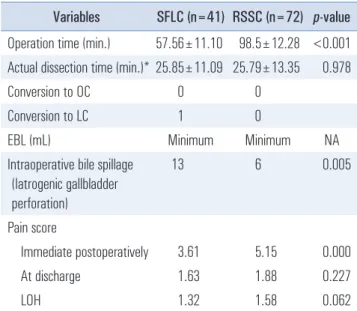
Intraoperative surgical outcomes were compared between the two groups (Table 2). Operation time (p<0.001, Fig. 1) was significantly longer for RSSC, but the actual dissection time (p=0.978, Fig. 2) was not significantly different between the
two approaches. For estimated blood loss, both RSSC and SFLC were observed to be minimal loss, and there was no significant difference between the two groups. In cases of intraoperative bile leakage (iatrogenic gallbladder perforation, p=0.005), patients undergoing RSSC showed a significantly smaller amount than did those undergoing SFLC. There were no cases of open conversion in either group, but both in- cluded one case of laparoscopic conversion. Postoperative data showed that postoperative pain score (base on NPIS) ( p=0.000) was significantly higher in the RSSC group versus the SFLC
Table 1. General characteristics and perioperative results of patients in whom SFLC or RSSC was attempted
Variables SFLC (n=41) RSSC (n=72) p-value Age (years)* 50.1±11.1 43.8±12.3 0.008 Male/female 13/28 (31.7/69.3) 29 /22 (73.4/26.6) 0.365 BMI (kg/m
2) 27.1±1.68 27.7±2.83 0.217 Symptom (yes /no) 22/19 (53.7/46.3) 37/35 (51.4/48.6) 0.816 GB stone /GB polyp 40/1 (97.5/2.5) 59/13 (81.9/18.1) 0.015
ASA score 1.34±0.575 1.43±0.601 0.443
SFLC = laparoscopic single-fulcrum cholecystectomy; RSSC = robot single-site cholecystectomy.
Table 2. Intraoperative & postoperative outcomes of patients with single-port minimally invasive cholecystectomy
Variables SFLC (n=41) RSSC (n=72) p-value Operation time (min.) 57.56±11.10 98.5±12.28 <0.001 Actual dissection time (min.)* 25.85±11.09 25.79±13.35 0.978
Conversion to OC 0 0
Conversion to LC 1 0
EBL (mL) Minimum Minimum NA
Intraoperative bile spillage (Iatrogenic gallbladder perforation)
13 6 0.005
Pain score
Immediate postoperatively 3.61 5.15 0.000
At discharge 1.63 1.88 0.227
LOH 1.32 1.58 0.062
LC = laparoscopic cholecystectomy; OC = open cholecystectomy; EBL
= estimated blood loss; Actual dissection time = the time from the be- ginning of dissection of Calot’s triangle to the end of gallbladder removal from the liver bed.
Fig. 1. Operation sequence over operation time.
group, but there was no significant difference between the two groups regarding discharge pain score ( p=0.272) or postopera- tive hospital stay length ( p=0.062, Table 2).
DISCUSSION
We conducted this study to investigate the difference be- tween intraoperative and postoperative outcomes of RSSC and SFLC in high-BMI patients (>25 kg/m
2). Usually, obesity is defined as BMI ≥30 kg/m
2according to the WHO criteria.
13However, Asian people are more likely to have a higher risk of diabetes mellitus than Westerners at the same BMI, and the population density of high BMI is also different in these two populations. Therefore, in this study, we included patients with BMI 25 kg/m
2or more according to the Asian criteria.
13In preoperative comparative analysis, there was a difference in age and diagnosis in the two patient groups. It is presumed that the young patients prefer robotic surgery. Intraoperative data showed that operation time was significantly longer in the SFLC group compared with in the SFLC group. This finding suggests that docking should be performed for robotic surgery.
However, actual dissection time was not significantly different between the two groups ( p=0.978), suggesting that intraopera- tive movement for effective dissection of Calot ’s triangle seems to be comparable. In cases of bile spillage during gallbladder dissection, the amount in the RSSC group was significantly smaller than that of the SFLC group, which is probably due to the better visual field of operation and fine movement in the former. This outcome is due to the inefficient movements in LSFC than RSSC, because of the limitation of movement.
In addition, by using the ICG technology, the dissection plane between the liver bed and gallbladder appears as a gray zone with no ICG signal, which can be visual guidance and make it easier to dissect. But there is a controversy as to whether this finding is clinically meaningful, because additional com-
plications related to bile spillage from gallbladder perforation do not occur in those patients. However, in case of gallblad- der polyp, unexpected gallbladder carcinoma can be detected in final pathologic diagnosis. Gallbladder perforation can be critical in those patients. Potential role of RSSC in terms with less gallbladder perforation need to be further investigated.
Considering the postoperative data, RSSC patients demon- strated a significantly higher immediate postoperative pain score than those in the SFLC group; this result may be due to the larger length of the incision in the former. However, there was no significant difference in length of hospital stay or discharge pain score between the two groups. Clinically, this finding would be of no great significance if the immediate postoperative pain was properly controlled.
Previous studies have shown that, when comparing RSSC and LSSC, RSSC is safer, easier to learn, less stressful, and technically easier for the operator to perform.
7,9,16,17Also, other investigations have detailed that the rates of major complica- tions and open conversion are lower in patients with high BMI compared with cases of RSSC and standard laparoscopic cho- lecystectomy.
18Therefore, when comparing RSSC and SFLC in high-BMI patients, RSSC seems to be a safer procedure associated with less morbidity.
However, when comparing RSSC and SFLC, RSSC showed a lower incidence of gallbladder perforation rate but no dif- ference in postoperative outcome, incidence of other compli- cations, or length of operation time. Postoperative pain was higher with RSSC but was managed at a similar level to those with SFLC at discharge.
The annual Korean costs of laparoscopic surgery and lapa- roscopic surgery are 2.2 million won and five million won, respectively. In terms of cost–benefit analysis, robotic surgery is not more advantageous than laparoscopic surgery.
Notably, our study was conducted using data from a single institution and involved only a single surgeon. Also, operation timing is different for SFLC and RSSC. Further studies will proceed of multicenter data in normal BMI patients or whole patients.
In conclusion, based on the above results, it is difficult to say for certain that RSSC is clearly better than SFLC. Howev- er, because of the convenience and efficiency of surgery with RSSC, which cannot be clinically measured, we have switched from LSFC to RSSC. Though the rising cost of this procedure is controversial, our patients are receiving safer and more ef- ficient surgical treatment.
ORCID
Kyu Min Lee, https://orcid.org/0000-0002-0048-0556
Dae Hun Han, https://orcid.org/0000-0003-2787-7876
Fig. 2. Actual dissection time over operation sequence.
Seoung Yoon Roh, https://orcid.org/0000-0002-1265-826X Ho Kyoung Hwang, https://orcid.org/0000-0003-4064-7776 Woo Jung Lee, https://orcid.org/0000-0001-9273-261X Chang Moo Kang, https://orcid.org/0000-0002-5382-4658
AUTHORS’ CONTRIBUTIONS
Conceptualization: CMK. Formal analysis: KML. Method- ology: DHH, KML. Writing-original draft: KML, Writing- review and editing: DHH, HKH, SYR, WJL, CMK.
CONFLICT OF INTEREST
None.
FUNDING
None.
ACKNOWLEDGMENTS
None.
REFERENCES
1) Polychronidis A, Laftsidis P, Bounovas A, Simopoulos C. Twenty years of laparoscopic cholecystectomy: Philippe Mouret--March 17, 1987. JSLS 2008;12:109-111.
2) Zucker KA, Bailey RW, Gadacz TR, Imbembo AL. Laparoscopic guided cholecystectomy. Am J Surg 1991;161:36-42; discussion 42-34.
3) Johnson AG. Reduced postoperative hospitalization after laparo- scopic cholecystectomy. Br J Surg 1991;78:1019.
4) Shaikh AR, Ali SA, Munir A, Shaikh AA. Single incision laparo- scopic cholecystectomy with conventional instruments and ports:
Initial experience at tertiary care public sector Hospital. Pak J Med Sci 2017;33:654-658.
5) Uras C, Boler DE. Endoloop retraction technique in single-port laparoscopic cholecystectomy: experience in 27 patients. J Lapa- roendosc Adv Surg Tech A 2013;23:545-548.
6) Morel P, Hagen ME, Bucher P, Buchs NC, Pugin F. Robotic
single-port cholecystectomy using a new platform: initial clinical experience. J Gastrointest Surg 2011;15:2182-2186.
7) Spinoglio G, Lenti LM, Maglione V, et al. Single-site robotic cho- lecystectomy (SSRC) versus single-incision laparoscopic chole- cystectomy (SILC): comparison of learning curves. First European experience. Surg Endosc 2012;26:1648-1655.
8) Lee SH, Jung MJ, Hwang HK, Kang CM, Lee WJ. The first expe- riences of robotic single-site cholecystectomy in Asia: a potential way to expand minimally-invasive single-site surgery? Yonsei Med J 2015;56:189-195.
9) Grochola LF, Soll C, Zehnder A, Wyss R, Herzog P, Breitenstein S. Robot-assisted single-site compared with laparoscopic single- incision cholecystectomy for benign gallbladder disease: protocol for a randomized controlled trial. BMC Surg 2017;17:13.
10) Seidell JC, Halberstadt J. The global burden of obesity and the challenges of prevention. Ann Nutr Metab 2015;66 Suppl 2:7-12.
11) Yilmaz H, Alptekin H, Acar F, Calisir A, Sahin M. Single-incision laparoscopic cholecystectomy and overweight patients. Obes Surg 2014;24:123-127.
12) Paajanen H, Kakela P, Suuronen S, Paajanen J, Juvonen P, Pih- lajamaki J. Impact of obesity and associated diseases on outcome after laparoscopic cholecystectomy. Surg Laparosc Endosc Percu- tan Tech 2012;22:509-513.
13) WHO Expert Consultation. Appropriate body-mass index for Asian populations and its implications for policy and intervention strategies. Lancet 2004;363:157-163.
14) Choi SH, Hwang HK, Kang CM, Lee WJ. Single-fulcrum lapa- roscopic cholecystectomy: a single-incision and multi-port tech- nique. ANZ J Surg 2012;82:529-534.
15) Jung MJ, Lee SY, Lee SH, Kang CM, Lee WJ. Single-Site Robotic Cholecystectomy: Reverse-Port Technique. Medicine (Baltimore) 2015;94:e1871.
16) Pietrabissa A, Sbrana F, Morelli L, et al. Overcoming the chal- lenges of single-incision cholecystectomy with robotic single-site technology. Arch Surg 2012;147:709-714.
17) Migliore M, Arezzo A, Arolfo S, Passera R, Morino M. Safety of single-incision robotic cholecystectomy for benign gallbladder disease: a systematic review. Surg Endosc 2018;32:4716-4727.
18) Svoboda S, Qaqish TR, Wilson A, Park H, Youssef Y. Robotic single-site cholecystectomy in the obese: outcomes from a single institution. Surg Obes Relat Dis 2015;11:882-885.