건강 기능성 연구를 중심으로 한 전통발효식품의 연구동향
⁃ 총설 ⁃
문은경1․김보경1․김은영2․이해정3․김 영4․박용순2․차연수1
1전북대학교 식품영양학과, 2한양대학교 식품영양학과
3가천대학교 식품영양학과, 4농촌진흥청 국립농업과학원
Research Trend in Traditional Fermented Foods Focused on Health Functional Evaluation
Eun-Gyung Mun
1, Bohkyung Kim
1, Eun-Young Kim
2, Hae-Jeung Lee
3, Young Kim
4, Yongsoon Park
2, and Youn-Soo Cha
11
Department of Food Science and Human Nutrition, Chonbuk National University
2
Department of Food and Nutrition, Hanyang University
3
Department of Food & Nutrition, Gachon University
4
National Institute of Agricultural Sciences, Rural Development Administration
ABSTRACT This study aimed to investigate the trends in five fermented foods used as seasonings in Korean cuisine:
ganjang (Korean fermented soy sauce), doenjang (Korean fermented soybean paste), kochujang (Korean fermented red pepper paste), cheonggukjang (Korean fermented soybean product), and jeotgal (Korean salted fish). There were 634 articles on traditional fermented foods published from 1995 to 2017. Among these, 159 papers were on the health function of fermented foods, 17 on ganjang, 60 on doenjang, 20 on kochujang, 58 on cheonggukjang, and four on jeotgal. Regarding ganjang and jeotgal, seven and two articles were published, respectively, based on cell and animal experiments, but no human trials were reported. Most studies on ganjang were related to immunological activity and inhibition of inflammation. In the experiments on doenjang, 31 papers were published, including three human trials, and most were anti-obesity/anti-diabetes studies. Four epidemiological studies have been reported on soybean including soybean products as well as fermented food categories reporting effects on gastric cancer, cardiovascular disease, and atopic dermatitis. For kochujang, 12 studies including cell and animal experiments, as well as three human trials were reported. The most published topics on kochujang were anti-obesity/anti-diabetes. In addition, suppressive effects on cancer cells, increased immune activity, and inhibition of inflammation were observed. Study of cheonggukjang consisted of 47 articles, including eight human trials, and 21 of them were anti-obesity/anti-diabetes experiments. Studies related to bone mineralization, skin improvement, and immune-boosting were conducted using cheonggukjang. This review focuses on the reported health benefits of Korean fermented foods, suggesting directions to be taken while planning a study on fermented foods by generating a database for the evaluation of the health benefits of Korean fermented foods.
Key words: Korean fermented foods, health functionality, human trials, case-study, research trends
Received 29 January 2018; Accepted 9 March 2018
Corresponding author: Youn-Soo Cha, Department of Food Science and Human Nutrition, Chonbuk National University, Jeonju, Jeon- buk 54896, Korea
E-mail: [email protected], Phone: +82-63-270-3822
서 론
아시아 문화권 사람들은 삶은 콩에 미생물(예, 곰팡이 및
Bacillus
sp.)을 증가시켜 효소의 활성을 통해 콩 단백질을 분해하여 독특한 맛을 생성하도록 하였다. 발효과정으로 인 해 독특한 풍미뿐만 아니라 영양학적인 가치 증진, 저장성 증대, 생리활성 물질 생성이 이루어진다(1,2). 2006년 미국 의 Health 잡지가 뽑은 세계적인 건강식품 중 한국의 김치,일본의 낫토, 그리스의 요구르트가 선정되어 발효식품이 건 강 기능성 식품으로 인정받고 있다(2).
해외에서는 발효식품의 R&D는 각 국가별로 자국의 전통 식품을 기초로 하여 진행되고 있다. 우리나라와 일본 등 아 시아 지역에서는 대두 발효식품에 치중하고 있으며, 유럽과 미주 지역에서는 치즈와 와인, 맥주 등을 위주로 한 발효식품 에 대해 연구가 활발하다. 유럽연합은 8개 working group 을 구성하여 전통식품에 대한 안전 관리에서부터 영양가치 향상, 마케팅에 이르는 전반적인 지원을 하고 있다(3). 우리 나라는 발효식품에 대한 연구는 지속해서 이루어지고 있으 나 국가적으로 통일된 지원체계는 확립되지 않은 실정이며, 연구 또한 산발적으로 이루어지고 있고 연구 결과에 대한 통합적인 데이터베이스가 없는 실정이다. 오히려 지역사회
Table 1. Publications on fermented foods classified by function
Publications Ganjang Doenjang Kochujang Cheonggukjang Jeotgal English Korean English Korean English Korean English Korean English Korean Healthy functionality
Microorganisms isolated from fermented foods
Characteristics of substances derived from fermented foods Characteristics of fermented
food
4 3 2 3
13 13 14 48
20 22 8 8
40 19 17 49
6 3 0 4
14 15 1 107
42 8 13
2
16 9 8 16
2 35
2 0
2 13 11 22
Total 12 88 58 125 13 137 65 49 39 48
100 183 150 114 87
Table 2. Healthy functionalities on ganjang
Protective effects Model1) Measured parameter2) Reference
Cancer Hypertension Immune /inflammation
Oxidant
Bacteria Thrombosis
C57BL/6J mice SD rat
In vitro
C3H/HeN and ICR mice RAW 264.7 cell
Human mast cell and RBL-1 cell BV2 microglial cells
Wistar rat
In vitro In vitro In vitro
Cytokine levels Blood pressure ACE inhibitor activity
Cytokine levels, cytokine expression
Fatty acid composition
Radical scavenging activity: DPPH, FRAP, ABTS
Antimicrobial activity Fibrinolytic activity
(5) (6,16,17)
(7,9-11)
(8,18-21)
(12) (13-15)
1)SD: Sprague-Dawley, RBL-1 cell: chemically-induced basophil cell.
2)ACE: angiotensin converting enzyme, DPPH: 1,1-diphenyl-2-picrylhydrazyl, FRAR: ferric-reducing antioxidant potential, ABTS:
2,2’-azino-bis(3-ethylbenzothiazoline-6-sulfonate).
가 장류를 전면으로 내세워 지역발전을 꾀하고 있어 전라북 도 순창군은 초고령 사회이자 비수도권 농촌지역이나 장류 제조의 강점과 지식의 축적을 통해 장류를 지역 브랜드로 만들었다(4). 전통 발효식품에 관한 연구동향 중 건강 기능 성에 대한 전반적인 고찰은 없었으며, 따라서 발효식품에 대한 건강 기능성에 대한 연구동향을 알아봐야 할 필요성이 대두된다.
본 총설에서 수집한 논문에 대한 분류는 다음과 같이 요약 할 수 있다. 1) 발효식품의 성분 및 그 유래 물질에 대한 정제와 특성 연구, 2) 발효에 이용된 미생물의 동정 및 특성 연구, 3) 건강 기능성 평가 연구. 이것은 발효식품 중의 한 가지 종류만으로도 다양한 분야에서 연구 결과를 얻을 수 있다는 것을 의미한다. 발효식품의 육성이 현 정부의 목표 중 하나이기 때문에 연구자들이 검증성 있는 논문 출판을 통해서 뒷받침해야 할 필요성이 있다. 본 총설에서는 다양한 건강 기능성 평가에 초점을 맞추어 살펴봄으로써 발효식품 에 대한 연구를 기획하고자 할 때 세워야 할 방향을 제시하 고자 하였다. 또한, 발효식품의 건강 기능성 평가에 대한 기 초적인 데이터베이스 작업이라 할 수 있다.
발효식품의 전반적인 연구동향
전반적인 연구동향에 대해 집계한 결과는 Table 1에 나
타내었다. 1995년부터 2017년까지 한국어와 영어로 출판 된 논문은 총 634편으로 집계되었다. 발효식품 종류별로 간 장 100편, 된장 183편, 고추장 150편, 청국장 114편, 젓갈 87편이었다. 언어로 구분하면 영어로 출판된 수는 187편, 한국어 출판은 447편이었다. 논문의 종류로 구분하면 건강 기능성에 관한 논문은 159편, 관련 미생물에 관한 논문은 140편, 장류에서 유래한 성분 특성에 관한 논문은 76편, 장 류에 대한 특성은 259편이 출판되었다. 전통 장류 중에서는 연구비율이 28.5%인 된장이 가장 많은 연구가 활발하게 이 루어졌으며, 젓갈과 간장이 가장 적은 연구가 이루어졌다.
그러나 발효식품마다 연구하는 분야의 비중이 다르게 나타 났다. 간장과 고추장에 대한 연구는 각 장류에 대한 특성 연구가 주류를 이루는 데 비하여 청국장에 대한 연구는 기능 성에 대한 연구가 활발하게 이루어져 있다. 된장은 각 연구 분야가 다양하게 보고되어 있으며, 젓갈에 대한 연구는 미생 물에 관한 연구가 다수 보고되었으나 다른 분야에 대한 연구 는 미비하였다.
간장에 대한 건강 기능성 연구
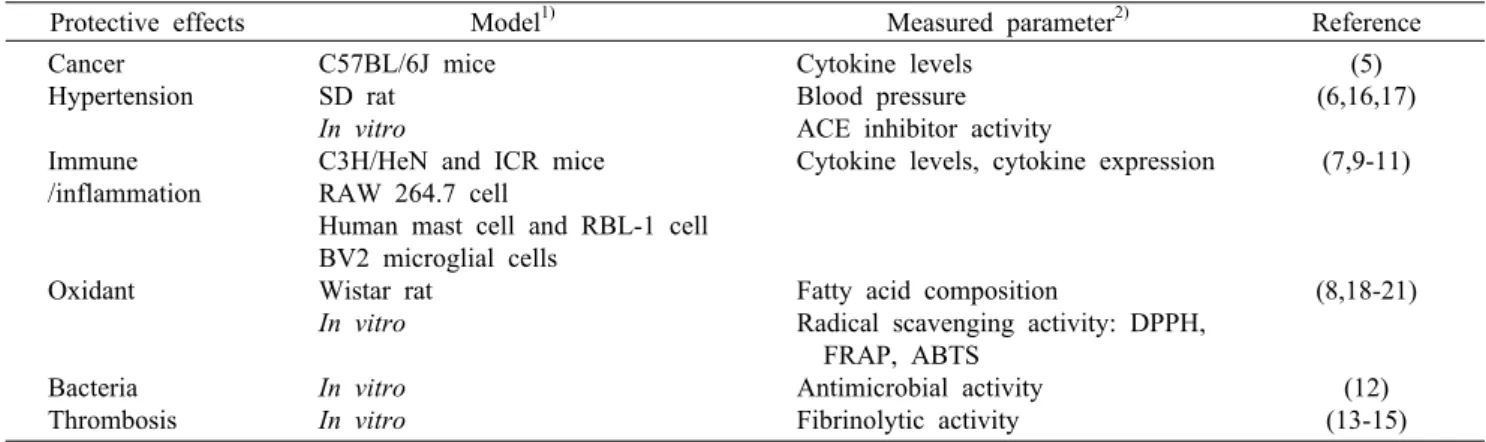
Table 2는 간장에 대한 건강 기능성 평가를 나타내었다.
항암에 대한 효과는 발효간장 및 양조간장, 혼합간장을 궤양 성 대장염을 유발한 C57BL/6J mice에게 섭취시킨 후 혈중
Table 3. Healthy functionalities on doenejang
Protective effects Model1) Measured parameter2) Reference
Cancer
Immune /inflammation
Obesity /diabetes mellitus Oxidant /mutant
Hypertension Thrombosis
Whitening Bacteria
Balb/c mice, Yac-1 cells ICR mice
C57BL/6 mice
AGS, HT-29, PC-3, DU145, A549, MCF-7, Hep3B and MEF cells SD rat
C57BL/6J mice C57BL/6N mice Balb/cByJ mice RAW 264.7 cell C57BL/6N mice SD rat
C57BL/6J mice C57BL/6J mice HT22 cell
In vitro
In vitro In vitro
In vitro In vitro
Metastasis, natural killer cell activity Micronucleus test
Cytokine levels Cell viability
Cytokine levels, cytokine expression Immunohistochemical density
Enzyme activity Lipid profiles Gene expression Protein expression
Antioxidant enzyme activities ROS level
Radical scavenging activity: DPPH, ABTS, TBARS
Nitrite scavenging ability Peroxide value
Ames test
ACE inhibitor activity Fibrin plate
Fibrinolytic activity Fibrin clotting inhibition Tyrosinase activity Melanin formation Antimicrobial activity
(22-32)
(33-38)
(39-45)
(23,34,38,39,46-59)
(47-49,53,56,58-63) (48,52,54,63-72)
(47-49,53,58,73,74) (52,63,66,75,76)
1)SD: Sprague-Dawley, AGS: gastric adenocarcinoma cell, HT-29: colorectal adenocarcinoma cell, PC-3 and DU145: prostate cancer cell, A549: lung carcinoma cell, MCF-7: brest cancer cell, Hep3B: hepatocellular carcinoma cell, MEF: mouse embryonic fibroblast cell, HT22: mouse neuronal cell.
2)ROS: reactive oxygen species, DPPH: 1,1-diphenyl-2-picrylhydrazyl, ABTS: 2,2’-azino-bis(3-ethylbenzothiazoline-6-sulfonate), TBARS: thiobarbituric acid reactive substances, ACE: angiotensin converting enzyme.
염증성 cytokine의 농도와 결장에서의 발현을 측정하였다.
그 결과 발효간장이 염증성 cytokine의 농도 및 발현을 감소 시킨 것으로 보고하였다(5). 항고혈압은 동일한 염도의 소금 물과 발효간장을 섭취시킨 Sprague-Dawley rats(SD rat) 의 혈압을 측정하였으며 발효간장의 혈압 강하 효과를 보고 하였다(6). 면역 증진은 간장에서 유래한 다당류를 섭취한 ICR mice를 이용하여 골수세포 증식 활성 및 cytokine의 농도 상승을 보고하였다(7). 항산화 효과에 대해서는 양조간 장을 섭취한 Wistar rat의 혈중 지방산 분석을 통해 지질산 화 억제 효과를 보고하였다(8). 세포실험은 간장에서 분리한 에탄올 추출물 및 다당류, indole alkaloids를 처리한 RAW 264.7 cell 및 mast cell, microglial cell에서 cytokine 농도 와 발현을 측정하여 면역 활성 증진 및 항염증에 대한 효과 를 보고하였다(9-11). 간장에 대한
in vitro
실험은 간장에 서 분리한 발효균을 처리하여 구강 유해균의 생존수 측정을 통한 항균 활성(12), 간장에서 분리한Bacillus
균주 및 다당 류를 처리한 fibrinogen plate를 이용한 항혈전 활성(13- 15), 간장에서 분리한Bacillus
균주 및 저염간장을 처리하 여 angiotensin converting enzyme(ACE) 저해 활성을 보고한 항고혈압 활성(16,17), 희석한 간장을 처리하여 라디 칼 소거능을 측정한 항산화 활성(18-21)을 보고하였다. 간 장에 대한 건강 기능성 연구는 분야가 다양하지 않았으며 검증된 논문의 수가 적게 발표되었다. 이는 더욱 다양한 분 야에서 검증된 논문의 출판이 필요한 것으로 보인다.
된장에 대한 건강 기능성 연구
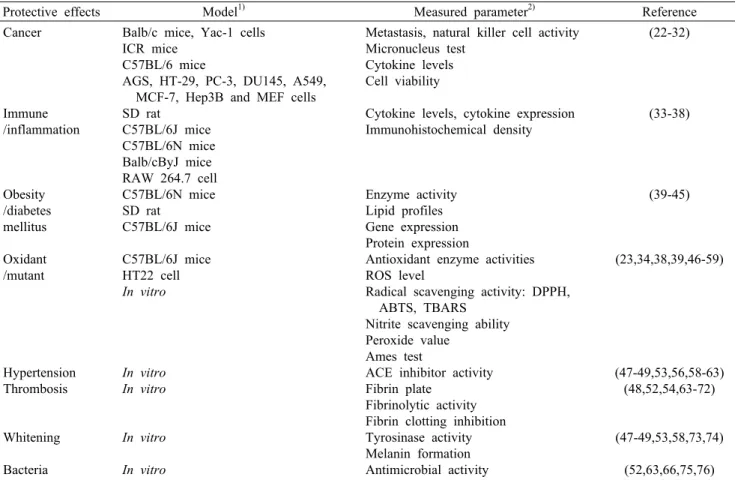
Table 3은 된장에 대한 건강 기능성 평가를 나타내었다.
된장에 대한 항암 활성은 면역세포인 Yac-1 cell을 이용해 서 natural killer cell activity를 측정하였으며, 암세포를 이식한 Balb/c mice에서의 암 전이를 억제하였다고 보고하 였다(22). 돌연변이를 유발한 ICR mice를 이용하여 micro- nucleus test를 실험하였다(23). 직장암을 유발한 C57BL/
6 mice에서의 cytokine 농도 및 발현을 측정하여 항암 효과 를 발표하였다(24). 인체 위암세포 및 결장암세포, 폐암세포, 전립선암세포, 유방암세포, 간암세포, mouse embryonic fibroblast(MEF)를 이용하여 세포 생존율을 측정하여 암세 포 사멸이나 DNA 합성 저해 효과를 보고하였다(25-32).
국문지로 출판된 연구에서는 암세포 사멸 혹은 증식 억제를
평가하였으며 2013년 이후로는 출판되지 않고 있다.
고지방 식이를 섭취한 SD rat 및 C57BL/6J mice를 이용 하여 염증에 관련한 cytokine 농도 및 발현을 측정하여 항염 증 효과를 보고하였다(33,34). C57BL/6J mice에서 장관 미 생물 구성 및 분변 lipopolysaccharide(LPS) 농도를 측정하 여 발표하였다(35). C57BL/6N mice의 공장 및 결장을 면 역조직화학적 염색을 통하여 면역 증강 효과를 보고하였다 (36). Balb/cByJ mice를 이용하여 natural killer cell func- tional assay 및 cytokine 농도를 측정하여 된장에 대한 전 반적인 면역 활성 효과를 보고하였다(37). LPS로 자극한 RAW 264.7 cell을 이용하여 항산화능 및 cytokine을 측정 하여 항염증 활성을 나타내었다(38).
고지방식이를 급여한 C57BL/6N mice에서 당대사 관련 효소 활성을 측정하여 된장 섭취가 고혈당을 억제하는 것으 로 보고하였으며(39), streptozotocin으로 당뇨가 유발된 SD rat에서의 혈중 성분을 측정하여 혈당 강하 효과를 보고 하였다(40). 고지방을 급여하여 비만을 유도한 SD rat 및 C57BL/6J mice, C57BL/6N mice에게서 효소 활성 및 지 질 성상, 유전자 혹은 단백질 발현을 분석하여 혈중 지질 개선 및 간 조직 병변 완화, 복부지방 감소 등의 효과를 보고 하였다(41-45). 된장의 섭취가 고지방식이로 인한 비만과 제1, 제2형 당뇨를 개선할 수 있으며, 인체실험 적용 가능성 이 있다고 고찰하고 있었다.
된장의 항산화 활성은
in vitro
실험을 통해 국문지로 출 판되었으며, 1,1-diphenyl-2-picrylhydrazyl(DPPH) 및 thiobarbituric acid reactive substances(TBARS), 2,2’- azino-bis(3-ethylbenzothiazoline-6-sulfonic acid)(ABTS) 활성을 측정하였다(46-54). 최근 3년 내 출판된 논문은 항 산화능뿐만 아니라 세포 보호 효과 및 항염증을 병합하여 연구하였다(34,38,39,55). 고지방식이와 된장을 섭취한 C57BL/6N mice에 항산화 효소 활성을 측정하여 산화적 스트레스를 억제한다고 보고하였다(39). 된장의 라디칼 소 거능 및 마우스 해마 세포(HT22 cell)에서의 reactive oxy- gen species(ROS) 수준을 측정하여 항산화능과 신경보호 효과를 제시하였다(55). 된장의 항돌연변이 활성은 Ames test를 통하여 입증하거나 활성 물질을 밝히기도 하였다 (23,47,53,56-59). 항고혈압 활성은 생체 내 실험은 없었으 며 ACE 저해 활성을 평가한 논문으로만 보고되었다(47- 49,53,56,58-63). 항혈전 활성은 fibrin plate 및 fibrin 응 고 지연 등으로 평가하였으며, 다수의 논문이 된장에서 분리 한 균주를 이용하고 있었다(48,52,54,63-72). 미백 활성은 tyrosinase 저해 활성을 측정하거나 멜라닌 생성을 억제하 는 것으로 평가하여 보고하였다(47-49,53,58,73,74). 된장 에 대한 항균 활성은 된장 추출물이 병원성 균주에 대한 항 균 활성을 실험하였다(52,63,66,75,76). 항산화 및 항고혈 압 등in vitro
실험으로 건강 기능성을 제시한 논문들은 다 양한 기능성 실험을 하여 생리활성 평가로 출판되었다.된장의 건강 기능성에 대한 인체 실험논문은 2012년부터
총 3편이 발표되었으며, 모두 과체중 및 비만인을 대상으로 하였다(77-79)(Table 4). 과체중 및 비만 대상자(n=26)가 12주간 하루에 9.8 g의 된장 동결건조 분말(된장중량=40 g)을 섭취했을 때 위약 섭취자(n=25)와 비교하여 체중, 총 지방량 및 내장 지방이 유의하게 감소하는 양상이 보고되었 다(77). 또한, 된장의 섭취 효과와 지질 생성의 관련 기전을 이해하기 위하여 지질 생성에 영향을 미치는 것으로 알려진 peroxisome proliferator activator receptor γ(PPAR-γ) 나 uncoupling protein-1(UCP-1) 다형성에 대한 연구를 수행한 결과 된장의 섭취가 PPAR-γ와 UCP-1의 다형성을 가진 피험자에서 효과적인 것으로 보고되었다. 즉 12주간 하루에 9.8 g의 된장 동결건조 분말 섭취는 PPAR-γ2 돌연 변이 대립유전자를 가진 대상자에서 항비만 및 항노화 효과 를 나타내었으며(78), UCP-1 다형성의 G 대립유전자를 가 진 대상자에서는 지방분해를 촉진, 유리지방산의 증가 및 내장지방 감소를 유발할 수 있을 것으로 보고하였다(79).
역학 연구에서는 된장이라는 개별 식품의 효과보다는 된 장이 포함된 ‘발효식품군’ 또는 ‘콩 및 콩 제품’ 등 식품군에 대한 분석 결과가 주로 보고되었다. 된장의 긍정적인 건강 기능성에 대한 단면연구 및 환자-대조군 연구는 비만 및 심 혈관계 질환 관련 1편, 아토피 개선 1편, 위암 관련 2편이 보고되었다(Table 5). 성인 남자를 대상으로 한 단면 연구에 서는 두부와 된장을 자주 섭취할수록 혈압이 낮았으며, 콩국 섭취빈도가 높을수록 HDL 콜레스테롤 수치가 높았고, 콩의 섭취빈도가 높을수록 BMI도 낮아졌다(80).
국민건강영양조사 데이터 분석 결과 된장, 청국장, 김치 등 발효식품을 한 달에 92회 이상 먹는 사람은 54회 미만으 로 먹는 사람에 비해 아토피 피부염 유병률이 0.56배 감소하 여 발효식품의 섭취는 아토피 피부염에도 긍정적인 효과를 주는 것으로 보였다(81). 환자 대조군 연구에서는 위암 환자 와 대조군 136쌍을 대상으로 분석하였을 때 콩 및 콩 제품의 섭취를 가장 적게 섭취한 군에 비해서 가장 많이 섭취한 군 의 위암 위험도가 0.35배 감소함을 보였으며(82), 또 다른 위암 환자-대조군 연구에서는 IL-10의 특정 유전자형을 가 진 사람의 경우 ‘콩 및 콩 제품’을 적게 먹을 경우 위암 위험 도가 증가했지만, 많이 섭취한 경우에는 유전자 변이에 의해 위험도가 증가하지 않아 콩 섭취량과 유전자형에 따라 위암 의 위험도가 다르게 나타났다(83).
고추장에 대한 건강 기능성 연구
고추장에 대한 건강 기능성 평가 연구는 Table 6에 나타 내었다. 고추장의 항암 효과는 자궁경부암 및 간암, 폐암, 위 암, 대장암 등의 암세포의 성장 억제 및 사멸에 대한 연구로 보고하였다(84-88). 면역 활성에 대한 논문은 Balb/c mice 에서 분리한 비장세포의 증식능을 실험하였고(84), RAW 264.7 cell을 이용하여 cytokine 농도를 측정하였다(89).
고추장의 항비만/당뇨 평가는 3T3-L1 cell 및 SD rat을 이 용하였다. 전지방세포인 3T3-L1 cell에 고추장 추출물을
처리하여 세포 분화 억제 및 지방 대사 관련 유전자 발현에 대하여 보고하였다(90). 고지방식이를 급여한 SD rat에게 고추장을 섭취하여 체지방 감소 및 혈중 지질 성상 개선에 대해 연구하여 항비만 효과를 밝혔다(91-93). 췌장을 절제 한 당뇨병성 SD rat을 이용하여 고추장이 당 대사를 개선한 다고 보고하였다(94).
항산화 활성은
in vitro
실험으로 이루어졌으며, SOD 유 사 활성 및 아질산염 소거능, 라디칼 소거능 등의 결과를 보 고하였다(95-100). Ames test를 통한 항돌연변이성 또한 제시하였다(84,85). 고혈압 활성은 ACE 저해 활성을 평가 하였으며(97), 항혈전 활성은 혈전용해능 및 혈소판응집 억 제능을 측정하여 보고하였다(89,97). 항균 활성은 비브리오 균을 제어할 수 있는 고추장을 개발하여 보고하였다(101).항비만/당뇨 활성을 제외한 고추장에 대한 연구는
in vitro
연구가 대다수이며, 그 기전이나 복합적인 생리활성을 밝히 는 연구가 부족한 실정이다.고추장의 건강 기능성에 대한 인체 실험논문은 2013년부 터 총 3편이 발표되었으며, 된장과 마찬가지로 모두 과체중 이나 비만인을 대상으로 하였다(102-104)(Table 4). 체질 량지수가 23 이상인 대상자(n=26)에게 12주간 하루에 32 g의 고추장 동결건조 분말(고추장 중량=50 g)을 섭취하거 나 위약을 섭취하여(n=27) 체중과 체지방 및 혈중 지질을 측정한 결과, 고추장 섭취군에서 내장지방, 혈중 중성지질 및 apolipoprotein(apo) B의 농도가 유의하게 감소하여 장 기간의 고추장 섭취가 항비만 및 항동맥경화 효과를 나타낼 수 있는 것으로 보고되었다(102). 또한, 고지혈증 환자가 하 루에 34.4 g의 고추장 동결건조 분말(n=15)이나 위약(n=
15)을 12주간 섭취했을 때 혈중 총 콜레스테롤이 유의하게 감소하였고 LDL-콜레스테롤은 감소하는 경향이 나타났으 며, HDL-콜레스테롤 농도에는 변화가 없어 고추장이 심혈 관질환의 위험성을 낮출 수 있을 것으로 보고하였다(103).
또한, 비만인에 대한 고추장의 효과를 PPAR-γ 다형성에 대해 분석한 결과 PPAR-γ2 T 돌연변이 대립유전자를 가진 경우 혈중 지질개선 효과보다는 인슐린 민감도가 증가하는 것으로 나타나 PPAR-γ 다형성에 따라 다른 효과를 나타낼 수 있음을 시사하였다(104).
청국장에 대한 건강 기능성 연구
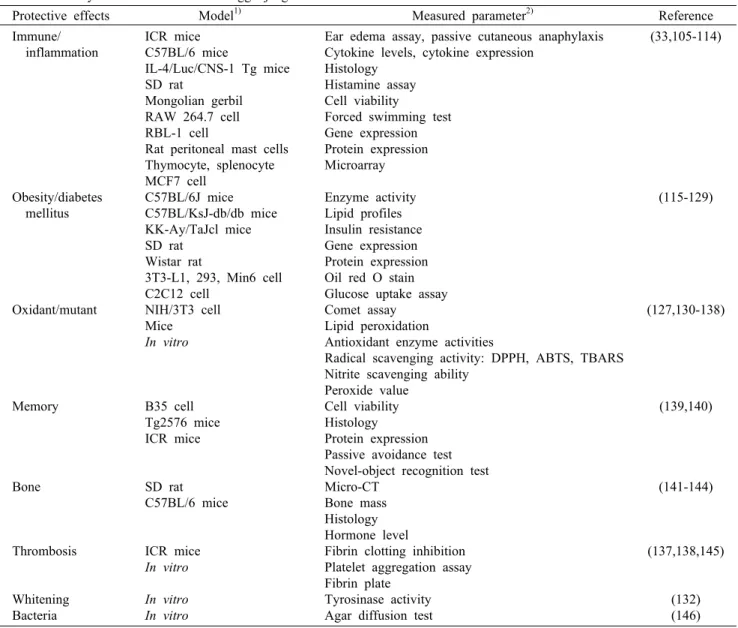
청국장에 대한 연구는 다른 장류에 비하여 많이 이루어져 있으며, 건강 기능성 평가도 다양한 분야에서 이루어져 있다 (Table 7). 청국장의 면역 활성에 대한 연구는 고지방을 섭 취한 SD rat을 이용하여 염증성 cytokine 농도를 측정하여 NF-κB 활성 및 그 대사 유전자 발현을 조절하여 항염증 효과를 나타낸다고 보고하였다(33). 또한, ICR mice에게서 귀의 부종을 측정하거나 SD rat에게서 수동피부아나필락시 스를 측정하여 천식이나 아토피 피부염과 같은 알레르기 반 응을 감소시킨다고 보고하였다(105-107). Balb/c mice에 서 수집한 흉선세포 및 비장세포의 세포 활성을 측정하여 세
포사멸(apoptosis)을 억제한다고 발표하였다(108). 일시적 인 동맥 폐쇄로 인한 전염증성 사이토카인 감소로 인한 췌장 베타세포와 해마세포 사멸을 막았다는 연구도 있다(109). 면 역 억제된 mice나 RAW 264.7 cell을 이용하여 청국장에서 추출한 다당류 투여가 면역 증가 활성이 있다고 보고하고 있 다(110,111). 유방암 세포(MCF7 cell)에 청국장 에탄올 추 출물을 처리하면 염증성 유전자 발현을 억제하여 유방암 예 방에 도움이 될 수 있다고 보고하였다(112). Wistar rat 및 ICR mice를 이용하여 청국장의 독성 평가를 하여 독성이 없음을 입증하였다(113,114).
청국장에 대한 항비만/당뇨 연구는 건강 기능성 평가 중 에서 가장 많이 이루어진 분야이다. 고지방식이를 급여한 C57BL/6J mice 및 SD rat, Wistar rat을 이용하여 항비만 효과를 보고하고 있다. 청국장의 섭취는 혈중 지질 성상을 개선하였으며, 지방 산화 유전자 발현을 증가시키며 지방 축 적 유전자 발현은 감소시켰다(115-120). 당뇨를 유발한 SD rat 및 C57BL/KsJ-
db/db
mice, KK-Ay/TaJcl mice를 이 용하여 청국장이 당뇨병증 하에서 고혈당증을 개선하며, 간 의 당 대사 관련 효소와 말초 조직에서 인슐린 민감성을 증 진한다고 보고하였다(121-126). 청국장 추출물은 전지방 세포(3T3-L1 cell)에서의 지질 축적 저해 효능, 베타세포 (Min6 cell)에서의 포도당에 의한 인슐린 분비를 자극하였 으며 세포 생존율을 증가시켰다(127-129). 청국장의 건강 기능성을 나타내는 기능성 물질로는 아이소플라본이나 아 이소플라본 아글리콘을 제시하고 있다(120,123,129).청국장의 에탄올 추출물은 NIH/3T3 cell과 mice에서 comet assay 및 lipid peroxidation을 측정하여 산화적 스 트레스를 억제한다고 발표하였다(130). 그 밖의 실험은
in
vitro
에서 이루어졌으며 라디칼 소거능 및 아질산염 소거능,과산화물가 등을 측정하여 항산화능을 보고하였다(127, 131-138). 청국장을 섭취시킨 ICR mice를 이용하여 수동 회피실험 및 인지능 실험을 진행하여 신경퇴행성 질병에 효 과를 나타낼 것으로 보고하였다(139). 또한, B35 cell 및 Tg2576 mice를 이용하여 신경생장인자(nerve growth factor)의 분비를 촉진하여 신경보호 효과를 제시하였다 (140). 2014년 이후 연구에서는 SD rat을 이용하여 뼈의 미네랄 함량 증가 및 성장호르몬 분비 증가, 성장 촉진에 도움이 될 수 있다고 보고하고 있다(141,142). 또한, 난소를 절제한 C57BL/6 mice 및 SD rat을 이용하여 청국장 섭취 가 폐경 후 골다공증을 예방하며 뼈의 건강을 증진할 것으로 보고하였다(143,144). 항혈전 활성은 ICR mice를 이용하거 나
in vitro
실험을 통하여 항혈전 효과를 검증하였다(137, 138,145). Tyrosinase 저해 활성을 측정하여 미백 기능성 을 제시하거나(132), 항균활성을 평가하였다(146).청국장의 건강 기능성에 대한 인체 실험논문은 2011년부 터 총 8편이 발표되었으며(Table 4), 청국장의 섭취와 혈중 지질이나 혈당의 개선을 비교한 3편의 연구와 청국장 섭취 와 더불어 마사지를 수행 시 중년여성의 피부 및 체형에 관
Table 7. Healthy functionalities on cheonggukjang
Protective effects Model1) Measured parameter2) Reference
Immune/
inflammation
Obesity/diabetes mellitus
Oxidant/mutant
Memory
Bone
Thrombosis
Whitening Bacteria
ICR mice C57BL/6 mice
IL-4/Luc/CNS-1 Tg mice SD rat
Mongolian gerbil RAW 264.7 cell RBL-1 cell
Rat peritoneal mast cells Thymocyte, splenocyte MCF7 cell
C57BL/6J mice C57BL/KsJ-db/db mice KK-Ay/TaJcl mice SD rat
Wistar rat
3T3-L1, 293, Min6 cell C2C12 cell
NIH/3T3 cell Mice
In vitro
B35 cell Tg2576 mice ICR mice
SD rat C57BL/6 mice
ICR mice
In vitro In vitro In vitro
Ear edema assay, passive cutaneous anaphylaxis Cytokine levels, cytokine expression
Histology Histamine assay Cell viability
Forced swimming test Gene expression Protein expression Microarray Enzyme activity Lipid profiles Insulin resistance Gene expression Protein expression Oil red O stain Glucose uptake assay Comet assay
Lipid peroxidation
Antioxidant enzyme activities
Radical scavenging activity: DPPH, ABTS, TBARS Nitrite scavenging ability
Peroxide value Cell viability Histology
Protein expression Passive avoidance test Novel-object recognition test Micro-CT
Bone mass Histology Hormone level
Fibrin clotting inhibition Platelet aggregation assay Fibrin plate
Tyrosinase activity Agar diffusion test
(33,105-114)
(115-129)
(127,130-138)
(139,140)
(141-144)
(137,138,145)
(132) (146)
1)SD: Sprague-Dawley, RBL-1 cell: chemically-induced basophil cell, MCF-7: breast cancer cell, 293: embryonic kidney cell, Min6:
insulinoma cell, C2C12: myoblast cell, B35, neuroblastoma cell.
2)DPPH: 1,1-diphenyl-2-picrylhydrazyl, ABTS: 2,2’-azino-bis(3-ethylbenzothiazoline-6-sulfonate), TBARS: thiobarbituric acid reactive substances, micro-CT, micro-computed tomography.
한 연구 5편으로 구분되었다. 혈액 중의 지표를 이용한 청국 장의 기능성을 연구한 3편의 논문 중 2편은 과체중이나 비 만인을 대상으로(147,148), 1편은 공복혈당장애(impaired fasting glucose)를 가진 대상자에 대하여 수행하였다(149).
과체중이나 비만인이 12주간 하루에 26 g의 청국장 동결건 조 분말(청국장 중량=70 g)을 섭취한 경우(n=29), 위약을 섭 취한 경우(n=26)에 비하여 혈중 apo B가 유의하게 감소하 였으며, 내장지방의 면적과 apo B/apo A1의 비율이 감소하 는 경향을 나타내어 청국장이 항동맥경화 효과를 나타낼 수 있음을 보고하였다(147). 또한, 과체중이나 비만인이 12주 간 하루에 동결건조 한 청국장 35 g(청국장 중량=70 g)을 섭 취하는 교차연구를 수행한 결과, 청국장 섭취기간 동안 여성 (n=43)에서 체지방 비율, 허리둘레 및 허리와 엉덩이 둘레
의 비와 동맥경화의 위험인자 중 하나인 high sensitive C- reactive protein(hs-CRP)의 농도가 감소하였다. 또한, 남 성(n=40)과 여성 대상자 모두에서 청국장을 섭취하는 기간 동안 apo B/apo A1의 비율이 유의적으로 감소하여 장기간 의 청국장 섭취가 과체중이나 비만인에게서 신체 조성 및 심장혈관 질환 위험인자의 개선 효과를 나타낼 수 있을 것으 로 보고하였다(148). 또한, 약한 과혈당증을 나타내는 성인 을 대상으로 동결건조 한 청국장 및 홍삼청국장을 하루에 20 g씩 8주간 섭취시킨 경우 청국장(n=15) 및 홍삼청국장 (n=15) 섭취 시 모두 유의하게 공복혈당 농도 및 총 콜레스 테롤과 LDL-콜레스테롤을 낮추는 것으로 나타나 청국장이 공복 포도당 장애를 나타내는 사람에서 혈당을 낮추고 혈중 지질을 개선하는 효과를 나타낸다고 보고하였다(149). 청국
Table 8. Healthy functionalities on jeotgal
Protective effects Model1) Measured parameter Reference
Immune Memory
Balb/c mice RAW 264.7 cell SD rat
Cytokine levels Histology
Passive avoidance test Water maze test Enzyme activity
(155) (156)
1)SD: Sprague-Dawley.
장 섭취와 마사지의 효과를 함께 비교한 5편의 연구는 2016 년 이후 수행되었고, 2편은 40~50대 중년여성을 대상으로 청국장 식이와 함께 등 마사지를 수행, 피부 및 체형에 미치 는 영향을 측정하였다. 연구 결과 청국장 식이의 섭취 시 (n=10) 섭취하지 않은 대조군(n=10)과는 달리 얼굴 피부의 멜라닌 색소 감소와 홍반 감소가 나타났고(150), 체중 감소, 근육량 증가 및 체지방 비율의 감소가 보고되었다(151). 이 러한 효과는 등 마사지를 함께 수행 시 더욱 증가한다고 하 였다. 3편의 논문은 청국장을 마쇄 후 40°C로 24시간 발효 후 섭취 시(n=10) 얼굴의 유분량 증가, 수분량 증가, 멜라닌 색소 및 홍반의 감소가 보고되었고(152), 피부의 pH가 낮아 졌으며 피부색의 변화 등 중년여성의 피부에 긍정적인 개선 효과를 나타낼 수 있을 것으로 생각되었다(153). 또한, 발효 청국장의 섭취는 체중, 체지방량 및 체질량지수의 감소와 함께 골격근량의 증가를 나타내어 중년여성의 비만과 체형 에 효과가 있으며 이러한 효과는 등 경락마사지를 함께 수행 하여 더욱 증진시킬 수 있다고 하였다(154).
젓갈에 대한 건강 기능성 연구
젓갈에 대한 건강 기능성 연구는 미비하며 연구가 이루어 지지 않았다(Table 8). 젓갈에 대한 대부분의 연구는 젓갈에 서 분리한 균주의 동정 및 특성을 평가하고 있었다. Balb/c mice 및 RAW 264.7 cell을 이용하여 면역조직화학적 염색 및 염증성 cytokine 농도를 측정하여 아토피 피부염 개선을 제시하였으나, 젓갈 자체를 이용한 것이 아니라 젓갈에서 분리한 프로바이오틱스를 평가하였다(155). 젓갈 자체를 평 가한 실험은 젓갈을 먹인 SD rat을 이용하여 수동회피실험 및 수중미로실험을 통하여 인지기능 개선을 보고한 것뿐이 었다(156). 젓갈은 한식의 중요한 양념 중 하나이나 그 기능 성에 대한 연구는 거의 이루어지지 않았기 때문에 활발한 연구가 필요하다.
요 약
본 연구는 한식에서 양념으로 이용하는 발효식품 5종류(간 장 및 된장, 고추장, 청국장, 젓갈)에 대한 연구 동향을 살펴 보았다. 발효식품에 대한 논문은 1995년부터 2017년까지 634편이 출판되었으며, 그중 159편이 건강 기능성을 평가 한 논문이었다. 간장이 17편, 된장 60편, 고추장 20편, 청국 장 58편, 젓갈이 4편으로 집계되었다. 간장과 젓갈을 대상으
로 한 세포 및 동물을 이용한 실험은 7편과 2편에 불과하였 으며 인체실험은 이루어지지 않았다. 간장은 면역 활성 및 염증 억제에 대한 연구가 가장 많이 이루어졌다. 된장을 이 용한 세포 및 동물실험은 인체실험 3편과 역학조사 4편을 포함하여 31편이 보고되었다. 된장의 건강 기능성 중 항비 만/당뇨에 대해 다루는 논문이 세포 및 동물, 인체실험을 모두 포함하여 11편으로 집계되었다. 전통발효식품을 연관 한 역학조사는 콩 및 콩 제품, 발효식품군의 섭취가 위암과 심혈관계 질환, 아토피 피부염에 미치는 영향을 보고하였다.
고추장에 대한 건강 기능성 평가는 12편이 세포 및 동물실 험을 이용하였고 인체실험은 3편이 보고되었다. 고추장 역 시 항비만/당뇨에 대한 건강 기능성 평가가 8편으로 가장 많 았다. 그 밖에 암세포를 이용한 항암실험 및 면역 활성 증강, 염증 억제에 대한 연구가 이루어졌다. 청국장에 대한 건강 기능성 평가는 8편의 인체실험을 포함하여 47편의 세포 및 동물실험이 이루어졌다. 그중 21편이 항비만/당뇨에 대한 연구였으며, 5편이 인체실험이 이루어졌다. 그 외에도 청국 장은 뼈의 미네랄 증진 및 피부 개선, 면역 활성 증진 등 다양 한 분야에서 건강 기능성 검증이 이루어졌으며, 다른 발효식 품에 비하여 연구의 범위가 넓었다. 본 총설은 발효식품의 건강 기능성 평가를 위한 데이터베이스 작업이며, 향후 연구 를 기획하고자 할 때 방향을 제시할 수 있을 것이다.
감사의 글
이 논문은 농촌진흥청 연구사업(PJ011427022017)의 지원 에 의해 이루어진 것이다.
REFERENCES
1. Shin D, Jeong D. 2015. Korean traditional fermented soy- bean products: Jang. J Ethnic Foods 2: 2-7.
2. Park KY. 2012. Increased health functionality of fermented foods. Food Industry and Nutrition 17(1): 1-8.
3. Na HJ, Ahn SH, Baek JW, Kim JS, Lee JY, Lim HR. 2014.
Analysis of the current status of the soybean industry and research on the advanced industrialization plan. Ministry of
Agriculture Food and Rural Affairs, Sejong, Korea. p 71-78.4. Huh D, Park S, Koo Y. 2016. Technological convergence and knowledge network in rural area: Fermented soy prod- uct manufacturing industry in Sunchang, Korea. J Economic
Geographical Society of Korea 19: 566-582.
5. Song JL, Choi JH, Seo JH, Lim YI, Park KY. 2014. Anti-
colitic effects of kanjangs (fermented soy sauce and sesame sauce) in dextran sulfate sodium-induced colitis in mice. J
Med Food 17: 1027-1035.
6. Mun EG, Sohn HS, Kim MS, Cha YS. 2017. Antihyperten- sive effect of ganjang (traditional Korean soy sauce) on Sprague-Dawley rats. Nutr Res Pract 11: 388-395.
7. Lee MS, Shin KS. 2014. Intestinal immune-modulating ac- tivities of polysaccharides isolated from commercial and tra- ditional Korean soy sauces. J Korean Soc Food Sci Nutr 43: 9-15.
8. Lee SJ, Ryu SH, Lee YS, Song YS, Moon GS. 2003. Protec- tive effect of soybean sauce and melanoidin on lipid oxida- tion in rats fed high PUFA oils. J Korean Soc Food Sci Nutr 32: 913-920.
9. Park HR, Lee MS, Jo SY, Won HJ, Lee HS, Lee H, Shin KS. 2012. Immuno-stimulating activities of polysaccharides isolated from commercial soy sauce and traditional Korean soy sauce. Korean J Food Sci Technol 44: 228-234.
10. Ko YJ, Lee GR, Ryu CH. 2013. Anti-inflammatory effect of polysaccharide derived from commercial Kanjang on mast cells. J Life Sci 23: 569-577.
11. Kim DC, Quang TH, Yoon CS, Ngan NTT, Lim SI, Lee SY, Kim YC, Oh H. 2016. Anti-neuroinflammatory activities of indole alkaloids from kanjang (Korean fermented soy source) in lipopolysaccharide-induced BV2 microglial cells.
Food Chem 213: 69-75.
12. Um SJ, Lee YJ, Kim JR, Lee ET, Kim SD. 2003. Isolation and identification of the antagonistic microorganisms against
Streptococous spp. causing dental caries in Korean soy sauce.
J Life Sci 13: 535-540.
13. Kim DY, Lee ET, Kim SD. 2003. Purification and character- ization of fibrinolytic enzyme produced by Bacillus subtilis K7 isolated from Korean traditional soy sauce. J Korean
Soc Agric Chem Biotechnol 46: 176-182.
14. Baek SY, Yun HJ, Park HD, Yeo SH. 2011. Isolation and optimized culture conditions of fibrinolytic enzyme produc- ing strain isolated from Korean traditional soybean sauce.
Korean J Microbiol Biotechnol 39: 330-336.
15. Lee NK, Ryu YJ, Yeo IC, Kwon KO, Suh EM, Hahm YT.
2012. Physiological activities of Korean traditional soybean- fermented royal court soy sauces, gungjungjang. J Korean
Soc Food Sci Nutr 41: 149-155.
16. Cha MH, Park JR. 2001. Isolation and characterization of the strain producing angiotensin converting enzyme inhibitor from soy sauce. J Korean Soc Food Sci Nutr 30: 594-599.
17. Shin YJ, Lee CK, Kim HJ, Kim HS, Seo HG, Lee SC. 2014.
Preparation and characteristics of low-salt soy sauce with anti-hypertensive activity by addition of miduduk tunic, mul- berry, and onion extracts. J Korean Soc Food Sci Nutr 43:
854-858.
18. Kim JS, Kim HO, Moon GS, Lee YS. 2008. Comparison of characteristics between soy sauce and black soy sauce according to the ripening period. J East Asian Soc Diet Life 18: 981-988.
19. Hwang CR, Lee SJ, Kang JR, Kwon MH, Kwon HJ, Chung JI, Sung NJ. 2012. Physicochemical characteristics and anti- oxidant activity of Kanjang made from soybean cultivars lacking lipoxygenase and kunitz trypsin inhibitor protein.
J Agric Life Sci 46(5): 111-125.
20. Won SB, Song HS. 2013. Antioxidant activity and sensory evaluation in soy sauce with fruit, stem, or twig of Hovenia
dulcis Thunb. Korean J Food Nutr 26: 258-265.
21. Shin JH, Kang MJ, Yang SM, Lee SJ, Ryu JH, Kim RJ, Sung NJ. 2010. Comparison of physicochemical properties
and antioxidant activities of Korean traditional kanjang and garlic added kanjang. J Agric Life Sci 44(2): 39-48.
22. Jung KO, Park SY, Park KY. 2006. Longer aging time in- creases the anticancer and antimetastatic properties of doen-
jang. Nutrition 22: 539-545.
23. Hwang KM, Jung KO, Song CH, Park KY. 2008. Increased antimutagenic and anticlastogenic effects of doenjang (Ko- rean fermented soybean paste) prepared with bamboo salt.
J Med Food 11: 717-722.
24. Jeong JK, Chang HK, Park KY. 2014. Doenjang prepared with smixed starter cultures attenuates azoxymethane and dextran sulfate sodium-induced colitis-associated colon car- cinogenesis in mice. J Carcinog 13: 9.
25. Choi SY, Cheigh MJ, Lee JJ, Kim HJ, Hong SS, Chung KS, Lee BK. 1999. Growth suppression effect of traditional fer- mented soybean paste (doenjang) on the various tumor cells.
J Korean Soc Food Sci Nutr 28: 458-463.
26. Hwang KM, Oh SH, Park KY. 2007. Increased antimutagenic and in vitro anticancer effects by adding green tea extract and bamboo salt during doenjang fermentation. J Korean Soc
Food Sci Nutr 36: 1-7.
27. Kwon SH, Shon MY. 2004. Antioxidant and anticarcinogenic effects of traditional doenjang during maturation periods.
Korean J Food Preserv 11: 461-467.
28. Lee SM, Chang HC. 2009. Growth-inhibitory effect of the solar salt-Doenjang on cancer cells, AGS and HT-29. J Ko-
rean Soc Food Sci Nutr 38: 1664-1671.
29. Lim SY, Park KY, Rhee SH. 1999. Anticancer effect of doen-
jang in in vitro sulforhodamine B (SRB) assay. J Korean Soc Food Sci Nutr 28: 240-245.
30. Lim SY, Rhee SH, Park KY. 2004. Inhibitory effect of meth- anol extract of doenjang on growth and DNA synthesis of human cancer cells. J Korean Soc Food Sci Nutr 33: 936- 940.
31. Park SL, Lee SY, Kim IS, Lim SI, Song J, Choi SY. 2013.
Hepatoprotective activity of quality certificated traditional
doenjang in Korea. Food Eng Prog 17: 401-406.
32. Yoon HH, Kim IC, Chang HC. 2012. Growth inhibitory ef- fects of doenjang, prepared with various solar salts, on can- cer cells. Korean J Food Preserv 19: 278-286.
33. Choi J, Kwon SH, Park KY, Yu BP, Kim ND, Jung JH, Chung HY. 2011. The anti-inflammatory action of fermented soybean products in kidney of high-fat-fed rats. J Med Food 14: 232-239.
34. Nam YR, Won SB, Chung YS, Kwak CS, Kwon YH. 2015.
Inhibitory effects of Doenjang, Korean traditional fermented soybean paste, on oxidative stress and inflammation in adi- pose tissue of mice fed a high-fat diet. Nutr Res Pract 9:
235-241.
35. Jang SE, Kim KA, Han MJ, Kim DH. 2014. Doenjang, a fermented Korean soybean paste, inhibits lipopolysaccharide production of gut microbiota in mice. J Med Food 17: 67- 75.
36. Lee CH, Youn Y, Song GS, Kim YS. 2011. Immunostimula- tory effects of traditional doenjang. J Korean Soc Food Sci
Nutr 40: 1227-1234.
37. Lee JH, Paek SH, Shin HW, Lee SY, Moon BS, Park JE, Lim GD, Kim CY, Heo Y. 2017. Effect of fermented soy- bean products intake on the overall immune safety and func- tion in mice. J Vet Sci 18: 25-32.
38. Kwak CS, Son D, Chung YS, Kwon YH. 2015. Antioxidant activity and anti-inflammatory activity of ethanol extract and fractions of Doenjang in LPS-stimulated RAW 264.7 mac- rophages. Nutr Res Pract 9: 569-578.
39. Chung SI, Rico CW, Kang MY. 2014. Comparative study on the hypoglycemic and antioxidative effects of fermented paste (doenjang) prepared from soybean and brown rice mixed with rice bran or red ginseng marc in mice fed with high fat diet. Nutrients 6: 4610-4624.
40. Yang BK, Jeong SC, Hur NJ, Ha SO, Kim KY, Kym KH, Yun JW, Song CH. 2000. Hypoglycemic effect of extracts of soybean paste containing mycelia of mushrooms in strep- tozotocin-induced diabetic rats. Korean J Mycol 28: 126- 129.
41. Kwak CS, Park SC, Song KY. 2012. Doenjang, a fermented soybean paste, decreased visceral fat accumulation and adi- pocyte size in rats fed with high fat diet more effectively than nonfermented soybeans. J Med Food 15: 1-9.
42. Lee IK, Kim JG. 2002. Effects of dietary supplementation of Korean soybean paste (doen-jang) on the lipid metabolism in rats fed a high fat and/or a high cholesterol diet. J Korean
Public Health Assoc 28: 282-305.
43. Lee SJ, Oh SJ, Chung JI, Ha ES, Hu WS, Koo OK, Sung NJ. 2016. Effect of Doenjang made with lipoxygenase-free genotypes soybean on the lipid improvement and antioxidant enzyme activity in rat fed a high fat-cholesterol diet. J Agric
Life Sci 50(5): 189-204.
44. Park NY, Rico CW, Lee SC, Kang MY. 2012. Comparative effects of doenjang prepared from soybean and brown rice on the body weight and lipid metabolism in high fat-fed mice. J Clin Biochem Nutr 51: 235-240.
45. Yang BK, Park JB, Ha SO, Kim KY, Kym KH, Park KY, Yun JW, Song CH. 2000. Hypolipidemic effect of extracts of soybean paste containing mycelia of mushrooms in hy- perlipidemic rats. Korean J Appl Microbiol Biotechnol 28:
228-232.
46. Ahn JB, Park JA, Jo H, Woo I, Lee SH, Jang KI. 2012.
Quality characteristics and antioxidant activity of commer- cial Doenjang and traditional Doenjang in Korea. Korean
J Food Nutr 25: 142-148.
47. Kim BS, Rhee CH, Hong YA, Woo CJ, Jang CM, Kim YB, Park HD. 2007. Changes of enzyme activity and physio- logical functionality of traditional Doenjang during fermen- tation using Bacillus sp. SP-KSW3. Korean J Food Preserv 14: 545-551.
48. Lee DH, Kim JH, Yoon BH, Lee GS, Choi SY, Lee JS. 2003.
Changes of physiological functionalities during the fermen- tation of medicinal herbs doenjang. Korean J Food Preserv 10: 213-218.
49. Lee HT, Kim JH, Lee SS. 2009. Comparison of biological activity between soybean pastes adding sword bean and gen- eral soybean pastes. J Food Hyg Safety 24: 94-101.
50. Lee JJ, Lee YM, Chang HC, Lee MY. 2009. Antioxidative effects of doenjang fermented using Bacillus subtilis DJI.
Korean J Food Preserv 16: 554-561.
51. Oh SJ, Lee HJ, Lee SJ, Chung SH, Sung NJ. 2014. Evalu- ation of quality characteristics and antioxidant activities from
Doenjang ripened for 30 years. J Agric Life Sci 48(4): 253-
271.52. Park SK, Jeong HJ, Kim HC, Lee SW. 2006. Physiological properties of extracts of traditional soybean Doenjang pre- pared with Korean herb medicines. Korean J Food Preserv 13: 241-245.
53. Rhee CH, Kim BS, Shin MK, Woo CJ, Kim JH, Kwon KY, Park HD. 2008. Changes in enzyme activity and physiological functionality of Doenjang (soybean paste) prepared with ex- tracts of Phellinus linteus. Korean J Food Preserv 15: 736- 742.
54. Shim JM, Lee KW, Kim HJ, Kim JH. 2016. Proteases and antioxidant activities of doenjang, prepared with different types of salts, during fermentation. Microbiol Biotechnol Lett 44: 303-310.
55. Kang SJ, Seo JY, Cho KM, Lee CK, Kim JH, Kim JS. 2016.
Antioxidant and neuroprotective effects of doenjang pre- pared with Rhizopus, Pichia, and Bacillus. Prev Nutr Food
Sci 21: 221-226.
56. Jang SM, Lee JB, An H, Rhee CH, Park HD. 2000. Changes of microorganism, enzyme activity and physiological func- tionality in the Korean soybean paste with various concen- trations of Ginseng extract during fermentation. Korean J
Postharvest Sci Technol 7: 313-320.
57. Park KY, Jung KO, Rhee SH, Choi YH. 2003. Antimutagenic effects of doenjang (Korean fermented soypaste) and its ac- tive compounds. Mutat Res 523-524: 43-53.
58. Rhee CH, Kim WC, Rhee IK, Lee OS, Park HD. 2006.
Changes in the physicochemical property, angiotensin con- verting enzyme inhibitory effect and antimutagenicity during the fermentation of Korean traditional soy paste (Doenjang).
Korean J Food Preserv 13: 603-610.
59. Rhee CH, Lee JB, Jang SM. 2000. Changes of microorgan- isms, enzyme activity and physiological functionality in the traditional Deonjang with various concentrations of Lentinus
edodes during fermentation. J Korean Soc Agric Chem Bio- technol 43: 277-284.
60. Hwang JH. 1997. Angiotensin Ⅰ converting enzyme inhib- itory effect of doenjang fermented by B. subtilis SCB-3 iso- lated from meju, Korean traditional food. J Korean Soc
Food Sci Nutr 26: 775-783.
61. Kim SH, Lee YJ, Kwon DY. 1999. Isolation of angiotensin converting enzyme inhibitor from Doenjang. Korean J Food
Sci Technol 31: 848-854.
62. Shin ZI, Ahn CW, Nam HS, Lee HJ, Lee HJ, Moon TH.
1995. Fractionation of angiotensin converting enzyme (ACE) inhibitory peptides from soybean paste. Korean J Food Sci
Technol 27: 230-234.
63. Youn Y, Kim YS. 2012. Physiological properties of tradi- tional doenjang. J Agric Life Sci 43(2): 20-24.
64. Hyun KW, Lee JS, Ham JH, Choi SY. 2005. Isolation and identification of microorganism with potent fibrinolytic ac- tivity from Korean traditional Deonjang. Korean J Microbiol
Biotechnol 33: 24-28.
65. Jang IH, In MJ, Chae HJ. 2004. Manufacturing method for traditional Doenjang and screening of high fibrin clotting inhibitory samples. J Korean Soc Appl Biol Chem 47: 149- 153.
66. Jeon HH, Jung JY, Chun BH, Kim MD, Baek SY, Moon JY, Yeo SH, Jeon CO. 2016. Screening and characterization of potential Bacillus starter cultures for fermenting low-salt soybean paste (doenjang). J Microbiol Biotechnol 26: 666- 674.
67. Kim SJ, Yoon JH, Lee MS, Kim HB. 1997. Isolation and characterization of Bacillus cereus secreting proteases from Korean soybean paste. Korean J Microbiol 33: 136-141.
68. Lee SK, Heo S, Joo HK, Song KB. 1999. The study on iso- lation of fibrinolytic bacteria from soybean paste. J Korean
Soc Agric Chem Biotechnol 42: 6-11.
69. Ok M, Cho YS. 2005. Screening of fibrinolytic enzyme pro- ducing from microorganisms in Korean fermented soybean paste and optimum conditions of enzyme production. Korean
J Food Preserv 12: 643-649.
70. Shon DH, Lee KA, Kim SH, Ahn CW, Nam HS, Lee HJ, Shin JI. 1996. Screening of antithrombotic peptides from
soybean paste by the microplate method. Korean J Food
Sci Technol 28: 684-688.
71. Yao Z, Liu X, Shim JM, Lee KW, Kim HJ, Kim JH. 2017.
Properties of a fibrinolytic enzyme secreted by Bacillus
amyloliquefaciens RSB34, isolated from doenjang. J Micro- biol Biotechnol 27: 9-18.
72. Yi JH, Heo NK, Choi BG, Park EH, Kwun SY, Kim MD, Hong WP, Yeo SH, Baek SY. 2014. Isolation of fibrinolytic yeasts from Korean traditional fermented soybean. Korean
J Microbiol Biotechnol 42: 184-189.
73. Kim DH, Park JS, Park NH, Moon EJ, Yu SH, Kim DH, Kim HK. 2009. o-Dihydroxyisoflavone derivatives from highly aged Korean fermented soybean paste by Jang Yang process and its biological activity. J Soc Cosmet Sci Korea 35: 203-208.
74. Park JS, Kim DH, Lee JK, Lee JY, Kim DH, Kim HK, Lee HJ, Kim HC. 2010. Natural ortho-dihydroxyisoflavone de- rivatives from aged Korea fermented soybean paste as po- tent tyrosinase and melanin formation inhibitors. Bioorg
Med Chem Lett 20: 1162-1164.
75. Kim HR, Kim YH, Park SC, Kim MS, Baik KS, Cho HW, Seong CN. 2007. Growth inhibition of Helicobacter pylori by ingestion of fermented soybean paste. J Life Sci 17: 1695- 1700.
76. Yi SD, Yang JS, Jeong JH, Sung CK, Oh MJ. 1999. Antimi- crobial activities of soybean paste extracts. J Korean Soc
Food Sci Nutr 28: 1230-1238.
77. Cha YS, Yang JA, Back HI, Kim SR, Kim MG, Jung SJ, Song WO, Chae SW. 2012. Visceral fat and body weight are reduced in overweight adults by the supplementation of
Doenjang, a fermented soybean paste. Nutr Res Pract 6:
520-526.
78. Cha YS, Park Y, Lee M, Chae SW, Park K, Kim Y, Lee HS. 2014. Doenjang, a Korean fermented soy food, exerts antiobesity and antioxidative activities in overweight sub- jects with the PPAR-γ2 C1431T polymorphism: 12-week, double-blind randomized clinical trial. J Med Food 17: 119- 127.
79. Lee M, Chae S, Cha Y, Park Y. 2012. Supplementation of Korean fermented soy paste doenjang reduces visceral fat in overweight subjects with mutant uncoupling protein-1 al- lele. Nutr Res 32: 8-14.
80. Lee MJ, Park OJ. 2008. Soy food intake behavior by socio- demographic characteristics of Korean housewives. Nutr Res
Pract 2: 275-282.
81. Park S, Bae JH. 2016. Fermented food intake is associated with a reduced likelihood of atopic dermatitis in an adult population (Korean National Health and Nutrition Examina- tion Survey 2012-2013). Nutr Res 36: 125-133.
82. Kim HJ, Chang WK, Kim MK, Lee SS, Choi BY. 2002.
Dietary factors and gastric cancer in Korea: a case-control study. Int J Cancer 97: 531-535.
83. Ko KP, Park SK, Cho LY, Gwack J, Yang JJ, Shin A, Kim CS, Kim Y, Kang D, Chang SH, Shin HR, Yoo KY. 2009.
Soybean product intake modifies the association between interleukin-10 genetic polymorphisms and gastric cancer risk.
J Nutr 139: 1008-1012.
84. Kim JY, Park KW, Yang HS, Cho YS, Jeong CH, Shim KH, Yee ST, Seo KI. 2005. Anticancer and immuno-activity of methanol extract from onion Kochujang. Korean J Food Pre-
serv 12: 173-178.
85. Ham SS, Choi HJ, Kim SH, Oh HT, Chung MJ. 2008. Anti- mutagenic and cytotoxic effects of kochujang extracts added deep sea water salt and sea tangle. J Korean Soc Food Sci
Nutr 37: 410-415.
86. Song HS, Kim YM, Lee KT. 2008. Antioxidant and anti- cancer activities of traditional kochujang added with garlic porridge. J Life Sci 18: 1140-1146.
87. Chang MI, Kim JY, Kim US, Baek SH. 2013. Antioxidant, tyrosinase inhibitory, and anti-proliferative activities of go-
chujang added with cheonggukjang powder made from
sword bean. Korean J Food Sci Technol 45: 221-226.88. Oh YS, Baek JW, Park KY, Hwang JH, Lim SB. 2013.
Physicochemical and functional properties of Kochujang with broccoli leaf powder. J Korean Soc Food Sci Nutr 42: 675-681.
89. Seo MY, Kim SH, Lee CH, Cha SK. 2007. Fibrinolytic, immunostimulating, and cytotoxic activities of microbial strains isolated from kochujang. Korean J Food Sci Technol 39: 315-322.
90. Ahn IS, Do MS, Kim SO, Jung HS, Kim YI, Kim HJ, Park KY. 2006. Antiobesity effect of Kochujang (Korean fermented red pepper paste) extract in 3T3-L1 adipocytes.
J Med Food 9: 15-21.
91. Shin HW, Jang ES, Moon BS, Lee JJ, Lee DE, Lee CH, Shin CS. 2016. Anti-obesity effects of gochujang products prepared using rice koji and soybean meju in rats. J Food
Sci Technol 53: 1004-1013.
92. Choo JJ. 2000. Anti-obesity effects of kochujang in rats fed on a high-fat diet. Korean J Nutr 33: 787-793.
93. Rhee SH, Kong KR, Jung KO, Park KY. 2003. Decreasing effect of kochujang on body weight and lipid levels of adi- pose tissues and serum in rats fed a high-fat diet. J Korean
Soc Food Sci Nutr 32: 882-886.
94. Kwon DY, Hong SM, Ahn IS, Kim YS, Shin DW, Park S. 2009. Kochujang, a Korean fermented red pepper plus soybean paste, improves glucose homeostasis in 90% pan- createctomized diabetic rats. Nutrition 25: 790-799.
95. Shin KE, Choi SK, Kim DS, Kim HY. 2012. Antioxidant compounds and activities of short-term green gochujang.
J East Asian Soc Diet Life 22: 657-666.
96. Park WP, Cho SH, Lee SC, Kim SY. 2007. Changes of characteristics in kochujang fermented with maesil (Prunus
mume) powder or concentrate. Korean J Food Preserv 14:
378-384.
97. Lim SI, Choi SY, Cho GH. 2006. Effects of functional in- gredients addition on quality characteristics of Kochujang.
Korean J Food Sci Technol 38: 779-784.
98. Youn K, Kim J, Yeo HR, Jun M. 2011. Improving the func- tional quality of Kochujang added with red ginseng and fermented wild herbal extract. J Korean Soc Food Sci Nutr 40: 1675-1679.
99. Jang YK, Shin GR, Jung ES, Lee S, Lee S, Singh D, Jang ES, Shin DJ, Kim HJ, Shin HW, Moon BS, Lee CH. 2017.
Process specific differential metabolomes for industrial go-
chujang types (pepper paste) manufactured using white
rice, brown rice, and wheat. Food Chem 234: 416-424.100. Shin JH, Yang SM, Kang MJ, Sung NJ. 2011. Quality changes of garlic added seasoning gochujang during storage.
J Agric Life Sci 45(2): 115-123.
101. Kim JD, Kim MY, Jung SJ, Seo HJ, Kim EO, Lee SY.
2005. Development of GOCHUJANG for controlling V.
parahaemolyticus with green tea and natural products. J Life Sci 15: 783-789.
102. Cha YS, Kim SR, Yang JA, Back HI, Kim MG, Jung SJ, Song WO, Chae SW. 2013. Kochujang, fermented soy- bean-based red pepper paste, decreases visceral fat and im- proves blood lipid profiles in overweight adults. Nutr