• 검색 결과가 없습니다.

Influence of Perceived Service Clues on Experienced Value, Trust, and Loyalty of Franchise Snack Bar: Focused on Busan Area

N/A
N/A
Protected

Academic year: 2021

Share "Influence of Perceived Service Clues on Experienced Value, Trust, and Loyalty of Franchise Snack Bar: Focused on Busan Area"

Copied!
8
0
0

로드 중.... (전체 텍스트 보기)

전체 글

(1)

¶ Corresponding Author: Sang-Mook Lee, Dept. of Foodservice Management, Kyungsung University, 309 Suyeong-ro, Nam-gu, Busan 608-736, South Korea, Tel. +82-10-663-4474, Fax. +82-51-627-6830, E-mail: [email protected]

Culinary Science & Hospitality Research. 2016;22(1):1-8.

https://cshr.jams.or.kr/ ISSN  2466‐0752  (Print) ISSN  2466‐1023  (Online)

Influence of Perceived Service Clues on Experienced Value, Trust, and Loyalty of Franchise Snack Bar: Focused on Busan Area

Soon-A Lee, Sung-Hee Song and Sang-Mook Lee

Dept. of Foodservice Management, Kyungsung University

ABSTRACT: The purpose of this study is to develop and test a model that explains the effect of perceived service factors on: 1) experienced value, 2) trust, and 3) loyalty in context of franchise snack bar. In addi- tion, the study will clarify how these variables relate to each other. The findings of this study identified that functional and humanic clues are the most significant components which influence on experiential value as well as trust in franchise snack bar sector. These findings may contribute to provide valuable marketing strategic for this business segmentation, and it can be utilized as a fundamental study to establish an efficient business plan to increase revenue in the industry.

Keywords: service clues, experiential value, trust, loyalty, franchise snack bar

INTRODUCTION

This study is performed to improve the quality of franchise snack bars’ service and increase customers’

trust, satisfaction as well as loyalty towards visitors.

For this, it analyzes various service factors perceived by franchise snack bars and finds out that those fac- tors have an effect on experience value, trust, sat- isfaction, and loyalty.

With economic growth, restaurants are gradually changing in western style a long with advanced sys- tem in franchise snack bar[1]. Since 2010 various franchise snack bars had become important parts in restaurant business and the number of franchises are still increasing[2].

Examining preceding research related to the si- milar service sector, the previous studies demon- strated the relationships among restaurants’ menu, service, image, customers’ satisfaction, and revisit in- tention[3,4,5,6]. For example, customer behavior is

affected not only from physical environment like the taste of food or interior, but also perceived value comes from emotional factors such as waiters and waitress’ attitudes to customers[3]. The service clues using restaurants’ attractiveness, employees service, food, and convenience are significantly linked to vis- itors' satisfaction[6]. Also, these factors are deeply re- lated to customer psychology. Although earlier stud- ies demonstrated diverse intrinsic attributes of res- taurant connected to positive values such as cus- tomers contentment, behavioral intention, however, study on franchise snack bar restaurant is still insufficient. Clearly, general restaurant and franchise snack bar business are different sector, and it exists to better understand the diverse service clues.

Therefore, this study pays attention the diverse service clues to predict customers behaviors by con- sidering service experiences in franchise snack bar.

In this study, specifically, causal model formulated to

estimate the perceived service factors of franchise

(2)

snack bar (physical clues, emotional clues, humanic clues, and emotional clues), experience value, cus- tomers’ trust, and loyalty.

LITERATURE REVIEW

Physical Clues

Physical clues is the objective element that is visi- ble and touchable, which can be controlled by a person or their organs[8]. In other words, it enables the quality of service to be evaluated through the use of elements anyone can perceive and feel th- rough senses[9]. In previous research, physical clues are regarded as a very important factor[6,10,11]. For example, franchise restaurant physical components like scents, music, and interior have a direct impact on customers’ judgement in restaurant experience [10]. In addition, comfortable facilities and equip- ments are significant antecedents in selection attrib- utes in context of franchise bakery[11]. Therefore, physical clues are essential elements that directly af- fect customers’ recognition of service experience in franchise sector.

Functional Clues

Functional clues are promised service and pro- ducts made by corporation and manufacturers, re- garded as a fundamental factor for successful mana- gement[12]. In preceding research, functional clues are identified as food and related functional ele- ments which area one of crucial factors for success in food service industry[13,12]. The functional ele- ments of food are consistently proved to give con- siderable impact on customers’ experience among various researchers[3,11,14]. For instance, restaurant atmosphere and environment, food quality are an- other important factors in customers' revisit in- tention[3]. In addition, food is a critical element which is closely related to experience value along with other components[14]. Eventually, various func- tional components of food such as the taste of food, decoration and variety, freshness, and temperature can be principle antecedents, which has an effect on customer’s experienced value, image, and their loy- alty further in both directly and indirectly.

Humanic Clues

Humanic clues are closely related to the general behavior of employees providing services[8,12]. In previous studies, humanic clues are used for custo- mers to access service and products. For example, employees’ kindness works positively on restaurant service evaluation and this can leads customers’ re- visiting[15]. Also, restaurant workers with high rec- ognition on their provided service can let customers reproduce positive company and restaurant’s image and stable loyalty towards their provider[12,16].

Based on these finding, therefore, humanic clues in foodservice segment can be a vital factors that di- rectly influence on experience value, image, as well as customer loyalty.

Emotional Clues

Emotional clues mean invisible environmental fac- tors. In foodservice management and tourism man- agement segment, in other words, these elements are emotional and affective self-assessment that is only able to be sensed through experiences[17,18, 19]. For example, people’s concern about health has intimate relations to eating behaviors and these emotional elements affect directly to decision[19].

Thus, considering emotional clues can also be close- ly related to experienced service, faithfulness to fran- chise company and customers’ future behavior in foodservice sector including franchise snack bar.

Experience Value

Experience value is customers’ recognition of val-

ue caused by experiences. In sum, it is direct or in-

direct occurred during consumption[20]. In previous

studies, generally, experience value is classified as

extrinsic value and intrinsic value[4,20]. Extrinsic val-

ue is economical and efficient value related to mo-

ney, time, convenience etc., and it is measured by

considering overall practical benefit a person can

get and sacrifice or loss[21]. For example, if a cus-

tomer becomes a patron with highest store loyalty,

he or she should feel reasonable and pro- per value

about provided service[22]. On the other hand, in-

trinsic value is customers’ pleasure and attraction

from service, which ultimately means subjective and

individual experience value[23]. These intrinsic fac-

(3)

tors represent customers’ enjoyment and delight through the purchase of certain goods or services and it is recognized as essential value for customers when evaluating experiences[21,23]. Restaurants’ ex- perience value is the overall evaluation of the serv- ice efficiency, greatness, beauty, and fun that a cus- tomer experiences[4]. For example, a study found that Korean family restaurant customers in U. S. dis- cover that the quality of food, employees’ attitude, reasonable price for food service, and pleasure dur- ing their meal can have cozy relations with experi- ence value[24].

Trust

Trust is a belief of certain brand that customers recognize. This belief is an important factor that af- fects customers’ decision before a consumer pur- chase or use any product or service[25]. A product with reliable brand fulfills consumer’s expectation and performs a safety recognition about function to customers when using that product[26]. Also, it is able to not only stimulate consumer psychology but also influence store loyalty like revisiting or reuse of product if high trust is established through per- ceived experiences.

Loyalty

Loyalty is a customers’ belief or consistency to re- visit the same restaurant or purchase same product because of satisfaction toward various variables that can change consumption behavior[27]. For long- term success of firm, it should be considered and evaluated[28]. In previous studies, customer loyalty has been measured in various fields and shown its importance[28,29]. In this regard, while some re- searchers have agreed on the significance of loyalty, at the same time argued that it should be accessed in multilateral sides since it involves various mean- ings in it[30,31]. Customer loyalty includes complex meanings, so that it is difficult to explain simply as customers’ purchasing behavior[30]. When measur- ing customer loyalty, three aspects-behavior, atti- tude, integration- should be dealt with in order to better comprehend the customers' loyalty and in- tention[31]. In fact, in order to measure loyalty, prior researcher considers both attitude aspect and be- havior aspect together. After then it announces that

customers’ perceived value and satisfaction about service has different effect on attitudinal loyalty and behavioral loyalty. Also attitudinal loyalty is proved to be an important predictor variable in behavioral loyalty[32]. Therefore, this study is conducted to test the loyalty of franchise snack bar visitors in terms of attitudes and behavioral aspects. In addition, pre- sent study performed to verify attitudinal loyalty is an important predictor of behavioral loyalty.

METHODOLOGY

For the validation studies, present study distri- buted total of 250 questionnaires over about two weeks from september 1, 2015 to september 14, 2015. Data were collected at university located in Busan, and most of participants were students.

Among the data 36 respondents that are unfaithful and unsuitable responses through outlier verification among these.

So the data of a total of 224 parts of the ques- tionnaires were analyzed utilizing SPSS 20.0 and AMOS 20.0. The confirmatory factor analysis and structural equation modeling(SEM) have been used research methods for frequency analysis, reliability analysis and measurement model validation.

RESULTS

Demographic Information

The demographic analysis indicates male custo- mers take 37.9% and female respondents 62.1%. The majority of respondents were between the age of 20 and 29, 50.4%. In terms of monthly visiting, 33.9

% people, were the largest group visiting 1~2 times for a month on average. When asked companion, 72.8% people responded friend and for recently vi- sit, 1 week had the highest score, 33%. The re- spondents, accounting for 57.6%, reported most fre- quently that average payment per visit is between 5,001~10,000won. In terms of recently visited fran- chise snack bar, Gobongmin, 24.1%, rank on the top.

Measurement Model and Discriminant Validity Analysis

Service factors perceived based on previous stud-

ies were measured by physical clues, functional

(4)

Characteristic n %

Gender Male 85 37.9

Female 139 62.1

Average monthly

visit

None 48 21.4

1~2 times 76 33.9

3~4 times 60 26.8

5~6 times 21 9.4

Over 7 times 19 8.5

Recently visit

Within 1 week 74 33

Within 2 weeks 45 20.1 Within 3 weeks 26 11.6 Within 1 month 34 15.2 Within 2 months 26 11.6 More than 3 months 19 8.5

Companion

Family 10 4.5

Couple 29 12.9

Friend 163 72.8

Colleague 4 1.8

Alone 15 6.7

Others 3 1.3

Average payment per visit

Under 3,000 5 2.2

3,001~5,000 70 31.3

5,001~10,000 129 57.6

10,001~20,000 20 8.9

Over 20,000 0 0.0

Visited franchise snack bar

Gobongmin 54 24.1

Jaws Ddockbokgi 34 15.2

Ppalbong 25 11.2

Kimbam Chunguk 24 10.7 Yeup-Gi Ddockbokgi 17 7.6

Shin-Jeon 15 6.7

Kuk-Dae Ddockbokgi 13 5.8

Kimganae 8 3.6

A Ddal 6 2.7

Etc 28 12.5

Total 224 100

Table 1. General characteristics of the subjects clues, humanic clues, and emotional clues using a total of 13 questions, and experience values, trust of franchise, attitudinal loyalty and behavioral loyalty were measured by three questions each. The con- vergent validity was confirmed since Average Vari- ance Extracted of all components are higher than 0.50[33]. Each squared correlation (R

2

) was less than the all components' AVE score, and all the discrimi- nant validity confirmed[33] (Table 2). Additionally, previous study demonstrated the 0.70 level as a re- quirement level for the reliability for all constructs in order to confirm the internal consistency of items, and all constructs of composite reliabilities verified appropriate level[35]. Last, Confirmatory factor anal- ysis were shown that the overall fit index are a value of over 0.90 (GFI: 0.930, CFI: 0.929, TLI: 0.914), a RMSEA value is also 0.069 that is below 0.08. These meet the standard model fit.

The verification results for the research model analyzed by using the covariance matrix were χ

2

(80)=544.183 (p<.001), GFI=0.922, CFI=0.921, RMSEA

=0.071. So overall fit index appeared to be good.

SEM

The proposed model identifies an good model fit to the data (χ

2

=544.183; df=255; p<0.001; IFI=

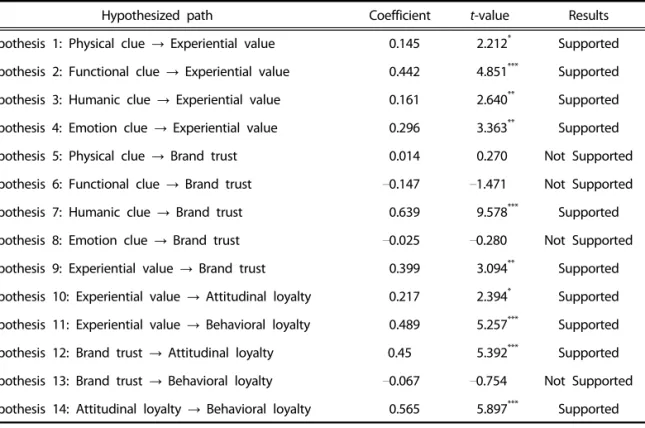
0.0.922; TLI=0.907; CFI=0.921; RMSEA=0.071. Table 2 shows the path coefficients for all hypothesized paths in proposed model and Figure 1 visually shows the paths. All the path coefficients in the model were significants and positive except four paths physical clue, humanic clue, emotion clue on brand trust, and brand trust on behavioral loyalty.

Therefore, current study has been partially sup- ported. Specifically, the results identify that the func- tional clue is the most significant factor among service clues (Hypothesis 2: β=0.442; t=4.851), but the humanic clue was only factor that significantly influence on brand trust (Hypothesis 7: β=0.639; t=

9.578). In addition, the relationships among expe- riential value, brand trust, attitudinal loyalty, and behavioral loyalty were statistically supported except one path between brand trust and behavioral loyalty (Hypothesis 14: β=

0.067; t=

0.754).

CONTRIBUTIONS

(5)

Table 3. Structural parameter estimates

Hypothesized path Coefficient t-value Results

Hypothesis 1: Physical clue → Experiential value 0.145 2.212

*

Supported Hypothesis 2: Functional clue → Experiential value 0.442 4.851

***

Supported Hypothesis 3: Humanic clue → Experiential value 0.161 2.640

**

Supported Hypothesis 4: Emotion clue → Experiential value 0.296 3.363

**

Supported Hypothesis 5: Physical clue → Brand trust 0.014 0.270 Not Supported Hypothesis 6: Functional clue → Brand trust

0.147

1.471 Not Supported Hypothesis 7: Humanic clue → Brand trust 0.639 9.578

***

Supported Hypothesis 8: Emotion clue → Brand trust

0.025

0.280 Not Supported Hypothesis 9: Experiential value → Brand trust 0.399 3.094

**

Supported Hypothesis 10: Experiential value → Attitudinal loyalty 0.217 2.394

*

Supported Hypothesis 11: Experiential value → Behavioral loyalty 0.489 5.257

***

Supported Hypothesis 12: Brand trust → Attitudinal loyalty 0.45 5.392

***

Supported Hypothesis 13: Brand trust → Behavioral loyalty

0.067

0.754 Not Supported Hypothesis 14: Attitudinal loyalty → Behavioral loyalty 0.565 5.897

***

Supported χ

2

=544.183, d.f.=255, IFI=0.922, TLI=0.907, CFI=0.921, RMSEA=0.071

Table 2. Confirmatory factor analysis and discriminant validity

PC FC HC EC EV TR AL BL

PC 0.555

a


FC 0.181 0.575        

HC 0.131 0.146 0.826      

EC 0.183 0.500 0.258 0.653    

EV 0.269 0.548 0.275 0.540 0.656  

TR 0.146 0.157 0.634 0.252 0.375 0.749

AL 0.117 0.123 0.163 0.213 0.247 0.408 0.573

BL 0.110 0.449 0.233 0.379 0.417 0.323 0.570 0.652

χ

2

=505.979, d.f.=247, IFI=0.930, TLI=0.914, CFI=0.929, RMSEA=0.069 PC=physical clue; FC=funtional clue; HC=humanic clue; EC=emotional clue;

EV=experiential value; TR=trust; AL=attitudinal loyalty; BL=behavioral loyalty;

IFI=incremental fit index; TLI=tucker-lewis index; CFI=comparative fit index;

RMSEA=root mean square error of approximation

Note.

a

AVE is on the diagonal. Squared of paired constructs are on the off-diagonal.

The results verify the hypothesis; all of four per- ceived service factors caused significant influence on

the value of experience. But, the humanic clues had

appeared as the only significant antecedents of

(6)

Figure 1. Results of structural equation model.

trust. These results had shown humanic clue is the most important factor when consumers get the trust of the franchise snack bar. In other words, the fran- chise snack bar company provide outstanding em- ployees higher and rapid services, which is consid- ered to have a direct impact on improving trust and loyalty by utilizing a regular employee training and various programs in franchise snack bar. In addition, in the four service clues, the functional clues showed the most significant impact on the statistical experi- ence values. It is the essential factors including the taste of the food, food temperature, appearance of food containing, amount of food and these func- tional clues of services are most closely affecting customers on the improved experience values, and these results were theoretically supported in pre- vious studies as well[36,1,37]. For example, if fran- chise snack bar provide a food with proper temper- ature using food warmer dishes or facility, it will contribute to increase general satisfaction of food quality among consumers. Therefore, the franchise snack bar business has to enhance the customer ex- perience value by improving the quality of food.

Based on these effort, the business will impact on attitudinal and behavioral loyalty positively.

As a result, functional and humanic clues in the various service factors of the franchise snack bar caused the most significant influence components and principle antecedents of loyalty that influence

on value of experience and trust. In addition, human clue was only element that has the influence on brand trust in current study. Therefore, well-devel- oped employees program can be significant factor to satisfy customer as well as provide outstanding service.

Although similar results were identified from prior scholars[38,39], current founding specifically contrib- ute to provide practical marketing suggestions for the franchise snack bar companies that occupies an important restaurant sector and it has sustained growth in the modern food industry.

This study has limitations on the target and re- gions by being carried out around Busan and aro- und college, so it is difficult to generalize. There- fore, it would be more meaningful empirical re- search if future study needs to expand the scope of research targeted at consumers nationwide.

REFERENCES

[1] Lee SA, Lee SM, Hahm SP (2015). The study of the relationships among service quality, satisfac- tion, and revisit intention of franchise snack bar:

Focused on Busan area. International Journal of Culinary Research 21(6):264-279.

[2] Statistics Korea [Internet]. Seo (Dae Jeon): Go-

vernment Buildings Management Office ; 2015

[modified 2006 Feb 2; citied 2009]. Available

(7)

from: http://kosis.kr/statHtml/statHtml.do? orgId

=101&tblId=DT_1KA2019&vw_cd=&list_id=&scrId

=&seqNo=&lang_mode=ko&obj_var_id=&itm_id

=&conn_path=K1&path=

[3] Sulek JM, Hensley RL (2004). The relative impor- tance of food, atmosphere, and fairness of wait.

Cornell Hotel and Restaurant Administration Quar- terly 45(3):235-247.

[4] Wu CH, Liang RD (2009). Effect of experiential value on customer satisfaction with service en- counters in luxury-hotel restaurants. Internatio- nal Journal of Hospitality Management 28(4):586- 593.

[5] Kim HG, Oh SY (2005). The impact of hotel coffee shops' physical environment on perceived ser- vice quality: Focused on the coffee shop of de- luxe hotel in Seoul. Journal of Toursim Services Research 5(1):89-104.

[6] Suh KY, Kim DS (2011) The effect of restaurant choice attributes on consumption emotion and customer satisfaction. Journal of Foodservice Ma- nagement 14(1):115-136.

[7] Song JJ, Kim SC, Yu JS (2006). Structural relation- ships among the service quality, attitude, in- tention of reusing, service value, satisfaction for hotel coffee shop customer. Journal of Foodser- vice Management 9(2):67-88.

[8] Bitner MJ (1992). Servicescapes: the impact of physical surroundings on customers and emplo- yees. Journal of Marketing 56(2):57-71.

[9] Santos J (2002). From intangibility to tangibility on service quality perceptions: a comparison stu- dy between consumers and service providers in four service industries. Managing Service Quality 12(5):292-302.

[10] Namasivayam K, Mattila AS (2007). Accounting for the joint effects of the servicescape and ser- vice exchange on consumers' satisfaction eva- luations. Journal of Hospitality & Tourism Resear- ch 31(1):3-18.

[11] Choi MK, Jung JC (2006). The importance⁃per- formance analysis of bakery cafe choice attri- butes perceived by customers in Seoul. Journal of Korean Society of Food Science and nutrition 35(4):456-463.

[12] Wall EA, Berry LL (2007). The combined effects of the physical environment and employee be-

havior on customer perception of restaurant service quality. Cornell Hotel and Restaurant Administration Quarterly 48(1):59-69.

[13] Namkung Y, Jang SC (2007). Does food quality really matter in restaurants? Its impact on cus- tomer satisfaction and behavioral intentions.

Journal of Hospitality & Tourism Research 31(3):

387-409.

[14] Quan S, Wang N (2004). Towards a structural model of the tourist experience: an illustration from food experiences in tourism. Tourism Ma- nagement 25(3):297-305.

[15] Grandey AA, Fisk GM, Mattila AS, Jansen KJ, Sideman LA (2005). Is “service with a smile”

enough? Authenticity of positive displays dur- ing service encounters. Organizational Behavior and Human Decision Processes 96(1):38-55.

[16] Noone BM (2008). Customer perceived control and the moderating effect of restaurant type on evaluations of restaurant employee perfor- mance. International Journal of Hospitality Ma- nagement 27(1):23-29.

[17] Hetherington MM (2007). Cues to overeat: Psy- chological factors influencing overconsump- tion. Proceedings of the Nutrition Society 66(1):

113-123.

[18] Steptoe A, Perkins-Porras L, McKay C, Rink E, Hilton S, Cappuccio FP (2003). Psychological factors associated with fruit and vegetable in- take and with biomarkers in adults from a low- income neighborhood. Health Psychology 22(2):

148-159.

[19] Sun YC (2008). Health concern, food choice mo- tives, and attitudes toward healthy eating: The mediating role of food choice motives. Appetite 51(1):42-49.

[20] Mathwick C, Malhotra N, Rigdon E (2001). Ex- periential value: conceptualization, measure- ment and application in the catalog and Inter- net shopping environment. Journal of Retailing 77(1):39-56.

[21] Overby JW, Lee EJ (2006). The effects of utili- tarian and hedonic online shopping value on consumer preference and intentions. Journal of Business Research 59(10-11):1160-1166.

[22] Park C (2004). Efficient or enjoyable? Consumer

values of eating-out and fast food restaurant

(8)

consumption in Korea. International Journal of Hospitality Management 23(1):87-94.

[23] Babin BJ, Darden WR, Griffin M (1994). Work and/or fun: measuring hedonic and utilitarian shopping value. The Journal of Consumer Re- search 20(4):644-656.

[24] Ha J, Jang SC (2010). Effects of service quality and food quality: The moderating role of at- mospherics in an ethnic restaurant segment.

International Journal of Hospitality Management 29(3):520-529.

[25] Chaudhuri A, Holbrook MB (2001). The chain of effects from brand trust and brand affect to brand performance: The Role of Brand Loyalty.

Journal of Marketing 65(2):81-9.

[26] Delgado-Ballester E, Munuera-Aleman JL (2000).

Brand trust in the context of consumer loyatly.

European Journal of Marketing 35(11):1238-1258.

[27] Oliver RL (1999). Whence consumer loyalty? The Journal of Marketing 63:33-44.

[28] Shoemaker S, Lewis RC (1999). Customer loya- lty: the future of hospitality marketing. Interna- tional Journal of Hospitality Management 18(4):

345-370.

[29] Morais DB, Dorsch MJ, Backman SJ (2004). Can tourism providers buy their customers’ loyalty?

Examining the influence of customer-provider investments on loyalty. Journal of Travel Resear- ch 42(3):235-242.

[30] Keller KL (2012). Strategic Brand Management:

Building, Measuring and Managing Brand Equi- ty. 4th ed. NJ. Prentice Hall, 600p.

[31] Oppermann M (2000). Tourism destination lo- yalty. Journal of Travel Research 39(1):78-84.

[32] Hernández-Lobato L, Solis-Radilla MM, Moliner- Tena MA, Sánchez-García J (2006). Tourism des- tination image, satisfaction and loyalty: A study

in Ixtapa-Zihuatanejo, Mexico. Tourism Geogra- phies 8(4):343-358.

[33] Bagozzi RP, Yi Y (1988). On the evaluation of structural equation models. Journal of the Aca- demy of Marketing Science 16(1):74-94.

[34] Fornell C, Larcker DF (1981). Structural equation models with unobservable variables and mea- surement error: Algebra and statistics. Journal of Marketing Research 18(3):382-388.

[35] Hair JF, Anderson RE, Tatham RL, Black WC.

Multivariate Analysis. 4th ed. NJ. Prentice Hall, 2006. 928p.

[36] Joung HS, Yoon HH (2010). A study on the ef- fects of perceived service quality in upscale Korean restaurants upon customer's feeling re- sponse and revisit intent. International Journal of Culinary Research 26(2):129-137.

[37] Yang JY, Kim TH, Kim MJ (2013). The effects of customer satisfaction based on user experience on commitment, loyalty and repeated use in franchise and chain coffee shops. International Journal of Culinary Research 19(5):206-224.

[38] Joung SM, Kim YH (2014). A study on the ef- fects of physical environment on the perceived service quality, menu quality and customer satisfaction. International Journal of Culinary Re- search 20(4):224-238.

[39] Lee JH (2013). A study on the effect of coffee shop service quality on perceived value and be- havioral intention: Foacusing on Busan area col- lege students. International Journal of Culinary Research 19(3):218-233.

Received: 11 JAN, 2016

Revised: 14 JAN, 2016

Accepted: 15 JAN, 2016

수치

Table 1. General characteristics of the subjects clues, humanic clues, and emotional clues using a  total of 13 questions, and experience values, trust  of franchise, attitudinal loyalty and behavioral loyalty  were measured by three questions each
Table 2. Confirmatory factor analysis and discriminant validity

참조

관련 문서