교신저자 : 고호연
주소 : 충북 충주시 봉방동 836 세명대학교충주한방병원 전화 : 043-841-1731 팩스 : 043-856-1731 E-mail : [email protected]
중풍 환자의 경직에 있어서 전침 치료 효과에 대한 체계적 고찰
고호연, 공경환, 신미란1, 장명웅2, 박선주3, 박정수3, 장보형3, 이주아5, 고성규3, 전찬용4.
세명대학교 부속한방병원 한방 내과, 세명대학교 부속한방병원 사상체질학과*, 동국대학교 부속한방병원 한방 내과**
경희대학교 예방의학교실***, 경원대학교 부속한방병원 한방 내과****, 한의학 연구원*****
Systematic Review of Efficacy of Electroacupuncture for Spasticity because of Stroke
Ho-Yeon Go, Kyung-Hwan Kong, Mi-ran Shin*, Myung-Woong Jang**, Sun-Ju Park***, Jung-Su Park***, Bo-Hyung Jang***, Seong-Gyu Ko***
Department of Oriental Internal Medicine, Semyung University.
Department of Sasang Constitutional Medicine, Semyung University*
Department of Oriental Internal Medicine, Dong-Guk University**
Department of Oriental Preventive Medcine, Kyunghee University***
Department of Oriental Internal Medicine, Kyungwon University****
Korea Institute of Oriental Medicine*****
Background : Prevalence of spasticity because of stroke are 40% patients after 12 month. Spasticity caused decrease of range of motor, motor function, and active daily living. Electroacupuncture widely used stroke. But it is been studied by systematic review between spasticity and electroacupuncture. This study is aimed to efficacy of electroacupuncture for spasticity because of stroke.
Methods : We had used pubmed(www.pubmed.com) and cochrane library(www.thecochranelibrary.com) database. Limits are‘human’,‘randomized controlled trial’and‘all adult 19+ years’in pubmed. The period was until 15, september, 2011.
We used MeSH(Medical Subject Headings terms. The search words were‘stroke’[mesh],‘muscle spasticity’[mesh and
‘electroacupuncture’[mesh]. In cochrane library, we used spasticity and electroacupuncture in cochrane library. We found 19 studies. But only 3 studies were included for inclusion criteria.
Results : The appropriate 3 studies were different from subject, acupoint, duration of treatment, endpoint and etc. But these studies were effective for spasticity because of stroke.
Conclusion : These studies were not meta analysis because of heterogeneity. But the above results might explain the electroacupuncture were effective for spasticity and further study needed to verify and standard electroacupuncture study for spasticity.
Key Words : electricacupuncture, spasticity, systematic review, strokeg
서론
중풍은 국내외를 제외하고, 높은 사망률과 장애률 로 인하여 관심이 집중되는 병이다. 특히 중풍환자는
후유증기에 다양한 장애를 가지게 되는데, 그중 강직 (spasticity)은 관절의 긴장도가 증가된 상태로서 관절 의 변형을 유발한 상태를 말하여, 중풍환자는 상지에 게는 굴곡근이, 하지에서는 신전근에 강직이 잘 발생 하게 된다.
원 저
중풍환자의 강직은 대개 1달 이내에 잘 발생하며1), 중풍 발병 후 12개월 지난 뒤에 40%정도에서 후유증 을 가지게 되는 것으로 알려져 있다2). 중풍으로 인한 강직은 관절 가동범위 감소, 수의적 운동기능 저하 및 일상생활에서 부정적 영향을 끼쳐 삶의 질을 저하하 는 문제를 가지고 있다.
국내에서는 중풍환자의 강직에 대하여 소양경 사 침치료3), 경근이완요법4), TENS5, 전침6) 등을 활용한 연구가 진행되고 있으며, 국외에서는 보튤리즘7-10) 약 물 등을 활용한 연구가 진행되고 있다. 그렇지만, 한 의계에서 다빈도로 활용하는 전침에 대하여 체계적인 고찰이 이루어지지 않았다. 이에 저자들은 침 중에서 중풍환자의 강직 증상에 대해 pubmed와 cochrane library를 중심으로 체계적인 고찰을 시도하고자 한 다.
연구방법
1. Clinical question
중풍환자의 강직에 전침 치료가 효과가 있는 가를 살펴보고자 하였다. 따라서 patient는 stroke patient, intervention은 electric acupuncture, comparable은 usual care, outcome은 muscle tone의 감소로 한정하 여 살펴보았다.
2. Database 및 limits
Database로는 pubmed(http://www.pubmed.com)를 활용하였다.와 cochrane library (www.thecochranelibrary.
com)을 활용하였다. Limits로는 human, randomized controlled trial, all adult 19+를 하였다. 검색시기는 2011년 9월 15일까지를 기준으로 하였다.
3. 검색용어
검색용어에 따른 결과는 다음과 같았다.
(1) ("stroke"[All Fields] OR "infarction"[All
Fields] OR "hemorrhage"[All Fields] OR "injury"[All Fields]) AND ("humans"[MeSH Terms] AND Ran- domized Controlled Trial[ptyp] AND "adult"[MeSH Terms]) 20,620
(2) ("stroke" OR "infarction" OR "hemorrhage"
OR "injury") AND and AND "spasticity" AND (Humans [Mesh] AND Randomized Controlled Trial[ptyp] AND adult[MeSH]) 154
(3) ("stroke"[All Fields] OR "infarction"[All Fields]
OR "hemorrhage"[All Fields] OR "injury"[All Fields]) AND "spasticity"[All Fields] AND "acupuncture"[All Fields] AND ("humans"[MeSH Terms] AND Randomized Controlled Trial[ptyp] AND "adult"[MeSH Terms]) 19
총 19편의 논문이 검색되었다.
spasticity와 electroacupuncture를 활용시에 7편의 논문이 검색되었다. 이중 5편은 중풍으로 인한 강직 이 아니었기에 제외하고 2편만을 포함하였다.
Pubmed에서 선정한 논문 19편 중 15편은 전침이 아닌 침에 대한 연구였으며, 1편은 spine injury에 해 당하는 논문으로 3편이 선정되었으며, cochrane library 의 두편과 중복되어, 총 선정논문은 3편이었다.
4. bias 평가방법
검색한 논문에 대하여 2인의 한의사가 bias에 대해 평가하였다. 평가 의견이 틀린 경우 서로 토론을 거쳐 최종 확정하였다.
결과
1. 선정 논문의 요약
검색한 3편의 논문에 대한 요약은 다음과 같다.
Methods Single center, Randomized controlled trial
Participants 35 Stroke patient with elbow spasticity who were more than 5 weeks out from the onset of stroke / 16 man 19 women/ mean age 62(range 40 to 76)/ Korean/ Korea/
Interventions
Arm 1(n=15) : usual care + electroacupuncture(LI11-LI10, TE5-LI4) 8 times Arm 2(n=10) : usual care + moxibustion(LI11, LI10, TE5, LI4)
Arm 3(n=10) : usual care
Outcomes modified ashworth scale, baseline, 1hour, 3hours, 24hours, 5days, 10days, 15days Notes Published data only (unpublished not sought)n No funding
Risk of bias
Low risk High risk Unclear
Selection bias Performance bias Detection bias Attrition bias Reporting bias Other sources of bias Table 1. Summary of Study by Moon SK et al11.
Methods Single center, crossover design, Randomized controlled trial
Participants
Ten chronic stroke survivors with average age of 60.1 years (range 35-75) were recruited for the study
All subjects had a documented diagnosis of stroke for more than 2 years, with an average of 7.6 years.
a mild motor impairment in one, moderate impairment in six, and severe impairment in three subjects
Interventions
duration of treatment : 6weeks
1) 40 minutes of electroacupuncture treatment 2) 30 minutes of strengthening exercises
electric acupoint : LI4, SI3, TW5, LI11, LI 10, LI 15 30 minutes of strengthening exercises
Outcomes Baseline à Modified ashworth scale, Uppe-limb Fugl-Meyer scale, Wrist ROM
Notes Published data only (unpublished not sought) research grant from the American Heart Association (grant 0555637Z).
Risk of bias
Low risk High risk Unclear
Selection bias Performance bias Detection bias Attrition bias Reporting bias Other sources of bias Table 2. Summary of Study by Liu W et al12.
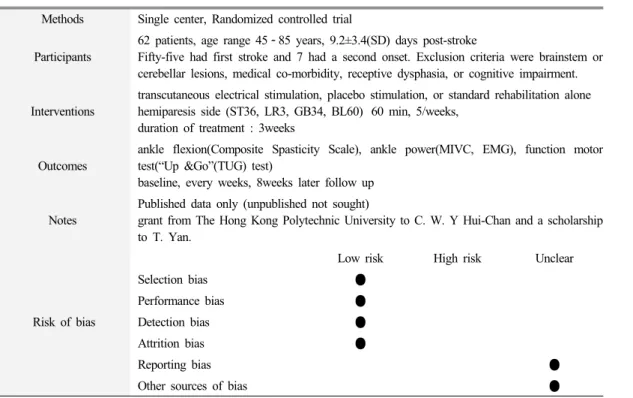
Methods Single center, Randomized controlled trial Participants
62 patients, age range 45 85 years, 9.2±3.4(SD) days post-stroke
Fifty-five had first stroke and 7 had a second onset. Exclusion criteria were brainstem or cerebellar lesions, medical co-morbidity, receptive dysphasia, or cognitive impairment.
Interventions
transcutaneous electrical stimulation, placebo stimulation, or standard rehabilitation alone hemiparesis side (ST36, LR3, GB34, BL60) 60 min, 5/weeks,
duration of treatment : 3weeks Outcomes
ankle flexion(Composite Spasticity Scale), ankle power(MIVC, EMG), function motor test(“Up &Go”(TUG) test)
baseline, every weeks, 8weeks later follow up Notes
Published data only (unpublished not sought)
grant from The Hong Kong Polytechnic University to C. W. Y Hui-Chan and a scholarship to T. Yan.
Risk of bias
Low risk High risk Unclear
Selection bias Performance bias Detection bias Attrition bias Reporting bias Other sources of bias Table 3. Summary of Study by Yan T et al13.
Random sequence generation(selection bias) Allocation concealment (selection bias) Blinding of participants and personnel (performance bias) Blinding of outcome assessment (detection bias) Incomplete outcome data (attrition bias) Selective reporting (reporting bias) Other bias
Low risk of bias Unclear risk of bias High risk of bias
Fig. 1. Bias of Study Electroacupuncture for Spasticity because of Stroke 2. 선정 논문의 bias
선정된 논문의 bias는 Fig. 1과 같다.
3. 선정 논문의 비교 검토 Table 4
고찰
중풍으로 발생한 강직은 환자의 관절의 가동범위 와 운동을 방해하여 삶의 질을 낮추게된다. 한의계에 서는 침, 전침, 뜸 등을 활용한 연구가 진행중이다. 본 연구에서는 근거수준이 높다고 평가되는 전향적 무작 위 대조군 임상시험을 검토하여 체계적으로 고찰하고 자 하였다.
size Participants and
Time post-stroke intervention Duration of
treatment Endpoint and follow up Results
Moon 2003 35
after 5 weeks post stroke
elbow spasticity
30minutes/time
50Hz LI11-LI10,
TE5-LI4
15days 8times
Modified ashworth scale
baseline, 1, 3, 24hours 5days, 10days, 15days
good
Liu 2008 10
after 2years post stroke
Upper extremity spasticity
40min/time
2Hz LI4, SI3, TW5, LI11, LI10, LI15 +strengthtraining
6weeks 12times
Upper limb Fugl-Meyer scale,
Wrist ROM
Baseline, 6, 12 weeks
good
Yan 2009 62
after 9.2±3.4(SD)days post
stroke
Lower extremity spasticity
60min/times 100Hz
ST36, LR3, GB34, BL60
3weeks 15times
ankle flextion(CSS), ankle power(MIVC, EMG),
function motor test(“Up
&Go” test)
baseline, 1,2,3,8 weeks
good Table 4. Comparison of Study Electroacupuncture for Spasticity because of Stroke
Moon 등11)의 논문을 살펴보면, 단일기관 연구로 서, 35명의 피험자를 대상으로 하였고, 그 중 전침군 은 15명으로 적은편이다. 팔꿈치의 강직을 대상으로 하였으며, 중풍 발병 후 5주이상 된 환자르르 대상으 로 하였다. 전침은 1회 30분 50Hz로 2일에 1회 실시 하였으며, 15일간 총 8회 실시하였다. 전침은 곡지혈- 수삼리혈, 외관혈-합곡혈 조합으로 30분간 50Hz을 이 용하였다. 치료기간이 증가할수록 전침군에서 팔꿈치 경직 증상이 호전되는 결과를 보였다. 그렇지만 추적 조사를 실시하지 않은 것이 아쉽다고 할 수 있다.
Liu 등12)의 연구에서는 10명을 대상으로 하였으며, 발병후 2년 이상 경과된 중풍환자를 대상으로 실시하 였다. 중등도 이상의 상지 경직 환자를 대상으로 실시 한 것으로 3개의 논문중 가장 발병후 기간이 오래된 환자를 대상으로 실시하였다. 이 연구에서는 전침만 을 활용한 것이 아니라 strength training까지 같이 실 시한 연구이며, crossover design을 채택하였다. 전침 은 40분간 2Hz로 놓았으며, 6주간, 주 2회 총 12회 실 시하였다. 전침에 사용한 혈자리는 합곡, 후계, 외관,
곡지, 수삼리, 견우의 6개의 혈자리를 활용하였다. 평 가기간은 baseline, 6주(치료 종료시), 12주(6주후 추 적조사)를 실시하였다. 치료결과 단순히 근력 강화 프 로그램을 활용한 군보다, 전침과 동시에 근력강화를 실시한 군에서 상지기능이 개선되었고, 손목의 가동 범위가 개선되는 효과가 있었다.
Yan 등13)의 연구는 2009년의 연구로서 연구디자인 에서 수행방법에서 가장 잘 기재가 된 논문이었다. 또 한 기존의 2개의 연구는 상지의 경직을 주된 것으로 본 반면, 본 연구는 발목의 하지 경직을 대상으로 한 논문이며, 중풍의 시기상 급성기 아급성기 환자를 대 상으로 실시한 연구이다. 전침의 방법은 60분간 100Hz를 대상으로 실시하였고, 3주간 주5회를 실시 하여 총 15회를 실시하였다. 기존의 연구와는 가장 높 은 주파수로, 가장 긴 시간, 가장 많은 전침 횟수를 가 지고 있다는 것이 본 연구의 특징이다. 전침의 혈자리 는 족삼리, 태충, 양릉천, 곤륜혈의 4곳을 활용하였다.
측정은 치료전 baseline에서의 측정, 3주간 매주 측정, 발병 8주후 최종 추적조사를 실시하였다. 치료 결과
는 발목강직이 감소하였고, 발등 굽힘 힘 등이 증가하 였다. 기존의 연구에서는 ashworth scale등 판단자의 주관이 들어가는 것에 비하여 본 연구에서는 근전도 등을 활용하여 측정의 객관성을 기하고자 한 것이 특 징이며, 3개의 연구중 가장 bias가 적다고 할 수 있다.
3개의 연구의 가장 큰 문제점은 적은 피험자수를 가지고 연구를 진행하였고 단일기관에서 진행한 연구 로 연구의 power가 크다고 할 수 없다는 것이 문제이 며, 연구방법을 자세히 기술하지 않아 여러 가지 bias 를 자세히 알 수가 없는 단점이 있다. 예를 들어, 무작 위 방법에 대해 Yan 등의 연구에서는 무작위 방법에 대해 기술하였으나, 다른 연구는 무작위만 하였다고 되어있다. 대조군에서 Moon 등, Liu 등의 연구에서는 이중맹검이 전혀 이루어지지 않았으나, Yan의 연구에 서는 placebo 자극을 준 것이 특징이라고 할 수 있다.
중풍으로 인한 강직에 전침의 효과를 기술한 무작 위대조군연구를 살펴보면, 연구가 많이 진행되지 않 았으며, 치료기간, intervention방법, 혈위, 대상자가 다양하고, 연구분야가 많다고 할 수 있다. 이를 극복 하기 위해서는 국내 중풍학회 등에서 공통된 protocol 을 개발하여, 한방병원 등에서 다양한 혈위와 자극법 에 대한 실험을 통하여 이를 극복할 수 있다고 생각된 다.
본 연구의 아쉬운 점은 유럽쪽 database인 embase 등을 경제적 사정으로 활용할 수 없다는 것과 meta분 석을 실시하지 못한 점이 아쉬움으로 남는다. 메타분 석을 시행할 수 없는 이유는 연구들의 특성이 서로 다 르고, 비뚤림 위험이 있으며, 심각한 보고 비뚤림이 있는 경우라고 되어있는데14), 본 연구의 논문들은 세 가지 모두 다 해당된다는 아쉬움이 있다.
또한 본 연구를 진행하면서 체계적 고찰에 대해 다 시 생각해볼 수 있는 기회가 되었는데, 기존 한의계 처치에 대한 체계적 고찰은 대부분 이질성을 인정하 는 상태에서 진행되었기 때문에 이러한 한의계 전반 에 대한 메타분석은 무의미하다는 생각을 할 수 있었 다. 또한 한의학은 변증시치의 특성상 질병에 초점을 맞추지 말고, 증상에 초점을 맞추는 것이 한의학적 중 재의 유효성을 잘 평가할 수 있을 것으로 사료된다. 또한 중풍학회 등에서 공통 protocol을 개발하여 다기
관 연구를 실시하는 것이 한의계의 위상을 높힐 것이 라 사료된다.
결론
편두통에 관한 한의학 치료는 충분히 가능할 것으 로 보이며, 氣滯血瘀, 痰濕中渚, 肝陽上亢, 氣血虧虛, 寒犯厥陰의 변증을 우선적으로 접근할 수 있을 것이 며, 처방에서는 血府逐瘀湯, 通竅活血湯, 半夏白朮天 麻湯, 天麻鉤藤飮, 大補元煎, 吳茱萸湯 등을 고려해 볼 수 있을 것이다. 적극적인 증례보고를 시작하여 편두 통에 관한 체계적인 임상연구가 필요할 것이다.
참고문헌
1. Lundström E, Smits A, Terént A, Borg J. Time- course and determinants of spasticity during the first six months following first-ever stroke. J Rehabil Med. 2010;42(4):296-301.
2. Watkins CL, Leathley MJ, Gregson JM, Moore AP, Smith TL, Sharma AK. Prevalence of spasticity post stroke. Clin Rehabil. 2002;16(5):
515-22.
3. 정명걸, 박진용, 김진규, 김수정, 이운석, 김용찬.
강직 및 경직의 소양경 사침치료에 대한 임상적 고찰. 대한한방내과학회지. 200;21(5):845-50.
4. 심우진, 문상현, 류한진, 정석희, 김성수, 이종수.
경근이완요법이 중풍 주관절 경직에 미치는 효 과. 한방재활의학과학회지. 2004;14(1):63-75.
5. 김용석. 중풍경직에 전침, TENS 및 신경근 자 극기의 효과에 대한 연구. 대한침구학회지. 2000;
17(2):209-20.
6. 이선우, 윤종민, 손지우, 강백규, 박상무, 윤효진, 김대중, 김태진, 이인, 신용일, 문병순. 뇌졸중 환자의 상지 경직에 대한 전침의 치료 효과. 대 한한방내과학회지. 2007;28(3):492-501.
7. Baguley IJ, Nott MT, Turner-Stokes L, De Graaff
S, Katrak P, McCrory P, de Abadal M, Hughes A. Investigating muscle selection for botulinum toxin-A injections in adults with post-stroke upper limb spasticity. J Rehabil Med. 2011;43 (11):1032-7.
8. Kaňovský P, Slawek J, Denes Z, Platz T, Comes G, Grafe S, Pulte I. Efficacy and safety of treat- ment with incobotulinum toxin A (botulinum neurotoxin type A free from complexing proteins;
NT 201) in post-stroke upper limb spasticity. J Rehabil Med. 2011 May;43(6):486-92.
9. Albani G, Cimolin V, Galli M, Vimercati S, Bar D, Campanelli L, Gandolfi R, Lombardi R, Mauro A. Use of surface EMG for evaluation of upper limb spasticity during botulinum toxin therapy in stroke patients. Funct Neurol. 2010 Apr-Jun;25(2):103-7.
10. Karadag-Saygi E, Cubukcu-Aydoseli K, Kablan N, Ofluoglu D. The role of kinesiotaping combined with botulinum toxin to reduce plantar flexors
spasticity after stroke. Top Stroke Rehabil. 2010;
17(4):318-22.
11. Moon SK, Whang YK, Park SU, Ko CN, Kim YS, Bae HS, Cho KH. Antispastic effect of electroacupuncture and moxibustion in stroke patients. Am J Chin Med. 2003;31(3):467-74.
PubMed PMID: 12943177.
12. Liu W, Mukherjee M, Sun C, Liu H, McPeak LK. Electroacupuncture may help motor recovery in chronic stroke survivors: a pilot study. J Rehabil Res Dev. 2008;45(4):587-95. PubMed PMID: 18712644.
13. Yan T, Hui-Chan CW. Transcutaneous electrical stimulation on acupuncture points improves muscle function in subjects after acute stroke: a randomized controlled trial. J Rehabil Med.
2009 Apr;41(5):312-6. PubMed PMID: 19363561.
14. 한국보건의료연구원. 체계적 문헌 고찰 메뉴얼.
서울. 2011. p 130.