pISSN 1976-1457 eISSN 2005-6168
The development of a taste education program for preschoolers and evaluation of a program by parents and childcare personnel
Choengmin Shon
1, Young Park
2, Hyunjoo Ryou
3, Woori Na
1and Kyungsuk Choi
4§1
Major in Food and Nutrition, Wonkwang University, Jeonbuk 570-749, Korea
2
R&D Planning Team, F&N health Co. LTD., Seoul 138-202, Korea
3
Health Promotion Division Seoul Metropolitan Government, Seoul 100-743, Korea
4
Department of Food Science and Nutrition, Daejin University, 11-1 Seondan-dong, Pocheon, Gyeonggi 487-711, Korea
Abstract
The change in people's dietary life has led to an increase in an intake of processed foods and food chemicals, raising awareness about taste education for preschoolers whose dietary habits start to grow. This study aims to evaluate the effectiveness and satisfaction of parents and childcare personnel after developing a taste education program and demonstrating it in class. A part of the curriculum developed by Piusais and Pierre was referred for the program. After educating 524 preschoolers in child care facilities in Seoul, a satisfaction survey was conducted on the program.
The data in this study were analyzed using SPSS 14.0. Statistical analysis was conducted based on the frequency after collecting the data. Mean
± SD used to determine satisfaction with taste education, with preferences marked on a five-point scale and the alpha was set at 0.05. The program includes five teachers' guides with subjects of sweetness, saltiness, sourness, bitterness and harmony of flavor, and ten kinds of teaching tools.
For the change in parents' recognition of the need for taste education based on five-point scale, the average of 4.06 ± 0.62 before the program has significantly increased to 4.32 ± 0.52 (P < 0.01). Regarding the change in the preferences for sweetness, saltiness, sourness, and bitterness, the average has increased to 3.83 ± 0.61, 3.62 ± 0.66, 3.64 ± 0.66, and 3.56 ± 0.75 respectively. In an evaluation of instructors in child care facilities, the average scores for education method, education effect, education contents and nutritionists, and teaching tools were at 4.15 ± 0.63, 3.91 ± 0.50, 4.18 ± 0.50, and 3.80 ± 0.56 respectively. In addition, the need for a continuous taste education scored 4.42 ± 0.67. This program has created a positive change in preschoolers' dietary life, therefore the continuation and propagation of the taste education program should be considered.
Key Words: Taste, nutrition education, preschooler
Introduction
12)Changes in the social environment due to economic develop- ment have affected our diets, with more people choosing processed foods and fast foods that contain many chemical additives to enhance their and preserve their flavor [1,2].
In particular, as women joined the workforce, supplies of convenience food increased. This affected the diets of children, whose eating habits depend heavily upon what their parents choose to eat [3,4]. However, regular intake of food chemicals from early childhood makes children become accustomed to the taste of food chemicals, even before they can recognize the taste of actual food. Accordingly, when such children grow up, they may not develop their palate sufficiently, which could lead to an aversion toward the taste of actual food and failure to choose a sufficiently varied diet. In short, these problems can cause nutritional imbalance, resulting in a harmful effect on nutritional status in adulthood. In other words, eating habits and education regarding taste in early childhood are essential for healthy living
since the dietary habits acquired in early childhood remain with people throughout their lives, and early habits ultimately affect adult health [5].
Children under the age of five can be made to perceive flavors while reducing an aversion to certain foods as they grow up in two basic ways [6]. One is to have them taste sweet and familiar foods first, and the second is to expose them to a variety of foods [7,8]. Further, devising hands-on learning methods is crucial when educating preschoolers about nutrition, as they start to perceive their environment by touching actual objects [9].
In France, after Puisais and Pierre [10] developed the concept of taste education, the French government adopted policies to support nutrition education, taking part in an effort to help preschoolers and children establish good dietary habits. In addition, the government designated the second week of October as “La Semaine du Goût (The Week of Taste)” to stimulate dietary education and encourage more interest in traditional local foods [13]. Japan enacted the Fundamental Act on Meat to teach ways of enjoying meals by using all five senses, and the Japanese
This paper was supported by the Seoul Metropolitan Government in 2010.
§Corresponding Author: Kyungsuk Chio, Tel. 82-31-539-1864, Fax. 82-31-539-1860, Email. [email protected] Received: July 5, 2012, Revised: September 5, 2012, Accepted: September 5, 2012
ⓒ2012 The Korean Nutrition Society and the Korean Society of Community Nutrition
This is an Open Access article distributed under the terms of the Creative Commons Attribution Non-Commercial License (http://creativecommons.org/licenses/by-nc/3.0/) which permits unrestricted non-commercial use, distribution, and reproduction in any medium, provided the original work is properly cited.
are now putting these measures into practice by seeking ways to make use of local foods [14,15].
The Korean government is currently promoting comprehensive education on diet in order to improve the dietary lives of people and to preserve and develop Korea’s traditional food culture, according to the Dietary Life Education Support Act enacted in 2009. However, even with strong governmental support, the situation remains problematic because little to no attention is given to educating preschoolers, who represent future food consumers and are potential targets for food education.
Against this background, this study aims to provide useful data in an effort to establish taste education as a part of nutrition education by developing a flavor-based education program, deter- mining effective ways to educate preschoolers in class, and evaluating program effectiveness and satisfaction levels of parents and childcare personnel.
Subjects and Methods
In this study, a taste education program for preschoolers was developed and teaching plans and teaching tools were designed.
And then they were demonstrated at child care facilities to survey the satisfaction of parents and child care personnel.
Development of protocol of the taste education program Using as a basis the taste education program developed by Puisais and Pierre [10] for preschoolers, this study developed a protocol for a similar program. The methodology of early childhood education was used to tailor the program to the level of preschoolers. The program comprised five classes on the subjects of sweetness, saltiness, sourness, bitterness, and harmony of flavor; the classes were based on practice, cooking, and experiences. Additionally, we developed teaching materials such as taste education textbooks and educational tools to enhance the understanding of preschoolers.
Effectiveness and satisfactory evaluation of the taste education program for preschoolers
Research Subjects and Survey Period
After educating preschoolers in childcare facilities in two districts in Seoul, we conducted a satisfaction survey regarding the taste education program for 524 preschoolers from November 2010 to January 2011. To select the child care facilities for the education, the health authorities of Seoul has officially requested to child care facilities, and 51 child care facilities that responded to the request positively were selected. The research team explained the purpose and the logistics of the research and requested cooperation of the facilities. The original five-week program was replaced by a four-week program owing to difficulties in the facilities, and the fourth and fifth classes were combined.
Accordingly, the taste education program comprised one class per week for four weeks. Six nutritionists served as instructors of the taste education program after completing a 35-hour training program.
Survey for parents: the necessity and effectiveness of the taste education program
Following the taste education, 524 parents participated in a survey assessing the need for and effectiveness of this education.
Parents also provided data about their gender and relationship with the child; the percentage of valid responses collected was 97.7%.
Questionnaire was developed based on literature search of similar study and matched the purpose of this study [11,12]. The survey included questions about the relationship between the development of preschoolers’ tastes and good dietary habits, and the relevance of teaching methods and educational contents. To determine the change in perception after the education program, items were evaluated using a five-point scale (Very much: 5, Somewhat: 4, Fair: 3, Not so much: 2, Not at all: 1).
To understand the changes in preschoolers’ tastes and their ability to discern sweet, salty, sour, and bitter flavors, their preferences were evaluated on a five-point scale (Excellent: 5, Good: 4, Fair: 3, Poor: 2, and Very Poor: 1). Regarding the change in preferences for sweetness, the survey included questions about the frequency of fruit intake and the consumption of milk and side dishes. For saltiness, participants indicated whether their children consume salt, and what kinds of soups and side dishes they typically eat. To assess the change in preferences for sourness, subjects were asked whether they eat sour fruits or sour processed foods, and for bitterness, one item asked about an aversion to bitter tastes and side dish preferences.
Evaluation by childcare personnel
After the program, 42 staff at the childcare facilities were administered a survey intended to evaluate their satisfaction with the program and that included basic information about the types of facilities, the ages of participants, and their gender. A five-point scale was utilized to evaluate teaching methods, the effectiveness of teaching, teaching contents, and teaching tools.
For the evaluation of teaching methods, items asked about lessons and preschoolers’ interest. For effectiveness of teaching, items assessed the preschoolers’ attitudes toward experiencing various tastes, including bitterness; drink choice; salt consumption; and choice of healthy sour snacks. In addition, the evaluation focused on teaching contents and instructors’ teaching ability, as well as teaching tools and materials used in class. The need for taste education, according to the personnel, was evaluated on a five-point scale.
Statistical analysis
The data in this study were analyzed using SPSS 14.0 (SPSS,
Step Subjects Program activity Type of teaching 1 Healthy sweetness ▪Compare healthy and unhealthy sweetness
▪Make a drink with chemical additional flavor
▪Make a healthful drink (milk flavored with banana)
Experiment, cooking
2 Saltiness : less is better ▪Identify the problem of eating salty foods habitually
▪Play a game to find the hidden salt
Lecture, game
3 Healthy sourness ▪Compare healthy and unhealthy sourness
▪Make a fruit pudding
Experiment, cooking
4 Bitterness : to protect our bodies ▪Play a game with bitter ingredients
▪Raise young sprouts
▪Study the secret of cocoa
Games practice in cooking
5 Harmony of tastes ▪Experience the taste of raw vegetables and their sources
▪Experience the taste of cooked vegetables
Experiment, cooking Table 1. Five steps of taste education program in preschoolers
Inc. Chicago, IL, USA). Statistical analysis was conducted based on the frequency after collecting the data. Mean ± SD used to determine satisfaction with taste education, with preferences marked on a five-point scale. In addition, t-tests were used to investigate changes in necessity of the taste education program in parents before and after the program, and the alpha was set at 0.05.
Results
Development of the taste education program
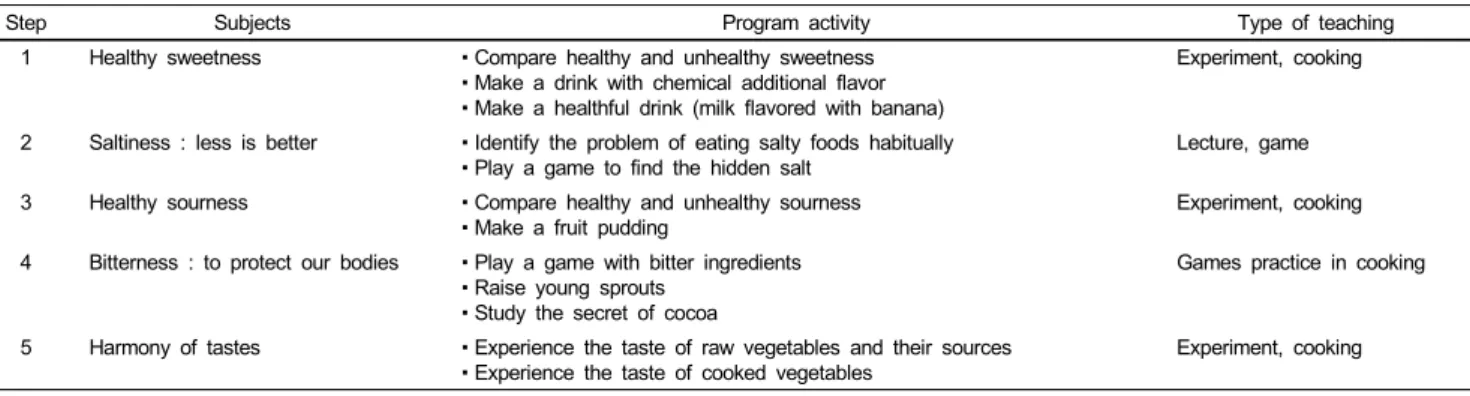
Development of protocol for the taste education program The program was developed with five classes on the subjects of sweetness, saltiness, sourness, bitterness, and harmony of flavors, respectively, and covered four weeks. The contents of the program are shown in Table 1.
The first class was developed to help the selection of healthy sweetness under the theme of ‘Healthy sweetness’. Food cards were utilized to compare healthy and unhealthy sweetness. To explain unhealthy sweetness containing chemical additives, instructors made the beverage containing chemical additives and healthy beverage (banana milk) with preschoolers. The second class was developed to reduce salt intake under the theme of
“Less salt is better,” The class helped preschoolers learn about the problems associated with eating salty foods and included a game called “Finding hidden salt (A game of cops and robbers)”
that taught preschoolers how to identify high-sodium foods. The third class ‘Healthy sourness’ which was developed to help preschoolers to select healthy sourness explained the differences between healthy and unhealthy sourness using food cards and engaged the preschoolers in a cooking class to make fruit puddings to explain healthy sourness containing chemical additives. The fourth class used food cards to teach preschoolers foods with bitterness under the theme of “Bitterness: to protect our bodies” and involved a game using bitter ingredients, an activity of raising sprouts, and a lesson on the secrets benefits of cocoa to explain to preschoolers that cocoa was in fact had bitterness, yet tasted sweet because of the content of a large amount of sugar. The fifth class “Harmony of tastes” involved
a comparison of the tastes of vegetables with and without sauce to teach preschoolers that a combination of foods with different taste made a food, and allowed preschoolers to make Vietnamese rice wraps while experiencing different tastes of cooked vegetables.
The development of teaching tools for the taste education program
Fig. 1 shows the types of teaching materials developed for the taste education program for preschoolers. A total of 10 teaching tools were developed, including taste education textbooks, a tongue-shaped board, taste puzzle pieces, taste trains, 20 food cards about 4 basic tastes, a test feedback sheet, a police sticker, game boards, and cooking class boards (for cooking the pudding and Vietnamese rice wraps).
The taste education textbook included a school newsletter to
the students’ families, an introduction to the taste education
program, and the class schedule. Its contents included a coloring
section for representative foods of each flavor, a food search,
a checklist for healthy foods, and a promise to activity try to
eat food with different flavors and an oath. The tongue-shaped
board, which was 70 cm high and 140 cm wide, explained the
parts of the tongue that are responsible for different flavors and
let preschoolers recognize each flavor with the parts while
playing a game of identifying representative foods. A total of
20 puzzle pieces with representative foods for each flavor were
developed, and participants were told to put the puzzle together
and identify the flavor. The taste train was used in a game to
learn about representative foods for each flavor, and a sticker
board was used to complement this game. In another game on
identifying healthy and unhealthy foods, five (two cards each)
kinds of cards denoted processed foods, and five (two card each),
natural foods. The evaluation form was used to evaluate
preschoolers' changes in attitudes and preferences from processed
foods to natural goods. The police sticker was used in a game
in the third class that resembled cops and robbers; its purpose
was to identify high-sodium foods. The answer board was used
to display correct answers in educational activities. The cooking
class was used as a supplementary tool to explain the steps
involved in making puddings and Vietnamese rice wraps for the
third and fifth classes.
Taste education textbook
Tongue‐shaped board Taste puzzle piece
Taste train Food card 1
(Raw vegetables and seasonings)
Food card 2 (Junk foods) Taste feedback sheet
Police sticker Answer board
Cooking class board Fig. 1. Taste education materials
Variable n %
Region Seongbuk-gu 322 67.7
Gangdong-gu 202 38.5
Years 7 203 38.7
6 172 32.8
5 124 23.7
4 25 4.8
Total 524 100.0
Table 2. General characteristics of children
Variable n %
Region Seongbuk-gu 285 55.7
Gangdong-gu 227 44.3
Responders Parent 497 97.0
Relative 8 1.6
Grandparent 4 0.8
No response 3 0.6
Total 512 100.0
Table 3. General characteristics of family members
General characteristics of preschoolers
The general characteristics of the preschoolers who participated in the survey are shown in Table 2. The children were 4-7 years old and lacked the ability to answer clearly. Therefore, only their ages were surveyed. The largest group comprised 203 children aged 7 (38.7%), followed by 172 six-year-olds (32.8%), 124 five-year-olds (23.7%), and 25 four-year-olds (4.8%).
Evaluation of the taste education program Parents’ evaluation
General characteristics of parents
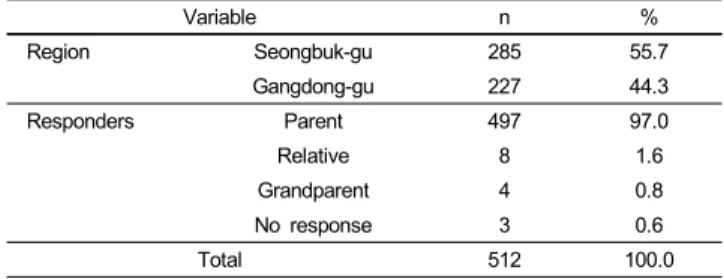
The general characteristics of the family members who participated in the survey are shown in Table 3. Among 512 respondents, 285 lived in Seongbuk-gu (55.7%) and 227 lived in Gangdong-gu (44.3%). In terms of the relationship to their child, 497 were parents (97.0%), followed by 8 relatives (1.6%) and 4 grandparents (0.8%); the relationship of 3 (0.6%) was unknown.
Necessity and effectiveness of the taste education program analysis of attitudes toward taste education and necessity of the program
Table 4 shows the results of the analysis of the respondents’
views of relationship between good eating habits and taste education in early childhood. Of the respondents, 224 and 263 chose “highly related” (43.7%) and “related” (51.4%), respectively.
Regarding the effectiveness of the program, 89 and 319 chose
“excellent” (17.4%) and “good” (62.3%), respectively. In terms of the appropriateness of the contents and the methods for taste education, 96 and 354 chose “excellent” (18.8%) and “good”
(69.1%), respectively. With regard to the propriety as a nutritional
education to the of taste education for preschoolers, 106 and 354
Variable n (%)
Excellent Good Fair Poor Very poor
The relationship between eating habits and taste education 224(43.7) 263(51.4) 23(4.5) 2(0.4) 0(0.0) The effect of the taste education program in encouraging children to make
healthy diet choices
89(17.4) 319(62.3) 87(17.0) 14(2.7) 3(0.6)
The appropriateness of the contents and methods for taste education 96(18.8) 354(69.1) 58(11.3) 4(0.8) 0(0.0) The propriety as nutritional education for the taste education program 106(20.7) 354(69.1) 44(8.6) 8(1.6) 0(0.0)
Total 512
Table 4. The effect of the taste education program and views on the relationship between eating habits and taste education
Variable Questionnaire Mean ± SD
Sweet 1. Started to enjoy the sweet taste in natural fruit 4.01 ± 0.701)
2. Started to prefer plain milk to man-made milk with artificial sweetener 3.63 ± 0.91
3. Started to eat food that does not taste sweet 3.84 ± 0.75
Average 3.83 ± 0.61
Salty 1. Started to reduce adding salt or soy sauce to food 3.72 ± 0.74
2. Developed a habit of eating the solid food in soup instead of the liquid 3.43 ± 0.88
3. Started to enjoy bland food 3.71 ± 0.75
Average 3.62 ± 0.66
Sour 1. Started to enjoy the sour taste in natural fruit 3.78 ± 0.78
2. Reduced consumption of sour sweets (including jellies and candies) that contain artificial sour flavor from food chemicals 3.50 ± 0.81
Average 3.64 ± 0.66
Bitter 1. Less repulsed by the bitterness of vegetables 3.36 ± 0.87
2. Developed a habit of eating vegetable dishes willingly 3.72 ± 0.83
3. Started to eat more vegetable dishes than usual 3.61 ± 0.85
Average 3.56 ± 0.75
Total 3.67 ± 0.56
1)5: Very much; 4 Somewhat; 3: Fair; 2: Not so much; 1: Not at all Table 5. Changes in dietary attitudes of preschoolers
Variable n %
Region Seongbuk-gu 26 61.9
Gangdong-gu 16 38.1
Types of Childcare Centers Private 26 61.9
Home 10 23.8
Municipal 4 9.5
Public 2 4.8
Position Teacher 35 83.3
Director 6 14.3
Other 1 2.4
Total 42 100.0
Table 6. General characteristics of the childcare personnel
chose “excellent” (20.7%) and “good” (69.1%), respectively.
The necessity of taste education was evaluated on a five-point scale. After the program, the mean scores for parents slightly increased, from 4.06 ± 0.62 to 4.32 ± 0.52 (P < 0.01) (data not shown).
Change in dietary preferences of the preschoolers
The changes in the preschoolers’ preferences for sweet, salty, sour, or bitter foods are shown in Table 5. The mean change in preference for sweetness was 3.83 ± 0.61, and among the answers, “Started to enjoy the sweet taste in natural fruit” scored the highest (4.01 ± 0.70). The mean change in preference for saltiness was 3.62 ± 0.66, with the answer “Started to reduce putting salt or soy sauce in food” scoring the highest (3.72 ±
0.74). The average for sourness was 3.64 ± 0.66, and the answer
“Started to enjoy the sour taste in natural fruit” received the highest scores (3.78 ± 0.78). The average for bitterness was 3.56
± 0.75 and the answer “Developed a habit of eating vegetable dishes willingly” scored the highest (3.72 ± 0.83).
On the other hand, with regard to the change in preference for sweetness, “Started to prefer plain milk to man-made milk with artificial sweetener” scored the lowest (3.63 ± 0.91), and for saltiness, “Developed a habit of eating the solid food in soup instead of the liquid” yielded a low score (3.43 ± 0.88). Concer- ning the change in preference for sourness, “Reduced consump-
tion of sour sweets (including jellies and candies) that contain an artificial sour flavor from food chemicals” also had a low score (3.50 ± 0.81). Attitudes toward eating foods with natural tastes had a fairly high score, and the change in preference for each taste, as well as dietary habits for artificial tastes, scored relatively low.
Satisfaction of childcare personnel General characteristics of the personnel
The general characteristics of the personnel who participated
in the survey are shown in Table 6. The childcare facilities are
located in Seongbuk-gu (26, 61.9%) and Gangdong-gu (16,
Variable Questionnaire Mean ± SD Teaching method 1. The education program, which involved experiments, quizzes, games, and cooking classes, was satisfactory. 4.14 ± 0.951)
2. Preschoolers showed great interest in the “Let’s restore an appetite for health goods” program. 4.17 ± 0.62
Average 4.15 ± 0.63
Effect 1. This education program helped build a positive attitude toward trying various foods in preschoolers. 4.05 ± 0.62 2. This education program helped to transform preschoolers’ appetite such that they avoid soft drinks with additives
and sugar and choose healthy drinks instead. 3.90 ± 0.72
3. This education program helped preschoolers to avoid salty foods. 3.81 ± 0.70
4. This education program helped preschoolers develop an appetite for healthy sour fruits instead of sour-tasting snacks
that contain additives or sugar. 4.00 ± 0.54
5. This education program instilled positive attitudes toward bitter foods by combining various flavors and cooking
classes. 3.81 ± 0.59
Average 3.91 ± 0.50
Education contents &
nutritionists
1. The taste education for preschoolers was satisfactory. 4.31 ± 0.51
2. The nutritionist was sufficiently well prepared. 4.12 ± 0.63
3. The nutritionist conducting the program and his/her delivery of the educational materials was satisfactory. 4.05 ± 0.58
4. The nutritionist was sufficiently confident and conscientious. 4.26 ± 0.62
5. The nutritionist had sufficient educational expertise. 4.17 ± 0.69
Average 4.18 ± 0.50
Teaching tools 1. Let’s restore a healthy appetite (school newsletter, children's teaching materials, text book) 3.88 ± 0.86
2. Tongue-shaped board 3.95 ± 0.66
3. Food card 3.81 ± 0.70
4. Taste train/Complementary train 3.60 ± 0.76
5. Taste puzzle pieces 3.60 ± 0.76
6. Cooking class board (for making a pudding and Vietnamese wrap) 4.05 ± 0.79
7. Police sticker 3.79 ± 0.71
8. Taste feedback sheet 3.71 ± 0.80
Average 3.80 ± 0.56
Total 3.96 ± 0.42
1)5: Very much; 4: Somewhat; 3: Fair; 2: Not so much; 1: Not at all Table 7. Feedback on the taste education program
38.1%), and among them, 26 are private (61.9%), followed by 10 homes (23.8%), 4 municipal facilities (9.5%), and 2 public facilities (4.8%). In terms of position, 35 people were teachers (83.3%), which comprised the largest group, 6 were directors (14.3%), and 1 selected “other” (2.4%).
Satisfaction with the taste education program
The facility personnel evaluated the educational methods, effectiveness of the program, educational contents, and teaching tools (Table 7). The average score for educational methods stood at 4.15 ± 0.63, and the answer “Preschoolers showed great interests in the program” scored the highest (4.17 ± 0.62). The average score for the effectiveness of education was 3.91 ± 0.50, with the answer “This education program helped build a positive attitude toward trying various foods in preschoolers” receiving the highest score (4.05 ± 0.62). Regarding education contents and nutritionists, the average score was 4.18 ± 0.50 and the answer,
“The taste education for preschoolers was satisfactory” had the highest score (4.31 ± 0.51). In the evaluation of teaching tools, the average score was 3.80 ± 0.56, and the cooking class board yielded the highest score (4.05 ± 0.79). The mean level of total satisfaction was 3.96 ± 0.42.
The continued necessity for the taste education programs was
evaluated on a five-point scale, and was estimated at 4.42 ± 0.67.
This result indicates that the majority of the respondents believed that it was necessary to continue the taste education program (data not shown).
Discussion
This study aimed to develop a taste education program for preschoolers and to evaluate parents’ and childcare personnel’s satisfaction with the program.
The present program was created on the basis of the concept of sensory education developed by Puisais and Pierre [10] in France, using only “Lesson 2 Taste,” with emphasis on the four distinct flavors. Research by Woo and Lee [16] developed a program that allowed elementary school children to experience traditional foods. On the other hand, current study’s subjects were children aged 4 to 7 years, and the educational program was tailored on the basis of their ages. The program emphasized the consumption of foods having the basic flavors and of natural foods so that the children could approach the subject in a more familiar and friendly way.
The survey was completed by parents whose children were
participating in the taste education program. The results indicated that the program led to positive changes in the children’s dietary habits, with significant changes in the following: “Started to enjoy the sweet taste in natural fruit,” “Started to prefer plain milk to man-made milk with artificial sweetener,” “Started to eat food that does not taste sweet,” “Started to reduce putting salt or soy sauce in food,” “Developed a habit of eating the solid food in soup instead of the liquid,” and “Started to enjoy bland food.” Changes in such dietary habits can have very positive consequences. Reducing the intake of sweets and sodium can prevent lifestyle-related diseases such as diabetes, dyslipidemia, and hypertension. This study showed that early taste education could help prevent these diseases and improve health.
This study also revealed that taste preferences tended to change in the order of sweet, sour, salty, and bitter, and showed a significant change in attitudes toward natural food, with respect to the following items: “Started to enjoy the sweet taste in natural fruit,” “Started to reduce putting salt or soy sauce in food,”
“Started to enjoy the sour taste in natural fruit,” and “Developed a habit of eating vegetable dishes willingly.”These results are similar to those of Woo and Lee [16], who developed a taste education program for elementary school children and achieved positive results in terms of increased consumption of traditional foods and raw vegetables. The present study suggests that attitudes toward natural foods can be changed even with a taste education program of short duration. This finding indicates that education should be improved to reduce children’s consumption of processed foods and food additives.
Regarding the evaluation of the program, 95.1% of the parents who responded to the survey said that good eating habits and taste education in early childhood are highly related, which means that they believe that taste education could contribute to developing good dietary habits in early childhood.
The personnel’s evaluation of the program showed that the program led to a positive change by increasing preschoolers’
interest in natural foods. Kim [17] showed that in developing nutrition education for preschoolers, the use of game-based programs including quizzes increased the children’s understan- ding of nutrition. Therefore, this program attempted to increase the preschoolers’ interest by utilizing a practice-based curriculum.
In particular, participants showed a substantial change in attitudes as they attempted to taste a variety of foods. According to Choi [18], food experiences in childhood have a significant influence on dietary habits in later life; this suggests the need for taste education programs for preschoolers.
According to the parents’ and personnel’s evaluations, the change in preschoolers' attitudes toward bitter and processed foods remained the smallest. Since preschoolers recognize sweet and familiar tastes first [7], they should be exposed often to foods with no bitterness or additives. Other researchers, particularly Lee and Lee [19], compared children who received nutrition education for two years with those who did not and discovered that the former had greater knowledge of nutrition. Therefore,
the continuation of the taste education program should be considered.
This study was conducted at a time when people paid little attention to taste education for preschoolers. After the program ended, parents and personnel were required to evaluate their satisfaction with the program and the changes in the preschoolers’
dietary habits. After 2009, when the Dietary Life Education Support Act was enacted, there was a growing need to implement nutrition education in various ways that could have a positive effect on preschoolers. The contribution of the present study is significant in that regard.
One limitation of this study is that because children between 4 and 7 years do not have well-developed cognitive abilities, they find it difficult to express their views about the effectiveness of the education program; consequently, the changes in pres- choolers’ attitudes were evaluated by parents and personnel through observations only. In future studies, researchers should ensure an adequate level of understanding in each age group with regard to evaluating the impact of taste education programs.
Furthermore, this taste education program focusing on palate in the nutrition education programs for preschoolers, has tried new approaches regarding nutrition education programs for preschoolers. Preschoolers are anticipated to improve their palate through the continued education of how to recognize sweetness, saltiness, sourness, and bitterness and as a result, grow into adults who lead healthy dietary life.
Acknowledgments
We are indebted to Yeonjung Kim for helping data collection.
References
1. Lyu ES, Lee KA, Yoon JY. The fast foods consumption patterns of secondary school students in Busan area. J Korean Soc Food Sci Nutr 2006;35:448-55.
2. Suh EN, Kin CK. Analysis of nutrition education for elementary schools - based upon elementary school teachers within inner Seoul -. Korean J Nutr 1998;31:787-98.
3. Jeong YH, Yoon JS, Park DY. Mothers' perceptions on preschool children's food preference, efforts in improving food intake and their beliefs in food selection. Korean J Community Nutr 2006;
11:714-24.
4. Kang HJ, Kim KM, Kim KJ, Ryu ES. The development and effect-evaluation of nutrition education program for nutrition support in kindergarten. Korean J Nutr 2000;33:68-79.
5. Story M, Neumark-Sztainer D, French S. Individual and environ- mental influences on adolescent eating behaviors. J Am Diet Assoc 2002;102:S40-51.
6. Birch LL. Development of food preferences. Annu Rev Nutr 1999;19:41-62.
7. Birch LL. Dimensions of preschool children's food preferences.
J Nutr Educ 1979;11:77-80.
8. Fisher JO, Birch LL. Restricting access to palatable foods affects children's behavioral response, food selection, and intake. Am J Clin Nutr 1999;69:1264-72.
9. Piaget J. The Child's Conception of Physical Causality. New York: Harcourt Brace & Co.; 1930. p.237-305.
10. Puisais J, Pierre C. Classes du Gout. Paris: Flammarion; 1987.
11. Moon YK, Jung JN, Lee Y. User's satisfaction and needs for infant care from private infant care centers. Korea J Child Care Educ 2008;54:163-87.
12. Shin EK, Shin KH, Kim HH, Park YH, Bea IS, Lee YK. A survey on the needs of educators, learners and parents for imple- menting nutrition education by nutrition teachers in elementary schools. J Korean Diet Assoc 2006;12:89-101.
13. Reverdy C, Schlich P, Köster EP, Ginon E, Lange C. Effect of sensory education on food preferences in children. Food Qual Prefer 2010;21:794-804.
14. Uchisaka Y. Sensory Education in Class. Tokyo: Godo-Shuppan;
2007. p.64-73.
15. Sato M. Introduction of sensory education in nutrition education.
Mon Nutr Educ 2009;9:10-28.
16. Woo T, Lee KH. Development of a sensory education textbook and teaching guidebook for preference improvement toward traditional Korean foods in schoolchildren. Korean J Nutr 2011;44:303-11.
17. Kim IO, Yang EY, Choi HD. Development and application of a nutrition education program for preschoolers. Korea J Child Care Educ 2010;61:45-62.
18. Choi MS. A comparing preschool children’s favorite food between preschool teachers and parents: centering preschool children in Wonjoo [Master’s Thesis]. Gwangju: Chosun University;
2000.
19. Lee JY, Lee SY. A comparative study on nutrition knowledge, eating behavior and nutrient intake for students at elementary schools with and without nutrition education program. J East Asian Soc Diet Life 2004;14:561-7.