INTRODUCTION
Many studies have consistently reported an association be- tween obesity and asthma.1-3 Obesity-related reductions in
pulmonary function as well as leptin and tumor necrosis factor-α production by adipose tissue have been suggested as the mech- anisms underlying asthma development in obese individu- als.4 On the other hand, however, few studies have demonstrat- ed an association between asthma and physical activity/seden- tary time/sleep time. Physical activity, sedentary time, and sleep time interact with each other, and they are also linked to obesity.5-7 Physical activity is inversely associated with sedentary time, while low physical activity and high sedentary time are related to obesity.8,9 Long sleep time is linked to obesity as an extension of sedentary time, whereas short sleep is also related to obesity.9-11 Hence, it is essential to evaluate these conditions with a sophis- ticated model that accounts for all of these factors to identify those that contribute to asthma.
The relation between obesity and allergic rhinitis/atopic dermatitis is controversial. Allergic rhinitis was not associated with obesity in some reports;12-14 however, it was clearly asso- ciated with obesity in another report.15 Atopic dermatitis is as- sociated with obesity in North America and Asia, but not in Eu-
Physical Activity, Sedentary Habits, Sleep, and Obesity are Associated with Asthma, Allergic Rhinitis, and
Atopic Dermatitis in Korean Adolescents
Man-Sup Lim
1*, Chang Hee Lee
2*, Songyong Sim
3, Sung Kwang Hong
2, and Hyo Geun Choi
21Department of Medical Education, Hallym University College of Medicine, Chuncheon;
2Department of Otorhinolaryngology-Head & Neck Surgery, Hallym University Sacred Heart Hospital, Hallym University College of Medicine, Anyang;
3Department of Statistics, Hallym University, Chuncheon, Korea.
Purpose: Since pathophysiologic evidence has been raised to suggest that obesity could facilitate an allergic reaction, obesity has been known as an independent risk factor for allergic disease such as asthma. However, the relationship between sedentary be- havior and lifestyle which could lead to obesity, and those allergic diseases remains unclear.
Materials and Methods: We analyzed the relations between physical activity, including sitting time for study, sitting time for lei- sure and sleep time, and obesity, asthma, allergic rhinitis, and atopic dermatitis using the Korea Youth Risk Behavior Web-based Survey, which was conducted in 2013. Total 53769 adolescent participants (12 through 18 years old) were analyzed using simple and multiple logistic regression analyses with complex sampling.
Results: Longer sitting time for study and short sitting time for leisure were associated with allergic rhinitis. High physical activity and short sleep time were associated with asthma, allergic rhinitis, and atopic dermatitis. Underweight was negatively associated with atopic dermatitis, whereas overweight was positively correlated with allergic rhinitis and atopic dermatitis.
Conclusion: High physical activity, and short sleep time were associated with asthma, allergic rhinitis, and atopic dermatitis.
Key Words: Motor activity, sedentary lifestyle, obesity, asthma, allergic, atopic
pISSN: 0513-5796 · eISSN: 1976-2437
Received: February 17, 2017 Revised: May 12, 2017 Accepted: June 4, 2017
Co-corresponding authors: Dr. Sung Kwang Hong, Department of Otorhinolar- yngology-Head & Neck Surgery, Hallym University Sacred Heart Hospital, 22 Gwan- pyeong-ro 170beon-gil, Dongan-gu, Anyang 14068, Korea.
Tel: 82-31-380-3849, Fax: 82-31-386-3860, E-mail: [email protected] and Dr. Hyo Geun Choi, Department of Otorhinolaryngology-Head & Neck Surgery, Hallym University Sacred Heart Hospital, 22 Gwanpyeong-ro 170beon-gil, Dongan-gu, Any- ang 14068, Korea.
Tel: 82-31-380-3849, Fax: 82-31-386-3860, E-mail: [email protected]
*Man-Sup Lim and Chang Hee Lee contributed equally to this work.
•The authors have no financial conflicts of interest.
© Copyright: Yonsei University College of Medicine 2017
This is an Open Access article distributed under the terms of the Creative Com- mons Attribution Non-Commercial License (http://creativecommons.org/licenses/
by-nc/4.0) which permits unrestricted non-commercial use, distribution, and repro- duction in any medium, provided the original work is properly cited.
Yonsei Med J 2017 Sep;58(5):1040-1046 https://doi.org/10.3349/ymj.2017.58.5.1040
rope.16 Therefore, the association between obesity and allergic rhinitis/atopic dermatitis should be further evaluated. Further- more, to the best of our knowledge, there has been no study on the relations between allergic rhinitis, atopic dermatitis, physical activity, sitting time, sleep time, and obesity after ad- justing for these factors in the same model.
In this study, we evaluated the relation between asthma/al- lergic rhinitis/atopic dermatitis and physical activity/seden- tary time/sleep time/obesity, using a nationwide representative sample of Korean adolescents. We hypothesized that lower physical activity, longer sitting time for study or leisure, short sleep time, long sleep time, and obesity would be associated with these allergic diseases.
MATERIALS AND METHODS
Study population and data collection
The Institutional Review Board (IRB) of the Centers for Disease Control and Prevention of Korea (KCDC) approved this study (2014-06EXP-02-P-A). Written informed consent was obtained from each participant prior to the survey. Because this web- based survey was performed at the schools with huge partici- pants, the informed consent from their parents was exempted.
This consent procedure was approved by the IRB of KCDC.
This study was a cross-sectional study using data from the Korea Youth Risk Behavior Web-based Survey (KYRBWS). The study covered one nation using statistical methods based on designed sampling and adjusted weighted values. The data from KYRBWS that were collected in 2013 by KCDC were ana- lyzed. Korean adolescents from 7th through 12th grade volun- tarily and anonymously completed the self-administered questionnaire. The validity and reliability of the KYRBWS were documented by other studies.17,18 The surveys evaluated the data from the South Korean adolescents using stratified, two-
stage (schools and classes) clustered sampling analyses based on data from the Education Ministry. The sampling was weight- ed by statisticians, who performed post-stratification and con- sidered the non-response rates and extreme values.
Of a total of 72435 participants, we excluded the following participants from this study: participants who did not provide their sleep time or who slept less than 2 h per night (14933 par- ticipants), participants who did not record their sitting times for study or leisure (2403 participants), and participants who did not record their height or weight (1330 participants). Fi- nally, 53769 participants (26819 male; 26950 female) aged 12 through 18 years were included in this study (Fig. 1).
Survey
Independent variables
The days of physical activity were measured as the days in the most recent 7 days on which exercise was performed for more than 60 minutes, sufficient to increase heart rate or respiration.
Because the mean physical activity day value was 1.9, physical activity was divided into the ≤2 d group (low physical activity) and >2 d group (high physical activity). The sitting time for study and leisure time within 7 days of the questionnaire was surveyed; sitting time for study included sitting time at school or a private institute, using a computer for studying, and watch- ing educational broadcasting. Sitting time for leisure included watching TV, playing videogames, conducting internet search- es not related to studying, and participating in online chats.
Sitting time for study was measured in hours and minutes. The mean daily sitting time was calculated by adding the weekday sitting time and weekend sitting time and by assigning them 5/7 weight and 2/7 weight, respectively. Because the mean sitting times for study and leisure times were 6.3 h and 3.0 h, respec- tively, sitting time for study was divided into the ≤6 h group (low study sitting) and the >6 h group (high study sitting), and sitting time for leisure was divided into the ≤3 h group (low leisure sitting) and the >3 h group (high leisure sitting). Sleep time in the most recent 7 days was surveyed. Times of falling asleep and waking up were measured by the hour in 10-min- ute increments. The sleep time duration was calculated by sub- tracting the falling asleep time from the waking up time. The mean daily sleep time was calculated by adding the weekday sleep time and weekend sleep time and by assigning them 5/7 weight and 2/7 weight, respectively. Sleep time was divided into 4 groups: <6 h, 6 h ≤time <7 h, 7 h ≤time <8 h, and ≥8 h. The National Sleep Foundation suggested that appropriate sleep duration for adolescents is 8 to 10 h. In Korea, only 1.1% of the participants reported sleeping >10 h per day. This >10 h sleep group was too small to be categorized as an additional group (long sleep group), therefore, we called the ≥8 h sleep group the ‘relatively long sleep group’, despite most of the sleep times being in the normal range. The obesity levels were categorized into 4 groups according to the Centers for Disease Control and Participants (n=72435)
Total study population (n=53769)
Participants without sleep time history (n=14933) Participants without sedentary time history (n=2403) Participants without height or weight record (n=1330)
Asthma (n=1186), allergic rhinitis (n=9018), atopic dermatitis (n=3546) for recent 12 months Fig. 1. A schematic of participant selection in the present study. Among a total of 72435 participants aged 12 to 18 years, individuals with incom- plete survey data were excluded from the study. The data from 53769 participants with complete data were analyzed.
Prevention guidelines regarding body mass index (kg/m2) for children and teens:19 obese, ≥95th percentile; overweight, ≥85th percentile and <95th percentile; healthy weight, ≥5th percen- tile and <85th percentile; and underweight, <5th percentile.
Covariates
The region of residence was divided into 3 groups based on ad- ministrative district: large city, small city, and rural area. Eco- nomic status was classified into 5 levels, from highest to low- est. The participants were asked to report how many days they had smoked in the last month and, based on these data, the participants were divided into 4 groups: 0 days per month, 1–5 days per month, 6–19 days per month, and ≥20 days per month.
The stress level of participants was divided into 5 groups: se- vere, moderate, mild, a little, no stress.
Dependent variables
The participants were asked about history of their allergic rhi- nitis, asthma, and atopic dermatitis in the most recent 12 months and over their entire life. For example, the participants were asked, “In the past 12 months, have you been diagnosed with allergic rhinitis by a doctor?” and “Have you ever been di- agnosed with allergic rhinitis by a doctor?” The participants who had been diagnosed by a medical doctor were recorded as positive.
Statistical analysis
The differences in mean age, physical exercise days, sitting time for study, and sitting time for leisure according to asthma, al- lergic rhinitis, and atopic dermatitis history (entire life and most recent 12 months) were compared using linear regres- sion analysis with complex sampling. The differences in sleep time, obesity, gender, region of residence, economic level, and smoking were compared using chi-square tests with Rao-Scott corrections.
The odds ratios (ORs) of physical exercise days, sitting time for study, sitting time for leisure, sleep time, and obesity for asthma, allergic rhinitis, and atopic dermatitis (entire life and most recent 12 months) were calculated by simple logistic re- gression analysis with complex sampling (unadjusted) and multiple logistic regression analysis with complex sampling adjusted by age, gender, region of residence, economic level, smoking, physical activity, sitting time for study, sitting time for leisure, sleep time, obesity, asthma, allergic rhinitis, and atopic dermatitis (adjusted model).
Two-tailed analyses were conducted, and p values less than 0.05 were considered to indicate significance. The 95% confi- dence intervals were also calculated. After applying the weight- ed values recommended by KYRBWS, all of the results were presented as weighted values. The results were analyzed with SPSS ver. 21.0 (IBM, Armonk, NY, USA).
RESULTS
Compared with the control group, the participants with asthma showed higher mean physical activity, higher rates of over- weight and obese, a higher proportion of males, higher eco- nomic levels, and a higher smoking rate. The participants with allergic exhibited higher mean physical activity, economic level and mean sitting time for study as well as a lower mean sitting time for leisure and less sleep time. The participants with atopic dermatitis exhibited higher mean sitting times for study and leisure, a greater prevalence of females, a higher smoking rate, and less sleep time (Table 1). The general characteristics according to the entire life histories are described in Supple- mentary Table 1 (only online).
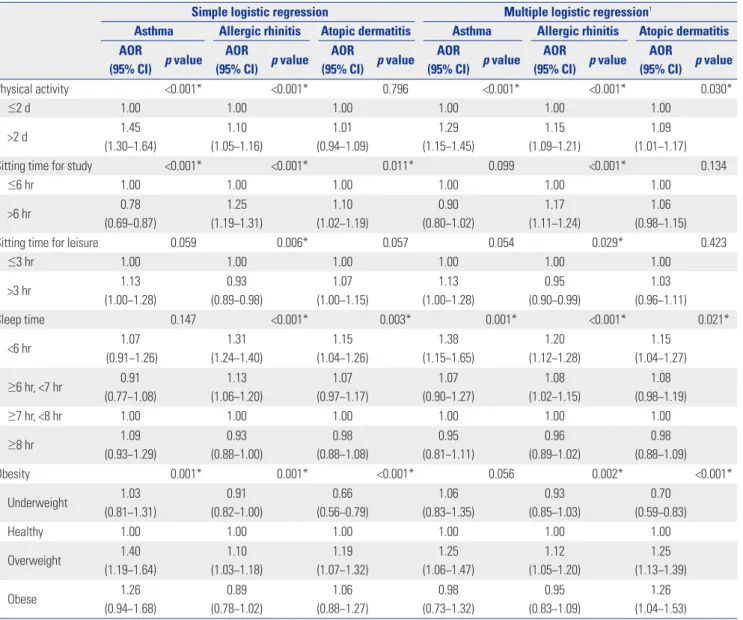
In the unadjusted model, higher physical activity was asso- ciated with asthma and allergic rhinitis, higher sitting time for study was associated with asthma, allergic rhinitis and atopic dermatitis, less sitting time for leisure was associated with aller- gic rhinitis, less sleep time was associated with allergic rhinitis and atopic dermatitis, and overweight was linked to all the above three diseases (Table 2).
We analyzed the relation between the subjects’ recent 12- month history and these diseases (asthma, allergic rhinitis, and atopic dermatitis) (Table 2). Higher physical activity was posi- tively associated with all of them. Sitting time for study was pos- itively associated with allergic rhinitis, whereas sitting for lei- sure was negatively associated with allergic rhinitis. Less sleep time was clearly associated with all of the above three diseases.
Underweight was negatively associated with atopic dermati- tis. Overweight was associated with allergic rhinitis and atopic dermatitis. Obese was only linked to atopic dermatitis. The re- sults of simple and multiple logistic regression analyses of en- tire life history of asthma, allergic rhinitis, and atopic dermati- tis are described in Supplementary Table 2 (only online).
DISCUSSION
High physical activity and less sleep time were consistently associated with asthma, allergic rhinitis, and atopic dermatitis.
Sitting times for study and leisure were associated with allergic rhinitis. Atopic dermatitis clearly showed dose-dependent as- sociation with obesity.
In 90% of asthma patients, the disease can be exacerbated by exercise.20 Therefore, many children with asthma should re- strict their exercise,21 but exercise can reduce the risk of asth- ma.22 We hypothesized that asthma might be associated with lower physical activity; however, the observed result was op- posite. Asthma has been associated with lower physical activ- ity.2,23,24 whereas it has been linked to higher physical activity13,25 or not associated with physical activity.26-28 Participants with asthma might have exercised more to improve their health, or participants with high physical activity might have been over-
diagnosed with asthma due to exercise-induced symptom ag- gravation compared with those with low physical activity.25 Sweating is the most commonly reported exacerbating factor for itching in patients with atopic dermatitis.29 Consistent with a previous study,13 we found that high physical activity was re-
lated not only to asthma but also to allergic rhinitis and atopic dermatitis. Confounding factors that we did not consider, such as residential environment, dietary habits, and the number of peo- ple in the household, might have affected these associations.
Previously, asthma was shown to be associated with seden- Table 1. General Characteristic of Participants According to History of Asthma, Allergic Rhinitis, and Atopic Dermatitis (Recent 12 Months)
Total Asthma Allergic rhinitis Atopic dermatitis
No Yes p value No Yes p value No Yes p value
Total, n (%) 53769
(100.0)
52583 (97.8)
1186 (2.2)
44751 (83.2)
9018 (16.8)
50223 (93.4)
3546 (6.6)
Estimated, n (%) 2747627
(100.0)
2686554 (97.8)
61073 (2.2)
2270721 (82.6)
476906 (17.4)
2495304 (93.3)
252323 (6.7)
Age (yr) 15.0±0.0 15.0±0.0 14.7±0.1 <0.001* 15.0±0.0 15.1±0.0 0.001* 15.0±0.0 14.9±0.0 0.009*
Physical exercise (d) 1.9±0.0 1.9±0.0 2.3±0.1 <0.001* 1.9±0.0 2.0±0.0 <0.001* 1.9±0.0 1.9±0.0 0.489 Sitting time for study (hr) 6.3±0.1 6.4±0.1 5.8±0.1 <0.001* 6.2±0.1 6.8±0.1 <0.001* 6.3±0.1 6.5±0.1 0.014*
Sitting time for leisure (hr) 3.0±0.0 3.0±0.0 3.2±0.1 0.003* 3.0±0.0 2.9±0.0 0.030* 3.0±0.0 3.1±0.0 0.015*
Sleep time (%) 0.152 <0.001† 0.005†
<6 hr 24.4 24.3 25.6 23.5 28.3 24.2 26.5
≥6 hr, <7 hr 25.9 26.0 23.4 25.8 26.6 25.9 26.3
≥7 hr, <8 hr 27.0 27.0 26.6 27.4 25.1 27.1 25.9
≥8 hr 22.7 22.7 24.4 23.3 20.0 22.8 21.3
Obesity (%) <0.001† <0.001† <0.001†
Underweight 6.0 6.0 5.8 6.1 5.6 6.2 4.1
Healthy 79.4 79.5 75.4 79.4 79.3 79.4 79.3
Overweight 11.2 11.1 14.7 11.0 12.1 11.0 13.1
Obese 3.4 3.4 4.1 3.5 3.1 3.4 3.6
Sex (%) <0.001† <0.001† <0.001†
Male 51.6 51.4 62.2 52.1 49.6 52.3 43.1
Female 48.4 48.6 37.8 47.9 50.4 47.7 56.9
Region (%) 0.539 0.002† 0.307
Large city 44.4 44.5 42.9 44.3 45.1 44.4 44.4
Small city 49.0 48.9 50.0 48.9 49.4 48.9 49.6
Rural area 6.6 6.6 7.1 6.8 5.5 6.6 6.0
Economic level (%) <0.001† <0.001† 0.001†
Highest 7.0 6.9 11.4 6.8 7.7 7.0 7.5
Middle high 25.5 25.5 24.2 24.9 28.4 25.6 24.3
Middle 48.1 48.2 43.4 48.5 45.8 48.2 46.4
Middle low 15.6 15.6 15.7 15.9 14.3 15.5 17.2
Lowest 3.8 3.8 5.2 3.9 3.7 3.8 4.6
Smoking (%) <0.001† 0.269 0.116
0 day a month 91.5 91.6 88.3 91.5 91.5 91.6 90.8
1−5 days a month 2.3 2.3 2.7 2.3 2.3 2.3 2.5
6−19 days a month 1.4 1.4 1.7 1.4 1.2 1.4 1.2
≥20 days a month 4.8 4.7 7.4 4.7 4.9 4.7 5.5
Stress level 0.006† <0.001† <0.001†
No 2.7 2.7 3.4 2.9 2.2 2.8 2.5
A little 14.3 14.3 13.7 14.9 11.6 14.5 11.2
Moderate 42.0 42.1 38.8 42.5 39.3 42.2 39.1
Severe 30.3 30.3 30.4 29.7 33.6 30.1 33.8
Very severe 10.6 10.6 13.8 10.0 13.4 10.4 13.3
*Linear regression analysis with complex sampling, significance at p<0.05, †Chi-square test with Rao-Scott correction, significance at p<0.05.
tary behavior,2,26 and asthma/allergic rhinitis/atopic dermati- tis with sedentary time.13 Furthermore, active and passive sed- entary behaviors were found to be differentially associated with obesity.30 In the present study, we divided sedentary (sitting) time based on specific purposes. As shown sitting time for study (mean, 6.3 h) was twice long compared to sitting time for leisure (mean, 3.0 h). Therefore, sitting time for study showed a potential relation with allergic diseases, while the relatively short sitting time for leisure showed inconsistent results. Dif- ferences in study and leisure sitting time locations might have affected the relations with allergic diseases.
Short sleep time (<6 h and 6 h ≤time <7 h) was associated with all of the diseases, whereas relatively long sleep time (≥8 h) was not. In a previous report, asthma in children was associated with sleep apnea, which was influenced by obesity.31 In the
present study, asthma was associated with a short sleep time, even after adjusting for obesity. Poor sleep hygiene in children with asthma and allergic rhinitis was previously reported.32 Pa- tients with asthma, allergic rhinitis, and atopic dermatitis expe- rience sleep disturbances because of their symptoms, such as coughing and dyspnea,33 nasal obstructions,34 and itching,35 re- spectively. Short sleep times are not only a consequence of these diseases but also a risk factor for them. In a healthy volunteer study, sleep deprivation was found to cause the release of vari- ous cytokines; IL-4 and IL-β, which increased in allergic diseas- es, were related to increased rapid eye movement sleep laten- cy.36 In some studies, sleep time itself was not associated with asthma, whereas missed sleep was indicated as a risk factor for asthma by inducing anxiety. In a study using polysomnog- raphy, children with asthma exhibited short sleep durations.
Table 2. Odds Ratios of Physical Activity, Sitting Time for Study, Sitting Time for Leisure, Sleep Time, and Obesity for Asthma, Allergic Rhinitis, and Atopic Dermatitis (Recent 12 Months) Using Simple and Multiple Logistic Regression Analysis with Complex Sampling
Simple logistic regression Multiple logistic regression†
Asthma Allergic rhinitis Atopic dermatitis Asthma Allergic rhinitis Atopic dermatitis AOR
(95% CI) p value AOR
(95% CI) p value AOR
(95% CI) p value AOR
(95% CI) p value AOR
(95% CI) p value AOR
(95% CI) p value
Physical activity <0.001* <0.001* 0.796 <0.001* <0.001* 0.030*
≤2 d 1.00 1.00 1.00 1.00 1.00 1.00
>2 d 1.45
(1.30−1.64)
1.10 (1.05−1.16)
1.01 (0.94−1.09)
1.29 (1.15−1.45)
1.15 (1.09−1.21)
1.09 (1.01−1.17)
Sitting time for study <0.001* <0.001* 0.011* 0.099 <0.001* 0.134
≤6 hr 1.00 1.00 1.00 1.00 1.00 1.00
>6 hr 0.78
(0.69−0.87)
1.25 (1.19−1.31)
1.10 (1.02−1.19)
0.90 (0.80−1.02)
1.17 (1.11−1.24)
1.06 (0.98−1.15)
Sitting time for leisure 0.059 0.006* 0.057 0.054 0.029* 0.423
≤3 hr 1.00 1.00 1.00 1.00 1.00 1.00
>3 hr 1.13
(1.00−1.28)
0.93 (0.89−0.98)
1.07 (1.00−1.15)
1.13 (1.00−1.28)
0.95 (0.90−0.99)
1.03 (0.96−1.11)
Sleep time 0.147 <0.001* 0.003* 0.001* <0.001* 0.021*
<6 hr 1.07
(0.91−1.26)
1.31 (1.24−1.40)
1.15 (1.04−1.26)
1.38 (1.15−1.65)
1.20 (1.12−1.28)
1.15 (1.04−1.27)
≥6 hr, <7 hr 0.91 (0.77−1.08)
1.13 (1.06−1.20)
1.07 (0.97−1.17)
1.07 (0.90−1.27)
1.08 (1.02−1.15)
1.08 (0.98−1.19)
≥7 hr, <8 hr 1.00 1.00 1.00 1.00 1.00 1.00
≥8 hr 1.09
(0.93−1.29)
0.93 (0.88−1.00)
0.98 (0.88−1.08)
0.95 (0.81−1.11)
0.96 (0.89−1.02)
0.98 (0.88−1.09)
Obesity 0.001* 0.001* <0.001* 0.056 0.002* <0.001*
Underweight 1.03
(0.81−1.31)
0.91 (0.82−1.00)
0.66 (0.56−0.79)
1.06 (0.83−1.35)
0.93 (0.85−1.03)
0.70 (0.59−0.83)
Healthy 1.00 1.00 1.00 1.00 1.00 1.00
Overweight 1.40
(1.19−1.64)
1.10 (1.03−1.18)
1.19 (1.07−1.32)
1.25 (1.06−1.47)
1.12 (1.05−1.20)
1.25 (1.13−1.39)
Obese 1.26
(0.94−1.68)
0.89 (0.78−1.02)
1.06 (0.88−1.27)
0.98 (0.73−1.32)
0.95 (0.83−1.09)
1.26 (1.04−1.53) AOR, adjusted odds ratio; CI, confidence interval.
*Significance at p<0.05, †This model was adjusted by age, sex, region of residence, economic level, smoking, physical activity, sitting time for study, sitting time for leisure, sleep time, obesity, asthma, allergic rhinitis, and atopic dermatitis.
Asthma has been associated with obesity in many studies.1,2 One study found this association specifically in women,3 and another report found this association only in underweight in- dividuals.14 In many reports, allergic rhinitis was not associat- ed with obesity,12-14 and associations with atopic dermatitis were not consistent.14,16 In our present study, underweight was negatively associated with atopic dermatitis, whereas obese was positively related to atopic dermatitis. On the other hand, the association between obesity and asthma was not statisti- cally significant, and the relation between obesity and allergic rhinitis was inconsistent.
The primary advantage of the present study was the large sample population (53769 participants), which enabled us to evaluate a representative population to ensure external validity.
Moreover, we analyzed various factors, such as physical activity, sedentary time according to purpose, sleep time, and obesity, as well as other confounding factors, such as region of residence, income level, and smoking status. In the present study, we ex- amined short sleep time in conjunction with possibly related behaviors such as physical activity and sedentary time, and formed that short sleep time was associated with all three dis- eases after adjusting for obesity, whereas other study focused on obstructive sleep apnea and asthma.31
Despite these advantages, the present study had several lim- itations. First, the study used a self-reported survey. Therefore, physical activity, sedentary time, and sleep time were evaluated based on self-reporting, while asthma, allergic rhinitis, and atopic dermatitis history were determined by verbal evidence, not by medical reports. This approach might have introduced inaccuracies due to recall bias; however, this method made it easier to inexpensively gather information from a large cohort.
Therefore, objective measurements of physical behavior using an accelerometer would be desirable. Second, we measured physical activity days, not daily physical activity time. In con- trast, sitting and sleep times were surveyed as daily times.
Therefore, we could not sum the daily activity. Additionally, we did not measure moderate or vigorous physical activity sepa- rately. Third, the study is subject to the same limitations of all cross-sectional studies, including possible reverse causality;
therefore, our calculated ORs should be interpreted with cau- tion. Fourth, ~25% of participants were excluded due to incom- plete questionnaire, which could act as the bias in this study.
In conclusion, high physical activity, and short sleep time were associated with asthma, allergic rhinitis, and atopic dermatitis.
However, the associations between obesity and these allergic diseases were inconsistent after adjusting for other factors.
ACKNOWLEDGEMENTS
We gratefully acknowledge the participants and examiners of the Division of Chronic Disease Surveillance at the Korean Centers for Disease Control and Prevention for participating in this survey and for their dedicated work.
This work was supported by a Research Grant funded by Hal- lym University Research Fund and the National Research Foun- dation (NRF) of Korea (NRF-2015R1D1A1A01060860).
REFERENCES
1. Chen YC, Dong GH, Lin KC, Lee YL. Gender difference of child- hood overweight and obesity in predicting the risk of incident asthma: a systematic review and meta-analysis. Obes Rev 2013;
14:222-31.
2. Tsai HJ, Tsai AC, Nriagu J, Ghosh D, Gong M, Sandretto A. Associa- tions of BMI, TV-watching time, and physical activity on respiratory symptoms and asthma in 5th grade schoolchildren in Taipei, Tai- wan. J Asthma 2007;44:397-401.
3. Chen Y, Dales R, Tang M, Krewski D. Obesity may increase the inci- dence of asthma in women but not in men: longitudinal observa- tions from the Canadian National Population Health Surveys. Am J Epidemiol 2002;155:191-7.
4. Kim KM, Kim SS, Kwon JW, Jung JW, Kim TW, Lee SH, et al. Asso- ciation between subcutaneous abdominal fat and airway hyper- responsiveness. Allergy Asthma Proc 2011;32:68-73.
5. Parsons TJ, Manor O, Power C. Television viewing and obesity: a prospective study in the 1958 British birth cohort. Eur J Clin Nutr 2008;62:1355-63.
6. Staiano AE, Harrington DM, Barreira TV, Katzmarzyk PT. Sitting time and cardiometabolic risk in US adults: associations by sex, race, socioeconomic status and activity level. Br J Sports Med 2014;
48:213-9.
7. Guallar-Castillón P, Bayán-Bravo A, León-Muñoz LM, Balboa-Cas- tillo T, López-García E, Gutierrez-Fisac JL, et al. The association of major patterns of physical activity, sedentary behavior and sleep with health-related quality of life: a cohort study. Prev Med 2014;
67:248-54.
8. Janssen I, Leblanc AG. Systematic review of the health benefits of physical activity and fitness in school-aged children and youth.
Int J Behav Nutr Phys Act 2010;7:40.
9. Kesaniemi YK, Danforth E Jr, Jensen MD, Kopelman PG, Lefèbvre P, Reeder BA. Dose-response issues concerning physical activity and health: an evidence-based symposium. Med Sci Sports Exerc 2001;33(6 Suppl):S351-8.
10. Cappuccio FP, Taggart FM, Kandala NB, Currie A, Peile E, Stranges S, et al. Meta-analysis of short sleep duration and obesity in chil- dren and adults. Sleep 2008;31:619-26.
11. Knutson KL, Turek FW. The U-shaped association between sleep and health: the 2 peaks do not mean the same thing. Sleep 2006;
29:878-9.
12. Sybilski AJ, Raciborski F, Lipiec A, Tomaszewska A, Lusawa A, Furman´czyk K, et al. Obesity--a risk factor for asthma, but not for atopic dermatitis, allergic rhinitis and sensitization. Public Health Nutr 2015;18:530-6.
13. Mitchell EA, Beasley R, Björkstén B, Crane J, García-Marcos L, Keil U; ISAAC Phase Three Study Group. The association between BMI, vigorous physical activity and television viewing and the risk of symptoms of asthma, rhinoconjunctivitis and eczema in children and adolescents: ISAAC Phase Three. Clin Exp Allergy 2013;43:73- 84.
14. Tanaka K, Miyake Y, Arakawa M, Sasaki S, Ohya Y. U-shaped asso- ciation between body mass index and the prevalence of wheeze and asthma, but not eczema or rhinoconjunctivitis: the ryukyus child health study. J Asthma 2011;48:804-10.
15. Sidell D, Shapiro NL, Bhattacharyya N. Obesity and the risk of chronic rhinosinusitis, allergic rhinitis, and acute otitis media in
school-age children. Laryngoscope 2013;123:2360-3.
16. Zhang A, Silverberg JI. Association of atopic dermatitis with being overweight and obese: a systematic review and metaanalysis. J Am Acad Dermatol 2015;72:606-16.
17. Bae J, Joung H, Kim JY, Kwon KN, Kim Y, Park SW. Validity of self- reported height, weight, and body mass index of the Korea Youth Risk Behavior Web-Based Survey questionnaire. J Prev Med Pub- lic Health 2010;43:396-402.
18. Bae J, Joung H, Kim JY, Kwon KN, Kim YT, Park SW. Test-retest reli- ability of a questionnaire for the Korea Youth Risk Behavior Web- Based Survey. J Prev Med Public Health 2010;43:403-10.
19. Centers for Disease Control and Prevention. About Child & Teen BMI [Accessed 14 November 14]. Available at: http://www.cdc.
gov/healthyweight/assessing/bmi/childrens_bmi/about_child- rens_bmi.html.
20. Randolph C. Exercise-induced asthma: update on pathophysiol- ogy, clinical diagnosis, and treatment. Curr Probl Pediatr 1997;27:
53-77.
21. Pianosi PT, Davis HS. Determinants of physical fitness in children with asthma. Pediatrics 2004;113(3 Pt 1):e225-9.
22. Fitch KD, Blitvich JD, Morton AR. The effect of running training on exercise-induced asthma. Ann Allergy 1986;57:90-4.
23. Firrincieli V, Keller A, Ehrensberger R, Platts-Mills J, Shufflebarger C, Geldmaker B, et al. Decreased physical activity among Head Start children with a history of wheezing: use of an accelerometer to measure activity. Pediatr Pulmonol 2005;40:57-63.
24. Rasmussen F, Lambrechtsen J, Siersted HC, Hansen HS, Hansen NC. Low physical fitness in childhood is associated with the devel- opment of asthma in young adulthood: the Odense schoolchild study. Eur Respir J 2000;16:866-70.
25. Ownby DR, Peterson EL, Nelson D, Joseph CC, Williams LK, John- son CC. The relationship of physical activity and percentage of body fat to the risk of asthma in 8- to 10-year-old children. J Asth-
ma 2007;44:885-9.
26. Jones SE, Merkle SL, Fulton JE, Wheeler LS, Mannino DM. Rela- tionship between asthma, overweight, and physical activity among U.S. high school students. J Community Health 2006;31: 469-78.
27. Rundle A, Goldstein IF, Mellins RB, Ashby-Thompson M, Hoepner L, Jacobson JS. Physical activity and asthma symptoms among New York City Head Start Children. J Asthma 2009;46:803-9.
28. Kim JW, So WY, Kim YS. Association between asthma and physical activity in Korean adolescents: the 3rd Korea Youth Risk Behavior Web-based Survey (KYRBWS-III). Eur J Public Health 2012;22:
864-8.
29. Kim A, Silverberg JI. A systematic review of vigorous physical ac- tivity in eczema. Br J Dermatol 2016;174:660-2.
30. Kikuchi H, Inoue S, Sugiyama T, Owen N, Oka K, Nakaya T, et al.
Distinct associations of different sedentary behaviors with health- related attributes among older adults. Prev Med 2014;67:335-9.
31. Lang JE. Obesity and asthma in children: current and future ther- apeutic options. Paediatr Drugs 2014;16:179-88.
32. Koinis-Mitchell D, Kopel SJ, Boergers J, Ramos K, LeBourgeois M, McQuaid EL, et al. Asthma, allergic rhinitis, and sleep problems in urban children. J Clin Sleep Med 2015;11:101-10.
33. Turner-Warwick M. Epidemiology of nocturnal asthma. Am J Med 1988;85:6-8.
34. Craig TJ, McCann JL, Gurevich F, Davies MJ. The correlation be- tween allergic rhinitis and sleep disturbance. J Allergy Clin Im- munol 2004;114(5 Suppl):S139-45.
35. Reuveni H, Chapnick G, Tal A, Tarasiuk A. Sleep fragmentation in children with atopic dermatitis. Arch Pediatr Adolesc Med 1999;
153:249-53.
36. Esteitie R, Emani J, Sharma S, Suskind DL, Baroody FM. Effect of fluticasone furoate on interleukin 6 secretion from adenoid tissues in children with obstructive sleep apnea. Arch Otolaryngol Head Neck Surg 2011;137:576-82.