• 검색 결과가 없습니다.

High-Power Conversion Efficiency of Photovoltaic Cells Fabricated with a Small-molecular and Polymer Donating Blend Layer

N/A
N/A
Protected

Academic year: 2021

Share "High-Power Conversion Efficiency of Photovoltaic Cells Fabricated with a Small-molecular and Polymer Donating Blend Layer"

Copied!
5
0
0

로드 중.... (전체 텍스트 보기)

전체 글

(1)

Nomenclature

PCE : power conversion efficiency, % Jsc : short circuit current, mA/cm

2

Voc : open circuit voltage, V FF : fill factor

Subscript

CuPc : copper phthalocyanine

P3HT : poly(3-hexylthiophene-2,5-diyl)

PCBM : [6,6]-phenyl-C61 butyric acid methyl ester OPV : organic photo voltaic

ITO : indium tin oxide Di water : deionized water IPA : isopropyl alcohol

PEDOT : PSS : poly(3,4-ethylenedioxylenethiophene):

polystyrene sulfonic acid

N2 : nitrogen

SMU : source measure unit

LUMO : lowest unoccupied molecular orbital HOMO : highest occupied molecular orbital

1. Introduction

Recently, photovoltaic devices on organic materials such as small-molecular and polymer materials are of huge interest because of their attractive properties such as large area, excellent mechanical flexibility, low production cost, and simple fabrication process

1-11)

. Therefore, many researchers have made an effort to improve the PCE of OPV cells

12-20)

. Polymer photovoltaic cell has many advantages in production process such as spin coating, inkjet printing, screen printing, and roll-to-roll process for glass or flexible substrate. However, the PCE of photovoltaic cells using small-molecular or polymer layer is still low due to the narrow absorption of small-molecular and polymer materials, and it remains a major limitation in achieving high PCE

9,23)

. Thus, tandem photovoltaic cell which significantly increases the light absorption, has been researched by using different absorption spectra materials

24-33)

. However, since the tandem photovoltaic cells are complicated process and expensive production cost, it is not easy to commercialize.

Therefore, in this paper, we suggest new photovoltaic cell structure to be able to have the tandem effect in a view point of the light absorption enhancement to replace the materials used in complicated tandem process. In particular, we used CuPc as a small-molecular donating material and P3HT as a polymer donating material to expand the wavelength range of a light absorption. In addition, by applying the CuPc:P3HT:PCBM

High-Power Conversion Efficiency of Photovoltaic Cells Fabricated with a Small-molecular and

Polymer Donating Blend Layer

Ji-Heon Kim ․ Jea-Gun Park*

Department of Electronics and Computer Engineering, Hanyang University, Seoul 133 –791, Republic of Korea

ABSTRACT: A photovoltaic cell of CuPc:P3HT:PCBM was introduced to extend the light absorption in the visible wavelength between 300~500 and 550~800 nm. By fabricating the photovoltaic cells of ITO / PEDOT:PSS / CuPc:P3HT:PCBM / BCP / Al with small- molecular and polymer donating materials blended layer, we demonstrated a high PCE of 4.20% with high Jsc of 10.05 mA/cm

2

. This performance of photovoltaic cell with the blended layer of small-molecular and polymer can be competitive with that of tandem cells.

Key words: OPV, Polymer solar cell, CuPc, P3HT:PCBM, wide light absorption

*Corresponding author: [email protected] Received May 9 2014; Revised May 23 2014;

Accepted June 2 2014

ⓒ 2014 by Korea Photovoltaic Society

This is an Open Access article distributed under the terms of the Creative Commons Attribution Non-Commercial License (http://creativecommons.org/licenses/by-nc/3.0)

which permits unrestricted non-commercial use, distribution, and reproduction in any medium, provided the original work is properly cited.

48

(2)

blended layer using spin-cast process in photovoltaic cells, we investigated the performance of photovoltaic cells fabricated with a CuPc:P3HT:PCBM blended layer.

2. Experimental

ITO anodes (150 nm thick) were deposited on glass substrates by RF-magnetron sputtering in Ar/O

2

mixture ambient using a sintered ceramic target of ~10 wt% SnO

2

-doped In

2

O

3

after cleaning process

34)

. The ITO glass had a sheet resistance of 15 Ω/□, as measured with a CMT-SR100 M-MP system (Changmin Tech, Korea). The ITO glass substrates (50 mm × 50 mm) were cleaned in an ultrasonic bath with a cleaning agent and then rinsed in DI water and hot IPA. They were dried in a vacuum oven at 100°C for more than 12 h. The CuPc:P3HT:

PCBM was dissolved in chlorobenzene at a weight ratio of (CuPc weight ratio : 0.5, 1 and 2):2:1 and stirred at 50°C on the hot plate for more than 72 h in the glovebox before spin casting to form the blend layer. To photovoltaic cells fabricated, the ITO glass substrate was treated in a 354 nm UV lamp during 60 sec and, continuously, placed at a 200 W oxygen plasma flow for 30 sec. A thin layer of PEDOT:PSS (Baytron PVPAI 4083) was spin-coated onto the ITO glass with a speed of ~2000 rpm for 60 sec after filtered through 5 μm pore size (Whatman, PTFE SYRINGE FILTER) and then baked at 140°C for 10 min in glovebox. The CuPc:P3HT:PCBM blended solution was filtered through 5 μm pore size. The CuPc:P3HT:PCBM blended layer was then spin-cast at ~1000 rpm for 60 sec on top of the PEDOT:PSS layer and then baked at 150°C for 10 min in glovebox. Continuously, the BCP layer was deposited by thermal evaporation as a hole/exciton blocking layer on the CuPc:P3HT:

PCBM blended layer at a pressure of about 5×10

-7

Torr and evaporated with 12 nm-thick. Finally, an Al electrode of about 80 nm-thick was deposited by thermal evaporation at a pressure of about 5×10

-7

Torr. The evaporation rates of the BCP layer and the metal electrode were 0.5 Å/s and 5 Å/s, respectively. All the electrical measurements were performed at a N

2

gas ambient in a glove box at room temperature. The detailed photovoltaic cells structure and thickness for each organic functional layer are described as ITO (150 nm) / PEDOT:PSS (25 nm) / Blended layer (P3HT:PCBM or CuPc:P3HT:PCBM) / BCP (12 nm) / Al (80 nm). The photocurrent-density vs. voltage (J–V) characteristics was analyzed using HP 4155C SMU. The photocurrent was

measured under a condition of AM 1.5G solar illumination at 100 mW/cm

2

(1 sun) supplied using a Newport 150 W solar simulator and the light intensity was monitored with a calibrated silicon photodiode for the AM 1.5G spectrum. The absorption spectra were measured on UV-visible (Shimadzu UV-3101PC, Japan) spectrophotometer. The detailed analysis samples structure for P3HT:PCBM and CuPc:P3HT:PCBM blended layer was then spin-cast at ~1000 rpm for 60 sec on the glass and then baked at 125°C for 10 min in a nitrogen (N

2

) glove box.

3. Results and discussion

Here, P3HT and CuPc were selected for the electron-donating material and the PCBM was used as the electron acceptor. The

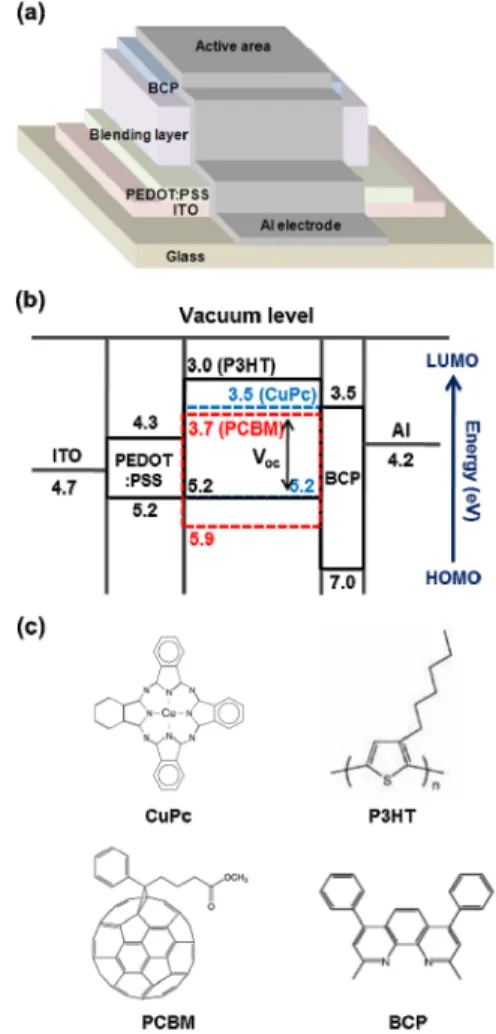
Fig. 1. (a) Schematic structure for photovoltaic cell fabricated

with the new blending layer. (b) Energy level diagram

showing the HOMO and LUMO energies level of each of

the component materials. (c) Molecular structures of

chemical used in this study. CuPc as a small-molecular

and P3HT as a polymer are donating materials. PCBM

and BCP are electron acceptor and hole/exciton blocking

materials, respectively

(3)

BCP layer was inserted as a hole/exciton blocking layer between blended layer (here, P3HT:PCBM or CuPc:P3HT:PCBM blended layer) and Al electrode. An ITO glass coated with PEDOT:PSS layer was adopted as the substrate. Fig. 1 shows a schematic cross sectional structure of the photovoltaic cell, the schematic energy level diagram, and chemical structure used in this study.

In the blended layer, Voc is determined by energy level as shown in the Fig. 1(b). Fig. 1(b) presents that the difference of the lowest unoccupied molecular orbital (LUMO) level for the BCP and CuPc blending layer was 0.2 eV, indicating that separated electrons from blended layer are transferred to BCP layer. In addition, excitons and separated holes are transported to the highest occupied molecular orbital (HOMO) level.

However, the difference of energy gap of HOMO level for the BCP and blending layer was almost ~1.8 eV, which means that excitons and the separated holes could not transport to Al electrode. In other words, the energy level of the junction between the blended layer and the BCP layer was perfectly matched to hole/exciton blocking and electron transport. In addition, HOMO and LUMO level of the CuPc material were 5.2 and 3.5 eV, respectively. These energy levels were similar to those of the LUMO level of BCP layer and the HOMO level of blending layer, respectively.

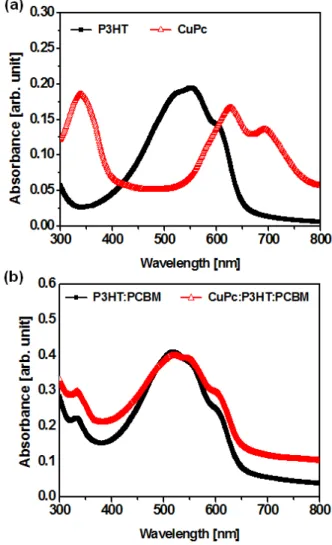
Fig. 2 shows the absorbance of the donating materials (here, CuPc and P3HT layer) and blended layer (here, P3HT:PCBM and CuPc:P3HT:PCBM layer) as a function of wavelength measured by UV-Vis. In Fig. 2(a), it was observed that although P3HT donating layer absorbed the light strongly in the wavelength between 450~650 nm, but did not in the other wavelength region (see red line). In the case of CuPc, the absorbance of the CuPc donating layer showed a strong band in a two range of wavelength between 300~400 and 600~750 nm. In addition, Fig. 2(b) shows the comparison of the absorbance of the P3HT:PCBM and the CuPc:P3HT:PCBM (weight ratio 1:2:1) blended layer as a function of wavelength. It exhibits that the absorbance of CuPc:P3HT:PCBM was higher than P3HT:PCBM that of show at in the wavelength between 300~400 and 600~750 nm. In addition, the tendency of the absorbance of CuPc:P3HT:PCBM on wavelength was almost same as that of P3HT, shown in Fig.

2(a). This means that the absorbance of the CuPc blended layer was affected more by P3HT than by CuPc.

Therefore, from the comparison of Figs. 2(a) and (b), it can be interpreted that although the absorbance for CuPc blended layer was influenced by P3HT, it increased in the wavelength between

300~450 and 600~750 nm by CuPc. In other words, the absorbance of P3HT:PCBM layer in the wavelength ranging 300~400 nm and greater than 650 nm increased 151% due to the blending with CuPc. Therefore, we can estimate that photocurrent for photovoltaics with a CuPc:P3HT:PCBM blended layer can be more generated because the light absorption of CuPc generated more excitons than that of P3HT:PCBM blended layer.

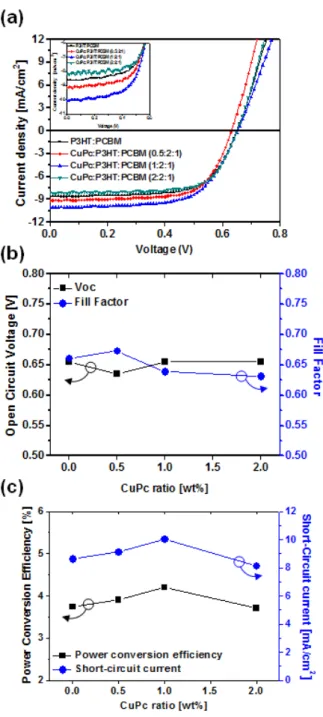
Fig. 3 shows the performance of the photovoltaic cells as a function CuPc ratio of blended layer of under a condition of 100 mW/cm

2

AM 1.5G illuminations. The CuPc weight ratio was varied with 0.5, 1 and 2 wt%. It was confirmed in Fig. 3(a) that the Jsc increased from 8.64 (without CuPc) to 10.05 mA/cm

2

(CuPc 1 wt%) as the CuPc concentration increased up to 1 wt%, and the rapidly decreased with increasing a CuPc concentration.

The Voc for all CuPc weight ratios were about 0.655 V, Fig. 2. (a) UV-visible light absorption spectra of single layer of

donating materials. (b) UV-visible light absorption spectra

of a P3HT:PCBM bulk heterojunction composite layer

and a CuPc:P3HT:PCBM bulk heterojunction composite

layer in visible range

(4)

indicating that Voc were almost independent CuPc ratio of the blended layer. This result could be confirmed from the energy band level in the Fig. 1(b). The HOMO and the LUMO level of the CuPc have 5.2 and 3.5 eV, respectively. Energy band level of CuPc was similar to that of the LUMO level of BCP layer and the HOMO level of P3HT:PCBM blended layer. Therefore, the CuPc could not influence on Voc. Therefore, the CuPc donating

material of CuPc:P3HT:PCBM blended layer contributes on absorbing more light, and improves the characteristics of Jsc rather than Voc of the photovoltaic cell. Also, the FF was not changed with varying a CuPc ratio of blended layer, as shown in Fig. 3(b). As a result, it was observed that the reference photovoltaic cell of the P3HT:PCBM blended layer (weight ratio 2:1) exhibited a PCE of 3.739 % with Jsc of 8.64 mA/cm

2

, Voc of 0.655 V, and FF of 0.661 as show in Fig. 3(b) and (c).

However, the photovoltaic cell with the CuPc:P3HT:PCBM (weight ratio 1:2:1) blended layer exhibited a PCE of 4.201 % with Jsc of 10.05 mA/cm

2

, Voc of 0.655 V, and FF of 0.639.

Thus, PCE and Jsc of the photovoltaic cell fabricated with the CuPc:P3HT:PCBM blended layer increased to ~12.3 % and

~16.5 % compared with those of the P3HT:PCBM blended layer, respectively. Jsc of photovoltaic was changed with varying a CuPc ratio. The PCE and Jsc were highest at a CuPc of 1 wt%

and decreased at a CuPc of 2 wt%. This tendency was probably attributed to that CuPc is a small-molecule material almost insoluble in solvent completely. In addition, the generated excitons by light absorption could not be separated to exictons of photocurrent because the thickness of CuPc:P3HT:PCBM blended layer is getting thicker with increasing the CuPc weight.

4. Conclusions

In summary, we investigated the improvement of the light absorption of the P3HT:PCBM blended layer by additing a CuPc donating material. It was confirmed that the light absorption of the CuPc: P3HT:PCBM blended layer was improved by ~30

% in the visible range, compared with the P3HT:PCBM blended layer. Therefore, by additing a CuPc donating material, more excitons were generated and photocurrent was enhanced with a proportion to the light absorption increased by the CuPc:P3HT:

PCBM blended layer. In particular, we observed that the photovoltaic cell fabricated with the CuPc:P3HT:PCBM blended layer demonstrated the PCE of 4.201%, Jsc of 10.05 mA/cm

2

, Voc of 0.655 V, and FF of 0.639.

Acknowledgments

This work was supported by the Brain Korea 21 PLUS Program in 2014.

Fig. 3. (a) The photocurrent density vs voltage for CuPc:

P3HT:PCBM J-V characteristics of photovoltaic cells.

(b) Comparison of open-circuit voltage vs. fill-factor

characteristics. (c) Comparison of power-conversion

efficiency vs. short-circuit current characteristics

(5)

References

1. Hong, K. D., "Stability Improvement of Center Lathes," J. of KSPE, Vo1. 2, No. 2, pp. 123-126, 1992.

2. C. J. Brabec, N. S. Sariciftci, J. C. Hummelen, Adv. Funct.

Mater. 2001, 11, 15.

3. P. Schilinsky, C. Waldauf, and C. J. Bradec, Appl. Phys. Lett.

2002, 81, 3885.

4. P. Peumans, A. Yakimov, and S. R. Forrest, J. Appl. Phys.

2003, 93, 3693.

5. S. R. Forrest, Nature 2004, 428, 911.

6. C. Winder, N.S. Saricftci, J. Mater. Chem. 2004, 14, 1077.

7. W. Y. Wong, X. Z. Wang, Z. He, A. B. Djurisic, C. T. Yip, K.

Y. Cheung, H. Wang, C. S. K. Mak, W. K. Chan, Nat. Mater.

2007, 6, 521.

8. J. Y. Kim, K. Lee, N. E. Coates, D. Moses, T. Q. Nguyen, M.

Dante, and A. J. Heeger, Science 2007, 317, 222.

9. M. Y. Chan, S. L. Lai, M. K. Fung, C. S. Lee, and S. T. Lee, Appl. Phys. Lett. 2007, 90, 023504.

10. J. Dai, X. X. Jiang, H. B. Wang, and D. H. Yan, Appl. Phys.

Lett. 2007, 91, 253503.

11. S. W. Tong, C. F. Zhang, C. X. Zhu, D. S. H. Chan, C. Y. Jiang, G. Liu, Q. D. Ling, and E. T. Kang, Chem. Phys. Lett. 2008, 453, 73.

12. Y. Kim, M. Shin, I. Lee, H. Kim, and S. Heutz, Appl. Phys.

Lett. 2008, 92, 093306.

13. S. Yoo, B. Domercq, B. Kippelen, Appl. Phys. Lett. 2004, 85, 5427.

14. J. Xue, S. Uchida, B. P. Rand, S. R. Forrest, Appl. Phys. Lett.

2004, 85, 5757.

15. Y. Shao, Y. Yang, Adv. Mater. 2005, 17, 2841.

16. C. W. Chu, V. Shrotriya, G. Li, Y. Yang, Appl. Phys. Lett.

2006, 88, 153504.

17. F. Yang, K. Sun, S. R. Forrest, Adv. Mater. 2007, 19, 4166.

18. W. Chen, H. Xiang, Z. Xu, B. Yan, V. A. L. Roy, C. Chea, P.

Lai, Appl. Phys. Lett. 2007, 91, 191109.

19. E. Ahlswede, W. Mühleisen, M. W. M. Wahi, J. Hanisch, M.

Powalla, Appl. Phys. Lett. 2008, 92, 143307.

20. J. C. Bernède, Y. Berredjem, L. Cattin, M. Morsli, Appl. Phys.

Lett. 2008, 92, 083304.

21. J. S. Kim, J. H. Park, J. H. Lee, J. Jo, D. Y. Kim, K. Choa, Appl. Phys. Lett. 2008, 91, 112111.

22. J. Xue, B. P. Rand, S. Uchida, S. R. Forrest, Adv. Mater. 2005, 17, 66.

23. W. Ma, C. Yang, X. Gong, K. Lee, A. J. Heeger, Adv. Funct.

Mater. 2005, 15, 1617.

24. J. Dai, X. X. Jiang, H. B. Wang, D. H. Yan, Appl. Phys. Lett.

2007, 91, 253503.

25. A. Yakimov, S. R. Forrest, Appl. Phys. Lett. 2002, 80, 1667.

26. J. Drechsel, B. Männig, F. Kozlowski, M. Pfeiffer, K. Leo, H.

Hoppe, Appl. Phys. Lett. 2005, 86, 244102.

27. G. Dennler, H. Prall, R. Koeppe, M. Egginger, R. Autengruber, N. S. Sariciftci, Appl. Phys. Lett. 2006, 89, 073502.

28. V. Shrotriya, E. H. Wu, G. Li, Y. Yao, Y. Yang, Appl. Phys.

Lett. 2006, 88, 064104.

29. K. Kawano, N. Ito, T. Nishimori, J. Sakai, Appl. Phys. Lett.

2006, 88, 073514.

30. A. Hadipour et al., Adv. Funct. Mater. 2006, 16, 1897.

31. J. Gilot, M. M. Wienk, R. A. J. Janssen, Appl. Phys. Lett. 2007, 90, 143512.

32. C. Zhang, S. W. Tong, C. Jiang, E. T. Kang, D. S. H. Chan, C.

Zhu, Appl. Phys. Lett. 2008, 92, 083310.

33. C. Zhang, S. W. Tong, C. Jiang, E. T. Kang, D. S. H. Chan, C.

Zhu, Appl. Phys. Lett. 2008, 93, 043307.

34. J. Y. Kim, K. Lee, N. E. Coates, D. Moses, T. Nguyen, M.

Dante, A. J. Heeger, Science 2007, 13, 222.

35. M. Bender, W. Seeling, C. Daube, H. Frankenberger, B. Ocker

and J. Stollenwerk, Thin Solid Films, 1998, 326, 72.

수치

Fig. 1. (a) Schematic structure for photovoltaic cell fabricated  with the new blending layer
Fig. 2 shows the absorbance of the donating materials (here,  CuPc and P3HT layer) and blended layer (here, P3HT:PCBM  and CuPc:P3HT:PCBM layer) as a function of wavelength  measured by UV-Vis
Fig. 3. (a) The photocurrent density vs voltage for CuPc:

참조

관련 문서

Recently, the use of organic–inorganic lead halide perovskite materials has attracted signi cant attention owing to the excellent power conversion

The effect of methanol crossover methanol crossover is equally is equally important and affects parameters such as fuel important and affects parameters such as fuel

• What are the distinctive physical and mechanical properties of nonferrous alloys?.. Materials Design‐for‐Properties : “Alloyed Pleasure”..

• Mechanical Properties of Materials Elasticity Plasticity and Creep.. • Elasticity,

• Equips students with fundamental knowledge in structural mechanics & structural materials for engineering.. • Pre-requisite to structural analysis/design modules

Going from a set of functional group building blocks to potential molecular starting materials can generate very large potential molecular starting materials can generate

Effect of electric current on the microstructure and mechanical properties of hard-to-sinter materials with high melting point.. Effect of electric current on the

Step 2: The second step in a life-cycle assessment is to inventory the outputs that occur, such as products, byproducts, wastes and emissions, and the inputs, such as raw