ABSTRACT
Background and Objectives: We aimed to investigate the association between serum parathyroid hormone (PTH) levels and the prevalence of atrial fibrillation (AF) in a population based study.
Methods: This study included a total of 9,007 community-dwelling Koreans aged 50 years and over who were enrolled in the Dong-gu study from 2007 to 2010. Electrocardiograms were recorded from the subjects using the HP-PageWriter 200 M1771A. All potential cases of AF were determined by 2 cardiologists. PTH concentration was measured by a chemiluminescent microparticle immunoassay. Multiple logistic regression analysis was used to evaluate the relationship between the quartiles of PTH and AF, adjusting for potential confounders.
Results: The prevalence of AF was 2.41% in males and 0.9% in females and increased with advanced age in both genders. The median and interquartile range (IQR) of serum PTH was 39.5 pg/mL (IQR, 30.6–50.8), which was significantly higher in patients with AF than in patients without AF (p<0.001). The prevalence of AF increased with increasing PTH quartile (0.8%, 0.9%, 1.6%, and 2.8% in the lowest, second, third, and highest PTH quartiles, respectively; p<0.001). Multivariable logistic analysis adjusted for cardiovascular risk factors showed the highest quartile of serum PTH levels was associated with a higher prevalence of AF than the lowest quartile (odds ratio, 3.34; 95% confidence interval, 1.93–5.78).
Conclusion: Higher levels of serum PTH were associated with higher prevalence of AF.
Further studies are needed to determine whether this association is present in other populations and in a prospective study setting.
Keywords: Atrial fibrillation; Parathyroid hormone
INTRODUCTION
Atrial fibrillation (AF) is the most common cardiac arrhythmia. The prevalence of AF increases with age, and affects 3% to 5% of people over 65. AF increases the risk of ischemic stroke by five times and causes approximately 15% to 20% of ischemic strokes.
1)AF is also
Original Article
Received: Aug 17, 2017 Revised: Oct 17, 2017 Accepted: Nov 8, 2017 Correspondence to
Min Ho Shin, MD, PhD
Department of Preventive Medicine, Chonnam National University Medical School, 264, Seoyang-ro, Hwasun 58128, Korea.
E-mail: [email protected] Hyung Wook Park, MD, PhD
Department of Cardiovascular Medicine, The Heart Center of Chonnam National University Hospital, 42, Jebong-ro, Dong-gu, Gwangju 61469, Korea.
E-mail: [email protected]
*Min Ho Shin and Hyung Wook Park contributed equally to this work.
Copyright © 2018. The Korean Society of Cardiology
This is an Open Access article distributed under the terms of the Creative Commons Attribution Non-Commercial License (https://
creativecommons.org/licenses/by-nc/4.0) which permits unrestricted noncommercial use, distribution, and reproduction in any medium, provided the original work is properly cited.
ORCID iDs
Ki Hong Lee
https://orcid.org/0000-0002-9938-3464 Min-Ho Shin
https://orcid.org/0000-0002-2217-5624 Hyung Wook Park
https://orcid.org/0000-0002-9630-0467
Ki Hong Lee , MD
1, Min-Ho Shin , MD, PhD
2,*, Hyung Wook Park , MD, PhD
1,*, Jeong Gwan Cho , MD
1, Sun-Seog Kweon , MD
2, and Young-Hoon Lee , MD
31
Department of Cardiovascular Medicine, Chonnam National University Hospital, Gwangju, Korea
2
Department of Preventive Medicine, Chonnam National University Medical School, Hwasun, Korea
3
Department of Preventive Medicine & Institute of Wonkwang Medical Science, Wonkwang University School of Medicine, Iksan, Korea
Association between Serum
Parathyroid Hormone Levels and the Prevalence of Atrial Fibrillation:
the Dong-gu Study
Jeong Gwan Cho
https://orcid.org/0000-0001-7855-4490 Sun-Seog Kweon
https://orcid.org/0000-0003-2378-8550 Young-Hoon Lee
https://orcid.org/0000-0003-1367-025X
Conflict of InterestThe authors have no financial conflicts of interest.
Author Contributions
Conceptualization: Shin MH; Data curation:
Kweon SS; Formal analysis: Shin MH;
Investigation: Cho JG; Methodology: Shin MH;
Project administration: Park HW; Supervision:
Park HW; Validation: Lee YH; Visualization:
Shin MH; Writing - original draft: Lee KH;
Writing - review & editing: Shin MH.
associated with an increased risk of heart failure and mortality. Although several risk factors of AF have been identified, including high blood pressure, heart failure, diabetes, ageing, hyperthyroidism, and heart disease, the pathogenesis of AF remains poorly understood.
Recent studies revealed that serum parathyroid hormone (PTH) levels are higher in subjects with AF than in controls.
2-4)Another prospective study found that a higher serum level of phosphorus was associated with an increased risk of AF.
5)Also, PTH excess was associated with major risk factors for the development and perpetuation of AF, including hypertension, myocardial dysfunction, and heart failure.
6-8)These findings suggest that serum PTH levels might be related with AF.
However, these previous studies had limitations due to the small number of patients enrolled and the independent effect of PTH on AF prevalence was not analyzed. To our knowledge, there has not been a population based study on the association between serum PTH and AF.
Therefore, the aim of this study was to investigate the association between serum PTH levels and the prevalence of AF in a population based study.
METHODS
Study population
The Dong-gu study is an ongoing prospective population-based study that was designed to investigate risk factors for chronic disease among 9,260 subjects aged 50 years and older in an urban elderly population.
9)Baseline examination of the Dong-gu study was conducted between April 2007 and July 2010 in the Dong-gu district of Gwangju Metropolitan City in Korea. After the exclusion of 228 participants who had incomplete data, a total of 9,007 subjects (3,606 men and 5,401 women) were included in the present study. All participants provided informed consent, and the study was conducted in accordance with the guidelines in the Declaration of Helsinki. The study was approved by the Institutional Review Board of Chonnam National University Hospital (approval number: I-2008-05-056).
Covariates
Body weight and body composition were measured while the subjects were wearing indoor clothing or a light gown without shoes using a calibrated Inbody 520 (Biospace Co., Seoul, Korea). Height was measured to the nearest 0.1 cm. Subjects were categorized based on smoking status as current smokers or nonsmokers (including ex-smokers), and based on alcohol intake as nondrinkers or current drinkers. Regular exercise was categorized as irregular or regular based on the weekly frequency of recreational activity and exercise.
After the subjects had rested for at least 5 minutes in a sitting position, blood pressure was measured on the right upper arm using a mercury sphygmomanometer (Baumanometer; W.A.
Baum Co., Inc., Copiague, NY, USA) with an appropriately sized cuff. The first appearance (phase I) and disappearance (phase V) of the Korotkoff sounds were used to determine systolic blood pressure (SBP)and diastolic blood pressure (DBP), respectively, which was recorded to the nearest 2 mmHg. SBP and DBP were measured three times at one-minute intervals, and the average values were used in our analysis. All participants underwent at least 10 hours of overnight fasting before blood samples were obtained from an antecubital vein.
Blood sampling was performed at a pre-fixed morning time between 8 and 9 AM. Serum was
separated on-site and stored at −70°C until analyzed. Serum total cholesterol, high-density
lipoprotein (HDL) cholesterol, triglycerides, and fasting blood glucose levels were measured
using enzymatic methods. All samples were analyzed using an automatic analyzer (Model 7600 Chemical Analyzer; Hitachi Ltd., Tokyo, Japan). C-reactive protein (CRP) levels were determined by particle-enhanced immunonephelometry using a BN II nephelometer (Dade Behring, Marburg, Germany). Kidney function was assessed by the estimated glomerular filtration rate (eGFR), which was calculated using the Modification of Diet in Renal Disease (MDRD) formula. Chronic kidney disease was defined as an eGFR <60 mL/min.
Serum PTH measurement
Concentrations of PTH were measured by a chemiluminescent microparticle immunoassay (ARCHITECT i2000; Abbott, Abbott Park, IL, USA). The coefficient of variation for the total analytic precision of this assay was ≤9%. The lower detection limit of this assay was 1.0 pg/
mL for PTH.
Assessment of AF
All participants underwent a 12-lead electrocardiogram (ECG). The ECGs were recorded using the same HP-PageWriter 200 M1771A (Hewlett Packard, Andover, MA, USA). AF was diagnosed if AF or atrial flutter was present on an ECG obtained from a baseline survey. The ECGs were initially analyzed by a computer-based ECG interpretation program (Philips 12- lead algorithm). All potential cases of AF were determined by two cardiologists.
Statistical analyses
The data are presented as the mean value and standard deviation for normally distributed continuous variables and proportions for categorical variables. Differences across quartiles of PTH were assessed by linear trends in the χ
2test and analysis of variance test, as appropriate.
Multiple logistic regression analysis was used to evaluate the relationship between the quartiles of PTH and AF, adjusting for potential confounders. We included all variables known to be confounder variables in previous studies as independent variables in the multivariate analysis. However, the levels of calcium and phosphorus that could mediate the association between PTH levels and AF were not included in the independent variables. The following cardiovascular risk factors were included as covariates: age, gender, body mass index (BMI), smoking, alcohol intake, physical activity, medication for hypertension, medication for diabetes, medication for dyslipidemia, SBP, DBP, fasting glucose, total cholesterol, HDL cholesterol, log-transformed triglyceride, aspartate aminotransferase (AST), alanine aminotransferase (ALT), and log-transformed values of high-sensitivity CRP and eGFR. The adjusted prevalence ratio was the predicted probability calculated from the logistic regression model using the “margins” command with the “atmeans” option in Stata. All statistical analyses were performed using Stata version 14 (StataCorp, College Station, TX, USA).
RESULTS
The general characteristics for the Dong-gu study participants by quartile of serum PTH
level are shown in Table 1. The mean age of the study participants was 65.2 (±8.6) years
and 40.0% were males. The median serum PTH level was 39.5 pg/mL (interquartile range
(IQR), 30.6–50.8), which was significantly higher in patients with AF than without AF (49.1
[IQR, 37.4-71.5] vs. 39.3 [IQR, 30.5-50.6] pg/mL; p<0.001) (Figure 1). Subjects in the highest
quartile of serum PTH were more likely to be older, female, non-smokers, non-drinkers, and
physically inactive. In addition, they had significantly higher mean values for BMI, SBP, and
DBP, but lower values for fasting glucose, total cholesterol, triglyceride, and eGFR.
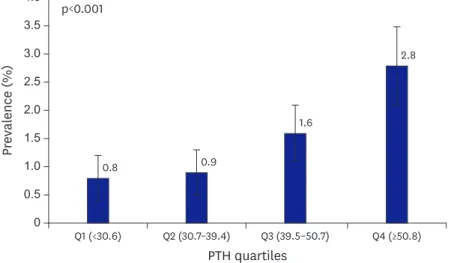
The prevalence of AF was 2.41% in males and 0.9% in females and increased with advanced age in both genders. The prevalence of AF increased with increasing PTH quartile in both males (1.6%, 1.9%, 2.3%, and 4.2% in the lowest, second, third, and highest quartiles, respectively; p<0.001) and females (0.2%, 0.2%, 1.1%, and 1.7%; p<0.001). There was no sex difference in the association between PTH level and the prevalence of AF (p for interaction=0.10). The prevalence of AF increased with increasing PTH quartile even after adjusting for age and gender (0.8%, 0.9%, 1.6%, and 2.8%; p<0.001) (Figure 2). The association between serum PTH and prevalence of AF is shown in Table 2. Serum PTH levels
Table 1. General characteristics of the study population (n=9,007) according to serum PTH levelCharacteristics Quartile of serum PTH level, pg/mL
<30.6 30.7–39.4 39.5–50.7 ≥50.8 p-value for trend
No. 2,242 2,261 2,245 2,259
Men 1,032 (46.0) 938 (41.5) 879 (39.2) 757 (33.5) <0.001
Age (years) 64.1±8.1 64.5±8.0 65.3±8.0 66.8±8.4 <0.001
BMI (kg/m
2) 24.3±2.8 24.2±2.9 24.4±2.9 24.5±3.1 0.003
Current smoker 289 (12.9) 232 (10.3) 234 (10.4) 230 (10.2) 0.008
Current alcohol intake 1,132 (50.5) 1,089 (48.2) 1,047 (46.6) 886 (39.2) <0.001
Physical activity 779 (34.7) 724 (32.0) 725 (32.3) 674 (29.8) 0.006
Treatment for hypertension 728 (32.5) 737 (32.6) 805 (35.9) 939 (41.6) <0.001
Treatment for diabetes 429 (19.1) 271 (12.0) 237 (10.6) 221 (9.8) <0.001
Treatment for dyslipidemia 202 (9.0) 184 (8.1) 185 (8.2) 194 (8.6) 0.718
SBP (mm Hg) 121.9±16.8 122.2±16.1 123.7±16.9 125.5±17.5 <0.001
DBP (mm Hg) 73.5±10.1 74.3±10.1 74.7±10.1 74.7±10.6 <0.001
Fasting glucose (mg/dL) 113.1±29.5 109.7±25.8 107.9±22.6 107.6±21.3 <0.001
Total cholesterol (mg/dL) 203.1±41.7 201.2±38.8 201±39.7 199.7±39.5 0.006
HDL cholesterol (mg/dL) 51.2±11.7 51.7±11.8 51.8±12.5 51.6±12.0 0.256
Triglycerides (mg/dL) 149.2±103.8 140.8±107.2 141.4±94.8 140.5±96.6 0.007
AST (mg/dL) 24.7±11.9 24.8±14.9 25.2±23.1 25.3±17.2 0.699
ALT (mg/dL) 21.3±13.4 21.1±15.5 20.5±17.9 19.8±13.6 0.004
High sensitivity-CRP (mg/dL) 0.17±0.49 0.14±0.35 0.16±0.49 0.15±0.33 0.306
eGFR (mL/min/1.73 m
2) 66.6±11.8 66.3±11.3 65.4±11.3 62.8±13.8 <0.001
Chronic kidney disease 607 (27.1) 603 (26.7) 640 (28.5) 841 (37.2) <0.001
Calcium (mg/dL) 8.23±0.04 8.32±0.04 8.34±0.04 8.47±0.04 <0.001
Phosphate (mg/dL) 3.85±0.01 3.77±0.01 3.71±0.01 3.65±0.01 <0.001
Data shown are number (%) or mean±standard deviation.
ALT = alanine aminotransferase; AST = aspartate aminotransferase; BMI = body mass index; CRP = C-reactive protein; DBP = diastolic blood pressure; eGFR = estimated glomerular filtration rate; HDL = high-density lipoprotein; PTH = parathyroid hormone; SBP = systolic blood pressure.
50
0 100 150
PTH ( pg /mL )
p<0.001
AF Normal
Figure 1. Serum levels of PTH in patients with normal sinus rhythm and AF. The median and IQR of serum PTH was
39.5 pg/mL (IQR, 30.6–50.8), which was significantly higher in patients with AF than without AF (p<0.001).
AF = atrial fibrillation; IQR = interquartile range; PTH = parathyroid hormone.
were positively associated with the risk for AF after adjustment for age and sex (odds ratio [OR] for the second quartile, 1.09; 95% confidence interval [CI], 0.57–2.08; OR for the third quartile, 2.03; 95% CI, 1.14–3.60; and OR for the fourth quartile, 3.65; 95% CI, 2.14–6.22).
After additional adjustment for cardiovascular risk factors, this association was slightly attenuated and remained significant (OR for the second quartile, 1.04; 95% CI, 0.54–1.99;
OR for the third quartile, 1.95; 95% CI, 1.09–3.48; OR for the fourth quartile, 3.34; 95% CI, 1.93–5.78). Multivariate analysis revealed that increasing age, female gender, high SBP, high DBP, and increasing serum PTH level were associated with higher prevalence of AF (Table 3).
DISCUSSION
AF is the most common form of sustained arrhythmia in clinical practice and occurs in approximately 1.5% of adults. AF is particularly important because it is associated with increased morbidity and mortality.
1)Also, AF is a major risk factor for cerebral embolism.
Thus, identifying contributing factors for the development of AF is critical. Numerous risk factors have been suggested to be associated with an increased prevalence of AF, including high blood pressure, heart failure, diabetes, ageing, hyperthyroidism, and heart disease.
Nonetheless, the cause of AF in a substantial number of patients remains unexplained.
0 2.5 2.0 1.5 1.0 0.5 3.5 3.0 4.0
Pr eval ence (% )
PTH quartiles p<0.001
Q3 (39.5–50.7) Q4 (≥50.8) Q2 (30.7–39.4)
Q1 (<30.6)
0.8 0.9
1.6
2.8
Figure 2. The prevalence of AF according to PTH quartiles adjusted by age and gender. Adjusted prevalence
was calculated by logistic regression adjusted for age and sex. The prevalence of AF even after age and gender adjustment increased with increasing PTH quartile (0.8%, 0.9%, 1.6%, and 2.8% in the lowest, second, third, and highest quartiles, respectively; p<0.001).
AF = atrial fibrillation; PTH = parathyroid hormone.
Table 2. ORs for AF by PTH quartiles in 9,007 participants from the Dong-gu study
Quartiles Age and sex adjusted OR (95% CI) p-value Multivariable
*adjusted OR (95% CI) p-value
Quartile 1 (<30.6) 1 (reference) 1 (reference)
Quartile 2 (30.7–39.4) 1.09 (0.57–2.08) 0.802 1.04 (0.54–1.99) 0.917
Quartile 3 (39.5–50.7) 2.03 (1.14–3.60) 0.016 1.95 (1.09–3.48) 0.025
Quartile 4 (≥50.8) 3.65 (2.14–6.22) <0.001 3.34 (1.93–5.78) <0.001
p-value for trend <0.001 <0.001
AF = atrial fibrillation; ALT = alanine aminotransferase; AST = aspartate aminotransferase; BMI = body mass index; CI = confidence interval; CRP = C-reactive protein; DBP = diastolic blood pressure; eGFR = estimated glomerular filtration rate; HDL = high-density lipoprotein; OR = odds ratio; PTH = parathyroid hormone; SBP = systolic blood pressure.
*
Adjusted for age, sex, BMI, smoking, alcohol intake, physical activity, medication for hypertension, medication for diabetes, mediation for dyslipidemia, SBP,
DBP, fasting glucose, total cholesterol, HDL cholesterol, AST, ALT, log-transformed triglyceride, log-transformed values of high-sensitivity CRP, and eGFR.
The median serum level of PTH has been found to be higher in patients with AF than in patients with a normal sinus rhythm. PTH plays a key role in calcium homeostasis and its release is triggered by a decrease in serum calcium levels, acting on bone, kidney, and intestine. Beyond these classical targets, PTH also acts as a cardiac hormone, a vasodilatory substance, and a regulator of smooth muscle proliferation.
10)11)An increased serum level of PTH was associated with hypertension, disturbances in the renin-angiotensin-aldosterone system, and cardiac arrhythmia, as well as structural and functional alterations in the vascular wall.
12)13)Previous population-based studies have reported that higher PTH levels were associated with higher levels of SBP and DBP.
14)Also, PTH infusion in healthy individuals raised blood pressure.
15)In the present study, treatment history of hypertension was significantly increased according to the increment of PTH quartiles. History of hypertension was marginally associated with the risk of AF even after covariate adjustment.
Hypertension is a well-known risk factor for the development of AF and its complications.
Hypertension leads to atrial and ventricular pressure overload and arterial and atrial stiffness, resulting in increased atrial workload and distension. Therefore, hypertension contributes to the elevated serum levels of PTH and the development of AF.
Another potential mechanism for the association between AF and PTH is that AF itself might increase PTH levels. Messenger RNA expression of PTH-related proteins in the heart is increased by physiologic maneuvers that increase atrial or ventricular workload and distention.
10)Loss of atrial contraction during AF causes atrial volume and pressure overload leading to atrial stretch. Also, the pathomechanism of AF involves atrial ischemia, infiltration, and inflammation, which promote local release of PTH.
16)This mechanism suggests that PTH release into the circulation could increase during AF. Increased levels of PTH may perpetuate AF by direct effects on cardiomyocytes. PTH can induce myocardial
Table 3. Multivariate analysis for association with the prevalence of AFCharacteristics OR (95% CI) p-value
Age 1.08 (1.05–1.10) <0.001
Sex 0.34 (0.22–0.52) <0.001
BMI (kg/m
2) 1.05 (0.99–1.11) 0.167
Current smoker 0.63 (0.34–1.16) 0.101
Current alcohol intake 0.96 (0.65–1.40) 0.821
Physical activity 1.05 (0.72–1.51) 0.802
Treatment for hypertension 1.48 (1.01–2.16) 0.042
Treatment for diabetes 1.49 (0.87–2.56) 0.151
Treatment for dyslipidemia 0.77 (0.40–1.49) 0.441
SBP (mm Hg) 0.94 (0.93–0.96) <0.001
DBP (mm Hg) 1.07 (1.05–1.10) <0.001
Fasting glucose (mg/dL) 1.00 (1.00–1.01) 0.254
Total cholesterol (mg/dL) 1.00 (0.99–1.00) 0.083
HDL cholesterol (mg/dL) 1.02 (1.00–1.03) 0.099
Log triglycerides (mg/dL) 0.73 (0.30–1.83) 0.507
AST (mg/dL) 1.01 (0.99–1.02) 0.448
ALT (mg/dL) 0.99 (0.97–1.01) 0.513
Log high sensitivity-CRP (mg/dL) 0.93 (0.16–5.30) 0.934
eGFR (mL/min/1.73 m
2) 0.98 (0.97–1.00) 0.016
PTH
Quartile 2 1.04 (0.54–1.99) 0.917
Quartile 3 1.95 (1.09–3.48) 0.025
Quartile 4 3.34 (1.93–5.78) <0.001
AF = atrial fibrillation; ALT = alanine aminotransferase; AST = aspartate aminotransferase; BMI = body mass index;
CI = confidence interval; CRP = C-reactive protein; DBP = diastolic blood pressure; eGFR = estimated glomerular
filtration rate; HDL = high-density lipoprotein; OR = odds ratio; PTH = parathyroid hormone; SBP = systolic blood
pressure.
hypertrophy and increase heart rate and automaticity, and thus increase the risk of AF.
11)17)McCarty et al.
18)demonstrated that PTH-induced activation of phospholipase C may increase arrhythmia by the generation of inositol-1,4,5-triphosphate, which has been associated with increased arrhythmogenicity.
Consistent with the present study, previous studies revealed that patients with AF presented higher serum levels of PTH than patients with a normal sinus rhythm. The increased serum level of calcium with increasing PTH quartile in the present study supports the explanation that an increased serum level of PTH is probably a response to AF. However, further studies are needed to evaluate the causal relationship between PTH and AF.
PTH excess increases intracellular calcium in target tissues and is associated with hypertension, arterial stiffness, left ventricular hypertrophy, and heart failure.
12)Recent clinical studies revealed that PTH excess was significantly associated with an increased risk for the development of cardiovascular disease and mortality.
19)20)Also, PTH excess was positively linked with the risk and severity of heart failure.
4)6)Patients with PTH excess were more likely to be older and physically inactive and had a higher prevalence of comorbidities, resulting in an increased risk of cardiovascular disease. Population based studies have shown that PTH excess was associated with major risk factors for the development of AF, including hypertension, left ventricular hypertrophy, myocardial dysfunction, left ventricular mass, and heart failure.
7)8)12)In the present study, subjects with higher serum PTH were more likely to be older, female, non-smokers, non-drinkers, and physically inactive. Also, they had a higher mean BMI and higher prevalence of hypertension. These demographic features might contribute to the higher prevalence of AF in patients with higher PTH levels. The Dong- gu study is an ongoing prospective population-based study and all participants are being examined for the development of cardiovascular disease using echocardiograms, ECGs, and laboratory examinations for 5 years after the initial enrollment. The Dong-gu study is expected to show the temporal relationship between serum levels of PTH and cardiovascular disease including heart failure as well as AF.
Some limitations of the present study need to be addressed. First, the serum level of PTH was not analyzed according to the AF type as either paroxysmal or persistent. Previous studies demonstrated that patients with persistent AF had significantly higher PTH levels than patients with paroxysmal AF.
2)3)Follow-up data from the Dong-gu study are expected to discriminate the association of PTH according to AF type. Second, the serum level of vitamin D was not incorporated into the multivariate logistic model. Vitamin D is another key factor involved in controlling calcium and phosphate homeostasis. Although there is conflicting data about the relationship between serum levels of vitamin D and cardiovascular disease, higher vitamin D levels have been associated with a higher risk of cardiovascular mortality and heart failure.
6)8)19)20)Third, the present study has a cross-sectional study design, which precludes determination of the causal relationship between PTH levels and AF prevalence, so further prospective studies are needed to reveal the cause and effect of this relationship.
Fourth, only a single measurement of PTH level was performed and biologic variation in PTH is expected over time. Multiple measurements of the PTH level might reduce the incidental relationship between PTH levels and AF prevalence.
Higher levels of serum PTH were associated with higher prevalence of AF. Further studies
are needed to determine whether the association is present in other populations and in a
prospective study setting. Patients with higher PTH levels were older, physically inactive,
obese, and had more comorbidities including hypertension. These features increased the risk of future cardiovascular disease. The Dong-gu study is expected to add evidence for the relationship between PTH levels and cardiovascular disease as well as AF.
REFERENCES
1. Kirchhof P, Benussi S, Kotecha D, et al. 2016 ESC guidelines for the management of atrial fibrillation developed in collaboration with EACTS. Eur Heart J 2016;37:2893-962.
PUBMED | CROSSREF
2. Rienstra M, Lubitz SA, Zhang ML, Cooper RR, Ellinor PT. Elevation of parathyroid hormone levels in atrial fibrillation. J Am Coll Cardiol 2011;57:2542-3.
PUBMED | CROSSREF
3. Shor R, Tilis Y, Boaz M, Matas Z, Fux A, Halabe A. Serum parathyroid hormone-related protein levels before and after paroxysmal atrial fibrillation. Am J Emerg Med 2008;26:361-3.
PUBMED | CROSSREF
4. Wannamethee SG, Welsh P, Papacosta O, Lennon L, Whincup PH, Sattar N. Elevated parathyroid hormone, but not vitamin D deficiency, is associated with increased risk of heart failure in older men with and without cardiovascular disease. Circ Heart Fail 2014;7:732-9.
PUBMED | CROSSREF
5. Lopez FL, Agarwal SK, Grams ME, et al. Relation of serum phosphorus levels to the incidence of atrial fibrillation (from the Atherosclerosis Risk In Communities [ARIC] study). Am J Cardiol 2013;111:857-62.
PUBMED | CROSSREF
6. Altay H, Zorlu A, Binici S, et al. Relation of serum parathyroid hormone level to severity of heart failure.
Am J Cardiol 2012;109:252-6.
PUBMED | CROSSREF
7. Pilz S, Tomaschitz A, Drechsler C, et al. Parathyroid hormone level is associated with mortality and cardiovascular events in patients undergoing coronary angiography. Eur Heart J 2010;31:1591-8.
PUBMED | CROSSREF
8. van Ballegooijen AJ, Visser M, Kestenbaum B, et al. Relation of vitamin D and parathyroid hormone to cardiac biomarkers and to left ventricular mass (from the Cardiovascular Health Study). Am J Cardiol 2013;111:418-24.
PUBMED | CROSSREF
9. Kweon SS, Shin MH, Jeong SK, et al. Cohort profile: the Namwon Study and the Dong-gu Study. Int J Epidemiol 2014;43:558-67.
PUBMED | CROSSREF
10. Ogino K, Burkhoff D, Bilezikian JP. The hemodynamic basis for the cardiac effects of parathyroid hormone (PTH) and PTH-related protein. Endocrinology 1995;136:3024-30.
PUBMED | CROSSREF
11. Andersson P, Rydberg E, Willenheimer R. Primary hyperparathyroidism and heart disease--a review. Eur Heart J 2004;25:1776-87.
PUBMED | CROSSREF
12. Saleh FN, Schirmer H, Sundsfjord J, Jorde R. Parathyroid hormone and left ventricular hypertrophy. Eur Heart J 2003;24:2054-60.
PUBMED | CROSSREF
13. Grant FD, Mandel SJ, Brown EM, Williams GH, Seely EW. Interrelationships between the renin- angiotensin-aldosterone and calcium homeostatic systems. J Clin Endocrinol Metab 1992;75:988-92.
PUBMED
14. Snijder MB, Lips P, Seidell JC, et al. Vitamin D status and parathyroid hormone levels in relation to blood pressure: a population-based study in older men and women. J Intern Med 2007;261:558-65.
PUBMED | CROSSREF
15. Jorde R, Svartberg J, Sundsfjord J. Serum parathyroid hormone as a predictor of increase in systolic blood pressure in men. J Hypertens 2005;23:1639-44.
PUBMED | CROSSREF
16. Watson T, Shantsila E, Lip GY. Mechanisms of thrombogenesis in atrial fibrillation: Virchow's triad revisited. Lancet 2009;373:155-66.
PUBMED | CROSSREF
17. Hara M, Liu YM, Zhen L, et al. Positive chronotropic actions of parathyroid hormone and parathyroid hormone-related peptide are associated with increases in the current, I(f ), and the slope of the pacemaker potential. Circulation 1997;96:3704-9.
PUBMED | CROSSREF
18. McCarty MF, Barroso-Aranda J, Contreras F. Can moderate elevations of parathyroid hormone acutely increase risk for ischemic cardiac arrhythmias? Med Hypotheses 2009;72:581-3.
PUBMED | CROSSREF
19. Kestenbaum B, Katz R, de Boer I, et al. Vitamin D, parathyroid hormone, and cardiovascular events among older adults. J Am Coll Cardiol 2011;58:1433-41.
PUBMED | CROSSREF
20. Anderson JL, Vanwoerkom RC, Horne BD, et al. Parathyroid hormone, vitamin D, renal dysfunction, and cardiovascular disease: dependent or independent risk factors? Am Heart J 2011;162:331-339.e2.
PUBMED | CROSSREF