ABSTRACT
Background and Objectives: The clinical characteristics of patients with diastolic
dysfunction characterized by a relaxation abnormality with possible elevated filling pressure is remain to be determined. We sought to test whether diastolic stress echocardiography (DSE) is useful for characterization of these patients.
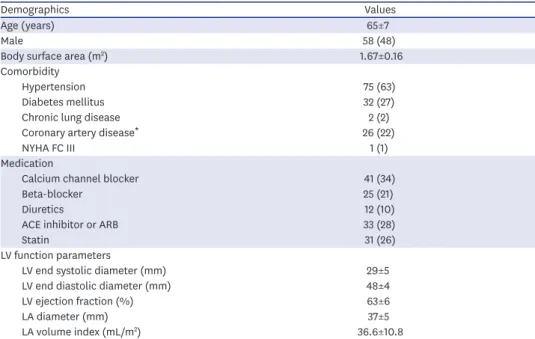
Methods: A total of 120 patients (58 men, mean age of 64±7 years) with E/A ratio <1.0 (mean±SD, 0.7±0.1) and 10≤ E/e′ <15 at rest echocardiography was enrolled prospectively for supine bicycle exercise up to 50 W.
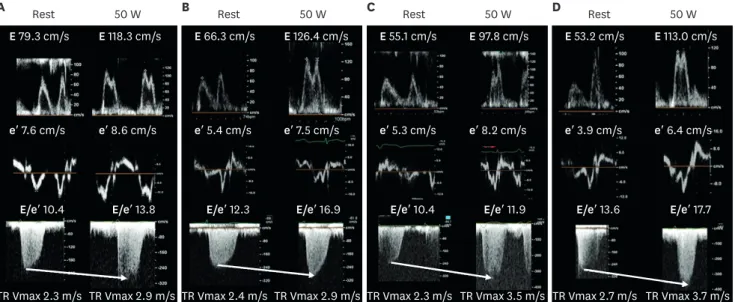
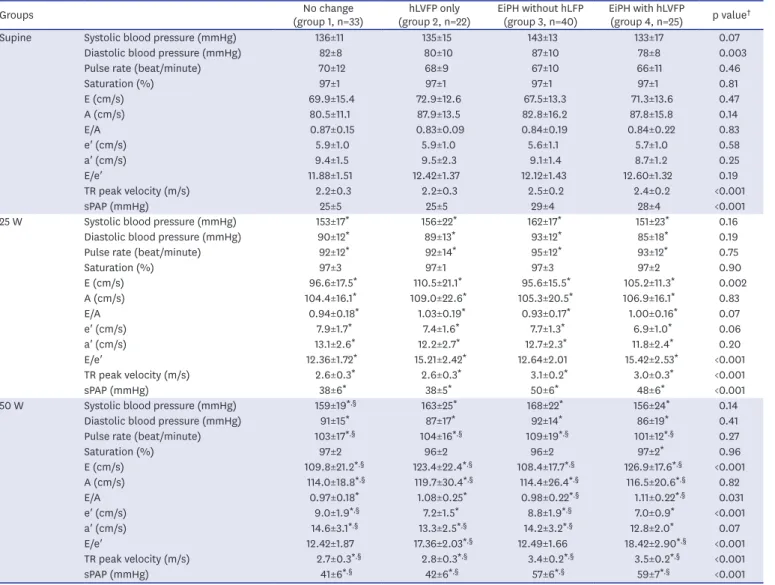
Results: During exercise, 47 patients (39%) showed high left ventricular filling pressure (E/e′ >15, hLVFP) and 40 (30%) developed exercise-induced pulmonary hypertension (systolic pulomary arterial pressure >50 mmHg, EiPH) without hLVFP. The remaining 33 patients did not show hLVFP or EiPH. The incidence of EiPH with hLVFP was 21% (25/120).
By multivariate analysis, age (odds ratio [OR], 1.07; 95% confidence interval [CI], 1.00–1.13;
p=0.039) and systolic pulmonary artery pressure at rest (OR, 1.14; 95% CI, 1.02–1.27; p=0.02) were associated with EiPH, whereas late diastolic transmitral velocity (OR, 1.04; 95% CI, 1.00–1.08; p=0.03) and diastolic blood pressure (OR, 0.94; 95% CI, 0.90–0.99; p=0.02) were associated with hLVFP during exercise.
Conclusions: Patients with relaxation abnormality and possibly hLVFP showed markedly heterogeneous hemodynamic changes during low-level exercise and DSE was useful to characterize these patients.
Keywords: Diastole; Exercise; Doppler echocardiography
INTRODUCTION
Assessment of diastolic function has been accepted as an important routine clinical practice, and Doppler echocardiography remains a main clinical tool.
1)Although clinical guidelines or recommendations are available for standard classification of diastolic dysfunction, the classification of diastolic stages continues to vary between observers, because conflicting findings are common and many patients fall “between” stages.
2)The most frequently
Original Article
Received: Feb 7, 2018 Revised: Mar 6, 2018 Accepted: Apr 4, 2018 Correspondence to Jae-Kwan Song, MD
Asan Medical Center Heart Institute, University of Ulsan College of Medicine, 88, Olympic-ro 43-gil, Songpa-gu, Seoul 05505, Korea.
E-mail: [email protected] Copyright © 2018. The Korean Society of Cardiology
This is an Open Access article distributed under the terms of the Creative Commons Attribution Non-Commercial License (https://
creativecommons.org/licenses/by-nc/4.0) which permits unrestricted noncommercial use, distribution, and reproduction in any medium, provided the original work is properly cited.
ORCID iDs Jeong Yoon Jang
https://orcid.org/0000-0002-5430-7679 Sahmin Lee
https://orcid.org/0000-0003-2250-7948 Dae-Hee Kim
https://orcid.org/0000-0002-8275-4871 Jong-Min Song
https://orcid.org/0000-0002-6754-8199 Duk-Hyun Kang
https://orcid.org/0000-0003-4031-8649 Jae-Kwan Song
https://orcid.org/0000-0002-6469-801X Conflict of Interest
The authors have no financial conflicts of interest.
Jeong Yoon Jang , MD
1, Sahmin Lee , MD
2, Dae-Hee Kim , MD
2, Jong-Min Song , MD
2, Duk-Hyun Kang , MD
2, and Jae-Kwan Song , MD
21
Department of Medicine, Graduate School, Kyung Hee University, Seoul, Korea
2