Received: November 5, 2012, Revised: December 17, 2012, Accepted: December 17, 2012 ISSN 1598-4478 (Print) / ISSN 2233-7679 (Online)
†Correspondence to: Ae-Hee Song
Department of Dental Hygiene, Chunnam Techno University, 113, Daehangno, Okgwamyeon, Gokseong 516-911, Korea Tel: +82-61-360-5370, Fax: +82-61-360-5377, E-mail: [email protected]
Copyright © 2012 by the Korean Society of Dental Hygiene Science
A pH Measurement Study on Commercial Alcoholic Drinks
Jae-Sun Shim and Ae-Hee Song
†Department of Dental Hygiene, Chunnam Techno University, Gokseong 516-911, Korea
시판주류의 pH 측정 연구
심재순ㆍ송애희†
전남과학대학교 치위생과
The purpose of this study was to determine pH value of some alcoholic drinks sold in Korea and to provide the basic information which can cause dental erosion. Alcoholic drinks commercially sold were purchased from various big markets in Korea. The sorts of drinks tested in this study consisted of 5 brands of beers, 24 brands of makgeollis, 9 brands of wines and 12 brands of sojus. The test groups were selected randomly and the pH of each beverage was determined using a pH meter he each pH was measured. For statistical data, Mann-Whitney test was used to analyze difference for red wine and white wine and Kruskal-Wallis test was used to compare the pH of each test group. The result of this study was as followings: the mean pH of 5 brands of beers was 4.21, that of 24 brands of makgeollis 3.88, of 9 brands of wines 3.34 and of 12 brans of sojus 7.86. Each test group was significantly different (p<0.05). Except for soju groups, the test groups had a low pH value which can cause dental erosion. In terms of comparing between pH value of red wine and white wine, the result of this study represented that the mean pH of red wine was 3.45 and that of white wine was 3.21. This result showed the pH of two kinds of wine had a low pH which can lead to dental erosion and the difference of two wine were significantly different (p<0.05). As a result, some drinks sold in Korea have a high erosive potential on teeth since they have a comparatively low pH expect soju. Hence, when we consume some kinds of alcoholic drinks, we make sure to remember that the alcoholics which had a low pH, can have an effect on dental erosion that mean we should avoid to drink some alcoholic drinks with low pH for long time.
Key Words: Alcoholic drinks, Dental erosion, pH
Introduction
Dental erosion is defined as loss of tooth structure by chemical processes without bacteria, caused by a variety of extrinsic and intrinsic factors. Intrinsic factors caused dental erosion include recurrent vomiting as a result of psychological disorders such as anorexia nervosa, bulimia nervosa and stress-induced psychosomatic vomiting1,2). Extrinsic causes of erosion can be divided into environ- mental factors, medication and diet. Among extrinsic
factors, environment can be associated with exposure to acid fumes on workers in factories, swimming pools with low pH. Medication and oral hygiene products with low pH have been also regarded as a factor can lead to dental erosion. Diet caused dental erosion, e.g., soft drinks, sports drink and dietary acids has been given the most attention3-6). The erosive capacity of the dietary substances was found to be related to their pH and titratable acidity7). In general, after immersion in beverages with low pH, the studies concluded the surface microhardness of the teeth
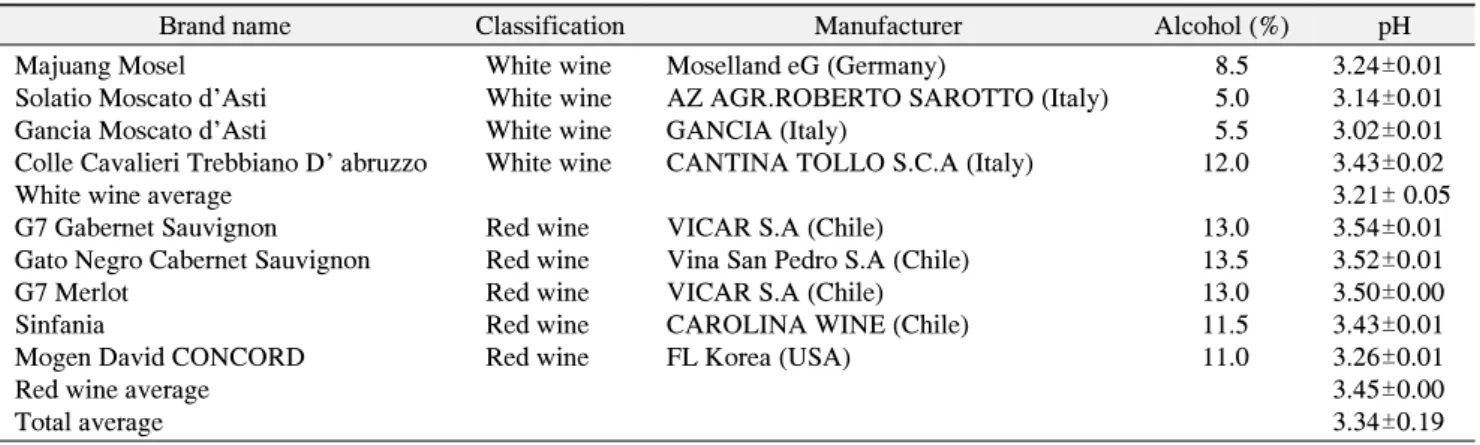
Brand name Classification Manufacturer Alcohol (%) pH
Majuang Mosel White wine Moselland eG (Germany) 8.5 3.24±0.01
Solatio Moscato d'Asti White wine AZ AGR.ROBERTO SAROTTO (Italy) 5.0 3.14±0.01
Gancia Moscato d'Asti White wine GANCIA (Italy) 5.5 3.02±0.01
Colle Cavalieri Trebbiano D' abruzzo White wine CANTINA TOLLO S.C.A (Italy) 12.0 3.43±0.02
White wine average 3.21± 0.05
G7 Gabernet Sauvignon Red wine VICAR S.A (Chile) 13.0 3.54±0.01
Gato Negro Cabernet Sauvignon Red wine Vina San Pedro S.A (Chile) 13.5 3.52±0.01
G7 Merlot Red wine VICAR S.A (Chile) 13.0 3.50±0.00
Sinfania Red wine CAROLINA WINE (Chile) 11.5 3.43±0.01
Mogen David CONCORD Red wine FL Korea (USA) 11.0 3.26±0.01
Red wine average 3.45±0.00
Total average 3.34±0.19
pH data are presented as mean±standard deviation.
Table 1. The pH and Alcoholic Percentage of Commercial Wines Used in this Study
Brand name Manufacturer Alcohol (%) pH
Cass OB Co., Ltd. (Korea) 4.5 4.32±0.02
Cafri OB Co., Ltd. (Korea) 4.2 4.24±0.02
OB blue OB Co., Ltd. (Korea) 4.4 4.20±0.02
Hite Hite Brewery Co., Ltd. (Korea) 4.5 4.05±0.02
Max Hite Brewery Co., Ltd. (Korea) 4.5 4.25±0.02
Total average 4.21±0.01
pH data are presented as mean±standard deviation.
Table 2. The pH and Alcoholic Percentage of Commercial Beers Used in this Study
was reduced8). The type of erosive damage may be various significantly in diverse people, according to the consump- tion of soft drinks and acidic drink such as sports beverages, acidic carbonated beverages with low pH.
These evidences have been reported in domestic or overseas literatures which are associated with dental erosion9-12). According to the Fair Trade Commission report13) reported in 2009, the consumption rate of alcoholic drinks over 19 year-old adults in Korea has been gradually increasing in the rate of annual consumption of sojus 68.26 bottle (360 ml), makgeollis 9.19 bottle (750 ml) and beer 9.19 bottle (500 ml). However, the only study by Hwang14) reported just pH values of four alcohol drinksassociated with alcoholic beverages for dental erosion in Korea. Several studies have reported dental erosion caused by different wine with low pH in overseas countries15,16). The pH values of the wine were very low and ranged between 2.95 and 3.45 and it has been reported having high erosive potential in professional wine assessor who may test 20∼200 varied wines with low pH that can
lead to high risk erosive potential15,17). According to the foreign study15,16), alcoholic drinks with low pH have high potential which can have effect on erosion. We can also presume the alcoholic drinks sold in Korea may have low pH. Therefore, it might be needed that the researches about the pH of commercial alcohols sold in Korea. Since pH is known to be one of the main factors for the dental erosion.
The purpose of this study was to assess the pH value of different commercial alcoholic drinks sold in Korean markets and to provide the basic data associated with one factor among various factors which can lead to erosive potential.
Materials and Methods
1. Materials
Commercially available alcoholic beverages were purchased from different big supermarket chains in Korea (Table 1∼4). According to liquor law, the alcoholic
Brand name Manufacturer Alcohol (%) pH
Baesangmyeonju Woorissal Saeng Baesangmyeonju Brewery (Korea) 6 3.99±0.01
Mimong Kooksoondang Brewery Co., Ltd. (Korea) 7 3.81±0.00
Jeonjuseang makgeolli Jeonju Brewery (Korea) 6 4.33±0.01
Uguksaeng Kooksoondang Brewery Co., Ltd. (Korea) 6 4.01±0.00
Pocheonssalrobicheun josuldang makgeolli Josuldang (Korea) 6 3.94±0.00
Kooksoondang saeng makgeolli Kooksoondang Brewery Co., Ltd. (Korea) 6 3.96±0.00
Seouljangsu saeng makgeolli Seoul Takju MAF Association (Korea) 6 3.41±0.01
Plus ssal makgeolli Woorisool (Korea) 7 4.38±0.00
Idong ssal makgeolli GwangjuMudeungsanTakju (Korea) 6 3.98±0.01
Mudeungsan ssal makgeolli GwangjuMudeungsanTakju (Korea) 6 3.25±0.00
Uri ssal seoseokdea makgeolli GwangjuMudeungsanTakju (Korea) 6 3.38±0.00
Baehaejungdoga saeng makgeolli BaehaejungDoga Co., Ltd. (Korea) 6 3.86±0.01
Chamsari saeng makgeolli Chamsari L&F (Korea) 6 3.68±0.00
Idongsaeng makgeolli E-Dong Brewery (Korea) 6 3.84±0.01
Seouljangsu wolmea ssal makgeolli Seoul Takju MAF Association (Korea) 6 3.74±0.00
Deapo makgeolli Baesangmyeonju Brewery (Korea) 7 3.72±0.01
Buandaechu makgeolli Guam Farm (Korea) 6 3.85±0.02
Buanchamppong makgeolli Naebyeongsan Co. (Korea) 6 3.84±0.00
Saengsaeng makgeolli Seoul Saeng Co. (Korea) 6 4.18±0.00
pocheon deodeok sul Idongbaekun Brewery (Korea) 6 4.05±0.29
Baesangmyeonju urissal sinseon Baesangmyeonju Brewery (Korea) 7 3.74±0.00
Kooksoondang ssal makgeolli Kooksoondang Brewery Co., Ltd. (Korea) 6 4.00±0.01
Ulgeumju Woorisool (Korea) 6 4.30±0.01
Bia Saeng makgeolli Gwangju Beer Brewery (Korea) 6 3.80±0.00
Total average 3.88±0.28
pH data are presented as mean±standard deviation.
Table 3. The pH and Alcoholic Percentage of Commercial Makgeollis Used in this Study
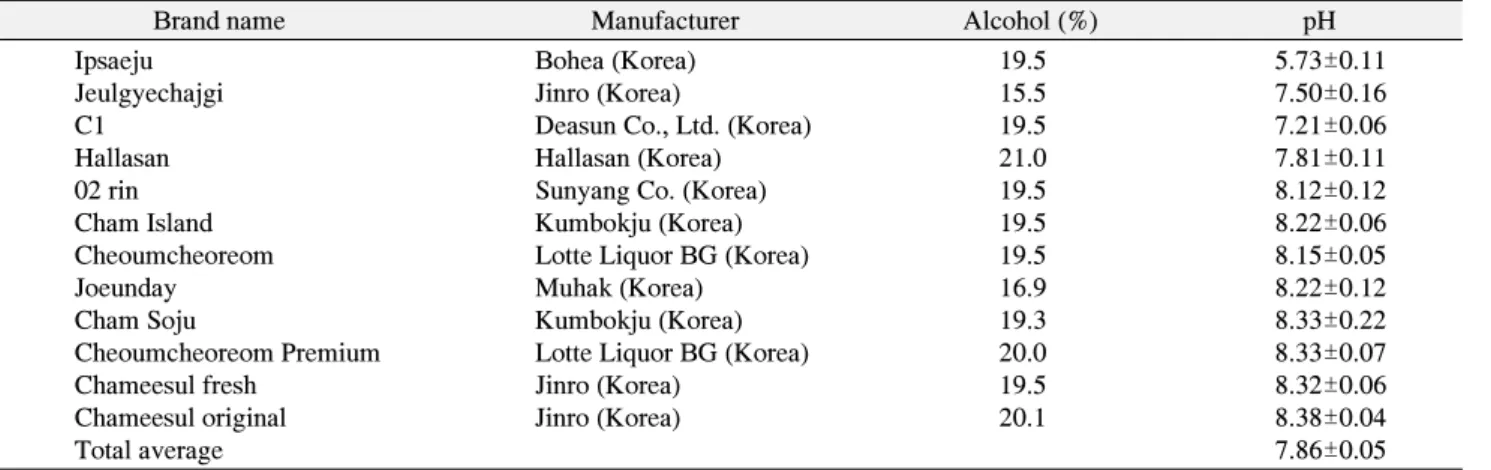
Brand name Manufacturer Alcohol (%) pH
Ipsaeju Bohea (Korea) 19.5 5.73±0.11
Jeulgyechajgi Jinro (Korea) 15.5 7.50±0.16
C1 Deasun Co., Ltd. (Korea) 19.5 7.21±0.06
Hallasan Hallasan (Korea) 21.0 7.81±0.11
02 rin Sunyang Co. (Korea) 19.5 8.12±0.12
Cham Island Kumbokju (Korea) 19.5 8.22±0.06
Cheoumcheoreom Lotte Liquor BG (Korea) 19.5 8.15±0.05
Joeunday Muhak (Korea) 16.9 8.22±0.12
Cham Soju Kumbokju (Korea) 19.3 8.33±0.22
Cheoumcheoreom Premium Lotte Liquor BG (Korea) 20.0 8.33±0.07
Chameesul fresh Jinro (Korea) 19.5 8.32±0.06
Chameesul original Jinro (Korea) 20.1 8.38±0.04
Total average 7.86±0.05
pH data are presented as mean±standard deviation.
Table 4. The pH and Alcoholic Percentage of Commercial Sojus Used in this Study
beverages can be classified into fermented alcoholic beverage including beers, makgeollis and fruit drink (wines) and distilled liquor including soju, the most popular alcoholic drinks in Korea. The pH values of total of fifty commercially available alcoholic drinks which were consisted of 9 brands of wines, 24 brands of
makgeollis, 5 brands of beers and 12 brands of sojus were measured. The test groups sold in big supermarkets in Korea were selected randomly.
2. pH measurements
Stored for 6 hours at room temperature, alcoholic drinks
Group Drinks*
Winea Beerb Makgeollic Sojud pH 3.34±0.19 4.21±0.01 3.88±0.28 7.86±0.05 pH data are presented as mean±standard deviation.
Analyzed by the Kruscal-Wallis test for four groups.
a∼dThe same letter indicates no significant difference by Mann-Whitney test at α=0.0125.
*p<0.001
Table 5. Comparisons of Each Mean pH of Alcoholic Drinks Used in This Study Using Kruskal-Wallis Test
were tested in triplicate to determine their pH. The pH of each beverage was determined using a pH meter (920A pH Meter; Thermo Orion, Singapore) placed directly into each solution. The pH meter was first calibrated according to the manufacturer’s instruction, using buffer standards of pH 7 and 4 (Thermo Orion Application SolutionⓇ; Thermo Orion). Each alcoholic drink was placed in a beaker, the pH meter inserted and the reading recorded.
3. Statistical analysis
SPSS software version 18.0 (SPSS Inc., Chicago, IL, USA) was used for statistical data. Mann-Whitney test was used to analyze difference between the pH of red wine and white wine. And Kruskal-Wallis test was used to compare the pH of each test group being comprised of wine group, makgeollis group, beer group and soju group.
Results
1. pH of alcoholic drinks
Table 1∼4 showed the pH value of each alcoholics group used in this study. The pH values of the investigated alcoholic beverages were very low and varied. Average pH of the alcoholic beverages experimented was as follows: among the test groups, the average pH of 9 brands of wine was 3.34±0.19, that of 5 brands of beers was 4.21±0.01, 24 brands of makgeollis was 3.88±0.28, and 12 brands of sojus was 7.86±0.05, respectively. Of the experiment groups, the lowest pH was 3.02±0.01 in wine, 4.05±0.02 in beer, 3.25±0.00 in makgeolli and 5.73±0.11 in soju. Two types of alcoholics, wine and makgeolli have lower pH, which is able to cause significantly dental erosion, than two other drinks. Table 1 showed the
difference of pH between red wine and white wine. It represented when it comes to the pH of wines classified with two types, red wine and white wine, the pH of red wine was higher than that of white wine; mean pH of red wine is 3.45 and white wine is 3.21. Mann-Whitney test was used to compare the mean pH of two wine groups and the statistics result represented that the two groups were significantly different.
2. Comparison of each mean pH of alcoholic drinks Table 5 showed each mean pH of alcoholic drinks to analyze whether groups had a difference between each groups by Kruskal-Wallis test. The result derived from each compared test groups showed that each group had significant differences.
Discussion
It was reported by Fair Trade Commission Report that the rate of alcoholics consumption have been augmenting13), the majority of the market was occupied by beer and soju in 2008 and makgellis have been getting popular among Korean people since 2005. Besides, as our society has been changing into westernization, the consumption of wine has been also increasing. Those are the reason why this study selected makgeolli, soju, beer and wine.
Furthermore, “drinking culture” that the drinking time of alcoholics are comparatively long18) is prevalent among Korean society, which implies that the alcoholics may be kept for long time in the mouth. Hence, study on alcoholic beverage including several kinds of beers, makgeollis, wines and sojus associated with dental erosion seemed to be needed. But as far as I know, there were just a few reports on the pH level of various alcoholics sold in Korea.
Since dissolving enamel can occur at the critical level of pH 5.519), the present study showed that many com- mercially available alcoholic beverages purchased in Korean markets had the high potential to cause dental erosion due to their comparatively low pH except only sojus over pH 5.5. In general, when it comes to evaluating dental erosion, pH value may be regarded as the first factor since among many studies the pH of beverages or alcoholics was determined to estimate the erosive po-
tential6,9,12,20). Other variables such as titratable acidity, types of acidic foods and beverages and salivary flow rate have been suggested to be important factors in dental erosion21,22). However, this present study focused on only the pH value that directly reflects its erosive potential on the teeth. The pH of experimental groups had significant differences (p<0.05). They revealed that the low pH of alcoholic drinks - wines with pH ranging from 3.02 to 3.54, makgeollis 3.25 to 4.38 and beers 4.05 to 4.32 - might be considered as having high potential on dental erosion. The result of this study was similar to other studies17,20).
However, when assessing how much beverage have the dental erosive potential not only the pH values of beverages and foods but also various factors such as titratable acidity, mineral content, clearance on tooth surface and chelation effect on tooth calcium23) should be considered.
In comparison of pH between red wine and white wine, the white wine had lower pH than red wine, which was significantly different (p<0.05). These results are similar to a previous in vitro study, where red wine showed higher pH than white wine15).
Hence, it is important to know that red wine might be able to cause tooth stain even though red wine showed higher pH than white wine. Of course more researches should be pioneered to identify what are the major factors to cause dental erosion in the alcoholic drinks although many studies related to common beverage, sports, soft drinks and some fruit juice have reported various factors associated with erosive potential. Therefore, it seems to be needed to identify other factor such as titratable acidity, type of acid and what mineral content comprised of the alcoholic drinks. The result obtained from this study has shown that majority of alcoholic beverages selected for this study had significant low pH that may lead to high erosive potential. Therefore, we have to keep in mind that whenever we drink alcoholics, especially comparatively having low pH, we should not to hold the alcohol drinks in oral cavity too long.
Summary
In this study, the pH of several commercially available alcoholic drinks in Korea were measured. Five kinds of beers, 24 kinds of makgeollies, 9 kinds of wines and 12 kinds of sojus with different brands were tested. The mean pH of 5 kinds of beer showed pH 4.21, pH 3.88 for 24 brands of makgeollies, pH 3.34 for for 9 brands of wines and pH 7.86 for 12 brands of sojus. Each tested group was significantly different by Kruskal-Wallis test (p<0.05).
Most of alcoholic drinks used in this study showed relatively low pH. This result implies that most alcoholic drinks might cause dental erosion.
References
1. Lussi A: Erosive tooth wear-a multifactorial condition of growing concern and increasing knowledge. Monographs in Oral Science, Bern, pp.1-8, 2006.
2. Scheutzel P: Etiology of dental erosion-intrinsic factors. Eur J Oral Sci 104: 178-190, 1996.
3. Cochrane NJ, Yuan Y, Walker GS, et al.: Erosive potential of sports beverages. Aust Dent J 57: 359-364, 2012.
4. De Carvalho Sales-Peres SH, Magalhaes AC, Machdo MA, Buzlalf MAI: Evaluation of the erosive potential of soft drinks. Eur J Dent 1: 10-13, 2007.
5. Zero DT: Etiology of dental erosion-extrinsic factors. Eur J Oral Sci 104: 162-177, 1996.
6. West N, Hughes J, Addy M: The effect of pH on the erosion of eentine and enamel by dietary acids in vitro. J Oral Rehabil 28: 860-864, 2001.
7. Zero DT, Lussi A: Erosion-chemical and biological factors of importance to the dental practitioner. Int Dent J 55: 285-290, 2005.
8. Lussi A, Kohler N, Zero D, Schaffner M, Megert B: A comparison of the erosive potential of different beverages in primary and permanent teeth using an in vitro model. Eur J Oral Sci 108: 110-114, 2000.
9. Bamise CT, Ogunbodede EO, Olusile AO, Esan TA: Erosive potential of soft drinks in Nigeria. World J Med Sci 2:
115-119, 2007.
10. Youn HJ, Jeong SS, Hong SJ, Choi CH: Surface micro- hardness changes caused by commercial drinks on sound
enamel of bovine teeth. J Korean Acad Oral Health 30: 23-36, 2006.
11. Shin YH, Kim YJ: Study on the primary tooth enamel erosion caused by children beverage. J Korean Acad Pediatr Dent 36:
227-236, 2009.
12. Van Eygen I, Vannet BV, Wehrbein H: Influence of a soft drink with low pH on enamel surfaces: An in vitro study. Am J Orthod Dentofacial Orthop 128: 372-377, 2005.
13. The Fair Trade Commission: The alcoholics industry and competition policy report. Seoul, 2010.
14. Hwang SH: Surface micro-hardness and color changes caused by commercial alcoholic drinks on composite resin material. Unpublished master's thesis, Chonnam National University, Gwangju, 2010.
15. Brand HS, Tjoe Fat GM, Veerman ECI: The effects of saliva on the erosive potential of three different wines. Aust Dent J 54: 228-232, 2009.
16. Willershausen B, Callaway A, Azrak B, Kloss C,
Schulz-Dobrick B: Prolonged in vitro exposure to white wines enhances the erosive damage on human permanent teeth compared with red wines. Nutr Res 29: 558-567, 2009.
17. Mok TB, Mcintyre J, Hunt D: Dental erosion: in vitro model of wine assessor's erosion. Aust Dent J 46: 263-268, 2001.
18. Korea Drinking Culture Research Center: Drinking status of Koreans. Korea Drinking Culture Research Center, 2001.
19. Preventive Dentistry Research: Clinical preventive dentistry.
4th ed. Komoonsa, Seoul, pp.373-374, 2009.
20. Seow WK, Thong KM: Erosive effects of common beverages on extracted premolar teeth. Aust Dent J 50: 173-178, 2005.
21. Linnett V, Seow WK: Dental erosion in children: a literature review. Pediatr Dent 23: 37-43, 2001.
22. Wiktorsson AM: Erosive tooth wear: prevalence and severity in Swedish wine tasters. Eur J Oral Sci 105: 544-550, 1997.
23. Lussi A, Jaeggi T: Erosion-diagnosis and risk factors. Clin Oral Invest 12: 5-13, 2008.