한국 과음기준의 DSM-5 알코올 사용 장애에 대한 진단적 유용성*
김성구1, 김종성2, 박한주1, 성한나1
1유성선병원 국제검진센터 가정의학과, 2충남대학교 의과대학 의학연구소 가정의학교실
Diagnostic Usefulness of Korean Standard on Heavy Drinking for the DSM-5 Alcohol Use Disorder
Seong Gu Kim1, Jong Sung Kim2, Han Ju Pack1, Han Na Sung1
1Department of Family Medicine, Sun Healthcare International, Yuseong Sun Hospital, Daejeon, Korea
2Department of Family Medicine, Research Institute for Medical Sciences, Chungnam National University School of Medicine, Daejeon, Korea
Background: This research investigated the usefulness of heavy drinking standards of 'guidelines for moderate alcohol drinking amount for Koreans' for diagnosis of Diagnostic and Statistical Manual of Mental Disorders 5th edition (DSM-5) alcohol use disorder.
Methods: This retrospective study was conducted with 976 adults who visited an health screening center in Daejeon for health check-up in 2015. Daily drinking amount, drinking frequency per week, and weekly drinking amount were investigated. Using the heavy drinking criteria of Korean guideline, participants were grouped by age and gender and classified as normal or heavy drinkers. The sensitivity, specificity, positive predictive value (PPV), negative predictive value (NPV), Positive likelihood ratio (LR+), Negative likelihood ratio (LR-), odds ra- tio (OR) and Youden's Index of heavy drinking according to Korean guideline for diagnosis of DSM-5 alcohol use disorder were calculated.
Results: The Area under the receiver operating characteristic (ROC) curve of a model screening DSM-5 alcohol use disorder by weekly drinking amount were 0.812 in males up to age 65 years and 0.931 in males over age 65 years and females respectively. The sensitivity, specificity, PPV and NPV of Korean guideline heavy drinking group for diagnosis of DSM-5 alcohol use disorder were 61.0%, 89.7%, 67.0%, and 87.05% respectively. The LR+, LR-, OR and Youden's Index of those were 5.917 (4.704-7.435), 0.434 (0.379-0.497), 13.623 (9.607-19.317), and 0.507 respectively.
Conclusions: This research shows the Korean heavy drinking standard is useful for diagnosis of DSM-5 alcohol use disorder in Korean people.
Korean J Health Promot 2017;17(2):91-98
Keywords: Alcohol drinking, DSM-5, Sensitivity, Specificity
■ Received: February 2, 2017 ■ Accepted: June 8, 2017
■Corresponding author : Jong Sung Kim, MD, PhD
Department of Family Medicine, Research Institute for Medical Sciences, Chungnam National University School of Medicine, 282 Munhwa-ro, Jung-gu, Daejeon 35015, Korea
Tel: +82-42-280-8172, Fax: +82-42-280-7879 E-mail: [email protected]
* This manuscript is based on the first author's doctoral dissertation from Chungnam National University.
Copyright ⓒ 2017 The Korean Society of Health Promotion and Disease Prevention
This is an Open Access article distributed under the terms of the Creative Commons Attribution Non-Commercial License (http://creativecommons.org/licenses/by-nc/3.0/) which permits unrestricted noncommercial use, distribution, and reproduction in any medium, provided the original work is properly cited.
서 론
그동안 음주량과 Diagnostic and Statistical Manual of Mental Disorders (DSM) 알코올 사용 장애 진단기준과의 관계를 이용한 여러 연구들이 있었다. Beseler 등1)은 대학 생들에서 폭음기준이 DSM-IV (4th edition) 알코올 사용 장애의 일부 문항과 유사한 선별 효과를 가진다고 하였다.
Robin 등2)은 미국 인디언들에서 폭음이 알코올 의존과 매 우 깊은 연관관계를 가진다고 하였다. Knight 등3)은 대학 생들에서 폭음이 알코올 남용과 의존에 깊은 연관관계가 있다고 하였다.
이렇듯 DSM 알코올 사용 장애에 대하여 음주량을 이용 한 연구는 많았으나 그 대부분이 한국인이 아닌 외국인들 을 대상으로 한 연구였으며 폭음기준이 아닌 과음기준을 이용한 연구는 많지 않다. 따라서 최근에 저자들은4) 한국 인들을 대상으로 이러한 미국 과음기준의 DSM-5 (5th edi- tion) 알코올 사용 장애 진단에 대한 유용성을 연구한 바 있다. 하지만 그 결과 낮은 민감도로 인하여 진단적 효과는 크지 않음을 확인하였다. 이는 미국인을 포함한 서양인들 을 대상으로 제안된 과음기준 음주량이 한국인의 알코올 사용 장애를 진단하기에는 적합하지 않음을 제시하는 것이 기도 하다.
사실 여러 음주선별검사 도구들을 알코올 사용 장애 진 단에 적용할 때에 인종 및 성별 등 환자군에 따라 동일한 절단값의 적용은 어렵다고 하였다.5) 이전에도 미국 등 해 외의 기준만을 따르는 것이 아니라 한국 고유의 적정음주 량을 찾으려는 여러 연구 성과들은 있었다. 특히 동양인은 서양인보다 체격도 작고 알코올 분해효소 aldehyde de- hydrogenase (ALDH)의 활성도가 적은 사람도 많으므로6) 한국인들을 대상으로 한국인 고유의 적절음주량을 찾으려 는 노력은 매우 의미가 있다. 한국인의 경우 주당 평균 음 주량이 4잔 이하인 경우 인슐린저항성이 낮았고7) 대사증후 군의 발생률이 낮았다.8) 역시 주당 평균 음주량이 4잔 이하 인 경우 10년간 심혈관질환 위험도가 낮았다.9) 또한 주당 평균 음주량이 8잔 이하인 경우 고호모시스테인혈증의 위 험도가 유의하게 낮았다.10) 주당 평균 음주량이 12잔을 초 과할 경우 혈중 carbohydrate deficient transferrin이, 8잔을 초과할 경우 혈중 gamma-glutamyl transpeptidase가 유의하 게 증가하였으며11) 고혈압 위험이 유의하게 증가하였다.12) 이러한 여러 연구결과들을 바탕으로 Kim13)은 한국인의 적절음주량으로 65세 미만 성인 남성의 경우 주당 음주량 8잔 이하, 여성 및 65세 이상 성인 남성의 경우 주당 음주량 4잔 이하를 제시한 바 있다. 이는 65세 미만 성인 남성군에 서 National Institute on Alcohol Abuse and Alcoholism (NIAAA) 기준의 적절 주당 음주량 14잔, 여성 및 65세 이 상 성인 남성군에서 NIAAA 기준의 적절 주당 음주량 7잔 과 비교하였을 때 현저히 더 적은 양이다. 이를 볼 때 한국 인을 대상으로 하는 연구에서의 과음기준 선택은 NIAAA 과음기준보다 한국인을 대상으로 한 한국 과음기준을 사용 하는 것이 더 타당할 수 있다. 이에 본 연구에서는 한국인 을 대상으로 개발된 한국 과음기준을 이용하여 DSM-5 알 코올 사용 장애 진단에 대한 유용성을 확인하고자 하였다.
방 법
1. 연구 대상
본 연구는 DSM-IV 및 DSM-5 진단기준의 알코올 사용 장 애에 대한 미국 국립알코올중독연구소의 과음, 폭음기준의 진단적 유용성에 대해 저자들이 발표한 이전 연구의4) 데이 터를 이용한 후속연구이다. 이는 2015년 상반기에 대전의 일 개 2차 병원에 속한 건강검진센터에 내원하여 건강검진을 받은 수검자들 중 음주설문지에 응답한 20세 이상 976명의 남녀 성인들을 대상으로 하였다. 본 연구는 보건복지부 지정 공용기관 생명윤리 위원회의 Institutional Review Board (IRB)에서 승인을 받았다(IRB No.: P01-201512-21-004).
2. 자료수집
건강검진센터의 문진표를 이용하여 성별과 연령, 주당 음주횟수와 1일 평균 음주량을 파악하였다. 주당 평균 음 주량 계산은 알코올 14 g의 표준잔으로14) 변환한 1일 평균 음주량에 주당 음주횟수를 곱하여서 계산하였다. 한국인의 적절음주량으로 제시된 기준에 따라,13) 65세 미만 남성군 에서 주당 평균 음주량이 8잔을 초과한 사람들과 여성 및 65세 이상 남성군에서 주당 평균 음주량이 4잔을 초과한 사람들을 과음군으로 설정하였다. DSM-5 알코올 사용 장 애 진단기준에 따른 11가지 문항 중 2개 이상 해당되면 알 코올 사용 장애로 진단하였다(Appendix).
3. 통계처리 및 분석
한국 기준의 과음군과 대조군(비과음군)의 연령, 주당 음 주횟수, 일회 음주량, 주당 평균 음주량은 연속형 변수이므 로 Kolmogorov-Smirnov test를 사용하여 정규분포를 보이 는지 확인하였다. 연속형 변수들이 비정규분포를 보임에 따라 independent sample Mann-Whitney U-test를 사용하 여 비교한 후 중간값(사분위수)으로 표시하였다. 범주형 변 수인 한국 과음기준에서 과음군 및 비과음군과 알코올 사 용 장애와의 관계를 chi-square test를 이용하여 교차분석하 였다. 본 연구에 참여한 연령대별 구성인원을 파악하기 위 해 20대, 30대, 40대, 50대, 60대, 70대 이상으로 연령군을 나누었다. 연령군별로 음주자, 남성음주자, 여성음주자, DSM-5 알코올 사용 장애 여부를 chi-square test를 이용하 여 교차분석하였다. 65세 미만 남성군과 여성 및 65세 이상 남성군에서 주당 음주량을 이용한 DSM-5 알코올 사용 장 애 진단모형에 대한 receiver operating characteristics (ROC) curve를 그리고 그 절단값(cut-off value), 곡선 아래
Variables Heavy alcohol drinking groupa
(n=227) Non-heavy alcohol drinking group
(n=749) Pb
Age 45.0 (39.0-52.0) 44.0 (40.0-52.0) 0.674
Drinking frequency per week 3.0 (2.0-4.0) 0.5 (0.0-1.0) <0.001
Drinksc per drinking time 5.7 (4.0-5.7) 1.0 (0.0-2.3) <0.001
Drinksc per week 12.0 (10.3-17.1) 0.6 (0.0-2.9) <0.001
DSM-5 criteria by alcohol use disorder 152 (67.0) 97 (13.0) <0.001
Abbreviation: DSM-5, Diagnostic and Statistical Manual of Mental Disorders 5th edition.
Values are presented as median (interquartile range) or n (%).
aHeavy alcohol drinking group for males up to age 65 years according to Korean guideline: over 8 drinks in a week. Heavy alcohol drinking group for males over age 65 years and females according to Korean guideline: over 4 drinks in a week.
bBy independent samples Mann-Whitney U-test or χ2 test.
c1 standard drink: ethanol 14 g.
Table 1. Characteristics of subjects
면적(area under ROC curve)을 구하였다. 알코올 사용 장 애에 대한 한국 기준 과음군의 민감도, 특이도, 양성예측도 (positive predictive value), 음성예측도(negative predictive value), 양성우도비(positive likelihood ratio), 음성우도비 (negative likelihood ratio), 교차비(odds ratio), Youden's Index를 구하였다. 통계적 분석에서 윈도우용 SPSS ver.
13.0 (SPSS Inc., Chicago, IL, USA)을 이용하였고 유의수준 은 0.05로 하였다.
결 과
1. 연구 대상자들의 일반적 특성
한국 기준 과음군의 연령은 45.0세(39.0-52.0), 비과음군 은 44.0세(40.0-52.0)로 양 군 간에 차이가 없었다(P=0.674).
과음군의 주당 음주횟수는 3.0회(2.0-4.0), 일회 음주량은 5.7잔(4.0-5.7), 주당 음주량은 12.0잔(10.3-17.1)이었고 비과 음군은 0.5회(0.0-1.0), 1.0잔(0.0-2.3), 0.6잔(0.0-2.9)으로 과 음군에서 유의하게 높았다(P<0.001). 과음군의 DSM-5 알 코올 사용 장애는 152명(67.0%)이었고, 비과음군의 DSM-5 알코올 사용 장애는 97명(13.0%)으로 과음군에서 유의하 게 높은 비율을 보였다(P<0.001) (Table 1).
2. 연구 대상자들의 연령대별 음주자 및 알코올 사용 장애자 분포
연령별 분포를 보았을 때 20대는 23명(2.4%), 30대는 220명 (22.5%), 40대는 429명(44.0%), 50대는 236명(24.2%), 60대 는 44명(4.5%), 70대 이상은 24명(2.5%)이었다. 연령별 음 주자는 20대가 19명(2.7%), 30대는 187명(26.7%), 40대는 309명(44.1%), 50대는 151명(21.5%), 60대는 24명(3.4%), 70대 이상은 11명(1.6%)이었다. DSM-5 알코올 사용 장애 에 해당되는 사람들의 연령별 분포는 20대가 3명(1.2%), 30대
가 65명(26.1%), 40대가 102명(41.0%), 50대가 63명(25.3%), 60대가 9명(3.6%), 70대 이상이 7명(2.8%)이었다(Table 2).
3. 주당 음주량을 통한 DSM-5 알코올 사용 장애 진단모형에 대한 ROC curve의 곡선 아래 면적과 절단값
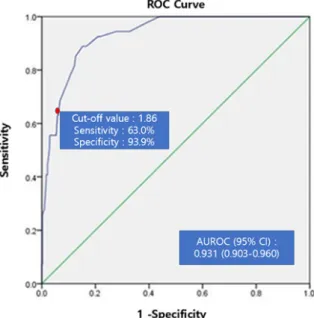
65세 미만 남성군에서 주당 음주량의 DSM-5 알코올 사 용 장애 진단에 대한 ROC curve의 절단값은 5.07잔이었고 곡선 아래 면적(95% confidence interval [CI])은 0.812 (0.774-0.850)였다(Figure 1). 여성 및 65세 이상 남성군에서 주당 음주량의 DSM-5 알코올 사용 장애 진단에 대한 ROC curve의 절단값은 1.86잔이었고 곡선 아래 면적(95%
CI)은 0.931 (0.903-0.960)이었다(Figure 2).
4. 한국 기준 과음의 DSM-5 알코올 사용 장애 진단에 대한 민감도, 특이도, 양성예측도, 음성예측도, 양성우도비, 음성우도비, 교차비
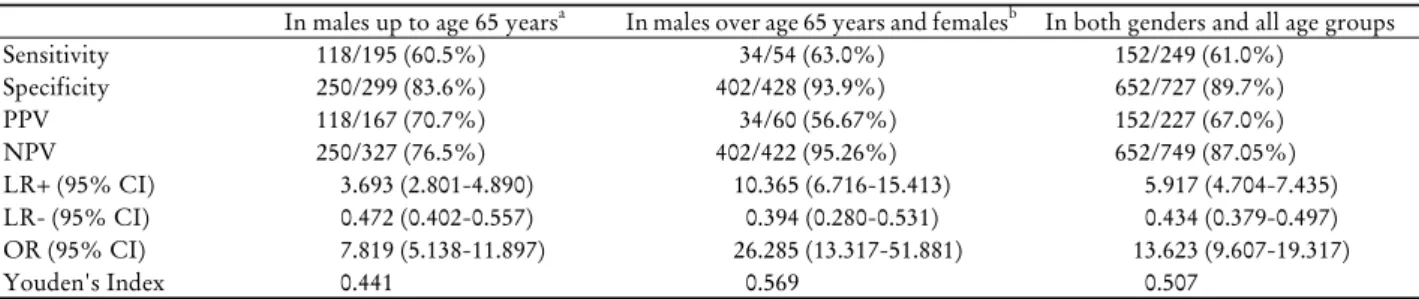
65세 미만 남성에서 한국 기준 과음의 DSM-5 알코올 사 용 장애 진단에 대한 민감도, 특이도는 60.5%, 83.6%였으며, 양성예측도, 음성예측도는 70.7%, 76.5%였고, 양성우도비, 음성우도비는 3.693 (2.801-4.890), 0.472 (0.402-0.557), 교차 비는 7.819 (5.138-11.897)였으며, Youden’s Index는 0.441이 었다. 여성 및 65세 이상 남성에서 한국 기준 과음의 DSM-5 알코올 사용 장애 진단에 대한 민감도, 특이도는 63.0%, 93.9%였으며 양성예측도, 음성예측도는 56.67%, 95.26%였 고, 양성우도비, 음성우도비는 10.365 (6.716-15.413), 0.394 (0.280-0.531), 교차비는 26.285 (13.317-51.881)였으며, Youden’s Index는 0.569였다. 전체 실험군에서 한국 기준 과음의 DSM-5 알코올 사용 장애 진단에 대한 민감도, 특이도는 61.0%, 89.7%
였으며, 양성예측도, 음성예측도는 67.0%, 87.05%였고, 양성 우도비, 음성우도비는 5.917 (4.704-7.435), 0.434 (0.379-0.497), 교차비는 13.623 (9.607-19.317)이었으며, Youden’s Index는
20's 30's 40's 50's 60's ≥70's Total Pa Total participants 23 (2.4) 220 (22.5) 429 (44.0) 236 (24.2) 44 (4.5) 24 (2.5) 976 (100.0)
Total alcohol drinker 19 (2.7) 187 (26.7) 309 (44.1) 151 (21.5) 24 (3.4) 11 (1.6) 701 (100.0) <0.001 Male participants 9 (1.7) 119 (23.1) 207 (40.2) 144 (28.0) 21 (4.1) 15 (2.9) 515 (100.0) 0.022 Male alcohol drinker 8 (1.8) 107 (24.0) 186 (41.8) 117 (26.3) 18 (4.0) 9 (2.0) 445 (100.0) 0.380 Female participants 14 (3.0) 101 (21.9) 222 (48.2) 92 (20.0) 23 (5.0) 9 (2.0) 461 (100.0) 0.022 Female alcohol drinker 11 (4.3) 80 (31.3) 123 (48.0) 34 (13.3) 6 (2.3) 2 (0.8) 256 (100.0) <0.001 DSM-5 alcohol use disorder
Male 1 (1) 47 (22.9) 84 (41.0) 58 (28.3) 8 (3.9) 7 (3.4) 205 (100.0) 0.194
Female 2 (4.5) 18 (40.9) 18 (40.9) 5 (11.4) 1 (2.3) 0 (0.0) 44 (100.0) 0.026
Total 3 (1.2) 65 (26.1) 102 (41.0) 63 (25.3) 9 (3.6) 7 (2.8) 249 (100.0) 0.371
Abbreviation: DSM-5, Diagnostic and Statistical Manual of Mental Disorders 5th edition.
Values are presented as n (%).
aBy χ2 test.
Table 2. Alcohol drinking by age group
Abbreviations: ROC, receiver operating characteristic;
DSM-5, Diagnostic and Statistical Manual of Mental Disorders 5th edition; AUROC, area under ROC curve;
CI, confidence interval.
Figure 1. ROC curves of a model screening DSM-5 alcohol use disorder by weekly drinking amount in males up to age 65 years.
Abbreviations: ROC, receiver operating characteristic;
DSM-5, Diagnostic and Statistical Manual of Mental Disorders 5th edition; AUROC, area under ROC curve;
CI, confidence interval.
Figure 2. ROC curves of a model screening DSM-5 alcohol use disorder by weekly drinking amount in males over age 65 years and females.
0.507이었다(Table 3).
고 찰
적절한 과음기준의 선택은 국민건강을 보호하고 음주 관 련 여러 사회경제적 손실을15,16) 예방하기 위해서도 매우 중 요하다. 전 세계적으로는 미국 국립알코올중독연구소가 제 시한 적절음주 및 과음기준이17) 널리 사용되고 있으나 서 양인을 대상으로 개발된 미국 과음기준을 한국인에 그대로
적용하는 것이 적절하지 않을 수도 있다고 판단되어 한국 과음기준을 이용하여 본 연구를 진행하였다.
먼저 과음기준의 척도인 주당 음주량을 이용한 DSM-5 알코올 사용 장애 진단모형에 대한 ROC curve의 곡선 아 래 면적은 65세 미만 남성군에서 0.812였고 여성 및 65세 이상 남성군에서 0.931이었다. ROC curve 곡선 아래 면적 의 정확도(accuracy) 분류에서18,19) 0.70-0.80을 fair, 0.80-0.90 을 good, 0.90-1을 excellent로 평가함을 감안하면 주당 음주 량의 알코올 사용 장애 진단에 대한 유용성이 매우 높음을
In males up to age 65 yearsa In males over age 65 years and femalesb In both genders and all age groups
Sensitivity 118/195 (60.5%) 34/54 (63.0%) 152/249 (61.0%)
Specificity 250/299 (83.6%) 402/428 (93.9%) 652/727 (89.7%)
PPV 118/167 (70.7%) 34/60 (56.67%) 152/227 (67.0%)
NPV 250/327 (76.5%) 402/422 (95.26%) 652/749 (87.05%)
LR+ (95% CI) 3.693 (2.801-4.890) 10.365 (6.716-15.413) 5.917 (4.704-7.435) LR- (95% CI) 0.472 (0.402-0.557) 0.394 (0.280-0.531) 0.434 (0.379-0.497) OR (95% CI) 7.819 (5.138-11.897) 26.285 (13.317-51.881) 13.623 (9.607-19.317)
Youden's Index 0.441 0.569 0.507
Abbreviations: PPV, positive predictive value; NPV, negative predictive value; LR+, positive likelihood ratio; LR-, negative likelihood ratio;
OR, odds ratio; CI, confidence interval.
aHeavy alcohol drinking group for males up to age 65 years according to Korean guideline: over 8 drinks in a week.
bHeavy alcohol drinking group for males over age 65 years and females according to Korean guideline: over 4 drinks in a week.
Table 3. Sensitivity, specificity, PPV, NPV, LR+, LR-, OR and Youden’s index of Korean heavy drinking standard for DSM-5 alcohol use disorder diagnosis
나타내는 근거가 되겠다. Nam 등20)은폭음 관련 질문의 알 코올 사용 장애를 포함한 문제음주 진단에 대한 ROC curve의 곡선 아래 면적을 남자에서 최대 0.937, 여자에서 최대 0.970으로 제시하였다. 서론에서 제시한 폭음 관련 연 구들을 포함하여 이렇듯 폭음의 알코올 사용 장애 진단에 대한 연구들은 많이 수행되는 경향이 있었고 그 유용성이 확인되었다. 이는 곧 과음기준의 알코올 사용 장애 진단에 대한 추가적인 연구의 필요성 및 사용가능성을 제시하는 것일 수 있다.
본 연구에서 65세 미만 남성군에서 DSM-5 알코올 사용 장애 진단에 대한 주당음 주량의 절단값은 5.07잔이었고 여성 및 65세 이상 남성군의 경우 각각 1.86잔이었다. 65세 미만 남성군에서의 NIAAA 과음기준은 14잔 초과이며 한 국 과음기준은 8잔 초과이다. 여성 및 65세 이상 남성군에 서의 NIAAA 과음기준은 7잔 초과이며 한국 과음기준은 4잔 초과로 설정되어 있다. 결과적으로 한국인을 대상으로 제시된 한국 과음기준이 미국 과음기준과 비교하여 알코올 사용 장애 진단에 대한 주당 음주량의 절단값에 더 근접함 을 확인할 수 있었다.
다음으로 DSM-5 알코올 사용 장애 진단에 대한 한국 과 음기준의 민감도, 특이도, 양성예측도, 음성예측도, You- den's Index를 계산하였다. 한국 과음군 전체의 DSM-5 알 코올 사용 장애 진단에 대한 민감도, 특이도는 61.0%, 89.7%였다. 양성예측도, 음성예측도는 67.0%, 87.05%였다.
Youden's Index는 0.507이었다. 이전 연구결과에서 보고한 미국 국립보건원 과음군 전체의 DSM-5 알코올 사용 장애 진단에 대한 민감도, 특이도는 35.3%, 95.5%였다. 양성예 측도, 음성예측도는 72.7%, 81.2%였다. Youden's Index는 0.308이었다.4) 한국 과음군과 미국 과음군의 DSM-5 알코 올 사용 장애 진단에 대한 민감도와 특이도를 McNemar's test를 사용하여 비교한 결과는 표로 제시하지는 않았지만, 한국 과음기준이 유의하게 민감도는 높고(P<0.001) 특이도
는 낮았다(P<0.001). 이는 절단값이 하향되면서 당연하게 나타난 결과로 보인다. 한국인을 포함한 동양인은 서양인 보다 체구가 작고 간의 알코올 분해효소인 ALDH의 비활 성화 비율이 높아 알코올 대사능력이 더 낮다. 이러한 한국 인들에게 미국인을 대상으로 제안된 미국 과음기준을 적용 하였을 때 진단에서 누락된 대상들이 한국 과음기준을 적 용하여 포함됨으로써 본 연구에서의 민감도는 올라가고 특 이도는 내려간 것으로 보인다.
양성예측도와 음성예측도는 유병률과 관련이 있어서 유 병률과 양성예측도는 비례관계, 유병률과 음성예측도는 반 비례관계에 있다. 하지만 본 연구의 한국 과음기준, 이전 연구의 미국 과음기준을 적용한 대상 집단은 동일하므로 유병률의 차이에 따른 양성예측도, 음성예측도의 변화는 없다고 할 수 있다. 이를 감안하면 양성예측도와 음성예측 도를 통계적으로 비교하지는 않았으나 미국 과음기준과 비 교하여 한국 과음기준의 DSM-5 알코올 사용 장애 진단에 대한 양성예측도는 더 낮고 음성예측도는 더 높았다. 즉 절 단값이 보다 낮은 한국 과음기준을 적용하였을 때 알코올 사용 장애로 나오지 않은 경우 실제로 알코올 사용 장애가 없을 확률이 미국 과음기준을 적용하였을 때보다 더 높다 고 할 수 있다.
본 연구에서 양성우도비는 알코올 사용 장애가 있는 사 람에서 과음기준이 양성인 확률을 알코올 사용 장애가 없 는 사람에서 과음기준이 양성인 확률로 나눈 값이다. 음성 우도비는 알코올 사용 장애가 있는 사람에서 과음기준이 음성인 확률을 알코올 사용 장애가 없는 사람에서 과음기 준이 음성인 확률로 나눈 값이다. 따라서 양성우도비는 1 보다 클수록, 음성우도비는 1보다 작을수록 알코올 사용 장애 진단에 대한 과음기준의 적용이 타당하다고 할 수 있 다. 본 연구에서 한국 과음군 기준의 DSM-5 알코올 사용 장애 진단에 대한 양성우도비는 5.917로 1보다 컸으며 음 성우도비는 0.434로 1보다 작았다. 우도비에 따른 확률의
변화를 연구한 McGee21)와 Henderson 등22)에 따르면 본 연 구에서 한국 과음군 기준의 DSM-5 알코올 사용 장애 진단 에 대한 양성우도비는 5.917로 검사 전 확률(pretest proba- bility)을 30% 이상 증가시켜서 최종(검사 후) 확률(final [post-test] probability)을 중등도 이상 상승시킨다고 할 수 있다. 마찬가지로 한국 과음군 기준의 DSM-5 알코올 사용 장애 진단에 대한 음성우도비는 0.434로 검사 전 확률을 15-30% 감소시켜서 최종(검사 후) 확률을 경도에서 중등 도로 낮춘다고 할 수 있다.
알코올 사용 장애가 있는 경우 과음군을 비과음군으로 나 눈 교차비를 알코올 사용 장애가 없는 경우 과음군을 비과음 군으로 나눈 교차비로 나눈 값으로 표현되어 알코올 사용 장 애와 과음과의 연관성을 나타내는 본 연구에서의 교차비는 13.623 (9.607-19.317)이었다. 흥미로운 사실은 65세 미만 남 성군에서의 교차비 7.819 (5.138-11.897)와 비교하여 여성 및 65세 이상 남성군에서의 교차비가 26.285 (13.317-51.881)로 더 높았다는 것이다. 이는 젊은 남성보다 여성 및 고령 남성 이 음주에 더 취약할 수 있음을 보여주는 것이라 하겠다.
Youden’s Index는 민감도와 특이도의 합에 1을 뺀 값이 다. 따라서 검사법에서 민감도와 특이도의 합이 최대가 되 는 최적의 절단값을 구할 때 Youden’s Index가 최대가 되 는 점을 구하게 된다. 본 연구에서는 주당 음주량의 절단값 을 구하는 것이 아닌 한국 과음기준의 주당 음주량, 미국 과음기준의 주당 음주량을 사용하여 진단적 유용성을 비교 하는 것이 주목적이다. 하지만 한국 과음기준을 사용하였 을 때 미국 과음기준과 비교하여 Youden’s Index는 더 높 았으며 이는 앞서 기술한대로 한국 과음기준이 미국 과음 기준과 비교하여 알코올 사용 장애 진단에 대한 주당 음주 량의 최적의 절단값에 더 근접함을 확인한 것과 일맥상통 하는 결과라고 할 수 있다.
현재까지 미국에서는 DSM 알코올 사용 장애에 관련하 여 폭음을 이용한 연구가 많은 경향이다. 하지만 일회 음주 량이 적절하다고 하더라도 매일 음주를 하는 등 주당 음주 량이 과도할 경우에도 건강에는 해를 끼친다는 것을23) 감 안하면 본 연구에서처럼 과음기준을 이용한 연구들이 추가 적으로 필요하다고 생각한다.
결론적으로 한국인을 대상으로 여러 연구를 통해 제안된 한국 과음기준이 서양인을 대상으로 고안된 NIAAA 과음기 준과 비교하여 한국인의 DSM-5 알코올 사용 장애 진단에 대 한 민감도는 더 높았고 특이도는 더 낮음을 확인할 수 있었다.
본 연구의 결과를 일반화시키는데 있어서 제한점을 들자 면 첫 번째로 후향적 연구로 향후 전향적 연구가 필요하다 는 점이다. 두 번째로 대전의 일개 병원의 건강검진센터 수 검자들만을 대상으로 한 연구이므로 우리나라 전체를 대표 하기에는 한계가 있다는 점이다. 건강검진을 받는 사람들
은 그렇지 않은 사람들에 비하여 건강에 대해 더 관심이 많고 적절음주를 포함하여 생활습관관리에 더 철저한 사람 들일 수 있다. 본 연구에서는 참가자들을 연령대별로 분류 하여 그 구성인원을 파악하고 각 연령대별 음주자, 남성음 주자, 여성음주자, DSM-5 알코올 사용 장애 여부를 조사하 여 연구 대상의 정확한 파악을 위해 노력하였으나 대표성 을 알기에는 부족함이 있다. 향후 연구에서는 더 다양한 지 역과 계층을 대상으로 생활습관, 신체측정지표, 사회 경제 학적 요소들을 추가로 포함하여 연구한다면 더 정확한 연 구결과를 얻을 수 있을 것이다.
이러한 제한점에도 불구하고 본 연구는 한국인을 대상으 로 개발된 대한가정의학회 알코올연구회 과음기준의 DSM-5 알코올 사용 장애 진단에 대한 사용 가능성에 대해, 서양인을 대상으로 고안된 NIAAA 과음기준과 비교하여 더 우수함을 확인해 보았다는 데에 그 의미가 있다. 또한 DSM-IV 문제음 주 기준이 아닌, 최근에 개정된 DSM-5 알코올 사용 장애 진 단기준을 반영하여 한국인을 대상으로 연구를 진행하였다는 데에도 그 의미가 있다고 하겠다.
요 약
연구배경: 본 연구는 한국인의 적절음주량 가이드라인 과 음기준의 DSM-5 알코올 사용 장애 진단에 대한 진단적 유 용성을 조사하였다.
방법: 2015년 상반기에 대전의 일개 2차 병원에 속한 건강 검진센터에 내원한 976명의 성인들을 대상으로 하였다. 주 당 음주횟수와 1일 평균 음주량을 파악 후 주당 음주량을 계산하였다. 65세 미만 남성군에서 8잔 초과, 여성 및 65세 이상 남성군에서 4잔 초과로 설정되어 있는 한국 과음기준 을 사용하여 성별, 연령별로 적절 음주군과 과음군으로 분 류하였다. DSM-5 알코올 사용 장애 진단에 대한 한국 과음 기준의 민감도, 특이도, 양성예측도, 음성예측도, 양성우도 비, 음성우도비, 교차비, Youden's Index를 계산하였다.
결과: 주당음 주량을 통한 DSM-5 알코올 사용 장애 진단 모형에 대한 ROC curve의 곡선 아래 면적은 65세 미만 남 성군에서 0.812였고 여성 및 65세 이상 남성군에서 0.931이 었다. 한국 과음기준의 DSM-5 알코올 사용 장애 진단에 대 한 민감도, 특이도, 양성예측도, 음성예측도는 각각 61.0%, 89.7%, 67.0%, 87.05%였으며 양성우도비, 음성우도비, 교 차비, Youden's Index는 각각 5.917 (4.704-7.435), 0.434 (0.379-0.497), 13.623 (9.607-19.317), 0.507이었다.
결론: 본 연구결과 한국인의 DSM-5 알코올 사용 장애 진 단에 대한 한국 과음기준의 유용성을 확인할 수 있었다.
중심 단어: 음주, DSM-5, 민감도, 특이도
REFERENCES
1. Beseler CL, Taylor LA, Leeman RF. An item-response theory analysis of dsm-iv alcohol-use disorder criteria and “binge” drink- ing in undergraduates. J Stud Alcohol Drugs 2010;71(3):418-23.
2. Robin RW, Long JC, Rasmussen JK, Albaugh B, Goldman D.
Relationship of binge drinking to alcohol dependence, other psychiatric disorders, and behavioral problems in an American Indian tribe. Alcohol Clin Exp Res 1998;22(2):518-23.
3. Knight JR, Wechsler H, Kuo M, Seibring M, Weitzman ER, Schuckit MA. Alcohol abuse and dependence among U.S. col- lege students. J Stud Alcohol 2002;63(3):263-70.
4. Kim SG, Kim JS, Pack HJ, Sung HN. Usefulness of heavy drinking and binge drinking for the diagnosis of alcohol use disorder. Korean J Fam Med 2016;37(4):214-20.
5. Cherpitel CJ. Analysis of cut points for screening instruments for alcohol problems in the emergency room. J Stud Alcohol 1995;56(6):695-700.
6. Shibuya A, Yasunami M, Yoshida A. Genotypes of alcohol de- hydrogenase and aldehyde dehydrogenase loci in Japanese alco- hol flushers and nonflushers. Hum Genet 1989;82(1):14-6.
7. Jung JG, Kim JS, Oh MK. The role of the flushing response in the relationship between alcohol consumption and insulin resistance. Alcohol Clin Exp Res 2010;34(10):1699-704.
8. Jung JG, Kim JS, Yoon SJ, Oh MK. Relationships among alco- hol consumption, facial flushing response, and metabolic syn- drome in healthy men. Ann Epidemiol 2012;22(7);480-6.
9. Suh HS, Kim JS, Kim SS, Jung JG, Yoon SJ, Ahn JB. Influence of the flushing response in the relationship between alcohol con- sumption and cardiovascular disease risk. Korean J Fam Med 2014;35(6):295-302.
10. Kim EC, Kim JS, Jung JG, Kim SS, Yoon SJ, Ryu JS. Effect of al- cohol consumption on risk of hyperhomocysteinemia based on alcohol-related facial flushing response. Korean J Fam Med 2013;34(4):250-7.
11. Kim SG, Kim JS, Kim SS, Jung JG, Yun SJ, Kim EC.
Relationships between the level of alcohol consumption and ab- normality in biomarkers according to facial flushing in Korean
male drinkers. Korean J Fam Med 2013;34(2):123-30.
12. Jung JG, Kim JS, Kim YS, Oh MK, Yoon SJ. Hypertension as- sociated with alcohol consumption based on the facial flushing reaction to drinking. Alcohol Clin Exp Res 2014;38(4):1020-5.
13. Kim JS. Guideline of moderate alcohol drinking amount for Koreans. Korean J Fam Pract 2015;5(Suppl 1):S117-9.
14. National Institute of Alcohol Abuse and Alcoholism. Rethinking drinking: Alcohol and your health [Internet]. Bethesda: Natio nal Institute of Alcohol Abuse and Alcoholism; 2016. [Accesse d June 25, 2017]. Available from: https://pubs.niaaa.nih.gov/pu blications/RethinkingDrinking/Rethinking_Drinking.pdf.
15. Bouchery EE, Harwood HJ, Sacks JJ, Simon, CJ, Brewer RD.
Economic costs of excessive alcohol consumption in the U.S., 2006. Am J Prev Med 2011;41(5):516-24.
16. Naimi TS, Brewer RD, Mokdad A, Denny C, Serdula MK, Marks JS. Binge drinking among US adults. JAMA 2003;289(1):70-5.
17. Willenbring ML, Massey SH, Gardner MB. Helping patients who drink too much: an evidence-based guide for primary care physicians. Am Fam Physician 2009;80(1):44-50.
18. Muller MP, Tomlinson G, Marrie TJ, Tang P, McGeer A, Low DE, et al. Can routine laboratory tests discriminate between se- vere acute respiratory syndrome and other causes of commun- ity-acquired pneumonia? Clin Infect Dis 2005;40(8):1079-86.
19. Song SW. Using the receiver operating characteristic (ROC) curve to measure sensitivity and specificity. Korean J Fam Med 2009;30(11):841-2.
20. Nam TW, Kim JS, Kim SS, Jung JG, Kang DS, Hyeon YH, et al.
Utility of single alcohol questions related to binge drinking in iden- tifying problem drinkers. Korean J Fam Med 2009;30(10):777-83.
21. McGee S. Simplifying likelihood ratios. J Gen Intern Med 2002;17(8):646-9.
22. Henderson MC, Tierney LM, Smetana GW. The patient his- tory: an evidence based approach to differential diagnosis. 2nd ed. New York: McGrawHill; 2012. p.30.
23. Anderson ML, Nokia MS, Govindaraju KP, Shors TJ. Moderate drinking? Alcohol consumption significantly decreases neuro- genesis in the adult hippocampus. Neuroscience 2012;224(8):202-9.
Question 1. please check in bracket at the corresponding answer.
What is your gender?
Male ( ) Female ( )
How many days do you drink in a week?
Not drink ( ) 1 days ( ) 2 days ( ) 3 days ( ) 4days ( ) 5 days ( ) 6 days ( ) 7 days ( )
Which kind of alcohol beverage do you mostly drink?
Beer ( ) Soju ( ) Whisky ( ) Wine ( ) Other (put specific kind of alcohol : )
Question 2. please fill in bracket with corresponding answer in figures
Please state your age below.
( ) years old
When drinking, how much do you drink on average per day?
I drink ( ) glasses a day
Question 3. please answer the question yes or no. yes no
Alcohol is often taken in larger amounts or over a longer period than was intended.
There is a persistent desire or unsuccessful efforts to cut down or control alcohol use.
A great deal of time is spent in activities necessary to obtain alcohol (e.g., driving long distances), use alcohol, or recover from its effects.
Craving, or a strong desire or urge to use alcohol.
Recurrent alcohol use resulting in a failure to fulfill major role obligations at work, school, or home.
Continued alcohol use despite having persistent or recurrent social or interpersonal problems caused or exacerbated by the effects of the alcohol.
Important social, occupational, or recreational activities are given up or reduced because of alcohol use.
Recurrent alcohol use in situations in which it is physically hazardous (e.g., driving an automobile or operating a machine when impaired by alcohol).
Alcohol use is continued despite knowledge of having a persistent or recurrent physical or psychological problem that is likely to have been caused or exacerbated by the substance.
A need for markedly increased amounts of alcohol to achieve intoxication or desired effect.
Alcohol is taken to relieve or avoid withdrawal symptoms (e.g., paroxysmal sweats, tremor, or anxiety).
Appendix. Questionnaire for drinking habits investigation