I. Introduction
Nations around the world provide various medical infor- mation services. Among them, online health information exchange (HIE) services have been expanded internationally among hospitals and communities. Previous studies related to HIE have shown that adoption of HIE services leads to higher patient satisfaction due to stronger therapeutic in- tervention and improvements in patient outcomes [1-4].
Furthermore, if patient clinical information is shared in a timely manner, the accuracy of diagnosis is improved, test duplication is reduced, and patient re-admission and medi-
Technology and Policy Challenges in the Adoption and Operation of Health Information Exchange Systems
Hyerim Ji, MS1*, Sooyoung Yoo, PhD1*, Eun-Young Heo, MS1, Hee Hwang, MD, PhD1,2, Jeong-Whun Kim, MD, PhD3
1Office of e-Health Research and Business, Seoul National University Bundang Hospital, Seongnam, Korea; Departments of 2Pediatrics and 3Otorhinolaryn- gology, Seoul National University Bundang Hospital, Seongnam, Korea
Objectives: This study aimed to identify problems and issues that arise with the implementation of online health information exchange (HIE) systems in a medical environment and to identify solutions to facilitate the successful operation of future HIE systems in primary care clinics and hospitals. Methods: In this study, the issues that arose during the establishment and operation of an HIE system in a hospital were identified so that they could be addressed to enable the successful establish- ment and operation of a standard-based HIE system. After the issues were identified, they were reviewed and categorized by a group of experts that included medical information system experts, doctors, medical information standard experts, and HIE researchers. Then, solutions for the identified problems were derived based on the system development, operation, and improvement carried out during this work. Results: Twenty-one issues were identified during the implementation and opera- tion of an online HIE system. These issues were then divided into four categories: system architecture and standards, docu- ments and data items, consent of HIE, and usability. We offer technical and policy recommendations for various stakeholders based on the experiences of operating and improving the online HIE system in the medical field. Conclusions: The issues and solutions identified in this study regarding the implementation and operate of an online HIE system can provide valuable in- sight for planners to enable them to successfully design and operate such systems at a national level in the future. In addition, policy support from governments is needed.
Keywords: Health Information Exchange, Health Level Seven, Electronic Health Records, Health Information Management
Healthc Inform Res. 2017 October;23(4):314-321.
https://doi.org/10.4258/hir.2017.23.4.314 pISSN 2093-3681 • eISSN 2093-369X
Submitted: July 31, 2017 Revised: October 10, 2017 Accepted: October 12, 2017 Corresponding Author Jeong-Whun Kim, MD, PhD
Department of Otorhinolaryngology, Seoul National University Bun- dang Hospital, 82 Gumi-ro 173beon-gil, Bundang-gu, Seongnam 13620, Korea. Tel: +82-31-787-7405, E-mail: [email protected]
*Both authors contributed equally to this work.
This is an Open Access article distributed under the terms of the Creative Com- mons Attribution Non-Commercial License (http://creativecommons.org/licenses/by- nc/4.0/) which permits unrestricted non-commercial use, distribution, and reproduc- tion in any medium, provided the original work is properly cited.
ⓒ 2017 The Korean Society of Medical Informatics
cation errors can be prevented [5,6]. The purpose of HIE is to improve the quality of patient care through timely sharing of health information. Recently, health information services have been expanding into HIE environments between com- munities or countries beyond the exchange of health infor- mation in hospitals using advanced information processing technology and high-speed network infrastructure [7].
In the United States, medical information exchange sys- tems have been implemented through the focus on medi- cal information technology in the American Recovery and Reinvestment Act enacted in 2009. This act establishes the roles and functions of the Office of the National Coordinator (ONC) for Health Information Technology and encourages the development of a medical information technology infra- structure that can be shared throughout the United States.
The United States has carried out a variety of projects to develop online HIE systems at the national level, and every state in the United States decides on and improves policies at the state level while executing state-level projects. For on- line HIE methods, direct and query-based exchanges can be used, and most states employ both types of exchanges simul- taneously [8]. France established the Agence des Systèmes d'Information Partagés de Santé (L’ASIP Santè) to define a framework for the improvement of medical information sharing. The implementation of HIE profiles in France re- quired additional setup to meet the requirements and the medical environment. They arranged profile vocabularies using the Classification Commune des Actes Médicaux (CCAM) and ICD-10, they used the HL7 Clinical Document Architecture (CDA) for clinical document standards, and they used Logical Observation Identifiers Names and Codes (LOINC) and SNOMED for examination term standards [9,10]. The basic act for personal information protection in France is the Act on Data Processing, Files, and Individual Liberties, enacted in 1978. The enforcement ordinance of the act specifies detailed regulations for medical research re- quests for personal data [11]. In 2005, the National E-Health Transition Authority (NEHTA) was founded through fund- ing from the Council of Australian Governments, which is the authority that is responsible for promoting access to e- Health sectors at the national level. For document exchange in the national central system, the Integrating the Healthcare Enterprise (IHE) Cross-Enterprise Document Sharing (XDS) standards were defined as the basic system, and the HL7 CDA was applied to standard HIE forms. Personal informa- tion protection in Australia is accomplished through a legal system that regulates the public and private sectors via a single legislative act [12,13].
Korea has also made progress in the digitization of hos- pital tasks, and its online HIE system has been expanding between cooperating healthcare organizations. This study aimed to identify issues and considerations that arise in re- lation to the implementation and operation of online HIE systems. Thus, this study may provide insights to assist in the implementation of other online HIE systems through the identification of problems and possible solutions.
II. Methods
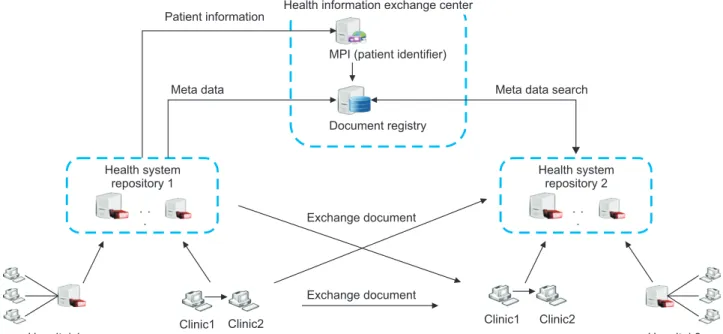
1. Implementation of a Standards-based Online HIE System In this paper, we define a central registry and multiple repos- itories as a standardized architecture. An online HIE center manages the metadata and patients, and healthcare organi- zations are participants (Figure 1).
In the HIE system, the HL7 Consolidated CDA (C-CDA) was adopted, and referral notes, medical examination docu- ments, and care record summaries (CRSs) were defined as the standard documents. To improve the information fidel- ity, we defined the values that are required and should be in- cluded if available [14]. The consent for online HIE was indi- vidual consent per event because of the medical act. Consent for the CRS was done collectively because patient care events occur frequently (Figure 2).
2. Operation of an Online HIE System and the Identifica- tion of Issues
The standard-based online HIE system was used between one hospital and 44 primary care clinics. A total of 2,583 pa- tients participated in online HIE for about 12 months from July 4, 2016 to June 30, 2017, during which 2,546 referrals and 161 transfers occurred. We attempted to understand the potential problems and barriers affecting the establishment and operation of HIE systems. We monitored and identified issues during the processes to establish a system for seamless HIE.
Prior to implementation of the system, we conducted sce- nario tests that included referrals, replies, transfers, and CRS creation from June 20 to July 1, 2016 to identify potential issues. Moreover, for stable operation of the HIE system, the issues identified during the operation after its opening were noted. To solve the identified issues, three medical infor- mation system experts, one medical information standard expert, four medical staff members, and two researchers of HIE systems compiled a list of such issues. These were then categorized into the four types, including usability, HIE contents (documents and data elements), system architec-
ture and standards, and participants’ informed consent, and regular meeting were held to find solutions for each issue.
If any issues that arose during the operation of the system needed to be resolved quickly, they were addressed immedi- ately through real-time online discussions. In addition, if a hospital policy needed to be modified to resolve the identi- fied issues, an HIE task force team (TFT) of 11 medical staff members, three researchers, and three medical information system experts gathered for a TFT conference and deter-
mined the policies related to HIE within the hospital. The definition of standard terms and the issues requiring policy consensus were classified separately so that stakeholders, a manager of the Department of Health and Welfare, and a manager of the Social Security Information Center defined the terms and shared the need for policy amendments.
When issues needed to be solved by alterations in the sys- tem, they were immediately implemented; when any terms needed to be defined, clear definitions were proposed. In the
Patient
Hospital
Admission Consent Maintenance Withdraw Termination
Since patient consent time search possibility
Admission - Personally admission - Admission through
hospital
- Substituted consent (proof of family relationships)
Withdraw Maintenance
- Electronic consent - Electronic signature - Voice record - SMS certification - Paper signiture scan
- Not discard data before withdraw - CRS search
comprehensive consent
- Form of withdraw registration
- Admission by health
information exchange center - Write yourself document storage
- Different institution documents search (select search period)
- Withdraw information registration
Figure 2. Policy of consent management in health information exchange (HIE). The consent policy was separated for patients and medical institutions, and after a patient consents, the medical institution can confirm the information.
Health information exchange center Patient information
MPI (patient identifier) Meta data
Document registry
Meta data search
Health system repository 1
Exchange document
Hospital 1
Clinic1
Health system repository 2
Exchange document
Hospital 2 Clinic2
Clinic1 Clinic2
Figure 1. Health information exchange (HIE) system architecture for exchange between hospitals and clinics. The HIE center consists of an MPI server and a registry, and it is interchangeable between all institutions.
case of issues requiring further policy agreement, efforts to come to a policy consensus on the relevant issues were made, and the results were derived.
III. Results
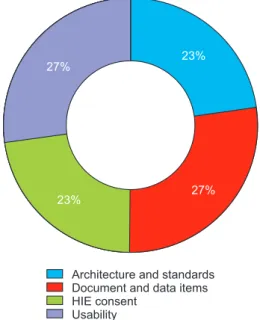
The identified issues were divided into categories accord- ing to which aspect of HIE implementation they concerned, namely, usability, documents and data, architecture and standards, and consent (Figure 3).
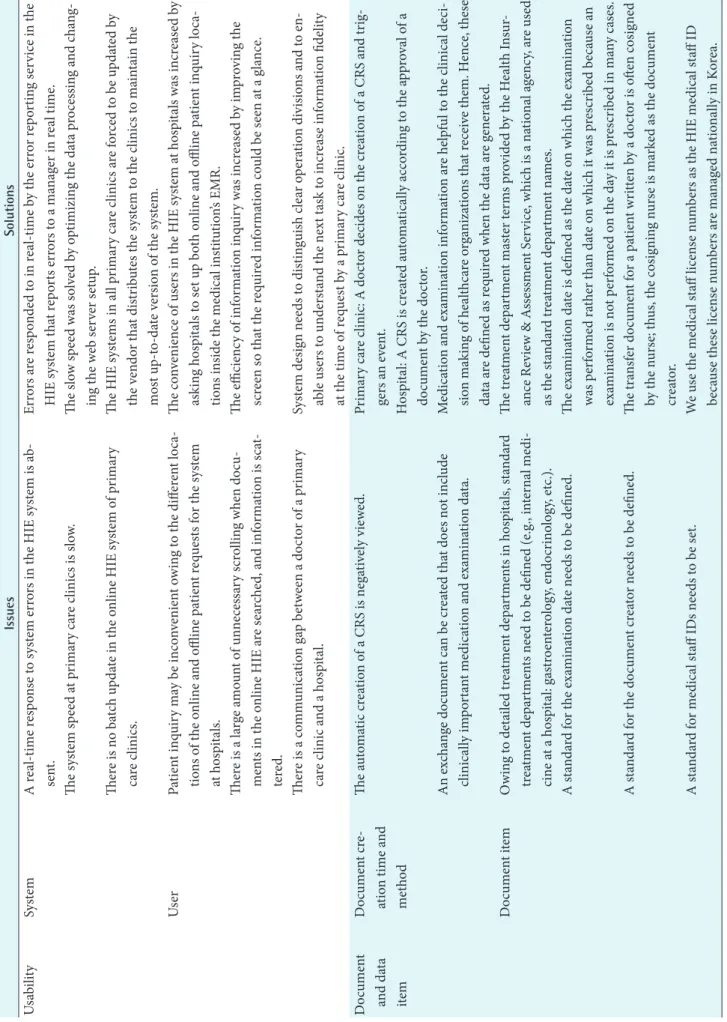
In total, 22 issues were identified and were divided into four categories (Table 1). Proposals and definitions were pro- posed as solutions to address the issues.
1. Usability
A previous study on medical system usability showed that by considering the usability requirements in system design, system can be used efficiently and effectively; therefore, we derived issues arising from the implementation of the HIE system from a user experience viewpoint [15]. The issues related to usability were identified from system errors, in- conveniences, and user experiences of online HIE. Each of the usability issues and solutions is presented in Table 1. The most common issues were an absence of real-time error re- sponses and a lack of a simple means of image file exchange, which were resolved by introducing additional services. The system usability issues in the primary care clinic were slow system speeds and the absence of a batch update function.
These issues were resolved by improving the update method
and web server setup. Improvements in the user experience (UX) and user interface (UI) of creation and inquiry screens are needed in the future to improve system usability.
2. HIE Documents and Data Elements
Online HIE documents require clear definitions when be- ing entered in the system; they are an important part that determines the quality of the data in an HIE. The issues found while defining documents and their solutions were determined prior to system operation (‘document and data items’ in Table 1). One issue related to document creation was raised because there were no detailed definitions for the circumstances of document creation. Hence, the process for creating a document was clearly defined to resolve this issue, and document items were redefined to be acceptable by all healthcare organizations.
3. System Architecture and Standards
We present the decisions and suggestions while defining the architecture and implementing the system (‘architecture and standards’ in Table 1). To resolve the need for a standard ar- chitecture and identification system, we defined the standard architecture and the OIDs of participating HIE institutions.
Among the standard code, the Korean EDI code was defined by the examination code, but nondeductible examinations were difficult to map to the medical fee codes. Hence, other standards for healthcare terms were also used to address this mapping problem.
4. HIE Consent
In recent years, Korea has provided a legal basis for sharing health information appropriately among healthcare organi- zations. In the past, treatment records could be sent to other medical providers with the consent of the patient or guard- ian (Paragraph 3 of Article 21 in the Medical Act), and a copy of the treatment record could be forwarded when new patients were sent to other healthcare organizations (Para- graph 5 of Article 21 in the Medical Act) [16]. The consent method was modified to enable comprehensive consent ac- cording to the standard notification of HIE in Korea. Each of the consent issues and their solutions are listed in Table 1.
To solve problems related to consent, a new consent method was added to the HIE system, and consent history manage- ment was changed to enable real-time queries about consent status. The consent policy issue relates to individual consent, which is the current consent method. To resolve this issue, a comprehensive consent method was proposed and defined to enable selective withdrawal of departments and healthcare
23%
Architecture and standards Document and data items HIE consent
Usability
23%
27%
27%
Figure 3. Classification of health information exchange (HIE) is- sues.
Table 1. HIE issues and their solutions IssuesSolutions UsabilitySystemA real-time response to system errors in the HIE system is ab- sent.Errors are responded to in real-time by the error reporting service in the HIE system that reports errors to a manager in real time. The system speed at primary care clinics is slow.The slow speed was solved by optimizing the data processing and chang- ing the web server setup. There is no batch update in the online HIE system of primary care clinics.The HIE systems in all primary care clinics are forced to be updated by the vendor that distributes the system to the clinics to maintain the most up-to-date version of the system. UserPatient inquiry may be inconvenient owing to the different loca- tions of the online and offline patient requests for the system at hospitals.
The convenience of users in the HIE system at hospitals was increased by asking hospitals to set up both online and offline patient inquiry loca- tions inside the medical institution’s EMR. There is a large amount of unnecessary scrolling when docu- ments in the online HIE are searched, and information is scat- tered.
The efficiency of information inquiry was increased by improving the screen so that the required information could be seen at a glance. There is a communication gap between a doctor of a primary care clinic and a hospital.System design needs to distinguish clear operation divisions and to en- able users to understand the next task to increase information fidelity at the time of request by a primary care clinic. Document and data item
Document cre- ation time and method
The automatic creation of a CRS is negatively viewed. Primary care clinic: A doctor decides on the creation of a CRS and trig- gers an event. Hospital: A CRS is created automatically according to the approval of a document by the doctor. An exchange document can be created that does not include clinically important medication and examination data.Medication and examination information are helpful to the clinical deci- sion making of healthcare organizations that receive them. Hence, these data are defined as required when the data are generated. Document itemOwing to detailed treatment departments in hospitals, standard treatment departments need to be defined (e.g., internal medi- cine at a hospital: gastroenterology, endocrinology, etc.).
The treatment department master terms provided by the Health Insur- ance Review & Assessment Service, which is a national agency, are used as the standard treatment department names. A standard for the examination date needs to be defined.The examination date is defined as the date on which the examination was performed rather than date on which it was prescribed because an examination is not performed on the day it is prescribed in many cases. A standard for the document creator needs to be defined.The transfer document for a patient written by a doctor is often cosigned by the nurse; thus, the cosigning nurse is marked as the document creator. A standard for medical staff IDs needs to be set.We use the medical staff license numbers as the HIE medical staff ID because these license numbers are managed nationally in Korea.
Table 1. Continued IssuesSolutions Architecture and stan- dards
ArchitectureA standard architecture for online HIEs needs to be defined.The standard online HIE architecture is defined in the following man- ner: the architecture of an IHE XDS.b profile-based central registry and multiple repositories. Identification systemA standard OID system for the healthcare organizations of the online HIE is needed.The OID system includes healthcare organizations, the HIE system, HIE documents, consent methods, and HIE term codes. It is a department below the Ministry of Health and Welfare. Standard itemsStandard documents in the online HIE are absent.The HL7 Consolidated-Clinical Document Architecture (CCDA) is defined as the standard documents of online HIE. Because different medical terms are used by healthcare organi- zations, standard terms are needed to ensure interoperability.The items that are applicable to a standard code should employ it to as- sure interoperability. Applied codes: Diagnosis name (KDC7), drug administration (KD, ATC), examination (EDI), and surgery (ICD9-CM). For nondeductible examination items, it is difficult to apply an EDI code.By using the Korean Standard term for Healthcare, nondeductible examination items, which are difficult to express in the EDI code, are accommodated. ConsentConsent manage- mentIt is difficult to check the details of consent in real time from other healthcare organizations.The consent status of patients is managed centrally by the online HIE center. There is a problem with the use of a resident registration num- ber because of the Personal Information Protection Act.The resident registration number of the patient is only used once at the time of first consent for the purpose of patient registration and consent. The MPI issued at that time is used for patient management. Consent policyIndividual consent for all documents during referral or transfer is cumbersome.Consent is changed to comprehensive consent, in which single consent is applied to all HIE events until withdrawal. It is difficult to select and remove only a specific medical in- stitution or specific treatment department information if the information is asked to be withdrawn.
A range of healthcare organizations and treatment departments can be set up during consent and withdrawal in online HIE. The definition of the period of document storage and inquiry in HIE according to consent is absent.The online HIE documents should be stored and retrievable until HIE consent is withdrawn by the patient. If a patient requests withdrawal of HIE consent, his/her HIE documents are deleted and queries are stopped immediately. HIE: health information exchange, CRS: care record summary, MPI: master patient index.
organizations.
IV. Discussion
The HIE service has been expanding through cooperative healthcare organizations to increase the quality of medical services. In particular, an online HIE system was imple- mented by complying with information exchange standards to share health information between heterogeneous systems.
This study summarized the issues that occurred during the implementation and operation of a standard-based online HIE system in Korea, and an effort was made to define con- cerns and resolve issues and thus operate the system reliably.
The issues derived from this study can be compared with those derived from HIE operations and experiences in France and North America. A major issue with the opera- tion of the HIE program in France was the low participation of patients in the HIE due to opt-in consent policy. In ad- dition, uncertainties in policy support and the difficulty of maintaining the technology were addressed in ways similar to the solutions adopted in our study [17]. Also, there have been issues regarding the lack of interoperability, high entry costs, and the lack of standards due to difficulties in adopt- ing HIE across the United States, which are similar to the issues related to our architecture and standards documents [18,19]. In this study, the issue of convenience for users of the HIE system was derived, and policy insights that need to be considered in the operation of HIE systems were derived.
This study was somewhat limited because the issues and results were identified through operations and diffusion in only one institution; thus the results reflect the character- istics of the specific context in which the study was con- ducted. Therefore, the results of this study might be difficult to generalize because they reflect the characteristics of the population in the area and the characteristics of medical per- sonnel in the institution where it was carried out. However, we believe that organizations and administrators establish- ing HIE systems in the future can to implement successful and sustainable HIE systems and avoid unexpected barriers through consideration of our experience and by adopting the problem-solving techniques applied in this study. Fur- thermore, active and strategic participation of governments in the development of HIE services is required to solve management issues, such as design proposals, and consen- sus methods must be improved to enhance information exchange systems. Through this study, we hope to reduce the communication gaps among medical institutions, to contrib- ute to the successful implementation of HIE systems, and to
promote the nationwide diffusion of HIE.
Conflict of Interest
No potential conflict of interest relevant to this article was reported.
Acknowledgments
This research was supported by a grant of the Korea Health Technology R&D Project through the Korea Health Industry Development Institute (KHIDI), funded by the Ministry of Health & Welfare, Republic of Korea (No. HI14C2756).
References
1. Unertl KM, Johnson KB, Gadd CS, Lorenzi NM. Bridg- ing organizational divides in health care: An ecological view of health information exchange. JMIR Med Inform 2013;1(2):e3.
2. Shade SB, Chakravarty D, Koester KA, Steward WT, Myers JJ. Health information exchange interventions can enhance quality and continuity of HIV care. Int J Med Inform 2012;81(10):e1-9.
3. Vest JR, Miller TR. The association between health information exchange and measures of patient satisfac- tion. Appl Clin Inform 2011;2(4):447-59.
4. McGee MK. Health information enhances decision making [Internet]. San Francisco (CA): Information- Week; 2010 [cited at 2017 Jun 16]. Available from:
http://www.informationweek.com/healthcare/clinical- information-systems/health-nformation-exchange- enhances-decision-making/d/d-id/1090004?page_num- ber=1.
5. Frisse ME, Johnson KB, Nian H, Davison CL, Gadd CS, Unertl KM, et al. The financial impact of health infor- mation exchange on emergency department care. J Am Med Inform Assoc 2012;19(3):328-33.
6. Kaelber DC, Bates DW. Health information exchange and patient safety. J Biomed Inform 2007;40(6 Suppl):
40-5.
7. Flanders AE. Medical image and data sharing: are we there yet? Radiographics 2009;29(5):1247-51.
8. HealthIT.gov. State health information exchange co- operative agreement program [Internet]. Washington (DC): US Department of Health and Human Services;
2014 [cited at 2017 Oct 1]. Available from: https://www.
healthit.gov/policy-researchers-implementers/state-
health-information-exchange.
9. Health Information and Quality Authority. Overview of healthcare interoperability standards. Dublin: Health Information and Quality Authority; 2013.
10. Seroussi B, Bouaud J. Adoption of a nationwide shared medical record in France: Lessons learnt after 5 years of deployment. AMIA Annu Symp Proc 2017;2016:1100-9.
11. Latham & Watkins Internet & Digital Media Industry Group. French digital republic law expands rights of users and regulators (Law No. 2016-321 of 7 October 2016). Los Angeles (CA): Latham & Watkins; 2016.
12. Bowd R. Development and evaluation of a program to improve clinician and patient communication during a telehealth consultation: CRISP Telehealth [dissertation].
Brisbane: School of Nursing, Institute of Health and Biomedical Innovation, Queensland University of Tech- nology; 2012.
13. PricewaterhouseCoopers. Australia introduces manda- tory data breach notification regime [Internet]. London:
PricewaterhouseCoopers; 2017 [cited at 2017 Oct 1].
Available from: http://www.pwc.com.au/legal/assets/
legaltalk/privacy-amendment-notifiable-data-breaches-
bill-2016.pdf.
14. Lee M, Heo E, Lim H, Lee JY, Weon S, Chae H, et al.
Developing a common health information exchange platform to implement a nationwide health informa- tion network in South Korea. Healthc Inform Res 2015;
21(1):21-9.
15. Moghaddasi H, Rabiei R, Asadi F, Ostvan N. Evaluation of nursing information systems: Application of usability aspects in the development of systems. Healthc Inform Res 2017;23(2):101-8.
16. Korean Medical Act Paragraph 5-6 of Article 21, Law No. 14438 (Amendments Dec. 20, 2016).
17. Hussain A, Rivers P, Stewart L, Munchus G. Health information exchange: current challenges and impedi- ments to implementing national health information infrastructure. J Health Care Finance 2015;42(1):1-8.
18. Luna D, Almerares A, Mayan JC, Gonzalez Bernaldo de Quiros F, Otero C. Health informatics in developing countries: going beyond pilot practices to sustainable implementations: a review of the current challenges.
Healthc Inform Res 2014;20(1):3-10.